What would the American Civil Rights Movement have been without the leadership of Dr. Martin Luther King, Jr.? On September 20, 1958, we almost lost him.
❧
The weather boded well for a good turnout. It was a sunny Saturday in New York City and Blumstein’s Department Store – at 230 W. 125th Street, between 7th and 8th Avenues, Harlem – was hustling to get ready for their big guest. On the ground floor, behind the shoe department, clerks had roped off an area where the Rev. Dr. Martin Luther King, Jr. would sit behind a desk to autograph copies of his first book, Stride Toward Freedom: The Montgomery Story.
The book related the success of the Montgomery, Alabama bus boycott that lead to a U.S. Supreme Court ruling on the unconstitutionality of segregated transit systems.

Two black ministers who were active in the long boycott of segregated buses in Montgomery, Alabama were among the first to ride after a Supreme Court integration order went into effect on December 21, 1956. At right, is the Rev. Ralph Abernathy, while at left is the Rev. Dr. Martin Luther King Jr. Black Americans no longer had to sit at the back of the bus or give up their seats to white people.
Dr. King, with his powerful oratory, had rocketed to fame nearly overnight and had become a significant figure on the national political scene for his participation in the victory. He was making four speeches a week to persuade the nation to stop the practice of racial segregation. It was the dawn of the civil rights movement.
“Dr. King is a rather soft-spoken man with a learning and maturity far beyond his 27 years. His clothes are in conservative good taste and he has a small trim mustache.”(1)
Izola Ware Curry
Blumstein’s Department Store – the site of the autograph party for Dr. King – wasn’t far from where Izola Ware Curry, 42, lived in a brownstone, at 121 West 122d Street in Harlem. Izola was a drifter, a sometimes maid, who had been in Harlem only two months. Izola had Dr. King on her radar. She detested him and all black preachers, calling their boycotts and protests a sham. She felt that blacks should move for social change through appeals to Congress. She hated the NAACP in particular – thought they were controlled by Communists – and white people in general. By 1956, paranoia had taken over her thinking. She started writing the FBI claiming that Communists were out to get her. She was anti-social, tended to babble and rant, her words often unintelligible and ungrammatical. Her neighbors wrote her off as “eccentric.” Izola Ware Curry was African-American.
The Rally The Night Before the Signing
The night before Dr. King’s book signing, just around the corner from Blumstein’s, a rally was held for Dr. King in front of the Hotel Teresa. On the podium he was joined by other dignitaries, among them baseball great Jackie Robinson, New York Governor Averell Harriman, and gubernatorial hopeful, Republican Nelson Rockefeller, with music provided by Duke Ellington. The crowd numbered 5,000. Izola Ware Curry, in her unstable mental state, was there.
When Rockefeller spoke:
This business about [Eisenhower] going slow on integration….I know the man!….Who sent the troops to Little Rock?”(2)
Curry heckled him, calling white people racists. King’s escort in the city, William Rowe,
“did his best to calm her down. And Frederick Weaver, a platform guest, motioned for police officers to make her stop. But the police were reluctant to get tough with her, fearing…an incident…that could escalate into a larger racial disturbance.” (2)
When Dr. King spoke, Curry jeered him, too, as did a few others. Curry shouted that no “negro” should ever try to cooperate with a white person. Rowe had to calm her down once more.
Miraculously, the rally ended without dissolving into chaos. Rowe feared more trouble at the next day’s signing, suggesting a bodyguard for Dr. King, an idea that Dr. King rejected.
The Booksigning
Saturday, September 20, 1958
Blumstein’s Department Store
3:30 p.m.

Izola Ware Curry, 42
As she pushed her way through the crowd to the desk where Dr. King sat, bystanders couldn’t help but notice the elegantly dressed black woman in her stylish suit, showy jewelry, and sequined cat’s-eyeglasses. Nothing on the surface betrayed the insanity beneath. Little did onlookers suspect that, secreted in Izola Curry’s bra, was a loaded Italian automatic pistol, and, in her enormous leather purse, a 7-inch steel letter opener.
With her purse slung over one arm, Izola Curry strode with purpose straight up to Dr. King, where he was seated, signing a book for a customer.
“Are you Martin Luther King?” she asked.
“Yes,” he replied, not looking up. (3)
She reached into her purse and withdrew the letter opener in an arc. Instinctively, Dr. King yanked his left arm up to block the weapon, cutting his left hand as she plunged the blade into his chest. Dr. King recalled:
“The next minute I felt something beating on my chest.”
A bystander knocked Curry’s hand away from the blade before she could withdraw it and stab Dr. King again.
“I’ve been after him for six years!” shouted Curry, starting to run. “I’m glad I done it!” (2)
A group of women chased her with umbrellas, shouting, “Catch her!” A journalist jumped out and grabbed Curry by the left arm and turned her over to the store security guard, who handcuffed her.

Dr. Martin Luther King, Jr. sits calmly with a letter opener protruding from his chest as Nettie C. Jackson tends his cut hand. September 20, 1958
Meanwhile, Dr. King sat still and calm and clear-thinking, with the letter opener protruding from his chest. Someone called for an ambulance to Harlem Hospital. Dr. King was carried, still seated in his chair, to the back of the store. When the ambulance arrived, he was placed carefully on his back. He was told, as was everyone present, that he must not touch the letter opener.
The stabbing nearly cost Dr. King his life, as the blade of the letter opener had lodged in his sternum, within millimeters of piercing the aorta. At Harlem Hospital, surgeons extracted the blade in a delicate operation. He developed pneumonia and had a long convalescence.
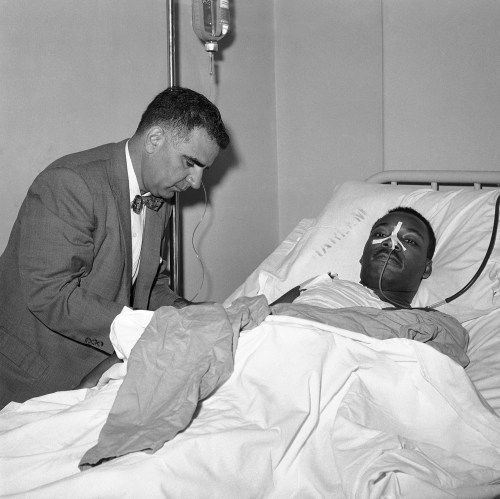
Surgeons performed a delicate 2 1/4 hour surgery to extract the letter opener from Dr. Martin Luther King’s manubrium, the top bone of the sternum. September 20, 1958

A rare photograph of the operation on Dr. Martin Luther King, Jr, when he was stabbed in Harlem on September 20, 1958
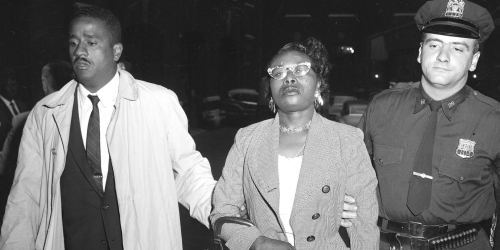
Izola Ware Curry, Dr. Martin Luther King’s assailant. Following her arrest, psychiatrists evaluated her and diagnosed her with paranoid schizophrenia and an I.Q. of about 70. She was institutionalized and died in 2015, at the age of 98. (Getty Images)

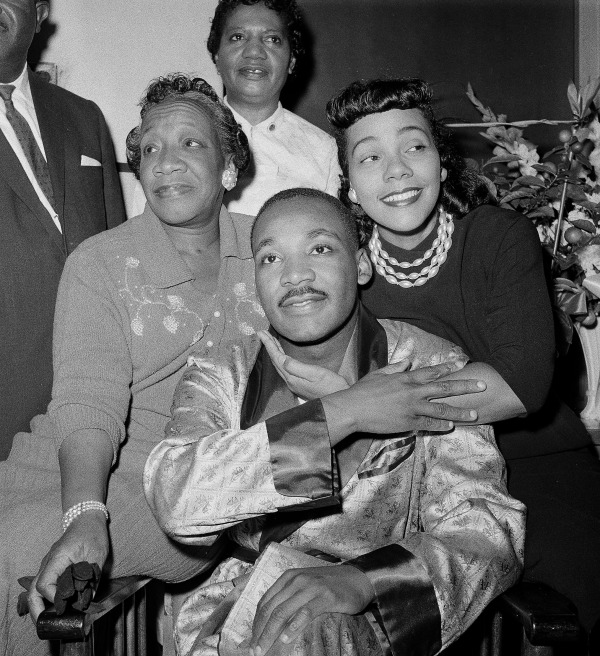
Dr. Martin Luther King, Jr., is embraced by his wife Coretta Scott King during a news conference at Harlem Hospital in New York, Sept 30, 1958, where he was recovering from a stab wound following an attack by Izola Ware Curry. At left is his mother, Alberta Williams King. (AP Photo/Tony Camerano)
Ten Years Later
On April 3, 1968, ten years after the Harlem stabbing, Dr. King recalled it in his “I’ve Been to the Mountaintop” speech in Memphis, Tennessee:
“The x-rays revealed that the tip of the blade was on the edge of my aorta, the main artery. And, once that’s punctured, you’re drowned in your own blood – that’s the end of you.”
The surgeon told him that, if he had sneezed before the operation, he would have died. To lively applause, he continued, in his “Mountaintop” speech:
“And I want to say tonight – I want to say tonight that I, too, am happy that I didn’t sneeze. Because if I had sneezed, I wouldn’t have been around here in 1960, when students all over the South started sitting in at lunch counters.
“If I had sneezed, I wouldn’t have been around here in 1961, when we decided to take a ride for freedom and ended segregation in interstate travel.
“If I had sneezed, I wouldn’t have been here in 1963, when the black people of Birmingham, Ala., aroused the conscience of this nation, and brought into being the Civil Rights Bill. If I had sneezed, I wouldn’t have had a chance later that year, in August, to try to tell America about a dream I had.”
He closed his speech with remarks about the possibility of his untimely death. The next day, in Memphis, he was assassinated by James Earl Ray, a white supremacist.
(1) “Battle Against Tradition: Martin Luther King, Jr.” The New York Times, March 21, 1956
(2) Pearson, Hugh. When Harlem Nearly Killed King. New York: Seven Stories Press, 2003.
(3) “Izola Ware Curry, Who Stabbed King in 1958, Dies at 98.” New York Times. March 22, 2015.
Read Full Post »








 Lisa's History Room