Available for sale now at your online booksellers. Amazon, Barnes & Noble, and other booksellers served by Ingram Distributors, booksellers receiving deep discounts.
Advance Praise
Kirkus Reviews
TITLE INFORMATION
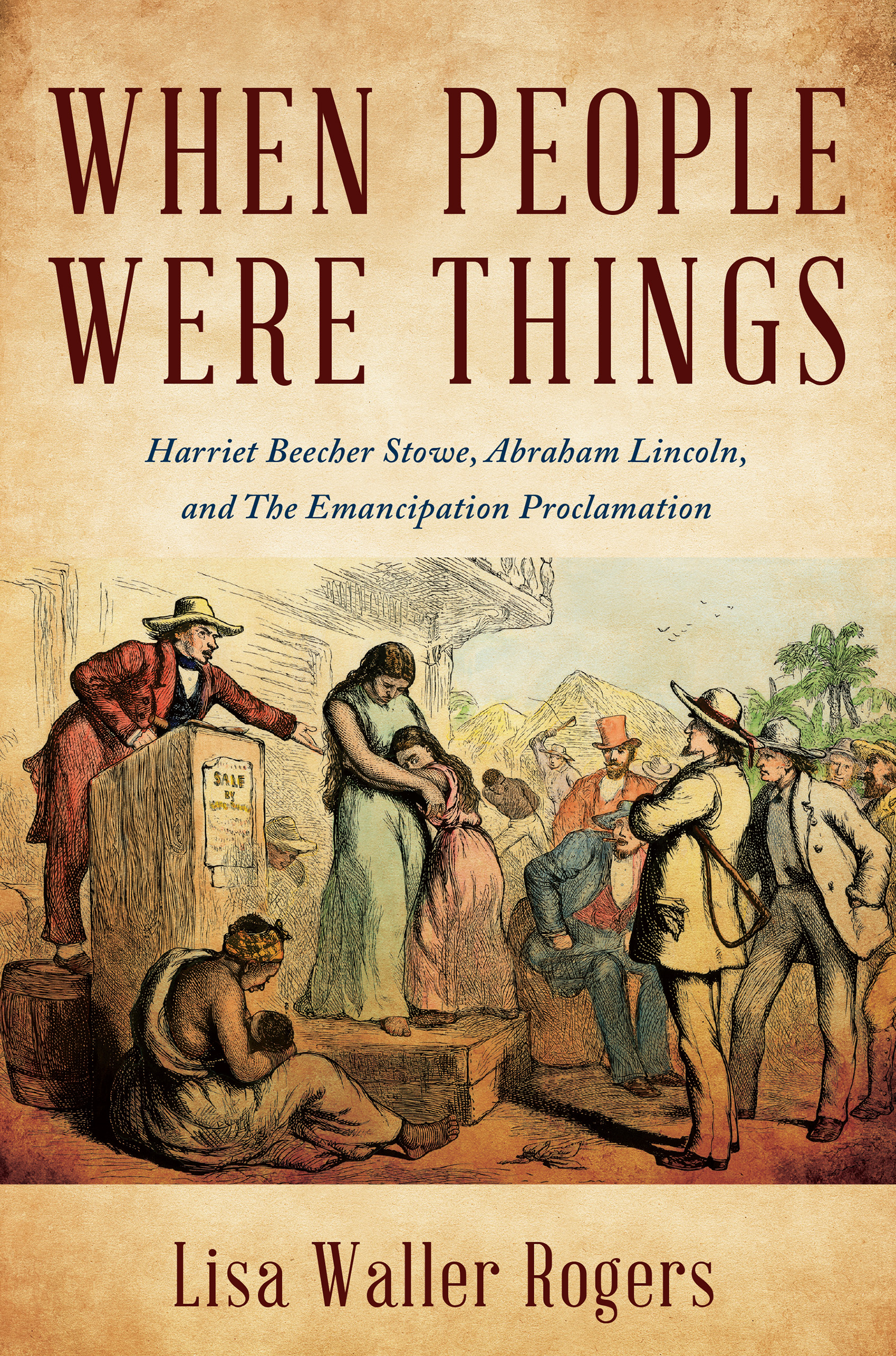
WHEN PEOPLE WERE THINGS
Harriet Beecher Stowe, Abraham Lincoln, and the Emancipation Proclamation
Lisa Waller Rogers
Barrel Cactus Press (662 pp.)
$9.99 e-book, $19.99 paperback, $36.99 hardcover ISBN: 9798999409621
September 1, 2025
BOOK REVIEW
“Rogers offers a scenic walk through a vivid, harrowing, and heartbreaking history of the abolitionist movement.
“The author delivers exceptional research and fresh perspectives as she dives into the biographies of President Abraham Lincoln and author Harriet Beecher Stowe, as well as the greater history of the abolitionist movement, as they all relate to the creation and execution of the Emancipation Proclamation. It’s divided into eight chronological sections, from “Words (1775-1831)” to “Hope (1862-1863).” These are, in many ways, thematic phases, involving a list of individuals that’s quite extensive, but the author effectively shows how they all played key roles, including radical abolitionist John Brown, presidential candidate Stephen A. Douglas, activist and writer Frederick Douglass, journalist William Lloyd Garrison, public speakers Sarah and Angelina Grimké, social reformer Lucretia Mott, Secretary of State William Henry Seward, and formerly enslaved activists Sojourner Truth and Harriet Tubman. Their backgrounds and actions weave through major events that preceded the Civil War, which include the Panic of 1837, the Nat Turner rebellion, the Dred Scott vs.Sandford case, and the establishment of the Underground Railroad. Of course, the publication of Stowe’s novel Uncle Tom’s Cabin (1852) became an ‘abolitionist manifesto, exposing slavery for the cruel and unjust institution it was,’ and, according to Lincoln, the main event that led to the Proclamation. Throughout all the various, detailed sections, the reader comes to understand how Lincoln was influenced by many others in his decision to champion the freeing of enslaved people, and they will gain a greater understanding of his declaration, on January 1, 1863, when he signed the Proclamation and stated, ‘If my name ever goes into history, it will be for this act, and my whole soul is in it.’
“A raw and emotional look at the sacrifices made by those who gave all to end slavery.
“our verdict √ GET IT”

COMING September 1, 2025
More Advance Praise
“In WHEN PEOPLE WERE THINGS, Lisa Waller Rogers gives us a magisterial treatment of the anti-slavery movement in America and its key players from roughly 1830 to the Emancipation Proclamation in 1863. The book is enlivened by descriptions of such bloody events as the slave insurrection led by Nat Turner, the murder spree of John Brown and his followers, and the brutal caning of Senator Charles Sumner on the Senate floor by a South Carolina congressman….Highly recommended.”
-John Oller, author of American Queen, The Rise and Fall of Kate Chase Sprague
“Readers may be surprised at how much humanity, wit and warmth runs through When People Were Things. Rogers’ vivid writing features real people who, whatever their failings and foibles, had moral courage and used it.”
-Nancy Koester, author of Harriet Beecher Stowe: A Spiritual Life, and We Will Be Free: The Life and Faith of Sojourner Truth.
“Lisa Waller Rogers’ storytelling brilliance lies in her ability to humanize historical figures as multidimensional individuals grappling with moral complexities, personal struggles, and the weight of their times….This is historical writing at its finest…”
-Emma Harris, 2024 Gilder Lehrman Maryland State American History Teacher of the Year
🌟🌟🌟🌟🌟
“When People Were Things is a compelling, in-depth look at the anti-slavery movement in the three decades leading up to the Emancipation Proclamation, shedding light on the activists who fought to end one of the darkest chapters in American history. Author Lisa Waller Rogers is a masterful storyteller, bringing these courageous activists to life with nuance and humanity.
“Rogers not only explores prominent figures in the abolitionist movement but also highlights lesser-known enslaved people and women whose contributions were vital to the cause. I especially appreciated the inclusion of so many women’s voices, which added depth and breadth to the narrative.
“Told in short, highly readable chapters, this meticulously researched book doesn’t shy away from the brutal realities of slavery. Yet, amid the horrors, Rogers emphasizes the resilience, love, and dignity of real people who endured and resisted unimaginable circumstances. Her attention to detail makes these historical figures feel fully dimensional and deeply human.
“When People Were Things helped me connect the dots between key historical moments and figures, deepening my understanding of this era of history. I highly recommend this powerful read.”
-Lexy Faist Largent, Net Galley Book Reviewer https://www.netgalley.com/book/637451/review/974555
“When People were Things” is an overview of the entire abolitionist movement from the 1830s up to the Civil War. Rogers highlights the main figures we are familiar with- Lincoln, Frederick Douglass, Harriet Beecher Stowe- while also bringing to life some of the fringe players that often get skipped over in the textbooks, such as James G. Birney. Whether you are a history buff or casual historian, there is something new for all in this book.”
Anthony Swierzbinski, 2024 Gilder-Lehrman Delaware State History Teacher of the Year
🌟🌟🌟🌟🌟
“A well researched, well written, engaging and informative account of the abolitionist movement in the United States leading up to the Emancipation Proclamation. I was enraptured from the first chapter and could barely put it down. I learned so much that I didn’t know, especially about Harriet Beecher Stowe, Harriet Tubman, John Brown, and the initial challenges of the Civil War. Highly recommended.” https://www.netgalley.com/book/637451/review/21954
Bruce Raterink – Net Galley, Top Reviewer





 Lisa's History Room