During the WWII years, actress Gene Tierney was at the height of her popularity. Her image graced countless magazine covers.
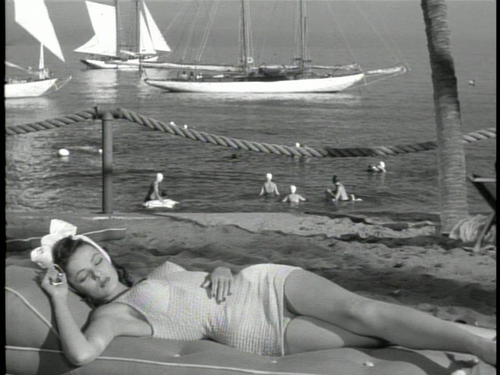
Gene Tierney sleeps in the sun in a scene from “Rings on Her Fingers,” filmed on Catalina Island.
Gene Tierney took time to entertain the troops at the Hollywood Canteen. From 1942-45, three million service personnel on leave – men and women, black and white – would pass through the doors of that converted barn to rub elbows with the stars. On any given night, Bob Hope might be on the stage cracking jokes while Rita Hayworth made sandwiches, Harry James played trumpet, or Hedy Lamarr danced with the soldiers.

Marlene Dietrich and Rita Hayworth serve food at the Hollywood Canteen, 1942
In the spring of 1943, Gene finished filming “Heaven Can Wait” in Hollywood. She was expecting her first child and, gratefully, not yet showing signs of pregnancy. She had kept that a secret for fear of being replaced in the film. She longed to be with husband Oleg Cassini in Kansas, where he was stationed in the army.

American film actress Gene Tierney. ca. 1941
Before leaving Los Angeles and starting her maternity leave, Gene decided to make one last appearance at the Hollywood Canteen. So, that night, Gene showed her support of American troops by signing autographs, mingling with the crowd, and shaking hands. The troops were homesick and sad; a little stardust lightened their load.
A few days after that visit, Gene woke up with red spots covering her arms and face. She had the German measles, or rubella. In 1943, there was no vaccine to prevent contracting the measles. That would not be available for 22 more years. Obstetricians advised patients to avoid crowds in their first four months of pregnancy, to avoid contracting the measles. At the time, it was believed that measles was a harmless childhood disease.
Little did Gene know at the time, but, just two years earlier,
“…[B]y studying a small cluster of cases in Australia, [eye doctor] Dr. N. M. Gregg first noted that the rubella virus could cause cataracts, deafness, heart deformities and mental retardation [in an unborn child].” (3)
Of course, this was before TV and Internet gave us 24/7 news cycles that would have immediately alerted the public to this critical finding. Gene didn’t know that her small act of kindness at the Canteen would have tragic and long-term consequences for both her and her baby’s health.
After a week of doctor-ordered rest, Gene rested, got better, then packed her bags for Fort Riley, Kansas, to join Oleg. The next several months were devoted to making her Junction City home ready for the baby and being a couple.
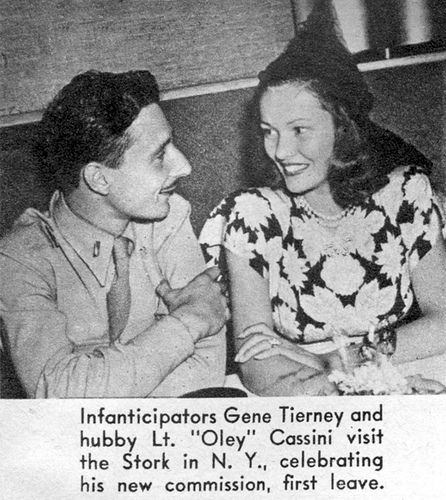
By the fall, Gene was living in Washington, D.C., while Oleg was awaiting orders in Virginia. On the morning of October 15, 1943, Gene gave birth to a premature baby girl, weighing only two and a half pounds. Oleg flew to Washington and joined his wife at Columbia Hospital. They named their baby “Daria.”
Doctors informed them that Daria was not in good shape. She was premature and going blind. She had cataracts in both eyes. After reviewing Gene’s medical chart, the doctors concluded that Gene’s measles were responsible for the baby’s defects. They cited the studies done by the Australian eye doctor, Dr. Gregg.
Daria continued to have health problems and delayed development. She had no inner ear fluid and became deaf. It was clear that she suffered from mental retardation. Gene and Oleg hoped against hope that a doctor somewhere could cure Daria. But, after consulting one specialist after another (much of it paid for by Howard Hughes), they had to face the fact that Daria was permanently disabled and needed more care than they were capable of giving her at home.
When Daria was about two years old, Gene got an unexpected jolt. She was at a tennis function. A fan approached her.
“Ms. Tierney, do you remember me?” asked the woman.
Gene had no memory of having met the stranger. She shook her head and replied, “No. Should I?”
The woman told Gene that she was in the women’s branch of the Marines and had met Gene at the Hollywood Canteen.
Gene never would forget what the woman said next.
“By the way, Ms. Tierney, did you happen to catch the German measles after that night I saw you at the Canteen?”
The woman revealed that she had had the measles herself at the time but had broken quarantine just to see Gene at the Canteen.
Gene was dumbstruck. That woman had given her the measles! She was the sole cause of Daria’s disabilities. Gene said nothing. She just turned and walked away.
When Daria was four, Oleg and Gene made the difficult decision to institutionalize Daria (1943-2010). Daria spent most of her life at the ELWYN, an institution for specially disabled in Vineland, NJ.
Gene Tierney never fully recovered from the blow that Daria was disabled. Although she gave birth to another daughter that was healthy, her marriage to Oleg ended in divorce, and her mental health began to deteriorate. She couldn’t concentrate. On the movie set, she would forget her lines. She began to fall apart and live a life of “stark misery and despair,” said ex-husband Oleg.
In much of the 1950s, Gene went from one mental health facility to another seeking help with her bouts of high and low moods and suicidal thoughts. She received 27 shock treatments, destroying even more of her memory. It is believed that Gene Tierney suffered from bipolar depression during a time when effective treatment for that disease was in its infancy.
If Daria had been born after 1965, Gene Tierney would have been vaccinated against the German measles and Daria would have been born healthy.
Currently, parts of the United States are experiencing an unusual outbreak of measles due to the antivaccination movement. Some parents in the western part of the United States have decided not to vaccinate their children due to unfounded worries about it causing autism. These few anti-vaxers are putting our whole population at risk.
Make no mistake. Measles is a highly contagious disease and is anything but harmless including to the fetus:
“Symptoms of measles include fever as high as 105, cough, runny nose, redness of eyes, and a rash that begins at the head and then spreads to the rest of the body. It can lead to inflammation of the brain, pneumonia and death.” (1)
and
“The very success of immunizations has turned out to be an Achilles’ heel,” said Dr. Mark Sawyer, a pediatrician and infectious disease specialist at Rady Children’s Hospital in San Diego. “Most of these parents have never seen measles, and don’t realize it could be a bad disease so they turn their concerns to unfounded risks. They do not perceive risk of the disease but perceive risk of the vaccine.” (2)
Postscript: In 1962, Dame Agatha Christie published the detective fiction, The Mirror Crack’d from Side to Side, using the real-life tragedy of Gene Tierney as the basis for her plot.
Readers, my new book, When People Were Things: Harriet Beecher Stowe, Abraham Lincoln, and the Emancipation Proclamation, is published.









 Lisa's History Room