
Clara Barton, ca. 1850
After a decade of teaching in Massachusetts, Clara Barton moved to New York for a year to study at the Clinton Liberal Institute. In 1851, she took a teaching job in Hightstown, New Jersey, at Cedarville School, where her pay was $2 per student for each eleven-week session. New Jersey offered no public education.
Clara began campaigning for public education in New Jersey. She successfully lobbied the Trenton officials and obtained a building and the funds to run a public school in Bordentown as a pilot project. In one year, the program proved to be such a success that local leaders looked to hiring a principal. Instead of hiring Clara, though, they appointed a man who had came from another place.
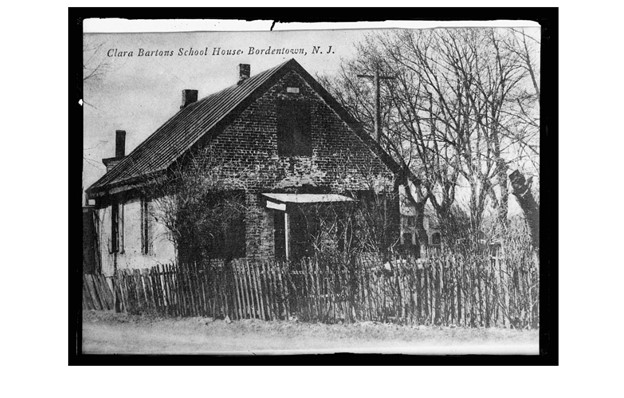
Clara Barton’s public school in Bordentown, New Jersey.
In 1854, Clara resigned. She became so distressed at having been passed over for the principalship that she became very ill and was unable to speak or to work. Finally, Clara and another teacher left New Jersey and boarded a train to Washington to find work as governesses.
Clara networked. She met with her Massachusetts congressman, Alexander De Witt, who was also a distant cousin. De Witt then introduced her to Charles Mason, the Commissioner of Patents. Mason wanted to hire Clara to go to Iowa to be the governess to his daughter. But De Witt saw enormous potential in Clara and urged Mason to hire Clara to work in the Patent office as a recording clerk. She was hired. Clara then became one of the first women to work for the federal government.
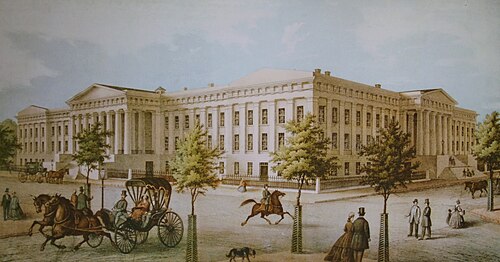
The U.S. Patent Office
Clara’s job at the Patent Office meant copying volumes of technical legal text with pen and ink. She had beautiful penmanship and a strong work ethic so she was up to the task. As if this work was not tedious enough, she had to contend with some male colleagues who resented what they perceived as her intrusion into their masculine domain. As she walked to and from her desk, they would spit tobacco juice at her and her skirts, make lewd remarks, and puffed cigar smoke in her face. Nevertheless, Clara soldiered on.

Examiners working at the Patent Office.
Despite her fortitude, these men succeeded in forcing her from the workplace. She was reassigned to work from her boardinghouse room, by candlelight, at lesser pay. In 1857, President Buchanan was inaugurated and she lost her clerkship, but, for a time, she had made the same yearly salary as the men.
She returned to Massachusetts for three years. But she was not done with Washington, D.C.
Clara Barton is featured in my book, When People Were Things: Harriet Beecher Stowe, Abraham Lincoln, and the Emancipation Proclamation. Click here to purchase.




 Lisa's History Room
Leave a comment