Feeds:
Posts
Comments

Grip the Raven

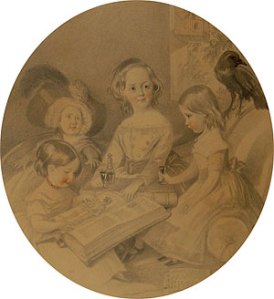
The Eldest Children of Charles Dickens with Pet Raven Grip by Daniel Maclise, 1941

The Eldest Children of Charles Dickens with Their Pet Raven "Grip" by Daniel Maclise, 1841

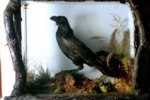
In yesterday’s post , I mentioned Grip the Raven, author Charles Dickens’ pet bird that was the inspiration for Edgar Allan Poe’s poem, “The Raven.” Dickens’ children loved the bird Grip although he did bite their ankles. At his children’s request, Dickens included Grip as a character in one of his books, Barnaby Rudge (1841). Dickens had three pet ravens, all named Grip. Grip I died in 1841, possibly because he ate lead chips scraped off a wall being repainted at the Dickens home. Dickens had the bird preserved and mounted in a glass case for display in his study. After Dickens’ death, a Poe collector acquired Grip I and donated him to the Free Library of Philadelphia where it remains today.

Dickens was saddened by Grip’s death. On March 12, 1841, he wrote the following letter to his friend, Daniel Maclise, who provided illustrations for his books and portraits of Dickens and his family, including the one on the left here featuring the eldest four of Dickens’ nine children: Charley, Mamie, Katey, and Walter. Dickens wrote:

 Mr. Dear Maclise,

Charles DickensYou will be greatly shocked and grieved to hear that the Raven is no more… On the clock striking twelve he appeared slightly agitated, but he soon recovered, walked twice or thrice along the coach-house, stopped to bark, staggered, exclaimed “Halloa old girl!” (his favorite expression) and died. The children seem rather glad of it. He bit their ankles but that was play…”

You might well ask why Grip the Raven is part of an Edgar Allan Poe Collection in Philadelphia. Toward the end of his life, Poe was a paid literary critic. In this role, he reviewed Dickens’ Barnaby Rudge, in which Grip the Raven plays a part. When Grip makes his first noise in the book, one of the characters says, “What was that — tapping at the door?” The answer is “‘Tis someone knocking softly at the shutter.” Poe’s criticism of Barnaby Rudge was that, although he liked the book overall, he felt that the raven’s “croaking might have been prophetically heard in the course of the drama.”

Four years later, Poe published his most famous work, the poem  “The Raven,” which gave the raven a more central role. It features a tapping and talking raven who flies into a man’s room and perches on a bust of Pallas Athena. Dickens’ raven could speak many words and had many comic turns, including the popping of a champagne cork, but Poe emphasized the bird’s darker “devil-bird”qualities. His bird spoke only one word, “Nevermore.” Poe’s raven may have represented a messenger from hell or the after-life, mirroring the gloom and foreshadowing the doom of the troubled narrator who misses his beloved Lenore.

                                                                 
  The Raven

verse 1

Once upon a midnight dreary, while I pondered, weak and weary,
Over many a quaint and curious volume of forgotten lore,
While I nodded, nearly napping, suddenly there came a tapping,
As of some one gently rapping, rapping at my chamber door.
“‘Tis some visitor,” I muttered, “tapping at my chamber door-
                Only this, and nothing more….”

verse 3

Presently my soul grew stronger; hesitating then no longer,
“Sir,” said I, “or Madam, truly your forgiveness I implore;
But the fact is I was napping, and so gently you came rapping,
And so faintly you came tapping, tapping at my chamber door,
That I scarce was sure I heard you”- here I opened wide the door;-
                Darkness there, and nothing more.

verse 4

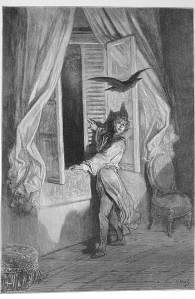
Open here I flung the shutter, when, with many a flirt and flutter,
In there stepped a stately Raven of the saintly days of yore;
Not the least obeisance made he; not a minute stopped or stayed he;
But, with mienof lord or lady, perched above my chamber door-
Perched upon a bust of Pallas just above my chamber door-
                Perched, and sat, and nothing more.

1884 Illustration from "The Raven" by Gustave Dore

1884 Illustration from "The Raven" by Gustave Dore

verse 5
Then this ebony bird beguiling my sad fancy into smiling,
By the grave and stern decorum of the countenance it wore.
“Though thy crest be shorn and shaven, thou,” I said, “art sure no craven,
Ghastly grim and ancient Raven wandering from the Nightly shore-
Tell me what thy lordly name is on the Night’s Plutonian shore!”
                Quoth the Raven, “Nevermore.”
Edgar Allan Poe
1845
2009 commemorative stamp

2009 stamp

Philadelphia wants the body of Edgar Allan Poe but Baltimore isn’t giving it up. Poe didn’t live in Baltimore long, but ever since he died and was buried there in 1849, the city has claimed him for its own. Not fair, says Edward Pettit, a Poe scholar in Philadelphia. He argues that Philadelphia was Poe’s true home, seeing that he wrote his most famous works in Philadelphia where he lived from 1838-1844, including the stories “The Murders in the Rue Morgue,” “The Masque of the Red Death,” and “The Tell-Tale Heart.”

“So, Philadelphians, let’s hop in our cars, drive down I-95 and appropriate a body from a certain Baltimore cemetery,” Mr. Pettit wrote in an article in October. “I’ll bring the shovel.”

Not so fast, said Jeff Jerome, the curator of the Poe House in Baltimore. “Philadelphia can keep its broken bell and its cheese steak, but Poe’s body isn’t going anywhere. If they want [another] body, they can have John Wilkes Booth,”  referring to Abraham Lincoln’s assassin, who is also buried in Baltimore.

Charles Dickens' pet raven, Grip, and the inspiration behind Edgar Allan's poem, "The Raven"

Charles Dickens' pet raven, Grip, and the inspiration behind Edgar Allan's poem, "The Raven"

Mr. Pettit didn’t really expect Poe’s body to be dug up and transferred to Philadelphia. He was merely starting a spirited debate to drum up interest in several Poe exhibits being held in Philadelphia this year to celebrate the bicentennial of the mystery writer’s birth. Among the many attractions was a show of artifacts that just recently closed at the Philadelphia Free Library. While Poe’s original manuscripts and first editions were hits with die-hard Poe fans, the star of the show was undeniably a stuffed bird, Grip, Charles Dickens’ pet raven and the inspiration behind Poe’s best-known work, “The Raven.”  

Poe began writing “The Raven” in Philadelphia but published it in New York where he relocated. Therefore, New York can also lay claim to Poe. Then there’s Boston where he was born. Poe, though, were he consulted on the matter, would have described himself as a Virginian, because he grew up and began his writing career in Richmond. Even South Carolina could cash in on Poe’s fame. Poe was stationed in the Army on Sullivan’s Island, South Carolina, in 1827, and set “The Gold Bug” there. He also lived in Britain.

But Paul Lewis, a professor of English at Boston College, says neither of his rival cities are deserving of Poe’s legacy. Boston was the site of Poe’s birth, stated Lewis, the only place where he was happy. Boston and only Boston was Poe’s true home. Poe was poor, alcoholic, and miserable in all those other cities, claimed Lewis. “Every single city inspired Poe because they were torturing him,” said Lewis, tongue-in-cheek.

The argument between the cities has spilled over into blogs and newspaper articles, giving Edgar Allan Poe a boost in popularity, a healthy result for all the cities claiming Poe as its favorite son.

Annabel Lee

Edgar Allan Poe (1809-1849)

Edgar Allan Poe (1809-1849)

Written the year of Edgar Allan Poe’s death, “Annabel Lee” is generally considered to be the last poem Poe wrote. We celebrated the 200th anniversary of Poe’s birth last month, as he and Abraham Lincoln were both born in 1809. Poe’s most famous works are arguably his macabre stories such as “Murders in the Rue Morgue” and his haunting poem, “The Raven.” Poe is considered to be the founder of the modern detective mystery. His love poem, “Annabel Lee,” though, comes on softly, gently, unlike anything else I’ve ever read of his, though it is very sad. I read it to my daughter Katie many times when she was very young and she loved it.
          

Annabel Lee

It was many and many a year ago,
In a kingdom by the sea,
That a maiden there lived whom you may know
By the name of Annabel Lee;
And this maiden she lived with no other thought
Than to love and be loved by me.

I was a child and she was a child,
In this kingdom by the sea;
But we loved with a love that was more than love-
I and my Annabel Lee;
With a love that the winged seraphs of heaven
Coveted her and me.

And this was the reason that, long ago,
In this kingdom by the sea,
A wind blew out of a cloud, chilling
My beautiful Annabel Lee;
So that her highborn kinsman came
And bore her away from me,
To shut her up in a sepulchre
In this kingdom by the sea.

The angels, not half so happy in heaven,
Went envying her and me-
Yes!- that was the reason (as all men know,
In this kingdom by the sea)
That the wind came out of the cloud by night,
Chilling and killing my Annabel Lee.

But our love it was stronger by far than the love
Of those who were older than we-
Of many far wiser than we-
And neither the angels in heaven above,
Nor the demons down under the sea,
Can ever dissever my soul from the soul
Of the beautiful Annabel Lee.

For the moon never beams without bringing me dreams
Of the beautiful Annabel Lee;
And the stars never rise but I feel the bright eyes
Of the beautiful Annabel Lee;
And so, all the night-tide, I lie down by the side
Of my darling- my darling- my life and my bride,
In the sepulchre there by the sea,
In her tomb by the sounding sea.

Edgar Allan Poe

 1849

Carolyn King Waller (b.1934)

Carolyn King Waller (b.1934)

My mother underwent a hip replacement last week. While waiting for Mom to be wheeled off to surgery, I had an opportunity to talk with both Mama (Carolyn) and Daddy (John) about their growing-up years in the thirties and forties.
Carolyn:You want to remember that in the 30s and later, the iceman brought ice to your doorstep. The garbage trucks would come by and the men would be standing in the truck beds knee-deep in garbage. It wasn’t very hygienic! Mother used to make me sugar and butter sandwiches. People ate a lot of cheap foods like butter beans, rice pudding, bread pudding. Think how cheap rice pudding would be. (My grandmother) Nona used to make cooked onions.
You would open a box of soap powder and you would find a little trinket in the flakes. There might be a dishcloth in it or a Shirley Temple spoon, or maybe a piece of depression glass. It cost 12 cents for a child to go to the movies and 30 cents for an adult. Think how cheap that was – to be transported into another world for two hours for only pennies! Hollywood stars would be dressed up (in the movies) in oh so fancy clothes. We didn’t have much money for clothes but we didn’t begrudge them (the stars) for that. don-winslow

The forties were a time of serial movies on Saturday afternoon. When you went to the movies on Saturday, you would get a serial thrown in. They were probably continuing week-to-week narratives, little short ones, about twenty minutes each. There was “Don Winslow in the Navy,” “The Green Hornet,” “The Green Lantern,” cowboy serials, “Zorro.”  They were always full of action. The serials came on at intermission. The serials had someone fighting against the enemy overseas or some other bad guys. The bad guys usually wore black hats; the good guys usually wore white hats. Our family wasn’t shallow but movies were our thing.

John A. Waller, Jr. (b.1930)

John A. Waller, Jr. (b.1930)


Lisa: Changing the subject, Dad, did you have a car when you went to UT in the early fifties?
John: My first car was the big white Oldsmobile that my parents had had before my wedding. They gave it to us before we got married. They’d bought it in 1947.
Carolyn: It had an automatic shift in the days when a lot of cars didn’t.
John: In 1937, my father had bought another car in Yoakum (Texas) that had an automatic shift. It was also an Oldsmobile. He didn’t buy another one for ten years, until he bought that big white one in 1947, the one he gave us. You couldn’t buy cars during the war years. All the metal, rubber and everything that had been used in car production went to the war vehicles.
Carolyn: In those days, everyone was on foot. Cars were useful, very important, if you had one. Drive-ins were a big deal. When you had a car, you went to a drive-in movie or a drive-up hamburger shop.
Lisa: Was gas rationed in the 40s?
Carolyn: Yes. There were different levels. Some people had As, some had Bs, and maybe Cs. When your grandparents passed away, Lisa, we found their ration books. They had saved them. The amount of gasoline rations you were issued depended upon your level of importance to the government. We had meatless Tuesdays. We cut down on our food consumption to save more “for the boys” (fighting the war). We had victory gardens to grow food for ourselves. In Hollywood, there had to be less fabric in the dresses so costumes were less sumptious. My mother’s cookbook at the time had recipes that were tailored to “the fighting forties.” They didn’t call for so much sugar and butter, or eggs, for that matter. They were more stringent recipes. We had sugar and meat coupons. Except for these cutbacks, we were really sheltered from the war.
John: It was all a newsreel war.
Carolyn: A gold star mother was someone in the community who had lost her son. Mrs. Pyle was one, maybe Mrs. Roscoe. Daddy and I didn’t pay any price.
John: I lived in Yoakum and they didn’t connect to anything.
Carolyn: I lived in Corpus Christi (Texas) where they had the largest naval station in the country. There may have been submarines in the Gulf of Mexico. We had black-out curtains. There was a rumor about a guy named Poenisch who was signaling Germans out on the water.
Lisa: Dad, back to your comment a while ago about World War II being “all newsreel war.”
John: That’s where we saw pictures of the war – at the movies. We saw newsreels that came on between the features. They were about 10 to 15 minutes long. Most of them were of the war, the battles. We saw pictures and heard the audio by Edward R. Murrow or Eric Severeid.
Carolyn: Oh, my gosh, he (Eric Sevareid) reported from the tops of burning buildings! Hollywood had been asked by the government to make happy propaganda. FDR asked the movie industry to do that. So we got movies like “30 Seconds Over Tokyo,” “So Proudly We Hail,” “Edge of Darkness,” “Bataan.”
best-years-of-our-livesJohn: After the war, there was “The Best Years of Our Lives.” That movie showed what it was really like for those soldiers coming home. They got the GI bill and went to college. That’s who I went to school with.
Carolyn: All through the war, we weren’t touched by the war personally, but we were affected by it because so many of the movies were about it. Oh, we can’t forget to mention “Casablanca.”

Upon return from her trip around the world, Nellie published an account of her travels

Upon return from her trip around the world, Nellie published an account of her travels

When we last left Nellie Bly, it was November 14, 1889 (see blog entries for Feb. 11 and 12) and she had just departed New York  for Southhampton, England, on an ocean steamer. In the next thirteen days, Nellie crossed the Atlantic, took a train to London, a boat across the English Channel to Calais, France, and a train through France and Italy. In Brindisi, Italy, she caught another steamer for China, the Victoria. Along the way, she wrote an account of her travels and cabled them back to her editor at the New York World for publication. The trip caused a sensation back home as readers followed her adventures with relish. 

Thirteen days into her journey, the steamer Victoria anchored at Port Said, Egypt, to take on coal.  Nellie and her fellow passengers gathered on deck and gazed out on a wide, sandy beach and a few  uninteresting houses. They gladly welcomed a change of scenery, though, and looked forward to some time on shore. Here is her account of that experience as recorded later in the book she wrote upon her return, Around the World in Seventy-Two Days:

Before the boat anchored the men armed themselves with canes, to keep off the beggars they said; and the women carried parasols for the same purpose. I had neither stick nor umbrella with me, and refused all offers to accept one for this occasion, having an idea, probably a wrong one, that a stick beats more ugliness into a person than it ever beats out.

Hardly had the anchor dropped than the ship was surrounded with a fleet of small boats, steered by half-clad Arabs, fighting, grabbing, pulling, yelling in their mad haste to be first. I never in my life saw such an exhibition of hungry greed for the few pence they expected to earn by taking the passengers ashore. Some boatmen actually pulled others out of their boats into the water in their frantic endeavors to steal each other’s places. When the ladder was lowered, numbers of them caught it and clung to it as if it meant life or death to them, and here they clung until the captain was compelled to order some sailors to beat the Arabs off, which they did with long poles, before the passengers dared venture forth. This dreadful exhibition made me feel that probably there was some justification in arming one’s self with a club.

Our party were about the first to go down the ladder to the boats. It had been our desire and intention to go ashore together, but when we stepped into the first boat some were caught by rival boatmen and literally dragged across to other boats. The men in the party used their sticks quite vigorously; all to no avail, and although I thought the conduct of the Arabs justified this harsh course of treatment, still I felt sorry to see it administered so freely and lavishly to those black, half-clad wretches, and marveled at their stubborn persistence even while cringing under the blows. Having our party divided there was nothing to do under the circumstances but to land and reunite on shore, so we ordered the Arabs to pull away. Midway between the Victoria and the shore the boatmen stopped and demanded their money in very plain and forcible English. We were completely at their mercy, as they would not land us either way until we paid what they asked. One of the Arabs told me that they had many years’ experience in dealing with the English and their sticks, and had learned by bitter lessons that if they landed an Englishman before he paid they would receive a stinging blow for their labor.

drawing of Abraham Lincoln as a boy

drawing of Abraham Lincoln as a boy

Today I want to get it just right. It is our precious Abe Lincoln’s 200th birthday. I want to choose just the right thing to say about him in this blog that does the great man justice, that gives us a look into his fine soul.

When I think of Lincoln, I think of his honesty, yes, his courage, of course, but mainly what comes to mind is his unfailing kindness – to Mary, his wife, when she was yelling at him while he was president and under the most terrific strain from the Civil War. He just shrugged off her verbal and sometimes physical assaults, picked up Willie or Tad and put them on his shoulders, and walked out of the room. He did not utter a harsh word at her. During his presidency, the White House was open to Civil War veterans and widows who wanted to meet with Lincoln. He would never refuse to see a one of them though he was terribly overworked, with little staff to help him run the country.

His kindness for the weakest among us showed up early in his youth. It is believed that his father Thomas Lincoln was ashamed that Abe was sensitive and fond of books, storytelling, and poetry, considering such interests “soft.” Thomas Lincoln felt contempt to discover such sentimentality in his own son. Lincoln and his father never were close. They remained isolated from one another from the time of Lincoln’s mother’s death when Abe was 9. The bad blood between them was never resolved. When Thomas Lincoln lay dying, Abraham refused a request to visit his father’s sickbed and did not attend his father’s funeral.

The following anecdote from Lincoln’s boyhood illustrates how his heart ached for the unfortunate:

He was always the champion of the helpless, no matter how humble the object of any ill-treatment might be. One day he came and caught a group of mischievous boys putting live coals on a poor mud-turtle’s back. The lads, and several girl friends, laughed to see the turtle moving slowly and aimlessly about in its surprise and misery. When Abe Lincoln saw what was going on he dashed into the group in a frenzy of wrath, snatched the shingle from the ringleader’s hand, dashed the burning coals off the poor turtle’s back, then began beating the boys with the thin board. When he had scattered them right and left, according to one of the girls who witnessed the sudden scene, “he preached against such cruelty” and, with angry tears in his deep gray eyes, told the snickering offenders that a terrapin’s or “an ant’s life is as sweet to it as ours is to us.” (1)

This boy champion of the underdog grew into a man and the 16th President of the United States of America. As a boy, he freed the turtle; as a man, he freed the slaves. Lincoln famously declared,

If slavery is not wrong, nothing is wrong.  

Happy 200th Birthday, Abe Lincoln.

(1) Whipple, Wayne. The Heart of Lincoln. (Philadelphia: George W. Jacobs & Co., 1915)

cartoon-nellie-around-the-worldYesterday, you will recall, we followed famed stunt reporter Nellie Bly as she tried to convince her editor to let her make a journalistic trip around the world in less than 80 days. Perhaps you noticed that I left out some information in yesterday’s post. I wrote that Nellie Bly’s New York World editor had two objections to sending her on the trip yet I proceeded to list only one of them for my readers, that, for such a journey, her editor thought she needed a male protector.

This is what Nellie recalled her boss having said that day:

“It is impossible for you to do it,” was the terrible verdict. “In the first place you are a woman and would need a protector, and even if it were possible for you to travel alone you would need to carry so much baggage that it would detain you in making rapid changes. Besides you speak nothing but English, so there is no use talking about it; no one but a man can do this.”

Nellie vigorously objected and her editor relented, eventually warming to the idea. A year passed before any more was spoken about it. Then one cold evening, Nellie was summoned into her editor’s office. When she entered, he looked up from the paper he was writing and asked her, “Can you start around the world day after tomorrow?”

“I can start this minute,” she replied without hesitating. She recalled his second objection, that she would travel with too much baggage, and set out to conquer that problem.

Early the next morning Nellie went to a dressmaker and ordered a custom dress to be made for her immediately. The dressmaker was at her service instantly. Nellie explained to him that she needed a traveling outfit that could stand constant wear for three months. She  was planning to go around the world in only one dress! After looking at several materials, the dressmaker selected two sensible fabrics: a plain blue broadcloth and a plaid camel’s hair. That afternoon, Nellie had her first fitting at 1:00, her second fitting at 5:00, and the dress was ready.

Nellie could then turn her attention to packing. She had bought one hand-bag and was determined to confine her baggage to its singular limit. “Packing that bag was the most difficult undertaking of my life….”

In her hand-bag, she packed:

two traveling caps, three veils, a pair of slippers, a complete outfit of toilet articles, ink-stand, pens, pencils, and copy-paper, pins, needles and thread, a dressing gown, a tennis blazer, a small flask and a drinking cup, several complete changes of underwear, a liberal supply of handkerchiefs and fresh ruchings and most bulky and uncompromising of all, a jar of cold cream to keep my face from chapping in the varied climates I should encounter.

That jar of cold cream was the bane of my existence. It seemed to take up more room than everything else in the bag and was always getting into just the place that would keep me from closing the satchel. Over my arm I carried a silk waterproof, the only provision I made against rainy weather.

She was given 200 lbs in English gold and Bank of England notes. She carried the gold in her pocket. The Bank of England notes she carried around her neck in a chamois-skin bag. She also took some American gold and paper money to see if it could be used at foreign ports. Her passport was in order. As she was traveling without an escort, a friend suggested that she carry a revolver, but Nellie refused to arm herself, saying she had a “strong belief in the world’s greeting” for her.

On November 14, 1889, Nellie Bly set sail from New York for Southhampton, England, on the ocean steamer, the August Victoria.


Nellie Bly

Nellie Bly

In 1888, stunt journalist Nellie Bly (see other entries in “Categories – Nellie Bly” in right sidebar) convinced her boss, the editor of the New York World, to send her on a trip around the world alone. She bet him that she could do it in eighty days or less. Where had she gotten this hairbrain scheme? From a book by Jules Verne, Around the World in Eighty Days. She was always getting wild and crazy ideas for her newspaper stories. Remember, of course, that the year before she had posed as an lunatic to get committed to an insane asylum. She had also posed as an unwed mother to expose the black market baby adoption rackets.

Nellie’s editor liked her idea but had two concerns. He thought she would need a male protector, that she shouldn’t travel alone.

 “Very well, start the man,” she said, “and I’ll start the same day for some other newspaper and beat him.”

Her editor got the idea. He couldn’t afford to let Nellie Bly quit his paper and go to work for a rival. New York newspaper competition was fierce and Nellie Bly’s articles dramatically boosted circulation for the World. He gave her the assignment.  A year later she was ready to go.

Next: Nellie in Egypt
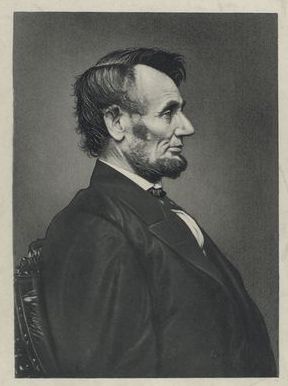
Taken by Alexander Gardner on February 9, 1864. This photograph would serve as the image that engraver Victor David Brenner would use to create the bas relief of Lincoln used on the penny.

Abraham Lincoln (1809-1865)Taken by Alexander Gardner on February 9, 1864, this photograph served as the image engraver Victor David Brenner would use to create the bas relief of Lincoln found on the 1909 penny.

It is President Teddy Roosevelt we have to thank for giving us the first Lincoln penny. Until the Lincoln penny debuted in 1909, no likeness of an actual person had appeared on a “regular-denomination circulating United States coin.” Too monarchial, deemed our first head of state, George Washington. Emperors, kings, and other authority figures had long stamped coins with their images to declare their power. Young America was done with that kind of governing. So the Mint Act of 1792 dictated that American coins would instead be “an impression emblematic of liberty.”

As a result, the coin designs of liberty – depicted by goddesses, mainly- grew “dowdy and uninspired.” President Roosevelt complained to his secretary of the treasury that, “Our coinage is artistically of atrocious hideousness.” So Roosevelt directed him to stamp the image of Lincoln on the one-cent piece to commemorate Lincoln’s 100th birthday.

It was done. When the Lincoln penny was released into circulation, it was a hit with the American people. Long lines formed at banks and Treasury buildings in New York, Washington, Boston, and other cities to snap up the new coins. In Philadelphia, some of the pennies were sold for 25 cents. It had been 44 years since Lincoln was assassinated. He was an icon. People were excited that they recognized the face on the coin.

Of course, as Lincoln himself remarked, you can’t please all the people all the time. Some people grumbled about the new coin, Confederate veterans, of course, plus the New York Times, calling it “another ill-considered freak of Mr. Roosevelt’s will.”

Nowadays, the complaints about the penny are different. There are some people who want to get rid of the penny altogether. Due to the rising price of metal, the cost of making the “copper-coated zinc corpus” (1.4 cents) now exceeds its face value.

Lincoln statue at the Lincoln Memorial

Lincoln statue at the Lincoln Memorial

Tucked into the massive central hall of the Lincoln Memorial sits an imposing marble statue of Abraham Lincoln. Over Lincoln’s head is inscribed:

IN THIS TEMPLE

AS IN THE HEARTS OF THE PEOPLE

FOR WHOM HE SAVED THE UNION

THE MEMORY OF ABRAHAM LINCOLN

IS ENSHRINED FOREVER 


The statue stands over 19 feet tall. Lincoln is shown in a seated position, but, if he could get up, he would stand 28 feet tall. He wears an expression of firm determination, eyes fixed rather sadly looking out onto the National Mall toward the Washington Monument.  Sculptor Daniel Chester French (1850-1931) began work on his design for the statue in 1915, making many bronze and plaster models. The sculptor consulted photographs by the well-known Civil War photographer Mathew Brady and used Lincoln’s life mask as well as casts of Lincoln’s own hands as models.

Lincoln's left hand

Lincoln's left hand

Now look at both of Lincoln’s hands. There’s a popular legend that Lincoln is shown using manual sign language to sign his initials, with his left hand shaped like the letter “A” and his right hand to form an “L.”  The National Park Service denies that this is the case. There is no evidence that Daniel Chester French intended for Lincoln’s hands to be formed into sign language letters. Nevertheless, it’s possible. Believers point out that a National Geographic Society publication states that French had a son who was deaf  – and French himself knew sign language.  He would have had good reason to do so, too, to honor Lincoln, as it was President Lincoln who signed into law the ability for Gallaudet University, a school for the deaf, to grant college degrees.

Lincoln's right hand

Lincoln's right hand

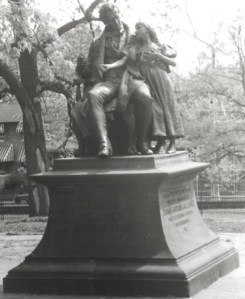
There are those who say French did shape Lincoln’s hands in this fashion on purpose yet others insist he didn’t. There is, however, evidence he could have. French had used sign language  in his sculptures before. In his 1889 portrait of deaf educator Thomas Gallaudet shown with his first student, Alice Cogswell, Gallaudet uses his right hand to make the sign for the letter “A” as Alice, too, makes the “A” sign with her right hand.

Thomas Gallaudet sculpture by Daniel Chester French

Thomas Gallaudet sculpture by Daniel Chester French

penny

penny-with-lincoln-memorial

In one week, the nation will celebrate the 200th birthday of our most revered president, Abraham Lincoln (February 12, 1809 – April 14, 1865). To commemorate the birthday of our 16th president and the issuing of the first penny a century ago, the U.S. Mint is issuing four new pennies. The “heads” side of the penny bearing Lincoln’s image remains the same while the “tails” side will alternate four new designs which represent the four major aspects of President Lincoln’s life:

Birth and early childhood in Kentucky (1809-1816)
Formative years in Indiana (1816-1830)
Professional Life in Illinois (1830-1861)
Presidency in Washington, DC (1861-1865)

Click here to see the unveiling of the images of the new coins at a ceremony held last September in Washington, D.C.

I hadn’t intended to write about Abe Lincoln today. Rather, for days now, I’ve gorged myself reading about his wife Mary, hoping soon to come to the end of the book and Internet material on her and get down to blogging. Well that is an impossible task. There is no end of Lincolnology. At last count, there were upward of 15,000 books about Abe and Mary, more than about any other person except Jesus.

A visit to the official website of the Lincoln Bicentennial assures me that I can blog all year on the Lincolns and be in step with the rest of the country, as celebrations and exhibits go on for the next eleven months.

While I was googling the image of the Lincoln Memorial which I present here, I got all misty-eyed.

Lincoln statue within the Lincoln Memorial

Lincoln statue within the Lincoln Memorial

What a great man Abraham Lincoln was. After reading about his life with Mary, I come away with even more admiration. What a difficult woman Mary was and so selfish, too (see my Feb. 3, 2009 blog below). I’ll give her credit for her abolitionist efforts but what a drag she was on our president during the darkest time of our nation’s history! She was jealous of his time away from her. He was running the country!

When I was in elementary school, February was the month we celebrated two presidents’ birthdays – Lincoln’s on the 12th and Washington’s on the 22nd. This was before there was an official “Presidents’ Day,” a day set aside to celebrate the birth of all presidents and before February became “Black History Month.” My teachers would always have a beautiful bulletin board displayed with a calendar, white doilies with red hearts for Valentine’s Day, and black cardboard cut-outs of Lincoln’s and Washington’s silhouettes. I love February.

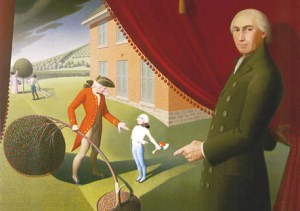
I learned that Lincoln was poor and lived in a log cabin, that he was humble, gave speeches outdoors, and chopped firewood. We heard the Mason Weems fable that Washington could not lie to his father about chopping down a cherry tree.

washington_cherry-tree

My birthday comes two days after Washington’s. As a result, I’ve always had cherry pie instead of cake for my special dessert, because of George chopping down that cherry tree. On one birthday, my grandmother Mimi made cherry tarts for my guests and me and we went to the movies to see Lucille Ball and Bob Hope in the comedy, “Fancy Pants.”

Back to the Lincoln penny, isn’t it ironic that a president who grew up “friendless, uneducated, penniless…” should find himself commemorated on a penny? Happy Early Birthday, Abe. You rock.

5-lincoln-m

Ty, the company that makes Beanie Babies, is honoring First Lady Michelle Obama’s wishes and dropping the names “Marvelous Malia” and “Sweet Sasha” from its Ty Girlz collection. CEO Ty Warner still maintains that the dolls weren’t intended to look like Malia and Sasha Obama. The dolls will be renamed Mariah and Sydney.

Regarding some of my recent posts on insane asylums (see sidebar, “Categories: The Insane Asylum”), my neighbor and friend, Karen O’Quin, wrote:

I really liked your blog – thanks for sending!!  I see a theme there.  My experience with Austin State Hospital is that when I first started working at Travis State School in 1967, they only had men there – they called them “boys”.  Some had been there for years as they had been admitted to ASH long before because they were a little “weird” and then became too institutionalized to be let out.  They did not have IQs consistent with mental retardation.  Some were later placed in group homes.  I don’t know if you’ve read Mary, Mrs. A Lincoln, but it is her account of being committed to a lunatic asylum by her son, Robert.  Someone very recently found letters she had written to her attorneys from the asylum.  I think they were going to be a book, too. 

Mary Lincoln (1818-1882)

Mary Lincoln (1818-1882)

When I was young, I remember my mother talking about Mary Todd Lincoln, wife of Abraham Lincoln, and her inappropriate and extravagant spending sprees during the depth of the Civil War. Above all I remember Mom mentioning that Mary had a collection of about 300 pairs of gloves. Thinking about it now, it reminds me of Imelda Marcos, wife of the president of the Philippines, Ferdinand Marcos, and her closet rack of 2700 pairs of shoes.

Mary Todd and Abraham Lincoln came together as husband and wife from two very different worlds. Mary was pampered and rich; Abraham was tested and wise. Both were prone to depression but it was Mary, with her fragile mind, perhaps schizophrenic or bipolar, who finally cratered under the constant barrage of grief and loss that became her sad lot in life.  Three of her sons died while her husband was president during a bloody and acrimonious civil war. The hate mail sent to her husband was unbelievable. Then her beloved Abraham, her anchor, was assassinated. It was more than Mary could bear. She descended into madness.

She began to wander hotel corridors in her nightgown, was certain someone was trying to poison her, complained that an Indian spirit was removing wires from her eyes, and continued her frantic spending, purchasing yard after yard of elegant drapery when she had no windows in which to hang it. (PBS American Experience: “The Time of the Lincolns”)

The doctors treated her with laudanum which gave her hallucinations, eye spasms, and headaches. She began to behave bizarrely, creating a public scandal. Her only surviving son Robert, a practicing attorney, arranged an insanity trial and had her committed to the asylum Bellevue Place just outside Chicago. Although Mary was only hospitalized for three months, she never forgave Robert for the humiliation and deprivation.

A recently published book, The Madness of Mary Lincoln by Jason Emerson, awarded “Book of the Year” by the Illinois State Historical Society in 2007, examines Mary’s mental illness. The book is based on a rare find – a trunk of letters found in the attic of Robert Lincoln’s lawyer. They contain the lost letters written by Mary during her stay in the asylum. The book sheds light on the ongoing mystery of Mary’s mental illness, its nature, roots, and progression, and suggests that Abraham Lincoln had some understanding of it and provided stability.

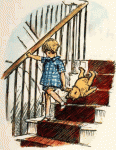
Christopher Robin with Winnie-the-Pooh illustration by E.H. Shepard

Christopher Robin with Winnie-the-Pooh illustration by E.H. Shepard

Reuters new service released this announcement on 01/09/09:

“The first official sequel to the original Winnie-the-Pooh books will appear in October, its publishers said on Saturday, more than 80 years after the honey-loving bear first appeared in print.”Return to the Hundred Acre Wood” is the follow up to A.A. Milne’s “Winnie-the-Pooh” and “The House At Pooh Corner,” which were famously illustrated by E.H. Shepard.

The new book, published by Egmont Publishing in Britain and Penguin imprint Dutton Children’s Books in the United States, will be written by David Benedictus, [and] Mark Burgess, who has already drawn classic children’s characters including Paddington Bear and Winnie-the-Pooh, is to provide the illustrations.”

This new Pooh illustrator Mark Burgess has illustrated several children’s picture books and many of teddy bears, but my limited Internet search has not turned up any of Winnie-the-Pooh. Following the classic work of original Pooh illustrator E.H. Shepard will be a tall order for Burgess. According to The Star Phoenix on January 14, 2009, a collection of Shepard’s drawings for the original Pooh books sold for almost $2 million in London last month.

E.H. Shepard is also famous as the original illustrator of The Wind in the Willows by Kenneth Grahame. Like Christopher Robin Milne, Shepard came to resent Winnie-the-Pooh, feeling that his illustrations for the Milne books overshadowed his other work.

The Wind in the Willows illustration by E.H. Shepard

The Wind in the Willows illustration by E.H. Shepard

Winnie-the Pooh

winniethepooh-bookThis is the story of how A.A. Milne came to write the stories of Winnie-the-Pooh, or just plain Winnie the Pooh, as Disney would have it.

It was the beginning of World War I. A Canadian lieutenant, Harry Colebourn, a veterinarian in Winnipeg,  offered his services to his country. He was already a trained officer attached to the 34th Regiment of Cavalry, and received orders to leave with the regiment on a train for Valcartier, Quebec, and then take a ship to England. While en route to Valcartier, he was detached from the 34th Regiment and transferred to  the Canadian Army Veterinary Corps.

On August 24, 1914, the train stopped at White River, Ontario, an important stop for all trains. Here they would take on coal and water as well as clean out the cinders. The trains carried men and horses, as horses were vital in the war effort. During the four-to-six hour stop, the horses would get off the train to be watered and exercised. Troops would drill along Winnipeg Street where the train station was located.

It was on the train platform that Lieutenant Colebourn noticed a man with a female black bear cub on a leash. It was not an uncommon sight for the times; several people had pet bears back then. Many old photos show bears leashed and posing with family members. Lieutenant Colebourn talked to the man and found out he was a trapper. The trapper told the lieutenant that he had killed the cub’s mother. The lieutenant, being a vet, knew that the cub had little chance now of surviving in the wild without its mother. So he paid the trapper $20 for the cub and took it back with him to the train. He named his new companion, “Winnie,” after his hometown of Winnipeg.

From Gaspe Bay, he and Winnie embarked for England aboard the S.S. Manitou with the rest of the troops, where they headed to a military encampment in Southern England on the Salisbury Plain (home to Stonehenge).

Lt. Harry Colebourn and Winnie

Lt. Harry Colebourn and Winnie.

Winnie became the mascot of the C.A.V.C. while the company remained in England. She became a pet to many of the soldiers, following them around like a tame dog. She slept under Harry’s cot in his tent. Sometimes she would climb the center pole of the tent in the night and give it a shake. But, as Winnie grew older and bigger, the men began to worry that the shaking would make the tent collapse in the night with them in it. From then on, they slept with Winnie tethered to a pole outside the tent.

But it was wartime. Soon the brigade was ordered to France. Harry, now a captain, could not take Winnie with him to the battlefront. On December the ninth of that same fall, Harry took Winnie to the London Zoo. It was his full intention to return for her after the war and return with her to Canada. Harry was very faithful to Winnie. When on leave from war duty, he made trips to London to visit Winnie in the zoo.

Winnie continued to capture the hearts of all those who met her. She became a very popular attraction at the London Zoo.  It was said that people would knock on her cage door and she would open it and come out. She would allow children to ride on her back and she would eat from their hands. Her attendants considered her trustworthy. No other bears were allowed such contact with the visitors to the zoo.

The war ended in 1918 but Harry didn’t take Winnie out of the London Zoo. Instead he donated her as a gesture of appreciation to the zoo for caring for Winnie through the war years and he returned to Winnipeg alone. Living in London at that time was author A.A. Milne. 

Christopher Robin Milne and Winnie at the London Zoo c.1924
Christopher Robin Milne and Winnie at the London Zoo c. 1924

On August 21, 1921, Milne’s son, Christopher Robin, or “Billy Moon,” as he later referred to himself, had his first birthday. Milne gave him an Alpha Farnell stuffed teddy bear which came to be known as “Edward.”  From 1924 on, Milne and his son began to visit Winnie the bear in the London Zoo. Christopher Robin became very attached to Winnie. He was even allowed inside the cage to feed Winnie condensed milk. Soon Christopher Robin’s stuffed bear underwent a name change. Although a boy, “Edward” soon became known as Winnie.

Inspired by both the zoo bear Winnie and his son’s stuffed bear of the same name, author Milne began to write and publish his Pooh’s Classics. In 1926 the first and best know of the series called Winnie-the-Pooh, was published, the additional name “Pooh,” being borrowed from the name of a swan. Milne’s characters are mostly inspired by Christopher Robin’s stuffed animals, among them Piglet, Tigger, and Eeyore. These toys are now on display at the New York Public Library.

At first, Christopher Robin enjoyed the fame his father’s books brought him, but, as he grew older, he became resentful. He felt his father was exploiting his childhood for personal gain.