Feeds:
Posts
Comments

Posts Tagged ‘biographies of women’

Pigeons gather in a square in Barcelona.

Note: Pigeons and doves form the bird family Columbidae, of which there are 300 species. Ornithologically, there is no simple way to distinguish a pigeon from a dove. Some specialists refer to the smaller species as “doves” and the larger ones as “pigeons,” but this is not consistently applied.

Collared Doves can be tamed in urban areas, such as these two being handfed in Poland.

Collared doves can be tamed in urban areas, such as these two sweeties being handfed in Poland.

In reference to the works of Spanish artist Pablo Picasso, the issue is further muddled. The titles of many of his works include the Spanish word la paloma, which means both “pigeon” and “dove,” so we aren’t sure which bird he intended to depict, if, indeed, he did intend to create such a distinction.

Finally, Picasso biographers, art curators, and translators have added their own layers of confusion. For example, the painting, “Child Holding a Dove,” (National Gallery, London) has been given two different French title translations: “L’Enfant A La Colombe” (Child With the Dove)  and “L’Enfant Au Pigeon” (Child With A Pigeon).

Therefore, for the purpose of this article, the terms, “pigeon” and “dove,” are used interchangeably, as is common practice, except when otherwise explicitly stated.

Now for our story:

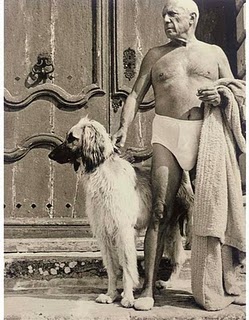
“Picasso in Underwear,” photo by David Douglas Duncan, 1957. From the earliest age, the most famous artist of the 20th Century did whatever he wanted, which might include posing in his jockeys on his front doorstep at age 76.

Famed Spanish artist Pablo Picasso (1881-1973) grew up around pigeons. His father, José Ruiz Blasco, an artist in his own right, bred pigeons (rock doves), which became his favorite subject to paint. Ruiz became known as El Palomero (The Pigeon Fancier). Pablo’s father taught him how to paint pigeons. (1)

In Pablo’s hometown of Málaga, Spain, pigeons roosted in the sycamore trees in the Plaza de la Merced, where he and his sisters played. While the girls frolicked in the square, Pablo used a stick to make bird drawings in the dirt. (2)

Much to the dismay of his elementary school teachers, Little Pablo, or “Pablito,” drew constantly. Every once in a while, he brought a pigeon to class and spent his time sketching it rather than doing his assigned schoolwork.

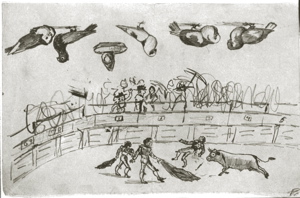
Pablo used every inch of his drawing paper, covering the page with scenes of his favorite subjects: bullfights and pigeons. (3)

Guided by his father, Picasso received professional art instruction. His talent grew and was recognized. By the age of 15, he was successfully exhibiting his artwork. By 1901, he was splitting his time between Barcelona and Paris, falling increasingly in the company of artists heavily influenced by post-impressionists such as Vincent Van Gogh.

That same year, at the age of 20, Picasso had become so respected an artist that he had a Paris show in the Galerie Vollard almost to himself, sharing it with another Basque. At this exhibition, Picasso

sold 15 of his 65 paintings and drawings before the exhibition had even opened.” (4)

Through all these changes, however, pigeons still charmed him, as is evident in his sentimental 1901 painting, “Child Holding a Dove” (1901), a piece that ushered in his somber Blue Period.

Pigeons even appeared during his cubist period, as in “Woman With Pigeons” ( 1930).

“Woman With Pigeons,” by Pablo Picasso, 1930.

Before 1937, Picasso had not used his art for political expression. It was in that year, though, that he was to create his most famous work. Commissioned by the Spanish Republican government, Picasso created an enormous mural called “Guernica.” It was named after a Spanish town in the Basque country that had been firebombed by Nazis, backers of the Nationalist forces of General Franco during the Spanish Civil War (1937-1939).

Guernica, Spain, after the April 26, 1937, aerial bombing by Nazis. It was market day and the quiet village was filled with women and children. There were few men left in Guernica, as most were off fighting in the Spanish Civil War against Franco. The Nazis bombed the town for two hours, slaughtering hundreds of innocents. When the town caught fire, those not burned to death tried to escape the inferno by taking refuge in the outskirts of town. Yet there was no escape, as they found themselves trapped all around by bombed-out bridges and roads. Some of these women and children were gunned down by aerialists. The Nazis supported the rebel forces of General Franco to test out war tactics and weapons. Although there was a military target outside Guernica, a munitions factory, it was left unscathed by the April 1937 bombing. It is believed that the bombing was used to intimidate those in opposition to Franco’s impending rule.

After the painting “Guernica” (see below) was exhibited in the Paris International Exhibition (1937), it toured Europe and the U.S., drawing international attention to the Spanish Civil War and the horrors of war.

“Guernica,” by Pablo Picasso. (1937)

 “Guernica” gained monumental status, becoming a potent anti-war symbol and thrusting Pablo Picasso to the forefront of the Peace Movement. In May of 1940, Hitler invaded France. Throughout WWII, Picasso lived in Nazi-occupied Paris, where he was continually harassed by the Gestapo who were familiar with his anti-Nazi mural.

Picasso continued to paint and draw pigeons and doves. In 1949, author Louis Aragon chose the artist’s lithograph, “La Colombe,” (The Dove) for the poster commemorating the Peace Conference in Paris. (5)

“La Colombe” (The Dove) by Picasso, 1949

Posters of “La Colombe” were all over Paris when Picasso’s daughter was born that April so he named his daughter Paloma (Spanish for dove).

In this 1951 image, Pablo Picasso is shown with 2 of his 4 children, whose mother was Francoise Gilot: Paloma (b. 1949) in his arms and Claude (b. 1947) Photo Edward Quinn, © edwardquinn.com

The model for the famous “peace dove” was one of artist Henri Matisse ‘s doves.

Henri Matisse in his studio with his doves. Vence, France. 1944. photo by Henri-Cartier Bresson

Matisse and Picasso had known each other since 1904 when they were introduced at the Paris salon of Gertrude Stein, an important collector of art, particularly Matisse’s. Matisse and Picasso had a profound influence on one another and their art.

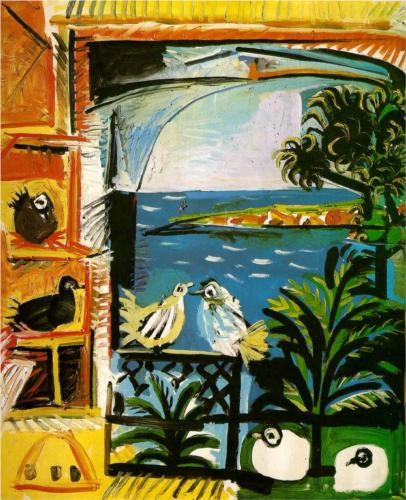
After Matisse died in 1954, Picasso was deeply saddened. He moved his family to a large villa near Cannes in the south of France and painted a series called “Studio” in homage to Matisse. He painted almost a dozen canvases of the same view from his third floor studio window – with the lush background of sky and garden and sea – while, in the foreground, “white doves” (6) nested and played in a dovecote Picasso had built on his terrace. Picasso did not ordinarily paint what he saw; he drew upon his imagination for artistic inspiration. It was his old friend Matisse who drew from nature. Therein lay Picasso’s tribute to Matisse.

“The Studio (Pigeons),” by Picasso, 1957, is painted in a style reminiscent of Matisse.

Meanwhile, the “Dove of Peace” Picasso had created for the 1949 Paris Peace Conference had caught on. It had become a symbol for the peace movement, the Communist Party, and other liberal groups. In the years that followed, Picasso agreed to create other peace doves for conferences across Europe.

The modern peace dove is a more whimsical bird than the 1949 original. This proud bird is portrayed in happy flight, bearing numerous bouquets of olive branches and flowers in its wings, beak, and feet.

one of the many versions of Picasso’s iconic “Dove of Peace”

(1)”Lines That Kept Moving and Knew No Boundaries,” by Smith, Roberta. New York Times, October 7, 2011.

(2) Hart, Tony. Famous Children: Picasso. New York: Barron’s Educational Series, 1994.

(3) Krull, Kathleen. Lives of the Artists: Masterpieces, Messes (and What the Neighbors Thought). New York: Harcourt Brace & Company, 1995.

(4) link

(5) Clark, Hiro. Picasso: In His Words. New York: Welcome Books, 2002.

(6) Douglas, David. Viva Picasso: A Centennial Celebration 1881-1981. Studio, 1980.


This is a  repost.

Read Full Post »

I was thinking it was time for a good ghost story. I was tossing around some ideas in my head when I recalled something I’d seen on TV as a child. Of course we didn’t have any Discovery Channel back then, but the program was definitely a documentary type. It featured haunted houses and the people who lived in them. I remember the narrator talked with a family who lived in a house in which a rocking chair rocked with no one sitting in it. That felt a little hokey so I wasn’t spooked. It was when the narrator interviewed a person I recognized that I scooted to the edge of my seat.

Sommer and Sellers in "A Shot in the Dark" (1964)

Sommer and Sellers in “A Shot in the Dark” (1964)

It was the beautiful, blonde, and sexy Hollywood actress Elke Sommer (b.1940). She was familiar to me because she had played the voluptuous maid Maria opposite Peter Sellers in the second Pink Panther movie, “A Shot in the Dark” (1964), which ReadersDigest.com names as one of the top funniest 50 films of all times. If you haven’t seen it, you should. Bumbling Inspector Clouseau (Sellers) trails after Maria whom he suspects of committing multiple murders, one of which is in a nudist camp.There’s a hilarious scene of Maria and Clouseau fleeing through Paris naked.a-shot-in-the-dark-movie-poster

Anyway, Elke and her husband Hollywood columnist and Bogart’s best friend Joe Hyams (1923-2009) lived in Benedict Canyon in North Beverly Hills. They claimed that a ghost was living in their house. My husband Tom also remembers seeing the same show when he was young.  “They (Elke and Joe) had a ghost in their dining room,” he recalled. “The chairs would move around at night. They would put marks on the floor below the chairs before they went to bed, then, the next morning, they’d look, and the chairs wouldn’t be standing on the marks anymore. The chairs would be all over the place.”

In the middle of the night, Elke and Joe would wake up to what sounded like a dinner party going on downstairs in the dining room, hearing voices, chairs scooting, glasses tinkling, and silverware clanging. Yet they would go downstairs and no one would be there. Elke said, “Things would move all the time and it would be very noisy and (it was) the usual poltergeist nonsense, you know.” (1) The ghost was described as being a middle-aged man wearing a white shirt. (2)

After battling the spirits with no relief, they called in some help, contacting the Parapsychological Institute at UCLA. When Life photographer Allan Grant arrived at the house to take some pictures, he was a sceptic – but not so when he left. He said:

Something happened that spooked me. On one roll of film that I shot in a particular room where they first spotted the ghost there were about four or five frames of film that were progressively fogged down to the end of the frame, giving it a ghostlike appearance, especially (of) Joe Hyams, who was in the shot. When that was processed and I took a look at it, I thought, there’s no way that would happen…in the center of a roll…something else had happened that I couldn’t explain and I’ve spent years as a photographer and that had never happened to me before….Something did happen in that house. (1)

The haunting continued. A mysterious fire erupted one night. Fortunately, Joe and Elke were able to get out through a window. Shortly thereafter, they moved out of the house permanently. (1) Joe Hyams wrote a book about it called The Day I Gave Up the Ghost. Evidently, though, the ghost didn’t give up. The “severely haunted house” at 2633 Benedict Canyon “was bought and sold more than seventeen times since Sommers vacated it, and many have reported ghostly phenomena.” (3)

(1) youtube interview: “Actress Elke Sommer with a Poltergeist.”
http://www.youtube.com/watch?v=NRLasAUl-eI
(2) California Paranormal Travel Guide.
http://www.haunted-places.com/californ.htm
(3) Ghosts of Hollywood: Celebrities Who Have Seen Ghosts. http://paranormal.about.com/cs/trueghoststories/a/aa022304_3.htm


This is a repost.

Read Full Post »

Expert Markswoman Annie Oakley performing her famous mirror trick

Expert Markswoman Annie Oakley performing her famous mirror trick (see Jan. 16 blog entry)

Aim at a high mark and you will hit it. No, not the first time, not the second time and maybe not the third. But keep on aiming and keep on shooting – for only practice will make you perfect. Finally, you’ll hit the bull’s-eye of success.
-Annie Oakley (1860-1926)

Chief Sitting Bull, whose army had defeated Custer’s troops at the Battle of Little Big Horn in 1876, was so impressed with Annie Oakley’s amazing precision with a shotgun that he gave her an Indian name, Watanya Cecila, or Little Sure Shot.

Annie Oakley was one of the first people to be filmed by Thomas Edison, inventor of the motion picture camera. (1) This 80-second film from late 1894 shows Annie firing a rifle 25 times in 27 seconds and shooting glass balls tossed in the air by manager husband Frank Butler. View a clip of it here:

http://www.youtube.com/watch?v=XN85Nj_bfQo

(1)Macy, Sue. Bull’s-Eye. National Geographic Society: Washington, D.C., 2001.

Read Full Post »

Regarding some of my recent posts on insane asylums (see sidebar, “Categories: The Insane Asylum”), my neighbor and friend, Karen O’Quin, wrote:

I really liked your blog – thanks for sending!!  I see a theme there.  My experience with Austin State Hospital is that when I first started working at Travis State School in 1967, they only had men there – they called them “boys”.  Some had been there for years as they had been admitted to ASH long before because they were a little “weird” and then became too institutionalized to be let out.  They did not have IQs consistent with mental retardation.  Some were later placed in group homes.  I don’t know if you’ve read Mary, Mrs. A Lincoln, but it is her account of being committed to a lunatic asylum by her son, Robert.  Someone very recently found letters she had written to her attorneys from the asylum.  I think they were going to be a book, too.

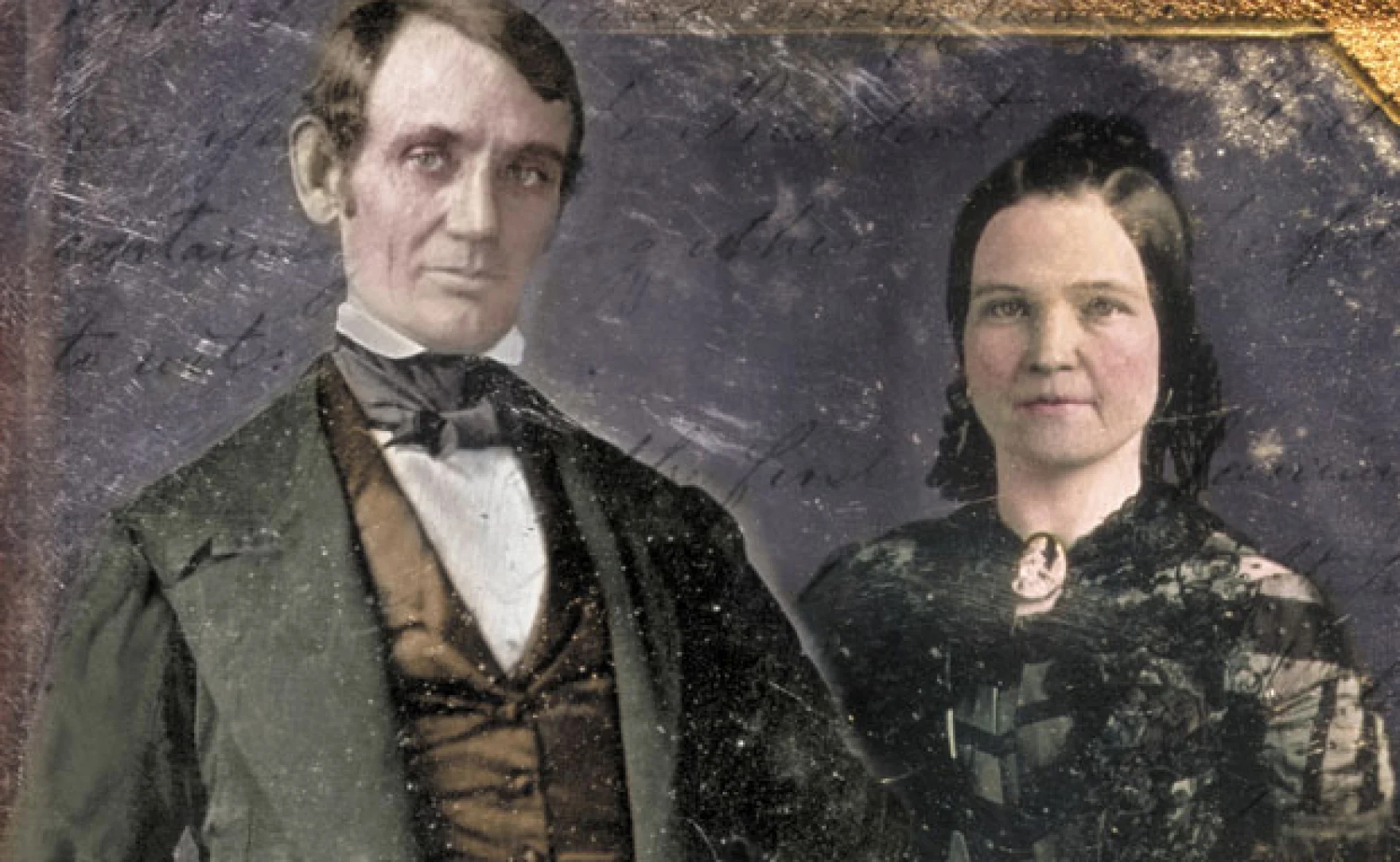
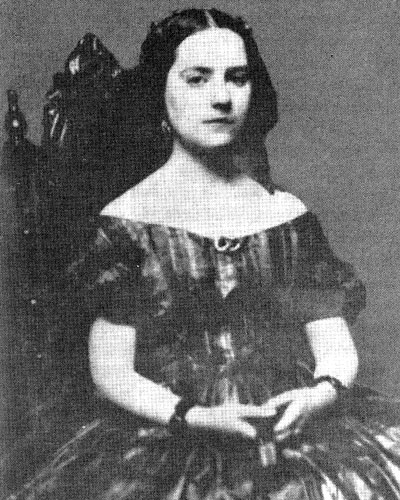
Mary Lincoln (1818-1882)

Mary Lincoln (1818-1882)

When I was young, I remember my mother talking about Mary Todd Lincoln, wife of Abraham Lincoln, and her inappropriate and extravagant spending sprees during the depth of the Civil War. Above all I remember Mom mentioning that Mary had a collection of about 300 pairs of gloves. Thinking about it now, it reminds me of Imelda Marcos, wife of the president of the Philippines, Ferdinand Marcos, and her closet rack of 2700 pairs of shoes.

Mary Todd and Abraham Lincoln came together as husband and wife from two very different worlds. Mary was pampered and rich; Abraham was tested and wise. Both were prone to depression but it was Mary, with her fragile mind, perhaps schizophrenic or bipolar, who finally cratered under the constant barrage of grief and loss that became her sad lot in life.  Three of her sons died while her husband was president during a bloody and acrimonious civil war. The hate mail sent to her husband was unbelievable. Then her beloved Abraham, her anchor, was assassinated. It was more than Mary could bear. She descended into madness.

She began to wander hotel corridors in her nightgown, was certain someone was trying to poison her, complained that an Indian spirit was removing wires from her eyes, and continued her frantic spending, purchasing yard after yard of elegant drapery when she had no windows in which to hang it. (PBS American Experience: “The Time of the Lincolns”)

The doctors treated her with laudanum which gave her hallucinations, eye spasms, and headaches. She began to behave bizarrely, creating a public scandal. Her only surviving son Robert, a practicing attorney, arranged an insanity trial and had her committed to the asylum Bellevue Place just outside Chicago. Although Mary was only hospitalized for three months, she never forgave Robert for the humiliation and deprivation.

A recently published book, The Madness of Mary Lincoln by Jason Emerson, awarded “Book of the Year” by the Illinois State Historical Society in 2007, examines Mary’s mental illness. The book is based on a rare find – a trunk of letters found in the attic of Robert Lincoln’s lawyer. They contain the lost letters written by Mary during her stay in the asylum. The book sheds light on the ongoing mystery of Mary’s mental illness, its nature, roots, and progression, and suggests that Abraham Lincoln had some understanding of it and provided stability.


This is a reblog.

Read Full Post »

Carolyn King Waller

Carolyn King Waller

My mother Carolyn King Waller stopped by Lisa’s History Room a while back for a little chat. Carolyn was born in Corpus Christi, Texas, in 1934. She has a mind like a steel trap; her ability to recall stories from the past is legend.

Lisa: Thanks for stopping by today, Mom. Everyone knows that you love history. What would you say is your favorite period?
Carolyn: Probably the World War Two years, 1941 to 1945. And of course World War Two for other countries was longer that. 1941 to 1945 were America’s war years.
Lisa: And why is that your favorite period?
Carolyn: The fate of the world hung in the balance. It was a lot of drama – really, truly, good against evil.
Lisa: So it fascinates you.
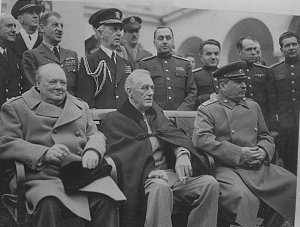
Carolyn: I’m not the only one…others are fascinated by it still…of course, we didn’t know about the Jews being exterminated, 6 million…then the Stalin thing…Stalin moved in from the east, we (the Allies) moved in from the west. The countries that Stalin occupied in the east became known as the countries behind the Iron Curtain. Churchill coined the phrase. The poor people who had been under Germany were then under Russia! We didn’t really free them. The people in those countries had no freedom. We slowly woke up to who Stalin was. The Russians never left, including East Berlin, so World War II strengthened the Russians, it helped one problem, it created a worse one though, by increasing the strength of the Communists. Roosevelt was blamed for that but there wasn’t much he could do. It was said that Roosevelt gave too much away to Stalin at the 1945 Conference of Yalta,

1945 Conference at Yalta

1945 Conference at Yalta

but there really was very little he could do about it. They (the Communists) were there – they had occupied Eastern Europe – they had “boots on the ground.” We didn’t know then that Stalin had murdered millions of his own people, that he was a monster. In the early days, Truman even said, “I like Old Joe.”
Lisa: What else makes it an interesting period?
Carolyn: Outsized personalities of Hitler, Stalin, Roosevelt, and Churchhill – huge . Churchhill was a fabulous orator, Roosevelt knew about ships, had knowledge of the military, selected good generals. Hitler was a poor strategist; he entered all those countries at once. He told the generals what to do but he wasn’t good at military strategy. He was just a madman.
Lisa: To learn more, are there some books you would recommend?
Carolyn: Books about the period abound, certainly the biographies of those four men, stories of the war itself would be good.
Lisa: Does a particular book come to mind?
Carolyn: Kennedy’s thesis that became a book, While England Slept, No Ordinary Time, the Churchill bios by William Manchester – The Last LionA Man Called Intrepid
Lisa: What films capture the flavor and the truth of the war?
Carolyn: “The Best Years of Our Lives” showed the problems of returning servicemen from the war. “Edge of Darkness,” with Errol Flynn and Ann Sheridan depicts the Norwegian struggle. Norway was given away by the Quisling leader. The Norwegians had to fight Germany in an underground movement. There may be another movie, “A Moon is Down,” by John Steinbeck about occupied Norway, but I’ve not seen it.
Lisa: What else?
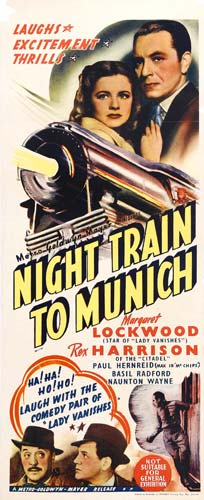
Carolyn: “Escape” which was a book by Ethel Vance, with Robert Taylor and Norma Shearer; “Night Train to Munich,” with Rex Harrison; and, of course, “Casablanca; “Ministry of Fear,” with Ray Milland; “Cloak and Dagger,” with Gary Cooper and Lily Palmer,night-train-to-munich “Watch on the Rhine,” with Bette Davis and Paul Lucas, and “OSS,” with Alan Ladd. All of those are great movies.
Lisa: What was it like to be a young girl in the war years?
Carolyn: In elementary school, our room would get the American flag for the week if our class bought the most war stamps and bonds that week. The classes competed to have the flag on display at the front of the room. It was a big deal. I was at Fisher School two years. Stamps were ten cents, bonds were $18.75 redeemable in ten years for $25. You had a book of stamps and you would try to fill the book with stamps. You would turn in a certain amount of stamps to redeem for a bond. That paid for the war! My grandparents sold cattle during the war years and they gave me money to do it because I was always a big stamp buyer. The government was smart to do that. It was an easy way for the government to get money from the citizens to finance, to fight the war. So many (citizens) had schoolchildren. While boys – women and men were fighting and dying in the war around the world – I was a young girl busy doing cartwheels in the front yard and joining little clubs – I was totally isolated. I didn’t know anyone who died in the war.
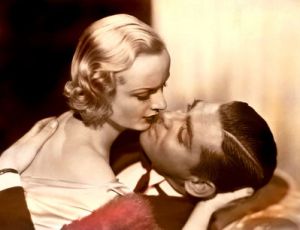
Lisa: Changing the subject, you wanted to say something about (actress) Carole Lombard.

Carole Lombard and Clark Gable

Carole Lombard and Clark Gable

Carolyn: Yes. Japan attacked us on Dec. 7, 1941. In January 1942 Carole Lombard went on a war bond tour – to Indiana I think. She wanted to get home to see (her husband and actor) Clark Gable afterward, in a hurry, because they had had a fight over Lana Turner. She insisted on flying out to California late at night when it was dark and foolish to fly over the Rockies. She should have waited for a better plan but she insisted on flying out. She crashed in her plane in the Rockies. She was only 33. All they found of her were her earrings. Clark went to the scene and was distraught. He was always a good drinker, but he isolated himself for a few days afterward or so and drank heavily before he came back out. Roosevelt said she (Lombard) was one of our first casualties of the war or maybe even first hero. Before she had left, she had said to Clark Gable, “Pappy, you need to join this man’s army (meaning the United States Army).” After she died, Gable did just that; he enlisted. He was about 41. He didn’t need to sign up. They were not drafting men of his age. But he was distraught and he did it. He was made a captain or something at the top – he became brass right away – he was too important to be just a regular fellow. He may have been in the Army but he was still a celebrity.
Lisa: Was Clark Gable decorated?
Carolyn: He was stationed in Great Britain, he was an officer, he may have been in some forays over Germany.
Lisa: What will we be talking about during your next visit to Lisa’s History Room?
Carolyn: What should we talk about? Should we talk about history?
Lisa: Well, if you had something you wanted to tell, what would it be?
Carolyn: I’d tell about the depression years. We had butter beans at Mother’s, and (my grandmother) Nona cooked cheap things, rice pudding, bread pudding, onions….the hobos, I don’t want to say that, the homeless people, they would come to the back door. Nona would give them a plate of food and they would to go and sit out under a tree in the backyard and eat their food. People weren’t afraid of other people back then.
Lisa: Okay, save those stories for next time. Thank you so much for stopping by today.
Carolyn: Well, bless your heart, you make me feel like a celebrity!


This is a reblog.

Read Full Post »

victorian-silhouetteIn Nellie Bly’s book, Ten Days in a Mad-House (see category, “Nellie Bly,” for related posts), Nellie Bly described various women she met in the Blackwell Island Women’s Lunatic Asylum. She was confined to Hall 6 with 45 of the least dangerous women in the institution. While some of them were certifiably “crazy,” (her words), many, she felt, had been wrongly locked up. A Frenchwoman, for example, named Josephine Despreau, fell sick in a boarding house and the woman of the house called in the police. They arrested her and took her to the station-house. She didn’t understand the proceedings because of the language barrier and the judge paid no attention to her protests. She was locked up in the insane asylum in no time.
Well into the twentieth century, it was easy to get a woman locked up in a mental institution. It was not unheard of for a man to tire of his wife in favor of another woman and get his wife declared insane and committed to an insane asylum. I was remarking upon this horror the other day and my mother told me that my great uncle Sam P did this very thing to his wife Helen. He had her committed to an asylum in San Antonio. Helen found a way out, though, and slipped away to Corpus Christi to live with her sister.

Do any of you have any asylum stories to share?

Read Full Post »

Nellie Bly (1864-1922)

Nellie Bly (1864-1922)

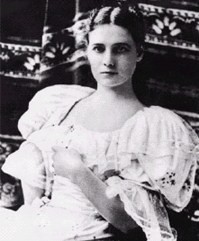
I’ve been thinking about the very different lives of reporter Nellie Bly and Rosemary Kennedy. Although over fifty years separated these women, both found themselves at the age of 23 at the mercy of mental health “professionals.” Nellie Bly placed herself in a dangerous lunatic asylum as an investigative journalist because she was desperate to land a job in a world that didn’t welcome female professionals. How else was an uneducated woman to earn a living in 1887?

Bly was the thirteenth of her wealthy father’s fifteen children, her mother being her father’s second wife. When Bly was six, her father died, failing to make specific provisions for Nellie, her mother, and her two brothers. Like many other great women, Nellie Bly (like Annie Oakley) took it upon herself to find a way to take care of her family. She ran a boarding house with her mother and marveled that her uneducated brothers were able to find jobs as clerks and drummers yet, because she was an uneducated woman, she could only aspire to be a chambermaid or washer-woman. Thus it was Nellie’s poverty and the absence of a father that lead her to have herself committed, at the age of 23, to an insane asylum.

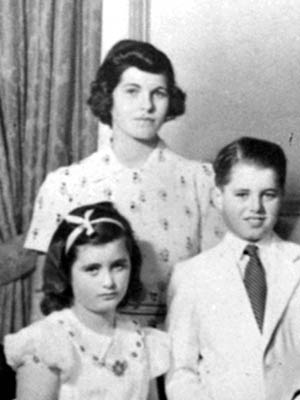
But the converse was true of Rosemary Kennedy. Rosemary landed in a mental institution because she was rich and had a father. She had the misfortune to be born “mildly mentally retarded, into a family dominated by her driven and ruthlessly ambitious father,” Joseph P. Kennedy. Rosemary had been living in a convent to keep her out of the public eye, but, as she developed as a young woman, she had begun sneaking out to see boys, and Kennedy was worried that she might damage his famous family’s reputation.

Rosemary Kennedy (back) (1918-2005), with sister Jean and brother Robert

Rosemary Kennedy (back) (1918-2005), with sister Jean and brother Robert

In an attempt to settle her down, her father, without telling his wife, used his money and powerful connections to arrange for his 23-year-old learning-disabled daughter Rosemary to undergo experimental brain surgery, one of the first prefrontal lobotomies ever performed. The operation took place in 1941, but, according to the historian Doris Kearns Goodwin, “something went terribly wrong.” Rosemary emerged from surgery not better, but far worse. She regressed to a state of helpless infancy and was confined to a mental asylum for the rest of her life until her death in 2005. Nellie Bly’s story, though, has a happy ending. She walked out of the asylum a free woman and an international celebrity.

To read more on the Kennedys on this site, scroll down the right sidebar to “Categories – People – Kennedys.”

Read Full Post »

victorian-letters-dover-clip-art-freeellie Bly was put on the island boat and sent to Blackwell’s Island. For ten days, she experienced firsthand the horrors of being locked up in cruel and inhumane conditions.  Upon her arrival, she was fed a disgusting meal of pink watery tea, prunes, and bread that was dirty and black and mostly dried dough. She found a spider in the slice given her. She didn’t eat it. Later she learned that the nurses didn’t like it when you didn’t eat your food. They might beat you for that.
After sitting in that long, freezing dining hall on bare yellow benches for what seemed an eternity, Bly and the other women in her ward were marched in two lines into a freezing cold, wet bathroom. As everyone looked on, the nurses stripped Bly of every bit of her clothing. They took away her dress, her skirts, her shoes, her stockings, and her hat. She then was forced to bathe in an ice-cold tub and be scrubbed by one of the craziest women in the ward.

“My teeth chattered and my limbs were goose-fleshed and blue with cold,” Nellie wrote later of the experience. “Suddenly I got, one after the other, three buckets of water over my head –  ice-cold water, too, into my eyes, my ears, my nose and my mouth.”

The nurses then put her, dripping wet, into a short flannel slip and locked her in an individual cell for the night. She couldn’t sleep. She kept picturing what would happen should a fire break out in the asylum. Every door was locked individually and bars covered the high windows. Should the building burn, there was no way the nurses or doctors could possibly unlock each door before the flames would engulf the building. She and the others would roast to death.

The asylum was spotlessly clean but it wasn’t the nurses who kept it so. The patients did all the work. There was little to distract the patients’ mind from the terrible cold and gnawing hunger. There were no books. The inmates did enjoy their short walks around the beautiful grounds. It was on one of those walks that Nellie Bly passed the kitchen and got a glimpse at the sort of food being prepared for the nurses and doctors: melons and grapes and all sorts of fruits, beautiful white bread and nice meats.

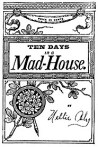
Bly complained to the doctors about the thin clothing issued to the patients, the intolerable cold, and the inedible food, but nothing came of it. It was only after her release ten days later that Nellie Bly would be able to draw attention to the neglect and abuse of people with mental disorders and others unfortunate enough to be sentenced to the asylum. Her expose of the conditions within the Lunatic Asylum, published in the World and later in book form,  Ten Days in a Mad-House , caused a sensation. Nellie Bly became an instant celebrity. madhouse-cvr

The public demanded to know how Nellie Bly had managed to hoodwink four physicians into believing she was insane. A grand jury launched an investigation into the claims made in Bly’s report and recommended the changes she had proposed, prompting an $850,000 increase in the budget of the Department of Public Charities and Corrections for the treatment of the insane.

nellie-bly-signature1

Read Full Post »

charles-dickens2One day, during my stay in New York, I paid a visit to the different public institutions on Long Island, or Rhode Island: I forget which. One of them is a Lunatic Asylum. The building is handsome; and is remarkable for a spacious and elegant staircase. The whole structure is not yet finished, but it is already one of considerable size and extent, and is capable of accommodating a very large number of patients.
blackswells-island-lunatic-asylum

I cannot say that I derived much comfort from the inspection of this charity.The different wards might have been cleaner and better ordered; I saw nothing of that salutary system which had impressed me so favourably elsewhere; and everything had a lounging, listless, madhouse air, which was very painful. The moping idiot, cowering down with long dishevelled hair; the gibbering maniac, with his hideous laugh and pointed finger; the vacant eye, the fierce wild face, the gloomy picking of the hands and lips, and munching of the nails: there they were all, without disguise, in naked ugliness and horror. In the dining room, a bare, dull, dreary place, with nothing for the eye to rest on but the empty walls, a woman was locked up alone. She was bent, they told me, on committing suicide. If anything could have strengthened her in her resolution, it would certainly have been the insupportable monotony of such an existence. The terrible crowd with which these halls and galleries were filled, so shocked me, that I abridged my stay within the shortest limits, and declined to see that portion of the building in which the refractory and violent were under closer restraint.

I have no doubt that the gentleman who presided over this establishment at the time I write of, was competent to manage it, and had done all in his power to promote its usefulness: but will lit be believed that the miserable strife of Party feeling is carried even into this sad refuge of afflicted and degraded humanity? Will it be believed that the eyes which are to watch over and control the wanderings of minds on which the most dreadful visitation to which our nature is exposed has fallen, must wear the glasses of some wretched side in Politics? Will it be believed that the governor of such a house as this, is appointed, and deposed, and changed perpetually, as Parties fluctuate and vary, and as their despicable weathercocks are blown this way or that? A hundred times in every week, some new most paltry exhibition of that narrow-minded and injurious Party Spirit, which is the Simoom of America, sickening and blighting everything of wholesome life within its reach, was forced upon my notice; but I never turned my back upon it with feelings of such deep disgust and measureless contempt, as when I crossed the threshold of this madhouse.

http://nyc10044.com/timeln/dickens.html

Read Full Post »

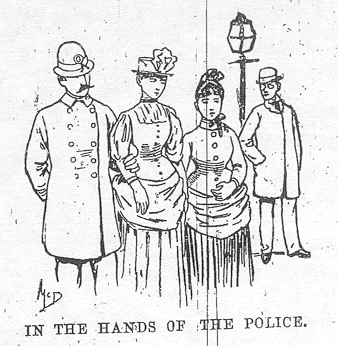
Nellie Bly could have won an Academy Award for her impersonation of a lunatic. On the morning of Saturday, September 24, 1887, within twenty-four hours of checking into the Temporary Home for Females at No. 84 Second Avenue, the police were called to escort “Nellie Brown” to the Essex police station. The assistant matron of the boardinghouse told the police that “Nellie Brown” had so terrified her female boarders with her crazy rantings that they feared being murdered in her beds. Bly claimed that all the women in the house were crazy. She had forgotten who she was, she said, and lost her trunks. She acted confused, vague, but not dangerous.
nellie-bly-in-the-hands-of-the-police1

The police took Bly before Judge Duffy who ordered her sent to Bellevue Hospital for examination, where Dr. William C. Braisted, head of the insane pavilion there, said Bly was “undoubtedly insane.” (1) There she passed two freezing cold nights, remembering that “all night long we were kept awake by the talk of the nurses and their heavy walking through the uncarpeted halls.” Nellie, being Nellie, complained to the nurses and the doctors about the lack of heat in the institution and the poor conditions. She was told that she could expect no kindness in the place as it was a charitable institution!

The stay at Bellevue was temporary though. The next day – Monday – a boat was expected. It would take Nellie Bly away permanently to Blackwell’s Island Lunatic Asylum for Women.

Just think. The speed of the thing was dizzying. On Thursday Nellie Bly had been sitting in the offices of the New York World contemplating the assignment of posing as an insane woman to gain admittance into an institution. It seemed an impossible hurdle – to be declared insane and committed for life to an insane asylum. Yet it was a mere three days later and Nellie Bly – a completely normal person – was being committed for life to an insane asylum – on the notorious Blackwell’s Island. How many other unfortunates had also suffered this fate?

(1) Kroeger, Brooke. Nelly Bly. (New York: Random House, 1994)

Next: Nellie being Nellie

Read Full Post »

Nellie Bly accepted the assignment. The task was frightening – to get herself committed to an asylum, to live among the lunatics for a week or so, then to write an expose on the conditions there – and she was nervous. But not about her skills as a writer. Her knack for including the telling detail made her articles compelling reading. No, she was nervous because she did not think she could pull off convincing the doctors that she was insane.

Bly had never known a crazy person. Just how did a crazy person look, she wondered.

nellie-practices-insanity4“So I flew to the mirror and examined my face,” she wrote later. “I remembered all I had read of the doings of crazy people, how first of all they have staring eyes, and so I opened mine as wide as possible and stared unblinkingly at my own reflection.” She began to sweat nervously, which unfortunately took the curl out of her Victorian bangs. Over and over again, she practiced her crazy face in the mirror. She ended up staying up all night, rehearsing her new role, thinking about her new mission, and reading scores of ghost stories to put her in a lunatic frame of mind.
When morning came, she bathed, bid her soap and toothbrush a fond farewell, and put on nondescript clothing. Then she went out into the street in search of a boarding house where she could begin her charade as the little lost and nutty Nellie Brown from Cuba.

Next: Inside the Madhouse

Read Full Post »

Mary Todd Lincoln, ca. 1861

When Mary and Abraham Lincoln moved into the White House in 1861, Mary was 42 years old, a time when women her age dressed in somber grays, dull browns, and boring blues. But not Mary Todd Lincoln. For her, expensive clothes were a mark of importance, of breeding. She proceeded to dress like a peacock, draping herself in bold blues, crimson, yellow, and royal purple, attracting a lot of unwanted attention and sparking criticism from the Washington social elite. Brought up among the overdressed ladies of Kentucky, her gowns and bonnets were ornamented with flowers, lace, dots, and bows sewn on yards of velvet, taffeta, and silk at a time of war when soldiers were going without blankets. Mary took her fashion cues from Eugenie, Empress of France, whose parties and clothes appeared in line drawings and detailed descriptions in one of Mary’s favorite magazines, Godey’s Lady’s Book. She was admonished for wearing low-necked dresses that revealed her “milking apparatus,” said one critic, and for the “flower beds which she carries on top of her head,” said another. A petite woman, the bell-shaped dresses overwhelmed her; hoops made her look shorter and squat.

Buoyed by a grandiose sense of self-importance coupled with her new position as the president’s wife, Mary demanded what she wanted. She expected everyone to do her bidding. She was surprised when clothing merchants sent her bills. The line between purchase and donation was fuzzy. Mary looked for donors to buy her gowns and hats, rewarding them with political favors. When she blew her four-year budget for White House renovations in under a year, she contrived several plots to secretly defray her debt. In one instance, she persuaded the White House gardener to sell manure from the stables at ten cents a wagonload. It raised more stink than cash. Her spending eventually came to light and became a national scandal. Lincoln was mortified and had to deal with it, all the while referring to it benignly as his beloved Mary’s silly “flub-a-dub.”

Willian's of Pennsylvania Avenue, Washington's best known milliner at the time, made Mary Todd Lincoln's bonnets. Unfortunately, he also made bonnets for Mrs. Horatio Taft.

Now, back to what we were saying about Mary and her clothing:

It was an April evening in 1861. The Marine Band was playing a concert on the White House lawn. Mary and President Lincoln had invited many guests, among them Mary Cook Taft, wife of Horatio Taft, an examiner at the U.S. Patent Office. Mary Taft was wearing a delicate straw bonnet lavishly trimmed with pretty purple ribbons embroidered with little black figures. The bonnet had long strings which tied beneath her chin in a bow. Mary Taft’s teenage daughter, Julia, accompanied her to the promenade grounds that day and vividly recalled their costumes:

“My mother, of course, wore the bonnet, together with a purple and white silk over a moderate crinoline, and lavender kid gloves. I was dressed in white Swiss, much beruffled, but without hoop skirt or crinoline, which was an abiding grievance with me. But my hat…was very gratifying and almost compensated for the lack of crinoline.”

Women’s Fashions 1860

Mary and Julia walked around mingling with the other guests while the band played on. The national anthem brought those in chairs to their feet, men doffing their hats, and all standing in patriotic attention. At the close of the concert, the Taft women walked over to the south front where the presidential party was sitting, to pay their respects. Mary Lincoln could not take her eyes off Mary Taft’s bonnet. Julia recalled what happened next:

Julia Taft, undated photo

“After a few words of greeting, [Mrs. Lincoln] took my mother aside and talked with her for a moment. While I could not hear their conversation, I knew someway that they were talking about my mother’s bonnet and I was a bit puzzled at the look of amazement on my mother’s face. I did not see why my mother should look so surprised at a passing compliment from Mrs. Lincoln.”

Mary Lincoln wanted the purple strings off Mary Taft’s bonnet and asked for them. Mary Taft was angry—she loved her bonnet with its pretty purple ribbon— but what could she do? Mary Taft’s husband was a government appointee. Mrs. Lincoln could get him fired and then how would they pay for Julia’s private Washington school? So, begrudgingly, Mrs. Taft agreed to give up her ribbons to “Madam President” as Mary Lincoln requested to be called by the White House staff. 

The Washington milliner Willian sent for Mary Taft’s bonnet, removing the purple ribbons for Mary Lincoln, and sending back Mary Taft’s bonnet with new lavender ribbon. Not long after this incident, Julia, who was often in the White House as a babysitter for her little brothers, Bud and Holly, the inseparable playmates of Tad and Willie Lincoln, caught sight of Mary Lincoln wearing a purple dress and a bonnet trimmed with her mother’s purple ribbons. 

Mary Lincoln is shown with two of her four sons. Willie is to our left and Tad is to our right. Tad’s name is Thomas. He was so wiggly that he was nicknamed Tadpole. One of the Lincoln’s sons, Eddie, died when they had lived in Springfield. The eldest Lincoln boy, Robert, was studying at Harvard in 1860, the year this photo was taken.

Source: Bayne, Julia Taft. Tad Lincoln’s Father. Boston, Little, Brown, and Co., 1931.

Readers: For more on Mary Lincoln, click here.

Read Full Post »

A biopic of the life of Amy Winehouse, Back to Black, will be released in the U.S. by Focus Features on May 15. Marisa Abela stars as the troubled British singer-songwriter. Since Winehouse’s death in 2011, many projects on her life and music had been in the works but none had gotten off the ground until now.

The film is a sympathetic portrayal of the life of the struggling artist, who, during her lifetime, the tabloids loved to bash. The film begins with her birth into a Jewish family, her parents’ divorce, the discovery of her amazing and unique talent, rise in the music industry, troubled marriage, ongoing battle with addiction and bulimia with the resulting dysfunction, trauma, and her inevitable decline, which led to her tragic death at 27.

Readers: Read more about Amy Winehouse on this blog by clicking here.

Read Full Post »

Katharine Hepburn from the Bryn Mawr College Yearbook 1928.

Katharine Hepburn from the Bryn Mawr College Yearbook 1928.

Alice Palache first met Hollywood actress Katharine Hepburn in 1924 when they were classmates at Bryn Mawr, an all-women’s liberal arts college near Philadelphia, Pennsylvania. The friends were a study in contrasts. “Palache,” as she was called, was popular, a great student, athletic, active in student council, and from a conventional home in which her dad, a Harvard professor and staunch Episcopalian, considered it sacrilegious for her to play with friends on Sunday. “Kath,” on the other hand, was a loner, one of the worst students in the class, and did whatever she pleased. She dressed as a boy, smoked scented cigarettes in her tower dorm room, and jumped into the cloister fountain – naked – to wake herself up after cramming all night for an exam.

This gallant good-time girl, her blazing red hair dragged back into a charwoman’s bun, wore baggy, unflattering cast-off clothes rumored to be held together with safety pins.”

Katharine Hepburn, age 21, performing in the dramatic production of "The Woman in the Moon," Bryn Mawr College, 1928

Katharine Hepburn, age 21, performing in the dramatic production of “The Woman in the Moon,” Bryn Mawr College, 1928

In their junior year, Kath invited Palache to visit her family home in Hartford, Connecticut. In between games of tennis, Kath and Palache spent time with Kath’s parents, Dr. Thomas Norval Hepburn and Mrs. Katharine (“Kate”) Houghton Hepburn. Both of Kath’s parents were highly-educated – Dad was a surgeon, Mom had 2 degrees from Bryn Mawr and was a prominent suffragette – and were militant public crusaders on the burning social issues of the day.

Dr. Thomas Hepburn and Katharine Houghton Hepburn, parents of Katharine Hepburn. Undated photo

Dr. Thomas Hepburn and Katharine Houghton Hepburn, parents of Katharine Hepburn. Undated photo

Katharine Hepburn's mother, Katharine Houghton Hepburn, was a prominent suffragette from Connecticut.

Katharine Hepburn’s mother, Katharine Houghton Hepburn, was a prominent suffragette from Connecticut. She is shown as “Mrs. Thomas N. Hepburn” in the photo at top center. Photo ca. 1925.

Dr. Hepburn’s dressing room was the center of the family home. Kath and Palache joined Dr. and Mrs. Hepburn there for  heated discussions. The family debated topics alien to Palache’s childhood home such as prostitution, venereal disease, and birth control. At times, Dr. Hepburn would be soaking in the tub during such discussions or, perhaps, shaving at the sink. The girls sat on a Queen Anne sofa in his dressing room as Dr. Hepburn would nonchalantly stride back and forth across the cork flooring wearing absolutely nothing.  Almost as shocking as the casual nudity – a naked man in his forties parading in front of his teenage daughter and her girlfriend – was Mrs. Hepburn’s attitude. When she would enter the room, she would hug and kiss her very naked husband, while declaring to the young women,

I find him beautiful,” while adding that the doctor “had no seat.”

Katharine Hepburn came from anything but a conventional home.

Katharine Hepburn, Bryn Mawr Class of 1928, is seen third from right in the dramatic production,"The Truth About Blayds," by A. A. Milne. At an all-girls college, Ms. Hepburn had the opportunity to play male as well as female roles.

Katharine Hepburn, Bryn Mawr Class of 1928, is seen third from right in the dramatic production,”The Truth About Blayds,” by A. A. Milne. At an all-girls college, Ms. Hepburn had the opportunity to play male as well as female roles.

Source: Leaming, Barbara. Katharine Hepburn. New York: Crown Publishers, Inc. 1995.

Source: Bryn Mawr College Archives Online

Read Full Post »

Edith Head in an undated photo

Edith Head in a Paramount Pictures shot. Undated

It was summer vacation of 1924 and Edith Head, 27, wanted a new job. She was tired of making peanuts – $1500 a year – teaching French and art at the Hollywood School for Girls. She did have a husband but he was a heavy drinker. If Edith wanted to improve her quality of life, it was up to her to make it happen. However, there were few jobs open to women in the 1920s but secretarial work and teaching, and neither paid much.

One day, Edith spotted a classified ad in the Los Angeles Times. The Famous Players-Lasky Studio (later, Paramount Pictures) was looking for a sketch artist to create costumes for a new Cecil B. DeMille silent film, “The Golden Bed.” Edith wanted that job. One problem: Edith Head was no artist. She could not draw the human form.

She had exaggerated her qualifications to teach art when applying at the Hollywood School for Girls. True, she was highly educated, and was more than qualified to teach French – but not art. She had received a B.A. in Letters and Sciences with Honors in French at University of California at Berkeley (1919) and a Master’s Degree in Romance Languages at Stanford (1920) – pretty impressive for a girl who grew up in mining camps in the deserts of Mexico and Nevada. But she had no training in art. Once she had been hired at the girls’ school, she had swiftly enrolled in evening art classes at the Chouinard Art School to gain some artistic skill, learning just enough each night to keep one step ahead of the next day’s lesson for her students. So far, though, she could only draw seascapes.

Undaunted, Edith wrote the studio for an interview. She received a prompt reply, telling her to be at the studio the very next morning at 10 a.m., bringing sketches. Sketches? All she had to show of her own were seascapes.

Agnes Ayres stars in Cecil B. DeMille's 1921 film, "Forbidden Fruit." In silent films, costume was an extremely important element. DeMille's films were always lavish extravaganzas.

Agnes Ayres stars in Cecil B. DeMille’s 1921 film, “Forbidden Fruit” at Famous Players-Studio (later Paramount Pictures). In silent films, costume was an extremely important element. DeMille’s films were always lavish extravaganzas.

Edith did not know what to do but she knew that she wanted that job! Soon a light bulb went on in her brain:

That night I made the rounds at Chouinard (Art School) and collected all the students’ best landscapes, seascapes, oils, watercolors, sketches, life, art, everything.”

Some accounts say that Edith actually erased her friends’ names from their sketches and substituted her own. That next day, she appeared at the studio for her interview, a portfolio of other people’s work in hand. Howard Greer, head of the studio wardrobe department, described the interview in his memoirs:

…A young girl with a face like a pussy cat crossed with a Fujita drawing appeared with a carpetbag full of sketches. There were architectural drawings, plans for interior decoration, magazine illustrations, and fashion design. Struck dumb with admiration for anyone possessed of such diverse talent, I hired the gal on the spot.” (1)

Her salary was $40 a week, more than double what she made teaching.

The very next day, Edith reported for work. She sat at her drafting table, her canvas, blank. The jig was up. She couldn’t draw. Greer recalled:

[She] looked out from under her bangs with the expression of a frightened terrier.” (1)

Edith Head

Edith Head

Edith confessed that she had misrepresented her talent, taking credit for others’ work. Inexplicably, Greer did not fire Edith. Curiously, he took her under his wing and taught her how to sketch. Within six months, she sketched in his style and was quite accomplished. Later, when asked about misrepresenting her talent at the interview, she tossed off the fraud as “youthful and naïve indiscretion” and something she would never do again. (Two more lies!)

Whereas Edith dismissed the padding of her resume as an isolated incident, never to be repeated, designing colleague Natalie Visart did not see it that way. She commented:

Edith lied when the truth would have served her better.” (2)

Edith was to have few friends in life, among them, President Richard Nixon and wife Pat and actress Elizabeth Taylor. Biographer David Chierichetti said that

Her lies made her feel in control….Her lying – even more than her blazing ambition – was what turned people against her.”

Reportedly, director John Farrow would not let Edith work on his 1953 film, “Botany Bay,” as he had caught her in too many lies in the past.

But I digress.

Meanwhile, back to the summer of 1924, Edith was working at the bottom of the totem pole in the wardrobe design department.

My first big assignment was to do the Candy Ball costumes for Cecil B. de Mille’s film, “The Golden Bed.” I drew girls dressed as lollypops, peppermint sticks and chocolate drops….

Then came the crisis. I’d drawn very elongated girls with bodies like peppermint sticks and candy cane fingernails two feet long. Came the day of the shooting and, shortly after, came a blast from Mr. DeMille….The peppermint sticks had started cracking during the dance routine….whenever the dancers got within a half a foot of each other, the candy would stick.”

Also, under the hot lights on the set, the chocolate drops melted, and the production had to be halted. Edith went back to the drawing board and designed dresses studded with marshmallows for the peculiar film.

The "Candy Ball" scene from Cecil B. DeMille's 1924 film, "The Golden Bed." Men surround women wearing marshmallow dresses, pull off the sweets, and eat them.

The “Candy Ball” scene from Cecil B. DeMille’s 1924 film, “The Golden Bed.” Men surround women wearing marshmallow dresses, pull off the sweets, and eat them.

In another of Edith’s costume faux pas, Director Raoul Walsh had to stop production on “The Wanderer” (1925) when one of the show’s elephants began eating its costume – wreaths of flowers and grapes and anklets of rose petals.

As Greer had suspected, Edith did have a natural talent for costume design and, before long, it showed up. She began to score more hits than misses. She became a savvy politician. Although the studio maintained that the actresses were not allowed any say in what they wore in the films, Edith got around that rule. She began to talk with the stars, asking each actress what she liked to wear, what she thought she looked good wearing. Edith became known as “The Dress Doctor,” as she approached the design of each actress’s costumes with their tastes and figures in mind, how they moved, talked, and were photographed.

Costume designer Edith Head and film star Gloria Swanson. Undated photo

Costume designer Edith Head and film star Gloria Swanson. Undated photo

In this way, she developed a large and loyal following of actresses such as Barbara Stanwyck, Elizabeth Taylor, and Grace Kelly even though there were stars like Mary Martin, Hedy Lamarr, and Claudette Colbert who didn’t like to work with her.

Edith boasted that she was a magician. She took ordinary women, and, through fashion magic, transformed them into screen sirens.

Accentuate the positive and camouflage the rest,” Edith liked to say.

Edith designed costumes for almost a thousand movies including westerns, biblical epics, war movies, and dramas. Her style was not flashy but flattered the star and advanced the story line. Here are some of Edith Head’s costume designs:

mae west she done him wrong

Mae West in “She Done Him Wrong,” 1933. Costumes by Edith Head.

Dorothy Lamour wearing a new version of a sarong in "Jungle Princess," 1936. Costumes by Edith Head.

Dorothy Lamour wearing a new version of a sarong in “Jungle Princess,” 1936. Costumes by Edith Head.


Barbara Stanwyck and Henry Fonda in "The Lady Eve," 1941. Costumes by Edith Head.

Barbara Stanwyck and Henry Fonda in “The Lady Eve,” 1941. Costumes by Edith Head.

Veronica Lake in "I Married a Witch," 1942. Costumes by Edith Head.

Veronica Lake in “I Married a Witch,” 1942. Costumes by Edith Head.

Hedy Lamarr in "Samson and Delilah," 1949. Costumes by Edith Head.

Hedy Lamarr in “Samson and Delilah,” 1949. Costumes by Edith Head.


Gloria Swanson in "Sunset Boulevard," 1950. Costumes by Edith Head.

Gloria Swanson in “Sunset Boulevard,” 1950. Costumes by Edith Head.

Elizabeth Taylor in "A Place in the Sun," 1951. Costumes by Edith Head.

Elizabeth Taylor in “A Place in the Sun,” 1951. Costumes by Edith Head.

Audrey Hepburn in "Roman Holiday," 1954. Costumes by Edith Head.

Audrey Hepburn in “Roman Holiday,” 1954. Costumes by Edith Head.

Edith Head sketch for Grace Kelly suit in "Rear Window," 1954

Edith Head sketch for Grace Kelly suit in “Rear Window,” 1954

Grace Kelly in "Rear Window," 1954, wearing green suit shown in above sketch. Costumes by Edith Head.

Grace Kelly in “Rear Window,” 1954, wearing green suit shown in above sketch. Costumes by Edith Head.

Shown here with costar Jimmy Stewart, Grace Kelly wears the green suit shown in the sketch above, sans jacket. "Rear Window," 1954.  Costumes by Edith Head.

Shown here with costar Jimmy Stewart, Grace Kelly wears the green suit shown in the sketch above, sans jacket. “Rear Window,” 1954. Costumes by Edith Head.

Sketch for evening gown by Edith Head for Grace Kelly in "Rear Window," 1954.

Sketch for evening gown by Edith Head for Grace Kelly in “Rear Window,” 1954.

From sketch above, Grace Kelly wears an evening gown from "Rear Window," 1954. Costumes by Edith Head.

From sketch above, Grace Kelly wears an evening gown from “Rear Window,” 1954. Costumes by Edith Head.

Grace Kelly models sunsuit from "To Catch a Thief," 1955. Costume by Edith Head.

Grace Kelly models sunsuit from “To Catch a Thief,” 1955. Costume by Edith Head.

Grace Kelly in "To Catch a Thief," 1955. Costumes by Edith Head.

Grace Kelly in “To Catch a Thief,” 1955. Costumes by Edith Head.

Grace Kelly in "To Catch a Thief," 1955. Costumes by Edith Head.

Grace Kelly in “To Catch a Thief,” 1955. Costumes by Edith Head.

Edith Head sketch for gold masquerade gown for Grace Kelly in "To Catch a Thief," 1955.

Edith Head sketch for gold masquerade gown for Grace Kelly in “To Catch a Thief,” 1955.

As in sketch above, Grace Kelly wears masquerade gown in "To Catch a Thief," 1955. Costumes by Edith Head.

As in sketch above, Grace Kelly wears masquerade gown in “To Catch a Thief,” 1955. Costumes by Edith Head.

Anne Baxter in Cecil B. DeMille's 1956 remake of "The Ten Commandments." Costumes by Edith Head.

Anne Baxter in Cecil B. DeMille’s 1956 remake of “The Ten Commandments.” Costumes by Edith Head.

Edith Head was awarded eight Oscars and was nominated 35 times for best costume design.

Legendary costume designer Edith Head (1897-1981) displays her 8 Oscar trophies. Originally, she wore blue tinted glasses because it allowed her to view fabrics as they would look in a black-and-white movie. Smoky lenses also made her inscrutable as well as disguising a slightly-crossed right eye. Undated photo

Legendary costume designer Edith Head (1897-1981) displays her 8 Oscar trophies. Originally, she wore blue tinted glasses because it allowed her to view fabrics as they would look in a black-and-white movie. Smoky lenses also made her inscrutable as well as disguising a slightly-crossed right eye. Undated photo

Her brilliant career, that began with a con, was marred by controversy. Often economical with the truth, she sometimes claimed credit for designs that were not her own. She accepted the Oscar for “Sabrina”(1955) although two gowns and one suit wore by Audrey Hepburn – the Parisian look that dominates the movie – were truly designed by then rising French designer Hubert de Givenchy.

Audrey Hepburn wears three dresses from the movie, "Sabrina," 1954. Edith Head designed the "Cinderella" clothes that Audrey's character wears before she travels to Paris. Upon her return, she wears a wardrobe designed by Hubert de Givenchy. Edith Head accepted the Academy Award for Best Costume Design and took credit for De Givenchy's work.

Audrey Hepburn wears three dresses from the movie, “Sabrina,” 1954. Edith Head designed the “Cinderella” clothes that Audrey’s character wears before she travels to Paris. Upon her return, she wears a wardrobe designed by Hubert de Givenchy. Edith Head accepted the Academy Award for Best Costume Design and took credit for De Givenchy’s work.

Edith said the Oscar belonged to her because the costumes had been made in her department. In her acceptance speech, she did not thank de Givenchy. Worse still, when the little black dress became enormously popular, copied by the thousands by clothing manufacturers, Edith made sketches of it for books and appearances and signed them with her name. (3) Only after Edith’s death did Givenchy, a true gentleman, confirm that the black cocktail dress with the bateau neckline and ballerina skirt was his original design, and had been made under Edith’s supervision at Paramount.The Sting movie poster

In 1974, Edith Head was awarded her eighth and final Oscar for her work in “The Sting,” starring Robert Redford and Paul Newman. In her trademark bangs, bun, and tinted owl glasses, Edith flitted happily onto the stage, trilling:

“Just imagine dressing the two handsomest men in the world, and then getting this!” she said, holding out her award.

Robert Redford and Paul Newman play ping pong. Undated photo.

Robert Redford and Paul Newman play ping pong. Undated photo.

She was promptly sued by a costume illustrator who said the work on “The Sting” was hers, not Edith’s. Famous designer Bob Mackie, Cher‘s favorite, who had also worked in the Paramount costume department, said of Edith:

She got more press out of The Sting than anything she ever did and she didn’t even do it.” (4)

(1) Greer, Howard. Designing Male: A Nebraska Farm Boy’s Adventures in Hollywood and with the International Set. G.P. Putnam’s Sons, 1951.

(2) Chierichetti, David. Edith Head: The Life and Times of Hollywood’s Celebrated Costume Designer. New York: HarperCollins Publishers, 2003.

(3) Head, Edith. The Dress Doctor. Boston: Little, Brown, 1959.

(4) Jorgensen, Jay. Edith Head: The Fifty Year Career of Hollywood’s Greatest Costume Designer. New York: Lifetime Media, 2010.

Readers, for more on Edith Head and her costume design, click here.

Read Full Post »

Older Posts »