Feeds:
Posts
Comments

Posts Tagged ‘A Christmas Carol’

Charles Dickens (aged 30). This portrait of Charles Dickens was painted by the American artist Francis Alexander (1800-1880) early in 1842, shortly after Dickens arrived in Boston at the start of his first visit to North America.

After returning from his 1842 visit to America, Charles Dickens (1812-1870) read a disturbing government report on child labor in the United Kingdom titled the Report of the Children’s Employment Commission. He read testimonies of little girls working as seamstresses, six hours a day, six days a week, and rooming above the factory floor. Girls told of dragging coal carts through tight underground passages over eleven-hour days.

A child laborer known as a “hurrier” is shown harnessed to a coal corve. Hurriers were required to drag an empty coal cart down from the shaft bottom along passageways between 24 to 30 inches high and return with a full load from the coal face. One child would be harnessed to the front of the corve, while another would follow behind, pushing the load with their hands and their heads. Most hurriers would have large septic calluses on their legs, hands and knees and many were bald as a result of pushing corves up steep inclines with their heads. Their bodies were often ‘old’ and broken before they reached adulthood.

Factory bosses used children to climb into the insides of industrial machinery to clear a jam, sometimes with fatal consequences. These were not isolated incidents but common. Families were poor and hungry and they took what work they could find, even if it meant sending a child as young as five to work.

Dickens at the Blacking Warehouse, From a drawing by Fred Bernard. Reproduced in “The Dickens Country” by kind permission of Messrs. Chapman and Hall

It is believed that, at the age of twelve,  Charles Dickens had been forced to drop out of school, sell his books, and go to work at the dirty, rat-infested Warren’s Blacking Warehouse, a shoe polish factory, near Charing Cross leading from the Strand to the Thames, where Charles typed up and labeled countless pots of shoe-blacking. Dickens’ father was locked up in a debtors’ prison, taking with him his wife and youngest children, and young Charles was expected to support his family at this grinding toil.  The pay was meager, only a few shillings a week. Young Dickens worked ten-hour days and saw his family only on Sundays. This he endured for three years, a most painful episode in his young life.

Influenced by his youth and a recent visit to the Field Lane Ragged School for street children, Dickens decided to shine a light on uneven workforce wages by writing a novella. The story came to him over six weeks as he took his nighttime strolls through London, walking fifteen or twenty miles a night, sometimes weeping, sometimes laughing. The result was a masterpiece called A Christmas Carol, published on December 19, 1843, a morality tale pointing out the benefits of compassion and the terrible cost of miserliness. In one scene, men and women, bosses and workers, young and old, dance and drink merrily, feast, and celebrate the joys of Christmas together. The book was a runaway bestseller.
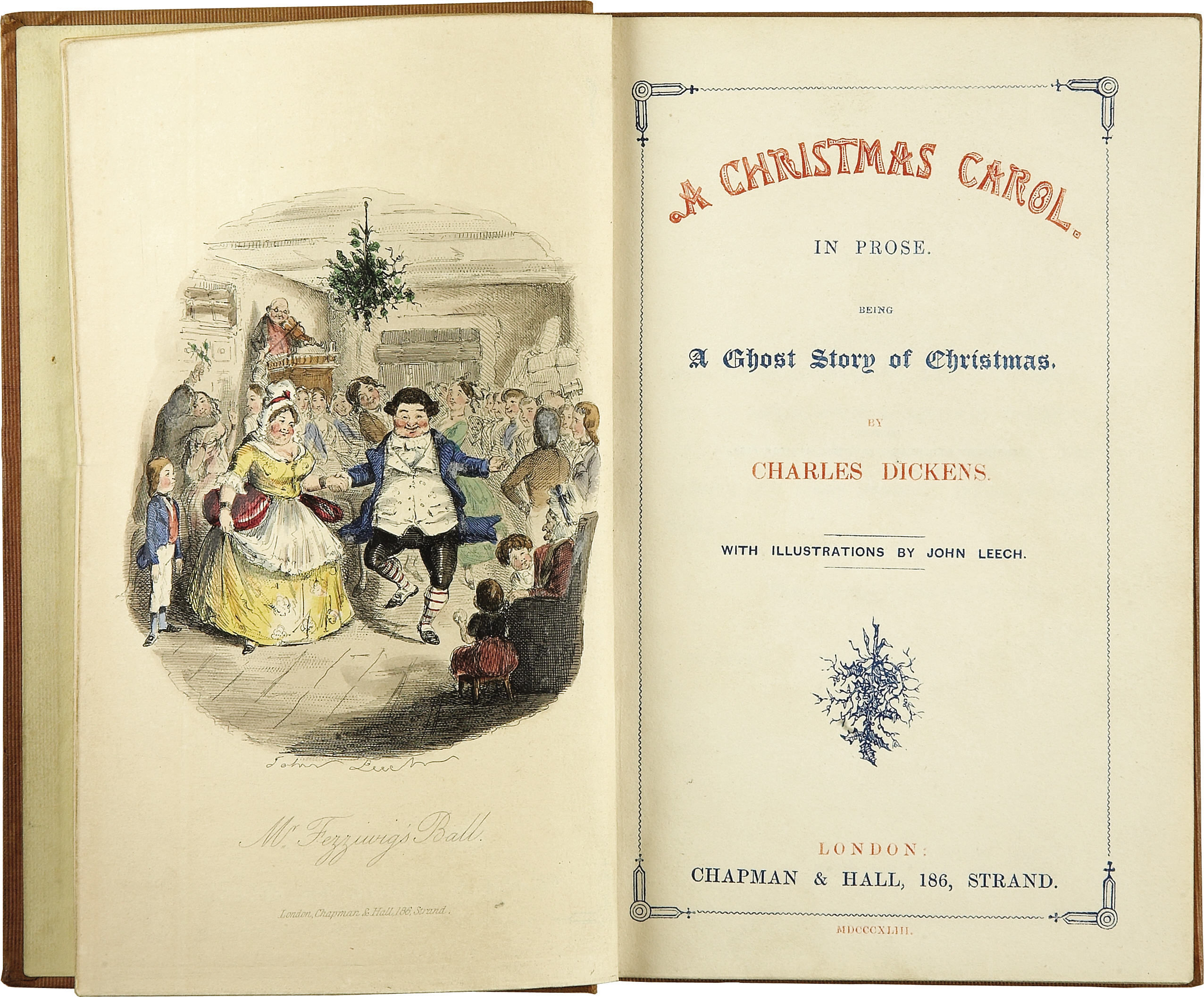
 

John Leech, Public domain, via Wikimedia Commons

Readers: For more on Charles Dickens, click here.

Read Full Post »

Old Fezziwig's Christmas Eve Ball from "A Christmas Carol" by Charles Dickens (1843)

The Morgan Library and Museum in Manhattan owns the entire handwritten manuscript of A Christmas Carol by Charles Dickens. The 66-page manuscript written in 1843 bears all of Dickens’ edits in his own hand. “He worked on it with loving care, doing much more rewriting than usual.” (1) The original story is written in light blue ink. Edits are in thick, black ink.

One edit is visible on page 12, where Scrooge encounters Marley’s ghost, and chalks up the vision to indigestion. Dickens originally wrote “a spot of mustard” then changed it to read: a “blot of mustard.”

The manuscript is exhibited each holiday season but, alas, only one page is put on view each year, under glass. This year, however, the Morgan has allowed the New York Times to photograph and display the entire handwritten treasure online at

http://www.nytimes.com/interactive/2009/11/30/nyregion/dickens-christmas-carol-pages.html

The Morgan challenges readers to go online and study the manuscript and submit what they think is the most interesting edit in the work. The contestant judged to have submitted the most intriguing edit will be invited as the newspaper’s guest to afternoon tea at the Morgan.

What motivated Charles Dickens to write his classic holiday ghost story?

“At the time A Christmas Carol was written, Dickens feared for his future. He had six children to feed, a large house in London to maintain, and a lavish lifestyle. Christmas was approaching.

Yet Martin Chuzzlewit, the work he was then producing, a few chapters at a time, was not selling as well as earlier installments of The Pickwick Papers or Nicholas Nickleby. Bitterly, he confided to a friend that his bank account was bare….

Conjuring up what Dickens himself described as a “ghost of an idea,”…he got to work. The 6,000 copies printed in time for Christmas sold out. But because he had splurged on hand-colored drawings by John Leech, one of England’s leading illustrators, the project was a financial bust.

Fortunately for Dickens, his quickie book went on to become a classic.” (2)

(1) Stanley, Diane and Vennema, Peter. Charles Dickens: The Man Who Had Great Expectations. New York: Morrow Junior Books, 1993.

(2) “Dickens the Editor To Dickens the Writer: Make it Sell.” The New York Times. A29. December 2, 2009.

Readers: Check out these other related posts:

“Dickens: Marley’s Ghost” 

“Grip the Raven” about Dickens’ pet raven

“Nellie Bly: Charles Dickens’ Visit to Blackwell Island Asylum 1842”

Read Full Post »

The ghost of Jacob Marley visits Ebenezer Scrooge in Charles Dickens' A Christmas Carol (1843); Illustration by Arthur Rackham (1915)

‘Mercy! [Scrooge] said. ‘Dreadful apparition, why do you trouble me?’

“Man of the worldly mind!’ replied the Ghost, ‘do you believe in me or not?’

‘I do,’ said Scrooge; ‘I must. But why do spirits walk the earth, and why do they come to me?’

‘It is required of every man,’ the Ghost returned, ‘that the spirit within him should walk abroad among his fellow-men, and travel far and wide; and, if that spirit goes not forth in life, it is condemned to do so after death. It is doomed to wander through the world – oh, woe is me! – and witness what it cannot share, but might have shared on earth, and turned to happiness!’

Marley's Ghost by John Leech (1843) from A Christmas Carol by Charles Dickens (1943)

Again the spectre raised a cry, and shook its chain and wrung its shadowy hands.

‘You are fettered,’ said Scrooge, trembling. ‘Tell me why?’

‘I wear the chain I forged in life,’ replied the Ghost. ‘I made it link by link, and yard by yard; I girded it on of my own free will, and of my own free will I wore it. Is its pattern strange to you?’

Scrooge trembled more and more.

‘Or would you know,’ pursued the Ghost, ‘the weight and length of the strong coil you bear yourself? It was full as heavy and as long as this seven Christmas Eves ago. You have labored on it since. It is a ponderous chain!'”

Read Full Post »