Feeds:
Posts
Comments

Posts Tagged ‘history’

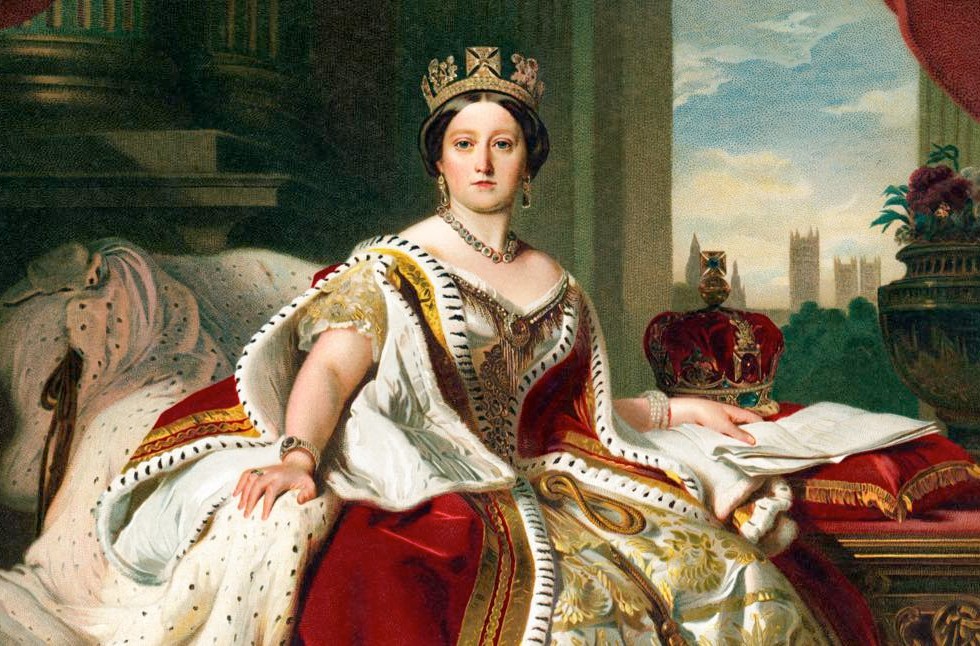
Mary Todd Lincoln, ca. 1861

When Mary and Abraham Lincoln moved into the White House in 1861, Mary was 42 years old, a time when women her age dressed in somber grays, dull browns, and boring blues. But not Mary Todd Lincoln. For her, expensive clothes were a mark of importance, of breeding. She proceeded to dress like a peacock, draping herself in bold blues, crimson, yellow, and royal purple, attracting a lot of unwanted attention and sparking criticism from the Washington social elite. Brought up among the overdressed ladies of Kentucky, her gowns and bonnets were ornamented with flowers, lace, dots, and bows sewn on yards of velvet, taffeta, and silk at a time of war when soldiers were going without blankets. Mary took her fashion cues from Eugenie, Empress of France, whose parties and clothes appeared in line drawings and detailed descriptions in one of Mary’s favorite magazines, Godey’s Lady’s Book. She was admonished for wearing low-necked dresses that revealed her “milking apparatus,” said one critic, and for the “flower beds which she carries on top of her head,” said another. A petite woman, the bell-shaped dresses overwhelmed her; hoops made her look shorter and squat.

Buoyed by a grandiose sense of self-importance coupled with her new position as the president’s wife, Mary demanded what she wanted. She expected everyone to do her bidding. She was surprised when clothing merchants sent her bills. The line between purchase and donation was fuzzy. Mary looked for donors to buy her gowns and hats, rewarding them with political favors. When she blew her four-year budget for White House renovations in under a year, she contrived several plots to secretly defray her debt. In one instance, she persuaded the White House gardener to sell manure from the stables at ten cents a wagonload. It raised more stink than cash. Her spending eventually came to light and became a national scandal. Lincoln was mortified and had to deal with it, all the while referring to it benignly as his beloved Mary’s silly “flub-a-dub.”
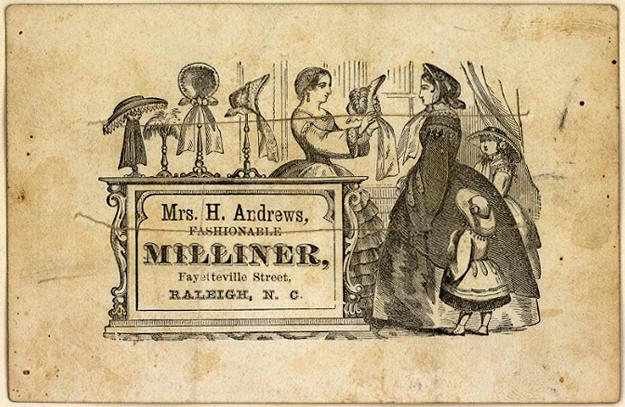
Willian's of Pennsylvania Avenue, Washington's best known milliner at the time, made Mary Todd Lincoln's bonnets. Unfortunately, he also made bonnets for Mrs. Horatio Taft.

Now, back to what we were saying about Mary and her clothing:

It was an April evening in 1861. The Marine Band was playing a concert on the White House lawn. Mary and President Lincoln had invited many guests, among them Mary Cook Taft, wife of Horatio Taft, an examiner at the U.S. Patent Office. Mary Taft was wearing a delicate straw bonnet lavishly trimmed with pretty purple ribbons embroidered with little black figures. The bonnet had long strings which tied beneath her chin in a bow. Mary Taft’s teenage daughter, Julia, accompanied her to the promenade grounds that day and vividly recalled their costumes:

“My mother, of course, wore the bonnet, together with a purple and white silk over a moderate crinoline, and lavender kid gloves. I was dressed in white Swiss, much beruffled, but without hoop skirt or crinoline, which was an abiding grievance with me. But my hat…was very gratifying and almost compensated for the lack of crinoline.”

Women’s Fashions 1860

Mary and Julia walked around mingling with the other guests while the band played on. The national anthem brought those in chairs to their feet, men doffing their hats, and all standing in patriotic attention. At the close of the concert, the Taft women walked over to the south front where the presidential party was sitting, to pay their respects. Mary Lincoln could not take her eyes off Mary Taft’s bonnet. Julia recalled what happened next:
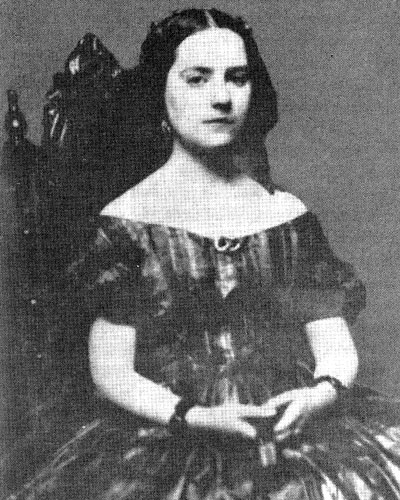
Julia Taft, undated photo

“After a few words of greeting, [Mrs. Lincoln] took my mother aside and talked with her for a moment. While I could not hear their conversation, I knew someway that they were talking about my mother’s bonnet and I was a bit puzzled at the look of amazement on my mother’s face. I did not see why my mother should look so surprised at a passing compliment from Mrs. Lincoln.”

Mary Lincoln wanted the purple strings off Mary Taft’s bonnet and asked for them. Mary Taft was angry—she loved her bonnet with its pretty purple ribbon— but what could she do? Mary Taft’s husband was a government appointee. Mrs. Lincoln could get him fired and then how would they pay for Julia’s private Washington school? So, begrudgingly, Mrs. Taft agreed to give up her ribbons to “Madam President” as Mary Lincoln requested to be called by the White House staff. 

The Washington milliner Willian sent for Mary Taft’s bonnet, removing the purple ribbons for Mary Lincoln, and sending back Mary Taft’s bonnet with new lavender ribbon. Not long after this incident, Julia, who was often in the White House as a babysitter for her little brothers, Bud and Holly, the inseparable playmates of Tad and Willie Lincoln, caught sight of Mary Lincoln wearing a purple dress and a bonnet trimmed with her mother’s purple ribbons. 

Mary Lincoln is shown with two of her four sons. Willie is to our left and Tad is to our right. Tad’s name is Thomas. He was so wiggly that he was nicknamed Tadpole. One of the Lincoln’s sons, Eddie, died when they had lived in Springfield. The eldest Lincoln boy, Robert, was studying at Harvard in 1860, the year this photo was taken.

Source: Bayne, Julia Taft. Tad Lincoln’s Father. Boston, Little, Brown, and Co., 1931.

Readers: For more on Mary Lincoln, click here.

Read Full Post »

Robert Francis Kennedy, photo, 1964

Robert Francis Kennedy (1925-1968)

After winning the 1960 presidential election, John F. Kennedy appointed his younger brother, Robert, as U.S. attorney general. “Bobby” was just thirty-five, and, although a graduate of Virginia Law School, had little legal experience. Although the appointment was a bold act of nepotism, it aroused little controversy, and only one senator voted against confirmation. JFK was so confident in this decision, that he joked at the annual Alfalfa Club Dinner, the night after the inauguration:

I just wanted to give [Bobby] some legal experience before he practices.

John F. Kennedy and Jacqueline Kennedy arrive at an inaugural ball, January 20, 1961

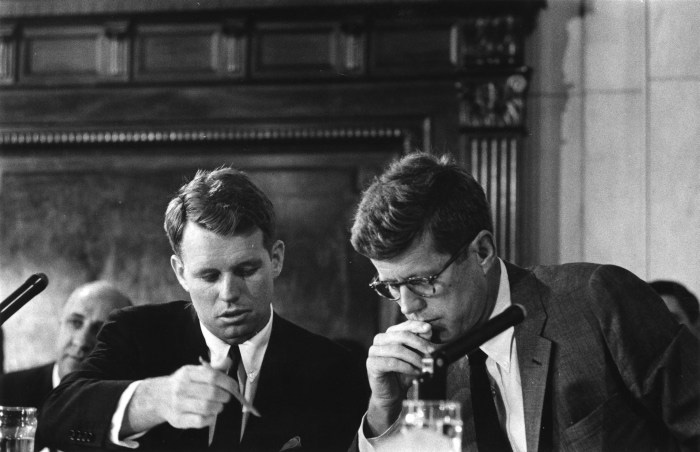
Bobby Kennedy was not an unknown in Washington politics. He had made a name for himself in 1957-1959 while serving as chief counsel to the U.S. Senate’s Select Committee on Improper Activities in Labor and Management, familiarly known as the “Senate Rackets Committee.” His brother, John, then a Massachusetts senator, sat on that committee. Bobby’s intelligence convinced him that Teamsters Union president Jimmy Hoffa had worked with the Mafia, extorted money from employers, and raided pension funds. During the hearings, both Kennedy men squared off with Hoffa and his mobster connections. In 1860, Bobby Kennedy published The Enemy Within, exposing the corruption within the Teamsters.

Robert F. Kennedy and John F. Kennedy during the Senate hearings circa May 1957. Photograph by Howard Jones for Look Magazine in the John F. Kennedy Presidential Library and Museum, Boston.

Although RFK’s tenure in the Kennedy administration would be associated with civil rights gains—the month prior to the 1860 presidential election, Bobby had negotiated to secure the release of the Rev. Dr. Martin Luther King, Jr., from an Atlanta jail—he was most identified with his relentless crusade against organized crime. Among his many achievements in this dangerous arena, he worked to secure the Federal Wire act, which specifically targeted the use of telephone, Internet, cable tv, and fiber optic communications with the aim to disrupt the Mafia’s gambling operations. Convictions against organized crime figures rose by 800 percent during his term. Kennedy worked to shift FBI Director J. Edgar Hoover’s focus away from communism to organized crime.

President John F. Kennedy and singer Frank Sinatra at the 1961 Inaugural Gala

Frank Sinatra

Singer and film star Frank Sinatra (1915-1998) grew up poor and lower class in Hoboken, New Jersey. Once he made it big in showbiz (thanks to help from his Mafia cronies), he obsessed about fitting in with the upper class. He wormed his way into politics, using his Hollywood star power to campaign and fundraise for Democratic heavyweights such as Franklin Roosevelt and John F. Kennedy. In attaching himself to men of honor, Sinatra hoped to achieve the respectability he craved.

Sinatra had cultivated a relationship with President Kennedy through movie star Peter Lawford, who was married to the president’s sister, Pat.

Host Frank Sinatra (L) wears an eyepatch, laughing with actor Peter Lawford and his wife Patricia Kennedy (1924 – 2006) during a surprise 21st birthday party held for actor Natalie Wood at Romanoff’s, Hollywood, California, July 20, 1959. (Photo by Murray Garrett/Getty Images)

In March 1962, President Kennedy was scheduled to fly to Southern California. Peter Lawford asked Sinatra to be the president’s host at his Palm Springs estate. Sinatra was thrilled. He went straight to work. At his own expense, Sinatra installed a helicopter pad, cottages for the Secret Service, and even a flagpole for the presidential flag.

But the president’s brother Bobby Kennedy wasn’t having it. When he heard about his brother Jack’s proposed stay at Sinatra’s, he went ballistic. Bobby was making the “most single-minded attack on organized crime in American history” and could not abide Jack associating with someone with mob connections. Peter Lawford was chosen to tell Sinatra that the president would not be staying with him.

Sinatra did not take the news well. He had a notoriously explosive temper:

“Sinatra vented his spleen by destroying the concrete landing pad with a sledgehammer. He applied a different kind of sledgehammer to his friendship with Peter and Pat [Lawford], banning them from his company….Jack ended up staying at the home of Bing Crosby. Marilyn Monroe flew down to be with the president, spending the night in his bedroom….”

Peter Lawford, Frank Sinatra, and Marilyn Monroe ca. 1961-62

Bedell Smith, Sally. Grace and Power: The Private World of the Kennedy White House. New York: Random House, 2004.

Leamer, Laurence. The Kennedy Women: The Saga of an American Family. New York: Fawcett Books, 1994.

Readers: For more on Frank Sinatra on this blog, click here.

Read Full Post »

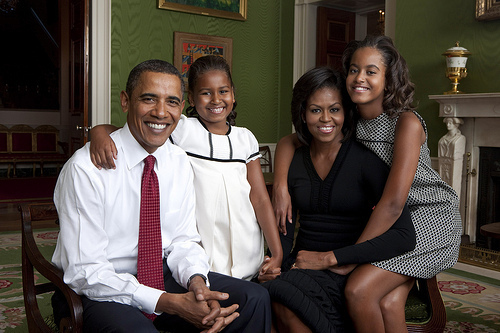
The Obama Family, the first official White House portrait shot by photographer Annie Leibovitz, Sept. 1, 2009

The Obama Family, the first official White House portrait shot by photographer Annie Leibovitz, Sept. 1, 2009

The White House has released the first official – and wonderful! – family portrait of President Barack Obama and his family. The photograph, taken by famed celebrity photographer Annie Leibovitz, was shot in the Green Room of the White House on September 1, 2009. It shows a happy First Family, from left to right, the President, his younger daughter Natasha (Sasha), wife Michelle, and older daughter Malia Ann.

The Lovely Michelle Obama

The Lovely Michelle Obama

For those of you who can’t get enough of Michelle Obama’s fashion sense, visit the blog “Mrs. O.”

Read Full Post »

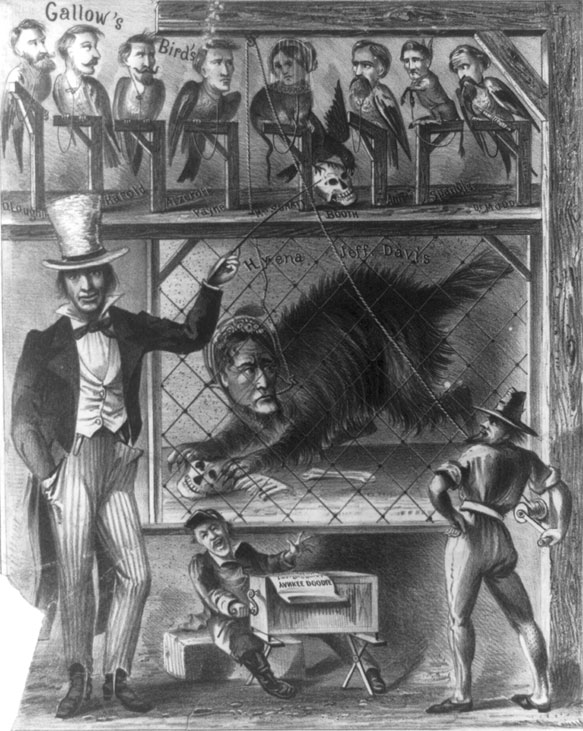
Uncle Sam's Menagerie

Uncle Sam's Menagerie

Issued in the wake of Lincoln’s assassination in April 1865, the political cartoon, “Uncle Sam’s Menagerie,” conveys the Northern hostility toward the conspirators, whom the public associated with former president of the Confederacy Jefferson Davis. Uncle Sam stands before a cage in which a hyena with the bonneted head of Jefferson Davis (1808-1889), president of the Confederacy, claws at a skull. Davis’ neck is in a noose, which will begin to tighten as a man at right turns the crank of a gallows. The bonnet on Davis’  head alludes to the embarrassing circumstances of his recent capture. As the Civil War drew to a close, Davis fled Richmond with his cabinet in early April 1865 and began a trek southward with federal troops in hot pursuit. While still weighing the merits of forming a government in exile,  Davis was captured by Union soldiers near Irwinville, Georgia, in early May 1865. Whether by accident or design, Davis was wearing his wife’s dark gray short-sleeved cloak and black shawl when captured.  

Below the caricature of Davis as a cross-dressing hyena, a man grinds out the song “Yankee Doodle” on a hand organ. Above, the Lincoln conspirators are portrayed as “Gallow’s Bird’s,” with their heads in nooses. From left to right they are: Michael O’Laughlin, David Herold, George Atzerodt, Lewis Paine, Mary Elizabeth Surratt, Samuel Arnold, Edman Spangler, and Dr. Samuel Mudd. At left, Uncle Sam points his stick at a skull “Booth,” on which sits a black crow. John Wilkes Booth was killed during a government raid on his hideout on April 26, 1865.

Read Full Post »

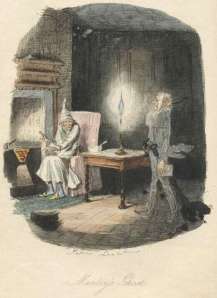
Jacob Marley's Ghost from A Christmas Carol by Dickens

Jacob Marley's Ghost from A Christmas Carol by Dickens

Now I get to tell my ghost story. It happened in July of 1999. I remember the date exactly because my daughter Katie’s birthday is July 27. She, my husband, Tom, and I were taking a summer road trip up through El Paso to Santa Fe. Katie had her eleventh birthday while we were away and she wasn’t happy to be so far from home. She had wanted a birthday party back in Austin with her friends.

On our way up to Santa Fe, I had booked us a night at a famous and historic mountain inn in a little town in south central New Mexico, Cloudcroft. My uncle Max was once a forest ranger there. Nine thousand feet above sea level in the Sacramento Mountains and surrounded by 200,00 acres of the Lincoln National Forest, the Lodge also boasts a nine-hole golf course, a four-star restaurant, and a ghost named Rebecca – but I didn’t know the last part until the day of our arrival.

Established over a hundred years ago, The  Lodge is very impressive – elegant, yet cozy. Inside and out, it looked just as you would expect a mountain inn to look. The lobby featured a stuffed and angry brown bear reared up on his back legs, a fireplace with a bright and shiny copper roof, and the head of a buck mounted on the wall. The decor was both Victorian and Southwestern with heavy dark wood furniture, thick pile carpet, and leather couches.

Guests are warmly welcomed. The reception area had a huge basket of red apples. I wanted one. I was carrying some green Granny Smith apples already in what Tom and Katie called my Mary Poppins bag. If you’ve seen the movie, “Mary Poppins,” you know what I’m describing. It’s a bottomless carpet bag. Anyway, the Granny Smith apples in my bag were for Tom but I don’t really like them. They’re too tart. I like red ones better and so does Katie. So I reached into the hospitality basket and helped myself to three or four red apples. I tucked them into my Mary Poppins bag. I tucked them down deep into the bottom below the magazines and books so they wouldn’t spill out and zipped the bag shut.

The Lodge at Cloudcroft, NM

The Lodge at Cloudcroft, NM

We were shown to our guest room which faced the front. It was tucked into a dormer which meant the inner walls – covered with a Victorian printed wallpaper – were sloping. Tom and I were to share a four-poster queen bed while Katie had a window seat sleeping arrangement. We parked our bags – I heaved the Mary Poppins bag up onto a tall antique chest of drawers – and then we all went outside to explore.

The grounds were magnificent. We wandered onto the golf course. There were apple trees with little red and green crabapples weighing down their branches. I was from South Texas and had never seen apples growing on trees before although I was forty-four years old that summer! We walked around in the cool, crisp mountain air. It soon grew dark and our legs were tired from so much climbing, so we went inside for dinner.

In the dining room aptly named “Rebecca'” after the “ghost,” I had my first Spring Mix salad with raspberry vinaigrette. Back in Texas, we were still eating iceberg lettuce with Thousand Islands Dressing. The food and service were first class.

"Rebecca"
“Rebecca”

The hotel was really capitalizing on the ghost of Rebecca theme. A painting of Rebecca hung in the restaurant. I asked the waiter if the rumors of a ghost were true. He said he had never seen the ghost himself but the chef had had some really weird supernatural encounters. He went and got the chef for me. The chef said that, on more than one occasion, knives had flown through the air of his kitchen right toward him. He was convinced the ghost was responsible. I chuckled and went back to my food.

After dinner, the others went upstairs to the room but I wandered into the gift shop. I browsed among the books where I found The Ghostly Register, by Arthur Myers. Chapter 43: “The Ghost Who Makes Phone Calls,” was devoted to the legend of Rebecca. The ghost they call Rebecca – no one has researched this – is believed to be the spirit of a chambermaid who was killed by her lumberjack lover when he found her in the arms of another in the early 1900s. Those who claim to have seen her wandering the halls of the Lodge describe her as a beautiful redhead who wears a long, flowing gown. Guests and employees have reported many unexplained happenings at the Lodge that they attribute to Rebecca – ashtrays that slide across tabletops unassisted, phones that ring yet no one is on the line, footsteps, and knockings on doors. She was often seen near Suite 101, the Governor’s Room. I bought the book and left.

I decided to conduct my own investigation of the ghost. This “ghost of maid killed by jealous lover” legend is attached to many hotels and I was sceptical that Rebecca was more than that.  I wandered into the hallway of Suite 101. I hung around a while but everything seemed perfectly normal – no ectoplasm there – so I went upstairs to join the others. I found both Katie and Tom piled up their individual beds with books. I decided to get ready for bed and then join them.

After I’d changed into my nightgown, taken off my make-up, and washed my face, I was ready to climb up in bed alongside Tom with a good book. It was then that I remembered the juicy red apples in my Mary Poppins bag. I wanted one. I walked over to the chest of drawers.

Tom and Katie weren’t paying me any attention. They were still deeply absorbed in their reading. I grabbed my Mary Poppins bag and pulled it toward me. It was heavy. I got up on my tiptoes to peek inside the bag and tilted it toward me some so I’d see well enough to select a sweet red apple rather than one of Tom’s sour green ones. I found a nice red one, then rooted around inside some more until I’d found my book. I then pushed everything back down again in the bag and shoved it back in place on the dresser. I didn’t zip the bag shut this time, though; I left the mouth of it open.

I then turned and set my book on the bed, before padding off to the bathroom to wash my apple before eating it. I was surprised when I heard a couple of thuds behind me. Something had fallen on the floor. I  turned to see two red apples rolling along the carpet behind me like bowling balls aimed right for my feet. I looked over at Tom first and then Katie but neither of them had moved a muscle. Nevertheless, it could have been a trick. I put my hands on my hips and asked, “Hey, who did that?”

“Who did what?” they both wanted to know.

“Threw those apples at me?” I pointed to the carpet where the two red apples now lay at rest.

“What are you talking about?” Katie asked. I told them what had happened, that I thought someone had thrown the apples at me.

They laughed. “Maybe you just left your bag open and they fell out,” volunteered Tom, wanting to get back to his reading.

I knew that wasn’t true. Those apples had definitely been hurled at me by someone or something, but I didn’t speak of the incident again that night. I didn’t want to scare Katie. Tom and Katie just resumed their reading and I joined them. When we turned out the lights, my heart beat hard in my chest, but I still didn’t reveal how frightening it was to be in the dark in that room in that hotel.  But the next day, when we were checking out to head to Santa Fe, I took the lead and cancelled our reservations for the return trip. I wasn’t about to sleep another night under that roof.  That place was definitely haunted. I didn’t know how that chef could show up to work each day knowing that each day might be his last, that he’d spend it dodging knives – or apples.

Read Full Post »

I was thinking it was time for a good ghost story. I was tossing around some ideas in my head when I recalled something I’d seen on TV as a child. Of course we didn’t have any Discovery Channel back then, but the program was definitely a documentary type. It featured haunted houses and the people who lived in them. I remember the narrator talked with a family who lived in a house in which a rocking chair rocked with no one sitting in it. That felt a little hokey so I wasn’t spooked. It was when the narrator interviewed a person I recognized that I scooted to the edge of my seat.

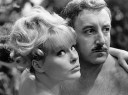
Sommer and Sellers in "A Shot in the Dark" (1964)

Sommer and Sellers in "A Shot in the Dark" (1964)

It was the beautiful, blonde, and sexy Hollywood actress Elke Sommer (b.1940). She was familiar to me because she had played the voluptuous maid Maria opposite Peter Sellers in the second Pink Panther movie, “A Shot in the Dark” (1964), which ReadersDigest.com names as one of the top funniest 50 films of all times. If you haven’t seen it, you should. Bumbling Inspector Clouseau (Sellers) trails after Maria whom he suspects of committing multiple murders, one of which is in a nudist camp.There’s a hilarious scene of Maria and Clouseau fleeing through Paris naked.a-shot-in-the-dark-movie-poster

Anyway, Elke and her husband Hollywood columnist and Bogart’s best friend Joe Hyams (1923-2009) lived in Benedict Canyon in North Beverly Hills. They claimed that a ghost was living in their house. My husband Tom also remembers seeing the same show when he was young.  “They (Elke and Joe) had a ghost in their dining room,” he recalled. “The chairs would move around at night. They would put marks on the floor below the chairs before they went to bed, then, the next morning, they’d look, and the chairs wouldn’t be standing on the marks anymore. The chairs would be all over the place.”

In the middle of the night, Elke and Joe would wake up to what sounded like a dinner party going on downstairs in the dining room, hearing voices, chairs scooting, glasses tinkling, and silverware clanging. Yet they would go downstairs and no one would be there. Elke said, “Things would move all the time and it would be very noisy and (it was) the usual poltergeist nonsense, you know.” (1) The ghost was described as being a middle-aged man wearing a white shirt. (2)

After battling the spirits with no relief, they called in some help, contacting the Parapsychological Institute at UCLA. When Life photographer Allan Grant arrived at the house to take some pictures, he was a sceptic – but not so when he left. He said:

Something happened that spooked me. On one roll of film that I shot in a particular room where they first spotted the ghost there were about four or five frames of film that were progressively fogged down to the end of the frame, giving it a ghostlike appearance, especially (of) Joe Hyams, who was in the shot. When that was processed and I took a look at it, I thought, there’s no way that would happen…in the center of a roll…something else had happened that I couldn’t explain and I’ve spent years as a photographer and that had never happened to me before….Something did happen in that house. (1)

The haunting continued. A mysterious fire erupted one night. Fortunately, Joe and Elke were able to get out through a window. Shortly thereafter, they moved out of the house permanently. (1) Joe Hyams wrote a book about it called The Day I Gave Up the Ghost. Evidently, though, the ghost didn’t give up. The “severely haunted house” at 2633 Benedict Canyon “was bought and sold more than seventeen times since Sommers vacated it, and many have reported ghostly phenomena.” (3)
 

(1) youtube interview: “Actress Elke Sommer with a Poltergeist.”
 http://www.youtube.com/watch?v=NRLasAUl-eI
(2) California Paranormal Travel Guide.
http://www.haunted-places.com/californ.htm
(3) Ghosts of Hollywood: Celebrities Who Have Seen Ghosts. http://paranormal.about.com/cs/trueghoststories/a/aa022304_3.htm

Read Full Post »

Dina Vierny in January 1944 with the sculptor Aristide Maillol.

Dina Vierny in January 1944 with the sculptor Aristide Maillol.

I came across this fascinating obituary by William Grimes in yesterday’s New York Times:
“Dina Vierny, the model whose ample flesh and soft curves inspired the sculptor Aristide Maillol, rejuvenating his career, and who eventually founded a museum dedicated to his work, died on Jan. 20 in Paris. She was 89.

Her death was announced by the Fondation Dina Vierny-Musée Maillol, which she founded in 1995.

In the same period when she was modeling, Ms. Vierny, who had joined the Resistance early on during World War II, led refugees from Nazism across the Pyrenees into Spain as part of an American organization operating out of Marseille.

Ms. Vierny was a 15-year-old lycée student in Paris when she met Maillol, in the mid-1930s. The architect Jean-Claude Dondel, a friend of her father’s, decided that she would make the perfect model for the artist, who was 73 and in the professional doldrums.

“Mademoiselle, it is said that you look like a Maillol and a Renoir,” Maillol wrote to her. “I’d be satisfied with a Renoir.”

For the next 10 years, until his death in a car accident in 1944, Ms. Vierny was Maillol’s muse, posing for monumental works of sculpture that belied her modest height of 5 feet 2 inches. By mutual agreement, the relationship was strictly artistic.

Maillol threw himself into his sculpture with renewed energy and, at Ms. Vierny’s urging, began painting again. After his death, she worked tirelessly to promote his art and enhance his reputation, eventually creating the Maillol Museum and donating 18 sculptures to the French government on the condition that they be placed in the Jardin des Tuileries. She later added two more.

Ms. Vierny was born in Kishinev, in what is now Moldova, in 1919 and was taken by her parents to France when she was a child. Her father, who played the piano at movie houses, made a modest living while opening his home to an entertaining collection of artists and writers.

Ms. Vierny, who was intent on studying physics and chemistry, took to the role of artist’s muse reluctantly at first, posing during school vacations and glancing sideways at her schoolbooks on a nearby stand. The generous modeling fees and Maillol’s sense of fun won her over.

For the first two years, though, she kept her clothes on, not out of modesty — she and her friends belonged to a nudist club — but because of Maillol’s timidity. She herself later proposed that he try some nude studies. “Since he never asked, I figured he would never have the courage,” she told National Public Radio last year.

The Mountain,” one of Maillol’s depictions of Ms. Vierny

The Mountain,” one of Maillol’s depictions of Ms. Vierny

Her Rubenesque figure and jet-black hair indeed made her, as Dondel had predicted, “a living Maillol,” memorialized in works like “The Seated Bather,” “The Mountain,” “Air,” “The River,” and “Harmony,” his last, unfinished sculpture. Maillol also turned to her as a subject for drawings and painted portraits, like “Dina With a Scarf,” now in the Maillol Museum.

In 1939, Maillol took refuge at his home in Banyuls-sur-Mer, at the foot of the eastern Pyrenees. There, Ms. Vierny, who had already begun working for a Resistance group in Paris, was approached by the Harvard-educated classicist Varian Fry, whose organization in Marseille helped smuggle refugees from occupied France into Spain. Unbeknownst to Maillol, she began working as a guide, identifiable to her fleeing charges by her red dress. The work was doubly dangerous because she was Jewish.

Ms. Vierny soon began dozing off at her posing sessions. The story came out, and Maillol, a native of the region, showed her secret shortcuts, smugglers’ routes and goat paths to use. After several months of working for the Comité Fry, Ms. Vierny was arrested by the French police, who seized her correspondence with her friends in the Surrealist movement but failed to notice stacks of forged passports in her room.

A lawyer hired by Maillol won her acquittal at trial, and to keep her out of harm’s way the artist sent her to pose for Matisse in Nice. “I am sending you the subject of my work,” Maillol told Matisse, “whom you will reduce to a line.”

Matisse did several drawings and proposed an ambitious painting that he called a “Matisse Olympia,” after the famous painting by Manet. When Maillol heard that the project would take at least six months, he hastily recalled her to Banyuls.

She also posed for Dufy and for Bonnard, who used her as the model for “Somber Nude.”

In 1943, Ms. Vierny was again arrested, this time by the Gestapo, in Paris. She was released after six months in prison when Maillol appealed to Arno Breker, Hitler’s favorite sculptor.

After the war, Ms. Vierny opened an art gallery in Paris, where she exhibited Maillol’s work, as well as that of others. After traveling to the Soviet Union in the 1960s, she began collecting and showing work by dissident artists like Ilya Kabakov and Erik Bulatov.

A passionate and unpredictable collector, Ms. Vierny accumulated no fewer than 90 antique carriages, including the omnibus that Toulouse-Lautrec used to pick up his friends and the carriage used by Chateaubriand when he was ambassador to Italy.

In the early 1970s, Ms. Vierny decided to start a Maillol museum. She began buying up apartments on the Rue de Grenelle in Paris, selling off her collection of 654 dolls along the way. In 1995 she opened the Fondation Dina Vierny-Musée Maillol, whose permanent collection also includes work by Degas, Kandinsky, Picasso, Duchamp and assorted naïve artists, yet another of Ms. Vierny’s enthusiasms.

It was at the museum that Ms. Vierny lived the rest of her life. She is survived by her two sons, Olivier Lorquin, the director of the Maillol Museum, and the art historian Bertrand Lorquin, its curator. The Maillol connection continues after her death. It may even have preceded her birth.

“One day, I was climbing up an almond tree and Maillol turned to my father,” Ms. Vierny told The Independent of London in 1996. “He said to him, ‘You made her, but it was I who invented her.’ And he really did believe that he had invented me. He said that he had been drawing my features for 20 years before my birth.”

Read Full Post »