Feeds:
Posts
Comments

Archive for March, 2009

Ferdinand and Imelda Marcos with U.S. President Ronald Reagan

Ferdinand and Imelda Marcos with U.S. President Ronald Reagan

For most of you, the names Ferdinand and Imelda Marcos won’t ring any bells. But from 1965 to 1986, Ferdinand was the President and Imelda the First Lady of the Philippines. In those 21 years, Ferdinand, with Imelda’s help, managed to rack up an astonishing record of abuses common to dictators – human rights violations, assassinations, corruption, embezzlement of public funds – and held onto power through the imposition of martial law, the abolition of the constitution, and the appointment of political cronies, including Imelda, a former beauty queen, to prominent posts.

Finally, in 1986, a people’s coup toppled the Marcos regime and the Marcoses were forced to flee their palace and the country. They were given safe passage by the Reagan Administration to Hawaii. In the palace, Imelda left behind 15 mink coats, 508 gowns, 888 handbags and 1060 pairs of shoes, some say 2700 pairs. It was estimated that the Marcos family was worth $35 billion.

Three years later, still in exile in Hawaii, Ferdinand was dead at 72 of complications from lupus. Imelda wanted Ferdinand to be buried in the Philippines but his body was refused entry. So Imelda kept the body in a refrigerated mausoleum in Oahu, complete with soft music, wheeling him out over the years for a birthday party and an anniversary celebration. (1) The power company soon threatened to suspend power for the costly tomb when thousands of dollars in electric bills went unpaid but, at the last minute, a friend came forward and picked up the tab.

In 2001, twelve years after his death, the Philippine government allowed Ferdinand’s corpse to return to his homeland and Imelda with it. Imelda went to work building a tomb in the national cemetery where Filipino heroes are buried. But fierce opposition broke out and blocked the former president’s burial. Ferdinand’s remains were then temporarily housed at a mansion in Batac, Ilocos Norte Province, in an air conditioned room. Eventually the corpse was moved to their present location in the Marcos family mausoleum in the village cemetery in Batac.

Former First Lady of the Philippines Imelda Marcos kisses the crystal coffin of her deceased husband, former President Ferdinand Marcos

Former First Lady of the Philippines kisses the crystal coffin of her deceased husband, former President Ferdinand Marcos

The once-ruthless dictator is now a shrunken fellow dressed in a barong tagalog and black slacks lying in a glass viewing case inside a refrigerated crypt in a stone room with soft lights and church music. He is on perpetual view. A steady flow of visitors file past him. There his restless corpse will remain, above ground, unless Imelda gets her way and the government relents, according him a government-sponsored burial with full military honors.

A visitor to the mausoleum says that the corpse of Ferdinand Marcos, according to Filipino burial tradition, lies shoeless in the coffin. He swears that Marcos’ face and hands, however, don’t look very natural, even for a corpse. Speculation is that the real corpse is under the glass coffin, and that the figure on display is a dummy. The family claims this is not so, that the corpse looks waxy because it has to be waxed periodically for preservation.

(1) Verdery, Katherine. The Political Lives of Dead Bodies. (New York: Columbia University Press, 2000)

 

Read Full Post »

Clark Gable (1901-1960)

Clark Gable (1901-1960)

In my last two posts, I blogged about Clark Gable destroying undershirt sales when he took off his shirt in the 1934 Columbia picture “It Happened One Night” to reveal only bare skin and no undergarment. Men wanted to be like Gable and stopped buying undershirts. It would take a war, 17 more years, and another sexy actor before undergarments would become popular again. This time though, the t-shirt would jump from underwear to outerwear.

It was 1951, the actor was Marlon Brando, and the production was “A Streetcar Named Desire.” On Broadway and then on the big screen, Brando electrified audiences with his portrayal of the animalistic Stanley Kowalski who struts about in his stand-alone, outerwear t-shirt. Originally, the t-shirt was issued by the U.S. Navy (as early as 1913) as a crew-necked, short-sleeved, white cotton undershirt to be worn under a uniform. Although men did wear soft cotton tees after the war, they were worn for labor or under a dress shirt, but not to be seen in public. But Brando’s Kowalski is a brawny exhibitionist, fond of strutting about the streets in a tight, sweaty, smelly, and sticky tee that accentuates his massive torso and rippling biceps. Brando pulls the tee shirt up and over his head in one scene as he flirts with the sister-in-law, and in another scene, rips at his shirt in anguish as he cries upstairs to his wife with the unforgettable line, “Stella!” (Click to see.)

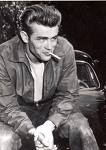
Actor James Dean (1931-1955)

Actor James Dean (1931-1955)

Offscreen, Marlon Brando took the rebel fashion statement even further, pairing his white t-shirt with boots, motorcycle, and an anti-establishment sneer. It started a t-shirt craze. Next thing we know, movie icon James Dean (“Rebel Without A Cause,” see last post) borrows the Brando t-shirt, jeans and boots look but tops it off with a jeans jacket. From that point on, the t-shirt is set loose and becomes next the symbol of restless and rebellious American youth.

Read Full Post »

Continuing from yesterday’s post, “Clark Gable: He’s Just Not That Into…Undershirts,” we are talking about name brand products being deliberately displayed in movies to influence consumer spending. Placing products in movies is big business for merchandisers, ad men, and marketers – and highly competitive, given the cluttered field.

To learn about strategic product placement in movies, I visited the website of Norm Marshall & Associates of Los Angeles/New York/Boston/Sydney/Tokyo, an entertaining marketing firm. We sense the cutthroat nature of the business when we read on Norm Marshall’s website that:

“As audiences continue to be sliced among proliferating media and properties, we continue to find ways to reach them.”  History has proven the effectiveness of product placement in movies. Norm Marshall cites these examples:

Tom Cruise in "Risky Business"

Tom Cruise in "Risky Business"

When Clark Gable got undressed for bed, he was seen not wearing an undershirt under his shirt in the 1934 movie “It Happened One Night.” The most popular undershirt in the 1930s was the sleeveless A-shirt, or tank top. Undershirt sales plummeted, thanks for Gable – for no real man would wear an undershirt if screen idol Gable didn’t.

James Dean, the movie idol of the 1950s, caused sales of Ace Combs to reach record levels when he slicked back his hair with one in “Rebel Without A Cause.”

Sales of RayBan™ sunglasses skyrocketed after handsome and sleek Tom Cruise wore them in the 1985 movie “Risky Business.”

Association with Steven Spielberg’s movie E.T. The Extraterrestrial increased the sales of peanut butter and chocolate Reeses Pieces™ by 70%.

condron.us

Read Full Post »

Warner Brothers' 2009 box office hit, PG-rated "He's Just Not That Into You"

Warner Brothers' 2009 box office hit, PG-13 rated "He's Just Not That Into You"

According to a February 25 New York Times article, The American Medical Association is planning on lodging an official complaint against Warner Brothers for its “disturbing images of specific cigarette brands” in their new movie, “He’s Just Not That Into You.” Melissa Walthers, director of the health advocacy group’s effort to reduce teenage smoking, says that there is no artistic reason to include such images.

While the movie “He’s Just Not That Into You” doesn’t show anyone smoking, there are numerous shots of the cigarette brand Natural American Spirit Lights in their recognizable bright yellow box as well as a red Marlboro carton, and the AMA is not happy. Ironically, the story line places smoking in a negative light. The main character, played by Jennifer Connelly, leaves her husband not because he cheated on her (although he did) but because he lied about quitting smoking.

Ms. Walthers says that various studies estimate that smoking in films prompts 200,000 young people to start smoking each year. Other health organizations besides the AMA have pressured The Motion Picture Association of America to “trim tobacco sequences” from their movies, but the industry cites the need for artistic license and, in 2007,  refused to consider an outright ban on cigarettes and smoking in film.

it-happened-one-nightAs for anyone out there skeptical about the power of the media to influence consumers, look back to the year 1934 and the release of the Frank Capra comedy, “It Happened One Night” with Clark Gable and Claudette Colbert, the winner of five Academy Awards, including Best Picture (Columbia). Sales of men’s undershirts declined sharply after Gable, undressing for bed in a scene, took off his shirt and appeared bare-chested and sexy. He was not wearing the traditional undershirt, a standard clothing item at the time for men. According to legend, sales of undershirts plummeted overnight. American men had made up their minds. If Clark Gable didn’t think he needed an undershirt under his shirt, then neither did they.

Click here to see the famous scene from “It Happened One Night” titled, “The Walls of Jericho.” (That’s Claudette Colbert with Gable, who, win finishing the movie, pronounced it the worst she’d ever made – then went on to win an Oscar for that very movie.

Read Full Post »

lincoln-drawingApril 14, 1865, was one of the happiest days of Abraham Lincoln’s life. It was Good Friday. General Robert E. Lee had surrendered five days earlier and the Civil War was over. The Union had been saved. Lincoln had a relaxing breakfast with his 21-year-old son Robert, whom he called “Bob,” who had just arrived for a visit. Robert Lincoln (1843-1926) had studied law at Harvard University until the closing weeks of the war when he joined the Union Army as part of General Ulysses Grant’s staff.
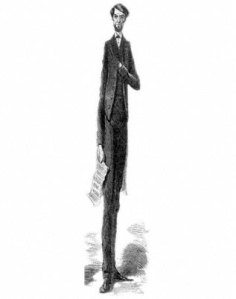
“Well, my son, you have returned safely from the front,” President Lincoln said. “The war is now closed, and we soon will live in peace with the brave men that have been fighting against us.” (1) He was eager to see the country heal and wanted no persecutions for the Confederacy, no “bloody work.” (2) Elizabeth Keckley, Mary Lincoln’s personal assistant, said that Lincoln’s face “was more cheerful than [she] had seen it for a long while.” (1)

At 11 a.m. he met with his regular cabinet and General Grant, who was concerned that not all of the Confederate forces under Johnston had surrendered to General Sherman. Lincoln told Grant not to worry, that good tidings were coming, “for he had last night the usual dream which he had preceding nearly every great and important event of the War.” He described the dream. He had seen himself on the water in some type of boat moving rapidly “towards an indefinite shore.” (1)

That afternoon, he took his usual carriage ride with Mary. Mary had never seen her husband so “cheerful,” she told a friend, “his manner was even playful. At three o’clock, in the afternoon, he drove out with me in the open carriage….I said to him, laughingly, ‘Dear Husband, you almost startle me by your great cheerfulness.'”

He replied, “And well I may feel so, Mary. I consider this day, the war, has come to a close….We must both, be more cheerful in the future – between the war and the loss of our darling Willie – we have both been very miserable.” As the carriage rolled toward the Navy Yard, Lincoln recalled happy memories of is old Springfield home and the adventures as a lawyer riding the circuit. He keenly felt the pressures of the presidency lifting and the future looking brighter.

lincoln-harpers-november-26-1864

Once back at the White House, Lincoln sat down and began reading a book, something humorous by John Phoenix. Mary kept calling him to dinner but he wouldn’t put the book down; he was totally absorbed – as always. Finally, Mary insisted he come to the table at once. They had to eat early, she reminded him, as they had plans to see Laura Keene perform in the play “Our American Cousin” at Ford’s Theatre that evening. It had been announced in the papers; they had to go. Lincoln preferred to stay home. He had no need for the escape of the theatre that day; he was already jubilant. But go he must, as he didn’t want to disappoint the people.

The morning edition of the National Republican had announced that Ulysses and Julia Grant would join the Lincolns in the president’s box for the play, but Julia didn’t want to go, saying she had her heart set on visiting their children in New Jersey. While that may have been true, it was more likely that it was an excuse to get out of an engagement with Mary Lincoln, whom she despised.

The Lincolns had a hard time finding a replacement for the Grants. Secretary of War Stanton and Secretary of the Treasury Chase also declined. Stanton had been trying for months to keep the president from exposing himself to the danger of such public places and both men thought the theatre a frivolity. It was decided that Clara Harris and her fiance, Major Henry Rathbone, would substitute for the Grants.

A little after eight o’clock, the carriage that would take Abraham and Mary to Ford’s Theatre rolled onto the front drive. Lincoln no doubt sighed. “I suppose it’s time to go,” he told Speaker Schuyler Colfax, “though I would rather stay.” He assisted Mary into the carriage and they took off.

(1) Goodwin, Doris Kearns. Team of Rivals. (New York: Simon & Schuster, 2005)
(2) Freedman, Russell. Lincoln: A Photobiography. (New York: Scholastic Inc., 1987)

Read Full Post »

Allan Pinkerton, President Lincoln, and Major John A. McClernand in an 1862 photo by Alexander Gardner following the Battle of Antietam. Pinkerton was the head of Union Intelligence Services then. It was alleged that, in 1861, his Pinkerton Detective Agency uncovered an assassination plot against the president in Baltimore on his way to the inauguration. Thanks to Pinkerton's warning, Lincoln changed his travel itinerary and the plot was foiled. On the 3-story Chicago building of the Pinkerton Detective Agency, their logo, a black-and-white eye, says "We Never Sleep." This was the origin of the slang term for detective "private eye."

Allan Pinkerton, President Lincoln, and Major John A. McClernand in an 1862 photo by Alexander Gardner following the Battle of Antietam. Pinkerton was the head of Union Intelligence Services then. It was alleged that, in 1861, his Pinkerton Detective Agency uncovered an assassination plot against the president in Baltimore on his way to the inauguration. Thanks to Pinkerton's warning, Lincoln changed his travel itinerary and the plot was foiled. On the 3-story Chicago building of the Pinkerton Detective Agency, their logo, a black-and-white eye, says "We Never Sleep." This was the origin of the slang term for detective "private eye."

Since he stepped foot into the White House, President Lincoln was dogged by rumors of assassination and kidnapping. Threatening letters arrived on an almost daily basis. Lincoln stuffed them away in a bulging envelope marked ASSASSINATION. (1)

Abe’s friends were worried. “I long ago made up my mind that if anyone wants to kill me, he will do it,” he told a newspaper reporter. “If I wore a shirt of mail, and kept myself surrounded by a bodyguard, it would be all the same. There are a thousand ways of getting at a man if it is desired that he should be killed.”

Nevertheless, soldiers camped on the lawn of the White House, the cavalry escorted him on his afternoon carriage rides, and private detectives served as bodyguards.

In early April of 1865, just before the fall of Richmond and the end of the Civil War (and less than two weeks before his assassination), Lincoln had a troubling dream he related to friends:

“About ten days ago, I retired very late. I had been up waiting for important dispatches from the front. I could not have been long in bed when I fell into a slumber, for I was weary. I soon began to dream. There seemed to be a death-like stillness about me. Then I heard subdued sobs, as if a number of people were weeping. I thought I left my bed and wandered downstairs. There the silence was broken by the same pitiful sobbing, but the mourners were invisible. I went from room to room; no living person was in sight, but the same mournful sounds of distress met me as I passed along. I saw light in all the rooms; every object was familiar to me; but where were all the people who were grieving as if their hearts would break? I was puzzled and alarmed. What could be the meaning of all this? Determined to find the cause of a state of things so mysterious and so shocking, I kept on until I arrived at the East Room, which I entered.

a catafalque is a raised platform supporting a body or coffin

a catafalque is a raised platform supporting a body or coffin

There I met with a sickening surprise. Before me was a catafalque, on which rested a corpse wrapped in funeral vestments. Around it were stationed soldiers who were acting as guards; and there was a throng of people, gazing mournfully upon the corpse, whose face was covered, others weeping pitifully.

‘Who is dead in the White House?’ I demanded of one of the soldiers.

‘The President,’ was his answer; ‘he was killed by an assassin.’

Then came a loud burst of grief from the crowd, which woke me from my dream. I slept no more that night; and although it was only a dream, I have been strangely annoyed by it ever since.”


(1) Freedman, Russell. Lincoln: A Photobiography. (New York: Scholastic Inc., 1987)

Read Full Post »

Willie Lincoln

Willie Lincoln

Abraham Lincoln was deeply interested in psychic phenomena. Following the death of his eleven-year-old son, Willie, (1850-1862) of typhoid fever, Lincoln was consumed with grief. He was persuaded by wife Mary to participate in several séances held in the White House. Mary believed that professional mediums could pierce the veil between this life and the next, thus allowing her and her husband to communicate with their dead son. Once Lincoln attended a seance in which a piano lifted up and moved around the room. It was in the opinion of the mediums who worked with President Lincoln that he was definitely “the possessor of extraordinary psychic powers.” (1)

Séances became popular during and after the Civil War as Americans longed to reconnect with their many loved ones killed in the violence of the Civil War

Séances became popular in the mid-to-late 19th Century as Americans longed to reconnect with their many loved ones killed in the Civil War.

The day after his first election to the presidency in 1860, Lincoln called his good friend journalist Noah Brooks (1830-1903) into his office. He had been startled by a vision of seeing two of his faces at once in a mirror and wanted to tell Brooks about it. Brooks made a written record of the conversation, later including it in his White House memoirs, Washington in Lincoln’s Time (1895). Adapted from Brooks’ work, these are Lincoln’s words:

Abraham Lincoln photographed by Mathew Brady, February 27, 1860

Abraham Lincoln photographed by Mathew Brady, February 27, 1860

It was just after my election in 1860, when the news had been coming in thick and fast all day and there had been a great “hurrah, boys,” so that I was well tired out, and went home to rest, throwing myself down on a lounge in my chamber. Opposite where I lay was a bureau with a swinging glass upon it (and here he got up and placed furniture to illustrate the position), and looking in that glass I saw myself reflected nearly at full length; but my face, I noticed had two separate and distinct images, the tip of the nose of one being about three inches from the tip of the other. I was a little bothered, perhaps startled, and got up and looked in the glass, but the illusion vanished. On lying down again, I saw it a second time, plainer, if possible, than before; and then I noticed that one of the faces was a little paler — say five shades — than the other.

Abraham Lincoln photographed by Alexander Gardner, February 5, 1865

Abraham Lincoln photographed by Alexander Gardner, February 5, 1865

I got up, and the thing melted away, and I went off, and in the excitement of the hour forgot all about it — nearly, but not quite, for the thing would once in a while come up, and give me a little pang as if something uncomfortable had happened. When I went home again that night I told my wife about it, and a few days afterward I made the experiment again, when (with a laugh), sure enough! the thing came back again; but I never succeeded in bringing the ghost back after that, though I once tried very industriously to show it to my wife, who was somewhat worried about it. She thought it was a “sign” that I was to be elected to a second term of office, and that the paleness of one of the faces was an omen that I should not see life through the last term. 

(1) Wallenchinsky, David and Wallace, Irving. The People’s Almanac (New York: Doubleday & Co., Inc., 1975)

Read Full Post »

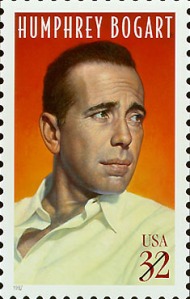
bogart-stamp
Everybody in my generation knows who Humphrey Bogart (1899-1957) is and how he gained his celebrity status – through his movies. He appeared in 75 feature motion pictures. His many roles included his portrayals of hard-boiled detective Sam Spade in “The Maltese Falcon” (1941), tough but noble nightclub owner Rick Blaine in “Casablanca” (1942), and crusty but lovable steamboat captain Charlie Allnut in “The African Queen” (1951), for which he won an Oscar.

Less well-known is that Humphrey Bogart attained celebrity status shortly after he was born, appearing as a pitchman in a national campaign to sell Mellin’s baby food. A drawing of Humphrey by his mother, successful commercial artist Maud Humphrey (1865-1940), was used in the advertisements. In sentimental Victorian tradition, Maud Humphrey portrayed her son as a little round-faced cherub with rosy cheeks, ringlet curls, and large eyes. She shamelessly dressed him in long white dresses or like Little Lord Fauntleroy in side-buttoned overalls with rolled-up cuffs and a billowing white starched shirt. He became known as the “original Maud Humphrey baby.” His friends and some professional models sat for her portraits, too. Her signature style was the chubby-cheeked, happy child.

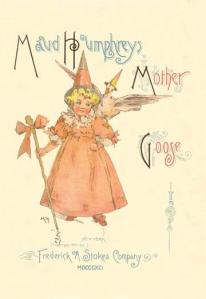
maud-humphrey-s-mother-goose-book-cover-20x30-posterFrom the 1890’s through the 1920’s, Maud Humphrey flourished as a child portrait painter, illustrating calendars, greeting cards, postcards, fashion magazines, and more than 20 story books. She was a child prodigy, having begun illustrating in children’s magazines at the age of sixteen. She studied art in Paris and also with the American painter James McNeill Whistler. Her technique was a dry watercolor similar to etching. By the turn-of-the-century, Maud Humphrey, who continued to use her maiden name after she was married to Dr. Belmont Bogart, was one of the most recognized, well-paid and popular illustrators in America. The illustrations of her stylized, beautiful, and perfect children promoted many national products including Ivory Soap, Crosman Bro’s Flower Seeds, Sunshine Stoves, Ranges, and Furnaces, Butterick Patterns, Metropolitan Life Insurance Company, and Anheuser-Busch.

art by Maud Humphrey

art by Maud Humphrey

Throughout his childhood, Humphrey was a model for his mother’s designs.” There was a period in American history,” he recalled years later, ” when you couldn’t pick up a … magazine without seeing my kisser in it.”

Maud Humphrey earned over $50,000 a year at a time when males dominated the workforce and women didn’t get the vote until 1919. Her husband’s surgical practice brought in an additional $20,000 annually for the family plus he inherited money. As a result, Humphrey grew up rich in Manhattan’s posh Upper West Side, attending private school, and summering in an elegant Victorian two-story cottage on 55 acres of land in western New York on Lake Canandaigua with a champion-class yacht moored at their private pier. Humphrey and his two little sisters were attended by nurses and nannies and servants in starched uniforms.

art by Maud Humphrey

art by Maud Humphrey

But summers at the lake were anything but idyllic for Humphrey and his sisters. “Lady Maud” as her friends called her was driven to create an estimated ten colored drawings per week. She limited herself to five hours of sleep a night. The pressing deadlines and demands of her craft exacted a heavy toll on her health and the quality of her family life. She suffered from excrutiatingly painful migraine headaches and left the care of the children to the servants, cruel ones, said the neighbors, of a low type given to a lot of yelling and frequent hitting.

The parents didn’t seem to notice. The marriage was also troubled. Both of Humphrey’s parents drank too much and argued bitterly. “We kids would  pull the covers over our ears to keep out the sound of fighting,” said Humphrey. It was commonly known that Dr. Bogart was addicted to morphine, giving himself injections and perhaps also to his headache-plagued wife, who also took pills he gave her.

Maud Humphrey’s drawings of the sweet simplicity of a child frolicking in a perfect and happy world were far removed from the life she created for her own brood – and herself. “I doubt that she read very much. I know that she never played any games,” said Humphrey. “She went to no parties, gave none. And I can’t remember that she even had any friends.” He called her “Maud,” never “Mother.” “She was essentially a woman who loved work…to the exclusion of everything else…[S]he was incapable of showing affection to us.” Humphrey’s was a childhood devoid of hugs and kisses.

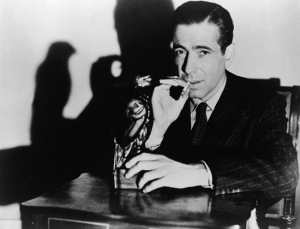
Bogart in "The Maltese Falcon"

Bogart in "The Maltese Falcon"

Burdened by his effeminate portraits on baby food ads, Humphrey was mocked by childhood schoolmates and called a sissy. Attempting to be more manly, he got into a lot of fights and once shot out the red lanterns at building sites with his new air rifle. His first movie roles were gangster ones, morphing over time from Little Lord Fauntleroy into the cigarette-puffing, tough-talking good guy we still love today.

Read Full Post »

« Newer Posts