Chapter 1
Our story begins a long way from here in China around the year 1890 in the coastal province of Zhejiang that bordered the East China Sea. Tien Fuh Wu, about age 6, was standing on a wharf with her father waiting to board a ferry to Ningbo, the large city south of the Yangtze River delta near where her grandmother lived. Tien and her father were going to pay her grandmother a short visit. Her mother was there to see them off. “Tien’s mother handed her a toothbrush and and a new washrag in a blue bag. Then she began to sob.”[i]
Her mother’s sadness baffled Tien. Tien liked visiting her grandmother who was very prosperous and wore silk and satin gown and bought delicacies for Tien’s family to eat. It was her grandmother’s idea to have Tien’s feet bound as a sign of her refinement and make her more marriageable.
Tien’s comforted her mother, saying, “Don’t cry, Mother, I’m just going to see Grandma and be right back.”[ii]But my mother knew the truth. My father had gambled away the family money and left us poor.
Tien’s father was lying. Boarding the ferry, her father locked her in their cabin and told her to eat her supper. While Tien was locked in the cabin, her father was meeting with a woman and negotiating the sale price of his daughter. Tien screamed to be let out.After the sale was accomplished, then they opened the door and let her out. With much difficulty, as her feet were bound and this crippled her, Tien walked up and down the boat looking for her father but he had left her without saying goodbye. The woman bought Tien to become a mui tsai, a child who would become a household slave. Tien’s father used the money from her sale to pay his gambling debts.
The woman (her owner) took Tien from Ningbo to Shanghai. Tien walked through a set of red gates to a home with a garden. She met another woman there who soaked off the tight cloth binding around Tien’s feet. These strips were almost never removed when Tien washed her feet. So when the strips came off, Tien’s feet smelled terrible and looked even worse. They were squashed.
The practice of foot binding had been afflicting Chinese woman for close to a thousand years. First, the young girl’s toes were broken and her feet were slowly and painfully bent into tiny, three-inch long appendages—about half the length of a pencil or the size of a small clenched fist.[iii]
The woman who took off the foot bindings told Tien to soak her feet several times a day in a bucket of water to help her feet to expand back to normal. Tien was touched by the Shanghai woman’s kindness. The woman didn’t ask Tien to work.
In 1892, yet a third woman came into the picture. She traveled with Tien on a steamer bound for San Francisco where she would become a mui tsai, a domestic slave girl. There were many Chinese immigrants in San Francisco. They came in large numbers in the 1850’s during the California Gold Rush. Some worked for low wages in the mines, and others worked hard to build the transcontinental railroad, and they didn’t make enough money to transport their wives (if they were married) to California. In 1882, most of these Chinese laborers left their families behind in China. Consequently, for every ten Chinese men in San Francisco, there was one Chinese woman[iv].California law at that time prohibited interracial marriages,which heightened the demand for prostitutes.[v] In the spring of 1882, the Chinese Exclusion Act was passed by Congress and signed by President Chester A. Arthur. This act provided an absolute 10-year ban on Chinese laborers immigrating to the United States.[vi] Chinese criminal syndicates called Tongs, which had begun as a protective association, became a profile human trafficking system in young girls and women into forced labor and prostitution.
The mui tsai system was legal in China and was quickly adopted by the wealthy Chinese merchants of San Francisco. Because of the new immigration act, when Tien arrived in San Francisco she was probably allowed to enter as a ‘paper daughter,’ meaning that she was pretending she was a relative of San Francisco merchant. She was put to work as a servant in the Peking, a brothel in Chinatown. Tien watched as the prostitutes put on their silk or satin gowns and gathered in the brothel’s main ground floor room and sit in front of a big window, facing the street, luring men into the brothel. Tien, probably between the ages of 6 and 10(she did not know her birthdate), didn’t realize what exactly was going on. If the police or white people came, the brothel keeper hid her under a bed and pushed a trunk in front of it to make sure no one saw her. It was dark under the bed.This happened often. Soon the brothel keepers, in debt, sold Tien to another woman who ran an illegal gambling establishment. Tien’s new owner spoke Cantonese but Tien spoke a Wu dialect. Therefore,Tien had difficulty following her instructions.
In her new position, Tien was made to carry “big fat baby on my back” and wash his diapers. Stooping over to wash the diapers was especially hard because the weight of the baby pulled her back. The baby cried an cried. She was powerless. Unfortunately, she turned her anger on the baby and reached behind her and pinched the baby’s bottom as hard as she could. Of course, the baby howled and his mother rushed to see what was the matter. She saw what Tien had done. She pinched Tien’s cheeks and arms then grabbed red-hot tongs and pressed the burning tool into Tien’s arm.
On January 17, 1894, what had happened to Tien reached to the Chinese Presbyterian Mission House. The supervisor was on medical leave. Annie Houseworth was serving in her place. Houseworth set out in the pouring rain accompanied by two police officers and the home’s translator for Jackson Street where the gambling business was located on the ground floor. Above was the apartment where Tien lived. The front door was barricaded. The officers were not deterred. The went into a nearby restaurant, climbed the rickety back stairs, crossed the roof and then headed back down into the premises where they unlocked and opened the front door. They searched the building then reached the apartment on the fourth floor.
When the officers saw the burn marks on Tien’s arm, they wiped back tears. In their line of work, they had seen much abuse, one officer said he’s never seen anything so cruel. Tien’s owner tried to show affection for Tien but the officers and Houseworth knew it was an act. The officers and Houseworth left without taking Tien with them because they thought she was too tiny to be the twelve-year girl they were searching for. The woman who reported Tien’s condition was upset they left without her. The group returned a second time and undressed Tien, finding black-and blue marks all over her small body, scarring on her face and signs that the owner had tortured her by dripping hot wax from a burning candle on her arms. They were convinced they had the right girl. One of the officers lifted her up into his sturdy arms and carried her though the wet streets to the Mission Home. “I was scared to death,” she said. “All the strangers and I didn’t know where I was going.[vii]”She did not not speak English.
The policeman carried Tien to 933 Sacramento Street, where she discovered fifty girls were squeezed in to the overcrowded former boarding house. They were dozen girls to a room and three girls shared a bed. Houseworth called a doctor to treat Tien’s wounds.
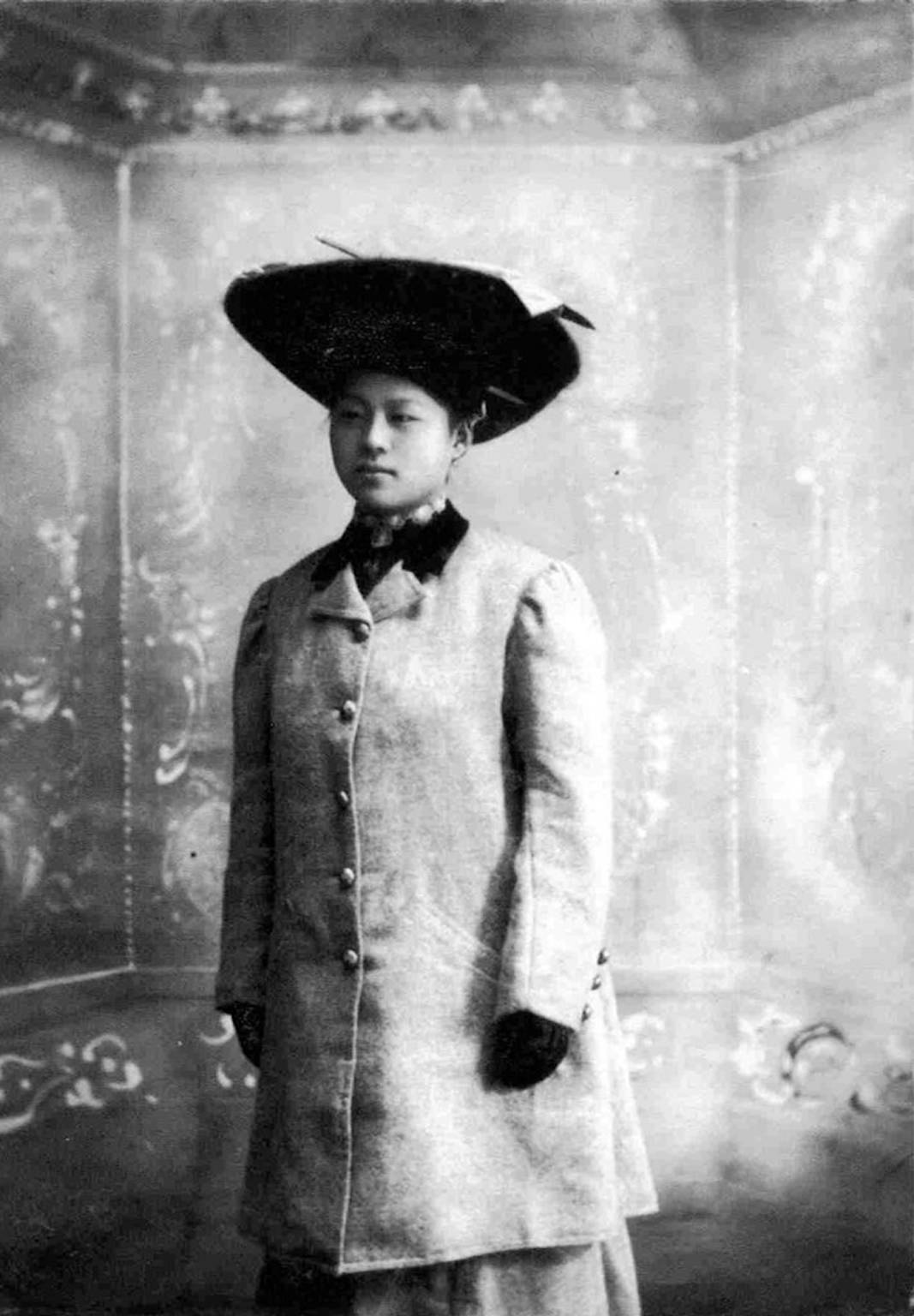
Tien Fuh Wu
In 1894, the mission home moved to more spacious quarters, right across the street at 920 Sacramento Street. Forty-five Chinese and a few Japanese girls were living at the home. It was a Presbyterian Mission and the supervisors not only wanted to rescue these girls from harm but also to convert them to Christianity. There was also a Methodist home in San Francisco. The rescues of prostitutes were causing the Presbyterian home to encounter legal battles with Chinatown’s brothel keepers. The home wanted to retain custody of the young women. The brothel keepers regarded the prostitute as their property.Donaldina Cameron became the supervisor of the Presyterian mission home in 1897 at age 27. hile most attention has been focused on Cameron, her work was made possible by Tien Fuh Wu and other aides, who also took part in dangerous rescues, translated for Cameron, and advocated fortrafficked women.It was nearly dusk on Dec. 14, 1933, when a Chinese teen named Jeung Gwai Ying fled from a hairdresser’s shop to a “safe house” in San Francisco’s Chinatown. Trafficked from China and forced into prostitution, Jeung sought freedom for herself and her unborn child. She was greeted by Tien Fuh Wu, a former slave who’d become a key staffer at the home. In Cantonese, Wu asked the teen to tell her story. Later, Wu would provide support for Jeung as she testified in court against her traffickers, who were convicted. Tien was a pioneer in the anti-human trafficking tade.
Chapter 1
[i] Siler, Julia Flynn, The White Devil’s Daughters : The Women Who Fought Slavery in San Francisco’s Chinatown, First edition. ed. (New York: Alfred A. Knopf, 2019), 83.
[ii] Yung, Judy, Unbound Feet : A Social History of Chinese Women in San Francisco, Reprint 2020 ed. (Berkeley: University of California Press, 1995), 39.
[iii] Siler, J. F., 82.
[iv] Ibid., 11.
[v] Ibid.
[vi] “The Chinese Exclusion Act,” National Archives.
[vii] Siler, J. F., 90.