Feeds:
Posts
Comments

Archive for the ‘LITERATURE, EDUCATION, & REFORM’ Category

Sojourner Truth (1797-1883), photograph by Mathew Brady c.1864

Sojourner Truth (1797-1883), photograph by Mathew Brady c.1864

Born into slavery in New York, Isabella Baumfree (Sojourner Truth’s given name) was an abolitionist and women’s rights activist. She spoke Dutch until the age of nine when she was sold to a new owner along with a flock of sheep. Eventually freed, she became a devout Christian and began to travel and preach about freedom.

Asking the Lord for a new name to reflect her new life, she claimed “Sojourner” was given to her because she was to travel the land and “Truth” because she was to declare the truth to all people.

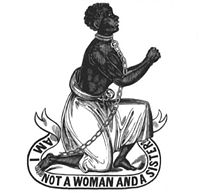
Sojourner Truth was a powerful speaker. Her most famous speech was delivered in 1851 at the Ohio Women’s Rights Convention. It is called “Ain’t I a Woman?” a slogan she adopted from a famous abolitionist image (See below.) The speech as shown here has been revised from the 19th century dialect in which she spoke.

When Sojourner got up to speak to the crowd, some men were present and they began to boo and hiss at her:

“Well, children, where there is so much racket, there must be something out of kilter. I think that ‘twixt the Negroes of the South and the women at the North, all talking about rights, the white men will be in a fix pretty soon. But what’s all this here talking about?

That man over there says that women need to be helped into carriages, and lifted over ditches, and to have the best place everywhere. Nobody ever helps me into carriages, or over mud-puddles, or gives me any best place! And ain’t I a woman? Look at me! Look at my arm! I have ploughed and planted, and gathered into barns, and no man could head me! And ain’t I a woman? I could work as much and eat as much as a man – when I could get it – and bear the lash as well! And ain’t I a woman? I have borne five children, and seen most all sold off to slavery, and when I cried out with my mother’s grief, none but Jesus heard me! And ain’t I a woman?”

Then they talk about this thing in the head; what’s this they call it? [member of audience whispers, “intellect”] That’s it, honey. What’s that got to do with women’s rights or Negroes’ rights? If my cup won’t hold but a pint, and yours holds a quart, wouldn’t you be mean not to let me have my little half measure full?

Abolition Movement poster

Abolition Movement poster

Then that little man in black there, he says women can’t have as much rights as men, ’cause Christ wasn’t a woman! Where did your Christ come from? Where did Christ come from? From God and a woman! Man had nothing to do with Him.If the first woman God ever made was strong enough to turn the world upside down all alone, these women together ought to be able to turn it back, and get it right side up again! And now they is asking to do it. The men better let them.

Obliged to you for hearing me, and now old Sojourner ain’t got nothing more to say.
Read Full Post »

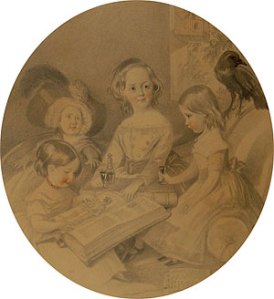
The Eldest Children of Charles Dickens with Pet Raven Grip by Daniel Maclise, 1941

The Eldest Children of Charles Dickens with Their Pet Raven "Grip" by Daniel Maclise, 1841

In yesterday’s post , I mentioned Grip the Raven, author Charles Dickens’ pet bird that was the inspiration for Edgar Allan Poe’s poem, “The Raven.” Dickens’ children loved the bird Grip although he did bite their ankles. At his children’s request, Dickens included Grip as a character in one of his books, Barnaby Rudge (1841). Dickens had three pet ravens, all named Grip. Grip I died in 1841, possibly because he ate lead chips scraped off a wall being repainted at the Dickens home. Dickens had the bird preserved and mounted in a glass case for display in his study. After Dickens’ death, a Poe collector acquired Grip I and donated him to the Free Library of Philadelphia where it remains today.

Dickens was saddened by Grip’s death. On March 12, 1841, he wrote the following letter to his friend, Daniel Maclise, who provided illustrations for his books and portraits of Dickens and his family, including the one on the left here featuring the eldest four of Dickens’ nine children: Charley, Mamie, Katey, and Walter. Dickens wrote:

 Mr. Dear Maclise,

Charles DickensYou will be greatly shocked and grieved to hear that the Raven is no more… On the clock striking twelve he appeared slightly agitated, but he soon recovered, walked twice or thrice along the coach-house, stopped to bark, staggered, exclaimed “Halloa old girl!” (his favorite expression) and died. The children seem rather glad of it. He bit their ankles but that was play…”

You might well ask why Grip the Raven is part of an Edgar Allan Poe Collection in Philadelphia. Toward the end of his life, Poe was a paid literary critic. In this role, he reviewed Dickens’ Barnaby Rudge, in which Grip the Raven plays a part. When Grip makes his first noise in the book, one of the characters says, “What was that — tapping at the door?” The answer is “‘Tis someone knocking softly at the shutter.” Poe’s criticism of Barnaby Rudge was that, although he liked the book overall, he felt that the raven’s “croaking might have been prophetically heard in the course of the drama.”

Four years later, Poe published his most famous work, the poem  “The Raven,” which gave the raven a more central role. It features a tapping and talking raven who flies into a man’s room and perches on a bust of Pallas Athena. Dickens’ raven could speak many words and had many comic turns, including the popping of a champagne cork, but Poe emphasized the bird’s darker “devil-bird”qualities. His bird spoke only one word, “Nevermore.” Poe’s raven may have represented a messenger from hell or the after-life, mirroring the gloom and foreshadowing the doom of the troubled narrator who misses his beloved Lenore.

                                                                 
  The Raven

verse 1

Once upon a midnight dreary, while I pondered, weak and weary,
Over many a quaint and curious volume of forgotten lore,
While I nodded, nearly napping, suddenly there came a tapping,
As of some one gently rapping, rapping at my chamber door.
“‘Tis some visitor,” I muttered, “tapping at my chamber door-
                Only this, and nothing more….”

verse 3

Presently my soul grew stronger; hesitating then no longer,
“Sir,” said I, “or Madam, truly your forgiveness I implore;
But the fact is I was napping, and so gently you came rapping,
And so faintly you came tapping, tapping at my chamber door,
That I scarce was sure I heard you”- here I opened wide the door;-
                Darkness there, and nothing more.

verse 4

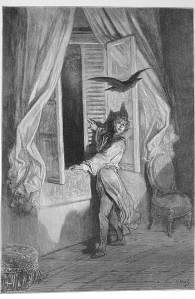
Open here I flung the shutter, when, with many a flirt and flutter,
In there stepped a stately Raven of the saintly days of yore;
Not the least obeisance made he; not a minute stopped or stayed he;
But, with mienof lord or lady, perched above my chamber door-
Perched upon a bust of Pallas just above my chamber door-
                Perched, and sat, and nothing more.

1884 Illustration from "The Raven" by Gustave Dore

1884 Illustration from "The Raven" by Gustave Dore

verse 5
Then this ebony bird beguiling my sad fancy into smiling,
By the grave and stern decorum of the countenance it wore.
“Though thy crest be shorn and shaven, thou,” I said, “art sure no craven,
Ghastly grim and ancient Raven wandering from the Nightly shore-
Tell me what thy lordly name is on the Night’s Plutonian shore!”
                Quoth the Raven, “Nevermore.”
Edgar Allan Poe
1845

Read Full Post »

2009 commemorative stamp

2009 stamp

Philadelphia wants the body of Edgar Allan Poe but Baltimore isn’t giving it up. Poe didn’t live in Baltimore long, but ever since he died and was buried there in 1849, the city has claimed him for its own. Not fair, says Edward Pettit, a Poe scholar in Philadelphia. He argues that Philadelphia was Poe’s true home, seeing that he wrote his most famous works in Philadelphia where he lived from 1838-1844, including the stories “The Murders in the Rue Morgue,” “The Masque of the Red Death,” and “The Tell-Tale Heart.”

“So, Philadelphians, let’s hop in our cars, drive down I-95 and appropriate a body from a certain Baltimore cemetery,” Mr. Pettit wrote in an article in October. “I’ll bring the shovel.”

Not so fast, said Jeff Jerome, the curator of the Poe House in Baltimore. “Philadelphia can keep its broken bell and its cheese steak, but Poe’s body isn’t going anywhere. If they want [another] body, they can have John Wilkes Booth,”  referring to Abraham Lincoln’s assassin, who is also buried in Baltimore.

Charles Dickens' pet raven, Grip, and the inspiration behind Edgar Allan's poem, "The Raven"

Charles Dickens' pet raven, Grip, and the inspiration behind Edgar Allan's poem, "The Raven"

Mr. Pettit didn’t really expect Poe’s body to be dug up and transferred to Philadelphia. He was merely starting a spirited debate to drum up interest in several Poe exhibits being held in Philadelphia this year to celebrate the bicentennial of the mystery writer’s birth. Among the many attractions was a show of artifacts that just recently closed at the Philadelphia Free Library. While Poe’s original manuscripts and first editions were hits with die-hard Poe fans, the star of the show was undeniably a stuffed bird, Grip, Charles Dickens’ pet raven and the inspiration behind Poe’s best-known work, “The Raven.”  

Poe began writing “The Raven” in Philadelphia but published it in New York where he relocated. Therefore, New York can also lay claim to Poe. Then there’s Boston where he was born. Poe, though, were he consulted on the matter, would have described himself as a Virginian, because he grew up and began his writing career in Richmond. Even South Carolina could cash in on Poe’s fame. Poe was stationed in the Army on Sullivan’s Island, South Carolina, in 1827, and set “The Gold Bug” there. He also lived in Britain.

But Paul Lewis, a professor of English at Boston College, says neither of his rival cities are deserving of Poe’s legacy. Boston was the site of Poe’s birth, stated Lewis, the only place where he was happy. Boston and only Boston was Poe’s true home. Poe was poor, alcoholic, and miserable in all those other cities, claimed Lewis. “Every single city inspired Poe because they were torturing him,” said Lewis, tongue-in-cheek.

The argument between the cities has spilled over into blogs and newspaper articles, giving Edgar Allan Poe a boost in popularity, a healthy result for all the cities claiming Poe as its favorite son.

Read Full Post »

Annabel Lee

Edgar Allan Poe (1809-1849)

Edgar Allan Poe (1809-1849)

Written the year of Edgar Allan Poe’s death, “Annabel Lee” is generally considered to be the last poem Poe wrote. We celebrated the 200th anniversary of Poe’s birth last month, as he and Abraham Lincoln were both born in 1809. Poe’s most famous works are arguably his macabre stories such as “Murders in the Rue Morgue” and his haunting poem, “The Raven.” Poe is considered to be the founder of the modern detective mystery. His love poem, “Annabel Lee,” though, comes on softly, gently, unlike anything else I’ve ever read of his, though it is very sad. I read it to my daughter Katie many times when she was very young and she loved it.
          

Annabel Lee

It was many and many a year ago,
In a kingdom by the sea,
That a maiden there lived whom you may know
By the name of Annabel Lee;
And this maiden she lived with no other thought
Than to love and be loved by me.

I was a child and she was a child,
In this kingdom by the sea;
But we loved with a love that was more than love-
I and my Annabel Lee;
With a love that the winged seraphs of heaven
Coveted her and me.

And this was the reason that, long ago,
In this kingdom by the sea,
A wind blew out of a cloud, chilling
My beautiful Annabel Lee;
So that her highborn kinsman came
And bore her away from me,
To shut her up in a sepulchre
In this kingdom by the sea.

The angels, not half so happy in heaven,
Went envying her and me-
Yes!- that was the reason (as all men know,
In this kingdom by the sea)
That the wind came out of the cloud by night,
Chilling and killing my Annabel Lee.

But our love it was stronger by far than the love
Of those who were older than we-
Of many far wiser than we-
And neither the angels in heaven above,
Nor the demons down under the sea,
Can ever dissever my soul from the soul
Of the beautiful Annabel Lee.

For the moon never beams without bringing me dreams
Of the beautiful Annabel Lee;
And the stars never rise but I feel the bright eyes
Of the beautiful Annabel Lee;
And so, all the night-tide, I lie down by the side
Of my darling- my darling- my life and my bride,
In the sepulchre there by the sea,
In her tomb by the sounding sea.

Edgar Allan Poe

 1849

Read Full Post »

Upon return from her trip around the world, Nellie published an account of her travels

Upon return from her trip around the world, Nellie published an account of her travels

When we last left Nellie Bly, it was November 14, 1889 (see blog entries for Feb. 11 and 12) and she had just departed New York  for Southhampton, England, on an ocean steamer. In the next thirteen days, Nellie crossed the Atlantic, took a train to London, a boat across the English Channel to Calais, France, and a train through France and Italy. In Brindisi, Italy, she caught another steamer for China, the Victoria. Along the way, she wrote an account of her travels and cabled them back to her editor at the New York World for publication. The trip caused a sensation back home as readers followed her adventures with relish. 

Thirteen days into her journey, the steamer Victoria anchored at Port Said, Egypt, to take on coal.  Nellie and her fellow passengers gathered on deck and gazed out on a wide, sandy beach and a few  uninteresting houses. They gladly welcomed a change of scenery, though, and looked forward to some time on shore. Here is her account of that experience as recorded later in the book she wrote upon her return, Around the World in Seventy-Two Days:

Before the boat anchored the men armed themselves with canes, to keep off the beggars they said; and the women carried parasols for the same purpose. I had neither stick nor umbrella with me, and refused all offers to accept one for this occasion, having an idea, probably a wrong one, that a stick beats more ugliness into a person than it ever beats out.

Hardly had the anchor dropped than the ship was surrounded with a fleet of small boats, steered by half-clad Arabs, fighting, grabbing, pulling, yelling in their mad haste to be first. I never in my life saw such an exhibition of hungry greed for the few pence they expected to earn by taking the passengers ashore. Some boatmen actually pulled others out of their boats into the water in their frantic endeavors to steal each other’s places. When the ladder was lowered, numbers of them caught it and clung to it as if it meant life or death to them, and here they clung until the captain was compelled to order some sailors to beat the Arabs off, which they did with long poles, before the passengers dared venture forth. This dreadful exhibition made me feel that probably there was some justification in arming one’s self with a club.

Our party were about the first to go down the ladder to the boats. It had been our desire and intention to go ashore together, but when we stepped into the first boat some were caught by rival boatmen and literally dragged across to other boats. The men in the party used their sticks quite vigorously; all to no avail, and although I thought the conduct of the Arabs justified this harsh course of treatment, still I felt sorry to see it administered so freely and lavishly to those black, half-clad wretches, and marveled at their stubborn persistence even while cringing under the blows. Having our party divided there was nothing to do under the circumstances but to land and reunite on shore, so we ordered the Arabs to pull away. Midway between the Victoria and the shore the boatmen stopped and demanded their money in very plain and forcible English. We were completely at their mercy, as they would not land us either way until we paid what they asked. One of the Arabs told me that they had many years’ experience in dealing with the English and their sticks, and had learned by bitter lessons that if they landed an Englishman before he paid they would receive a stinging blow for their labor.

Read Full Post »

cartoon-nellie-around-the-worldYesterday, you will recall, we followed famed stunt reporter Nellie Bly as she tried to convince her editor to let her make a journalistic trip around the world in less than 80 days. Perhaps you noticed that I left out some information in yesterday’s post. I wrote that Nellie Bly’s New York World editor had two objections to sending her on the trip yet I proceeded to list only one of them for my readers, that, for such a journey, her editor thought she needed a male protector.

This is what Nellie recalled her boss having said that day:

“It is impossible for you to do it,” was the terrible verdict. “In the first place you are a woman and would need a protector, and even if it were possible for you to travel alone you would need to carry so much baggage that it would detain you in making rapid changes. Besides you speak nothing but English, so there is no use talking about it; no one but a man can do this.”

Nellie vigorously objected and her editor relented, eventually warming to the idea. A year passed before any more was spoken about it. Then one cold evening, Nellie was summoned into her editor’s office. When she entered, he looked up from the paper he was writing and asked her, “Can you start around the world day after tomorrow?”

“I can start this minute,” she replied without hesitating. She recalled his second objection, that she would travel with too much baggage, and set out to conquer that problem.

Early the next morning Nellie went to a dressmaker and ordered a custom dress to be made for her immediately. The dressmaker was at her service instantly. Nellie explained to him that she needed a traveling outfit that could stand constant wear for three months. She  was planning to go around the world in only one dress! After looking at several materials, the dressmaker selected two sensible fabrics: a plain blue broadcloth and a plaid camel’s hair. That afternoon, Nellie had her first fitting at 1:00, her second fitting at 5:00, and the dress was ready.

Nellie could then turn her attention to packing. She had bought one hand-bag and was determined to confine her baggage to its singular limit. “Packing that bag was the most difficult undertaking of my life….”

In her hand-bag, she packed:

two traveling caps, three veils, a pair of slippers, a complete outfit of toilet articles, ink-stand, pens, pencils, and copy-paper, pins, needles and thread, a dressing gown, a tennis blazer, a small flask and a drinking cup, several complete changes of underwear, a liberal supply of handkerchiefs and fresh ruchings and most bulky and uncompromising of all, a jar of cold cream to keep my face from chapping in the varied climates I should encounter.

That jar of cold cream was the bane of my existence. It seemed to take up more room than everything else in the bag and was always getting into just the place that would keep me from closing the satchel. Over my arm I carried a silk waterproof, the only provision I made against rainy weather.

She was given 200 lbs in English gold and Bank of England notes. She carried the gold in her pocket. The Bank of England notes she carried around her neck in a chamois-skin bag. She also took some American gold and paper money to see if it could be used at foreign ports. Her passport was in order. As she was traveling without an escort, a friend suggested that she carry a revolver, but Nellie refused to arm herself, saying she had a “strong belief in the world’s greeting” for her.

On November 14, 1889, Nellie Bly set sail from New York for Southhampton, England, on the ocean steamer, the August Victoria.

Read Full Post »


Nellie Bly

Nellie Bly

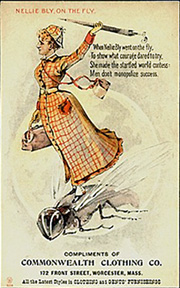
In 1888, stunt journalist Nellie Bly (see other entries in “Categories – Nellie Bly” in right sidebar) convinced her boss, the editor of the New York World, to send her on a trip around the world alone. She bet him that she could do it in eighty days or less. Where had she gotten this hairbrain scheme? From a book by Jules Verne, Around the World in Eighty Days. She was always getting wild and crazy ideas for her newspaper stories. Remember, of course, that the year before she had posed as an lunatic to get committed to an insane asylum. She had also posed as an unwed mother to expose the black market baby adoption rackets.

Nellie’s editor liked her idea but had two concerns. He thought she would need a male protector, that she shouldn’t travel alone.

 “Very well, start the man,” she said, “and I’ll start the same day for some other newspaper and beat him.”

Her editor got the idea. He couldn’t afford to let Nellie Bly quit his paper and go to work for a rival. New York newspaper competition was fierce and Nellie Bly’s articles dramatically boosted circulation for the World. He gave her the assignment.  A year later she was ready to go.

Next: Nellie in Egypt

Read Full Post »

« Newer Posts