Feeds:
Posts
Comments

Archive for the ‘PEOPLE’ Category

Lincoln's Secretary of War Edwin Stanton (1814-1869)

Lincoln's Secretary of War Edwin Stanton (1814-1869)


Much has been made of Democratic President Obama’s attempt to incorporate a Republican into his cabinet, a move that today’s political pundits liken to an overture made by the President Lincoln when, in 1862, he appointed Democrat Edwin Stanton as secretary of war in his Republican administration. Stanton was not just Lincoln’s political opponent, he was one of his most scathing critics, referring to the “imbecility” of the Lincoln administration’s handling of the Civil War. Not only that, he and Lincoln had met on another occasion – in a courtroom six years earlier – and Stanton had treated Lincoln with surly condescension.

During that case, Stanton headed a team of lawyers that included Lincoln that challenged Cyrus McCormack’s patent on the reaper. Nationally-renowned patent lawyer George Harding was another member of that same team. Harding never forgot the first time he caught sight of Abraham Lincoln arriving at the Burnet House in Cincinnati where the lawyers were lodged. Lincoln approached Harding and Stanton. Harding described Lincoln as a

“tall, rawly-boned, ungainly back woodsman, with coarse, ill-fitting clothing, his trousers hardly reaching his ankles, holding in his hands a blue cotton umbrella with a ball on the end of the handle.” (1)

Lincoln introduced himself to the two men, saying,

“Let’s go up in a gang.”

Both Stanton and Harding were shocked that this country bumpkin was part of their team. Stanton pulled Harding aside, whispering,

“Why did you bring that d____d long armed Ape here?”

Though the three of them spent a week together in trial and stayed at the same hotel, neither Harding nor Stanton asked Lincoln to join them for a meal or go with them to or from court. The brief Lincoln prepared for use in the trial was never even opened by Harding and Stanton. The judge presiding over the trial hosted a dinner for both teams of lawyers yet Lincoln was not invited.

Yet, in 1862, Lincoln set aside his ego and offered Stanton “the most powerful civilian post” – the post of secretary of war. Stanton accepted the position only to “help save the country.” While Stanton was hot-tempered and brusque, Lincoln recognized his brilliance and ability. Over the three years of their working relationship, Stanton and Lincoln grew close.

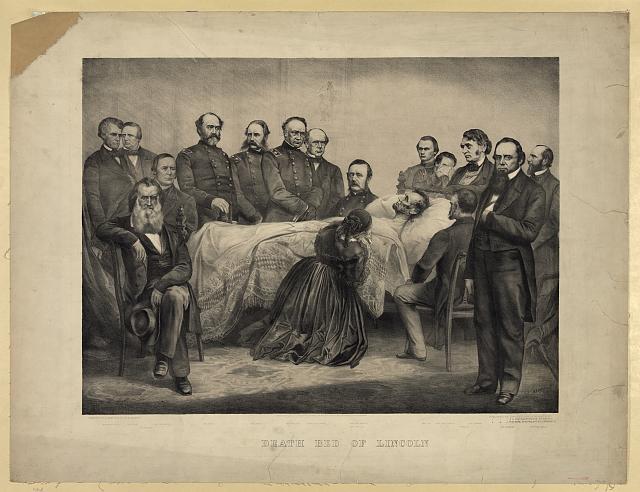
On the night of Lincoln’s assassination, Edwin Stanton was alerted. When he arrived at the Petersen boardinghouse across from Ford’s Theatre, he found that the president had been placed diagonally across a bed to accommodate his large frame. Lincoln was stripped of his shirt. “His large arms were of a size which one would scarce have expected from his spare appearance,” noted Stanton’s companion. Edwin Stanton and the other cabinet members except for Seward were present when President Lincoln was pronounced dead at 7:22 a.m. on April 15, 1865. Stanton’s tribute at that moment is still with us today.

“Now he belongs to the ages,” Stanton said of Lincoln.

Death Bed of Lincoln

Death Bed of Lincoln

Throughout that long night when the president had lingered between life and death, the task had fallen to Secretary of War Stanton to alert the generals. Coolly and with self-possession, Stanton dictated numerous dispatches. But when the president was pronounced dead, Stanton could bear his grief no longer. He could not stop the tears from flowing down his face. No one could control his grief that long night. One witness observed, “there was not a soul present that did not love the president.”

But “Stanton’s grief was uncontrollable,” recalled Horace Porter, “and,” some time later, “at the mention of Mr. Lincoln’s name, he would break down and weep bitterly.” (1) Stanton later wrote that he came to love Lincoln more than any other person outside of his immediate family.

(1) Goodwin, Doris Kearns. Team of Rivals. New York: Simon and Schuster, 2005.

Read Full Post »

Uncle Sam's Menagerie

Uncle Sam's Menagerie

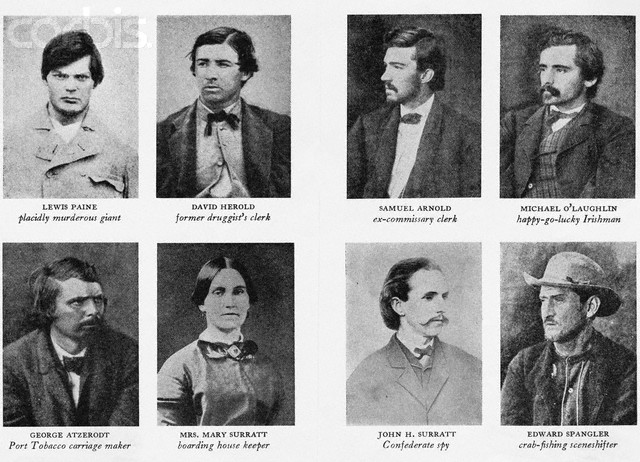
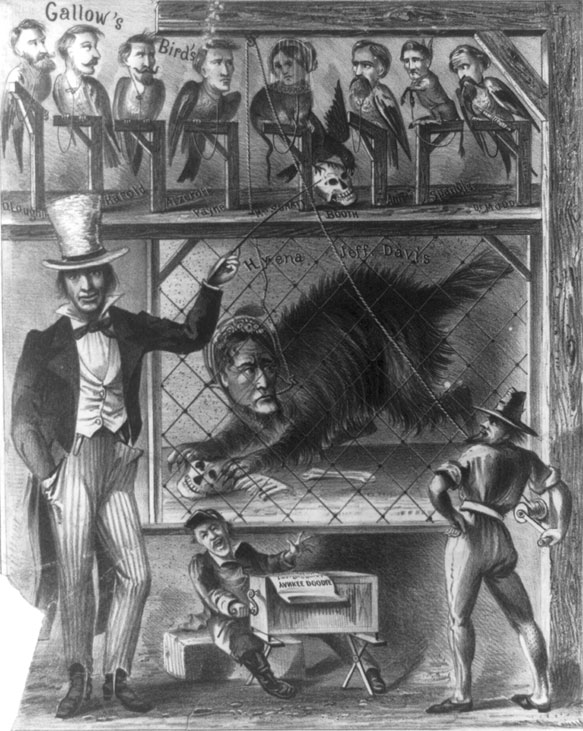
Issued in the wake of Lincoln’s assassination in April 1865, the political cartoon, “Uncle Sam’s Menagerie,” conveys the Northern hostility toward the conspirators, whom the public associated with former president of the Confederacy Jefferson Davis. Uncle Sam stands before a cage in which a hyena with the bonneted head of Jefferson Davis (1808-1889), president of the Confederacy, claws at a skull. Davis’ neck is in a noose, which will begin to tighten as a man at right turns the crank of a gallows. The bonnet on Davis’  head alludes to the embarrassing circumstances of his recent capture. As the Civil War drew to a close, Davis fled Richmond with his cabinet in early April 1865 and began a trek southward with federal troops in hot pursuit. While still weighing the merits of forming a government in exile,  Davis was captured by Union soldiers near Irwinville, Georgia, in early May 1865. Whether by accident or design, Davis was wearing his wife’s dark gray short-sleeved cloak and black shawl when captured.  

Below the caricature of Davis as a cross-dressing hyena, a man grinds out the song “Yankee Doodle” on a hand organ. Above, the Lincoln conspirators are portrayed as “Gallow’s Bird’s,” with their heads in nooses. From left to right they are: Michael O’Laughlin, David Herold, George Atzerodt, Lewis Paine, Mary Elizabeth Surratt, Samuel Arnold, Edman Spangler, and Dr. Samuel Mudd. At left, Uncle Sam points his stick at a skull “Booth,” on which sits a black crow. John Wilkes Booth was killed during a government raid on his hideout on April 26, 1865.

Read Full Post »

Eva Duarte de Peron, First Lady of Argentina (1946-1952)

Eva Duarte de Peron, First Lady of Argentina (1946-1952)

At 8:52 p.m. on the night of July 26, 1952, all radio broadcasts in Argentina were interrupted for an emergency announcement: First Lady Eva Peron – “the Spiritual Leader of the Nation” – was dead of cancer at 33. All activity came to an abrupt halt. Movies stopped playing. Shops closed. Restaurants were emptied of patrons. Argentina went into mourning.

The enormous public display of grief took the government by surprise. Crowds gathered outside the official presidential residence, congesting the streets for ten blocks in any direction. In a panic to be near Eva Peron’s body when it was being moved, eight people were crushed to death in the pressing throngs and 2,000 were treated for injuries at area hospitals. The streets of Buenos Aires were overflowing with tall stacks of flowers laid in remembrance for the people’s beloved Evita. Although she never held an official political office, Eva Peron (1919-1952) was eventually given an official funeral worthy of a head of state. To the poor of Argentina, Senora Evita was a saint.

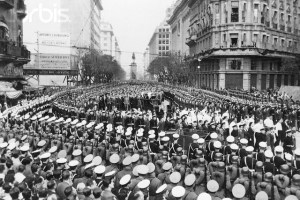
The Body of Eva Peron Being Carried Through the Honor Guard to the building of the General Labor Federation in Buenos Aires to Lie in State (Aug. 13, 1952)

The Body of Eva Peron Being Carried Through the Honor Guard to the building of the General Labor Federation in Buenos Aires to Lie in State (Aug. 13, 1952)

Before Eva had died, her husband, Argentine President Juan Domingo Peron (1895-1974), had contacted the famed embalmer, Dr. Pedro Ara, whose work was referred to as “the art of death,” to preserve Eva’s body. Dr. Ara’s technique of replacing the corpse’s blood with glycerine, which preserved all organs, created a lifelike appearance. Eva weighed only eighty pounds at death and was severely burned from radiation treatments but Dr. Ara was able to recreate her former beauty and give her an embalmment equal to that of Lenin. It has been suggested that Dr. Ara fell in love with Eva’s body. Plans were made to build a marble monument to Evita’s honor larger than the Statue of Liberty. During the construction her embalmed body lay in state for two years.

Then President Peron was overthrown and the body of Eva Peron stolen. For sixteen years, the whereabouts of Eva’s body remained a mystery. Juan fled to Spain in exile. Finally, in 1971, Eva’s body was discovered in a grave under a false name outside of Rome. It was exhumed and flown to Spain where Juan Peron kept the corpse in an open casket on the dining room table in his villa. Juan was now married to third wife Isabel who combed the corpse’s hair in a daily devotion and, at Juan’s request, was rumored to occasionally lie inside the coffin next to Evita to absorb some of her political magic.

In 1974, Juan returned to power as president of Argentina. Upon his death, wife Isabel succeeded him. Isabel returned Eva’s body to Argentina where it was briefly displayed next to Juan’s body.

Bodies of Juan and Eva Peron Lying in State (c. 1974-76)

Bodies of Juan and Eva Peron Lying in State (c. 1974-76)

Isabel was overthrown in 1976. The new military leaders had Eva Peron’s body safely buried in the Duarte family tomb under three plates of steel in the Recoleta Cemetery in Buenos Aires. The tomb was said to be secure enough to withstand a nuclear attack or a restless corpse.

Now read “Eva Peron’s Restless Corpse Part 2.”


Read Full Post »

Roy Rogers on his golden palomino Trigger, with wife and costar Dale Evans

Roy Rogers on his golden palomino Trigger, with wife and costar Dale Evans

It was 1938 and Leonard Slye needed a horse. Not just any horse. His horse had to be fast, well-trained, and handsome. You see, Leonard was a singing cowboy who had just gotten his first leading role in a western movie called “Under Western Stars.” He needed a horse to ride in the movie. Several stables in the Hollywood area sent out horses for Leonard to choose among. After trying out six or seven of them, he rode a golden palomino named “Golden Cloud.” It was love at first ride. He chose Golden Cloud for the movie role but renamed him “Trigger” because of his tremendous speed. Leonard Slye changed his own name, too, and became known as Roy Rogers.

“Under Western Stars” was a huge hit. As Roy toured the country promoting the film, Roy realized that his fans wanted to see Trigger as much as they wanted to see him. But Roy didn’t own Trigger. At that time, Roy was only making $75 a week as a contract actor for Republic Pictures and Trigger costs $2500! Roy also had a wife to support. But Roy couldn’t take the chance that Trigger would be paired with another star in a movie. Roy wanted to make more movies with Trigger and take him on tours around the country. So Roy took the financial risk and arranged to buy the expensive horse, arranging to pay off his debt to Trigger’s owners on installment, much, like Roy said, like he was paying off a bedroom set. Roy later said it was the best $2500 he ever spent.

Roy and Trigger went on to become superstars, making 88 movies and 100 tv shows together. Roy was called “The King of the Cowboys” and Trigger was known as “The Smartest Horse in the World.” Their western shows thrilled audiences with their wild cowboy and faithful horse adventures and horse-pumping action.

When Trigger died in 1965 at approximately the age of 35, the Smithsonian Institute asked Roy Rogers for his body for their collection of historical Americana. Wife and costar Dale Evans wanted Trigger to have a decent burial with a nice headstone. But Roy didn’t like either idea. He didn’t want Trigger to be so far away from California or buried underground. So Roy arranged for Trigger’s hide to be stretched over a plastic likeness of a horse in a rearing position.

Trigger is still the most popular attraction at the Roy Rogers-Dale Evans Museum in Branson, Missouri. Roy also arranged for his German shepherd Bullet and Dale’s horse Buttermilk to be preserved and exhibited at the museum. Roy used to joke that after he died, he wanted to be preserved and mounted on the saddle on Trigger.

Roy Rogers’ son, Dusty, once said of his father. “Trigger died and Dad had him stuffed. Bullet died and Dad had him stuffed. Buttermilk died and Dad had her stuffed. Now Mom sleeps with one eye open!”
 
When Roy Rogers died, my husband Tom cried. Watch this video and you’ll see why. Here’s Roy Rogers and Trigger at the Hollywood Canteen:

Read Full Post »

The Nubian Giraffe, by Jacques-Laurent Agasse (c.1827), depicts one of the three giraffes sent to Europe by Mehmet Ali Pasha. This one was received by George IV in London. The gentleman shown in the top hat is Edward Cross, operator of the menagerie at Exeter Exchange and then Royal Surrey Gardens. Also shown are the giraffe's Egyptian attendants, and, in the background, the Egyptian cows that supplied the young giraffe with milk.

The Nubian Giraffe, by Jacques-Laurent Agasse (c.1827), depicts one of the three giraffes sent to Europe by Mehmet Ali Pasha. This one was received by George IV in London. The Egyptian cows in the background supplied the young giraffe with milk.

In my last two posts, I wrote about Charles Dickens and his pet raven, Grip. Upon Grip’s death in 1841, Charles Dickens couldn’t bear to part with his beloved pet so he had him stuffed and mounted in a glass case to display in his study. Dickens was one of many Brits caught up in the pet preservation craze popularized by King George IV of England (1762-1830).

George IV is credited with establishing a private zoo at the Sandpit Gate at the Windsor Great Park at Windsor Castle. His menagerie consisted of such exotics as “wapiti, sambur, zebus, gnus, quaggas,…’corine’ antelopes, llamas, wild swine, emus, ostriches, parrots, and waterfowl. There was also an ‘enormous tortoise.'” (1) The showpiece of his collection, however, was a female Nubian giraffe, or “cameleopard,” as it was sometimes called. A diplomatic gift from Mehmit Ali, Pasha of Egypt, this young specimen arrived in London on August 11, 1827, along with several cows that provided her with milk. The gift giraffe was only 18 months old yet ten and a half feet in height. She was the first giraffe ever seen in England. Till she arrived, “there was a general belief that descriptions of the giraffe were partly fabulous.” (2)

The State of the Giraffe, 1829, a caricature print by William Heath, showing George IV and Lady Conyngham trying to lift the giraffe by pulley

The State of the Giraffe, 1829, a caricature print by William Heath, showing George IV and Lady Conyngham trying to lift the giraffe by pulley

From the beginning, there was trouble. An artist commissioned to paint the giraffe’s portrait noticed that her lower limbs seemed deformed from injuries. Investigation revealed that, on part of her journey from Senaar to Cairo, she was borne on the back of a camel, the wounds being caused because her legs were lashed together under the camel’s body. (1) At Windsor Castle, she was much doted on and continued to live on cow’s milk. After two years, though, she became very debilitated from those early wounds and exercise became painful and hard.  Someone came up with a plan to keep her moving. A gigantic triangle on wheels was constructed in which “the creature was somehow secured each day and trundled round her paddock, the hooves just touching the ground.” (1)

Despite the kind treatment, giraffes are accustomed to the warm, open savannahs of Africa, not the cold and wet confines of a British zoo. Two years after her arrival on the continent, the giraffe died, having only grown 18 inches while in captivity. It is said that King George IV had been obsessed with his giraffe and was distraught over her death. He commissioned the taxidermist John Gould to stuff his recently deceased pet giraffe.

 The stuffer to the Zoological Society, Mr. Gould, has had the performing of his duty…Soon after the giraffe expired, De Ville, the modellist, was ordered down to Windsor, by His Majesty, and took a cast of the animal. From this cast a wooden form was manufactured, on which the skin of the animal is now placed, and which preserves its beauty in an extraordinary degree.

The Times, April 15, 1830

Pet preservation is still alive and well in the twenty-first century – stuffed is out, though, and freeze-dried is in.

(1) Kisling, Vernon N. From Zoo and Aquarium History.
(2) Thomas, William John: White, William: Doran, John; Turle, Henry Frederick. Notes and Queries.

Read Full Post »

The Eldest Children of Charles Dickens with Pet Raven Grip by Daniel Maclise, 1941

The Eldest Children of Charles Dickens with Their Pet Raven "Grip" by Daniel Maclise, 1841

In yesterday’s post , I mentioned Grip the Raven, author Charles Dickens’ pet bird that was the inspiration for Edgar Allan Poe’s poem, “The Raven.” Dickens’ children loved the bird Grip although he did bite their ankles. At his children’s request, Dickens included Grip as a character in one of his books, Barnaby Rudge (1841). Dickens had three pet ravens, all named Grip. Grip I died in 1841, possibly because he ate lead chips scraped off a wall being repainted at the Dickens home. Dickens had the bird preserved and mounted in a glass case for display in his study. After Dickens’ death, a Poe collector acquired Grip I and donated him to the Free Library of Philadelphia where it remains today.

Dickens was saddened by Grip’s death. On March 12, 1841, he wrote the following letter to his friend, Daniel Maclise, who provided illustrations for his books and portraits of Dickens and his family, including the one on the left here featuring the eldest four of Dickens’ nine children: Charley, Mamie, Katey, and Walter. Dickens wrote:

 Mr. Dear Maclise,

Charles DickensYou will be greatly shocked and grieved to hear that the Raven is no more… On the clock striking twelve he appeared slightly agitated, but he soon recovered, walked twice or thrice along the coach-house, stopped to bark, staggered, exclaimed “Halloa old girl!” (his favorite expression) and died. The children seem rather glad of it. He bit their ankles but that was play…”

You might well ask why Grip the Raven is part of an Edgar Allan Poe Collection in Philadelphia. Toward the end of his life, Poe was a paid literary critic. In this role, he reviewed Dickens’ Barnaby Rudge, in which Grip the Raven plays a part. When Grip makes his first noise in the book, one of the characters says, “What was that — tapping at the door?” The answer is “‘Tis someone knocking softly at the shutter.” Poe’s criticism of Barnaby Rudge was that, although he liked the book overall, he felt that the raven’s “croaking might have been prophetically heard in the course of the drama.”

Four years later, Poe published his most famous work, the poem  “The Raven,” which gave the raven a more central role. It features a tapping and talking raven who flies into a man’s room and perches on a bust of Pallas Athena. Dickens’ raven could speak many words and had many comic turns, including the popping of a champagne cork, but Poe emphasized the bird’s darker “devil-bird”qualities. His bird spoke only one word, “Nevermore.” Poe’s raven may have represented a messenger from hell or the after-life, mirroring the gloom and foreshadowing the doom of the troubled narrator who misses his beloved Lenore.

                                                                 
  The Raven

verse 1

Once upon a midnight dreary, while I pondered, weak and weary,
Over many a quaint and curious volume of forgotten lore,
While I nodded, nearly napping, suddenly there came a tapping,
As of some one gently rapping, rapping at my chamber door.
“‘Tis some visitor,” I muttered, “tapping at my chamber door-
                Only this, and nothing more….”

verse 3

Presently my soul grew stronger; hesitating then no longer,
“Sir,” said I, “or Madam, truly your forgiveness I implore;
But the fact is I was napping, and so gently you came rapping,
And so faintly you came tapping, tapping at my chamber door,
That I scarce was sure I heard you”- here I opened wide the door;-
                Darkness there, and nothing more.

verse 4

Open here I flung the shutter, when, with many a flirt and flutter,
In there stepped a stately Raven of the saintly days of yore;
Not the least obeisance made he; not a minute stopped or stayed he;
But, with mienof lord or lady, perched above my chamber door-
Perched upon a bust of Pallas just above my chamber door-
                Perched, and sat, and nothing more.

1884 Illustration from "The Raven" by Gustave Dore

1884 Illustration from "The Raven" by Gustave Dore

verse 5
Then this ebony bird beguiling my sad fancy into smiling,
By the grave and stern decorum of the countenance it wore.
“Though thy crest be shorn and shaven, thou,” I said, “art sure no craven,
Ghastly grim and ancient Raven wandering from the Nightly shore-
Tell me what thy lordly name is on the Night’s Plutonian shore!”
                Quoth the Raven, “Nevermore.”
Edgar Allan Poe
1845

Read Full Post »

2009 commemorative stamp

2009 stamp

Philadelphia wants the body of Edgar Allan Poe but Baltimore isn’t giving it up. Poe didn’t live in Baltimore long, but ever since he died and was buried there in 1849, the city has claimed him for its own. Not fair, says Edward Pettit, a Poe scholar in Philadelphia. He argues that Philadelphia was Poe’s true home, seeing that he wrote his most famous works in Philadelphia where he lived from 1838-1844, including the stories “The Murders in the Rue Morgue,” “The Masque of the Red Death,” and “The Tell-Tale Heart.”

“So, Philadelphians, let’s hop in our cars, drive down I-95 and appropriate a body from a certain Baltimore cemetery,” Mr. Pettit wrote in an article in October. “I’ll bring the shovel.”

Not so fast, said Jeff Jerome, the curator of the Poe House in Baltimore. “Philadelphia can keep its broken bell and its cheese steak, but Poe’s body isn’t going anywhere. If they want [another] body, they can have John Wilkes Booth,”  referring to Abraham Lincoln’s assassin, who is also buried in Baltimore.

Charles Dickens' pet raven, Grip, and the inspiration behind Edgar Allan's poem, "The Raven"

Charles Dickens' pet raven, Grip, and the inspiration behind Edgar Allan's poem, "The Raven"

Mr. Pettit didn’t really expect Poe’s body to be dug up and transferred to Philadelphia. He was merely starting a spirited debate to drum up interest in several Poe exhibits being held in Philadelphia this year to celebrate the bicentennial of the mystery writer’s birth. Among the many attractions was a show of artifacts that just recently closed at the Philadelphia Free Library. While Poe’s original manuscripts and first editions were hits with die-hard Poe fans, the star of the show was undeniably a stuffed bird, Grip, Charles Dickens’ pet raven and the inspiration behind Poe’s best-known work, “The Raven.”  

Poe began writing “The Raven” in Philadelphia but published it in New York where he relocated. Therefore, New York can also lay claim to Poe. Then there’s Boston where he was born. Poe, though, were he consulted on the matter, would have described himself as a Virginian, because he grew up and began his writing career in Richmond. Even South Carolina could cash in on Poe’s fame. Poe was stationed in the Army on Sullivan’s Island, South Carolina, in 1827, and set “The Gold Bug” there. He also lived in Britain.

But Paul Lewis, a professor of English at Boston College, says neither of his rival cities are deserving of Poe’s legacy. Boston was the site of Poe’s birth, stated Lewis, the only place where he was happy. Boston and only Boston was Poe’s true home. Poe was poor, alcoholic, and miserable in all those other cities, claimed Lewis. “Every single city inspired Poe because they were torturing him,” said Lewis, tongue-in-cheek.

The argument between the cities has spilled over into blogs and newspaper articles, giving Edgar Allan Poe a boost in popularity, a healthy result for all the cities claiming Poe as its favorite son.

Read Full Post »

Annabel Lee

Edgar Allan Poe (1809-1849)

Edgar Allan Poe (1809-1849)

Written the year of Edgar Allan Poe’s death, “Annabel Lee” is generally considered to be the last poem Poe wrote. We celebrated the 200th anniversary of Poe’s birth last month, as he and Abraham Lincoln were both born in 1809. Poe’s most famous works are arguably his macabre stories such as “Murders in the Rue Morgue” and his haunting poem, “The Raven.” Poe is considered to be the founder of the modern detective mystery. His love poem, “Annabel Lee,” though, comes on softly, gently, unlike anything else I’ve ever read of his, though it is very sad. I read it to my daughter Katie many times when she was very young and she loved it.
          

Annabel Lee

It was many and many a year ago,
In a kingdom by the sea,
That a maiden there lived whom you may know
By the name of Annabel Lee;
And this maiden she lived with no other thought
Than to love and be loved by me.

I was a child and she was a child,
In this kingdom by the sea;
But we loved with a love that was more than love-
I and my Annabel Lee;
With a love that the winged seraphs of heaven
Coveted her and me.

And this was the reason that, long ago,
In this kingdom by the sea,
A wind blew out of a cloud, chilling
My beautiful Annabel Lee;
So that her highborn kinsman came
And bore her away from me,
To shut her up in a sepulchre
In this kingdom by the sea.

The angels, not half so happy in heaven,
Went envying her and me-
Yes!- that was the reason (as all men know,
In this kingdom by the sea)
That the wind came out of the cloud by night,
Chilling and killing my Annabel Lee.

But our love it was stronger by far than the love
Of those who were older than we-
Of many far wiser than we-
And neither the angels in heaven above,
Nor the demons down under the sea,
Can ever dissever my soul from the soul
Of the beautiful Annabel Lee.

For the moon never beams without bringing me dreams
Of the beautiful Annabel Lee;
And the stars never rise but I feel the bright eyes
Of the beautiful Annabel Lee;
And so, all the night-tide, I lie down by the side
Of my darling- my darling- my life and my bride,
In the sepulchre there by the sea,
In her tomb by the sounding sea.

Edgar Allan Poe

 1849

Read Full Post »

Upon return from her trip around the world, Nellie published an account of her travels

Upon return from her trip around the world, Nellie published an account of her travels

When we last left Nellie Bly, it was November 14, 1889 (see blog entries for Feb. 11 and 12) and she had just departed New York  for Southhampton, England, on an ocean steamer. In the next thirteen days, Nellie crossed the Atlantic, took a train to London, a boat across the English Channel to Calais, France, and a train through France and Italy. In Brindisi, Italy, she caught another steamer for China, the Victoria. Along the way, she wrote an account of her travels and cabled them back to her editor at the New York World for publication. The trip caused a sensation back home as readers followed her adventures with relish. 

Thirteen days into her journey, the steamer Victoria anchored at Port Said, Egypt, to take on coal.  Nellie and her fellow passengers gathered on deck and gazed out on a wide, sandy beach and a few  uninteresting houses. They gladly welcomed a change of scenery, though, and looked forward to some time on shore. Here is her account of that experience as recorded later in the book she wrote upon her return, Around the World in Seventy-Two Days:

Before the boat anchored the men armed themselves with canes, to keep off the beggars they said; and the women carried parasols for the same purpose. I had neither stick nor umbrella with me, and refused all offers to accept one for this occasion, having an idea, probably a wrong one, that a stick beats more ugliness into a person than it ever beats out.

Hardly had the anchor dropped than the ship was surrounded with a fleet of small boats, steered by half-clad Arabs, fighting, grabbing, pulling, yelling in their mad haste to be first. I never in my life saw such an exhibition of hungry greed for the few pence they expected to earn by taking the passengers ashore. Some boatmen actually pulled others out of their boats into the water in their frantic endeavors to steal each other’s places. When the ladder was lowered, numbers of them caught it and clung to it as if it meant life or death to them, and here they clung until the captain was compelled to order some sailors to beat the Arabs off, which they did with long poles, before the passengers dared venture forth. This dreadful exhibition made me feel that probably there was some justification in arming one’s self with a club.

Our party were about the first to go down the ladder to the boats. It had been our desire and intention to go ashore together, but when we stepped into the first boat some were caught by rival boatmen and literally dragged across to other boats. The men in the party used their sticks quite vigorously; all to no avail, and although I thought the conduct of the Arabs justified this harsh course of treatment, still I felt sorry to see it administered so freely and lavishly to those black, half-clad wretches, and marveled at their stubborn persistence even while cringing under the blows. Having our party divided there was nothing to do under the circumstances but to land and reunite on shore, so we ordered the Arabs to pull away. Midway between the Victoria and the shore the boatmen stopped and demanded their money in very plain and forcible English. We were completely at their mercy, as they would not land us either way until we paid what they asked. One of the Arabs told me that they had many years’ experience in dealing with the English and their sticks, and had learned by bitter lessons that if they landed an Englishman before he paid they would receive a stinging blow for their labor.

Read Full Post »

drawing of Abraham Lincoln as a boy

drawing of Abraham Lincoln as a boy

Today I want to get it just right. It is our precious Abe Lincoln’s 200th birthday. I want to choose just the right thing to say about him in this blog that does the great man justice, that gives us a look into his fine soul.

When I think of Lincoln, I think of his honesty, yes, his courage, of course, but mainly what comes to mind is his unfailing kindness – to Mary, his wife, when she was yelling at him while he was president and under the most terrific strain from the Civil War. He just shrugged off her verbal and sometimes physical assaults, picked up Willie or Tad and put them on his shoulders, and walked out of the room. He did not utter a harsh word at her. During his presidency, the White House was open to Civil War veterans and widows who wanted to meet with Lincoln. He would never refuse to see a one of them though he was terribly overworked, with little staff to help him run the country.

His kindness for the weakest among us showed up early in his youth. It is believed that his father Thomas Lincoln was ashamed that Abe was sensitive and fond of books, storytelling, and poetry, considering such interests “soft.” Thomas Lincoln felt contempt to discover such sentimentality in his own son. Lincoln and his father never were close. They remained isolated from one another from the time of Lincoln’s mother’s death when Abe was 9. The bad blood between them was never resolved. When Thomas Lincoln lay dying, Abraham refused a request to visit his father’s sickbed and did not attend his father’s funeral.

The following anecdote from Lincoln’s boyhood illustrates how his heart ached for the unfortunate:

He was always the champion of the helpless, no matter how humble the object of any ill-treatment might be. One day he came and caught a group of mischievous boys putting live coals on a poor mud-turtle’s back. The lads, and several girl friends, laughed to see the turtle moving slowly and aimlessly about in its surprise and misery. When Abe Lincoln saw what was going on he dashed into the group in a frenzy of wrath, snatched the shingle from the ringleader’s hand, dashed the burning coals off the poor turtle’s back, then began beating the boys with the thin board. When he had scattered them right and left, according to one of the girls who witnessed the sudden scene, “he preached against such cruelty” and, with angry tears in his deep gray eyes, told the snickering offenders that a terrapin’s or “an ant’s life is as sweet to it as ours is to us.” (1)

This boy champion of the underdog grew into a man and the 16th President of the United States of America. As a boy, he freed the turtle; as a man, he freed the slaves. Lincoln famously declared,

If slavery is not wrong, nothing is wrong.  

Happy 200th Birthday, Abe Lincoln.

(1) Whipple, Wayne. The Heart of Lincoln. (Philadelphia: George W. Jacobs & Co., 1915)

Read Full Post »

cartoon-nellie-around-the-worldYesterday, you will recall, we followed famed stunt reporter Nellie Bly as she tried to convince her editor to let her make a journalistic trip around the world in less than 80 days. Perhaps you noticed that I left out some information in yesterday’s post. I wrote that Nellie Bly’s New York World editor had two objections to sending her on the trip yet I proceeded to list only one of them for my readers, that, for such a journey, her editor thought she needed a male protector.

This is what Nellie recalled her boss having said that day:

“It is impossible for you to do it,” was the terrible verdict. “In the first place you are a woman and would need a protector, and even if it were possible for you to travel alone you would need to carry so much baggage that it would detain you in making rapid changes. Besides you speak nothing but English, so there is no use talking about it; no one but a man can do this.”

Nellie vigorously objected and her editor relented, eventually warming to the idea. A year passed before any more was spoken about it. Then one cold evening, Nellie was summoned into her editor’s office. When she entered, he looked up from the paper he was writing and asked her, “Can you start around the world day after tomorrow?”

“I can start this minute,” she replied without hesitating. She recalled his second objection, that she would travel with too much baggage, and set out to conquer that problem.

Early the next morning Nellie went to a dressmaker and ordered a custom dress to be made for her immediately. The dressmaker was at her service instantly. Nellie explained to him that she needed a traveling outfit that could stand constant wear for three months. She  was planning to go around the world in only one dress! After looking at several materials, the dressmaker selected two sensible fabrics: a plain blue broadcloth and a plaid camel’s hair. That afternoon, Nellie had her first fitting at 1:00, her second fitting at 5:00, and the dress was ready.

Nellie could then turn her attention to packing. She had bought one hand-bag and was determined to confine her baggage to its singular limit. “Packing that bag was the most difficult undertaking of my life….”

In her hand-bag, she packed:

two traveling caps, three veils, a pair of slippers, a complete outfit of toilet articles, ink-stand, pens, pencils, and copy-paper, pins, needles and thread, a dressing gown, a tennis blazer, a small flask and a drinking cup, several complete changes of underwear, a liberal supply of handkerchiefs and fresh ruchings and most bulky and uncompromising of all, a jar of cold cream to keep my face from chapping in the varied climates I should encounter.

That jar of cold cream was the bane of my existence. It seemed to take up more room than everything else in the bag and was always getting into just the place that would keep me from closing the satchel. Over my arm I carried a silk waterproof, the only provision I made against rainy weather.

She was given 200 lbs in English gold and Bank of England notes. She carried the gold in her pocket. The Bank of England notes she carried around her neck in a chamois-skin bag. She also took some American gold and paper money to see if it could be used at foreign ports. Her passport was in order. As she was traveling without an escort, a friend suggested that she carry a revolver, but Nellie refused to arm herself, saying she had a “strong belief in the world’s greeting” for her.

On November 14, 1889, Nellie Bly set sail from New York for Southhampton, England, on the ocean steamer, the August Victoria.

Read Full Post »


Nellie Bly

Nellie Bly

In 1888, stunt journalist Nellie Bly (see other entries in “Categories – Nellie Bly” in right sidebar) convinced her boss, the editor of the New York World, to send her on a trip around the world alone. She bet him that she could do it in eighty days or less. Where had she gotten this hairbrain scheme? From a book by Jules Verne, Around the World in Eighty Days. She was always getting wild and crazy ideas for her newspaper stories. Remember, of course, that the year before she had posed as an lunatic to get committed to an insane asylum. She had also posed as an unwed mother to expose the black market baby adoption rackets.

Nellie’s editor liked her idea but had two concerns. He thought she would need a male protector, that she shouldn’t travel alone.

 “Very well, start the man,” she said, “and I’ll start the same day for some other newspaper and beat him.”

Her editor got the idea. He couldn’t afford to let Nellie Bly quit his paper and go to work for a rival. New York newspaper competition was fierce and Nellie Bly’s articles dramatically boosted circulation for the World. He gave her the assignment.  A year later she was ready to go.

Next: Nellie in Egypt

Read Full Post »

Taken by Alexander Gardner on February 9, 1864. This photograph would serve as the image that engraver Victor David Brenner would use to create the bas relief of Lincoln used on the penny.

Abraham Lincoln (1809-1865)Taken by Alexander Gardner on February 9, 1864, this photograph served as the image engraver Victor David Brenner would use to create the bas relief of Lincoln found on the 1909 penny.

It is President Teddy Roosevelt we have to thank for giving us the first Lincoln penny. Until the Lincoln penny debuted in 1909, no likeness of an actual person had appeared on a “regular-denomination circulating United States coin.” Too monarchial, deemed our first head of state, George Washington. Emperors, kings, and other authority figures had long stamped coins with their images to declare their power. Young America was done with that kind of governing. So the Mint Act of 1792 dictated that American coins would instead be “an impression emblematic of liberty.”

As a result, the coin designs of liberty – depicted by goddesses, mainly- grew “dowdy and uninspired.” President Roosevelt complained to his secretary of the treasury that, “Our coinage is artistically of atrocious hideousness.” So Roosevelt directed him to stamp the image of Lincoln on the one-cent piece to commemorate Lincoln’s 100th birthday.

It was done. When the Lincoln penny was released into circulation, it was a hit with the American people. Long lines formed at banks and Treasury buildings in New York, Washington, Boston, and other cities to snap up the new coins. In Philadelphia, some of the pennies were sold for 25 cents. It had been 44 years since Lincoln was assassinated. He was an icon. People were excited that they recognized the face on the coin.

Of course, as Lincoln himself remarked, you can’t please all the people all the time. Some people grumbled about the new coin, Confederate veterans, of course, plus the New York Times, calling it “another ill-considered freak of Mr. Roosevelt’s will.”

Nowadays, the complaints about the penny are different. There are some people who want to get rid of the penny altogether. Due to the rising price of metal, the cost of making the “copper-coated zinc corpus” (1.4 cents) now exceeds its face value.

Read Full Post »

Lincoln statue at the Lincoln Memorial

Lincoln statue at the Lincoln Memorial

Tucked into the massive central hall of the Lincoln Memorial sits an imposing marble statue of Abraham Lincoln. Over Lincoln’s head is inscribed:

IN THIS TEMPLE

AS IN THE HEARTS OF THE PEOPLE

FOR WHOM HE SAVED THE UNION

THE MEMORY OF ABRAHAM LINCOLN

IS ENSHRINED FOREVER 


The statue stands over 19 feet tall. Lincoln is shown in a seated position, but, if he could get up, he would stand 28 feet tall. He wears an expression of firm determination, eyes fixed rather sadly looking out onto the National Mall toward the Washington Monument.  Sculptor Daniel Chester French (1850-1931) began work on his design for the statue in 1915, making many bronze and plaster models. The sculptor consulted photographs by the well-known Civil War photographer Mathew Brady and used Lincoln’s life mask as well as casts of Lincoln’s own hands as models.

Lincoln's left hand

Lincoln's left hand

Now look at both of Lincoln’s hands. There’s a popular legend that Lincoln is shown using manual sign language to sign his initials, with his left hand shaped like the letter “A” and his right hand to form an “L.”  The National Park Service denies that this is the case. There is no evidence that Daniel Chester French intended for Lincoln’s hands to be formed into sign language letters. Nevertheless, it’s possible. Believers point out that a National Geographic Society publication states that French had a son who was deaf  – and French himself knew sign language.  He would have had good reason to do so, too, to honor Lincoln, as it was President Lincoln who signed into law the ability for Gallaudet University, a school for the deaf, to grant college degrees.

Lincoln's right hand

Lincoln's right hand

There are those who say French did shape Lincoln’s hands in this fashion on purpose yet others insist he didn’t. There is, however, evidence he could have. French had used sign language  in his sculptures before. In his 1889 portrait of deaf educator Thomas Gallaudet shown with his first student, Alice Cogswell, Gallaudet uses his right hand to make the sign for the letter “A” as Alice, too, makes the “A” sign with her right hand.

Thomas Gallaudet sculpture by Daniel Chester French

Thomas Gallaudet sculpture by Daniel Chester French

Read Full Post »

penny

penny-with-lincoln-memorial

In one week, the nation will celebrate the 200th birthday of our most revered president, Abraham Lincoln (February 12, 1809 – April 14, 1865). To commemorate the birthday of our 16th president and the issuing of the first penny a century ago, the U.S. Mint is issuing four new pennies. The “heads” side of the penny bearing Lincoln’s image remains the same while the “tails” side will alternate four new designs which represent the four major aspects of President Lincoln’s life:

Birth and early childhood in Kentucky (1809-1816)
Formative years in Indiana (1816-1830)
Professional Life in Illinois (1830-1861)
Presidency in Washington, DC (1861-1865)

Click here to see the unveiling of the images of the new coins at a ceremony held last September in Washington, D.C.

I hadn’t intended to write about Abe Lincoln today. Rather, for days now, I’ve gorged myself reading about his wife Mary, hoping soon to come to the end of the book and Internet material on her and get down to blogging. Well that is an impossible task. There is no end of Lincolnology. At last count, there were upward of 15,000 books about Abe and Mary, more than about any other person except Jesus.

A visit to the official website of the Lincoln Bicentennial assures me that I can blog all year on the Lincolns and be in step with the rest of the country, as celebrations and exhibits go on for the next eleven months.

While I was googling the image of the Lincoln Memorial which I present here, I got all misty-eyed.

Lincoln statue within the Lincoln Memorial

Lincoln statue within the Lincoln Memorial

What a great man Abraham Lincoln was. After reading about his life with Mary, I come away with even more admiration. What a difficult woman Mary was and so selfish, too (see my Feb. 3, 2009 blog below). I’ll give her credit for her abolitionist efforts but what a drag she was on our president during the darkest time of our nation’s history! She was jealous of his time away from her. He was running the country!

When I was in elementary school, February was the month we celebrated two presidents’ birthdays – Lincoln’s on the 12th and Washington’s on the 22nd. This was before there was an official “Presidents’ Day,” a day set aside to celebrate the birth of all presidents and before February became “Black History Month.” My teachers would always have a beautiful bulletin board displayed with a calendar, white doilies with red hearts for Valentine’s Day, and black cardboard cut-outs of Lincoln’s and Washington’s silhouettes. I love February.

I learned that Lincoln was poor and lived in a log cabin, that he was humble, gave speeches outdoors, and chopped firewood. We heard the Mason Weems fable that Washington could not lie to his father about chopping down a cherry tree.

washington_cherry-tree

My birthday comes two days after Washington’s. As a result, I’ve always had cherry pie instead of cake for my special dessert, because of George chopping down that cherry tree. On one birthday, my grandmother Mimi made cherry tarts for my guests and me and we went to the movies to see Lucille Ball and Bob Hope in the comedy, “Fancy Pants.”

Back to the Lincoln penny, isn’t it ironic that a president who grew up “friendless, uneducated, penniless…” should find himself commemorated on a penny? Happy Early Birthday, Abe. You rock.

5-lincoln-m

Read Full Post »

« Newer Posts - Older Posts »