Feeds:
Posts
Comments

Archive for the ‘PEOPLE’ Category

John F. Kennedy loved to eat at Howard Johnson restaurants:

Whenever he saw one on the campaign trail, we’d have to stop so he could duck in, order two hot dogs and a soft drink,” said photographer Stanley Tretick, who covered the 1960 presidential campaign for United Press International. Kennedy was the democratic candidate.

1960 Presidential Campaign Sticker

1960 Presidential Campaign Sticker

Once Tretick almost got a candid shot of Kennedy eating a hotdog. Kennedy was sitting in his car. Tretick aimed his camera but

He [Kennedy] slid under the dashboard so I couldn’t see him,” recalled Tretick. Then Kennedy wolfed down his lunch undisturbed. (1)

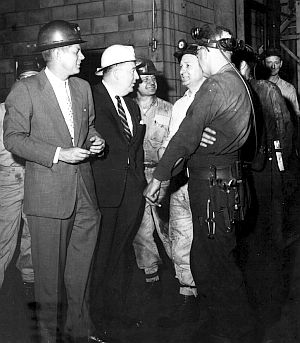
Kennedy thought such photographs – politicians eating hot dogs, for example – were “corny.” He cared immensely about his image. Kennedy studiously avoided being photographed eating, drinking, combing his hair, or wearing any one of the endless hats – sombreros, cowboy, Native American headdresses –  given to him while on the campaign trail. He generally refused to put on the hats, except a hard hat. Heavy laborers – miners, electricians, factory workers – “went big” for him and he appreciated their acceptance.

Senator John F. Kennedy wears a hardhat. May 1959

Senator John F. Kennedy (l.) wears a hardhat. May 1959

THE RICE HAT

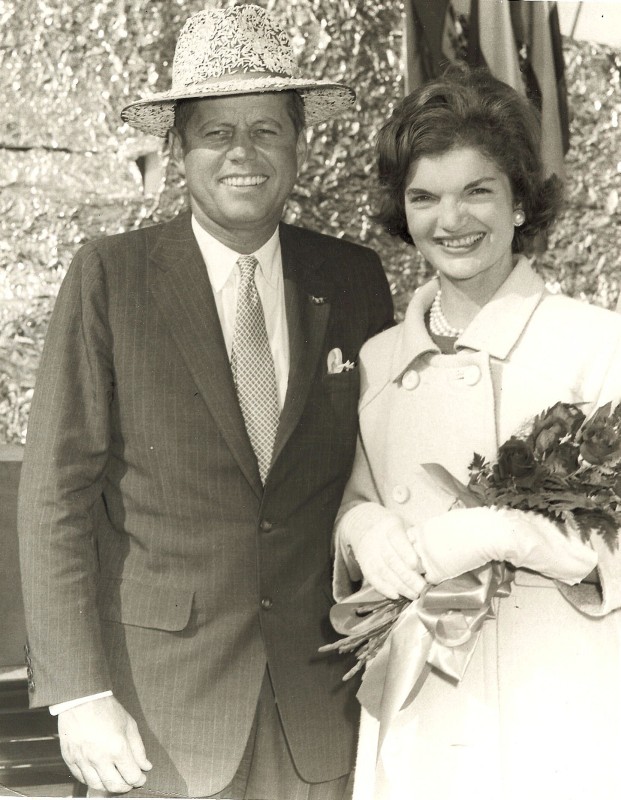
Below is the rare photo in which Kennedy looks a little silly. It was taken before he had actually declared his candidacy for president. It was October 1959 and he was Senator Kennedy from Massachusetts. He and his wife Jackie were guests at the International Rice Festival in Crowley, Louisiana. Kennedy was drumming up interest in a presidential run.

Kennedy is wearing a rice hat. I’d like to think that, the next day, Kennedy saw this picture in a local newspaper and thought, “Woah! I’ve got to be more careful when I actually do declare my candidacy! If I look this dopey, I’ll never beat Dick Nixon!” I’d like to think that this picture taught him the lesson he needed to eschew wearing hats in photos that would go viral.

Senator John F. Kennedy and wife Jackie at the Rice Festival, Crowley, Louisiana. October 1959

Senator John F. Kennedy and wife Jackie at the Rice Festival, Crowley, Louisiana. October 1959. Reggie Family Archives.

Three years into his presidency and the president’s aversion to wearing hats was legendary. But that didn’t stop the hatmakers from forcing hats on him everywhere he went.

Here’s YouTube footage of John Kennedy refusing to put on a cowboy hat given to him at a Chamber of Commerce breakfast in Fort Worth, Texas, on the last day of his life. He enters the ballroom at 9:45 on the tape and he jovially refuses to wear the hat at 45:45.

In three hours he would be dead. The hat was never found.

(1) Kelley, Kitty. Capturing Camelot: Stanley Tretick’s Iconic Images of the Kennedys. New York: St. Martin’s Press, 2012.


Read Full Post »

American journalist and author Kitty Kelley (b. 1942)

American journalist and author Kitty Kelley (b. 1942)

Writer Kitty Kelley always wondered what her photographer friend Stanley Tretick kept in his Marine Corps locker that he used as a coffee table in his study. One day she asked him what was inside.

Nude pictures,” he told her, winking.

She took him at his word and thought no more about it. The two had been friends since 1981 but it wasn’t until 1999, when Tretick died, that Kelley found out what was really in the battered old trunk, as Tretick had left it to her in his will.

Inside she discovered a trove of keepsakes from Tretick’s days of photographing President John F. Kennedy for United Press International and Look magazine.

American photographer Stanley Tretick (l.) photographs President John F. Kennedy in the Oval Office, 1962. (Abbie Rowe, JFK Library and Museum)

American photographer Stanley Tretick (l.) photographs President John F. Kennedy in the Oval Office, 1962. (Abbie Rowe, JFK Library and Museum)

Among the signed photographs of the president and his wife, Jackie, handwritten notes and letters, and Kennedy buttons and bumper stickers was this PT-109 boat tie clasp that JFK had given Tretick when he followed him in his 1960 presidential campaign. (1)

JFK PT 109 boat pin

JFK PT 109 boat pin

The 1960 Kennedy presidential campaign distributed this boat pin as a reminder of Kennedy’s WWII military service aboard the patrol torpedo boat PT-109.

Patrol Torpedo 109 commanded by John F. Kennedy at far right. 1943

Patrol Torpedo 109 commanded by John F. Kennedy at far right. 1943

On the starless, moonless night of August 1, 1943, Lieutenant Kennedy was at the helm of PT-109, cruising the Solomon Islands in the South Pacific to spot Japanese warships, when:

At about 2:30 in the morning, a shape loomed out of the darkness three hundred yards off PT-109’s starboard bow.”(2)

It was the Japanese destroyer the Amagiri, cruising at top speed. It rammed the PT-109 just forward of the forward starboard torpedo tube, ripping away the starboard aft side of the boat, and cutting the boat in two.

Painting of the August 2, 1943 sinking of PT-109 by the Japanese destroyer Amagiri. By Gerard Richardson. Courtesy of the John F. Kennedy Library and Museum

Painting of the August 2, 1943 sinking of PT-109 by the Japanese destroyer Amagiri. By Gerard Richardson. Courtesy of the John F. Kennedy Library and Museum.

The extreme impact tossed Kennedy around the cockpit. Most of the crew were knocked into the water. Two died; two were injured. Fully expecting the boat to explode into flames, Kennedy ordered his crew to abandon ship.

The eleven survivors took to the water and struck out swimming for an islet three-and-a-half miles away.

Lieutenant Kennedy was a strong swimmer. He had been on the swim team at Harvard University. He saved one of his men by towing him ashore with a lifejacket strap clenched between his teeth. He was the first of his crew to reach the island.

Six days later, islanders scouting for the Allies on Naru Island found the men and sent for help, delivering the following SOS message Kennedy had scratched into the husk of a green coconut:

NAURO (sic) ISL
COMMANDER . . . NATIVE KNOWS
POS’IT . . . HE CAN PILOT . . . 11 ALIVE
NEED SMALL BOAT . . . KENNEDY

Despite the proximity of the Japanese patrols, the crew was rescued without incident and the men reached the U.S. base at Rendova on the Solomon Islands on August 8, 1943.

PT-109 Collision August 1943 (by Philg88; Attribution: Wikimedia Foundation)

PT-109 Collision August 1943 (by Philg88; Attribution: Wikimedia Foundation)

John F. Kennedy receives the Navy and Marine Corps Medal for his courage in the PT-109 incident. 1943

John F. Kennedy receives the Navy and Marine Corps Medal for his courage in the PT-109 incident. 1943

Upon the crew’s return, Kennedy was awarded the Navy and Marine Corps Medal for his leadership and courage. For injuries suffered, he also qualified for a Purple Heart.

(1) Kelley, Kitty. Capturing Camelot: Stanley Tretick’s Iconic Images of the Kennedys. New York: St. Martin’s Press, 2012.

(2) John F. Kennedy Memorial Library and Museum online

Read Full Post »

Excerpt from interview by Jamie Lee Curtis Taete with American fashion designer, Bob Mackie.
“Bob Mackie Has Dressed Almost Everyone,” March 7, 2013. VICE online.

The television shows you designed wardrobe for back then were classic big productions like The Carol Burnett Show. It all seemed so cohesive. Were you responsible for designing every costume and look?
Well, not everything was designed. I would rent a lot of stuff like uniforms and period pieces, but we were doing 50 to 70 costumes per episode, and we had a show every week.

Carol Burnett and Bob Mackie at Carol's home, 1967

Carol Burnett and Bob Mackie at Carol’s home, 1967

I watched an interview with you during which you said that to get inspiration for sketch-comedy wardrobes, you’d walk around the mall and people-watch. You also said that you couldn’t believe what people thought they looked good in. Is strolling around malls or other public places something you still do? 
I don’t do sketch comedy anymore, but I definitely still walk around malls and airports—especially airports—and I think, Oh my God, look at her, or, Look at those ugly shoes! Today, a lot of women are wearing very unflattering clothes.

Yes, I think the worst-dressed people can be found at the airport because somewhere along the line everyone decided that unabashed comfort trumps any sort of decorum whatsoever. It’s crazy. You have people going on two-hour flights in pajamas with neck pillows and their bare feet stinking up the cabin. 
I know! But the thing is, you can be comfortable without looking like a pig. When I fly, I sit there and I watch people board the plane and I think, Where are they going when they arrive? Where can you go when you look that ridiculous?

Are there any specific current trends that you just can’t stand? 
Leggings worn on their own. It stops me cold some days; I just can’t believe my eyes! Just because it’s stretchy, it doesn’t mean it fits or looks good.

And what about from the past?
Well, sometimes, when they’re happening you think, Oh my God, what’s going on here? And then after a while you start liking it. Like when mini-dresses came in, they were just above the knee and everyone was so shocked. Then all of a sudden they were barely covering the crotch. And now everybody’s got it all hanging out and we’re used to it.

Does that happen with things you’ve designed in the past? Do you ever look back and go, “What was I thinking?”
Well, I look back and I say to myself, “That was 30 or 40 years ago and that was the trend at the time.”

READERS: For more Bob Mackie posts, click here

Read Full Post »

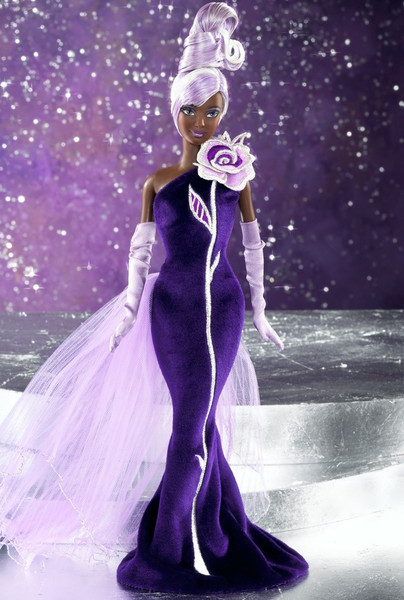
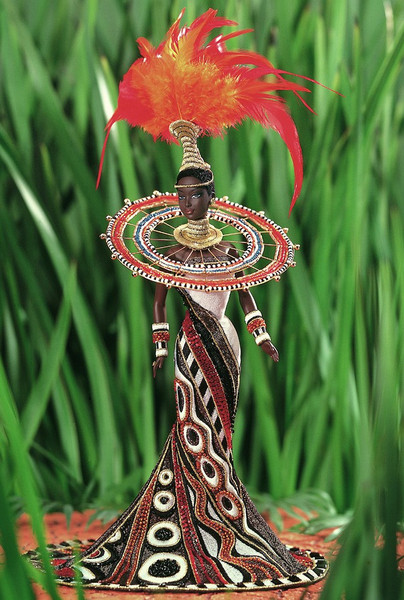
In 1990, American fashion guru Bob Mackie began to design Barbie dolls for toymaker Mattel. A peek at that collection demonstrates Mackie’s incomparable creative imagination:

This one is exotic.

Brazilian Banana Bonanza Barbie is sultry.

Sterling Silver Rose is alluring and soft.

Sterling Silver Rose Barbie is elegant.

The Charleston Barbie is sassy

The Charleston Barbie is sassy.

Cher 1980 Barbie is provocative and skimpy.

Cher 1980 Barbie is outrageously sexy.

Fantasy_Goddess_of_Africa_grande

Fantasy Goddess of Africa is exotic.

Couture Confection Bride Barbie is classy.

Couture Confection Bride Barbie is classy.

Sultry. Elegant. Sassy. Outrageously Sexy. Exotic. Classy. While these Bob Mackie costumes are fantastically diverse, they have one trait in common. They are glamorous. They are designed to flatter the woman – and to make her stand out. Whether designing for the stars or for Barbie, the Bob Mackie name has become synonymous with over-the-top, splashy, flashy glamour.

Then isn’t it ironic that the costume for which Mackie may be most remembered is not glamorous at all but wildly funny and enormously unflattering?

Not really. Because Bob Mackie got his start in designing costumes for TV, most memorably for “The Carol Burnett Show” (1967-1978), a variety/sketch comedy show for which he designed costumes for all 287 episodes for the entire crew – from the dancers to the secondary actors to the stars – for all the skits, every week, comic and elegant clothing.

We made a lot of costumes!” said Bob Mackie. ‘Nobody had more fun than I did, doing that kind of a show, a weekly show like that…. We could be glamorous one moment, horrible the next. It was just crazy, It was crazy, and I loved it.'”  (1)

Carol Burnett’s costar Vicky Lawrence said of Bob Mackie:

I just thought he was a genius….I just remember always feeling either very funny or very beautiful.”

The Dress in the Window

The eighth episode of the tenth season of “The Carol Burnett Show” (Nov. 13, 1976) opened with Carol Burnett introducing the comedy sketch, “Went With the Wind,” a parody spoof on the 1939 epic film, “Gone With the Wind.” Carol said:

Recently, nearly the entire nation spent a total of 5 hours watching ‘Gone with the Wind’ make its TV debut. So for those of you who ran out of Kleenex and were unable to watch it, we put together our own mini-version to let you know what you’ve missed. Uh-huh.” (2)

Bob Mackie was responsible for the costume design for “Went With the Wind.” As usual, he had read the script for creative inspiration. When the script called for Carol Burnett, as Starlet O’Hara, to tear the curtains down and turn them into a dress that just hung off her, Mackie did not find it funny, as that is the same thing Scarlett O’Hara had done in the actual film. He had to think of something original. He was stymied for ideas.

In "Gone With the Wind," Scarlett O'Hara prepares to tear down the curtains to make a dress.

In “Gone With the Wind,” Scarlett O’Hara prepares to tear down the curtains to make a dress.

Finally, the morning of the Thursday filming, he thought of what to do. He ordered a real curtain rod to be fitted into the velvet drapes. The rod was enormously heavy. He carried it up the narrow back steps behind the stage staircase and helped Carol’s dresser – a tiny woman –  put it on Carol.

In the next scene, Carol makes her dramatic entrance. She descends the stairwell to greet Captain Ratt Butler, played by Harvey Korman, trying to entice him into giving her money. Carol is wearing not just the curtains and sash but also the curtain rod like a long shoulder pad. When the audience saw the curtain rod jutting out from Carol’s shoulders, they shrieked with laughter.

Carol Burnett and Harvey Korman as "Starlet and Ratt" in comic sketch, "Went With the Wind." (1976)

Carol Burnett and Harvey Korman as “Starlet and Ratt” in comic sketch, “Went With the Wind.” (1976)

Ratt tells Starlet,

Starlet, I love you. That – that – gown is gorgeous.”

Starlet replies,

Thank you. I saw it in the window, and I just couldn’t resist it.”

Bob Mackie's sketch of Carol Burnett wearing the curtain rod dress for "Went With the Wind."

Bob Mackie’s sketch of Carol Burnett wearing the curtain rod dress for “Went With the Wind.”

Remembers Mackie:

I’ve never heard laughter like that in my life. It just hit….It just made people laugh, and it still does. Every time I talk to anybody, they bring up this silly curtain rod outfit, with the velvet drapes attached to it. I had an exhibit in New York of my whole career and what was in the front window, that outfit! ….It will be on my tombstone one day.” (3)

At left, the green curtain rod dress designed by Walter Plunkett and worn by actress Vivien Leigh in the 1939 film, Gone With the Wind. At right, is the Bob Mackie spoof of this dress for the Nov. 1976 "Went With the Wind" parody shown on The Carol Burnett Show and worn by Ms. Burnett.

At left, the green curtain rod dress designed by Walter Plunkett and worn by actress Vivien Leigh in the 1939 film, “Gone With the Wind.” At right, is the Bob Mackie spoof of this dress for the Nov. 1976 “Went With the Wind” TV parody shown on The Carol Burnett Show and worn by Ms. Burnett.

This dress scene was number 2 in TV Guide’s January 23-29, 1999, list of “The 50 Funniest Moments in Television” (the funniest moment was the chocolate wrapping scene from “I Love Lucy”).

Now Mackie’s curtain rod dress is enshrined in the Smithsonian Museum as part of the American History Museum’s Kennedy Center Honors Collection.

Click here to watch the youtube clip of “Went With the Wind.” The curtain rod dress appears at 13:13. Enjoy!

Sources:

(1) Youtube clip: “Gags and Gowns: The Genius of Bob Mackie on The Carol Burnett Show.”

(2) wiki: “Went With the Wind”

(3) Youtube clip: Bob Mackie interview: “’The Carol Burnett Show’: TV legends”

(4) “Went With the Wind” script

READERS: For more Bob Mackie posts, click here

Read Full Post »

American costume designer Bob Mackie in an undated photo.

American costume designer Bob Mackie in an undated photo.

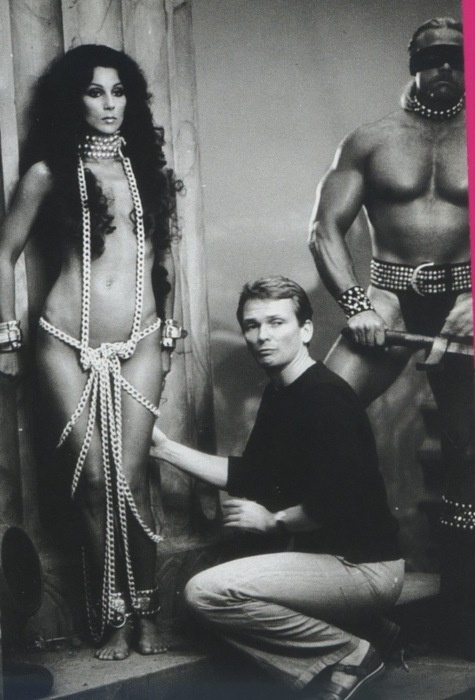
In my last post, I introduced American fashion designer Bob Mackie (b. 1940), designer to the stars. He is famous for dressing entertainers such as Cher, Carol Burnett, Diana Ross, Barbara Eden, Bette Midler, Judy Garland, Liza Minnelli, Tina Turner, Joan Rivers, Whitney Houston, Pink, Sharon Stone, Beyonce, Goldie Hawn, Barbra Streisand, Bernadette Peters, Lucille Ball, Ann-Margret, and Mitzi Gaynor. He also creates designs for collector’s edition Barbie dolls.

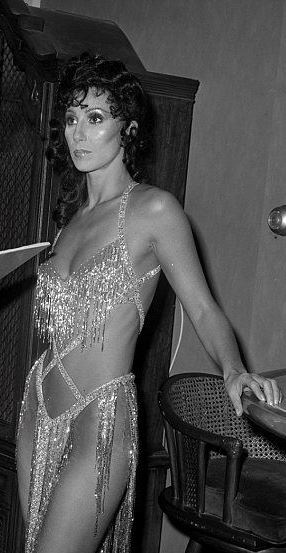
Although his designs can be elegant, they can also be outrageous. Many of Mackie’s most spectacular designs have a Vegas show-girl quality. They are flamboyant. The gowns and bodysuits are skimpy, clingy, see-through, and spangled with strategically-placed sequins, crystals, and feathers. Mackie has been referred to as “The Sultan of Sequins,” or “The Rajah of Rhinestones,” for his sparkling and imaginative costume designs. (1)

Often, his gowns leave little to the imagination of the girl underneath. Of this, he has said:

A woman who wears my clothes is not afraid to be noticed.”

Mackie has enjoyed tremendous success. He has received nine Emmy Awards and been nominated three times for an Academy Award for dressing Diana Ross in “Lady Sings The Blues,” Barbra Streisand in “Funny Lady,” and Bernadette Peters in “Pennies From Heaven.” In 2002, he was inducted into the Television Hall of Fame.

Here are a few of his most memorable designs.

CHER

Cher wears a sleek Bob Mackie jersey dress for "The Sonny & Cher Comedy Hour." ca. 1975.

Cher wears a sleek Bob Mackie jersey dress for “The Sonny & Cher Comedy Hour.” ca. 1975.

Cher accepts the Best Actress Oscar for her film role in "Moonstruck" at the 1988 Academy Awards. Her costume was designed by Bob Mackie. It made headlines.

Cher accepts the Best Actress Oscar for her film role in “Moonstruck” at the 1988 Academy Awards. Her costume was designed by Bob Mackie. It made headlines.

Floral Cher

cher-1973-oscars

Cher Prison album photo shoot

Cher in Mackie TV

Cher in album cover B Mackie

Cher dripping Bob Mackie

Cher by B Mackie

Cher by B Mackie Egyptian

Cher B Mackie later

Cher B Mackie fire costume

Short hair cher

PINK

Singer Pink performs at the 2010 Grammy Award Ceremony in her nude sequined bodysuit by Bob Mackie.

Singer Pink performs at the 2010 Grammy Award Ceremony in her nude sequined bodysuit by Bob Mackie.

 DIANA ROSS

Diana Ross in B Mackie short

 BEYONCE

beyonce

 TINA TURNER

Tina Turner by B Mackie2

Tina Turner by B Mackie

ANN-MARGRET

Ann Margret in B Mackie seated

IVANKA TRUMP WEARS MOTHER IVANA TRUMP’S MACKIE

Ivanka Trump in Ivana's vintage B Mackie

MADONNA

Madonna in Mackie

MITZI GAYNOR

Mitzi Gaynor by B Mackie

RAQUEL WELCH

Raquel Welch in B Mackie

SHARON STONE

Sharon Stone in Mackie

AND, OF COURSE, CAROL BURNETT 

TSDCABU EC001

(1) ”Bob Mackie,” Wikipedia.

READERS: For more Bob Mackie posts, click here

Read Full Post »

Before “The Sonny & Cher Comedy Hour” debuted on CBS television in 1972, Cher said,

Sonny and I wore clothes, but they were so kind of unisex, you know? Some people don’t even know I was a girl!”

Here is a glance back at the American singing duo, Sonny & Cher, in their unisex phase of the 1960s, before they launched their glitzier TV career:

Salvatore Phillip "Sonny" Bono (1935-1998) and Cherilyn Sarkisian (b. 1946) AKA known as the American singing duo, Sonny & Cher, are shown here in their trend-setting unisex fashion. 1965.

Salvatore Phillip “Sonny” Bono (1935-1998) and Cherilyn Sarkisian (b. 1946) AKA known as the American singing duo, Sonny & Cher, are shown here in their trend-setting unisex fashion. They were married from 1964-1975. They had one child: Chastity “Chaz” Bono. Photo 1965.

Cher and Sonny wear matching striped bell-bottoms. Sonny often wore a furry open vest, as he is here. ca. 1965

Cher and Sonny wear matching striped bell-bottoms. 1965

Cher's father was of Armenian heritage and her mother had some Cherokee blood. She played up her Native American heritage by wearing traditional costumes with beadwork and fringe and singing songs such as "Half-Breed" and "Gypsies, Tramps, and Thieves." Note the unisex theme in their outfits. ca. 1965.

Cher’s father was of Armenian heritage and her mother had some Cherokee blood. She played up her Native American heritage by wearing traditional costumes with beadwork and fringe and singing songs such as “Half-Breed” and “Gypsies, Tramps, and Thieves.” Note the unisex theme in their outfits. ca. 1965.

In 1965, the Sonny (r.) & Cher song, "I've Got You, Babe," knocked the Beatles off the top of the British music charts. English teenagers copied the singing duo's iconic fashion style. Their shows "attracted girls who were ironing their hair straight and dyeing it black, to go with their vests and bell-bottoms" ("Cher,' wikipedia). Cher was fond of fringe; Sonny, of fur.

In 1965, the Sonny (r.) & Cher song, “I’ve Got You, Babe,” knocked the Beatles off the top of the British music charts. English teenagers copied the singing duo’s iconic fashion style. Their shows “attracted girls who were ironing their hair straight and dyeing it black, to go with their vests and bell-bottoms” (“Cher,’ wikipedia). Cher was fond of fringe; Sonny, of fur. 1965

Cher hoped that her new variety show would revive her flagging career. Sonny & Cher had been a big hit in the early to mid-sixties but, in the last several years, their popularity had taken a nosedive. By 1971, when CBS offered them a TV variety show contract, their folk rock style of music had given way to heavier sounds by groups like “Cream” and “Iron Butterfly.” In spite of their revolutionary, hip clothing style that set fashion trends in the sixties, Sonny & Cher were quite conservative when it came to sex and drugs, and, in their wholesomeness, had lost their fan base. They needed a new look to make their show a success.

And Cher knew just who could give it to them. She had met him four years earlier, on the set of “The Carol Burnett Show.” He was Bob Mackie; he worked in the wardrobe department. Mackie recalled:

It was 1967 and I was working on a loose thread on a beaded gown and Cher came over and said, ‘Oh, someday, I’m going to have one of those. And we became friends after that.”

Fashion designer, Bob Mackie, AKA "The Rajah of Rhinestones" or "The Sultan of Sequins" with TV comedienne, Carol Burnett, with whom he worked from 1967-1978. Photo 1967. Courtesy Bob Mackie.

Fashion designer, Bob Mackie, AKA “The Rajah of Rhinestones” or “The Sultan of Sequins” with TV comedienne, Carol Burnett, with whom he worked from 1967-1978. Photo 1967. Courtesy Bob Mackie.

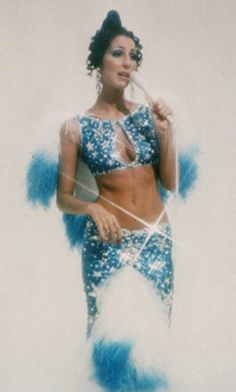
Now that Cher had a production budget, she hired Mackie to design splashy costumes for the “Sonny & Cher Comedy Hour” (1972-1975) as well as for many later productions. A collaboration that lasted forty-two years was born. From then on, Mackie designed clothes for Cher that left viewers with no doubt that Cher was all girl. With Bob Mackie in charge of Cher’s wardrobe, it was, all of a sudden,

Goodbye, baggy blouses and bell-bottom britches!

and

Hello, belly-buttons, bottoms, and bosoms!

Mackie outfitted Cher as a Native American princess for 'The Sonny and Cher Comedy Hour' television show.

Mackie outfitted Cher as a Native American princess. Photo ca. 1973.

Cher in her 'Half Breed'outfit 1973

Cher’s song, “Half-Breed,” topped the Billboard charts for the week ending October 6,1973. Here she is shown debuting the song on “The Sonny and Cher Comedy Hour.” She wears a Bob Mackie original costume: a headdress decked out in feathers, a sequined halter top, and a loin cloth that reached down to her platform shoes. Photo ca. 1963

Mackie transformed Cher from a shapeless hippie into a shameless sexpot. He created outlandish-for-the-day, navel-baring outfits bedecked with beads, sequins, and feathers topped off by enormous headdresses. Her skimpy outfits made the network censors question whether or not they were appropriate for prime time television. Cher’s bronzed and taut midriff was enviable.

Mackie had the time of his life designing for Cher:

 ‘She was like a big Barbie doll,’ he said. (1)

Cher 1975 B Mackie for tv special

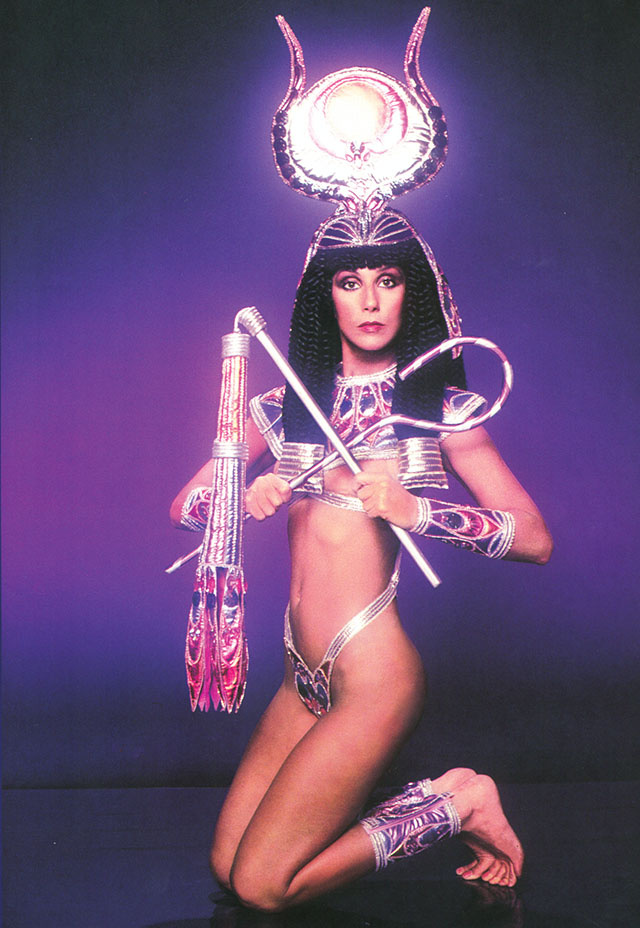
Cher channels the Egyptian goddess Isis in this Bob Mackie costume designed for a 1975 TV special.

Cher’s TV shows were popular, as she was a talented singer, comedienne, and actress, but part of the reason she became such a towering success was because people tuned into her programs each week to see what she would OR WOULDN”T be wearing. And Cher never disappointed – thanks to Bob Mackie.

Cher began to make fashion statements on the red carpet, appearing at celebrity functions in “barely there” outfits by Mackie.

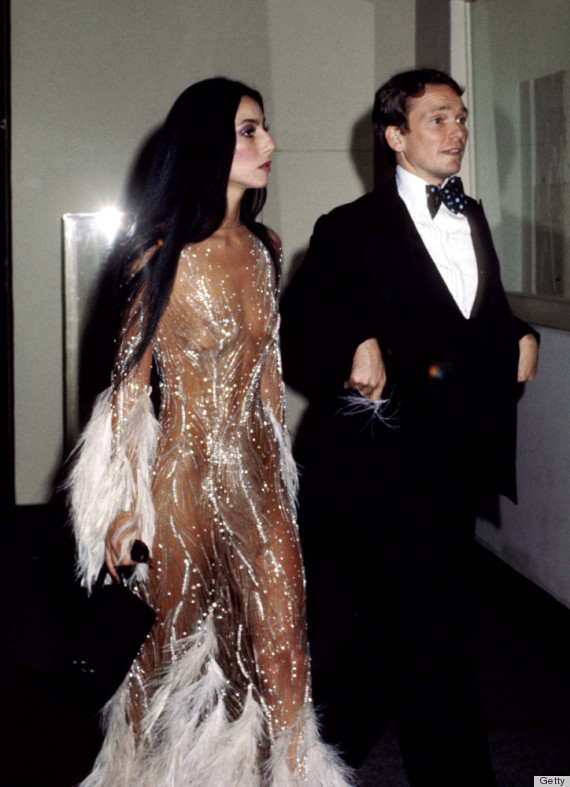
Cher and her designer Bob Mackie arrive at a Met gala, 1974. She is wearing a Mackie bodysuit embroidered with feathers and crystals. Mackie said of his muse, "She had such an unbelievable body. She could wear anything." This outfit would be featured on the cover of "Time" magazine the following spring. (1)

Cher and her designer Bob Mackie arrive at a Met gala, 1974. She is wearing a Mackie bodysuit embroidered with feathers and crystals. Mackie said of his muse, “She had such an unbelievable body. She could wear anything.” This outfit would be featured on the cover of “Time” magazine the following spring. (1)

Cher arrives at the 1974 Academy Awards wearing a Bob Mackie design.

Cher arrives at the 1974 Academy Awards wearing a Bob Mackie design.

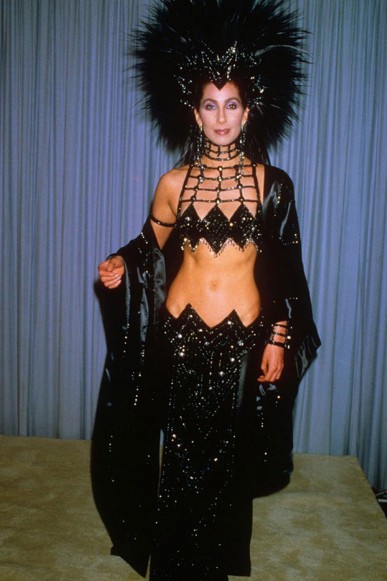
Cher was miffed that she wasn't nominated for her 1985 starring role in the film, "Mask," prompting her to appear in her role as an award presenter in this provocative Mackie number. 1986

Cher was miffed that she wasn’t nominated for her 1985 starring role in the film, “Mask,” prompting her to appear in her role as an award presenter in this a provocative Mackie design that challenged the Academy’s dress code. 1986

Source:

(1) Barnard, Christopher. “Cher’s One-of-a-Kind Fashion Legacy,” November 10, 2010.  Vanity Fair. Web Exclusive.

READERS: For more Bob Mackie posts, click here.

Read Full Post »

In the 1950s, Audrey Hepburn's face was plastered on magazines across the globe. She was a big hit. She was fresh. Harper's Bazaar, 1956

In the 1950s, Audrey Hepburn’s face was splashed on magazines across the globe. She was a big hit. She was fresh. She had style. Harper’s Bazaar, 1956

Readers, at the beginning of this year, I had entertained the idea of writing a juvenile biography of Audrey Hepburn (1929-1993) and the five years she spent in Nazi-occupied Holland as an underground resistance worker. Having read many biographies on Audrey, I was familiar with the yarns about her being a courier for the Dutch Resistance movement against the German occupation and participating in clandestine dance performances to raise money for the cause.

I must say that, after scouring tons of resources -bios, interview transcripts, old Hollywood magazine articles – I am not sure that Audrey actually participated in any underground activities to fight back against the Germans. To begin with, she was only eleven years old when the war started and sixteen when it ended. Her name does not appear – nor does her mother’s – on any government list of resistance activists.

Audrey’s Real World War II Experience

The fact that Audrey did not work in the Dutch Resistance in WWII should not detract from the knowledge that the war took a great toll on Audrey’s physical, mental, and emotional health. She suffered from the horrors of war like any other citizen in a war zone. Germans were everywhere with guns with bayonets and barking attack dogs. Everyone’s liberties were restricted. There was no way to get real news as the newspapers were controlled by the Nazis and filled with propaganda. The BBC in England broadcast reliable news but the Nazis confiscated radios. Audrey saw people executed in the streets and Jewish families loaded into cattle cars bound for death camps.

German Nazis round up Dutch Jews for deportation to Poland's death camps. WWII. Photo undated.

German Nazis round up Dutch Jews for deportation to Poland’s death camps. WWII. Photo undated.

One of her brothers went into hiding to avoid being deported to a German labor camp. The other brother was deported to Germany. Her own uncle was arrested, imprisoned, then murdered as a reprisal against saboteurs. Sometimes 900 planes a day flew over Arnhem, German, American, and British planes, often engaging in wicked dogfights and crashing nearby. The Battle of Arnhem raged in the streets of the city and outlying towns.

In the winter of 1944-1945, 20,000 Dutch people died of starvation. There was no food to eat. Schools shut down. The trains were not running so no food was being delivered.  The people subsisted on a diet of 500 calories a day. They were reduced to eating bread made from flour from crushed tulip bulbs.  That “Hunger Winter,” there was no wood to build a fire to warm even one room in the house. It was a very desperate time, with the Germans taking over people’s houses and forcing large groups of people to huddle together in small dwellings.

Dutch people strip the tram rails out of the street to use for firewood. This was the last year of the war, a desperate time of scant food and resources known at "The Hunger Winter," 1944-45.

Dutch people strip the tram rails out of the street to use for firewood. This was the last year of the war, a desperate time of scant food and resources known at “The Hunger Winter,” 1944-45.

Audrey almost died from starvation. Her body, adolescent at the time, did not develop adequately and never fully recovered from the deprivations. Her rib cage was underdeveloped, and she suffered from an eating disorder all her life. She was so malnourished that her ankles swelled up and she could barely walk. She retained stretch marks on her ankles from where the skin was stretched from the edema. She suffered from anemia and respiratory problems, too.

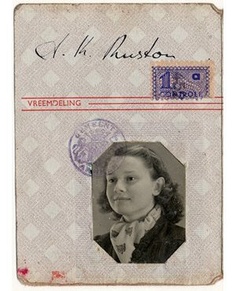
Nazis required all Dutch people over the age of 15 to carry an i.d. card. Here is Audrey's at age 15. Her card doesn't bear the dreaded letter, J, for Jew, which would mark her for deportation to the east for gassing at Auschwitz. 1944

Nazis required all Dutch people over the age of 15 to carry an i.d. card. Here is Audrey’s at age 15. Her card doesn’t bear the dreaded letter, J, for Jew, which would mark her for deportation to the east for gassing at Auschwitz. 1944

For a long time after the war was over, she had no stamina. She would go on eating binges, as she herself said: she couldn’t just eat one spoonful out of the jelly jar. She had to eat and eat until the jar was empty! She would then get fat, then diet herself back to rail thinness so she could compete in the worlds of ballet, modeling, stage, and screen. She forever was nervous, adored chocolate most of all, worked hard, and chain smoked, dying of cancer at the relatively young age of 63.

What They Tried to Make us Believe about Audrey’s War Time

In interviews, Audrey did not volunteer that she was a resistance worker. She didn’t really talk about the war days. Those stories were mostly generated in the fifties by her Hollywood publicists, largely appearing in popular magazines such as Modern Screen and Photoplay. Although the stories were mostly false, they entered the public lore, were repeated in article after article, and thus acquired an undeserved air of authenticity. Some of the stories include:

  •  Audrey helped a downed Allied pilot in the woods. She encountered a German patrol on the way and pretended to just be picking flowers.
  • Audrey was almost deported by the Germans.
  • Audrey hid in a basement for a month with only a few apples to eat to avoid being picked up by a Nazi patrol who wanted her for a cook.
  • Audrey delivered illegal newspapers on her bicycle.
  • Audrey danced in blacked-out homes to an audience that didn’t clap for fear they would be discovered by the Nazis (Audrey claims this part is true; how many times did she do it, though, once? Also, her ballet teacher was a Dutch Nazi, so I doubt she would have approved of Audrey dancing for the Resistance.)

However, this resistance worker that braved life and limb for country and kin did not exist except in magazine articles. That Audrey Hepburn was a invention of Hollywood’s.

The irony is that Audrey’s World War II experience needed no embellishment. It is a tale of great endurance, of courage in the face of daily fear.

The lies about her involvement with the Dutch Resistance weren’t Audrey’s fault. Myth making was show business in the fifties. Hollywood wanted control. Hollywood wanted its leading ladies squeaky clean and, if they could keep her that way, Audrey was going to be a big star.

February 12, 1952 Look Magazine featuring rising Hollywood star, Audrey Hepburn

February 12, 1952 Look Magazine featuring rising Hollywood star, Audrey Hepburn

The Hollywood image machine went into overdrive creating the myth of Perfect Audrey, the Resistance Worker, to cover up the embarrassing truth about her past and her roots. They claimed her father was an international banker (a lie) and that her mother was a Dutch noblewoman (which was true, but no one mentioned that she liked rich playboys). Hollywood created this myth because Audrey Hepburn had a lot of skeletons rattling around in her closet. As it turns out, her parents – the Dutch Baroness Ella van Heemstra and her British husband Joseph Anthony Ruston — did some very bad things with some very bad people before and during World War II. And neither of them was a decent parent to little and lovely Audrey.

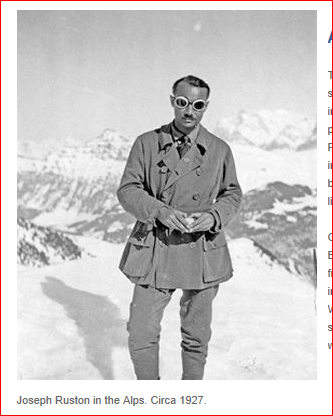
Audrey Hepburn's father in the Alps, 1927: Joseph Anthony Victor Ruston (later Hepburn-Ruston)

Audrey Hepburn’s father in the Alps, 1927: Joseph Anthony Victor Ruston (later Hepburn-Ruston)

The Dutch Baroness Ella van Heemstra and daughter, Audrey Ruston (Hepburn) ca. 1935

The Dutch Baroness Ella van Heemstra and daughter, Audrey Ruston (Hepburn) ca. 1935

In 1953, Audrey won the Best Actress Oscar for her debut American film, “Roman Holiday.”

Even a hint of scandal would have jeopardized Audrey’s budding career; Americans had no stomach for Nazis. So the Hollywood image makers hid the truth.

What Her Parents Were Really Like

The truth can now be told: Audrey’s parents were devotees of the notorious British fascist, Sir Oswald Mosley, a Hitler wannabe, whose followers were called the Blackshirts (the British Union of Fascists or BUF). Mosley, like Hitler, blamed the Jews for all the problems Britain faced. There was no truth to this monstruous lie, but this is how fascists always derive their short-term power, by turning one group of citizens against another.

ad Mosley Speaks October 29, 1938_ACTION. No. 141, Page EfcvcrtIn October 1934, Mosley was losing steam politically so, in order to keep his following and funding, he ramped up the anti-Semitic rhetoric. At the Albert Hall in London, he addressed a huge crowd, saying,

I openly and publicly challenge the Jewish interest in this country commanding commerce, commanding the press, commanding the cinema, commanding the City of London, commanding sweatshops.” (1)

Oswald Mosley and his Blackshirts march to stir up hatred against British Jews and Communists. 1936

Oswald Mosley and his Blackshirts march to stir up hatred against British Jews and Communists. 1936

What Audrey’s Parents Did for Her Sixth Birthday

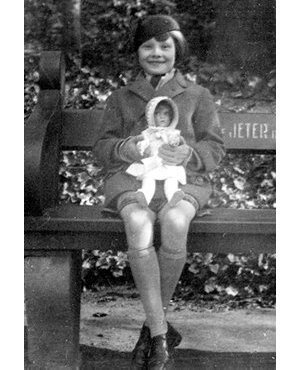
Audrey Ruston (Hepburn) ca. 1936

Audrey Ruston (Hepburn) ca. 1936

Audrey Ruston Hepburn turned six years old on May 4, 1935, in Brussels, Belgium, but neither of her parents were there with her to celebrate. Ella and “Joe” were touring Germany with a delegation from Mosley’s BUF. They were there to observe what a wonderful job the Nazis had done in restoring the German economy. Along with the infamous Unity Mitford of England, Hitler’s lackey, they toured autobahns, factories, schools, and housing developments.

Adolf Hitler and British citizen and devotee, Unity Mitford. photo undated, ca. 1938

Adolf Hitler and British citizen and devotee, Unity Mitford. photo undated, ca. 1938

Then Audrey’s parents met Hitler himself at the Nazis’ Brown House headquarters in Munich. A photo was taken of Ella in front of the Brown House, showing her with her friends Unity and Pam Mitford. Upon her return, Ella put the photo in a silver frame and displayed it proudly in her home.

Shortly after Audrey’s parents returned from Germany, her father and mother had a terrible argument. Audrey’s father walked out on the family, leaving her, her mother, and her two half-brothers to fend for themselves. (This was Ella’s second marriage). Some said Joe was a big drinker and that had caused the split-up. Others said he was a womanizer, with a lover or two on the side. Worse, it was rumored that the Dutch Queen Wilhelmina had spoken to Ella’s father, the Baron, about Joe’s embarrassing politics and told him to tell Ella to end the marriage.

Chances are, though, that Joe just wanted to be free of domestic entanglements to pursue his rabid anti-Communist agenda. At that time, he was very active in the Belgian fascist party, the Rexists. He would soon divide his time between Belgium and England.

Audrey remembers her mother sobbing for days on end, mourning the loss of yet another husband. But Ella must have recovered herself fairly quickly because, four months later, she was back in Germany with the Mitford sisters, this time, to witness the military pageantry of a Nuremberg Rally (and have a quick fling with the sexy and much younger journalist Micky Burn).

British citizens at the Nuremberg Rally, Germany, ca. 1935-35. Second from left is Diana Mitford, who marries Sir Oswald Mosley. Third from left is journalist Michael ("Micky") Burn.

British citizens at the Nuremberg Rally, Germany, ca. 1935-35. Second from left is Diana Mitford, who marries Sir Oswald Mosley. Third from left is journalist Michael (“Micky”) Burn.

Upon her return to Brussels, Ella wrote a gushing editorial in The Blackshirt, extolling Hitler’s virtues:

At Nuremberg…What stuck me most forcibly amongst the million and one impressions I received there were (a) the wonderful fitness of every man and woman one saw, on parades or in the street; and (b) the refreshing atmosphere around one, the absolute freedom from any form of mental pressure or depression.

These people certainly live in spiritual comfort….

From Nuremberg I went to Munich….I never heard an angry word….They [the German people] are happy….

Well may Adolf Hitler be proud of the rebirth of this great country…” (2)

Ella’s article appeared in column two of The Blackshirt. To its right, in column three, appeared this anti-Jewish propaganda fiction purportedly written by someone named “H. Saunders”:

I walked along Oxford-street, Piccadilly, and Coventry-street last Saturday and I thought I had stepped into a foreign country.

A Jew converted to Christianity becomes a hidden Jew, and a greater menace. Jews have conquered England without a war….” (2)

What Ella did Next

In 1939, Baroness Ella van Heemstra, now divorced, moved with Audrey to Arnhem, the Netherlands, where her parents lived. Ella’s noble and esteemed father, A.J.A.A. Baron van Heemstra, had been the mayor of Arnhem from 1910-1920.

Audrey’s maternal grandparents, Baroness Elbrig van Asbeck and Baron Aernoud van Heemstra, pictured in Suriname (the Dutch East Indies) where the Baron was governor 1920-28.

Then, in May 1940, the Nazis invaded the Netherlands. Ella and Audrey would spend the entire war years in Arnhem, (1940-1945) yet they would not live with Audrey’s grandparents much of the time.

In May 1940, the Nazis invaded the Netherlands. Sadly, there were Dutch citizens sympathetic to the Nazi Party. Here they provide the invading troops with the Nazi salute. These Nazi sympathizers were called "NSBers." They were collaborators and were always spying for the Nazis. May 1940

In May 1940, the Nazis invaded the Netherlands. Sadly, there were Dutch citizens sympathetic to the Nazi Party. Here they provide the invading troops with the Nazi salute. These Nazi sympathizers were called “NSBers.” They were collaborators and were always spying for the Nazis. May 1940

Although he had, at an earlier time, been somewhat pro-German in his outlook, the Baron van Heemstra had changed his views. When the Nazis occupied Arnhem, they tried to coerce him to become the director of a disgraceful charity called Winterhulp. However, the Baron refused the post. Stung, the Germans struck back. As a reprisal, early in 1942, they confiscated many of his lands, houses, bank accounts, stocks, and even jewelry. German soldiers were quartered in his grand home at Zijpendaal and he was forced to move to his country homes in the small villages of Velp and Oosterbeek.

Castle Zijpendaal (or Zypendaal in Arnhem, the Netherlands. This was the home of Audrey's maternal grandparents.

Castle Zijpendaal (or Zypendaal) in Arnhem, the Netherlands. This was the home of Audrey’s maternal grandparents.

Ella, on the other hand, had none of her father’s integrity. She liked to drink and she liked to have a good time. The way she saw it, the Germans had all the good things that she lacked. Unlike the average Dutch person, the German officers drank real coffee and real tea and champagne. They had cars, too, and petrol to put in them, whereas the Dutch citizens couldn’t even take their bicycles out into the street without the Germans commandeering them. Ella liked the good life and the German officers could give it to her. She openly fraternized with them, having them into the family home, and going out with them in their cars, even crossing the border and driving into Germany for entertainment. She even organized a cultural evening in Dusseldorf, Germany, along with the regional head of the NSDAP (the Dutch Nazi Party). She was ruthless in pursuit of pleasure.

The illegal press of the Dutch Resistance suspected the Baroness of being an agent for the Gestapo (the Nazi secret police). She worked for the German Red Cross in the Diaconessenhuis (hospital) in Arnhem, nursing wounded German soldiers. Before the war, Ella had already displayed a Nazi swastika and a German eagle on the wall of her house in Arnhem. (3) She was the worst of the worst. And this is the home and the atmosphere in which she raised sensitive Audrey.

Hatred ran so high against the van Heemstra family – because of Ella’s Nazi sympathies and her collaboration with the Germans – that, when the Allies liberated Arnhem in May, 1945, the Baron had to hang his head in shame. He felt compelled to leave town and move to the Hague. (4)

Ella van Heemstra and Audrey Hepburn, ca. 1946.

Ella van Heemstra and Audrey Hepburn, ca. 1946.

With the war behind them, Ella concentrated her energies in forging ties with people who could further daughter Audrey’s career in becoming a prima ballerina, then a model, followed by a film star. They lived in Amsterdam for a time and then The Hague before settling in London.

Audrey Hepburn as a model. 1952

Audrey Hepburn as a model. 1952

What Joe Had Been Doing

Meanwhile, in the time since Audrey’s father had left his family, he had managed to get in a lot of legal and financial trouble. From 1935-1940, “Joe” Ruston was involved in multiple questionable business transactions that kept landing his name in the news in the Netherlands, England, and Belgium. In 1938, for example, he was being investigated by both the Belgium Parliament and the British House of Commons for his involvement in a corporation with financial ties to the Third Reich:

Mr. Anthony Ruston, a director of the European Press Agency, Ltd. [was] alleged in the Belgian parliament to have received £110,000 from German industrial chiefs in close touch with Dr. Goebbels [Nazi propaganda minister] to publish an anti-communist newspaper.” (5)

His two business partners at the European Press Agency were a Nazi lawyer and a member of the Gestapo.

Curiously, a year later, Anthony Ruston officially renounced and abandoned the name Anthony Joseph Victor Ruston and adopted the new name of Anthony Joseph Victor HEPBURN-Ruston. (6) Ruston claimed to have had a Hepburn relative with blood ties to James Hepburn, 4th Earl of Bothwell, the fourth husband of Mary, Queen of Scots. But the claim was bogus. True, there was a marriage to a Hepburn in his family line but there was no issue of which Ruston is kin.

Perhaps Ruston was attempting to prove his Britishness by connecting himself with a Scottish king. War clouds were gathering over Britain and Ruston was in hot water for his connections with Germany.

In June 1940, the Battle of Britain had begun, and England was earnestly at war with Germany. Anthony Ruston was arrested and imprisoned in England under Defense Regulation 18B, as he was considered an enemy of the state for his membership in “the British Union of Fascists…and as an associate of foreign fascists.” (7) He was interned for the duration of WWII, after which he settled in Ireland.

Sources:

(1) Dalley, Jan. Diana Mosley: A Biography of the Glamorous Mitford Sister who Became Hitler’s Friend and Married the Leader of Britain’s Fascists. New York: Alfred A. Knopf, 2000. p. 195

(2)At Nuremberg,” The Blackshirt, October 11, 1935.

(3) 1557 Documentatiecollectie Tweede Wereldoorlog. Inventory number 247 Audrey Hepburn.  Gelders Archive. Arnhem, the Netherlands.

(4) Heemstra, Aarnoud Jan Anne Aleid Baron (1871-1957). Huygens: Biographical Dictionary of the Netherlands. (online)

(5) “Banned Nazi Barrister ‘Plays Violin Beautifully,'” Daily Express, March 31, 1938. (Manchester, UK newspaper with leading circulation in the 1930s)

(6) The London Gazette, April 21, 1939.

(7) Public Record, reference # KV 2/3190. The National Archives, Kew, UK

For more on Audrey Hepburn, click here.

Read Full Post »

Katharine Hepburn from the Bryn Mawr College Yearbook 1928.

Katharine Hepburn from the Bryn Mawr College Yearbook 1928.

Alice Palache first met Hollywood actress Katharine Hepburn in 1924 when they were classmates at Bryn Mawr, an all-women’s liberal arts college near Philadelphia, Pennsylvania. The friends were a study in contrasts. “Palache,” as she was called, was popular, a great student, athletic, active in student council, and from a conventional home in which her dad, a Harvard professor and staunch Episcopalian, considered it sacrilegious for her to play with friends on Sunday. “Kath,” on the other hand, was a loner, one of the worst students in the class, and did whatever she pleased. She dressed as a boy, smoked scented cigarettes in her tower dorm room, and jumped into the cloister fountain – naked – to wake herself up after cramming all night for an exam.

This gallant good-time girl, her blazing red hair dragged back into a charwoman’s bun, wore baggy, unflattering cast-off clothes rumored to be held together with safety pins.”

Katharine Hepburn, age 21, performing in the dramatic production of "The Woman in the Moon," Bryn Mawr College, 1928

Katharine Hepburn, age 21, performing in the dramatic production of “The Woman in the Moon,” Bryn Mawr College, 1928

In their junior year, Kath invited Palache to visit her family home in Hartford, Connecticut. In between games of tennis, Kath and Palache spent time with Kath’s parents, Dr. Thomas Norval Hepburn and Mrs. Katharine (“Kate”) Houghton Hepburn. Both of Kath’s parents were highly-educated – Dad was a surgeon, Mom had 2 degrees from Bryn Mawr and was a prominent suffragette – and were militant public crusaders on the burning social issues of the day.

Dr. Thomas Hepburn and Katharine Houghton Hepburn, parents of Katharine Hepburn. Undated photo

Dr. Thomas Hepburn and Katharine Houghton Hepburn, parents of Katharine Hepburn. Undated photo

Katharine Hepburn's mother, Katharine Houghton Hepburn, was a prominent suffragette from Connecticut.

Katharine Hepburn’s mother, Katharine Houghton Hepburn, was a prominent suffragette from Connecticut. She is shown as “Mrs. Thomas N. Hepburn” in the photo at top center. Photo ca. 1925.

Dr. Hepburn’s dressing room was the center of the family home. Kath and Palache joined Dr. and Mrs. Hepburn there for  heated discussions. The family debated topics alien to Palache’s childhood home such as prostitution, venereal disease, and birth control. At times, Dr. Hepburn would be soaking in the tub during such discussions or, perhaps, shaving at the sink. The girls sat on a Queen Anne sofa in his dressing room as Dr. Hepburn would nonchalantly stride back and forth across the cork flooring wearing absolutely nothing.  Almost as shocking as the casual nudity – a naked man in his forties parading in front of his teenage daughter and her girlfriend – was Mrs. Hepburn’s attitude. When she would enter the room, she would hug and kiss her very naked husband, while declaring to the young women,

I find him beautiful,” while adding that the doctor “had no seat.”

Katharine Hepburn came from anything but a conventional home.

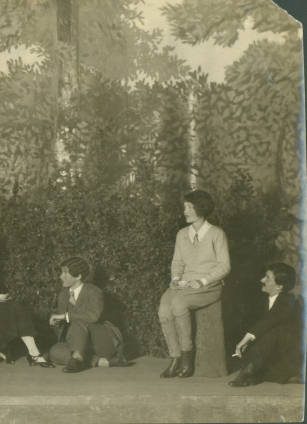
Katharine Hepburn, Bryn Mawr Class of 1928, is seen third from right in the dramatic production,"The Truth About Blayds," by A. A. Milne. At an all-girls college, Ms. Hepburn had the opportunity to play male as well as female roles.

Katharine Hepburn, Bryn Mawr Class of 1928, is seen third from right in the dramatic production,”The Truth About Blayds,” by A. A. Milne. At an all-girls college, Ms. Hepburn had the opportunity to play male as well as female roles.

Source: Leaming, Barbara. Katharine Hepburn. New York: Crown Publishers, Inc. 1995.

Source: Bryn Mawr College Archives Online

Read Full Post »

Diana Vreeland, Empress of Fashion, 1903-1989

Before her career as editor and columnist at fashion magazines Harper’s Bazaar and Vogue, Diana Vreeland, like other society women of her class, ran a little lingerie shop near Berkeley Square in London. She often traveled to Paris where she would buy her clothes, notably, Chanel. She remembered one such trip in the summer of 1932:

“One night in Paris, after I was married, a friend and I went to a little theatre above Montmartre to see a German[-French] movie called “L’Atlantide,” with a wonderful actress in it called Brigitte Helm, who played the Queen of the Lost Continent. It was the middle of July. It was hot. The only seats in the theatre were in the third balcony, under the rafters, where it was even hotter. There were four seats in a row, and we took two.

L'Atlantide poster 1932

“We sat there, the movie started…and I became totally intoxicated by it. I was mesmerized! …I was absorbed by these three lost Foreign Legion soldiers with their camels, their woes…they’re so tired, they’re delirious with dehydration…And then you see the fata morgana [mirage]. That means that if you desire a woman, you see a woman, if you desire water, you see water – everything you dream, you see. But you never reach it. It’s all an illusion.

“Then…a sign of an oasis! There’s a palm…and more palms. Then they’re in the oasis, where they see Brigitte Helm, this divine looking woman seated on a throne – surrounded by cheetahs! The cheetahs bask in the sun. She fixes her eyes on the soldiers. One of them approaches her. She gives him a glass of champagne and he drinks it. Then she takes the glass from him, breaks it, cuts his throat with it…

Brigette Helm as the Queen of Atlantis, the Lost Continent, shown here with one of her screen cheetahs.  "L'Atlantide" (1932)

Brigette Helm as the Queen of Atlantis, the Lost Continent, shown here with one of her screen cheetahs. “L’Atlantide” (1932)

“This goes on and on. I hadn’t moved an inch. At some point I moved my hand…to here…where it stayed for the rest of the movie. I was spellbound because the mood was so sustained. I was sucked in, seduced by this thing of the desert, seduced by the Queen of the Lost Continent, the wickedest woman who had ever lived…and her cheetahs!

The essence of movie-ism.

“Then…the lights went on, and I felt a slight movement under my hand. I looked down – and it was a cheetah! And beside the cheetah was Josephine Baker!”

Josephine Baker was a hit in Paris cabarets, singing, dancing, and goofing around. In the 1930s, she was the most successful American entertainer in Paris. She got rich fast and was a superstar. She is wearing her notorious silly but erotic banana skirt. ca. 1925

When Josephine Baker began performing her exotic, erotic, and peculiar dances in Paris cabarets in 1925, she became an instant hit, a superstar. In the thirties, she was the most successful American entertainer working in France. She was known as “The Black Pearl” and “The Bronze Venus.” Whether sitting high up in a giant bird cage covered with peacock feathers or dancing semi-nude in a skirt of dangling fabric bananas, audiences were captivated by her infectious charm. ca. 1925

Meanwhile, back to our story:

Diana Vreeland was chatting with Josephine Baker in the balcony of a hot theater, looking at a cheetah.

Diana says to Josephine:

“‘Oh,” I said, ‘you’ve brought your cheetah to see the cheetahs!’

“Yes,” she said,’ that’s exactly what I did.’

“She was alone with the cheetah on a lead. She was so beautifully dressed.  She was wearing a marvelous little short black skirt and a little Vionnet shirt – no sleeves, no back, no front, just crossed bars on the bias. Don’t forget how hot it was, and, of course, the great thing was to get out of this theatre we were in. The cheetah, naturally, took the lead, and Josephine, with those long black legs, was dragged down three flights of stairs as fast as she could go, and that’s fast.

“Out in the street there was an enormous white-and-silver Rolls-Royce waiting for her. The driver opened the door; she let go of the lead; the cheetah whooped, took one leap into the back of the Rolls, with Josephine right behind; the door closed…and they were off!

…Ah! Style was a great thing in those days.” (1)

American entertainer Josephine Baker (1906-1936) often performed onstage in Paris nightclubs with pet cheetah Chiquita. Chiquita wore a diamond collar. Sometimes, during a performance, Chiquita would decide to jump off the stage and into the orchestra pit, causing quite a ruckus. Early 1930s. Courtesy of Victoria and Albert Museum.

American entertainer Josephine Baker (1906-1936) often performed onstage in Paris nightclubs with pet cheetah Chiquita. Chiquita wore a diamond collar. Sometimes, during a performance, Chiquita would decide to jump off the stage and into the orchestra pit, causing quite a ruckus. ca. 1931. Courtesy of Victoria and Albert Museum.

Heads turned when entertainer Josephine Baker took her pet cheetah Chiquita on a walk, sometimes down the Champs-Élysées in Paris. Ca. 1930

Heads turned when entertainer Josephine Baker took her pet cheetah Chiquita on a walk, sometimes down the Champs-Élysées in Paris. Ca. 1930

Sheet music with Josephine Baker and Chiquita

Sheet music with Josephine Baker and Chiquita.

Comparing Josephine Baker to a beautiful Egyptian queen,  artist Pablo Picasso dubbed her “the Nefertiti of Now.” She posed for him in all her glory: “tall, coffee skin, ebony eyes, legs of paradise, a smile to end all smiles.” (2)

Gorgeous, talented, and funny Josephine Baker, an original. Undated photo, ca. 1930

Gorgeous, talented, and funny Josephine Baker, an original. Undated photo, ca. 1930

(1)Vreeland, Diana. D.V. New York: Da Capo Press, 1984

(2) Picasso quote


Read Full Post »

Elizabeth Taylor, age 44, the year she married John Warner. April 1976. Photo: Henry Wynberg

Elizabeth Taylor, age 44, the year she married John Warner. April 1976. Photo: Henry Wynberg

Elizabeth Taylor (1932-2011) was willing to do almost anything to get her seventh husband, Virginia lawyer John Warner, elected to the U.S. Senate in 1978.  To woo voters and the Republican Party leaders, Elizabeth had to prove to be an asset to the campaign. She had to make the transformation from movie queen to political wife. (Readers: For how they got together, read the previous post.)

During their brief courtship, Warner was given cause to worry that she could not make the leap. He recalled inviting Elizabeth to lunch with him in Washington, D.C.. Looking forward to showing her off, he was embarrassed when she appeared at the Bicentennial office (where he was director)

wearing a flowing black silk pajama outfit with a low-cut neckline.” (1)

Then there were her showy jewels, for example, an “eye-popping necklace of…egg-sized canary diamonds and amethysts as big as her fist.” Elizabeth promised her husband she would dress down, cutting down on the diamonds and the décolletage, opulence that would not go over big with plain Southern Virginia folk.

At a British Embassy reception, Queen Elizabeth II of England gets a look at Elizabeth Taylor's famous jewels: the Bulgari Vladimir Suite of emeralds and diamonds from her soon-to-be-ex-husband, Richard Burton. July 1976

At a British Embassy reception, Queen Elizabeth II of England gets a look at Elizabeth Taylor’s famous jewels: the Bulgari Grand Duchess Vladimir Suite of emeralds and diamonds from her soon-to-be-ex-husband, Richard Burton. July 1976

The Grand Duchess Vladimir Suite of emeralds and diamonds, once part of the Elizabeth Taylor Collection

The Grand Duchess Vladimir Suite of emeralds and diamonds, once part of the Elizabeth Taylor Collection

Besides sacrificing her fashion sense, Elizabeth would set her career aside during this period, appearing in only a handful of films and, then, mostly in cameo roles, requiring only a short stint away from the campaign.

Elizabeth Taylor, age 44, wears her signature color, purple, to match her violet eyes. 1977

Elizabeth Taylor, age 44, wears her signature color, purple, to match her violet eyes. 1977

Then there were her friends of the moment, the hard-partying, cocaine-sniffing crowd of the notorious New York disco Studio 54: Liza Minnelli, fashion designer Halston, Andy Warhol, Bianca Jagger. Warner steered her away from hanging out with them at the club (although she did install a discotheque at the farm for entertaining them).

Elizabeth Taylor dances with her fashion designer friend Halston at Studio 54. Note that Elizabeth wears a purple pantsuit. Feb. 1978

Elizabeth Taylor dances with her fashion designer friend Halston at Studio 54. Note that Elizabeth wears a purple pantsuit. Feb. 1978

Self-restraint, too, was called into play, if Elizabeth was going to help Warner hit a home run, for Elizabeth was a hot-blooded woman, prone to hard-drinking, cursing, and screaming at photographers trying to shoot her from uncomplimentary angles.

In January, 1977, weeks after returning from honeymooning in Switzerland, Elizabeth and John hit the campaign trail with an appearance at the Hearts of Gold Ball in Richmond, which they reached by Greyhound bus. From here on out, for Elizabeth, it would be a 23-month slog of kissing babies, speechifying, ribbon-cutting, riding in parades, chairing galas, raising funds, eating corn-on-the cob at county fairs, signing autographs, hurling cream pies, and pinning Warner buttons on Democrats. If a college campus had a drama department, she held a seminar for the students and allowed friendly question and answer sessions, unscripted, with no retakes, to which she was accustomed on a movie set. Toward the end of the race, she and Warner put in 12-15 hour days, riding in planes, buses, cars, and trains to reach their destinations.

John Warner and Elizabeth Taylor in her favorite purple pantsuit by Halston. 1977

John Warner and Elizabeth Taylor in her favorite purple pantsuit by Halston. 1977

Large, enthusiastic crowds turned out to see Elizabeth, accessible to them, no longer protected by bodyguards, as  in her movie stardom days. She shook so many hands that, one day, two blood vessels broke in her hand. That did not slow her down. She continued to shake hands, though her hand was swollen and protected by an elastic bandage. Elizabeth’s bursitis flared up in her shoulder from such rigorous handshaking. She received cortisone injections to help with the pain. Sometimes she campaigned in a wheelchair. But she kept going. She did it because

‘They come to see my wrinkles and pimples, and I don’t disappoint them, do I?’ she laughed. ‘This face has been around a lot of years. People want to see if my eyes really are violet or bloodshot or both. Once they check me out, they can go home and say, ‘I saw Liz Taylor and you know what? She ain’t so hot!'” (1)

At almost every campaign stop, Elizabeth Taylor look-alikes would show up, in big wigs and evening gowns.

Unfortunately, a lot of the people who showed up at rallies came to see if Elizabeth was as obese as it was being reported in the press. The strain of the campaign was beginning to take its toll on her. Her weight had ballooned and she was drinking booze in excess and eating way too much. Joan Rivers was regularly lampooning her with fat jokes on  “The Tonight Show“:

Every time Liz Taylor goes into McDonald’s, the numbers on the sign outside start changing. When she looks up and see five billion, she thinks it’s her weight.”

John Warner and Elizabeth Taylor, ca. 1978

John Warner and Elizabeth Taylor, ca. 1978

Elizabeth was affected by such cruel commentary. Nevertheless, she continued eating and drinking herself into oblivion. Dinner guests reported seeing her eat, in one sitting, mounds of mashed potatoes drowned in gravy, followed by five rich desserts and countless bottles of champagne. (2) In her defense, she remarked:

‘I am not a monument that pigeons can doo-doo on. I am a living human being, and if I want to eat fried chicken six times a day and can still function, that’s up to me!'” (1)

Elizabeth Taylor and John Warner campaign for the U.S. Senate seat. June 2, 1978

In August, 1978, John Warner became the Republic nominee for the U.S. Senate seat from Virginia, when the original nominee was suddenly killed.

John Warner became the Republican nominee for the 1978 U.S. Senate race by a strange circumstance. Richard Obenshain was the nominee but he died in a plane crash. John Warner and wife Elizabeth Taylor are shown here at Obenshain's funeral. Aug. 5, 1978. Photo: Don Long, Richmond Times Dispatch

John Warner became the Republican nominee for the 1978 U.S. Senate race by a strange circumstance. Richard Obenshain was the nominee but he died in a plane crash. John Warner and wife Elizabeth Taylor are shown here at Obenshain’s funeral. Aug. 5, 1978. Photo: Don Long, Richmond Times Dispatch

The general election was on November 7; there were three months to go. The strain of the long and grueling campaign trail was apparent in both of them; tempers frayed and Elizabeth kept eating, eating, and then eating some more. Some campaign leaders worried that Elizabeth’s star appeal was overshadowing the candidate. They considered removing her from the campaign.

On October 12, 1978, three weeks before the election, Elizabeth was to suffer one of the many freak accidents for which she was known. She appeared at a rally at Big Stone Gap, Virginia. The whole countryside was in a dither to see her.

Elizabeth Taylor wore her purple silk Halston pantsuit accessorized with a sumptuous gold necklace studded with amethyst stones the size of cookies and matching drop earrings encrusted with pearls. She had tucked a small bouquet of fresh violets behind one ear. She posed for photo after photo with a smile that was genuine.

Elizabeth Taylor and John Warner, center, pose at a campaign rally in Big Stone Gap, Virginia. Oct. 12, 1978

Elizabeth Taylor and John Warner, center, pose at a campaign rally in Big Stone Gap, Virginia. Oct. 12, 1978. Note the purple Halston pantsuit Elizabeth is wearing.

Later that evening, John and Elizabeth stopped for a chicken dinner at Fraley’s Coach House, where Elizabeth took a bite of a fried chicken breast and accidentally swallowed a two-and-a-half inch bone. The bone lodged in her throat. She clutched her neck, barely able to breathe. She tried to cough it up, but in vain. She stuffed some rolls into her mouth to try to push the bone down her throat but it didn’t work. It was clear that she was choking to death. (3) She was rushed to Lonesome Pine Hospital, where a thoracic surgeon inserted a rubber hose down her throat and stuffed the bone down where it dissolved in digestion. She was overnight in the hospital. The next day, she made the headlines:

‘ACTRESS NEARLY CHOKES AT CAMPAIGN RALLY,’ screamed The Washington Star.

Elizabeth Taylor is assisted by her husband, John Warner (r.) as she returns from a hospital stay in Richmond, Va. Oct. 13, 1978

Elizabeth Taylor is assisted from an airplane by her husband, John Warner (r.) as she returns from a hospital stay in Richmond, Va. Oct. 13, 1978

Strangely, it was about this time that a delegation of women who ran the Warner campaign chose to approach Elizabeth and inform her that she could no longer wear purple to John’s rallies. Everyone knows that purple was her signature color. Her legendary eyes were violet. In a 1997 interview with Kevin Sessums, Elizabeth recalled:

‘If the woman is the politician, then it might be quite different. But if you’re wedded to the politician, it’s like your lips are sealed. You are a robot. They even tell you what you can wear. You can imagine how that sat with me! I was told that I—me!—was not allowed to wear purple because it smacked of royalty.’ 

She told Harper’s Bazaar:

‘The Republican women told me, ‘You simply cannot wear the purple pantsuit you’ve been campaigning in anymore.’ I ended up in a tweed suit. Me. Little tweed suits. What I won’t do for love.'”

Twelve days before the U.S. Senate election,Republican women crowd around Elizabeth Taylor Warner at the Meadowbrook Country Club, Richmond. Va.  Oct. 26, 1978.

Twelve days before the U.S. Senate election,Republican women crowd around Elizabeth Taylor Warner at the Meadowbrook Country Club, Richmond. Va. Oct. 26, 1978.

On November 7, John Warner squeaked to victory. Out of 1.2 million votes, he was elected to the U.S. Senate from Virginia by only 4,271 votes.  He could not have done it without Elizabeth. Some say that the chicken bone incident moved the public to sympathy for her, swinging the vote in Warner’s favor. Elizabeth joked later

‘I seem to have at least 4, 271 fans in Virginia, so at least I know I pulled my own weight!'” (2)

After the election, the Republican women threw Elizabeth a luncheon in her honor, for all she had done in the campaign. In her Kevin Sessums interview, Elizabeth said she

…put on my purplest Halston pantsuit. I told them the story that the women who ran John Warner’s campaign had forbid me to wear purple. I got up and pointed out one specific woman. I said, ‘That one! Right there!'”

The subjugation of her own ego to John’s for two full years damaged Elizabeth’s self-esteem. There were few movie roles for an aging beauty, especially a puffy one. Elizabeth Taylor, movie star, had lost her self-identity.

John and Elizabeth moved to Washington, D.C., where, on January 16, 1979 in the gallery of the U.S. Senate, John was sworn in with Elizabeth and her mother in attendance. Things looked rosy for the couple at that moment. John and Elizabeth threw each other big Hollywood kisses, but John immediately became consumed by his new job, declaring he would never miss a roll call. Elizabeth was left alone for long stretches of time in their Washington home or Virginia farmhouse, consoling herself with massive quantities of Jack Daniels and chili dogs. She resorted to trips to New York to hang out at Studio 54. Elizabeth liked to have a man around and John wasn’t there for her. Whereas John may have loved Elizabeth, he loved work more.

Elizabeth Taylor, center, hangs out at Studio 54 with singer Liza Minnelli (l.) and First Lady Betty Ford (r.). 1979

Elizabeth Taylor, center, hangs out at Studio 54 with singer Liza Minnelli (l.) and First Lady Betty Ford (r.). 1979

Elizabeth had married John Warner in the hopes that he would give her the roots (and a private life) that she had longed for so much in her hurried life. Instead, she had spent the first two years of their marriage on the campaign trail and in the public eye more than before, if that is possible. Her life was more stressful than ever. As a star, she was used to crushingly cruel movie reviews but nothing could have been as brutal as the punishing ridicule she had received from the media for her weight gain.

Though these years were painful for Elizabeth – she and John Warner would divorce after six years of marriage – her worsening addiction to alcohol, pain pills and food would put her feet firmly on a path that led, in 1983, to a life-changing stay at the Betty Ford Clinic. A new Elizabeth Taylor would emerge from the famous rehab: a savvy and respected politician who would use her high profile celebrity to raise mega millions to combat the deadly disease, AIDS, by creating AMFAR.

Elizabeth Taylor, age 55, looking healthy and trim. 1987

Elizabeth Taylor, age 55, looking healthy and trim. 1987

(1) Kelley, Kitty. Elizabeth Taylor: The Last Star. New York: Simon & Schuster, 1981.

(2) Heymann, C. David. Liz: An Intimate Portrait of Elizabeth Taylor. New York; Simon & Schuster, 1995.

(3) Taraborrelli, J. Randy. Elizabeth. New York: Grand Central Publishing, 2006.

Readers: For more on Elizabeth Taylor, click here.

Read Full Post »

Engaged to be married, Elizabeth Taylor and John Warner visit his alma mater, Washington and Lee, as well as visiting nearby Virginia Military Institute. November 11, 1976

Engaged to be married, Elizabeth Taylor and John Warner visit his alma mater, Washington and Lee, as well as visiting nearby Virginia Military Institute. November 11, 1976

They made their debut as a couple at the Virginia Military Institute, Lexington, on Founders’ Day on November 11, 1976, where John Warner gave a speech and Elizabeth Taylor looked up adoringly at her fiancé – rugged yet stately, tall, muscular, with “marvelous silver hair.” John then introduced Elizabeth, who promptly stood up and saluted the cadets. The men temporarily forgot their military bearing and tossed their hats up into the air.

John Warner had been appearing at functions around Virginia, testing the political waters for a possible U.S. Senate run in 1978. Elizabeth’s name recognition lent star power to his possible candidacy, raising his political profile.  He amused audiences with this oft-repeated anecdote:

I feel just like Ben Franklin. He was born in Boston. Moved to Philadelphia. Met a lady on the street. They got engaged. And then he discovered electricity. Ladies and gentleman,’ he would conclude, turning toward wife Elizabeth, “allow me to share some electricity with you.” (1)

Elizabeth Taylor, 44, and John Warner, 50, prior to their marriage, December 1978.

Elizabeth Taylor, 44, and John Warner, 50, prior to their marriage, December 1978.

Elizabeth was bowled over by Warner from the start, when he was her blind date to a British Embassy ball in honor of Queen Elizabeth II of England on July 8, 1976. Elizabeth was in the middle of a second bruising divorce from Richard Burton. Three years earlier, Warner had divorced Catherine Mellon, the daughter of billionaire Paul Mellon. Their divorce was so friendly that she lived next door to his 2,600 acre farm outside Middleburg, Virginia, in Atoka, to more easily share the care of their three children. Elizabeth was worth $50 million; Warner, $10 million, a result of his hefty post divorce settlement. Warner was one of the nation’s most eligible bachelors – a playboy, definitely – who unabashedly selected dates and debutantes out of the Social Register and Washington, D. C., Green Book, copies of which he kept on his desk at all times. He had dated many desirable women, including TV host Barbara Walters, remarking to her that

A woman like you could probably get me elected senator. “

She declined his proposal. (2)

But Barbara Walters was no match for the celebrity and mega-glamour of super-sexy La Liz.

British

John Warner and Elizabeth Taylor, first date, July 8, 1976, at a reception for Queen Elizabeth II at the British Embassy. At the time, John Warner was the Director of the American Revolution Bicentennial Administration, appointed by President Gerald Ford.

There was much speculation about this power couple. Was John using Elizabeth to advance his career? Would she boost his chances of winning the 1978 U.S. Senate seat from Virginia? Or, rather, would her five previous marriages and scandals drag him down?

Elizabeth Taylor, 39,  in a scene from X, Y, and Zee, 1971

Elizabeth Taylor, 39, in a scene from X, Y, and Zee, 1971. Elizabeth Taylor was a beautiful and talented woman with a name known around the world.

Elizabeth was ready to leave behind the showbiz life, marry this country gentleman farmer/lawyer, and become the Lady of the Manor. Warner’s farm at Middleburg was a little over an hour away from Washington:

It sat at the end of a mile-long drive, amid spacious fields where a herd of 600 pedigree Hereford cattle grazed….Elizabeth was enchanted by the duck ponds….The farm won her heart….She married John Warner for his roots.” (2)

There were horses there, too, evoking Elizabeth’s idyllic childhood in England. Although Elizabeth owned homes in Mexico and Switzerland, she had spent the bulk of the last fifteen years living on her and Burton’s yacht, the Kalizma, and in hotels around the world. She had made over fifty films, had four children, and had been married six times, twice to Richard Burton. Elizabeth, a star since childhood, had been a vagabond her entire life. She needed a change. A marriage to John Warner would bring with it a home, something sorely lacking in her chaotic world.

Elizabeth Taylor and John Warner exchange wedding bands on Dec. 4, 1976

Elizabeth Taylor and John Warner exchange wedding bands on Dec. 4, 1976

Five months after their first date, they tied the knot. On Dec. 4, 1976, Elizabeth Taylor and John Warner were married at the top of a hill on the farm, in a simple Episcopalian ceremony, at sunset. Only Warner’s son, the rector, and a few friends were also in attendance. Elizabeth wore a purple turban, a dress of lavender grey, with gray suede boots and a matching coat of silver fox. She carried a bouquet of lavender and her husband’s gold wedding band in her glove.

Elizabeth relaxed into her new role. “I’m so happy to just be John’s wife. I finally feel that I have a home. My search for roots is finally over.” (3)  John called her his “Little Heifer” and “Pooters.”

She was now Elizabeth Taylor Hilton Wilding Todd Fisher Burton Burton Warner but she called herself “Mrs. John Warner.” The wedding was international news, one paper shouting:

Here She Goes Again, Number 7 for Liz

(1) Kelley, Kitty. Elizabeth Taylor: The Last Star. New York: Simon and Schuster, 2011.

(2) Heymann, C. David. Liz: An Intimate Biography of Elizabeth Taylor. New York: Simon and Schuster, 1995, 2011.

(3) Taraborrelli, J. Randy. Elizabeth. New York: Grand Central Publishing, 2007.

Readers: For more on Elizabeth Taylor, click here.


Read Full Post »

Edith Head in an undated photo

Edith Head in a Paramount Pictures shot. Undated

It was summer vacation of 1924 and Edith Head, 27, wanted a new job. She was tired of making peanuts – $1500 a year – teaching French and art at the Hollywood School for Girls. She did have a husband but he was a heavy drinker. If Edith wanted to improve her quality of life, it was up to her to make it happen. However, there were few jobs open to women in the 1920s but secretarial work and teaching, and neither paid much.

One day, Edith spotted a classified ad in the Los Angeles Times. The Famous Players-Lasky Studio (later, Paramount Pictures) was looking for a sketch artist to create costumes for a new Cecil B. DeMille silent film, “The Golden Bed.” Edith wanted that job. One problem: Edith Head was no artist. She could not draw the human form.

She had exaggerated her qualifications to teach art when applying at the Hollywood School for Girls. True, she was highly educated, and was more than qualified to teach French – but not art. She had received a B.A. in Letters and Sciences with Honors in French at University of California at Berkeley (1919) and a Master’s Degree in Romance Languages at Stanford (1920) – pretty impressive for a girl who grew up in mining camps in the deserts of Mexico and Nevada. But she had no training in art. Once she had been hired at the girls’ school, she had swiftly enrolled in evening art classes at the Chouinard Art School to gain some artistic skill, learning just enough each night to keep one step ahead of the next day’s lesson for her students. So far, though, she could only draw seascapes.

Undaunted, Edith wrote the studio for an interview. She received a prompt reply, telling her to be at the studio the very next morning at 10 a.m., bringing sketches. Sketches? All she had to show of her own were seascapes.

Agnes Ayres stars in Cecil B. DeMille's 1921 film, "Forbidden Fruit." In silent films, costume was an extremely important element. DeMille's films were always lavish extravaganzas.

Agnes Ayres stars in Cecil B. DeMille’s 1921 film, “Forbidden Fruit” at Famous Players-Studio (later Paramount Pictures). In silent films, costume was an extremely important element. DeMille’s films were always lavish extravaganzas.

Edith did not know what to do but she knew that she wanted that job! Soon a light bulb went on in her brain:

That night I made the rounds at Chouinard (Art School) and collected all the students’ best landscapes, seascapes, oils, watercolors, sketches, life, art, everything.”

Some accounts say that Edith actually erased her friends’ names from their sketches and substituted her own. That next day, she appeared at the studio for her interview, a portfolio of other people’s work in hand. Howard Greer, head of the studio wardrobe department, described the interview in his memoirs:

…A young girl with a face like a pussy cat crossed with a Fujita drawing appeared with a carpetbag full of sketches. There were architectural drawings, plans for interior decoration, magazine illustrations, and fashion design. Struck dumb with admiration for anyone possessed of such diverse talent, I hired the gal on the spot.” (1)

Her salary was $40 a week, more than double what she made teaching.

The very next day, Edith reported for work. She sat at her drafting table, her canvas, blank. The jig was up. She couldn’t draw. Greer recalled:

[She] looked out from under her bangs with the expression of a frightened terrier.” (1)

Edith Head

Edith Head

Edith confessed that she had misrepresented her talent, taking credit for others’ work. Inexplicably, Greer did not fire Edith. Curiously, he took her under his wing and taught her how to sketch. Within six months, she sketched in his style and was quite accomplished. Later, when asked about misrepresenting her talent at the interview, she tossed off the fraud as “youthful and naïve indiscretion” and something she would never do again. (Two more lies!)

Whereas Edith dismissed the padding of her resume as an isolated incident, never to be repeated, designing colleague Natalie Visart did not see it that way. She commented:

Edith lied when the truth would have served her better.” (2)

Edith was to have few friends in life, among them, President Richard Nixon and wife Pat and actress Elizabeth Taylor. Biographer David Chierichetti said that

Her lies made her feel in control….Her lying – even more than her blazing ambition – was what turned people against her.”

Reportedly, director John Farrow would not let Edith work on his 1953 film, “Botany Bay,” as he had caught her in too many lies in the past.

But I digress.

Meanwhile, back to the summer of 1924, Edith was working at the bottom of the totem pole in the wardrobe design department.

My first big assignment was to do the Candy Ball costumes for Cecil B. de Mille’s film, “The Golden Bed.” I drew girls dressed as lollypops, peppermint sticks and chocolate drops….

Then came the crisis. I’d drawn very elongated girls with bodies like peppermint sticks and candy cane fingernails two feet long. Came the day of the shooting and, shortly after, came a blast from Mr. DeMille….The peppermint sticks had started cracking during the dance routine….whenever the dancers got within a half a foot of each other, the candy would stick.”

Also, under the hot lights on the set, the chocolate drops melted, and the production had to be halted. Edith went back to the drawing board and designed dresses studded with marshmallows for the peculiar film.

The "Candy Ball" scene from Cecil B. DeMille's 1924 film, "The Golden Bed." Men surround women wearing marshmallow dresses, pull off the sweets, and eat them.

The “Candy Ball” scene from Cecil B. DeMille’s 1924 film, “The Golden Bed.” Men surround women wearing marshmallow dresses, pull off the sweets, and eat them.

In another of Edith’s costume faux pas, Director Raoul Walsh had to stop production on “The Wanderer” (1925) when one of the show’s elephants began eating its costume – wreaths of flowers and grapes and anklets of rose petals.

As Greer had suspected, Edith did have a natural talent for costume design and, before long, it showed up. She began to score more hits than misses. She became a savvy politician. Although the studio maintained that the actresses were not allowed any say in what they wore in the films, Edith got around that rule. She began to talk with the stars, asking each actress what she liked to wear, what she thought she looked good wearing. Edith became known as “The Dress Doctor,” as she approached the design of each actress’s costumes with their tastes and figures in mind, how they moved, talked, and were photographed.

Costume designer Edith Head and film star Gloria Swanson. Undated photo

Costume designer Edith Head and film star Gloria Swanson. Undated photo

In this way, she developed a large and loyal following of actresses such as Barbara Stanwyck, Elizabeth Taylor, and Grace Kelly even though there were stars like Mary Martin, Hedy Lamarr, and Claudette Colbert who didn’t like to work with her.

Edith boasted that she was a magician. She took ordinary women, and, through fashion magic, transformed them into screen sirens.

Accentuate the positive and camouflage the rest,” Edith liked to say.

Edith designed costumes for almost a thousand movies including westerns, biblical epics, war movies, and dramas. Her style was not flashy but flattered the star and advanced the story line. Here are some of Edith Head’s costume designs:

mae west she done him wrong

Mae West in “She Done Him Wrong,” 1933. Costumes by Edith Head.

Dorothy Lamour wearing a new version of a sarong in "Jungle Princess," 1936. Costumes by Edith Head.

Dorothy Lamour wearing a new version of a sarong in “Jungle Princess,” 1936. Costumes by Edith Head.


Barbara Stanwyck and Henry Fonda in "The Lady Eve," 1941. Costumes by Edith Head.

Barbara Stanwyck and Henry Fonda in “The Lady Eve,” 1941. Costumes by Edith Head.

Veronica Lake in "I Married a Witch," 1942. Costumes by Edith Head.

Veronica Lake in “I Married a Witch,” 1942. Costumes by Edith Head.

Hedy Lamarr in "Samson and Delilah," 1949. Costumes by Edith Head.

Hedy Lamarr in “Samson and Delilah,” 1949. Costumes by Edith Head.


Gloria Swanson in "Sunset Boulevard," 1950. Costumes by Edith Head.

Gloria Swanson in “Sunset Boulevard,” 1950. Costumes by Edith Head.

Elizabeth Taylor in "A Place in the Sun," 1951. Costumes by Edith Head.

Elizabeth Taylor in “A Place in the Sun,” 1951. Costumes by Edith Head.

Audrey Hepburn in "Roman Holiday," 1954. Costumes by Edith Head.

Audrey Hepburn in “Roman Holiday,” 1954. Costumes by Edith Head.

Edith Head sketch for Grace Kelly suit in "Rear Window," 1954

Edith Head sketch for Grace Kelly suit in “Rear Window,” 1954

Grace Kelly in "Rear Window," 1954, wearing green suit shown in above sketch. Costumes by Edith Head.

Grace Kelly in “Rear Window,” 1954, wearing green suit shown in above sketch. Costumes by Edith Head.

Shown here with costar Jimmy Stewart, Grace Kelly wears the green suit shown in the sketch above, sans jacket. "Rear Window," 1954.  Costumes by Edith Head.

Shown here with costar Jimmy Stewart, Grace Kelly wears the green suit shown in the sketch above, sans jacket. “Rear Window,” 1954. Costumes by Edith Head.

Sketch for evening gown by Edith Head for Grace Kelly in "Rear Window," 1954.

Sketch for evening gown by Edith Head for Grace Kelly in “Rear Window,” 1954.

From sketch above, Grace Kelly wears an evening gown from "Rear Window," 1954. Costumes by Edith Head.

From sketch above, Grace Kelly wears an evening gown from “Rear Window,” 1954. Costumes by Edith Head.

Grace Kelly models sunsuit from "To Catch a Thief," 1955. Costume by Edith Head.

Grace Kelly models sunsuit from “To Catch a Thief,” 1955. Costume by Edith Head.

Grace Kelly in "To Catch a Thief," 1955. Costumes by Edith Head.

Grace Kelly in “To Catch a Thief,” 1955. Costumes by Edith Head.

Grace Kelly in "To Catch a Thief," 1955. Costumes by Edith Head.

Grace Kelly in “To Catch a Thief,” 1955. Costumes by Edith Head.

Edith Head sketch for gold masquerade gown for Grace Kelly in "To Catch a Thief," 1955.

Edith Head sketch for gold masquerade gown for Grace Kelly in “To Catch a Thief,” 1955.

As in sketch above, Grace Kelly wears masquerade gown in "To Catch a Thief," 1955. Costumes by Edith Head.

As in sketch above, Grace Kelly wears masquerade gown in “To Catch a Thief,” 1955. Costumes by Edith Head.

Anne Baxter in Cecil B. DeMille's 1956 remake of "The Ten Commandments." Costumes by Edith Head.

Anne Baxter in Cecil B. DeMille’s 1956 remake of “The Ten Commandments.” Costumes by Edith Head.

Edith Head was awarded eight Oscars and was nominated 35 times for best costume design.

Legendary costume designer Edith Head (1897-1981) displays her 8 Oscar trophies. Originally, she wore blue tinted glasses because it allowed her to view fabrics as they would look in a black-and-white movie. Smoky lenses also made her inscrutable as well as disguising a slightly-crossed right eye. Undated photo

Legendary costume designer Edith Head (1897-1981) displays her 8 Oscar trophies. Originally, she wore blue tinted glasses because it allowed her to view fabrics as they would look in a black-and-white movie. Smoky lenses also made her inscrutable as well as disguising a slightly-crossed right eye. Undated photo

Her brilliant career, that began with a con, was marred by controversy. Often economical with the truth, she sometimes claimed credit for designs that were not her own. She accepted the Oscar for “Sabrina”(1955) although two gowns and one suit wore by Audrey Hepburn – the Parisian look that dominates the movie – were truly designed by then rising French designer Hubert de Givenchy.

Audrey Hepburn wears three dresses from the movie, "Sabrina," 1954. Edith Head designed the "Cinderella" clothes that Audrey's character wears before she travels to Paris. Upon her return, she wears a wardrobe designed by Hubert de Givenchy. Edith Head accepted the Academy Award for Best Costume Design and took credit for De Givenchy's work.

Audrey Hepburn wears three dresses from the movie, “Sabrina,” 1954. Edith Head designed the “Cinderella” clothes that Audrey’s character wears before she travels to Paris. Upon her return, she wears a wardrobe designed by Hubert de Givenchy. Edith Head accepted the Academy Award for Best Costume Design and took credit for De Givenchy’s work.

Edith said the Oscar belonged to her because the costumes had been made in her department. In her acceptance speech, she did not thank de Givenchy. Worse still, when the little black dress became enormously popular, copied by the thousands by clothing manufacturers, Edith made sketches of it for books and appearances and signed them with her name. (3) Only after Edith’s death did Givenchy, a true gentleman, confirm that the black cocktail dress with the bateau neckline and ballerina skirt was his original design, and had been made under Edith’s supervision at Paramount.The Sting movie poster

In 1974, Edith Head was awarded her eighth and final Oscar for her work in “The Sting,” starring Robert Redford and Paul Newman. In her trademark bangs, bun, and tinted owl glasses, Edith flitted happily onto the stage, trilling:

“Just imagine dressing the two handsomest men in the world, and then getting this!” she said, holding out her award.

Robert Redford and Paul Newman play ping pong. Undated photo.

Robert Redford and Paul Newman play ping pong. Undated photo.

She was promptly sued by a costume illustrator who said the work on “The Sting” was hers, not Edith’s. Famous designer Bob Mackie, Cher‘s favorite, who had also worked in the Paramount costume department, said of Edith:

She got more press out of The Sting than anything she ever did and she didn’t even do it.” (4)

(1) Greer, Howard. Designing Male: A Nebraska Farm Boy’s Adventures in Hollywood and with the International Set. G.P. Putnam’s Sons, 1951.

(2) Chierichetti, David. Edith Head: The Life and Times of Hollywood’s Celebrated Costume Designer. New York: HarperCollins Publishers, 2003.

(3) Head, Edith. The Dress Doctor. Boston: Little, Brown, 1959.

(4) Jorgensen, Jay. Edith Head: The Fifty Year Career of Hollywood’s Greatest Costume Designer. New York: Lifetime Media, 2010.

Readers, for more on Edith Head and her costume design, click here.

Read Full Post »

Richard Taylor and Elizabeth Burton. Undated photo

Richard Taylor and Elizabeth Burton. Undated photo

On July 4, 1973, American film actress Elizabeth Taylor (1932-2011) issued the following press release:

“I am convinced it would be a good and constructive idea if Richard [Burton] and I separated for a while. Maybe we loved each other too much. I never believed such a thing was possible. But we have been in each other’s pockets constantly, never being apart but for matters of life and death, and I believe it has caused a temporary breakdown of communication.

I believe with all my heart that the separation will ultimately bring us back to where we should be – and that’s together. I think in a few days’ time I shall return to California, because my mother is there, and I have old and true friends there, too.” (1)

Leaving Richard at the Long Island estate of his lawyer Aaron Frosch, Elizabeth checked out of her room at the Regency Hotel, Park Avenue, New York and flew to Los Angeles. She had to put distance between herself and Richard’s endless drinking, their endless quarreling. She hid from the paparazzi at the Hollywood home of her old and dear friend, Edith Head, the legendary fashion designer for Paramount Pictures. Upon Elizabeth’s arrival, “Edie” got out the bottle of Jack Daniels  for the two of them to share.

Elizabeth considered Edith to be like a second mother to her. Edith returned the affection. In her Spanish-style home in Coldwater Canyon that she shared with her husband Bill, she had placed a plaque at the bottom of the stairwell that read,

ELIZABETH TAYLOR SLEEPS HERE


Edith Head designed costumes at Paramount Pictures for 43 years. (1952)

Edith Head designed costumes at Paramount Pictures for 43 years. (1952)

Edith Head (1897-1981) had won one of her eight Oscars for best costume design for “A Place in the Sun” (1951) in which Elizabeth played socialite Angela Vickers. Taylor’s costumes were so beautiful in that film that they set fashion trends for prom and ball gowns that year. (2)

One evening gown, in particular, was a huge sensation and remains an iconic dress today. It was strapless, to show off Elizabeth’s gorgeous shoulders, which Edith considered one of her best assets, with a sweetheart neckline that showed just a trace of virginal décolletage.

An Edith Head sketch of Elizabeth Taylor's white tulle gown in "A Place in the Sun." (1952)

An Edith Head sketch of Elizabeth Taylor’s white tulle gown in “A Place in the Sun.” (1952)

The bodice was highlighted by clusters of tiny fabric violets. Below the nipped in waist, a full skirt erupted in countless yards of white tulle studded with white velvet violets. It was a flattering silhouette for Elizabeth who Edith considered “one of the prettiest human beings I’ve ever seen.”

Elizabeth Taylor and Montgomery Clift in "A Place in the Sun." (1952)

Elizabeth Taylor and Montgomery Clift in “A Place in the Sun.” (1952)

Eighteen years later, Elizabeth wore another of Edith’s designs to the 1970 Academy Awards, at which she presented the Best Picture Award to “Midnight Cowboy.” It was a chiffon dress – in violet, to match Elizabeth’s famous violet eyes – with a plunging V-neckline. Nestled in Elizabeth’s tanned cleavage was the famous 69-carat, pear-shaped Taylor-Burton diamond, a diamond as big as the Ritz that cost well over a million dollars. It was one of many outstanding pieces in the Elizabeth Taylor Jewelry Collection.

Richard Burton and Elizabeth Taylor arrive at the 1970 Academy Awards. Burton was nominated for Best Actor in "Anne of a Thousand Days" but did not win.

Richard Burton and Elizabeth Taylor arrive at the 1970 Academy Awards. Burton was nominated for Best Actor in “Anne of a Thousand Days” but did not win.

Elizabeth had a love affair with jewelry. She had long admired one piece that Edith Head often wore, a gold and ivory necklace made up of Victorian opera tokens.

Edith Head with sketch

Film costume designer Edith Head wearing her Victorian opera token necklace.

The Edith Head Necklace

The Edith Head Necklace

In 1981, Edith passed away, leaving her necklace to Elizabeth in her will.

E Taylor and e Head necklace

Elizabeth Taylor wears a Victorian opera token necklace of ivory and gold, a gift from her friend Edith Head. Undated photo

I had the opportunity to see the Edith Head Necklace in 2011 at the Christie’s auction of Elizabeth Taylor’s jewelry collection in New York. It was my favorite piece of all of Elizabeth’s jewelry. The necklace was estimated to sell at between $1,500 and $2,000, but it sold for $314,500!

(1) Kashner, Sam and Schoenberger, Nancy. Furious Love: Elizabeth Taylor, Richard Burton, and the Marriage of the Century. New York: HarperCollins Publishers, 2010.

(2) Jorgensen, Jay. Edith Head: The Fifty Year Career of Hollywood’s Greatest Costume Designer. New York: Lifetime Media, 2010.

Readers: For more on Elizabeth Taylor, click here. For more on Edith Head, click here.


Read Full Post »

Lady Diana Spencer reads a romance novel by her favourite author, Barbara Cartland. Diana is probably 16. Photo ca. 1977

Lady Diana Spencer reads a romance novel by her favorite author, Barbara Cartland. Diana is probably 16 years old. Photo ca. 1977

Princess Diana (1961-1997) loved to read romantic fiction. She devoured novels by British author Barbara Cartland, of which there was an endless and steady supply. In her lifetime, Cartland (1901-2000) is credited with having written 723 books. In 1983 alone, she wrote 23 of them. She holds The Guinness Book of World Records for writing the most books in a single year.

Reclining on a chaise lounge at her home, Cartland dictated her hundreds of stories to her secretary. They both wore pink. Pink was Cartland’s signature color.

British romance novelist Barbara Cartland dictates stories to her secretary while relaxing with one of her Pekinese pets.

British romance novelist Barbara Cartland dictates stories to her secretary Jean Smith while relaxing at home in Camfield Place in Essendon, U.K.

Cartland, self-styled as the “Queen of Romance,” was a celebrity favorite with journalists as she was always holding forth on topics of the day, and sometimes saying outrageous and unprintable things such as speculating on the private parts of the exiled Duke and Duchess of Windsor.

She was well-known for her flamboyant appearance, resembling a fairy queen with cotton candy hair. Her dresses were ultra-girly, adorned with feathers, frills, flounces, fluff, and froth. She was heavily perfumed and glittered with jewels. Her thick make-up was more suited to the stage, and the end result was often clown-like. To achieve a more youthful look, she pulled back her cheeks with the application of sticking plaster (which, sadly, often showed). Her “forests of false eyelashes” were legendary, jet black, and preposterous. Her secret? In 1959, she wrote to a fan that, instead of mascara:

I use Meltonian black shoe cream for my eyelashes.” (1)

Barbara Cartland up close and personal

Barbara Cartland up close

In her writing as well as her appearance, Cartland was an accomplished illusionist. Her books were fairy tales of the most fantastic nature. In them, the young virgin heroine – usually with an exotic name like Vada, Lalitha, Syringa, Fenella, Kamala, or Anthea – always marries Prince Charming. They live happily ever after. They never quarrel, they don’t have affairs, and they certainly don’t divorce.

More than one of Diana's Spencer's acquaintances remarked on her dreamy nature. Photo ca. 1977

More than one of Diana’s Spencer’s acquaintances remarked on her dreamy nature. Photo ca. 1977

Not so in the Spencer household. From her earliest years, Princess Diana’s parents had had a troubled marriage, and her home was a scene of violent quarrels. Diana’s mother, Frances, felt as if her husband Johnnie Spencer, Viscount Spencer, treated her like a brood mare, sending her to fertility experts to explain why she had given birth to three girls in a row. He wanted a male heir to carry on the royal family line. Diana listened behind the door when her parents had a shouting match and her sister turned up the record player volume.

Frances did give birth to a boy, Charles, but the breach in the marriage had become, by then, an unbridgeable chasm.

When Diana was six, her mother left her four children and husband to pursue an affair in London with Peter Shand Kydd, also married. In 1968, she divorced Diana’s father, Johnnie Spencer, who, surprisingly for the times, was granted custody of the children. It is not surprising once you know that a surprise witness at the divorce hearing provided the damning testimony that decided in his favor. Testifying to Johnnie’s superior parenting skills was Frances’s own mother, Lady Fermoy, testifying against her daughter.

Three months after the divorce, Frances married Kydd and they moved to Scotland. With her two older sisters away at boarding school, only Diana and her younger brother Charles remained behind at Park House on the Queen’s royal Sandringham estate. Her father holed up, silently, in his study, abandoned.

The spirit of gaiety was gone from Park House along with Frances’s furniture.” (2)

A Hazard of Hearts (1948) by Barbara Cartland

A Hazard of Hearts (1948) by Barbara Cartland

Cartland’s novels provided young Diana Spencer with an escape into a fantasy dream world. Diana came to believe in the magical rescue power of princes, waiting for her prince to ride up and take her away to her own happy ending. Her life view was shaped by this unreality and it would pitch her into a cold marriage to a man whose heart already belonged to another.

No fairy tale is complete without a wicked stepmother, and, in July, 1976, Diana got one. Her name was Raine, Countess Dartmouth. By this time, the Spencers had moved into the family’s stately home of Althorp, as Diana’s grandfather had died, passing the earldom on to Johnnie. He became the 8th Earl Spencer and Diana became Lady Diana. Raine began an extensive remodeling of Althorp, proving unpopular with Diana and her siblings, who hated their new (wicked) stepmother, calling her “Acid Raine.” Johnnie, however, became very happy after his marriage to Raine.

Princess Diana, at right, stands with stepmother, Raine, Countess Spencer, middle, and a friend. Undated photo, ca. 1977

Princess Diana, at right, stands with stepmother, Raine, Countess Spencer, middle, and a friend. Undated photo, ca. 1977

Now that you have seen this photo of Raine (above), you will not find it hard to believe that her mother was Barbara Cartland, Diana’s favorite novelist! That made Cartland Diana’s stepgrandmother. She learned of Diana’s love for her books and sent them to Diana by the cartload.

In 1977, Diana moved into Coleherne Court in South Kensington, London. Her roommates remember that she always got up before the meal was finished to clear the table. She hated dirty dishes. Diana loved to do the washing and ironing of shirts for friends. Her big sister Sarah paid her to clean her apartment. Diana was Cinderella, sweeping the hearth free of ashes.

Diana first revealed her crush on Prince Charles when on a ski holiday with friends in Val Claret in the French Alps. She surprised her friends one evening, saying that she was going to marry Charles AKA Prince Charming. According to those who knew her well, Diana kept herself chaste for her husband on their wedding night. (3)

Oxford student Adam Russell sits with Lady Diana Spencer. They are vacationing with a group in the French Alps. Russell is said to have had a ‘galumphing’ crush on Diana. Nothing, however, happened between them. According to royal author Andrew Morton, Mr Russell went travelling for a year, and when he returned to the UK in 1980 and told a friend that he liked Diana, he was told: ‘You’ve only got one rival, the Prince of Wales’. Read more: http://www.dailymail.co.uk/news/article-2257321/Revealed-Mystery-rival-Prince-Charles-pictured-relaxing-Lady-Diana-1979-Old-Etonian-aristocrat-Adam-

Oxford student Adam Russell sits with Lady Diana Spencer. They are vacationing with a group in the French Alps. Russell is said to have had a ‘galumphing’ crush on Diana. Nothing, however, happened between them. According to royal author Andrew Morton, Mr Russell went travelling for a year, and when he returned to the UK in 1980 and told a friend that he liked Diana, he was told: ‘You’ve only got one rival, the Prince of Wales’. Source: The Daily Mail

And Lady Diana did indeed marry Prince Charles on July 29, 1981. Her fairy tale unfolded as she had imagined. Her father gave her away. She wore a confection of a dress with a 25 foot-long train. She rode to St. Paul’s Cathedral in a carriage. She became Her Royal Highness, Diana, Princess of Wales. When Charles became King one day, she would become his queen, and their son, a king, too.

Prince Charles and Princess Diana smile for their wedding photo. July 1981

Prince Charles and Princess Diana smile for their wedding photo. July 1981

As we all know, Diana’s life with Charles did not have a happy ending. Her marriage was miserable, ending in a nasty divorce (1996) which led to her disastrous loneliness and tragic death (1997). Diana’s story was a fractured fairy tale of the worst imaginable kind.

By the way, stepmother Raine attended the royal wedding. However, stepgrandmother Barbara Cartland – the fairy queen who nurtured this fairy tale of Diana’s – did not attend.  Someone – maybe the Queen’s sister, Princess Margaret – considered her an embarrassment and did not want her there. We don’t know if she wasn’t invited OR was offered an invitation but declined because her seat was behind a column! Anyway, not being present at Diana’s wedding proved to be the biggest humiliation of Barbara Cartland’s life.

In 1993, Barbara Cartland remarked:

The only books Diana ever read were mine, and they weren’t terribly good for her.” (2)

In 1996, Cartland had figured out why the marriage had failed:

Of course, you know where it all went wrong. She wouldn’t do oral sex.”

Hell hath no fury like a woman scorned….

For more about Princess Diana, click here.

(1)

(2) Brown, Tina. The Diana Chronicles. New York: Doubleday, 2007.

(3)

Read Full Post »

Dr. Martin Luther King, Jr., at the March on Washington, August 28, 1963. Credit:-/AFP/Getty Images

Dr. Martin Luther King, Jr., at the March on Washington, August 28, 1963. Credit:-/AFP/Getty Images

On Aug. 28, 1963,  Dr. Martin Luther King, Jr. stood on the steps of the Lincoln Memorial and delivered his rousing, “I Have a Dream” speech to over 250,000 civil rights supporters gathered for the March on Washington. The speech calls for an end to racism in America. It was considered by many to be the most important speech of the Twentieth Century and helped advance President John F. Kennedy‘s important civil rights legislation then in Congress.

At the March on Washington, August 1963, peaceful African-Americans called for decent jobs with equal pay.

At the March on Washington, August 1963, peaceful African-Americans called for decent jobs with equal pay.

Dr. King timed his March on Washington to coincide with the 100th anniversary of Abraham Lincoln‘s signing of the Emancipation Proclamation which freed millions of American black slaves in 1863.

Dr. Martin Luther King, Jr. stands in front of the statue of President Abraham Lincoln at the Lincoln Memorial, Washington, D.C. ca. 1963

Dr. Martin Luther King, Jr. stands in front of the statue of President Abraham Lincoln at the Lincoln Memorial, Washington, D.C. ca. 1963

His opening lines in his speech evoke the Gettysburg Address by President Lincoln:

Five score years ago, a great American, in whose symbolic shadow we stand today, signed the Emancipation Proclamation. This momentous decree came as a great beacon light of hope to millions of Negro slaves who had been seared in the flames of withering injustice. But one hundred years later, the Negro still is not free. It came as a joyous daybreak to end the long night of captivity.” 

Dr. King asked for justice to be made a reality for all of God’s children.

We can never be satisfied as long as the Negro is the victim of the unspeakable horrors of police brutality. We can never be satisfied, as long as our bodies, heavy with the fatigue of travel, cannot gain lodging in the motels of the highways and the hotels of the cities….

We can never be satisfied as long as our children are stripped of their selfhood and robbed of their dignity by signs stating “For Whites Only”. We cannot be satisfied as long as a Negro in Mississippi cannot vote and a Negro in New York believes he has nothing for which to vote. No, no, we are not satisfied, and we will not be satisfied until justice rolls down like waters and righteousness like a mighty stream. “(1)

He spoke of his dream.

I have a dream that one day this nation will rise up and live out the true meaning of its creed: ‘We hold these truths to be self-evident: that all men are created equal.’


I have a dream that one day on the red hills of Georgia, the sons of former slaves and the sons of former slave owners will be able to sit down together at a table of brotherhood.'”

***

Fast forward to August 28, 2013, the 50th anniversary of Dr. King’s March on Washington and his landmark speech. 

Anderson Cooper of CNN is interviewing African-American writer Maya Angelou (1928-2014). They reflect on the state of Dr. King’s dream. Maya Angelou knew Dr. King and was part of the struggle for civil rights change in this country.

Cooper: Do you believe that the arc of history is moving in the right direction? President Obama, recently, when he was talking about Trayvon Martin, he said that he looks at his daughters and that his daughters’ generation is better than his generation was. Do you believe that?

Angelou: Yes, I do. I know that there was a time when people were lynched with everybody’s agreement – not everybody – but with the “Might’s” agreement. The might was white and white was might and so people were lynched.

I grew up in a village in Arkansas where a man was lynched and the skin of his body – after being lynched and burned – the skin was taken off in skin the size of a postage stamp and given to people as mementoes.

You can’t do that in the United States today. I mean you can lynch people and murder people in many ways but you can’t do it in the city square.

Cooper: Hmm.

Angelou: You see? We are better. Not nearly enough. Not nearly enough. But we come and we have to admit that. Because, Mr. Cooper, if we don’t, young people will say, ‘You mean to tell me, with the lives and deaths of Dr. Martin Luther King and Malcolm X and Rosa Parks and the Kennedys, then there’s no point in me trying, because those people were bigger than life.’ So we have to say, ‘You have come a long way.’

***

President Barack Obama spoke from the Lincoln Memorial steps to honor the half-century anniversary of Dr. Martin Luther King, Jr.’s iconic speech, “I Have a Dream.” August 28, 2013.

Our first African-American president was on hand at the Fiftieth Anniversary of the March on Washington Celebration. Like Dr. King, President Barack Obama is a great orator. In his speech to those gathered at the Lincoln Memorial, he echoed Maya Angelou’s sentiment in regard to the civil rights movement, progress, and where America stands.

To dismiss the magnitude of this progress, to suggest as some sometimes do that little has changed, that dishonors the courage and the sacrifice of those who paid the price to march in those years.”

Members of Dr. King’s family, including his then 5-year-old granddaughter, Yolanda King, were present as bells rang at 3 p.m. to mark the historical moment.

President Obama greets Yolanda King, age 5, Dr. Martin Luther King, Jr.'s granddaughter at the 50th Anniversary of the March on Washington. August 28, 2013. Credit; Getty Images

President Obama greets Yolanda King, age 5, Dr. Martin Luther King, Jr.’s granddaughter at the 50th Anniversary of the March on Washington. August 28, 2013. Credit; Getty Images

For more on Maya Angelou, click here.

Read Full Post »

« Newer Posts - Older Posts »