Feeds:
Posts
Comments

Archive for the ‘Abraham and Mary Todd Lincoln’ Category

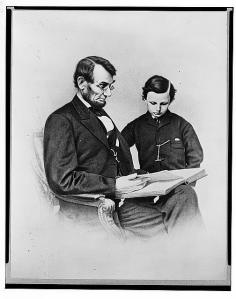
President Lincoln and son "Tad" (Thomas) in a February 9, 1864 photograph by Anthony Berger of the Brady Studio.

President Lincoln and son "Tad" (Thomas) in a February 9, 1864 photograph by Anthony Berger of the Brady Studio.

April 11, 1865 became the official day of celebrating the end of the Civil War. An even larger crowd was assembled on the White House lawn than the night before. (See last post.) The band was playing triumphant music, people were waving banners and shouting, “Hoorah!” and calling out for President Lincoln to speak. It was evening, but Washington D.C., was blazing with light. The Capitol, other government buildings, the White House, and private homes were lit up from within to ring in the good news.

A great cheer went up from the crowd when the President appeared on the second-floor balcony to deliver his speech. There he stood patiently and quietly as waves of applause rolled toward him. Finally, the crowd settled down and Lincoln, holding a candle in his left hand and his notes in his right, prepared to speak. But the juggling of the candle and his manuscript instantly proved awkward for the president. So he gave the candle to his friend Noah Brooks to hold. Son Tad knelt at his feet to catch each fluttering page of his father’s notes as he dropped them.

The crowd was silent when Lincoln began:

“Reuniting our country is fraught with great difficulty…and we differ among ourselves as to the mode and manner and means of reconstruction….”

Lincoln continued in this same vein, spelling out in greater and more boring detail the plans he had for reuniting the torn nation. The crowd was somewhat taken aback by the president’s tone. This was not the speech they’d expected. They had come to hear a rousing speech, praising the Union troops for their bravery and sacrifice, but, instead their president was droning on with no merriment, skipping past the present and jumping into the future without pausing to savor victory. Not waiting for the end of the president’s speech, some members of the crowd drifted away no doubt to find a jazzier way to spend the celebration.

John Wilkes Booth (1838-1865)

John Wilkes Booth (1838-1865)

One of the people in the crowd that day was the famous young actor and Southern sympathizer John Wilkes Booth. Along with him were drugstore clerk David Herold and former Confederate soldier Lewis Powell, also known as Lewis Payne. Just weeks earlier, these three men and five others had been planning to kidnap Lincoln and exchange him for Confederate P.O.W.s. But now that the Confederacy had collapsed, Lee had surrendered, and Rebel P.O.W.s were being released, there was no incentive to kidnap the president. Still, Booth wanted to act. He hated Lincoln and considered him a tyrant along the lines of Julius Caesar. He was determined to do something heroic in defense of the South and to punish Lincoln.

Booth was startled to hear what the President said next.  Lincoln said something that no other president had ever said publicly. He told the crowd that he was in favor of granting some black men the right to vote, especially, “the very intelligent and those who served our cause as soldiers.” One hundred eighty thousand black men had served in the Union Army.

Booth went ballistic. He turned to his fellow co-conspirator Powell. “That means nigger citizenship. That is the last speech he will ever make,”  he vowed.  He begged Powell to shoot Lincoln then and there. When Powell said no, Booth proclaimed, “By God, I’ll put him through.”

Booth was true to his word. It was the last speech Lincoln ever made. Four days later, the president would be dead, killed by a bullet fired into his head by John Wilkes Booth.


For related posts on this blog, see left sidebar “Categories.” Select Mary and Abraham Lincoln. In particular, you might enjoy reading “The Lincoln Assassination: Mary Surratt & the 7 Hoods.”
Read Full Post »

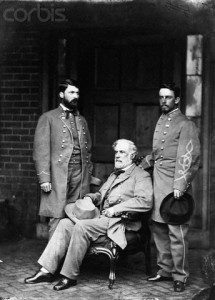
Confederate General Robert E. Lee, seated, with 2 of his officers, photographed by Mathew Brady in April, 1865, following Lee's surrender to General Ulysses S. Grant at the Appomattox Court House in Richmond, Virginia.

Confederate General Robert E. Lee, seated, with 2 of his officers, photographed by Mathew Brady in April, 1865, following Lee's surrender to General Ulysses S. Grant at the Appomattox Court House in Richmond, Virginia.

At daylight on April 10, 1865, the firing of 500 cannons spread the news throughout Washington, D.C.,  that the War Between the States was over and the Union preserved. The cannons were so loud that they broke windows on Lafayette Square, the neighborhood around the White House. (1) “Guns are firing, bells ringing, flags flying, bands playing, men laughing, children cheering – all, all jubilant,” wrote Secretary of the Navy Gideon Wells. (2)

Expecting the president to make a speech, several thousand people gathered outside the White House. President Lincoln was not sure what to say as he was planning on giving a formal address the following evening.Just then, his twelve-year-old son Tad appeared at a second-floor window, waving a captured Confederate flag. It gave the president an idea. He asked the Marine Band to play a favorite tune of his, “Dixie,” the unofficial Confederate anthem.

“I have always thought ‘Dixie” one of the best tunes I ever heard,” he told the surprised crowd. “It is good to show the rebels that with us they will be free to hear it again.”

True to the promise he made in his second inaugural address, Lincoln was already trying to bind up the nation’s wounds.
 
Now let’s hear Elvis Presley sing “Dixie.”

(1) White, Ronald C. A. Lincoln. (New York: Random House, 2009)

(2) Fleming, Candace. The Lincolns: A Scrapbook Look at Abraham and Mary. (New York: Schwartz & Wade, 2008)

Read Full Post »

Mary Todd Lincoln in mourning clothes, 1863. Even during the period in 1862 and 1863 when Mrs. Lincoln was in mourning for her son Willie and wore only black, she managed to go further into debt for new clothes. By 1864, she told Elizabeth Keckley: "The President glances at my rich dresses and is happy to believe that the few hundred dollars that I obtain from him supply all my wants. I must dress in costly materials. The people scrutinize every article that I wear with critical curiosity... If he is elected, I can keep him in ignorance of my affairs, but if he is defeated, then the bills will be sent."3 Only on January 1, 1865 did she completely shed her mourning attire.

Mary Todd Lincoln in mourning clothes, 1863. Even during the period in 1862 and 1863 when Mrs. Lincoln was in mourning for her son Willie and wore only black, she managed to go further into debt for new clothes. By 1864, she told Elizabeth Keckley: "The President glances at my rich dresses and is happy to believe that the few hundred dollars that I obtain from him supply all my wants. I must dress in costly materials. The people scrutinize every article that I wear with critical curiosity... If he is elected, I can keep him in ignorance of my affairs, but if he is defeated, then the bills will be sent." Only on January 1, 1865 did she completely shed her mourning attire.

After her son Willie’s death at age eleven on February 20, 1862,  Mary Todd Lincoln went into deep mourning. She traded in her sparkling jewels, frilly white and colorful gowns, and flowered bonnets made fashionable by her icon the French Empress Eugénie (click to read earlier post) for widow’s weeds of dull black crepe. Her stylish White House parties were put to the side. Gaiety gave way to sadness. Mary had lost her favorite son, the perfect one, the one she considered most like her husband.

After Willie died, Mary’s youngest son, eight-year-old Tad, still tossed with the same typhoid fever that killed his brother. He lay critically ill nearby, but Mary, incapacitated by grief, would not and did not rush to his side to nurse him. Meanwhile, Willie’s embalmed body was laid out in the Green Room of the White House and his coffin was open. Mary mustered enough energy to place a sprig of laurel on Willie’s chest before retreating to her bedroom and shutting the door. She took to her bed, weeping and sobbing  in such uncontrolled spasms that she became quite ill.

She did not come out of her bedroom to attend Willie’s funeral and never again entered the Green Room or the second floor guest room where Willie died. She rid the house of all of Willie’s toys and clothes and forbade his and Tad’s best friends, the Taft boys, from ever returning to the White House to play.

During Mary’s tormented period, Abraham, also heartbroken at his son’s death, sent for help. Two of Mary’s  friends, a nurse, and Mary’s sister Elizabeth heeded the calling. One of the friends was the esteemed Washington seamstress Elizabeth Keckley. In memoirs she wrote with a ghostwriter six years later, she recalled a day when President Lincoln led his distraught wife (whom he called “Mother”) to the window, pointed to the lunatic asylum at a distance from the White House, and said,

 “Mother, do you see that large white building on the hill yonder? Try and control your grief or it will drive you mad and we may have to send you there.”

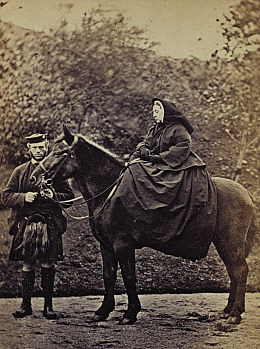
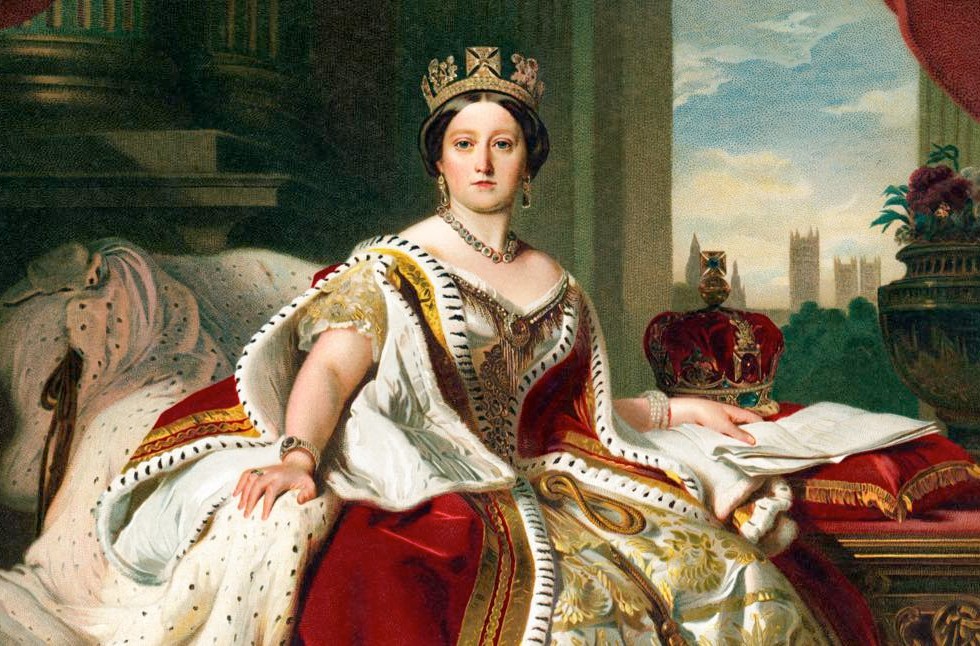
The recently widowed Queen Victoria wearing mourning clothes at Balmoral, Scotland, 1863. She is riding "Fyvie" and is accompanied by her faithful servant John Brown. Her husband, Prince Albert died in December of 1861 of typhoid fever or perhaps cancer of the stomach. For forty more years, the rest of Victoria's life, she wore black widow's weeds. Suspicion was aroused by Victoria's partiality to John Brown as a servant; most of the members of the Royal Household referred to him as "the Queen's stallion" and defamatory pamphlets referred to her a "Mrs. Brown." A 1997 film with Judy Dench titled "Mrs. Brown" was about the possible love affair.

The recently widowed Queen Victoria wearing mourning clothes at Balmoral, Scotland, 1863. She is riding "Fyvie" and is accompanied by her faithful servant John Brown. Her husband, Prince Albert, died in December of 1861 of typhoid fever or perhaps cancer of the stomach. For forty more years, the rest of Victoria's life, she wore black widow's weeds. Suspicion was aroused by Victoria's partiality to John Brown as a servant; most of the members of the Royal Household referred to him as "the Queen's stallion" and defamatory pamphlets referred to her as "Mrs. Brown." A 1997 film with Judy Dench titled "Mrs. Brown" was about their rumored love affair.

It was three weeks before Mary could even be persuaded to get up out of  bed and put on her mourning clothes. Queen Victoria (1819-1901) now became the First Lady’s fashion model. Victoria’s husband Prince Albert had died unexpectedly just three months earlier and Victoria had plunged herself and her entire staff into the deep black dress of mourning. Following Victoria’s lead and further compounding her debt to clothing merchants (click to read an earlier post), Mary Lincoln ordered an entire new wardrobe of dull black crepe dresses, bonnets, and weeping veils.

For more than a year, six months longer than was called for in the mourning manuals of the day, Mary wore first-degree mourning. Her black crepe straw bonnet was so heavily veiled that she could not turn her head, which gave her an odd appearance as she was always facing forward. She became a very public mourner. She wanted to draw attention to her grief as if she was the only one who had lost a child at a time when Civil War soldiers were dying in record numbers from Mississippi to Maryland on the nation’s bloody battlefields.  During her mourning, she cancelled the Saturday afternoon Marine Band Concerts held on the White House lawn, explaining that, “When we are in sorrow, quiet is necessary.”  She bought black jet jewelry to accent her sooty “widow’s weeds” and used writing paper with the thickest margins of black.

Finally, in 1863, Mary ordered another new wardrobe, running up yet more bills, and moved into the stage known as half-mourning, exchanging her lusterless black for fabric in lavender, gray, and somber purples with a little touch of white at the wrist. (1)


Click here to access my related post, “The Madness of Mary Lincoln.” Also, for more posts on the Lincolns, view the drop down menu, “Categories,” in the left column, find at the top, Abraham and Mary Todd Lincoln, and click.

(1) Baker, Jean H. Mary Todd Lincoln: A Biography. (New York: W.W. Norton & Company, 1987)

Read Full Post »

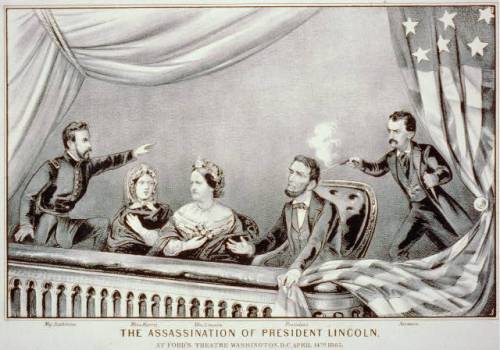
Lincoln is assassinated at Ford's Theatre by John Wilkes Booth, April 14, 1865

Lincoln is assassinated at Ford's Theatre by John Wilkes Booth, April 14, 1865

On the morning of April 15, 1865, the day Abraham Lincoln died, someone emptied his pockets. These contents were put in a box which was then wrapped in brown paper and tied with a string. The box was then handed to Abraham’s oldest son Robert Lincoln who was at his father’s deathbed. Robert Lincoln then passed the box on to his daughter, Mary Lincoln Isham, who donated the box to the Library of Congress in 1937. Labeled “Do Not Open,” the mystery box was tucked away in a vault in the Librarian’s office and forgotten for almost four decades.

Finally, in 1975, then Librarian of Congress Daniel J. Boorstin decided to open the box. With staff looking on in eager anticipation, Boorstin untied the string, tore off the brown paper, and opened the box.

Lincoln assassination artifacts: contents of Lincoln's pockets the night he was murdered (left) and copy of a newspaper announcing the assassination (right)

Lincoln assassination artifacts: contents of Lincoln's pockets the night he was murdered (left) and copy of a newspaper announcing the assassination (right)

The night Lincoln was murdered at Ford’s Theatre, he was carrying: 

  • a pair of small spectacles folded into a silver case,
  • a pair of reading glasses,
  • a small velvet eyeglass cleaner (I can’t find above),
  • an ivory pocketknife trimmed with silver,
  • a large linen handkerchief with “A. Lincoln” stitched in red,
  • a tiny pencil ( I can’t find above),
  • a brass sleeve button,
  • a fancy watch fob, and
  • a brown leather wallet lined with purple silk. It contained a Confederate five-dollar bill bearing the likeness of Confederate President Jefferson Davis and 8 newspaper clippings Lincoln had cut out and saved. All of the clippings praised him. (2)
  •  These artifacts were put on display at the Library of Congress in Washington, D.C, in 1976, the year of our nation’s 200th birthday and are still on view today. Though only everyday items, the contents of Lincoln’s pockets are among the items visitors to the Library most often ask to see.

    Here’s a close-up of Lincoln’s reading glasses, broken at the left hinge and mended with a bit of string. Frugal Abe wore rickety reading glasses while, in contrast, extravagant Mary had a collection of 300 pairs of gloves.

    Abraham Lincoln's reading glasses

    Abraham Lincoln's reading glasses


    (1) Freedman, Russell. Lincoln: A Photobiography. (New York: Clarion Books, 1987)
    (2) Fleming, Candace. The Lincolns: A Scrapbook Look at Abraham and Mary.  (New York: Random House, Inc., 2008)

    Read Full Post »

    lincoln-drawingApril 14, 1865, was one of the happiest days of Abraham Lincoln’s life. It was Good Friday. General Robert E. Lee had surrendered five days earlier and the Civil War was over. The Union had been saved. Lincoln had a relaxing breakfast with his 21-year-old son Robert, whom he called “Bob,” who had just arrived for a visit. Robert Lincoln (1843-1926) had studied law at Harvard University until the closing weeks of the war when he joined the Union Army as part of General Ulysses Grant’s staff.
    “Well, my son, you have returned safely from the front,” President Lincoln said. “The war is now closed, and we soon will live in peace with the brave men that have been fighting against us.” (1) He was eager to see the country heal and wanted no persecutions for the Confederacy, no “bloody work.” (2) Elizabeth Keckley, Mary Lincoln’s personal assistant, said that Lincoln’s face “was more cheerful than [she] had seen it for a long while.” (1)

    At 11 a.m. he met with his regular cabinet and General Grant, who was concerned that not all of the Confederate forces under Johnston had surrendered to General Sherman. Lincoln told Grant not to worry, that good tidings were coming, “for he had last night the usual dream which he had preceding nearly every great and important event of the War.” He described the dream. He had seen himself on the water in some type of boat moving rapidly “towards an indefinite shore.” (1)

    That afternoon, he took his usual carriage ride with Mary. Mary had never seen her husband so “cheerful,” she told a friend, “his manner was even playful. At three o’clock, in the afternoon, he drove out with me in the open carriage….I said to him, laughingly, ‘Dear Husband, you almost startle me by your great cheerfulness.'”

    He replied, “And well I may feel so, Mary. I consider this day, the war, has come to a close….We must both, be more cheerful in the future – between the war and the loss of our darling Willie – we have both been very miserable.” As the carriage rolled toward the Navy Yard, Lincoln recalled happy memories of is old Springfield home and the adventures as a lawyer riding the circuit. He keenly felt the pressures of the presidency lifting and the future looking brighter.

    lincoln-harpers-november-26-1864

    Once back at the White House, Lincoln sat down and began reading a book, something humorous by John Phoenix. Mary kept calling him to dinner but he wouldn’t put the book down; he was totally absorbed – as always. Finally, Mary insisted he come to the table at once. They had to eat early, she reminded him, as they had plans to see Laura Keene perform in the play “Our American Cousin” at Ford’s Theatre that evening. It had been announced in the papers; they had to go. Lincoln preferred to stay home. He had no need for the escape of the theatre that day; he was already jubilant. But go he must, as he didn’t want to disappoint the people.

    The morning edition of the National Republican had announced that Ulysses and Julia Grant would join the Lincolns in the president’s box for the play, but Julia didn’t want to go, saying she had her heart set on visiting their children in New Jersey. While that may have been true, it was more likely that it was an excuse to get out of an engagement with Mary Lincoln, whom she despised.

    The Lincolns had a hard time finding a replacement for the Grants. Secretary of War Stanton and Secretary of the Treasury Chase also declined. Stanton had been trying for months to keep the president from exposing himself to the danger of such public places and both men thought the theatre a frivolity. It was decided that Clara Harris and her fiance, Major Henry Rathbone, would substitute for the Grants.

    A little after eight o’clock, the carriage that would take Abraham and Mary to Ford’s Theatre rolled onto the front drive. Lincoln no doubt sighed. “I suppose it’s time to go,” he told Speaker Schuyler Colfax, “though I would rather stay.” He assisted Mary into the carriage and they took off.

    (1) Goodwin, Doris Kearns. Team of Rivals. (New York: Simon & Schuster, 2005)
    (2) Freedman, Russell. Lincoln: A Photobiography. (New York: Scholastic Inc., 1987)

    Read Full Post »

    Allan Pinkerton, President Lincoln, and Major John A. McClernand in an 1862 photo by Alexander Gardner following the Battle of Antietam. Pinkerton was the head of Union Intelligence Services then. It was alleged that, in 1861, his Pinkerton Detective Agency uncovered an assassination plot against the president in Baltimore on his way to the inauguration. Thanks to Pinkerton's warning, Lincoln changed his travel itinerary and the plot was foiled. On the 3-story Chicago building of the Pinkerton Detective Agency, their logo, a black-and-white eye, says "We Never Sleep." This was the origin of the slang term for detective "private eye."

    Allan Pinkerton, President Lincoln, and Major John A. McClernand in an 1862 photo by Alexander Gardner following the Battle of Antietam. Pinkerton was the head of Union Intelligence Services then. It was alleged that, in 1861, his Pinkerton Detective Agency uncovered an assassination plot against the president in Baltimore on his way to the inauguration. Thanks to Pinkerton's warning, Lincoln changed his travel itinerary and the plot was foiled. On the 3-story Chicago building of the Pinkerton Detective Agency, their logo, a black-and-white eye, says "We Never Sleep." This was the origin of the slang term for detective "private eye."

    Since he stepped foot into the White House, President Lincoln was dogged by rumors of assassination and kidnapping. Threatening letters arrived on an almost daily basis. Lincoln stuffed them away in a bulging envelope marked ASSASSINATION. (1)

    Abe’s friends were worried. “I long ago made up my mind that if anyone wants to kill me, he will do it,” he told a newspaper reporter. “If I wore a shirt of mail, and kept myself surrounded by a bodyguard, it would be all the same. There are a thousand ways of getting at a man if it is desired that he should be killed.”

    Nevertheless, soldiers camped on the lawn of the White House, the cavalry escorted him on his afternoon carriage rides, and private detectives served as bodyguards.

    In early April of 1865, just before the fall of Richmond and the end of the Civil War (and less than two weeks before his assassination), Lincoln had a troubling dream he related to friends:

    “About ten days ago, I retired very late. I had been up waiting for important dispatches from the front. I could not have been long in bed when I fell into a slumber, for I was weary. I soon began to dream. There seemed to be a death-like stillness about me. Then I heard subdued sobs, as if a number of people were weeping. I thought I left my bed and wandered downstairs. There the silence was broken by the same pitiful sobbing, but the mourners were invisible. I went from room to room; no living person was in sight, but the same mournful sounds of distress met me as I passed along. I saw light in all the rooms; every object was familiar to me; but where were all the people who were grieving as if their hearts would break? I was puzzled and alarmed. What could be the meaning of all this? Determined to find the cause of a state of things so mysterious and so shocking, I kept on until I arrived at the East Room, which I entered.

    a catafalque is a raised platform supporting a body or coffin

    a catafalque is a raised platform supporting a body or coffin

    There I met with a sickening surprise. Before me was a catafalque, on which rested a corpse wrapped in funeral vestments. Around it were stationed soldiers who were acting as guards; and there was a throng of people, gazing mournfully upon the corpse, whose face was covered, others weeping pitifully.

    ‘Who is dead in the White House?’ I demanded of one of the soldiers.

    ‘The President,’ was his answer; ‘he was killed by an assassin.’

    Then came a loud burst of grief from the crowd, which woke me from my dream. I slept no more that night; and although it was only a dream, I have been strangely annoyed by it ever since.”


    (1) Freedman, Russell. Lincoln: A Photobiography. (New York: Scholastic Inc., 1987)

    Read Full Post »

    Willie Lincoln

    Willie Lincoln

    Abraham Lincoln was deeply interested in psychic phenomena. Following the death of his eleven-year-old son, Willie, (1850-1862) of typhoid fever, Lincoln was consumed with grief. He was persuaded by wife Mary to participate in several séances held in the White House. Mary believed that professional mediums could pierce the veil between this life and the next, thus allowing her and her husband to communicate with their dead son. Once Lincoln attended a seance in which a piano lifted up and moved around the room. It was in the opinion of the mediums who worked with President Lincoln that he was definitely “the possessor of extraordinary psychic powers.” (1)

    Séances became popular during and after the Civil War as Americans longed to reconnect with their many loved ones killed in the violence of the Civil War

    Séances became popular in the mid-to-late 19th Century as Americans longed to reconnect with their many loved ones killed in the Civil War.

    The day after his first election to the presidency in 1860, Lincoln called his good friend journalist Noah Brooks (1830-1903) into his office. He had been startled by a vision of seeing two of his faces at once in a mirror and wanted to tell Brooks about it. Brooks made a written record of the conversation, later including it in his White House memoirs, Washington in Lincoln’s Time (1895). Adapted from Brooks’ work, these are Lincoln’s words:

    Abraham Lincoln photographed by Mathew Brady, February 27, 1860

    Abraham Lincoln photographed by Mathew Brady, February 27, 1860

    It was just after my election in 1860, when the news had been coming in thick and fast all day and there had been a great “hurrah, boys,” so that I was well tired out, and went home to rest, throwing myself down on a lounge in my chamber. Opposite where I lay was a bureau with a swinging glass upon it (and here he got up and placed furniture to illustrate the position), and looking in that glass I saw myself reflected nearly at full length; but my face, I noticed had two separate and distinct images, the tip of the nose of one being about three inches from the tip of the other. I was a little bothered, perhaps startled, and got up and looked in the glass, but the illusion vanished. On lying down again, I saw it a second time, plainer, if possible, than before; and then I noticed that one of the faces was a little paler — say five shades — than the other.

    Abraham Lincoln photographed by Alexander Gardner, February 5, 1865

    Abraham Lincoln photographed by Alexander Gardner, February 5, 1865

    I got up, and the thing melted away, and I went off, and in the excitement of the hour forgot all about it — nearly, but not quite, for the thing would once in a while come up, and give me a little pang as if something uncomfortable had happened. When I went home again that night I told my wife about it, and a few days afterward I made the experiment again, when (with a laugh), sure enough! the thing came back again; but I never succeeded in bringing the ghost back after that, though I once tried very industriously to show it to my wife, who was somewhat worried about it. She thought it was a “sign” that I was to be elected to a second term of office, and that the paleness of one of the faces was an omen that I should not see life through the last term. 

    (1) Wallenchinsky, David and Wallace, Irving. The People’s Almanac (New York: Doubleday & Co., Inc., 1975)

    Read Full Post »

    eugenie
    As mentioned in yesterday’s post, Mary Todd Lincoln slavishly followed the fashion lead of the Empress Eugénie, Empress Consort of France (1853-1871), the wife of Napoléon III, Emperor of the French. The empress’ style was reported in detail by the Vogue magazine of the day, Godey’s Lady’s Book. In 1860, age 32, the Empress Eugénie was considered one of the most beautiful women in Europe. At a ball, she outshone all other women. It was said that every man was in love with her. Her friend, the Princess de Metternich recalled that, on one occasion, the empress was

    “attired in a white gown spangled with silver and dressed with her most beautiful diamonds. She had carelessly thrown over her shoulders a sort of burnous of white embroidered with gold, and the murmurs of admiration followed her like a trail of lighted gunpowder.”

    In 1862, the Empress Eugénie set the fashion world on fire. She appeared at the races, one of the biggest social events of the year, without a shawl, a bold move for a society woman, especially for an empress. She was wearing an elegant, off-the-shoulder gown by the very up-and-coming couturier Charles Frederick Worth, an Englishman who had recently opened the haute couture shop, “The House of Worth,” in Paris. The empress did not want the lovely gown hidden from view. The world of fashion took note. “The streets of Paris were soon buzzing with ladies without shawls.”

    From her childhood days, Mary Todd Lincoln adored being the center of male attention. Once she became the First Lady, she longed to become a fashion trend setter. Ignoring the dowdy style of the English Queen Victoria, she modeled herself after Empress Eugénie, sticking flowers in her hair and bodice, piling on the jewels, and opting for expensive gowns that dipped in the bust and shoulder. Husband Abraham Lincoln called Mary’s dresses her “cat-tails.” Mary tried hard to be fashionably dressed but she was generally displeased with the result; the hooped dresses and yards of fabric swamped her short frame and the excess jewelry and ornamentation was overwhelming.

    Mary Todd Lincoln in a photograph by Mathew Brady, November 1861, in a heavy white silk dress onto which Washington modiste Elizabeth Keckley had sewn 60 velvet bows and countless black dots.

    Mary Todd Lincoln in a photograph by Mathew Brady, November 1861, in a heavy white silk dress onto which modiste Elizabeth Keckley had sewn 60 velvet bows and countless black dots.

    Mary’s departure from the high-necked muslins worn by Western women brought swift condemnation from Oregon Senator James Nesmith, a guest at an 1862 East Room reception, who wrote to his wife of the 43-year-old “weak-minded Mrs. Lincoln and her sorry show of skin and bones. She had her bosom on exhibition, a flower pot on her head – There was a train of silk dragging on the floor behind her of several yards in length.” Mary Lincoln, continued the senator, who used to “cook Old Abe’s dinner and milk the cows,” now seemed eager “to exhibit her milking apparatus to public gaze.”

    Mary’s plunging necklines caught Abe’s eye, too. “Whew,” he is quoted as saying, “our cat has a long tail tonight – if some of that tail was nearer the head, it would be in better style.”

    (1) Baker, Jean H. Mary Todd Lincoln. (New York: W. W. Norton & Company, Inc., 1987)

    Read Full Post »

    Mary Todd Lincoln, ca. 1861

    When Mary and Abraham Lincoln moved into the White House in 1861, Mary was 42 years old, a time when women her age dressed in somber grays, dull browns, and boring blues. But not Mary Todd Lincoln. For her, expensive clothes were a mark of importance, of breeding. She proceeded to dress like a peacock, draping herself in bold blues, crimson, yellow, and royal purple, attracting a lot of unwanted attention and sparking criticism from the Washington social elite. Brought up among the overdressed ladies of Kentucky, her gowns and bonnets were ornamented with flowers, lace, dots, and bows sewn on yards of velvet, taffeta, and silk at a time of war when soldiers were going without blankets. Mary took her fashion cues from Eugenie, Empress of France, whose parties and clothes appeared in line drawings and detailed descriptions in one of Mary’s favorite magazines, Godey’s Lady’s Book. She was admonished for wearing low-necked dresses that revealed her “milking apparatus,” said one critic, and for the “flower beds which she carries on top of her head,” said another. A petite woman, the bell-shaped dresses overwhelmed her; hoops made her look shorter and squat.

    Buoyed by a grandiose sense of self-importance coupled with her new position as the president’s wife, Mary demanded what she wanted. She expected everyone to do her bidding. She was surprised when clothing merchants sent her bills. The line between purchase and donation was fuzzy. Mary looked for donors to buy her gowns and hats, rewarding them with political favors. When she blew her four-year budget for White House renovations in under a year, she contrived several plots to secretly defray her debt. In one instance, she ordered the White House gardener into selling manure from the stables at ten cents a wagonload. It raised more stink than cash. Her spending eventually came to light and became a national scandal. Lincoln was mortified and had to deal with it, all the while referring to it benignly as his beloved Mary’s silly “flub-a-dub.”

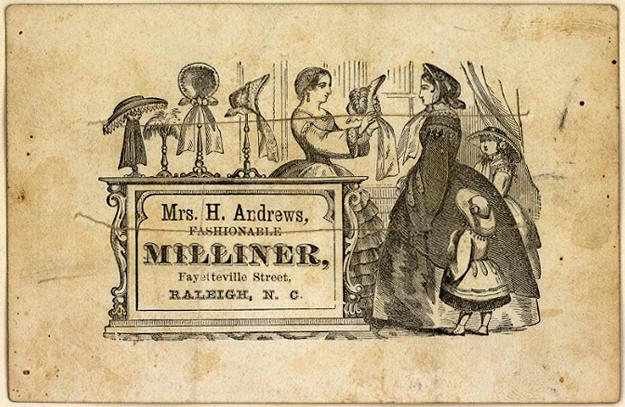
    Willian's of Pennsylvania Avenue, Washington's best known milliner at the time, made Mary Todd Lincoln's bonnets. Unfortunately, he also made bonnets for Mrs. Horatio Taft.

    Now, back to what we were saying about Mary and her clothing:

    It was an April evening in 1861. The Marine Band was playing a concert on the White House lawn. Mary and President Lincoln had invited many guests, among them Mary Cook Taft, wife of Horatio Taft, an examiner at the U.S. Patent Office. Mary Taft was wearing a delicate straw bonnet lavishly trimmed with pretty purple ribbons embroidered with little black figures. The bonnet had long strings which tied beneath her chin in a bow. Mary Taft’s teenage daughter, Julia, accompanied her to the promenade grounds that day and vividly recalled their costumes:

    “My mother, of course, wore the bonnet, together with a purple and white silk over a moderate crinoline, and lavender kid gloves. I was dressed in white Swiss, much beruffled, but without hoop skirt or crinoline, which was an abiding grievance with me. But my hat…was very gratifying and almost compensated for the lack of crinoline.”

    Women’s Fashions 1860

    Mary and Julia walked around mingling with the other guests while the band played on. The national anthem brought those in chairs to their feet, men doffing their hats, and all standing in patriotic attention. At the close of the concert, the Taft women walked over to the south front where the presidential party was sitting, to pay their respects. Mary Lincoln could not take her eyes off Mary Taft’s bonnet. Julia recalled what happened next:

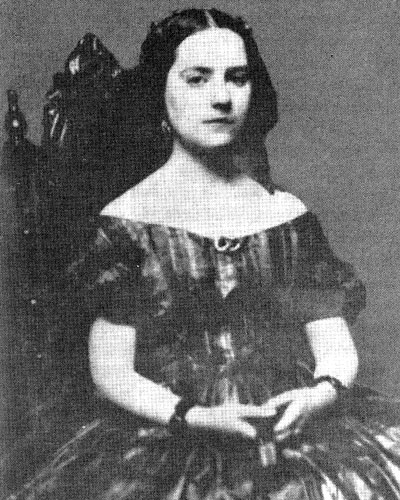
    Julia Taft, undated photo

    “After a few words of greeting, [Mrs. Lincoln] took my mother aside and talked with her for a moment. While I could not hear their conversation, I knew someway that they were talking about my mother’s bonnet and I was a bit puzzled at the look of amazement on my mother’s face. I did not see why my mother should look so surprised at a passing compliment from Mrs. Lincoln.”

    Mary Lincoln wanted the purple strings off Mary Taft’s bonnet and asked for them. Mary Taft was angry—she loved her bonnet with its pretty purple ribbon— but what could she do? Mary Taft’s husband was a government appointee. Mrs. Lincoln could get him fired and then how would they pay for Julia’s private Washington school? So, begrudgingly, Mrs. Taft agreed to give up her ribbons to “Madam President” as Mary Lincoln requested to be called by the White House staff. 

    The Washington milliner Willian sent for Mary Taft’s bonnet, removing the purple ribbons for Mary Lincoln, and sending back Mary Taft’s bonnet with new lavender ribbon. Not long after this incident, Julia, who was often in the White House as a babysitter for her little brothers, Bud and Holly, the inseparable playmates of Tad and Willie Lincoln, caught sight of Mary Lincoln wearing a purple dress and a bonnet trimmed with her mother’s purple ribbons. 

    Mary Lincoln is shown with two of her four sons. Willie is to our left and Tad is to our right. Tad’s name is Thomas. He was so wiggly that he was nicknamed Tadpole. One of the Lincoln’s sons, Eddie, died when they had lived in Springfield. The eldest Lincoln boy, Robert, was studying at Harvard in 1860, the year this photo was taken.

    Source: Bayne, Julia Taft. Tad Lincoln’s Father. Boston, Little, Brown, and Co., 1931.

    Readers: For more on Mary Lincoln, click here.

    Read Full Post »

    After the assassination of Lincoln and the attempted assassination of Secretary of State William Seward, Secretary of War Edwin Stanton doggedly pursued the apprehension and prosecution of the conspirators. From the beginning, he knew that actor John Wilkes Booth had murdered the president. Booth was hunted down and killed on April 26, 1865, only eleven days after the asssasination. In the search for Booth’s co-conspirators, dozens of suspects were soon arrested and detained. It was determined that the attack had been a Confederate conspiracy designed to topple the United States government, and was, thus, an act of war. It was decided then that the proceedings would be handled by a military tribunal, and, therefore, be under Stanton’s control.

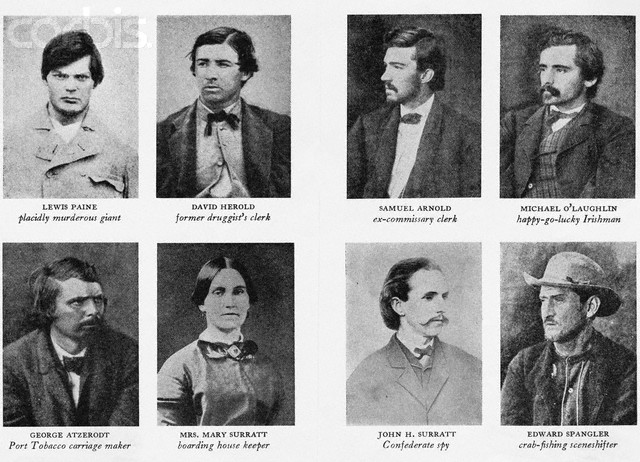
    Eight of Lincoln Assassination Conspirators

    Eight of Lincoln Assassination Conspirators

    Ultimately, the suspects were narrowed down to seven men and one woman: Samuel Arnold, George Atzerodt, David Herold, Samuel Mudd, Michael O’Laughlen, Lewis Powell, Edmund Spangler, and Mary Surratt.

    Extraordinary security measures were taken with the prisoners. Mary Surratt and Dr. Samuel Mudd first were jailed at the Old Capitol Prison, while the other six were imprisoned on the ironclad ships the Montauk and Saugus. They were all later confined to separate cells in the Old Arsenal Penitentiary. Stanton had no tolerance for traitors; he had built a reputation as the secretary of war for ruthlessly rooting out Confederate sympathizers and prosecuting them harshly. Matter of fact,
    Lincoln’s last act as President was overriding Stanton’s decision supporting the execution of George S.E. Vaughn for spying. Lincoln pardoned Vaughn an hour before he was assassinated.

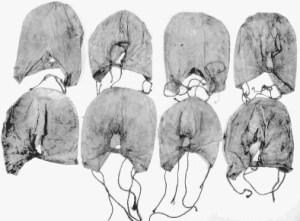
    Canvas Hoods Worn by Lincoln Assassination Conspirators before Trial July 7, 1865

    Canvas Hoods Worn by Lincoln Assassination Conspirators before Trial July 7, 1865

    “Stanton ordered an unusual form of isolation for the eight suspects. He ordered eight heavy canvas hoods made, padded one-inch thick with cotton, with one small hole for eating, no opening for eyes or ears. Stanton ordered that the bags be worn by the seven men day and night as a preventive to conversation. Hood number eight was never used on Mrs. Surratt, the owner of the boarding house where the conspirators had laid their plans, Stanton knew the furor of indignation that would cause. A ball of extra cotton padding covered the eyes so that there was painful pressure on the closed lids. No baths or washing of any kind were allowed, and during the hot breathless weeks of the trial the prisoners’ faces became more swollen and bloated by the day, and even the prison doctor began to fear for the conspirators’ sanity inside those heavy hoods laced so tight around their necks. But Stanton would not allow them to be removed, nor the rigid wrist irons, nor the anklets, each of which was connected to an iron ball weighing seventy-five pounds.”(1)

    (1) Stanton, Edwin M. Wikipedia. http://en.wikipedia.org/wiki/Edwin_M._Stanton

    Read Full Post »

    Lincoln's Secretary of War Edwin Stanton (1814-1869)

    Lincoln's Secretary of War Edwin Stanton (1814-1869)


    Much has been made of Democratic President Obama’s attempt to incorporate a Republican into his cabinet, a move that today’s political pundits liken to an overture made by the President Lincoln when, in 1862, he appointed Democrat Edwin Stanton as secretary of war in his Republican administration. Stanton was not just Lincoln’s political opponent, he was one of his most scathing critics, referring to the “imbecility” of the Lincoln administration’s handling of the Civil War. Not only that, he and Lincoln had met on another occasion – in a courtroom six years earlier – and Stanton had treated Lincoln with surly condescension.

    During that case, Stanton headed a team of lawyers that included Lincoln that challenged Cyrus McCormack’s patent on the reaper. Nationally-renowned patent lawyer George Harding was another member of that same team. Harding never forgot the first time he caught sight of Abraham Lincoln arriving at the Burnet House in Cincinnati where the lawyers were lodged. Lincoln approached Harding and Stanton. Harding described Lincoln as a

    “tall, rawly-boned, ungainly back woodsman, with coarse, ill-fitting clothing, his trousers hardly reaching his ankles, holding in his hands a blue cotton umbrella with a ball on the end of the handle.” (1)

    Lincoln introduced himself to the two men, saying,

    “Let’s go up in a gang.”

    Both Stanton and Harding were shocked that this country bumpkin was part of their team. Stanton pulled Harding aside, whispering,

    “Why did you bring that d____d long armed Ape here?”

    Though the three of them spent a week together in trial and stayed at the same hotel, neither Harding nor Stanton asked Lincoln to join them for a meal or go with them to or from court. The brief Lincoln prepared for use in the trial was never even opened by Harding and Stanton. The judge presiding over the trial hosted a dinner for both teams of lawyers yet Lincoln was not invited.

    Yet, in 1862, Lincoln set aside his ego and offered Stanton “the most powerful civilian post” – the post of secretary of war. Stanton accepted the position only to “help save the country.” While Stanton was hot-tempered and brusque, Lincoln recognized his brilliance and ability. Over the three years of their working relationship, Stanton and Lincoln grew close.

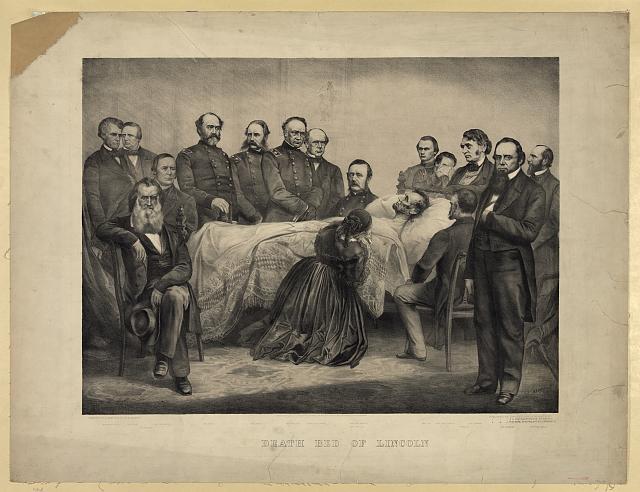
    On the night of Lincoln’s assassination, Edwin Stanton was alerted. When he arrived at the Petersen boardinghouse across from Ford’s Theatre, he found that the president had been placed diagonally across a bed to accommodate his large frame. Lincoln was stripped of his shirt. “His large arms were of a size which one would scarce have expected from his spare appearance,” noted Stanton’s companion. Edwin Stanton and the other cabinet members except for Seward were present when President Lincoln was pronounced dead at 7:22 a.m. on April 15, 1865. Stanton’s tribute at that moment is still with us today.

    “Now he belongs to the ages,” Stanton said of Lincoln.

    Death Bed of Lincoln

    Death Bed of Lincoln

    Throughout that long night when the president had lingered between life and death, the task had fallen to Secretary of War Stanton to alert the generals. Coolly and with self-possession, Stanton dictated numerous dispatches. But when the president was pronounced dead, Stanton could bear his grief no longer. He could not stop the tears from flowing down his face. No one could control his grief that long night. One witness observed, “there was not a soul present that did not love the president.”

    But “Stanton’s grief was uncontrollable,” recalled Horace Porter, “and,” some time later, “at the mention of Mr. Lincoln’s name, he would break down and weep bitterly.” (1) Stanton later wrote that he came to love Lincoln more than any other person outside of his immediate family.

    (1) Goodwin, Doris Kearns. Team of Rivals. New York: Simon and Schuster, 2005.

    Read Full Post »

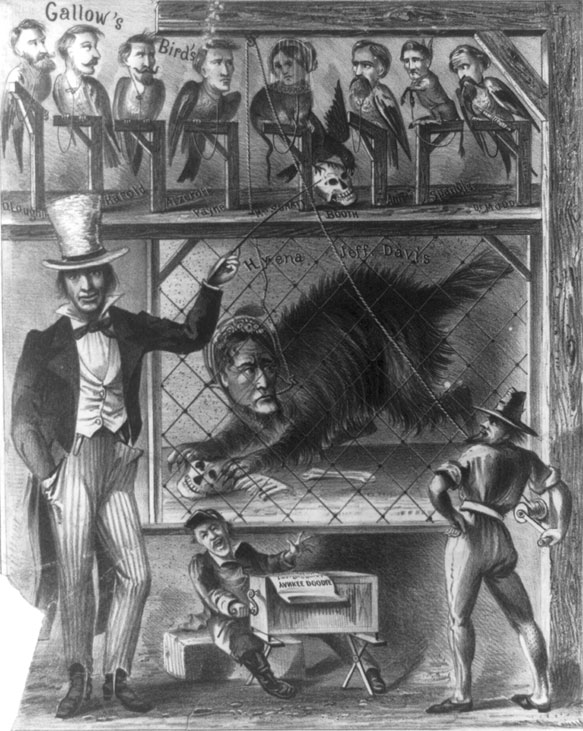
    Uncle Sam's Menagerie

    Uncle Sam's Menagerie

    Issued in the wake of Lincoln’s assassination in April 1865, the political cartoon, “Uncle Sam’s Menagerie,” conveys the Northern hostility toward the conspirators, whom the public associated with former president of the Confederacy Jefferson Davis. Uncle Sam stands before a cage in which a hyena with the bonneted head of Jefferson Davis (1808-1889), president of the Confederacy, claws at a skull. Davis’ neck is in a noose, which will begin to tighten as a man at right turns the crank of a gallows. The bonnet on Davis’  head alludes to the embarrassing circumstances of his recent capture. As the Civil War drew to a close, Davis fled Richmond with his cabinet in early April 1865 and began a trek southward with federal troops in hot pursuit. While still weighing the merits of forming a government in exile,  Davis was captured by Union soldiers near Irwinville, Georgia, in early May 1865. Whether by accident or design, Davis was wearing his wife’s dark gray short-sleeved cloak and black shawl when captured.  

    Below the caricature of Davis as a cross-dressing hyena, a man grinds out the song “Yankee Doodle” on a hand organ. Above, the Lincoln conspirators are portrayed as “Gallow’s Bird’s,” with their heads in nooses. From left to right they are: Michael O’Laughlin, David Herold, George Atzerodt, Lewis Paine, Mary Elizabeth Surratt, Samuel Arnold, Edman Spangler, and Dr. Samuel Mudd. At left, Uncle Sam points his stick at a skull “Booth,” on which sits a black crow. John Wilkes Booth was killed during a government raid on his hideout on April 26, 1865.

    Read Full Post »

    drawing of Abraham Lincoln as a boy

    drawing of Abraham Lincoln as a boy

    Today I want to get it just right. It is our precious Abe Lincoln’s 200th birthday. I want to choose just the right thing to say about him in this blog that does the great man justice, that gives us a look into his fine soul.

    When I think of Lincoln, I think of his honesty, yes, his courage, of course, but mainly what comes to mind is his unfailing kindness – to Mary, his wife, when she was yelling at him while he was president and under the most terrific strain from the Civil War. He just shrugged off her verbal and sometimes physical assaults, picked up Willie or Tad and put them on his shoulders, and walked out of the room. He did not utter a harsh word at her. During his presidency, the White House was open to Civil War veterans and widows who wanted to meet with Lincoln. He would never refuse to see a one of them though he was terribly overworked, with little staff to help him run the country.

    His kindness for the weakest among us showed up early in his youth. It is believed that his father Thomas Lincoln was ashamed that Abe was sensitive and fond of books, storytelling, and poetry, considering such interests “soft.” Thomas Lincoln felt contempt to discover such sentimentality in his own son. Lincoln and his father never were close. They remained isolated from one another from the time of Lincoln’s mother’s death when Abe was 9. The bad blood between them was never resolved. When Thomas Lincoln lay dying, Abraham refused a request to visit his father’s sickbed and did not attend his father’s funeral.

    The following anecdote from Lincoln’s boyhood illustrates how his heart ached for the unfortunate:

    He was always the champion of the helpless, no matter how humble the object of any ill-treatment might be. One day he came and caught a group of mischievous boys putting live coals on a poor mud-turtle’s back. The lads, and several girl friends, laughed to see the turtle moving slowly and aimlessly about in its surprise and misery. When Abe Lincoln saw what was going on he dashed into the group in a frenzy of wrath, snatched the shingle from the ringleader’s hand, dashed the burning coals off the poor turtle’s back, then began beating the boys with the thin board. When he had scattered them right and left, according to one of the girls who witnessed the sudden scene, “he preached against such cruelty” and, with angry tears in his deep gray eyes, told the snickering offenders that a terrapin’s or “an ant’s life is as sweet to it as ours is to us.” (1)

    This boy champion of the underdog grew into a man and the 16th President of the United States of America. As a boy, he freed the turtle; as a man, he freed the slaves. Lincoln famously declared,

    If slavery is not wrong, nothing is wrong.  

    Happy 200th Birthday, Abe Lincoln.

    (1) Whipple, Wayne. The Heart of Lincoln. (Philadelphia: George W. Jacobs & Co., 1915)

    Read Full Post »

    Taken by Alexander Gardner on February 9, 1864. This photograph would serve as the image that engraver Victor David Brenner would use to create the bas relief of Lincoln used on the penny.

    Abraham Lincoln (1809-1865)Taken by Alexander Gardner on February 9, 1864, this photograph served as the image engraver Victor David Brenner would use to create the bas relief of Lincoln found on the 1909 penny.

    It is President Teddy Roosevelt we have to thank for giving us the first Lincoln penny. Until the Lincoln penny debuted in 1909, no likeness of an actual person had appeared on a “regular-denomination circulating United States coin.” Too monarchial, deemed our first head of state, George Washington. Emperors, kings, and other authority figures had long stamped coins with their images to declare their power. Young America was done with that kind of governing. So the Mint Act of 1792 dictated that American coins would instead be “an impression emblematic of liberty.”

    As a result, the coin designs of liberty – depicted by goddesses, mainly- grew “dowdy and uninspired.” President Roosevelt complained to his secretary of the treasury that, “Our coinage is artistically of atrocious hideousness.” So Roosevelt directed him to stamp the image of Lincoln on the one-cent piece to commemorate Lincoln’s 100th birthday.

    It was done. When the Lincoln penny was released into circulation, it was a hit with the American people. Long lines formed at banks and Treasury buildings in New York, Washington, Boston, and other cities to snap up the new coins. In Philadelphia, some of the pennies were sold for 25 cents. It had been 44 years since Lincoln was assassinated. He was an icon. People were excited that they recognized the face on the coin.

    Of course, as Lincoln himself remarked, you can’t please all the people all the time. Some people grumbled about the new coin, Confederate veterans, of course, plus the New York Times, calling it “another ill-considered freak of Mr. Roosevelt’s will.”

    Nowadays, the complaints about the penny are different. There are some people who want to get rid of the penny altogether. Due to the rising price of metal, the cost of making the “copper-coated zinc corpus” (1.4 cents) now exceeds its face value.

    Read Full Post »

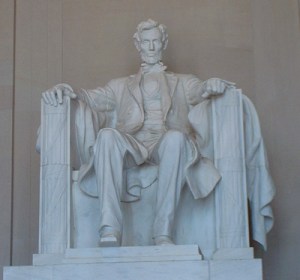
    Lincoln statue at the Lincoln Memorial

    Lincoln statue at the Lincoln Memorial

    Tucked into the massive central hall of the Lincoln Memorial sits an imposing marble statue of Abraham Lincoln. Over Lincoln’s head is inscribed:

    IN THIS TEMPLE

    AS IN THE HEARTS OF THE PEOPLE

    FOR WHOM HE SAVED THE UNION

    THE MEMORY OF ABRAHAM LINCOLN

    IS ENSHRINED FOREVER 


    The statue stands over 19 feet tall. Lincoln is shown in a seated position, but, if he could get up, he would stand 28 feet tall. He wears an expression of firm determination, eyes fixed rather sadly looking out onto the National Mall toward the Washington Monument.  Sculptor Daniel Chester French (1850-1931) began work on his design for the statue in 1915, making many bronze and plaster models. The sculptor consulted photographs by the well-known Civil War photographer Mathew Brady and used Lincoln’s life mask as well as casts of Lincoln’s own hands as models.

    Lincoln's left hand

    Lincoln's left hand

    Now look at both of Lincoln’s hands. There’s a popular legend that Lincoln is shown using manual sign language to sign his initials, with his left hand shaped like the letter “A” and his right hand to form an “L.”  The National Park Service denies that this is the case. There is no evidence that Daniel Chester French intended for Lincoln’s hands to be formed into sign language letters. Nevertheless, it’s possible. Believers point out that a National Geographic Society publication states that French had a son who was deaf  – and French himself knew sign language.  He would have had good reason to do so, too, to honor Lincoln, as it was President Lincoln who signed into law the ability for Gallaudet University, a school for the deaf, to grant college degrees.

    Lincoln's right hand

    Lincoln's right hand

    There are those who say French did shape Lincoln’s hands in this fashion on purpose yet others insist he didn’t. There is, however, evidence he could have. French had used sign language  in his sculptures before. In his 1889 portrait of deaf educator Thomas Gallaudet shown with his first student, Alice Cogswell, Gallaudet uses his right hand to make the sign for the letter “A” as Alice, too, makes the “A” sign with her right hand.

    Thomas Gallaudet sculpture by Daniel Chester French

    Thomas Gallaudet sculpture by Daniel Chester French

    Read Full Post »

    « Newer Posts - Older Posts »