After winning the 1960 presidential election, John F. Kennedy appointed his younger brother, Robert, as U.S. attorney general. “Bobby” was just thirty-five, and, although a graduate of Virginia Law School, had little legal experience. Although the appointment was a bold act of nepotism, it aroused little controversy, and only one senator voted against confirmation. JFK was so confident in this decision, that he joked at the annual Alfalfa Club Dinner, the night after the inauguration:
I just wanted to give [Bobby] some legal experience before he practices.
John F. Kennedy and Jacqueline Kennedy arrive at an inaugural ball, January 20, 1961
Bobby Kennedy was not an unknown in Washington politics. He had made a name for himself in 1957-1959 while serving as chief counsel to the U.S. Senate’s Select Committee on Improper Activities in Labor and Management, familiarly known as the “Senate Rackets Committee.” His brother, John, then a Massachusetts senator, sat on that committee. Bobby’s intelligence convinced him that Teamsters Union president Jimmy Hoffa had worked with the Mafia, extorted money from employers, and raided pension funds. During the hearings, both Kennedy men squared off with Hoffa and his mobster connections. In 1860, Bobby Kennedy published The Enemy Within, exposing the corruption within the Teamsters.
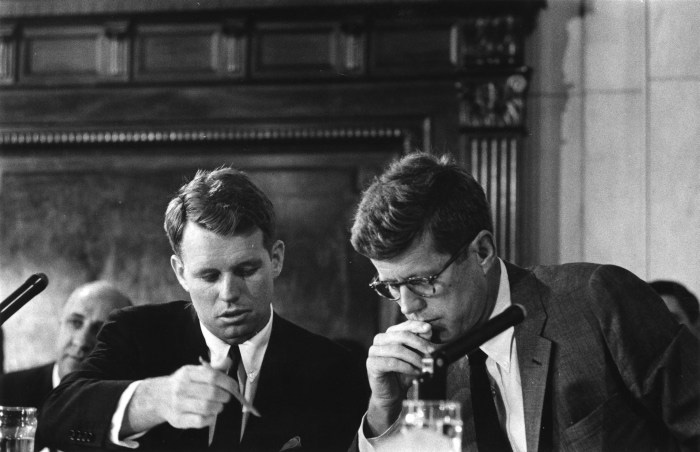
Robert F. Kennedy and John F. Kennedy during the Senate hearings circa May 1957. Photograph by Howard Jones for Look Magazine in the John F. Kennedy Presidential Library and Museum, Boston.
Although RFK’s tenure in the Kennedy administration would be associated with civil rights gains—the month prior to the 1860 presidential election, Bobby had negotiated to secure the release of the Rev. Dr. Martin Luther King, Jr., from an Atlanta jail—he was most identified with his relentless crusade against organized crime. Among his many achievements in this dangerous arena, he worked to secure the Federal Wire act, which specifically targeted the use of telephone, Internet, cable tv, and fiber optic communications with the aim to disrupt the Mafia’s gambling operations. Convictions against organized crime figures rose by 800 percent during his term. Kennedy worked to shift FBI Director J. Edgar Hoover’s focus away from communism to organized crime.
President John F. Kennedy and singer Frank Sinatra at the 1961 Inaugural Gala
Frank Sinatra
Singer and film star Frank Sinatra (1915-1998) grew up poor and lower class in Hoboken, New Jersey. Once he made it big in showbiz (thanks to help from his Mafia cronies), he obsessed about fitting in with the upper class. He wormed his way into politics, using his Hollywood star power to campaign and fundraise for Democratic heavyweights such as Franklin Roosevelt and John F. Kennedy. In attaching himself to men of honor, Sinatra hoped to achieve the respectability he craved.
Sinatra had cultivated a relationship with President Kennedy through movie star Peter Lawford, who was married to the president’s sister, Pat.
Host Frank Sinatra (L) wears an eyepatch, laughing with actor Peter Lawford and his wife Patricia Kennedy (1924 – 2006) during a surprise 21st birthday party held for actor Natalie Wood at Romanoff’s, Hollywood, California, July 20, 1959. (Photo by Murray Garrett/Getty Images)
In March 1962, President Kennedy was scheduled to fly to Southern California. Peter Lawford asked Sinatra to be the president’s host at his Palm Springs estate. Sinatra was thrilled. He went straight to work. At his own expense, Sinatra installed a helicopter pad, cottages for the Secret Service, and even a flagpole for the presidential flag.
But the president’s brother Bobby Kennedy wasn’t having it. When he heard about his brother Jack’s proposed stay at Sinatra’s, he went ballistic. Bobby was making the “most single-minded attack on organized crime in American history” and could not abide Jack associating with someone with mob connections. Peter Lawford was chosen to tell Sinatra that the president would not be staying with him.
Sinatra did not take the news well. He had a notoriously explosive temper:
“Sinatra vented his spleen by destroying the concrete landing pad with a sledgehammer. He applied a different kind of sledgehammer to his friendship with Peter and Pat [Lawford], banning them from his company….Jack ended up staying at the home of Bing Crosby. Marilyn Monroe flew down to be with the president, spending the night in his bedroom….”
Peter Lawford, Frank Sinatra, and Marilyn Monroe ca. 1961-62
Bedell Smith, Sally. Grace and Power: The Private World of the Kennedy White House. New York: Random House, 2004.
Leamer, Laurence. The Kennedy Women: The Saga of an American Family. New York: Fawcett Books, 1994.
Readers: For more on Frank Sinatra on this blog, click here.
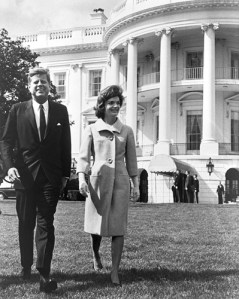
American Royalty: President John and Jackie Kennedy stroll the White House grounds.
It was a star-studded event. It was Saturday, May 19, 1962, and the young, dashing, and popular U.S. President John F. Kennedy was turning 45. The Democratic Party held a huge fundraiser at New York’s Madison Square Garden. The birthday salute was televised before a national audience and 15,000 people had paid for seats to catch the show live at the Garden. The cream of American show business turned out to pay homage to Kennedy – Ella Fitzgerald, Peggy Lee, Jack Benny, Henry Fonda, Harry Belafonte. Greek opera diva Maria Callas was also there. Actor Peter Lawford, the president’s brother-in-law, served as master-of-ceremonies. But the pièce de résistance – the showstopper – was the performer who sang the finale – sexpot and film star Marilyn Monroe.
First Lady Jackie Kennedy riding horses with her children at their Middleburg, Virginia, retreat “Glen Ora.” Jackie grew up surrounded by horses and was an accomplished equestrian. President John Kennedy did not share her passion for horse shows and riding. He was allergic to horse hair. November 19, 1962.
It seemed that everyone was there – except the honoree’s wife – Jackie Kennedy. The president attended the ceremony without the First Lady at his side. When Jackie had learned that Marilyn was to be performing at the benefit, she decided she was not about to attend. She instead became a last-minute participant in the Loudoun Hunt Horse Show at Glen Ora, her weekend home. Jackie knew that her husband and Marilyn Monroe were lovers – and Jackie was not about to have her nose rubbed into it in front of a national audience.
Marilyn Monroe (1926-1962) was wild for Jack Kennedy. She accepted the invitation to appear in New York in violation of her contract with Twentieth-Century Fox – and their relationship was already at its breaking point. Production on her latest film, “Something’s Got to Give,” had been on start/stop for months due to Marilyn’s chronic tardiness and absence. Marilyn was in a narcotics and booze nosedive and living on impulse. She was in hot pursuit of Jack Kennedy and nothing would get in her way. She was scheduled to sing “Happy Birthday” to the president.
Marilyn Monroe in “Gentleman Prefer Blondes” (1953)
“A manic energy propelled her….” wrote Barbara Leaming in Marilyn Monroe:
“All weekend, the white-carpeted, unfurnished rooms at Fifth Helena echoed with Marilyn’s whispery voice. She lay in the tub singing “Happy Birthday.” She sat on the living room floor, endlessly tape recording and listening to herself….” (1)
Then, ignoring the studio’s stern warning, Marilyn flew from Hollywood to New York with Peter Lawford, singing on the airplane. She continued to practice once in her New York apartment. Those who listened said her interpretation grew sexier, more and more outrageous. Friend Paula Strasberg warned that it verged on self-parody.
Finally, the night of the performance arrived. Backstage, Marilyn got into her costume – a flesh-toned slip of a dress by Jean-Louis sewn with 2500 rhinestones. The gown was so snug Marilyn had to be sewn into it. Paralyzed with stage fright, Marilyn kept ignoring her cue to appear on stage. She hung back, drowning her fears in alcohol, before Milt Ebbins shoved her onto the stage.
“She walked like a geisha….” (1)
“The figure was famous and, for one breathless moment, the 15,000 people in Madison Square Garden thought they were going to see all of it. Onto the stage sashayed Marilyn Monroe, attired in a great bundle of white mink. Arriving at the lectern, she turned and swept the furs from her shoulders. A slight gasp rose from the audience before it was realized that she was really wearing a skintight flesh-toned gown.” (2)
Marilyn Monroe at the microphone singing “Happy Birthday, Mr. President,” at President John F. Kennedy’s birthday bash, May 19, 1962.
“When she came down in that flesh-colored dress, without any underwear on…” said Hugh Sidey of Time, “you could just smell lust. I mean, Kennedy went limp or something. We all were just stunned to see this woman.”
“What an ass…what an ass,” whispered Kennedy.
“Happy…Birthday…to you,” Marilyn began to sing [whisper]. (3)
Her rendition of “Happy Birthday, Mister President” – was soft, seductive, and pathetic. The 35-year-old Marilyn was high as a kite (and wearing a wig that was slipping). Columnist Dorothy Kilgallen called it nothing less than:
“…making love to the President in the direct view of forty million Americans.”
President John F. Kennedy speaks to the audience at Madison Square Garden at his 45th birthday bash, May 19, 1962.
At the end of the performance, a noticeably-embarrassed President Kennedy took to the stage and announced disingenuously:
“I can now retire from politics after having had Happy Birthday sung to me in such a sweet wholesome way.” (2)
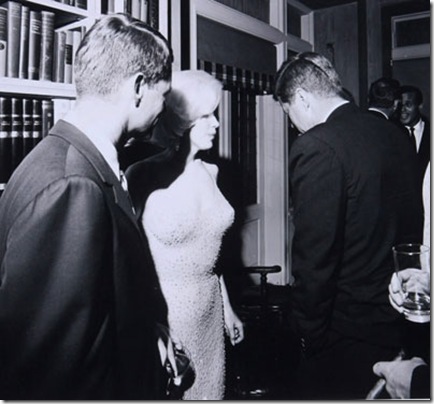
At an after-party, a photographer caught President Kennedy and brother Robert Kennedy hovering over Marilyn in the library, still wearing the see-through dress Marilyn called “skin and beads.”
Bobby Kennedy, Marilyn Monroe, and President John Kennedy gather following Monroe’s iconic performance of “Happy Birthday, Mr. President,” at Madison Square Garden, May 19, 1962. Marilyn is still wearing the gown she wore in the performance which she referred to as “skin and beads.” The auction house Christie’s later sold this dress for $1.2 million, the most money ever paid for a dress.
Kennedy’s Ambassador to the United Nations, Adlai Stevenson, was at the party and saw Marilyn’s “skin and beads” dress. He later wrote to Mary Lasker:
“I didn’t see the beads!”
Greek opera diva Maria Callas (1923-1977) laughs it up with blonde bombshell Marilyn Monroe at President Kennedy’s 45th birthday bash at Madison Square Garden, May 19, 1962. First Lady Jackie Kennedy did not attend the celebration. Marilyn Monroe was President Kennedy’s lover when Jackie was Mrs. Kennedy. Maria Callas was the clandestine lover of Aristotle Onassis when Jackie was Mrs. Onassis.
Jackie Kennedy watched Marilyn’s performance on TV the next day. She was livid. The rumors about Jack and Marilyn were flying. Jackie called up sister-in-law Ethel Kennedy and complained that she just knew Bobby had staged the prank. Jackie ordered Jack to stop seeing Marilyn. (4) Jack also sent word to the press that there was nothing to the rumors of an extramarital affair between him and Marilyn Monroe, which, we know, was a lie.
President Kennedy broke off the relationship with Marilyn. Her performance at Madison Square Garden became her last public appearance. Marilyn became profoundly affected by the break-up with the President and her loss of other men, including ex-husband Arthur Miller, who had recently remarried.
As a result, the summer following the Madison Square Garden show, Marilyn dove deeper and deeper into a downward spiral of drugs and alcohol, storm and stress, and depressed isolation. Out of necessity, the production of her film, “Something’s Got to Give” came to a halt, because the star was a “no-show” on the set.
The movie was never finished. On August 5, Marilyn Monroe – born Norma Jeane Baker – was found dead in her home from a drug overdose – an apparent suicide – and the world was shocked.
Goodbye, Norma Jeane
(1) Leaming, Barbara. Marilyn Monroe. New York: Three Rivers Press, 1998.
(2) Smith, Sally Bedell.Grace and Power: The Private World of the Kennedy White House. New York: Random House, Inc., 2004. (excerpted from a Time magazine article)
(3) Klein, Edward. All Too Human: The Love Story of Jack and Jackie Kennedy. New York: Pocket Books, 1996.
(4) Taraborrelli, J. Randy. Jackie Ethel Joan. New York: Warner Books, Inc., 2000.
*Readers: I’ve written many posts on Jackie O and the Kennedys. Please look in the right sidebar – Categories – People – the Kennedys. Enjoy!
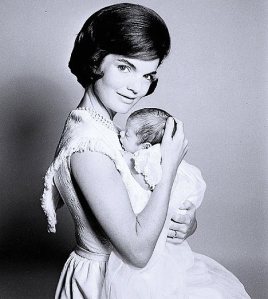
Jackie Kennedy holds son John F. Kennedy, Jr., born November 25, 1960, 16 days after his father, John F. Kennedy won the presidential election. He was nicknamed “John-John.” Three years later on his own birthday, John F. Kennedy, Jr. would salute his father’s coffin at his funeral.
Jacqueline Kennedy Onassis (1929-1994) is remembered for many things, her fashion statements, her redecoration of the White House, her brave young face at the 1963 funeral of her slain husband President John F. Kennedy. There were many things she cared about. But what mattered to her most in life was raising her two children, John F. Kennedy, Jr., and Caroline Kennedy (Schlossberg), to be good people. She said:
“If you bungle raising your children, I don’t think whatever else you do matters very much.”
She wanted so much for her children to lead normal lives. But, in the aftermath of JFK‘s assassination, it proved to be an impossible dream. She tried to continue living in their Georgetown home but tour buses added it to their route and reporters mobbed them on their doorstep. The crowds were too much to bear.
“The world is pouring terrible adoration at the feet of my children,” she’d once confided to her decorator Billy Baldwin, “and I fear for them, for this awful exposure. How can I bring them up normally?” (1)
Jackie ended up moving them all to New York where, to her dismay, she discovered her children weren’t being invited for playdates and parties by their school friends. It turned out that their parents were intimated by the Kennedy children’s fame.
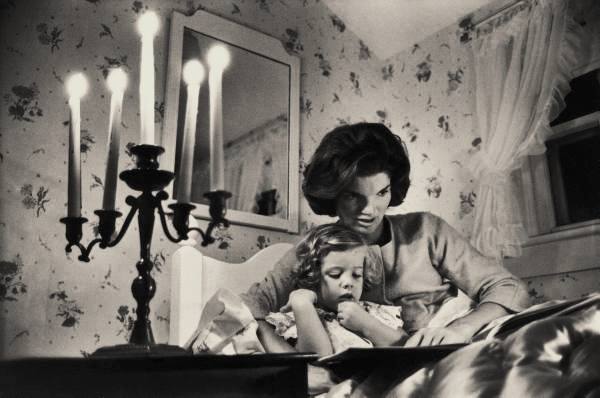
Jackie Kennedy, wife of then-Senator John F. Kennedy, reads a bedtime story to daughter, Caroline, at the family home in Hyannisport, Massachusetts. Jackie Kennedy loved books and passed this joy on to her children. September 13, 1960
In the post-JFK years, Jackie wasn’t just mobbed by tourists and reporters. The beautiful and charming young widow was besieged by male suitors, among them author Philip Roth, Frank Sinatra, Marlon Brando, and director Mike Nichols. Jackie’s friend and White House advisor Letitia Baldrige said that, even in the pre-JFK years, “she [Jackie] had more men per square inch than any woman I’ve ever known.”
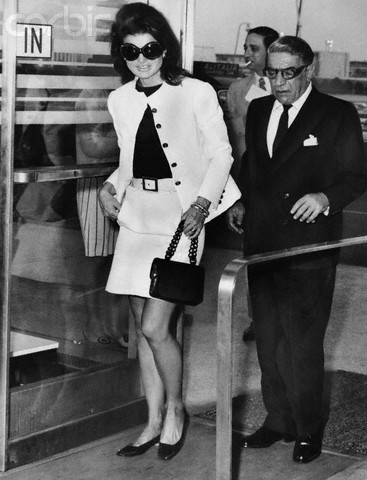
Jackie Kennedy Onassis with husband Ari Onassis on June 5, 1969, at New York’s Kennedy Airport
By 1968, Jackie’s most serious – and unlikely – suitor was Greek shipping tycoon Aristotle Onassis, “Ari,” for short. Whereas Jackie was cultured, sleek, and classy, Onassis was short, paunchy, and often rumpled and vulgar. Plus, he was 23 years Jackie’s senior. The Kennedy clan despised him. JFK’s younger brother, Robert “Bobby” Kennedy, who was running for president that year, urged Jackie to break off her relationship with Onassis. She promised him that she would put off talk of marriage until after the presidential election.
Then, on June 5, 1968, just moments after winning the California primary, Bobby Kennedy was assassinated. Jackie was devastated – and terrified.
I despise America,” a distraught Jackie told a friend. “If they are killing Kennedys, my children are the No. 1 targets. I want to get out of this country.”
She did, on October 20, when, in a small private ceremony, she wed Ari Onassis on the Greek isle of Skorpios. She was 39; he was 62. (1)
by guest blogger Loise King Waller, B.S. Political Science, summa cum laude, Boston University; J.D., University of Texas School of Law
From Joseph Kennedy‘s ambassadorship to England at a time when we were on the brink of WWII, the Kennedy family’s fate has, for better or worse, been inextricably linked with our nation’s. Although John Kennedy was young and untested when he took office in 1961 as President of the United States and presided over defeat at the Bay of Pigs, he finessed the Russians during the Cuban Missile Crisis and successfully avoided a nuclear showdown between the superpowers. The Civil Rights Act of 1964 would never have been passed without the initiative of his administration.
JFKs Attorney General, brother Robert Kennedy, courageously took on the mob, at great peril to himself and his family. His efforts to enfranchise minorities and mobilize antiwar sentiment during his ill-fated run for the presidency piqued the conscience of America.
Most people would agree that although he was not a perfect human being (who is?) Senator Ted Kennedy came of age as a distinguished statesman and tireless advocate of universal healthcare. We need him now. He will be missed.
To read more on the Kennedys on this site, scroll down the right sidebar to “Categories – People – Kennedys.”
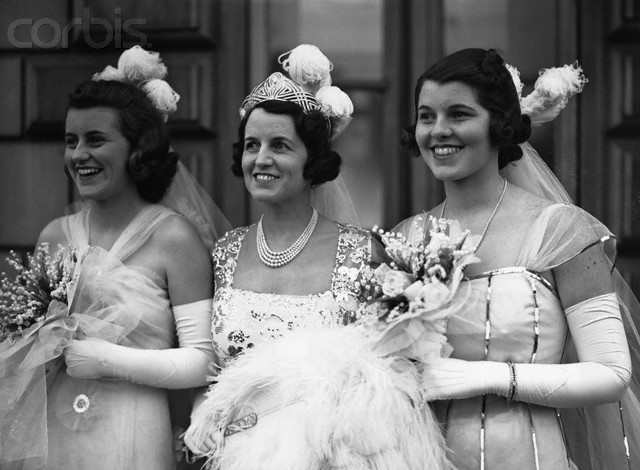
Rose Kennedy, wife of newly-appointed American ambassador to Great Britain, Joseph Kennedy, is shown at center with two of her daughters, Kathleen "Kick" Kennedy (l) and Rosemary Kennedy, at their 1938 presentation at Buckingham Palace. Kathleen's lively personality made her a great hit among the British social set. In 1944, Kathleen made what many considered a brilliant marriage to William "Billy" Harrington, the Marquess of Hartington, the heir to the 10th Duke of Devonshire. Kathleen became the Marchioness of Harrington. Her mother, however, was incensed that Kathleen would marry an Anglican and refused to attend the wedding ceremony. Only Kathleen's eldest brother, Joe Kennedy, Jr., attended. Then, four months later, Billy was killed in the war and Kathleen became a widow. It wasn't long before Kathleen was back in the social whirl of London parties and country estate weekends, and with a new man - a married man. He was Peter Wentworth-Fitzwilliam, 8th Earl Fitzwilliam. Kathleen fell madly for him and publicly became his mistress. Rose was furious - but not why you think. She was incensed because Peter - like Kathleen's first husband, Billy - was an Anglican and not a Catholic. Nevertheless, over her mother's objections, Kathleen planned to wed Peter after his divorce, Catholic or not. Their wedding never came about. In a 1948 trip to the south of France, both Peter and Kathleen died in an airplane crash. Still furious with Kathleen, Rose Kennedy did not attend her daughter's funeral and discouraged Kathleen's eight surviving siblings from attending. Only Kathleen's father, Joseph P. Kennedy, attended her funeral service. Kathleen Kennedy Cavendish was buried in the Cavendish family plot in Devonshire, England. There her body remains today.
Factbox: Kennedy Political Dynasty Marked By Tragedy
By REUTERS
Published: August 26, 2009
(Compiled from Web sites by the World Desk Americas)
The lives of Kennedy family members, noted for their extraordinary accomplishments, have also been marked by tragedy, including the assassinations of President John Kennedy and of Senator Robert Kennedy.
Following is a chronology of some of the tragedies that befell the storied U.S. political dynasty:
1941: Rosemary Kennedy, (pictured here), the oldest daughter of Joseph and Rose Kennedy, who was mentally disabled, was institutionalized for the rest of her life after a lobotomy reduced her abilities. She died in 2005.
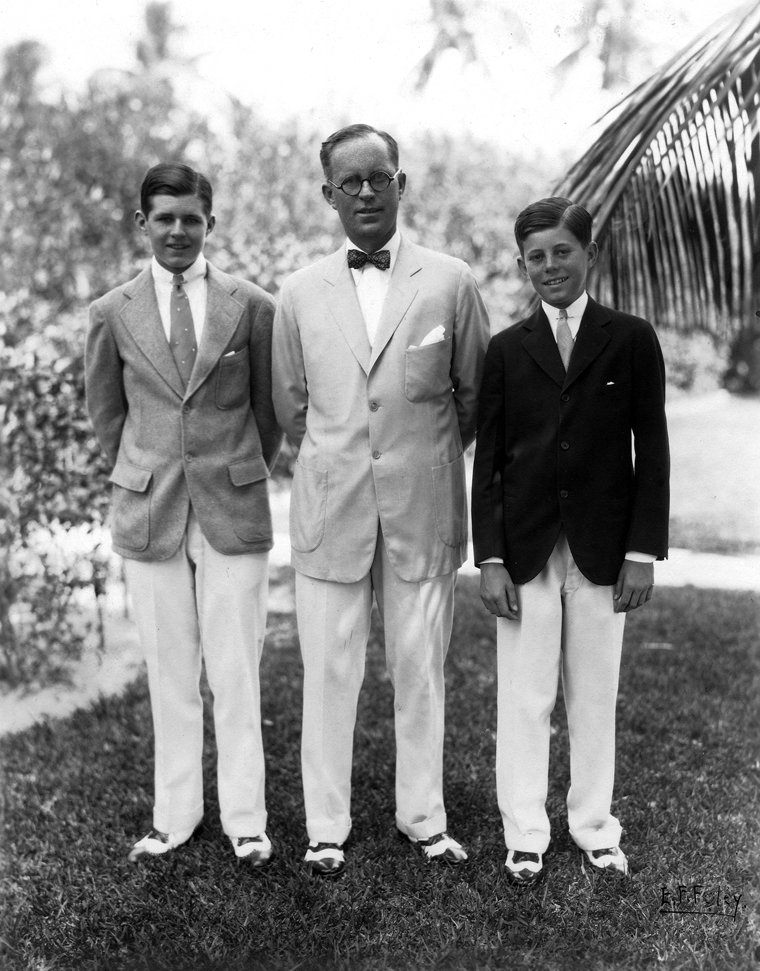
Joseph P. Kennedy, Sr. (c) with 2 of his 4 sons: Joe Kennedy, Jr. (l) and John F. Kennedy
1944: Joseph Kennedy Jr., the oldest of the nine Kennedy children, died at age 29 in a plane crash over the English Channel during World War Two while flying a mission.
1948: Kathleen Kennedy Cavendish, the fourth of the Kennedy children, was killed in a plane crash in France at age 28.
1963: President John Kennedy was assassinated on November 22 while riding in a presidential motorcade with his wife in Dallas, Texas, at age 46.
1964: Senator Edward Kennedy, the youngest in the family, narrowly escaped death in a plane crash that killed an aide.
1968: Senator Robert Kennedy was assassinated on June 5 in Los Angeles at age 42, just after he won California’s Democratic presidential primary election.
1969: Edward Kennedy drove off a bridge on his way home from a party on Chappaquiddick Island in Massachusetts. An aide in the car with him, Mary Jo Kopechne, died in the accident.
1984: David Kennedy, a son of Robert, died of a drug overdose at age 28.
1997: Another of Robert Kennedy’s sons, Michael, died in a skiing accident in Aspen, Colorado, at age 39.
1999: John Kennedy Jr. along with his wife and sister-in-law were killed when the plane he was flying crashed in the waters off Martha’s Vineyard in Massachusetts.
For more on the Kennedys, scroll down the right sidebar in “Categories – People – the Kennedys.”
The New York Post, quoting a new book, reports that Jackie Kennedy and Bobby Kennedy had a four-year love affair that began shortly after President Kennedy was killed.
Author C. David Heymann says Bobby was Jackie’s “true love” and that the affair was well known among family members. When Bobby was shot after winning the California presidential primary, Jackie — not Bobby’s wife Ethel Kennedy or his brother Ted Kennedy — ordered that he be removed from a respirator, the book says.
The book, Bobby and Jackie: A Love Story, arrives in stores this month. The Post says it “includes recollections of the steamy affair” from Kennedy family intimates, including Pierre Salinger, Arthur Schlesinger, Jack Newfield, Gore Vidal, Truman Capote and Morton Downey Jr. Heymann told the paper he spent nearly two decades researching the book and had access to FBI and Secret Service files. Tapes of his interviews are available at the SUNY Stony Brook library.
The Kennedy family at their home in Hyannisport, Massachusetts on the night after John F Kennedy won the 1960 presidential election. Front row from left: Eunice Shriver, Rose Kennedy , Joseph Kennedy , Jacqueline Kennedy, and Ted Kennedy. Back row, from left: Ethel Kennedy, Stephen Smith, Jean Smith, John F Kennedy, Robert F Kennedy, Pat Lawford , Sargent Shriver, Joan Kennedy, and Peter Lawford
Among the book’s revelations:
— Six months after JFK’s death, during a May 1964 dinner cruise on the presidential yacht the USS Sequoia, Bobby and Jackie “exchanged poignant glances” before disappearing below deck, leaving Ethel upstairs. “When they returned, they looked as chummy and relaxed as a pair of Cheshire cats,” according to Schlesinger.
— At one point, Ethel Kennedy implored family friend Frank Moore to “tell Bobby to stop sleeping with Jackie.” Instead, Moore told her to find a marriage counselor.
— Shipping tycoon Aristotle Onassis — RFK’s rival for Jackie’s attention — once threatened to “bring down” Bobby by going public with details of the affair. “I could bury that sucker,” Onassis said, “although I’d lose Jackie in the process.”
The New York Daily News reports that the book already is generating criticism:
“It’s a new low, and you just wonder how far people are willing to go,” Laurence Learner, author of The Kennedy Men, The Kennedy Women and Sons of Camelot told the paper.
“[Heymann] is just trying to make a buck. Yes, Bobby and Jackie had a relationship as friends, but [the romance] is a total exaggeration. I feel sorry for Heymann,” he said.
Lisa: Carolyn, today let’s dish on Ethel Kennedy. What were you telling me about her anger?
Bobby Kennedy California Primary Victory Party at the L.A. Ambassador Hotel, June 5, 1968, the night of his assassination
Carolyn: She loved Bobby so. She urged him to run for the presidency in 1968 and then, of course, he was assassinated. Jackie (Kennedy) had said that the same thing that had happened to Jack (murder) would happen to Bobby, but Ethel wouldn’t listen, and Jackie was right. But Ethel was the chief component in having Bobby run. She was extremely ambitious for Bobby. When Bobby started to run, Jackie said, “Oh, we’ll be in the White House again!”
And Ethel said, “Who is this we?”
Ethel’s anger was displaced when Bobby died. She was more Kennedy than Kennedy. Kennedys were always told not to show anything but courage to the outside world. Ethel couldn’t show the world that she was in private anguish over the loss of her beloved Bobby after he died. So she had displaced anger that she vented on her oldest sons: Joseph, Bobby Jr., and David – David had a drug problem but that had a lot of reasons to it. Bobby Jr. and Joseph got the worst of her wrath.
She pretty much let those kids run wild. She made them not want to be at home because she was raging. They became homeless in Hyannisport and Hickory Hill. They didn’t have a place to sleep at home. She sent them away the summer Bobby died. They were unwelcome at Ethel’s house. Some of the Kennedy elders kept their children away from Ethel’s kids because they were so wild. Ethel lived an unexamined life.
Lisa: Explain.
Carolyn: She never said I’m so angry, I’m so sad. She whaled into her older sons. She beat them with a hair brush. She sublimated her sadness. She had a black rage. For example, years earlier, when she found out that (actor) Paul Newman had become a supporter of Kenneth Keating of New York, a rival of Bobby Kennedy’s, she got mad. On a pretext, she invited Paul to play a friendly game of tennis with her.
Paul Newman
LaDonna Harris witnessed the match:
“From the moment they got on the court, Ethel wouldn’t let up on Paul. Ethel has an unhealthy kind of competitiveness, a masculine kind of meanness. She told him he was a lousy player. She teased him nonstop….He just didn’t know how to deal with it. He finally walked off the court. He had tears in his eyes.” (1)
Carolyn: Ethel had a quirky sense of humor. She used live frogs for centerpieces at her dinner parties. People got pushed into swimming pools at her parties.
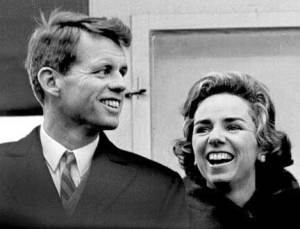
Bobby and Ethel Kennedy
I think she called Lyndon Johnson Uncle Cornpone. I think she looked for weaknesses in others and then hurt them with it. I think the whole point here is that Ethel had displaced anger, her early years – she grew up in an atmosphere of too much liquor, bad upbringing – they let them run wild. They drove fast. Had a lot of money. She was ruthless. Bobby, too. But he was kinder. He liked children and animals. But not Ethel. She was cruel. Bobby was spiritual. He had a good side; he was a fine father. His kids somewhat fell apart when he died because they needed his nurturing. Bobby was the nurturer; that’s it.
(1) Oppenheimer, Jerry. The Other Mrs. Kennedy. (New York: St. Martin’s Press, 1994)
To read more on the Kennedys on this site, scroll down the right sidebar to “Categories – People – Kennedys.”













 Lisa's History Room