Nellie Bly could have won an Academy Award for her impersonation of a lunatic. On the morning of Saturday, September 24, 1887, within twenty-four hours of checking into the Temporary Home for Females at No. 84 Second Avenue, the police were called to escort “Nellie Brown” to the Essex police station. The assistant matron of the boardinghouse told the police that “Nellie Brown” had so terrified her female boarders with her crazy rantings that they feared being murdered in her beds. Bly claimed that all the women in the house were crazy. She had forgotten who she was, she said, and lost her trunks. She acted confused, vague, but not dangerous.
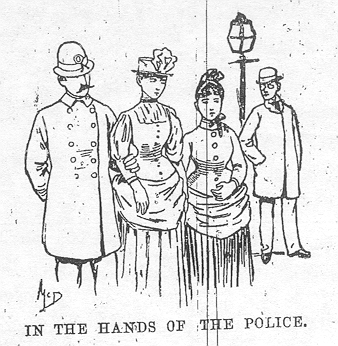
The police took Bly before Judge Duffy who ordered her sent to Bellevue Hospital for examination, where Dr. William C. Braisted, head of the insane pavilion there, said Bly was “undoubtedly insane.” (1) There she passed two freezing cold nights, remembering that “all night long we were kept awake by the talk of the nurses and their heavy walking through the uncarpeted halls.” Nellie, being Nellie, complained to the nurses and the doctors about the lack of heat in the institution and the poor conditions. She was told that she could expect no kindness in the place as it was a charitable institution!
The stay at Bellevue was temporary though. The next day – Monday – a boat was expected. It would take Nellie Bly away permanently to Blackwell’s Island Lunatic Asylum for Women.
Just think. The speed of the thing was dizzying. On Thursday Nellie Bly had been sitting in the offices of the New York World contemplating the assignment of posing as an insane woman to gain admittance into an institution. It seemed an impossible hurdle – to be declared insane and committed for life to an insane asylum. Yet it was a mere three days later and Nellie Bly – a completely normal person – was being committed for life to an insane asylum – on the notorious Blackwell’s Island. How many other unfortunates had also suffered this fate?
(1) Kroeger, Brooke. Nelly Bly. (New York: Random House, 1994)
Next: Nellie being Nellie
 “So I flew to the mirror and examined my face,” she wrote later. “I remembered all I had read of the doings of crazy people, how first of all they have staring eyes, and so I opened mine as wide as possible and stared unblinkingly at my own reflection.” She began to sweat nervously, which unfortunately took the curl out of her Victorian bangs. Over and over again, she practiced her crazy face in the mirror. She ended up staying up all night, rehearsing her new role, thinking about her new mission, and reading scores of ghost stories to put her in a lunatic frame of mind.
 It had been four months since she’d left Pittsburgh for New York yet Elizabeth Jane Cochran, or “Nellie Bly,” as her byline read, still hadn’t landed a job as a newspaper reporter. She had left the Pittsburgh Dispatch because she was tired of being assigned to the ladies’ pages – writing the society column, reviewing operas, and reporting on the latest women’s fashions.




 Lisa's History Room