Feeds:
Posts
Comments

Posts Tagged ‘biographies of actresses’

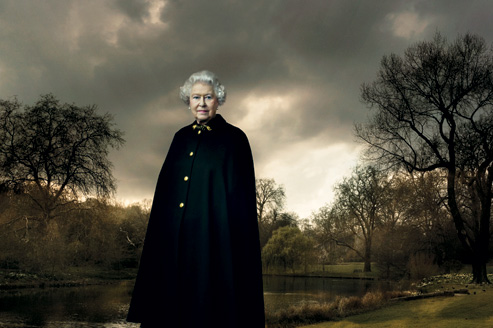
photo of Queen Elizabeth II at Buckingham Palace, March 28, 2007, by Annie Leibovitz

Annie Leibovitz photographed Queen Elizabeth. Here’s what she had to say about that experience.
Excerpted from Annie Leibovitz at Work, by Annie Leibovitz, published by Random House © 2008

The Queen

In 2007, a few weeks before Queen Elizabeth visited the United States for the 400th anniversary of the founding of Jamestown, I was asked to take her portrait. I was the first American to be asked by the Palace to make an official portrait of the Queen, which was very flattering. I felt honored. I also felt that because I was an American I had an advantage over every other photographer or painter who had made a portrait of her. It was O.K. for me to be reverent. The British are conflicted about what they think of the monarch. If a British portraitist is reverent, he’s perceived to be doting. I could do something traditional.

It’s ironic that the sitting with the Queen became controversial. I’m rather proud of having been in control of a complicated shoot. The controversy arose about two months after the pictures were published, when the BBC claimed that the Queen had walked out while we were shooting. This was completely untrue, and although they retracted the claim and issued an apology to the Queen and to me almost immediately, the scandal had a life of its own. The story, which came to be referred to as Queengate, wouldn’t die. Eventually the head of BBC One resigned over it.

When I was preparing for the shoot, I thought about using the landscape around Balmoral Castle, in Scotland. I brought this up in the very first conference call with the Palace. I said that Americans thought of the Queen as an outdoorswoman. I had been influenced by Helen Mirren’s performance in The Queen and I couldn’t help mentioning how much I liked her character in that film. There was a long silence on the other end of the line.

The second idea I had, after Balmoral, was to photograph the Queen on horseback. I asked where she rode and they said she went riding every Saturday at Windsor Castle. I said that I would love to see her in her riding clothes, and in a later conversation I asked if she could stop during her weekend ride and get off her horse and mount it again. That is, could I do a portrait of her in the trees. They said, No, it was not possible. She just rode the horse and came back, and, anyway, she didn’t wear riding clothes anymore. A few days later they said it was going to be Buckingham Palace and no horses.

I realized that I was going to need some time on the ground for this. When we arrived in London, we went straight to the palace and were shown all the rooms, including the throne room—everywhere except the private quarters. And then we scouted the back. There was a wintery sky and the trees didn’t have leaves. It was an appropriate mood for this moment in the Queen’s life. There was no way, however, that she was going to stand outside in formal attire.

For a sitting like this you don’t put all your eggs in one basket. You try to have as many options as possible. I kept thinking that somehow I would get the Queen outside, but I began choosing formal outfits. I narrowed the robes down to a very handsome Order of the Garter cape, but then we were told that she could wear only a white dress under it. We were lobbying for a gold dress. I was also hoping for a dress with more body to it. The Queen wears very streamlined dresses now that she’s older, and I wanted her in something with more volume. But she didn’t have anything like that. Finally everyone agreed that she could wear a gold-and-white dress under the Order of the Garter robe. The Queen was 80 years old. She was sturdy, but putting on and taking off a lot of heavy clothes is tiring, and she had to be dressed in layers to expedite things. The gold-white dress became the base.

I was still upset that I couldn’t get her outside. It was so beautiful out there. And it wasn’t cold or raining or anything. I began thinking about what Cecil Beaton had done. He brought in flowered backdrops. Beaton was big on backdrops. He made very stagy portraits. Perhaps because the pictures were made in black and white you don’t notice the backdrops. They sort of go out of focus. I realized that I could do something similar digitally. I decided to photograph the garden and the trees for a backdrop.

The Palace had given us 25 minutes with the Queen, so there had to be a battle plan. I chose a grand reception room, the White Drawing Room, as the principal setting because of the light from the tall windows. Supplementary lights had been pre-set so that when the Queen moved from one spot to another all we needed to do was switch them on. We had constructed a gray canvas backdrop in an anteroom, and she was to come in there wearing the Order of the Garter robe and the dress, but no tiara. The first shot was to be made on a balcony, with the sky behind her. That sky could be digitally exchanged later for the pictures I had taken in the gardens the day before. I didn’t want her to be wearing a tiara in the gardens.

The morning of the shoot, the Queen came walking down the hall very purposefully. She was definitely a force. This was all being taped by the BBC for a documentary. I would never have agreed to their being there if I felt I had any choice, but they had been following her around for months. Their microphone picked up her saying, “I’ve had enough of dressing like this, thank you very much,” as she marched down the hall. Later, when segments of footage for the BBC were edited for a promotional film, it appeared as if the Queen were stomping out of the photo session rather than going into it. Thus the brouhaha.

The Queen was about 20 minutes late, which we thought was a little strange. When that happens, you never know if it can be made up on the other end. My five-year-old daughter, Sarah, had come with us, and she curtsied and offered the Queen flowers, and I introduced my team. At this point I was in shock. The Queen had the tiara on. That was not the plan. It was supposed to be added later. The dresser knew that. The Queen started saying, “I don’t have much time. I don’t have much time,” and I took her to the first setup and showed her the pictures of the gardens. I think she understood what we had in mind. Then I walked her into the drawing room, probably sooner than I would have if things had been going well. She composed herself when I took some pictures.

I knew how tight everything was, especially with the loss of 20 minutes, and I asked the Queen if she would remove the tiara. (I used the word “crown,” which was a faux pas.) I suggested that a less dressy look might be better. And she said, “Less dressy! What do you think this is?” I thought she was being funny. English humor. But I noticed that the dresser and everyone else who had been working with her were staying about 20 feet away from her.

We removed the big robe, and I took the picture of the Queen looking out the window, and then I said, Listen, I was a little thrown when you first came in, and I have one more picture I’d like to try, with an admiral’s boat cloak. I was thinking of one of Cecil Beaton’s last pictures of the Queen. A very stark and simple and strong portrait in which she’s wearing a boat cloak. We went back into the anteroom, where the gray canvas backdrop had been set up, and she took off the tiara and put on the cloak. That’s the shot we digitally imposed on pictures of the garden.

Right after we finished, I went up to the press secretary and said how much I loved the Queen. How feisty she was. Later I mentioned to a couple of friends that she had been a bit cranky, but it was nothing unusual. What was remarkable about the shoot, and I wrote the Queen a note about this later, was something the BBC missed: her resolve, her devotion to duty. She stayed until I said it was over. Until I said, “Thank you.” We were finished a little before our allotted 25 minutes were up.


Readers, for more on this episode, read my post, “The Queen is Mad.”

Read Full Post »

Dorothy Hale and Isamu Noguchi at the premiere of Four Saints in Three Acts, February 7, 1934, Hartford, Connecticut

Dorothy Hale and Isamu Noguchi at the premiere of “Four Saints in Three Acts,” February 7, 1934, Hartford, Connecticut

In 1934, the socialite and actress Dorothy Hale took a road trip through Connecticut with two old friends, writer Clare Boothe Luce and sculptor Isamu Noguchi. They drove in a special car Noguchi had designed with his drinking buddy, futuristic inventor Buckminster Fuller. The car was called the Dymaxion.

The Dymaxion Car

The Dymaxion Car

Buckminster Fuller with his portrait by Isamu Noguchi, 1929, photo by Noguchi

Buckminster Fuller with his portrait by Isamu Noguchi, 1929, photo by Noguchi

The 20-foot long aluminum-bodied Dymaxion car caused a traffic jam wherever it went.  This was between the two world wars when cars were sedans and pick-up trucks. “Bucky” Fuller’s car was shaped like a teardrop and ran on three wheels. It went 90 m.p.h. and was fuel-efficient at 30 m.p.g. The 3-wheeler made a 360-degree turn on a dime. A periscope that came out of the roof gave extra visibility. It seated eleven passengers.

It was the car of the future – for a while. Unfortunately, only three Dymaxion cars were ever produced. Orchestra conductor Leopold Stokowski bought one. Amelia Earhart was interested in investing. Financing was a problem and Fuller was running out of cash.

Aviator Amelia Earhart

Aviator Amelia Earhart

Any hope of putting the Dymaxion in full-scale production dried up quickly when the car was involved in a fatal accident at the 1933 Chicago World’s Fair. Another car was blamed for the crash but that didn’t stop the negative publicity for the Dymaxion.

Sadly, only one of the Dymaxions exists today. You can view the restored exterior of the car at the National Automobile Museum in Reno, Nevada. Disappointingly, though, the car windows are painted opaque from the inside to prevent you looking inside. Evidently, the inside was in very bad shape when the car was acquired and little information exists as to its original look in order to guide the museum restoration artists. The rumor is that the car had been used as a chicken coop somewhere in the Midwest before it was discovered, which explains the wrecked state of the interior!

View this youtube video to see the amazing turning radius of the Dymaxion. While you’re viewing, keep a lookout for Amelia Earhart in the back seat.

http://www.youtube.com/watch?v=YlLZE23EJKs&feature=related

For more on Dorothy Hale, see my most popular post, Frida Kahlo: The Suicide of Dorothy Hale.”

Read Full Post »

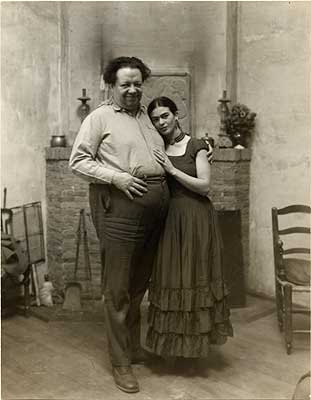
Artists Diego Rivera and Frida Kahlo

Artists Diego Rivera and Frida Kahlo

By the summer of 1938, Frida Kahlo was on her way to being discovered as an artist in her own right, rather than only being referred to as the wife of famed Mexican muralist Diego Rivera. That summer, actor and art collector Edward G. Robinson had traveled to Mexico City just to see her paintings and had paid $200 each for four of them. Frida was thrilled. She had sold only a few of her paintings so far and had been content to just give them away. She later wrote of the Robinson sale:

“For me it was such a surprise that I marveled and said, “This way I am going to be able to be free; I’ll be able to travel and do what I want without asking Diego for money.”

She and Diego had become increasingly estranged because of his many illicit extramarital affairs, including one with Frida’s sister Cristina. Frida was heartsick by Diego’s infidelities and retaliated by having multiple affairs of her own, with both men and women. Despite their discord, they remained deeply in love. Frida and Diego made up one of those married couples who could neither stay together nor apart. By the summer of 1939, they would be divorced – only to remarry a year later.

"Self-Portrait Dedicated to Leon Trotsky (Between the Curtains)" 193

“Self-Portrait Dedicated to Leon Trotsky (Between the Curtains)” by Frida Kahlo, 1937

That November, Frida Kahlo traveled to New York City for her first one-person exhibition of her paintings, held at the Julien Levy Gallery, confident in her new status as celebrated artist. As always, her exotic Zapotec clothing and heavy jewelry created a buzz in the press. Her show was a great success. Time magazine noted that “the flutter of the week in Manhattan was caused by the first exhibition of paintings by famed muralist Diego Rivera’s…wife, Frida Kahlo.” Frida Kahlo’s hand, bedecked with huge rings, adorned a cover of Vogue.

Notables such as artist Georgia O’Keeffe attended the gallery exhibit as did playwright and former editor of the fashion magazine Vanity Fair Clare Boothe Luce.

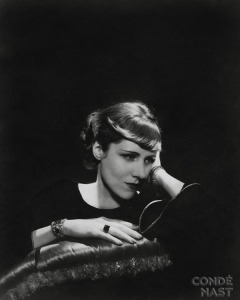
Claire Booth Brokaw (Luce) (1903-1987) as photographed by Cecil Beaton for the August 1934 issue of Vanity Fair

Claire Boothe Brokaw (Luce) (1903-1987) as photographed by Cecil Beaton for the August 1934 issue of Vanity Fair

Luce remembered the occasion well:

“The exhibition was crowded. Frida Kahlo came up to me through the crowd and at once began talking about Dorothy’s suicide [Dorothy Hale was a friend of both Kahlo and Luce’s].…Kahlo wasted no time suggesting that she do a recuerdo of Dorothy. I did not speak enough Spanish to understand what the word recuerdo meant….I thought Kahlo would paint a portrait of Dorothy in the style of her own self-portrait [dedicated to Trotsky][see above], which I bought in Mexico….

Suddenly it came to me that a portrait of Dorothy by a famous painter friend might be something [Dorothy’s] poor mother might like to have. I said so, and Kahlo thought so, too. I asked the price, Kahlo told me, and I said, ‘Go ahead. Send the portrait to me when it is finished. I will then send it on to Dorothy’s mother.’”

Dorothy Hale was a sometime actress, Ziegfeld showgirl, and socialite. Hale’s life had gone downhill seven years earlier after her husband Gardner Hale was killed when his car drove off a 500 foot cliff in Santa Maria, California. Hale’s career as an actress was drying up; she was failing her screen tests. She was in severe financial trouble and living on charity from friends.  On October 20, 1938, Hale assembled her close friends for a party at her New York apartment and announced that she was taking a long trip. The farewell party lasted until the wee hours of the morning. Hale stayed up writing good-bye letters to her friends and drinking the last of the vodka. A little before  6 a.m. on the 21st,  Hale put on her black velvet dress and pinned on it a corsage of small yellow roses sent to her by the sculptor Isamu Noguchi. She then climbed onto the windowsill of her luxury high-rise apartment suite and jumped to her death.

"The Suicide of Dorothy Hale" by Frida Kahlo, 1938/39

“The Suicide of Dorothy Hale” by Frida Kahlo, 1938/39

From the encounter between Luce and Kahlo at the gallery exhibit arose one of Frida Kahlo’s most shocking and controversial paintings, “The Suicide of Dorothy Hale” (1938/39). Kahlo painted Dorothy Hale as she jumped, fell, and landed, dead and bloody, on the concrete walk outside her apartment building. Blood-red lettering at the bottom of the retablo details the tragedy in Spanish:

“In New York City on the 21st of October 1938, at 6:00 in the morning, Dorothy Hale committed suicide by throwing herself from a very high window in the Hampshire House. In her memory, this portrait was executed by Frida Kahlo.”

Luce recalls the horror she felt when the painting was delivered to her home and she first laid eyes on it.

“[W]hen I pulled the painting out of the crate…I felt really physically sick. What was I going to do with this gruesome painting of the smashed corpse of my friend, and her blood dripping down all over the frame? I could not return it – across the top of the painting there was an angel waving an unfurled banner which proclaimed in Spanish that this was ‘The Suicide of Dorothy Hale, painted at the request of Clare Boothe Luce, for the mother of Dorothy’. I would not have requested such a gory picture of my worst enemy, much less of my unfortunate friend.”

Luce wanted to have the painting destroyed, but was dissuaded by friends. Instead, she had sculptor and friend Noguchi paint over the angel with the banner and gave the painting to a friend.

Luce couldn’t have known at the time that Kahlo was in a desperate state of mind as she always was when she was afraid of losing Diego. At the time she painted “The Suicide of Dorothy Hale,” Kahlo herself was having repeated thoughts of committing suicide.

READERS: For more posts on Frida Kahlo, click here.

For more on Dorothy Hale, read my post, “Dorothy Hale and the Dymaxion Car.”

Read Full Post »

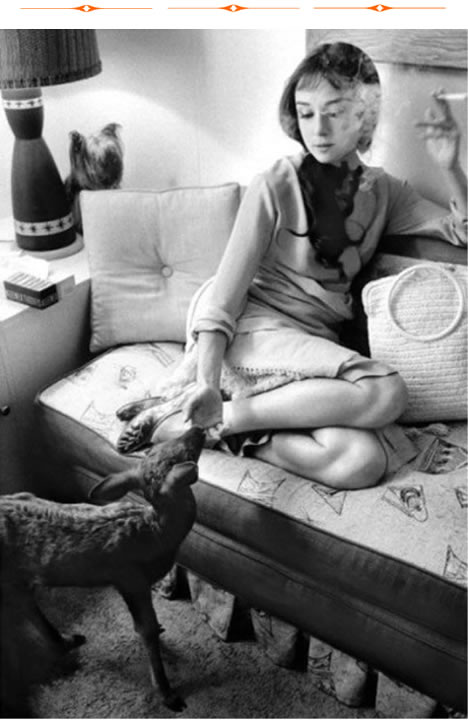
Audrey Hepburn in her dressing room during the filming of "Green Mansions." She is feeding Ip the fawn while her Yorkshire terrier Mr. Famous looks on from the left.

Audrey Hepburn in her dressing room during the filming of “Green Mansions.” She is feeding Ip the fawn while her Yorkshire terrier Mr. Famous looks on from the left.

This is an excerpt from,”Hollywood icon Audrey Hepburn is still full of surprises“:

[The book] Remembering Audrey, features candid portraits by Bob Willoughby, a photographer on the set of many of Hepburn’s films who became close enough to the beauty to literally follow her home. His visual account of Hepburn’s private life and career is peppered with unexpected moments, such as cameos by Pippin, nicknamed Ip, the fawn. When Hepburn was making her 1959 flick “Green Mansions,” directed by then-husband Mel Ferrer, the animal trainer on the set suggested that she take her on-screen sidekick, a baby deer, home with her so that he would learn to follow her. “It was truly amazing to see Audrey with that fawn,” remembers Willoughby in the caption alongside a photo of Pippin cuddling up to Hepburn like a lap dog as she naps on the couch. (Her pet dog, Mr. Famous, is curled in a ball at the other end of the sofa.) “While Audrey’s maid had been told about the little deer, she could not believe her eyes seeing Ip sleeping with Audrey so calmly,” writes Willoughby. “She was shaking her head and just kept smiling.”

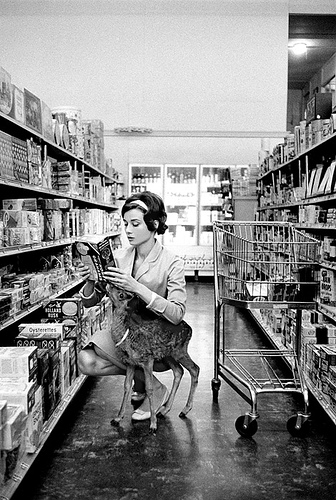
Audrey Hepburn shopping in Beverly Hills with her pet deer and costar, Pippin, known as "Ip." (1958)
Audrey Hepburn shopping in Beverly Hills with her pet deer and costar, Pippin, known as “Ip.” (1958)

In another shot, the fawn inspects a box of Honey Grahams, shopping with Hepburn in a Beverly Hills supermarket. “Beverly Hills habitués are fairly blasé about what they see,” writes Willoughby, “but Audrey being followed around town by this lovely creature stopped everyone in their tracks.”

For more on Audrey Hepburn on this site, click here.

Read Full Post »

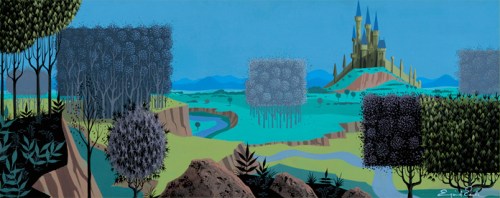
The iconic castle from "Sleeping Beauty," by artist Eyvind Earle for Disney
The iconic castle from “Sleeping Beauty,” by artist Eyvind Earle for Disney

Up until the release of Disney’s “Sleeping Beauty” in 1959, the Disney characters were normally drawn first for a film and then the background was drawn later to complement the characters. But this process was reversed in 1951 – causing some hard feelings – when Walt Disney Studios hired the new background painter, Eyvind Earle.

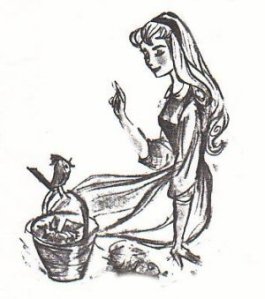
Tom Oreb's early drawings of Sleeping Beauty, influenced by Audrey Hepburn

Tom Oreb's early drawing of Sleeping Beauty, influenced by Audrey Hepburn

Walt Disney wanted the setting to have a very Renaissance Germanic look and Earle’s style fit the bill. The problem was that, when Earle joined the studio, the characters for “Sleeping Beauty” had already been drawn. Soft and round in the Disney tradition, the characters clashed with Earle’s stylized angular backgrounds. Though it was unusual to take style direction from a background painter, that’s what the character artists were forced to do. They had to go back to the drawing board and reconceive all the characters in a style that suited Earle’s design.

Although Sleeping Beauty would have blonde hair in the film, character stylist Tom Oreb based the princess’ original design on the physical geometry of  brunette Audrey Hepburn.

Audrey Hepburn

Audrey Hepburn

“The qualities of that actress’ slender, willowy physicality lend themselves beautifully to the design environment of the film,” said Disney historian Jeff Kurtti.

drawing of Sleeping Beauty by Marc Davis, redesigned for use in 1959 film

drawing of Sleeping Beauty by Marc Davis, redesigned for use in 1959 film

Originally,” said Disney animator Ron Dias, “Sleeping Beauty looked a lot like Audrey Hepburn; she was softer, rounder, more like the ‘designy’ Disney girl. Back at the drawing board, Marc Davis redesigned her. She became very angular, moving with more fluidity and elegance, but her design had a harder line. The edges of her dress became squarer, pointed even, and the back of her head came almost to a point rather than round and cuddly like the other Disney girls. It had to be done to complement the background.”

Click below to see Helene Stanley perform in the Disney Studio as the live action model for Sleeping Beauty as Disney artists sketch away. This video was part of the premiere of the Disneyland TV show.

Read Full Post »

I was thinking it was time for a good ghost story. I was tossing around some ideas in my head when I recalled something I’d seen on TV as a child. Of course we didn’t have any Discovery Channel back then, but the program was definitely a documentary type. It featured haunted houses and the people who lived in them. I remember the narrator talked with a family who lived in a house in which a rocking chair rocked with no one sitting in it. That felt a little hokey so I wasn’t spooked. It was when the narrator interviewed a person I recognized that I scooted to the edge of my seat.

Sommer and Sellers in "A Shot in the Dark" (1964)

Sommer and Sellers in "A Shot in the Dark" (1964)

It was the beautiful, blonde, and sexy Hollywood actress Elke Sommer (b.1940). She was familiar to me because she had played the voluptuous maid Maria opposite Peter Sellers in the second Pink Panther movie, “A Shot in the Dark” (1964), which ReadersDigest.com names as one of the top funniest 50 films of all times. If you haven’t seen it, you should. Bumbling Inspector Clouseau (Sellers) trails after Maria whom he suspects of committing multiple murders, one of which is in a nudist camp.There’s a hilarious scene of Maria and Clouseau fleeing through Paris naked.a-shot-in-the-dark-movie-poster

Anyway, Elke and her husband Hollywood columnist and Bogart’s best friend Joe Hyams (1923-2009) lived in Benedict Canyon in North Beverly Hills. They claimed that a ghost was living in their house. My husband Tom also remembers seeing the same show when he was young.  “They (Elke and Joe) had a ghost in their dining room,” he recalled. “The chairs would move around at night. They would put marks on the floor below the chairs before they went to bed, then, the next morning, they’d look, and the chairs wouldn’t be standing on the marks anymore. The chairs would be all over the place.”

In the middle of the night, Elke and Joe would wake up to what sounded like a dinner party going on downstairs in the dining room, hearing voices, chairs scooting, glasses tinkling, and silverware clanging. Yet they would go downstairs and no one would be there. Elke said, “Things would move all the time and it would be very noisy and (it was) the usual poltergeist nonsense, you know.” (1) The ghost was described as being a middle-aged man wearing a white shirt. (2)

After battling the spirits with no relief, they called in some help, contacting the Parapsychological Institute at UCLA. When Life photographer Allan Grant arrived at the house to take some pictures, he was a sceptic – but not so when he left. He said:

Something happened that spooked me. On one roll of film that I shot in a particular room where they first spotted the ghost there were about four or five frames of film that were progressively fogged down to the end of the frame, giving it a ghostlike appearance, especially (of) Joe Hyams, who was in the shot. When that was processed and I took a look at it, I thought, there’s no way that would happen…in the center of a roll…something else had happened that I couldn’t explain and I’ve spent years as a photographer and that had never happened to me before….Something did happen in that house. (1)

The haunting continued. A mysterious fire erupted one night. Fortunately, Joe and Elke were able to get out through a window. Shortly thereafter, they moved out of the house permanently. (1) Joe Hyams wrote a book about it called The Day I Gave Up the Ghost. Evidently, though, the ghost didn’t give up. The “severely haunted house” at 2633 Benedict Canyon “was bought and sold more than seventeen times since Sommers vacated it, and many have reported ghostly phenomena.” (3)
 

(1) youtube interview: “Actress Elke Sommer with a Poltergeist.”
 http://www.youtube.com/watch?v=NRLasAUl-eI
(2) California Paranormal Travel Guide.
http://www.haunted-places.com/californ.htm
(3) Ghosts of Hollywood: Celebrities Who Have Seen Ghosts. http://paranormal.about.com/cs/trueghoststories/a/aa022304_3.htm

Read Full Post »

Carolyn King Waller

Carolyn King Waller

My mother Carolyn King Waller stopped by Lisa’s History Room this afternoon for a little chat. Carolyn was born in Corpus Christi, Texas, in 1934. She has a mind like a steel trap; her ability to recall stories from the past is legend.

Lisa: Thanks for stopping by today, Mom. Everyone knows that you love history. What would you say is your favorite period?
Carolyn: Probably the World War Two years, 1941 to 1945. And of course World War Two for other countries was longer that. 1941 to 1945 were America’s war years.
Lisa: And why is that your favorite period?
Carolyn: The fate of the world hung in the balance. It was a lot of drama – really, truly, good against evil.
Lisa: So it fascinates you.
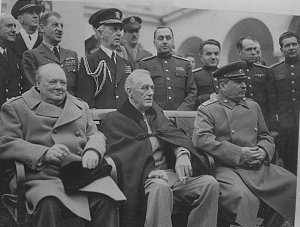
Carolyn: I’m not the only one…others are fascinated by it still…of course, we didn’t know about the Jews being exterminated, 6 million…then the Stalin thing…Stalin moved in from the east, we (the Allies) moved in from the west. The countries that Stalin occupied in the east became known as the countries behind the Iron Curtain. Churchhill coined the phrase. The poor people who had been under Germany were then under Russia! We didn’t really free them. The people in those countries had no freedom. We slowly woke up to who Stalin was. The Russians never left, including East Berlin, so World War II strengthened the Russians, it helped one problem, it created a worse one though, by increasing the strength of the Communists. Roosevelt was blamed for that but there wasn’t much he could do. It was said that Roosevelt gave too much away to Stalin at the 1945 Conference of Yalta,

1945 Conference at Yalta

1945 Conference at Yalta

but there really was very little he could do about it. They (the Communists) were there – they had occupied Eastern Europe – they had “boots on the ground.” We didn’t know then that Stalin had murdered millions of his own people, that he was a monster. In the early days, Truman even said, “I like Old Joe.”
Lisa: What else makes it an interesting period?
Carolyn: Outsized personalities of Hitler, Stalin, Roosevelt, and Churchhill – huge . Churchhill was a fabulous orator, Roosevelt knew about ships, had knowledge of the military, selected good generals. Hitler was a poor strategist; he entered all those countries at once. He told the generals what to do but he wasn’t good at military strategy. He was just a madman.
Lisa: To learn more, are there some books you would recommend?
Carolyn: Books about the period abound, certainly the biographies of those four men, stories of the war itself would be good.
Lisa: Does a particular book come to mind?
Carolyn: Kennedy’s thesis that became a book, While England Slept, No Ordinary Time, the Churchill bios by William Manchester – The Last LionA Man Called Intrepid
Lisa: What films capture the flavor and the truth of the war?
Carolyn: “The Best Years of Our Lives” showed the problems of returning servicemen from the war. “Edge of Darkness,” with Errol Flynn and Ann Sheridan depicts the Norwegian struggle. Norway was given away by the Quisling leader. The Norwegians had to fight Germany in an underground movement. There may be another movie, “A Moon is Down,” by John Steinbeck about occupied Norway, but I’ve not seen it.
Lisa: What else?
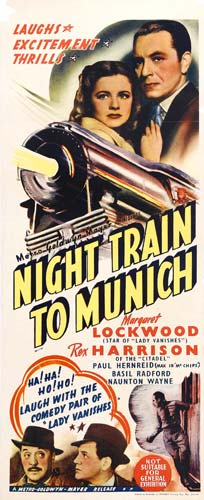
Carolyn: “Escape” which was a book by Ethel Vance, with Robert Taylor and Norma Shearer; “Night Train to Munich,” with Rex Harrison; and, of course, “Casablanca; “Ministry of Fear,” with Ray Milland; “Cloak and Dagger,” with Gary Cooper and Lily Palmer,night-train-to-munich “Watch on the Rhine,” with Bette Davis and Paul Lucas, and “OSS,” with Alan Ladd. All of those are great movies.
Lisa: What was it like to be a young girl in the war years?
Carolyn: In elementary school, our room would get the American flag for the week if our class bought the most war stamps and bonds that week. The classes competed to have the flag on display at the front of the room. It was a big deal. I was at Fisher School two years. Stamps were ten cents, bonds were $18.75 redeemable in ten years for $25. You had a book of stamps and you would try to fill the book with stamps. You would turn in a certain amount of stamps to redeem for a bond. That paid for the war! My grandparents sold cattle during the war years and they gave me money to do it because I was always a big stamp buyer. The government was smart to do that. It was an easy way for the government to get money from the citizens to finance, to fight the war. So many (citizens) had schoolchildren. While boys – women and men were fighting and dying in the war around the world – I was a young girl busy doing cartwheels in the front yard and joining little clubs – I was totally isolated. I didn’t know anyone who died in the war.
Lisa: Changing the subject, you wanted to say something about (actress) Carole Lombard.

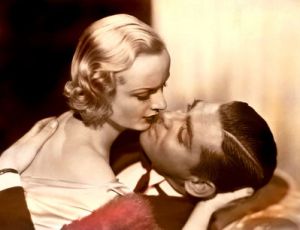
Carole Lombard and Clark Gable

Carole Lombard and Clark Gable

Carolyn: Yes. Japan attacked us on Dec. 7, 1941. In January 1942 Carole Lombard went on a war bond tour – to Indiana I think. She wanted to get home to see (her husband and actor) Clark Gable afterward, in a hurry, because they had had a fight over Lana Turner. She insisted on flying out to California late at night when it was dark and foolish to fly over the Rockies. She should have waited for a better plan but she insisted on flying out. She crashed in her plane in the Rockies. She was only 33. All they found of her were her earrings. Clark went to the scene and was distraught. He was always a good drinker, but he isolated himself for a few days afterward or so and drank heavily before he came back out. Roosevelt said she (Lombard) was one of our first casualties of the war or maybe even first hero. Before she had left, she had said to Clark Gable, “Pappy, you need to join this man’s army (meaning the United States Army).” After she died, Gable did just that; he enlisted. He was about 41. He didn’t need to sign up. They were not drafting men of his age. But he was distraught and he did it. He was made a captain or something at the top – he became brass right away – he was too important to be just a regular fellow. He may have been in the Army but he was still a celebrity.
Lisa: Was Clark Gable decorated?
Carolyn: He was stationed in Great Britain, he was an officer, he may have been in some forays over Germany.
Lisa: What will we be talking about during your next visit to Lisa’s History Room?
Carolyn: What should we talk about? Should we talk about history?
Lisa: Well, if you had something you wanted to tell, what would it be?
Carolyn: I’d tell about the depression years. We had butter beans at Mother’s, and (my grandmother) Nona cooked cheap things, rice pudding, bread pudding, onions….the hobos, I don’t want to say that, the homeless people, they would come to the back door. Nona would give them a plate of food and they would to go and sit out under a tree in the backyard and eat their food. People weren’t afraid of other people back then.
Lisa: Okay, save those stories for next time. Thank you so much for stopping by today.
Carolyn: Well, bless your heart, you make me feel like a celebrity!

Read Full Post »

« Newer Posts