The Mamas and the Papas, from left to right: Michelle Phillips, John Phillips (in tube), Denny Doherty, and Mama Cass Elliot. The sixties pop rock band is remembered for its sweet harmony and enchanting melodies.
Father and Daughter, John and MacKenzie Phillips, in 1998.
Associated Press
Wed Sep 23, 12:37 pm ET
CHICAGO – Former child star Mackenzie Phillips said Wednesday her father, John Phillips, who was a leader of the 1960s pop group the Mamas and the Papas, raped her when she was a teenager and that her sexual relationship with him later became what she termed “consensual.”
Mackenzie Phillips writes in her new book, High on Arrival, that she had sex with her father on the night before she was to get married in 1979 at age 19, according to People magazine.
“On the eve of my wedding, my father showed up, determined to stop it,” writes Phillips, who was 19 and a heavy drug user at the time. “I had tons of pills, and Dad had tons of everything too. Eventually I passed out on Dad’s bed.”
“My father was not a man with boundaries. He was full of love, and he was sick with drugs. I woke up that night from a blackout to find myself having sex with my own father.”
She told “The Oprah Winfrey Show” in an interview that aired Wednesday that her siblings “definitely have a problem with this.” Winfrey also read a statement from Genevieve Waite, John Phillips’ wife at the time of the alleged abuse and Mackenzie’s stepmother that said he was “incapable, no matter how drunk or drugged he was, of having such a relationship with his own child.”
At far right, MacKenzie Phillips from a publicity photo for the 80s TV sitcom, “One Day at a Time.” MacKenzie Phillips is best known for her roles as an emotionally troubled and rebellious teenager.
Phillips, who starred on TV’s “One Day at a Time,” said the sexual relationship with her father lasted a decade and ended when she became pregnant and didn’t know who had fathered the child. She had an abortion, which her father paid for, and “and I never let him touch me again.”
Phillips told Winfrey that she first tried cocaine when she was 11 years old. Her father did drugs with her, taught her to roll joints and injected her with cocaine. Phillips said she’s been clean for a year after pleading guilty to possessing cocaine and entering a drug treatment program.
Phillips said the sexual relationship, although she believes it became consensual, was “an abuse of power” and “a betrayal” on her father’s part. She said she forgave John Phillips on his deathbed.
“I can’t be the only one this has happened to,” Phillips said. “Someone needs to put a face on consensual incest.”
Here is a video of the Mamas and the Papas singing “California Dreaming.” MacKenzie Phillips’ father, John Phillips – “Papa John” – plays guitar, wearing a fur hat. The other band members are Michelle Phillips (at the time, John Phillips’ wife and MacKenzie’s stepmother), Mama Cass Elliot, and Denny Doherty.
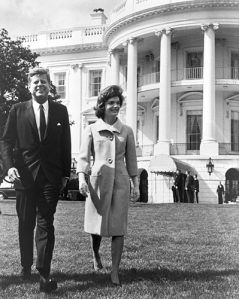
American Royalty: President John and Jackie Kennedy stroll the White House grounds.
It was a star-studded event. It was Saturday, May 19, 1962, and the young, dashing, and popular U.S. President John F. Kennedy was turning 45. The Democratic Party held a huge fundraiser at New York’s Madison Square Garden. The birthday salute was televised before a national audience and 15,000 people had paid for seats to catch the show live at the Garden. The cream of American show business turned out to pay homage to Kennedy – Ella Fitzgerald, Peggy Lee, Jack Benny, Henry Fonda, Harry Belafonte. Greek opera diva Maria Callas was also there. Actor Peter Lawford, the president’s brother-in-law, served as master-of-ceremonies. But the pièce de résistance – the showstopper – was the performer who sang the finale – sexpot and film star Marilyn Monroe.
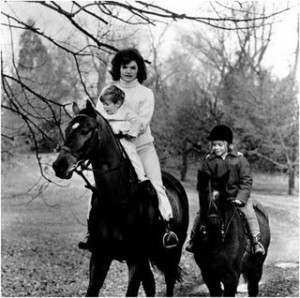
First Lady Jackie Kennedy riding horses with her children at their Middleburg, Virginia, retreat “Glen Ora.” Jackie grew up surrounded by horses and was an accomplished equestrian. President John Kennedy did not share her passion for horse shows and riding. He was allergic to horse hair. November 19, 1962.
It seemed that everyone was there – except the honoree’s wife – Jackie Kennedy. The president attended the ceremony without the First Lady at his side. When Jackie had learned that Marilyn was to be performing at the benefit, she decided she was not about to attend. She instead became a last-minute participant in the Loudoun Hunt Horse Show at Glen Ora, her weekend home. Jackie knew that her husband and Marilyn Monroe were lovers – and Jackie was not about to have her nose rubbed into it in front of a national audience.
Marilyn Monroe (1926-1962) was wild for Jack Kennedy. She accepted the invitation to appear in New York in violation of her contract with Twentieth-Century Fox – and their relationship was already at its breaking point. Production on her latest film, “Something’s Got to Give,” had been on start/stop for months due to Marilyn’s chronic tardiness and absence. Marilyn was in a narcotics and booze nosedive and living on impulse. She was in hot pursuit of Jack Kennedy and nothing would get in her way. She was scheduled to sing “Happy Birthday” to the president.
Marilyn Monroe in “Gentleman Prefer Blondes” (1953)
“A manic energy propelled her….” wrote Barbara Leaming in Marilyn Monroe:
“All weekend, the white-carpeted, unfurnished rooms at Fifth Helena echoed with Marilyn’s whispery voice. She lay in the tub singing “Happy Birthday.” She sat on the living room floor, endlessly tape recording and listening to herself….” (1)
Then, ignoring the studio’s stern warning, Marilyn flew from Hollywood to New York with Peter Lawford, singing on the airplane. She continued to practice once in her New York apartment. Those who listened said her interpretation grew sexier, more and more outrageous. Friend Paula Strasberg warned that it verged on self-parody.
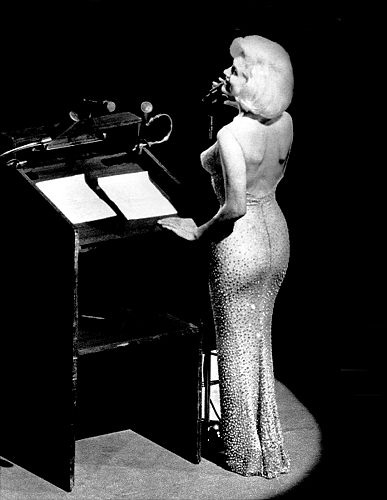
Finally, the night of the performance arrived. Backstage, Marilyn got into her costume – a flesh-toned slip of a dress by Jean-Louis sewn with 2500 rhinestones. The gown was so snug Marilyn had to be sewn into it. Paralyzed with stage fright, Marilyn kept ignoring her cue to appear on stage. She hung back, drowning her fears in alcohol, before Milt Ebbins shoved her onto the stage.
“She walked like a geisha….” (1)
“The figure was famous and, for one breathless moment, the 15,000 people in Madison Square Garden thought they were going to see all of it. Onto the stage sashayed Marilyn Monroe, attired in a great bundle of white mink. Arriving at the lectern, she turned and swept the furs from her shoulders. A slight gasp rose from the audience before it was realized that she was really wearing a skintight flesh-toned gown.” (2)
Marilyn Monroe at the microphone singing “Happy Birthday, Mr. President,” at President John F. Kennedy’s birthday bash, May 19, 1962.
“When she came down in that flesh-colored dress, without any underwear on…” said Hugh Sidey of Time, “you could just smell lust. I mean, Kennedy went limp or something. We all were just stunned to see this woman.”
“What an ass…what an ass,” whispered Kennedy.
“Happy…Birthday…to you,” Marilyn began to sing [whisper]. (3)
Her rendition of “Happy Birthday, Mister President” – was soft, seductive, and pathetic. The 35-year-old Marilyn was high as a kite (and wearing a wig that was slipping). Columnist Dorothy Kilgallen called it nothing less than:
“…making love to the President in the direct view of forty million Americans.”
President John F. Kennedy speaks to the audience at Madison Square Garden at his 45th birthday bash, May 19, 1962.
At the end of the performance, a noticeably-embarrassed President Kennedy took to the stage and announced disingenuously:
“I can now retire from politics after having had Happy Birthday sung to me in such a sweet wholesome way.” (2)
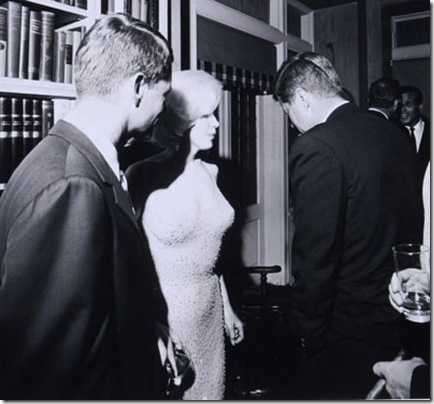
At an after-party, a photographer caught President Kennedy and brother Robert Kennedy hovering over Marilyn in the library, still wearing the see-through dress Marilyn called “skin and beads.”
Bobby Kennedy, Marilyn Monroe, and President John Kennedy gather following Monroe’s iconic performance of “Happy Birthday, Mr. President,” at Madison Square Garden, May 19, 1962. Marilyn is still wearing the gown she wore in the performance which she referred to as “skin and beads.” The auction house Christie’s later sold this dress for $1.2 million, the most money ever paid for a dress.
Kennedy’s Ambassador to the United Nations, Adlai Stevenson, was at the party and saw Marilyn’s “skin and beads” dress. He later wrote to Mary Lasker:
“I didn’t see the beads!”
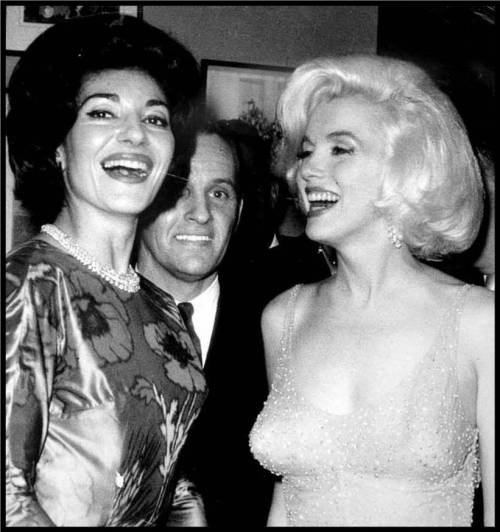
Greek opera diva Maria Callas (1923-1977) laughs it up with blonde bombshell Marilyn Monroe at President Kennedy’s 45th birthday bash at Madison Square Garden, May 19, 1962. First Lady Jackie Kennedy did not attend the celebration. Marilyn Monroe was President Kennedy’s lover when Jackie was Mrs. Kennedy. Maria Callas was the clandestine lover of Aristotle Onassis when Jackie was Mrs. Onassis.
Jackie Kennedy watched Marilyn’s performance on TV the next day. She was livid. The rumors about Jack and Marilyn were flying. Jackie called up sister-in-law Ethel Kennedy and complained that she just knew Bobby had staged the prank. Jackie ordered Jack to stop seeing Marilyn. (4) Jack also sent word to the press that there was nothing to the rumors of an extramarital affair between him and Marilyn Monroe, which, we know, was a lie.
President Kennedy broke off the relationship with Marilyn. Her performance at Madison Square Garden became her last public appearance. Marilyn became profoundly affected by the break-up with the President and her loss of other men, including ex-husband Arthur Miller, who had recently remarried.
As a result, the summer following the Madison Square Garden show, Marilyn dove deeper and deeper into a downward spiral of drugs and alcohol, storm and stress, and depressed isolation. Out of necessity, the production of her film, “Something’s Got to Give” came to a halt, because the star was a “no-show” on the set.
The movie was never finished. On August 5, Marilyn Monroe – born Norma Jeane Baker – was found dead in her home from a drug overdose – an apparent suicide – and the world was shocked.
Goodbye, Norma Jeane
(1) Leaming, Barbara. Marilyn Monroe. New York: Three Rivers Press, 1998.
(2) Smith, Sally Bedell.Grace and Power: The Private World of the Kennedy White House. New York: Random House, Inc., 2004. (excerpted from a Time magazine article)
(3) Klein, Edward. All Too Human: The Love Story of Jack and Jackie Kennedy. New York: Pocket Books, 1996.
(4) Taraborrelli, J. Randy. Jackie Ethel Joan. New York: Warner Books, Inc., 2000.
*Readers: I’ve written many posts on Jackie O and the Kennedys. Please look in the right sidebar – Categories – People – the Kennedys. Enjoy!
In 2007, a few weeks before Queen Elizabeth visited the United States for the 400th anniversary of the founding of Jamestown, I was asked to take her portrait. I was the first American to be asked by the Palace to make an official portrait of the Queen, which was very flattering. I felt honored. I also felt that because I was an American I had an advantage over every other photographer or painter who had made a portrait of her. It was O.K. for me to be reverent. The British are conflicted about what they think of the monarch. If a British portraitist is reverent, he’s perceived to be doting. I could do something traditional.
It’s ironic that the sitting with the Queen became controversial. I’m rather proud of having been in control of a complicated shoot. The controversy arose about two months after the pictures were published, when the BBC claimed that the Queen had walked out while we were shooting. This was completely untrue, and although they retracted the claim and issued an apology to the Queen and to me almost immediately, the scandal had a life of its own. The story, which came to be referred to as Queengate, wouldn’t die. Eventually the head of BBC One resigned over it.
When I was preparing for the shoot, I thought about using the landscape around Balmoral Castle, in Scotland. I brought this up in the very first conference call with the Palace. I said that Americans thought of the Queen as an outdoorswoman. I had been influenced by Helen Mirren’s performance in The Queen and I couldn’t help mentioning how much I liked her character in that film. There was a long silence on the other end of the line.
The second idea I had, after Balmoral, was to photograph the Queen on horseback. I asked where she rode and they said she went riding every Saturday at Windsor Castle. I said that I would love to see her in her riding clothes, and in a later conversation I asked if she could stop during her weekend ride and get off her horse and mount it again. That is, could I do a portrait of her in the trees. They said, No, it was not possible. She just rode the horse and came back, and, anyway, she didn’t wear riding clothes anymore. A few days later they said it was going to be Buckingham Palace and no horses.
I realized that I was going to need some time on the ground for this. When we arrived in London, we went straight to the palace and were shown all the rooms, including the throne room—everywhere except the private quarters. And then we scouted the back. There was a wintery sky and the trees didn’t have leaves. It was an appropriate mood for this moment in the Queen’s life. There was no way, however, that she was going to stand outside in formal attire.
For a sitting like this you don’t put all your eggs in one basket. You try to have as many options as possible. I kept thinking that somehow I would get the Queen outside, but I began choosing formal outfits. I narrowed the robes down to a very handsome Order of the Garter cape, but then we were told that she could wear only a white dress under it. We were lobbying for a gold dress. I was also hoping for a dress with more body to it. The Queen wears very streamlined dresses now that she’s older, and I wanted her in something with more volume. But she didn’t have anything like that. Finally everyone agreed that she could wear a gold-and-white dress under the Order of the Garter robe. The Queen was 80 years old. She was sturdy, but putting on and taking off a lot of heavy clothes is tiring, and she had to be dressed in layers to expedite things. The gold-white dress became the base.
I was still upset that I couldn’t get her outside. It was so beautiful out there. And it wasn’t cold or raining or anything. I began thinking about what Cecil Beaton had done. He brought in flowered backdrops. Beaton was big on backdrops. He made very stagy portraits. Perhaps because the pictures were made in black and white you don’t notice the backdrops. They sort of go out of focus. I realized that I could do something similar digitally. I decided to photograph the garden and the trees for a backdrop.
The Palace had given us 25 minutes with the Queen, so there had to be a battle plan. I chose a grand reception room, the White Drawing Room, as the principal setting because of the light from the tall windows. Supplementary lights had been pre-set so that when the Queen moved from one spot to another all we needed to do was switch them on. We had constructed a gray canvas backdrop in an anteroom, and she was to come in there wearing the Order of the Garter robe and the dress, but no tiara. The first shot was to be made on a balcony, with the sky behind her. That sky could be digitally exchanged later for the pictures I had taken in the gardens the day before. I didn’t want her to be wearing a tiara in the gardens.
The morning of the shoot, the Queen came walking down the hall very purposefully. She was definitely a force. This was all being taped by the BBC for a documentary. I would never have agreed to their being there if I felt I had any choice, but they had been following her around for months. Their microphone picked up her saying, “I’ve had enough of dressing like this, thank you very much,” as she marched down the hall. Later, when segments of footage for the BBC were edited for a promotional film, it appeared as if the Queen were stomping out of the photo session rather than going into it. Thus the brouhaha.
The Queen was about 20 minutes late, which we thought was a little strange. When that happens, you never know if it can be made up on the other end. My five-year-old daughter, Sarah, had come with us, and she curtsied and offered the Queen flowers, and I introduced my team. At this point I was in shock. The Queen had the tiara on. That was not the plan. It was supposed to be added later. The dresser knew that. The Queen started saying, “I don’t have much time. I don’t have much time,” and I took her to the first setup and showed her the pictures of the gardens. I think she understood what we had in mind. Then I walked her into the drawing room, probably sooner than I would have if things had been going well. She composed herself when I took some pictures.
I knew how tight everything was, especially with the loss of 20 minutes, and I asked the Queen if she would remove the tiara. (I used the word “crown,” which was a faux pas.) I suggested that a less dressy look might be better. And she said, “Less dressy! What do you think this is?” I thought she was being funny. English humor. But I noticed that the dresser and everyone else who had been working with her were staying about 20 feet away from her.
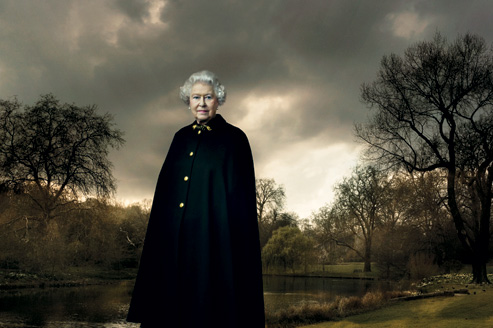
We removed the big robe, and I took the picture of the Queen looking out the window, and then I said, Listen, I was a little thrown when you first came in, and I have one more picture I’d like to try, with an admiral’s boat cloak. I was thinking of one of Cecil Beaton’s last pictures of the Queen. A very stark and simple and strong portrait in which she’s wearing a boat cloak. We went back into the anteroom, where the gray canvas backdrop had been set up, and she took off the tiara and put on the cloak. That’s the shot we digitally imposed on pictures of the garden.
Right after we finished, I went up to the press secretary and said how much I loved the Queen. How feisty she was. Later I mentioned to a couple of friends that she had been a bit cranky, but it was nothing unusual. What was remarkable about the shoot, and I wrote the Queen a note about this later, was something the BBC missed: her resolve, her devotion to duty. She stayed until I said it was over. Until I said, “Thank you.” We were finished a little before our allotted 25 minutes were up.
Dorothy Hale and Isamu Noguchi at the premiere of “Four Saints in Three Acts,” February 7, 1934, Hartford, Connecticut
In 1934, the socialite and actress Dorothy Hale took a road trip through Connecticut with two old friends, writer Clare Boothe Luce and sculptor Isamu Noguchi. They drove in a special car Noguchi had designed with his drinking buddy, futuristic inventor Buckminster Fuller. The car was called the Dymaxion.
The Dymaxion Car
Buckminster Fuller with his portrait by Isamu Noguchi, 1929, photo by Noguchi
The 20-foot long aluminum-bodied Dymaxion car caused a traffic jam wherever it went. This was between the two world wars when cars were sedans and pick-up trucks. “Bucky” Fuller’s car was shaped like a teardrop and ran on three wheels. It went 90 m.p.h. and was fuel-efficient at 30 m.p.g. The 3-wheeler made a 360-degree turn on a dime. A periscope that came out of the roof gave extra visibility. It seated eleven passengers.
It was the car of the future – for a while. Unfortunately, only three Dymaxion cars were ever produced. Orchestra conductor Leopold Stokowski bought one. Amelia Earhart was interested in investing. Financing was a problem and Fuller was running out of cash.
Aviator Amelia Earhart
Any hope of putting the Dymaxion in full-scale production dried up quickly when the car was involved in a fatal accident at the 1933 Chicago World’s Fair. Another car was blamed for the crash but that didn’t stop the negative publicity for the Dymaxion.
Sadly, only one of the Dymaxions exists today. You can view the restored exterior of the car at the National Automobile Museum in Reno, Nevada. Disappointingly, though, the car windows are painted opaque from the inside to prevent you looking inside. Evidently, the inside was in very bad shape when the car was acquired and little information exists as to its original look in order to guide the museum restoration artists. The rumor is that the car had been used as a chicken coop somewhere in the Midwest before it was discovered, which explains the wrecked state of the interior!
View this youtube video to see the amazing turning radius of the Dymaxion. While you’re viewing, keep a lookout for Amelia Earhart in the back seat.
By the summer of 1938, Frida Kahlo was on her way to being discovered as an artist in her own right, rather than only being referred to as the wife of famed Mexican muralist Diego Rivera. That summer, actor and art collector Edward G. Robinson had traveled to Mexico City just to see her paintings and had paid $200 each for four of them. Frida was thrilled. She had sold only a few of her paintings so far and had been content to just give them away. She later wrote of the Robinson sale:
“For me it was such a surprise that I marveled and said, “This way I am going to be able to be free; I’ll be able to travel and do what I want without asking Diego for money.”
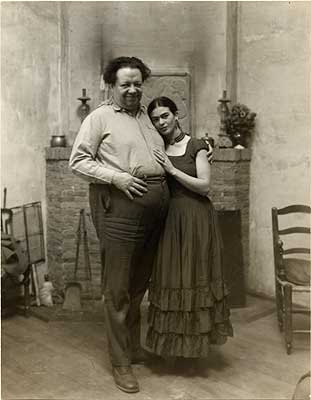
She and Diego had become increasingly estranged because of his many illicit extramarital affairs, including one with Frida’s sister Cristina. Frida was heartsick by Diego’s infidelities and retaliated by having multiple affairs of her own, with both men and women. Despite their discord, they remained deeply in love. Frida and Diego made up one of those married couples who could neither stay together nor apart. By the summer of 1939, they would be divorced – only to remarry a year later.
“Self-Portrait Dedicated to Leon Trotsky (Between the Curtains)” by Frida Kahlo, 1937
That November, Frida Kahlo traveled to New York City for her first one-person exhibition of her paintings, held at the Julien Levy Gallery, confident in her new status as celebrated artist. As always, her exotic Zapotec clothing and heavy jewelry created a buzz in the press. Her show was a great success. Time magazine noted that “the flutter of the week in Manhattan was caused by the first exhibition of paintings by famed muralist Diego Rivera’s…wife, Frida Kahlo.” Frida Kahlo’s hand, bedecked with huge rings, adorned a cover of Vogue.
Notables such as artist Georgia O’Keeffe attended the gallery exhibit as did playwright and former editor of the fashion magazine Vanity Fair Clare Boothe Luce.
Claire Boothe Brokaw (Luce) (1903-1987) as photographed by Cecil Beaton for the August 1934 issue of Vanity Fair
Luce remembered the occasion well:
“The exhibition was crowded. Frida Kahlo came up to me through the crowd and at once began talking about Dorothy’s suicide [Dorothy Hale was a friend of both Kahlo and Luce’s].…Kahlo wasted no time suggesting that she do a recuerdo of Dorothy. I did not speak enough Spanish to understand what the word recuerdo meant….I thought Kahlo would paint a portrait of Dorothy in the style of her own self-portrait [dedicated to Trotsky][see above], which I bought in Mexico….
Suddenly it came to me that a portrait of Dorothy by a famous painter friend might be something [Dorothy’s] poor mother might like to have. I said so, and Kahlo thought so, too. I asked the price, Kahlo told me, and I said, ‘Go ahead. Send the portrait to me when it is finished. I will then send it on to Dorothy’s mother.’”
Dorothy Hale was a sometime actress, Ziegfeld showgirl, and socialite. Hale’s life had gone downhill seven years earlier after her husband Gardner Hale was killed when his car drove off a 500 foot cliff in Santa Maria, California. Hale’s career as an actress was drying up; she was failing her screen tests. She was in severe financial trouble and living on charity from friends. On October 20, 1938, Hale assembled her close friends for a party at her New York apartment and announced that she was taking a long trip. The farewell party lasted until the wee hours of the morning. Hale stayed up writing good-bye letters to her friends and drinking the last of the vodka. A little before 6 a.m. on the 21st, Hale put on her black velvet dress and pinned on it a corsage of small yellow roses sent to her by the sculptor Isamu Noguchi. She then climbed onto the windowsill of her luxury high-rise apartment suite and jumped to her death.
“The Suicide of Dorothy Hale” by Frida Kahlo, 1938/39
From the encounter between Luce and Kahlo at the gallery exhibit arose one of Frida Kahlo’s most shocking and controversial paintings, “The Suicide of Dorothy Hale” (1938/39). Kahlo painted Dorothy Hale as she jumped, fell, and landed, dead and bloody, on the concrete walk outside her apartment building. Blood-red lettering at the bottom of the retablo details the tragedy in Spanish:
“In New York City on the 21st of October 1938, at 6:00 in the morning, Dorothy Hale committed suicide by throwing herself from a very high window in the Hampshire House. In her memory, this portrait was executed by Frida Kahlo.”
Luce recalls the horror she felt when the painting was delivered to her home and she first laid eyes on it.
“[W]hen I pulled the painting out of the crate…I felt really physically sick. What was I going to do with this gruesome painting of the smashed corpse of my friend, and her blood dripping down all over the frame? I could not return it – across the top of the painting there was an angel waving an unfurled banner which proclaimed in Spanish that this was ‘The Suicide of Dorothy Hale, painted at the request of Clare Boothe Luce, for the mother of Dorothy’. I would not have requested such a gory picture of my worst enemy, much less of my unfortunate friend.”
Luce wanted to have the painting destroyed, but was dissuaded by friends. Instead, she had sculptor and friend Noguchi paint over the angel with the banner and gave the painting to a friend.
Luce couldn’t have known at the time that Kahlo was in a desperate state of mind as she always was when she was afraid of losing Diego. At the time she painted “The Suicide of Dorothy Hale,” Kahlo herself was having repeated thoughts of committing suicide.
READERS: For more posts on Frida Kahlo, click here.
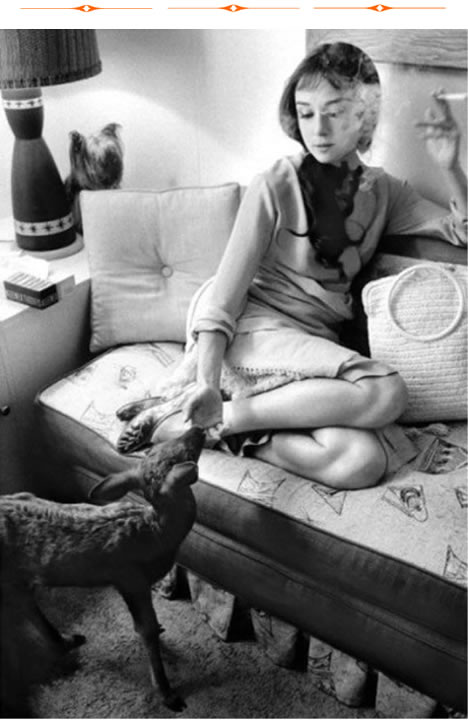
Audrey Hepburn in her dressing room during the filming of “Green Mansions.” She is feeding Ip the fawn while her Yorkshire terrier Mr. Famous looks on from the left.
[The book] Remembering Audrey, features candid portraits by Bob Willoughby, a photographer on the set of many of Hepburn’s films who became close enough to the beauty to literally follow her home. His visual account of Hepburn’s private life and career is peppered with unexpected moments, such as cameos by Pippin, nicknamed Ip, the fawn. When Hepburn was making her 1959 flick “Green Mansions,” directed by then-husband Mel Ferrer, the animal trainer on the set suggested that she take her on-screen sidekick, a baby deer, home with her so that he would learn to follow her. “It was truly amazing to see Audrey with that fawn,” remembers Willoughby in the caption alongside a photo of Pippin cuddling up to Hepburn like a lap dog as she naps on the couch. (Her pet dog, Mr. Famous, is curled in a ball at the other end of the sofa.) “While Audrey’s maid had been told about the little deer, she could not believe her eyes seeing Ip sleeping with Audrey so calmly,” writes Willoughby. “She was shaking her head and just kept smiling.”
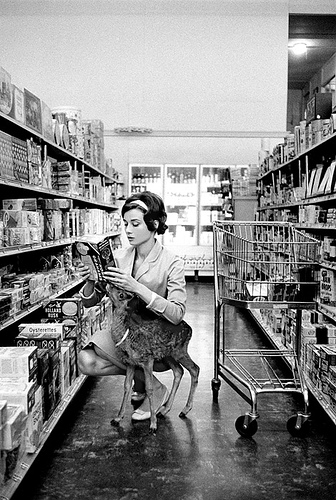
Audrey Hepburn shopping in Beverly Hills with her pet deer and costar, Pippin, known as “Ip.” (1958)
In another shot, the fawn inspects a box of Honey Grahams, shopping with Hepburn in a Beverly Hills supermarket. “Beverly Hills habitués are fairly blasé about what they see,” writes Willoughby, “but Audrey being followed around town by this lovely creature stopped everyone in their tracks.”
For more on Audrey Hepburn on this site, click here.
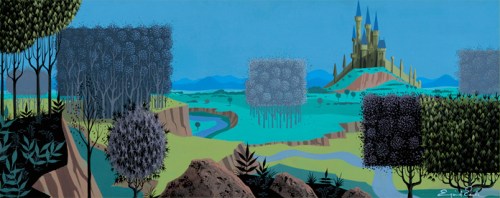
The iconic castle from “Sleeping Beauty,” by artist Eyvind Earle for Disney
Up until the release of Disney’s “Sleeping Beauty” in 1959, the Disney characters were normally drawn first for a film and then the background was drawn later to complement the characters. But this process was reversed in 1951 – causing some hard feelings – when Walt Disney Studios hired the new background painter, Eyvind Earle.
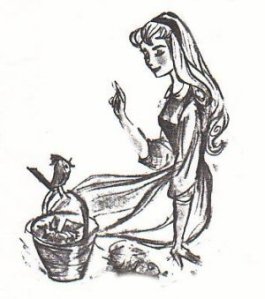
Tom Oreb's early drawing of Sleeping Beauty, influenced by Audrey Hepburn
Walt Disney wanted the setting to have a very Renaissance Germanic look and Earle’s style fit the bill. The problem was that, when Earle joined the studio, the characters for “Sleeping Beauty” had already been drawn. Soft and round in the Disney tradition, the characters clashed with Earle’s stylized angular backgrounds. Though it was unusual to take style direction from a background painter, that’s what the character artists were forced to do. They had to go back to the drawing board and reconceive all the characters in a style that suited Earle’s design.
Although Sleeping Beauty would have blonde hair in the film, character stylist Tom Oreb based the princess’ original design on the physical geometry of brunette Audrey Hepburn.
Audrey Hepburn
“The qualities of that actress’ slender, willowy physicality lend themselves beautifully to the design environment of the film,” said Disney historian Jeff Kurtti.
drawing of Sleeping Beauty by Marc Davis, redesigned for use in 1959 film
Originally,” said Disney animator Ron Dias, “Sleeping Beauty looked a lot like Audrey Hepburn; she was softer, rounder, more like the ‘designy’ Disney girl. Back at the drawing board, Marc Davis redesigned her. She became very angular, moving with more fluidity and elegance, but her design had a harder line. The edges of her dress became squarer, pointed even, and the back of her head came almost to a point rather than round and cuddly like the other Disney girls. It had to be done to complement the background.”
Click below to see Helene Stanley perform in the Disney Studio as the live action model for Sleeping Beauty as Disney artists sketch away. This video was part of the premiere of the Disneyland TV show.