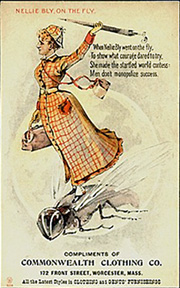
 Yesterday, you will recall, we followed famed stunt reporter Nellie Bly as she tried to convince her editor to let her make a journalistic trip around the world in less than 80 days. Perhaps you noticed that I left out some information in yesterday’s post. I wrote that Nellie Bly’s New York World editor had two objections to sending her on the trip yet I proceeded to list only one of them for my readers, that, for such a journey, her editor thought she needed a male protector.
This is what Nellie recalled her boss having said that day:
“It is impossible for you to do it,” was the terrible verdict. “In the first place you are a woman and would need a protector, and even if it were possible for you to travel alone you would need to carry so much baggage that it would detain you in making rapid changes. Besides you speak nothing but English, so there is no use talking about it; no one but a man can do this.”
Nellie vigorously objected and her editor relented, eventually warming to the idea. A year passed before any more was spoken about it. Then one cold evening, Nellie was summoned into her editor’s office. When she entered, he looked up from the paper he was writing and asked her, “Can you start around the world day after tomorrow?”
“I can start this minute,” she replied without hesitating. She recalled his second objection, that she would travel with too much baggage, and set out to conquer that problem.
Early the next morning Nellie went to a dressmaker and ordered a custom dress to be made for her immediately. The dressmaker was at her service instantly. Nellie explained to him that she needed a traveling outfit that could stand constant wear for three months. She was planning to go around the world in only one dress! After looking at several materials, the dressmaker selected two sensible fabrics: a plain blue broadcloth and a plaid camel’s hair. That afternoon, Nellie had her first fitting at 1:00, her second fitting at 5:00, and the dress was ready.
Nellie could then turn her attention to packing. She had bought one hand-bag and was determined to confine her baggage to its singular limit. “Packing that bag was the most difficult undertaking of my life….”
In her hand-bag, she packed:
two traveling caps, three veils, a pair of slippers, a complete outfit of toilet articles, ink-stand, pens, pencils, and copy-paper, pins, needles and thread, a dressing gown, a tennis blazer, a small flask and a drinking cup, several complete changes of underwear, a liberal supply of handkerchiefs and fresh ruchings and most bulky and uncompromising of all, a jar of cold cream to keep my face from chapping in the varied climates I should encounter.
That jar of cold cream was the bane of my existence. It seemed to take up more room than everything else in the bag and was always getting into just the place that would keep me from closing the satchel. Over my arm I carried a silk waterproof, the only provision I made against rainy weather.
She was given 200 lbs in English gold and Bank of England notes. She carried the gold in her pocket. The Bank of England notes she carried around her neck in a chamois-skin bag. She also took some American gold and paper money to see if it could be used at foreign ports. Her passport was in order. As she was traveling without an escort, a friend suggested that she carry a revolver, but Nellie refused to arm herself, saying she had a “strong belief in the world’s greeting” for her.
On November 14, 1889, Nellie Bly set sail from New York for Southhampton, England, on the ocean steamer, the August Victoria.
Read Full Post »
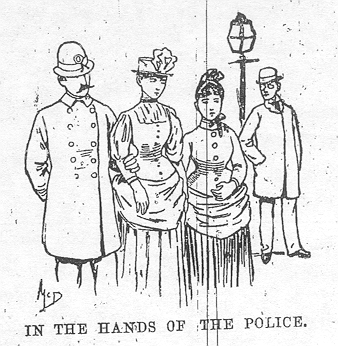
 In Nellie Bly’s book, Ten Days in a Mad-House (see category, “Nellie Bly,” for related posts), Nellie Bly described various women she met in the Blackwell Island Women’s Lunatic Asylum. She was confined to Hall 6 with 45 of the least dangerous women in the institution. While some of them were certifiably “crazy,” (her words), many, she felt, had been wrongly locked up. A Frenchwoman, for example, named Josephine Despreau, fell sick in a boarding house and the woman of the house called in the police. They arrested her and took her to the station-house. She didn’t understand the proceedings because of the language barrier and the judge paid no attention to her protests. She was locked up in the insane asylum in no time.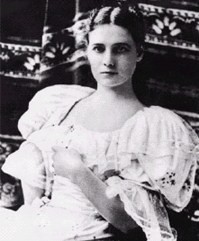
 ellie Bly was put on the island boat and sent to Blackwell’s Island. For ten days, she experienced firsthand the horrors of being locked up in cruel and inhumane conditions. Upon her arrival, she was fed a disgusting meal of pink watery tea, prunes, and bread that was dirty and black and mostly dried dough. She found a spider in the slice given her. She didn’t eat it. Later she learned that the nurses didn’t like it when you didn’t eat your food. They might beat you for that.

 “So I flew to the mirror and examined my face,” she wrote later. “I remembered all I had read of the doings of crazy people, how first of all they have staring eyes, and so I opened mine as wide as possible and stared unblinkingly at my own reflection.” She began to sweat nervously, which unfortunately took the curl out of her Victorian bangs. Over and over again, she practiced her crazy face in the mirror. She ended up staying up all night, rehearsing her new role, thinking about her new mission, and reading scores of ghost stories to put her in a lunatic frame of mind.




 Lisa's History Room