Feeds:
Posts
Comments

Posts Tagged ‘biographies of women’

Lucille Mulhall (1885-1940)

Lucille Mulhall (1885-1940)

Lucille Mulhall was an authentic cowgirl who found fame in both wild west shows and the rodeo circuit. She interests me for several reasons. For one, humorist Will Rogers began his career as a cowboy on her father Zack Mulhall’s Oklahoma ranch, later joining Mulhall’s wild west show, billed as the “Cherokee Kid.”

It was Will Rogers who claimed that the term “cowgirl” was first coined (circa 1900) to describe Lucille Mulhall and her ranch skills. Lucille is famous for many reasons, largely because she could rope and ride like none other. She could rope eight men riding abreast (1). She was the most famous cowgirl of her time, catching both Teddy Roosevelt’s eye (who invited her to the White House) and Geronimo’s (who gave her a beaded vest and a decorated bow).

But I started researching Lucille Mulhall largely because of a reference in many sources to her uncanny ability as a horse trainer. She could train horses to do things others couldn’t. Of her unique ability, Lucille Mulhall said,

My system of training consists of three things – patience, perseverence, and gentleness. Gentleness I consider one of the greatest factors in successful training….Governor, the horse I ride in our exhibitions,…has nearly forty tricks….He can shoot a gun; pull off a man’s coat and put it on again; can roll a barrel; can walk up stairs and down again – a difficult feat; is perfect in the march and the Spanish trot; extends the forelegs so that an easy mount may be made; kneels, lies down and sits up; indeed, he…does nearly everything but talk.

I’d love to have seen Governor’s tricks, especially the one when he pulls off a man’s coat. But what is unclear is whether or not Governor is pulling the coat off his own body or some man’s!

(1) Alter, Judy. Wild West Shows: Rough Riders and Sure Shots Watts: New York, 1997.

Read Full Post »

Releasing Lunatics from their Chains (Robert-fleury)

Releasing Lunatics from their Chains (Robert-fleury)

I was recalling something my grandmother told me about a “field trip” she and her sister Maurine took to Austin, Texas, back in the 1920’s. Both Grandmother and Aunt Maurine were young and single, living in Lufkin, Texas. They had heard all about the state lunatic asylum and wanted to see it for themselves. I think they were hoping to spot a flesh and blood lunatic. The trip was a real highlight.

The two took the train all alone from East Texas to Austin to visit the asylum.

 “It’s lucky they weren’t captured,” says my sister Loise.

I’ve seen the maps of Austin from those days. The important buildings are marked, including the University of Texas, the State Capital, and the State Lunatic Asylum.  True, the Lunatic Asylum was a garden spot and people other than my relatives were drawn to it for good reasons. But I think novels like Jane Eyre give us an insight into attitudes toward the mentally ill. They were weird, scary, and dangerous.

Evidently the Texas State Lunatic Asylum was ahead of its time in its compassionate approach toward the mentally ill. The asylum movement in America and Europe at that time “strived to provide a healthy diet, exercise, fresh air, adequate rest, a strict daily routine, social contact, and a kind but firm approach,” according to the website of the Texas Dept. of State Health Services (1). No longer flogging the patient or tossing cold water on him, the treatment for the mentally ill in the first half of the twentieth century was still far from humane. 

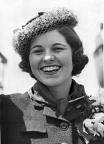
Rosemary Kennedy

Rosemary Kennedy

In 1941, Joseph Kennedy authorized a frontal lobotomy for his beautiful special needs daughter Rosemary, who was proving to be a bit of an embarrassment to him when she tripped curtseying to the Queen of England.

According to Dr. Watts, a surgeon assisting in the lobotomy of Rosemary Kennedy: 

“We went through the top of the head, I think she was awake. She had a mild tranquilizer. I made a surgical incision in the brain through the skull. It was near the front. It was on both sides. We just made a small incision, no more than an inch.” The instrument Dr. Watts used looked like a butter knife. He swung it up and down to cut brain tissue. “We put an instrument inside,” he said. As Dr. Watts cut, Dr. Freeman put questions to Rosemary. For example, he asked her to recite the Lord’s Prayer or sing “God Bless America” or count backwards. … “We made an estimate on how far to cut based on how she responded.” … When she began to become incoherent, they stopped.” (2)

1. http://www.dshs.state.tx.us/mhhospitals/AustinSH/ASH_About.shtm

2. http://en.wikipedia.org/wiki/Rosemary_Kennedy

NEXT: Stunt reporter for THE NEW YORK WORLD Nellie Bly writes TEN DAYS IN A MAD-HOUSE

Read Full Post »

« Newer Posts