The SS Athenia
On September 1, 1939, Germany invaded Poland. Hitler justified this action by lying to the German people and the world saying:
This past night for the first time, Polish regular soldiers fired on our territory. Since 5:45 A.M. we have been returning the fire, and from now on bombs will be met with bombs[1]
No Polish soldiers fired on Germany territory nor did Polish war planes drop a single bomb on Germany. Germans were in no danger from the Poles. Instead, the Germans had organized a fake attack by Polish troops on the radio station at Gleiwitz, a German town on the Polish border. The report was published in American newspapers, as forwarded by the A.P. and U. P. to New York. At Gleiwitz, Heinrich Himmler, Reichsführer-SS (Head of the SS) and Chief of the German Police, was appointed to oversee the fake operation. They needed practical evidence to make the attack by the Poles appear believable. To that end, the Gestapo rounded up twelve to thirteen condemned men from a concentration camp and dressed them in Polish uniforms. These men were given fatal injections by a doctor chosen by Reinhard Heydrich, who helped organize the German pogrom, Kristallnacht. Then the men would be shot and left dead on the ground for the press to witness .
With the German invasion of Poland, Britain and France were obliged to enter the conflict, as they had guaranteed military assistance should Poland’s independence be threatened. This was a change of British policy, as Prime Minister Neville Chamberlain had formerly believed he could appease Hitler with concessions. In late summer, Germany and Soviet Russia had signed a non-aggression pact and made secret plans to carve up Europe between them. On September 3, 1939, at 11:15 A.M. Prime Minister Chamberlain of England announced in a radio broadcast that Britain declared war on Germany. Later in the day, France declared war on Germany. This was the beginning of World War II (WWII).
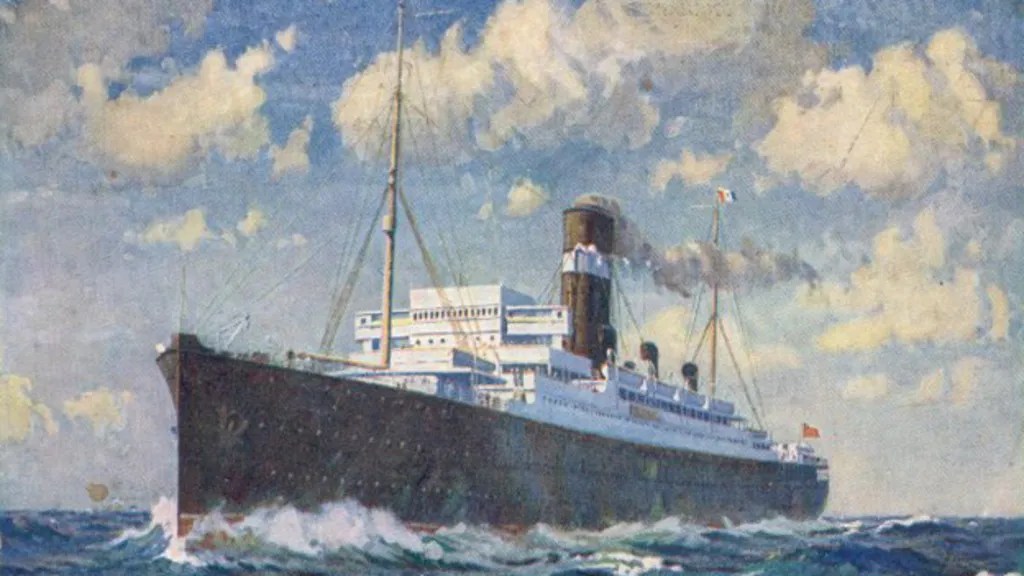
The SS Athenia
The ocean liner SS Athenia was well out at sea on September 3, carrying European refugees, Americans, and Canadians passengers eager to leave the Continent and the United Kingdom (the countries of England, Scotland, Wales, and Northern Ireland, with London as its capital). The SS Athenia was sailing the North Atlantic heading in a westward -bound direction for Montreal, Canada, when the war news was conveyed to the ship passengers by a written notice outside the purser’s office. The captain wanted little talk of this; he did not want to alarm the passengers. The ship was carrying two hundred extra passengers and forty-one extra crew. The ship was really three floating hotels, with “first class luxury facilities, economy tourist accommodations, and boarding house immigrant fare.”[2] The total number of passengers was 1,102, and 316 in the ship’s company. The surplus number of passengers reflected the wartime reality of Great Britain (England, Scotland, and Wales) taking transatlantic liners out of service to be refitted to carry soldiers. Many of the passengers saw their bookings on these British requisitioned ships cancelled, such as the tour group of eighteen women students from the University of Texas, who had tickets to sail on the California on August 26. Their travel guides pulled some strings in Texas and found spaces for the college students on available ships. Fifteen of the women found berths on the Athenia, while three were booked on the merchant freighter, City of Flint. Passengers boarded at Glasgow, Scotland, Belfast, Northern Ireland, and Liverpool, England. Many of the European passengers were Jewish refugees, hailing from Poland and Germany. Some wore peasant clothes, carrying their goods in wicker baskets, blanket rolls, and bundles. Some were barefoot. Yet others were educated and “cosmopolitan.”[3] Among the refugees was a Polish family of seven, the Kucharczuks, father, Spirydon, 42, and mother, Ewdokia, 40. Fleeing Poland for Canada with their five children, whose ages ranged from two to twenty -one years old. It was said that before they left Poland, “Titianna-Juka put a curse on the Kucharczuks; as a result fifteen-year-old Steve Kucharczuk went to a fortune teller for advice prior to leaving on their journey. The fortune teller told him that “they would travel to Canada but not all of them would arrive.”[4] They boarded the Athenia at Liverpool
All passengers were issued lifejackets “consisting of cork floating blocks held together by canvas. The wearer placed their head through a hole in the center of the jacket.”[5] All were assigned a lifeboat station. Because of the war, the portholes and all lights were blocked from view. On September 2, Rose Griffin of Toronto had finished her dinner and with all the darkness, missed her step on the stairway of the dining room, fell, and landed on her face. She broke her nose and was knocked unconscious. She was carried to the ship’s hospital ward.
All staterooms were shared. Husbands and wives, such as David and Barbara Cass-Beggs, were separated, Barbara took their child Rosemary with her into a cabin they shared with another mother and her infant son. Normally women changed into more fashionable clothes for dinner, but now the rooms were so crowded with luggage as to discourage many from that tradition. With so many passengers on board, dinner was served in three sittings.
Once Captain James Cook was notified of the English Prime Minister’s declaration of war, he ordered Chief Officer Barnet Mackenzie Copland to remove the canvas covers of the ship’s twenty-six lifeboats (thirteen hanging on each side of the ship), the gear for lowering the lifeboats was checked; the drainage plugs put in place in each of the boats, and provisions of water and condensed milk added. September 3, 1939, fell on a Sunday. Church services were held, the congregation sang hymns which included, “Eternal Father, Strong to Save,” with its refrain of “Oh, hear us when we cry to Thee, For those in peril on the sea“ and “Oh, God, Our Help in Ages Past.” Lunch was served and passengers enjoyed games of shuffleboard, cards, and deck tennis.[6] The children raced along the deck, making up their own games. Others sunned themselves on deck and talked among themselves, drinking their drinks. Smoking was not allowed on deck. There were few men among the passengers, mostly women and children were aboard. Many passengers were seasick and remained in their cabins, trying to keep down dry toast or crackers, including David and Barbara Beggs.
Captain Cook, outwardly calm and collected, was in fact quite worried. The ship was in truly dangerous waters now. A morning lifeboat drill was conducted. As nightfall approached, the Athenia was steered in a zigzag course and proceeded north of its usual path. This was done to confuse any German submarine, or U-Boat as they were called, which might be lurking in the deep waters of the Atlantic.

Judith Evelyn
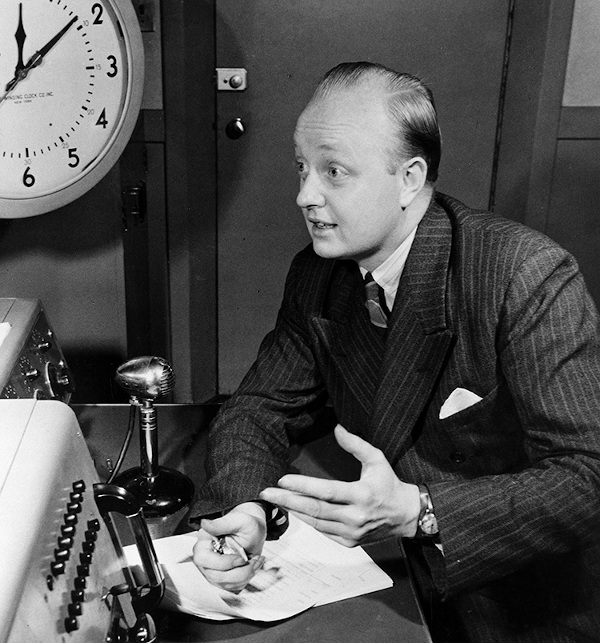
Andrew Allan
Judith Evelyn, a beautiful young actress raised in Moose Jaw, Saskatchewan, sharing a cabin with three other women and their luggage did not change for dinner. Having watched the canvas cover taken off the lifeboats, Judith had a bad feeling that “we shan’t be out of this without being in the lifeboats.”[7]
She wore her tennis shoes and improved her appearance with a quick wash and brushing. She was in the second sitting for dinner (7:00), where she joined her fiancé, Andrew Allan, a young Canadian working in London, producing radio programs, while Judith acted in several London productions. They sat at the table with Andrew’s father, the Reverend William Allan, a Presbyterian minister from Toronto, who was known for his popular devotional radio programs. They talked about the suitability of the month of September to visit Scotland. The first course was a half a grapefruit.
Out on the deck, children were singing, “Down Mexico Way.” At about 7:30, young Roy Barington, standing with his mother on the tourist deck, saw “a pipe” sticking up from the water.[8]
Back in the dining room, the grapefruit was cleared away. The main course of chicken and rice was just served,
when the dining room was shaken by a loud report. The lights in the dining room and throughout the ship went out, followed by what sounded like a second explosion. The ship took a distinct list to the port (left) side; glasses, dishes, and silverware fell to the floor; and chairs and tables slid across the room. With the windows and portholes painted black, the dining dining room was left in complete darkness and shock. The Athenia had been hit by a torpedo from a German submarine. “This is it,” said Judith Evelyn, announcing to her stunned dinner table companions what was in fact the first shot of the Second World War in the West.[9]
The U-30 submarine, commanded by Oberleutnant Fritz-Julius Lemp had miscalculated. He thought the Athenia was an armed merchant cruiser or a troopship, but instead he had sunk a civilian passenger liner, violating the Hague Conventions and the German Prize Rules that stated a “warning shot across the bows should be made.”[10] Instead Lemp fired torpedoes. Germany did not want the United States drawn into the war because its citizens were not deemed safe on the ocean. Lemp swore his crew to silence. He even inserted a counterfeit page in his war diary. He would offer no help to the people in the lifeboats and several passengers reported the submarine crew was firing at them. The German High Command knew nothing of Lemp’s action and later learned of the sinking of the Athenia from a British radio report. But Hitler suspected what had been done. He had the message sent to his submarine fleet: “By order of the Führer. Passenger-ships until further notice shall not be attacked even if escorted.”[11]
When the torpedo struck, the emergency whistle blew. At the time of the blast, many passengers were reclining on the hatch covers on the deck. A marine engineer, standing near hatch No. 5, explained what happened to the hatch. “The explosion of gasses came right up the trunk of the hatch. The effect of the explosion was like a heavy door slamming. The hatch went up in the air and the people who were reclining on the hatch went up in the air and then went down the hatch.”[12] A man on deck had his trousers blown off and several people on deck found their shoes were gone. Crew members assembled at their assigned lifeboat stations to get the lifeboats lowered and launched. On deck, mothers screamed the names of the children and children cried for their mothers.
The third-class staterooms on D Deck (the lowest passenger deck) and the engine room were destroyed by the torpedo explosion. All men in the engine room were killed. The torpedo hit on the port (left) side of the ship, in the area of the engine room (located roughly at midship) below the third-class dining room. George Williams, a cook from Glasgow, said that “the galley floor where he was working seemed to split right open. Some were killed outright by the blast.”[13] The stoves overturned, sending hot soup and boiling cooking oil flying everywhere. The kitchen crew were scalded. They smelled cordite, a propellant to fire projectile. George Hail, a steward from Scotland, was working in the pantry, where he was hit hard on the head by falling debris and was knocked to the floor. The galleys filled quickly with sea water. Hail picked himself up and went out on the deck. He could not tell if people lying about were dead or alive. One man appeared to be reading a newspaper, but upon closer examination, it was discovered he was dead. There were multiple injuries to the living.
Many people were thrown to the floor in the dining room and rolled around in the chaos of the attack. Judith Evelyn called out “Andrew” and found him in the dining room. They lit matches and cigarette lighters to climb the stairway to A Deck and their lifeboat stations. Judith had her wits about her but she noted confusion in her fellow passengers. Judith went to her cabin to get her lifejacket and then was back on deck at No. 10 lifeboat. Realizing she was going to shiver in the lifeboat, she went back to her cabin again, put on her fur coat, and gathered several other coats, giving one to Allan, and giving the rest to those on the deck in need.
Down in the dark cabins was pandemonium. Ruby Mitchell and Margaret Calder were in bed in the cabin, as they were both seasick. When the torpedo struck and the lights went out, Margaret screamed and went for the door while Ruby searched under the bunk for their lifejackets. Margaret’s sister, Christina Horgan, came down to get them. Christina said, “We have to go upstairs immediately. There’s something gone wrong.”[14] They made their way into the corridor where they could not see, but they smelled gas. Ruby noticed something wrong about the stairs. “I’m stepping on people,” she said.[15] Her sister told her not to think about it and to hurry on.
Fifteen-year-old Jane Hannah was on deck when the torpedo hit. Her mother was in their cabin, seasick on D Deck. She ran to get her. She wanted to descend the stairwell to D Deck, but she said, “I couldn’t go any further because it was already flooded with water and oil. The crew told her to go to her lifeboat. James Goodson was coming up from D Deck when the ship was hit. When the emergency lights came on, he returned to the corridor he had just left. The wooden stairway was demolished and D Deck below was flooded. People were clinging to bits of wreckage to stay afloat. Goodson got into the filthy water and, working with the crew members, worked to rescue the children first. They rescued the ones they could and found the dead body of a young boy.
Father O’Connor, whose cabin door was jammed shut, was able to break out the panels, and then he heard cries for help coming from a stairwell. With several others, he followed the sound. He had a flashlight and spied a woman holding a baby under a shattered stairwell. The infant was passed up the deck. The woman was pinned down and one of her legs was cut off. She was dying from a tremendous loss of blood. Father O’Connor gave her the last rites and she died as the seawater encompassed her.
Rachel Lamont and her ten-year-old son, Alexander, were getting ready for bed when the torpedo hit. The blast sent a heavy oscillating fan off the cabinet, crashing into Mrs. Lamont’s head. She was stunned. Her son called to her. Water was pouring into the cabin and this awakened her senses. They squeezed out of their cabin and found themselves in a stream of broken wood, clouds of dust, and floating luggage. They made their way to the stairwell, and climbed the shattered staircase, past the the dying woman and several dead bodies. The woman’s severed leg was floating on a piece of luggage. “I will never forget that sight,” Rachel Lamont recalled.[16]
At 10:30 the British Admiralty, headed now by Winston Churchill, received the Athenia’s distress signal that it had been hit and was sinking. The order was given to dispatch two destroyers to the ship’s aid.
To the Lifeboats
In the crush of getting into the lifeboats as the Athenia was badly listing to the port side, and clearly going to sink, people found that their assigned lifeboat no longer mattered. Many of the crewmembers, at first, called out, “Women and Children first,” and loaded these people in the first lifeboats available.[xvii] This meant splitting up families, and putting them in different boats. The men stood aside. Evacuating women and children first, though, with many woman cradling infants, left no men in the lifeboats to do the rowing. So the policy was changed to put more men in with the women and children. A crew member also went with each lifeboat, usually an able-bodied seaman, but in Lifeboat NO. 7A, the crew member was the assistant bartender.
Launching then lowering each lifeboat could be difficult. Yet boats 1, 1A, 2, and 2A, on the forward deck of the ship, were swung out on their davits and lowered to the deck level, then filled with passengers and crew, and lowered into the water. All four boats got away quickly, before 8 P.M. The submarine’s torpedo hit the stern (back) of the ship. On the starboard (right) side, Boats 3, 5, and 7 were lowered into the water without passengers. Rope ladders were hung over the side of the Athenia for the passengers to scramble down into the boats. The weight of the people on these ladders was too much and one of the side ropes broke, leaving people dangling. Ruth Rabenold was climbing down the ladder into boat No. 3 and saw several women miss the boat and fall into the sea. When they came up, they were choking from swallowing seawater and oil. Others got in their lifeboats by shimmying down a fire hose. Many were not strong enough to grip the wide hose and fell into the sea. They were all pulled into their lifeboats.
Judith Evelyn, Andrew Allan, and the Rev. Allan were no longer lining up for boat No. 10. They were now getting into boat No. 5A. Judith was halfway down the broken rope ladder and was hauled on board with difficulty. One woman, tossed into the boat, hurt her ribs. A stout woman fell into the water, and in the process of the men pulling her into the lifeboat, she broke her arm.
Judith and the Allans’ boat, 5A, scraped and bumped along the side of the listing ship. Seaman Dillon took charge of this boat, “which was loaded from the promenade deck with about sixty-four people all wearing lifejackets. The boat was cut away from the falls (part of the ropes and pulley system for lowering the boat) with a hatchet, and as it pulled away from the ship, two stewards climbed down the lifelines into the water and were hauled into the boat.”[xviii] The Kucharczuk family was loaded into lifeboat #5A, except for the twenty-one year-old son Jan, who got into another boat.
Many lifeboats had to deal with the plug coming out of the bottom of the boat, which allowed it to fill with seawater and oil. Passengers used their shoes to furiously bail. Many sat in waist deep water. They shot off flares. They dealt with wet clothing, water, waves, cold, brief rainsqualls, seasick people vomiting from the roll of the waves in the six-to-ten-foot swells, and lost children. Maneuvering the heavy lifeboats in the waves was the real problem. It was difficult to find the oarlocks and put them in place. The rowers aimed to keep the boat headed into the wind. Women, boys, and men took turns with the oars. Maxine Robinson, 16, one of the Texas college girls rowed for four hours and her hands were covered in blisters. Some of the crew members had broken arms.
Passengers in lifeboat No. 5A dealt with these matters, as well, and something much worse. As Andrew Allan wrote:
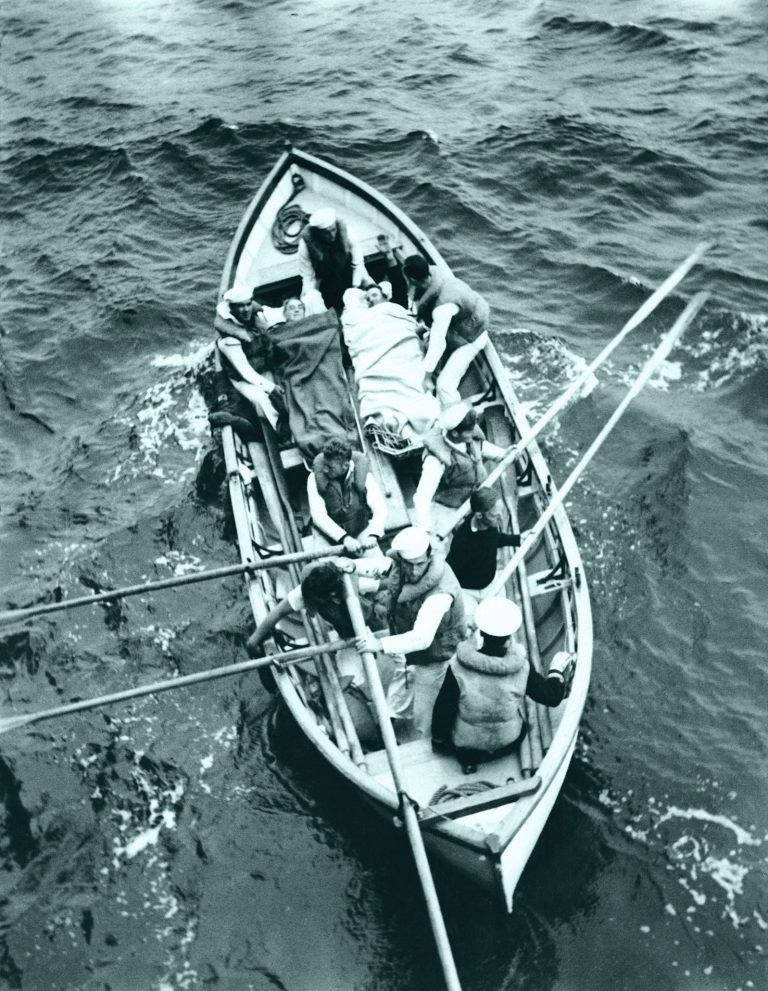
Athenia lifeboat
The man at the tiller in the stern sheets (the front of the rowboat) was an ordinary seaman, without either temperament or training for an event of this kind. He made a fatal mistake. We had seen the riding lights of a ship, (he) apparently hove to (pulled up)and had made for them. The ship, [although we didn’t know it then] was the Knute Nelson, a Norwegian freighter, standing by for survivors. Since she was in ballast, she was riding high, her (propeller) blades (in the stern) well out of the water. Our man in the stern sheets, in his eagerness, came around the stern. At this moment, to keep seaway, she (the Knute Nelson) turned over her engines. Her naked blades thrashed at the water—caught us in the wash—and hacked us to pieces. On the thwart (seat) ahead of me a man was cut in half, as I leapt into the sea.
I seemed to be going down forever, lungs bursting, before I emerged into air again. A young steward in a white coat was struggling with something. “Push!” he said. We both pushed at a fragment of our shattered lifeboat. We turned it keel-up, to keep what air we could under it for buoyancy. The riding lights of the Knute Nelson were an astonishing distance away, and receding. There was no sound except the wash of waters.
As I perched with the steward on our bit of keel (the backbone of the lifeboat), I heard my name called. I called back, in voice that could not possibly have been mine. Judith swam out of the blackness and climbed beside us.
There was room for only about eight of us on that keel: a dizzy, precarious perch, the water washing clear over our heads at times. Perhaps a dozen or so more clung to us, unable to hoist themselves out of the sea. It was cold, and it was three hundred miles from land.
..[A] big yacht…passed us and ignored us. We all cried out together, but she held to her way. She was the Southern Cross, belonging to the Swedish millionaire, Axel Wenner-Gren, friend of Hermann Goering. That was when our people died. They rattled and gasped and dropped away.
Then, at the first streak of dawn, there was the tiny outline of a ship….We shouted “Ahoy!”…[S]he stopped… And she made for us with incredible speed. She was the British destroyer, Escort. Seven of us were hauled up the side of that destroyer; six of us lived. It was later calculated that there had been eighty-five in our lifeboat.
…I never saw my father again.[xix]
Of the Kucharczuk family on lifeboat 5A, only the father and one daughter, Nina, 19, survived.[xx] Jan was rescued from his separate lifeboat. The three Kucharczuks were united through the Red Cross. Several ships rescued lifeboat passengers. Of the 1,418 aboard, 98 passengers and 19 crew members were killed. Fifty were crushed in the propeller of the Knute Nelson. Another accident happened when No. 8 lifeboat capsized in a rough sea below the stern of the Southern Cross, killing ten people. Three people were crushed to death in the transfer from the lifeboats to the Royal Navy destroyers.
Once Chief Officer Copland was rescued by the Electra, he consulted with the Athenia’s doctor to be sure that Rose Griffin with the broken nose was carried to a lifeboat. This had not been done. The Electra supplied its whale motorboat for Copland and others to return to the Athenia around 10 A.M. Monday morning. The ship had a 30-degree list to port, was down at the stern, riding low in the water. The men boarded the Athenia, located Rose Griffin still in the hospital ward, unconscious still, and put her in the motorboat. The ship was beyond saving. The rescue team watched as the Athenia “heel over on her port beam. Her bow rose almost straight up out the water, showing her bright bottom paint with water streaming off. Almost in slow motion, the Athenia then settled stern first into the sea.”[xxi] It was almost 11:00 A.M. The Athenia took fourteen hours to sink. Rose Griffin was taken to Victoria Infirmary in Glasgow where she died from her injuries.
The passenger liner Orizaba brought home Athenia survivors to America. Travelers to Canada arrived on the City of Flint.
In October, Germany spoke about the sinking of the Athenia:
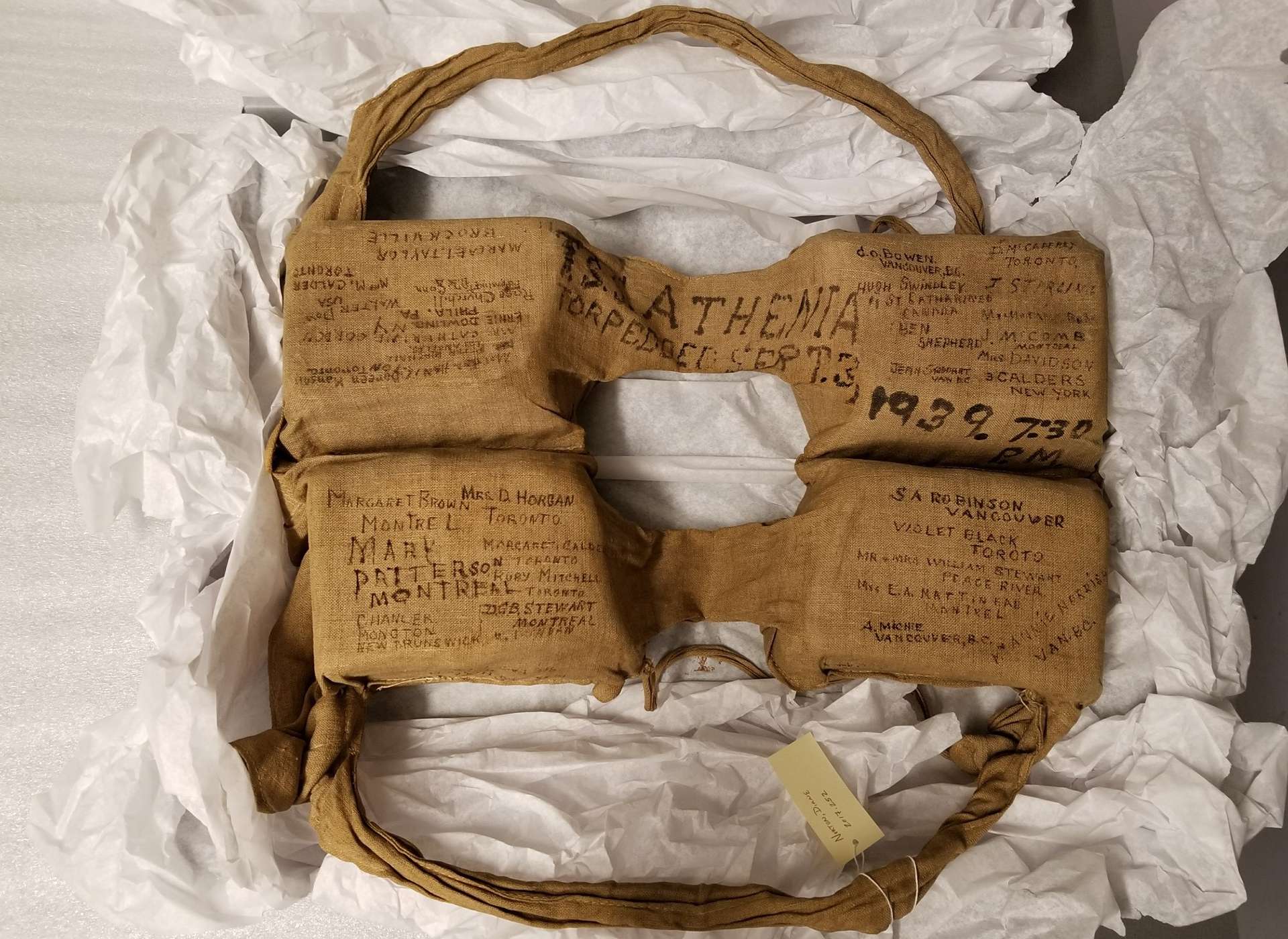
Michael McShane’s lifejacket signed by survivors of the Athenia
BERLIN, Oct. 22—Propaganda Minister Joseph Goebbels in a radio broadcast tonight presented himself in the role of prosecuting attorney before a world court accusing Winston Churchill, Britain’s First Lord of the Admiralty, of having ordered the sinking of the Athenia in an effort to get the United States into the war.[xxii]
[1] “This past night” Shirer, William L., The Nightmare Years, 1930-1940, 20th Century Journey, a Memoir of a Life and the Times V. 2 (Boston ; Toronto: Little, Brown, 1984), 446.
[2] Carroll, Francis M., Athenia Torpedoed: The U-Boat Attack That Ignited the Battle of the Atlantic (Annapolis, Md.: Naval Institute Press, 2012), 16.
[3] “cosmopolitan” ibid., 19.
[4] “Titianna-Juka””Kucharczuk Family-Survivor Account and Passenger Lists,” Benjidog Historical Research Resources: Athenia.
[5] “ consisting of cork” “The Sinking of the Ss Athenia,” The National WWII Museum, New Orleans, September 3, 2020.
[6] “Eternal Father” Caulfield, Max, Tomorrow Never Came; the Story of the S.S. Athenia, 1st American ed. (New York,: Norton, 1959), 49.
[7] “we shan’t” Carroll, F. M., 2.
[8] “a pipe” Caulfield, M., 63.
[9] “when the dining room” Carroll, F. M., 2.
[10] “a warning shot” Gregory, Mackenzie, “Ss Athenia, First Casualty of the U-Boat War on the 3rd of September 1939,” Ahoy-Mac’s Web Log.
[11] “By order” Carroll, F. M., 37.
[12] “The explosion” ibid., 49.
[13] “galley floor” ibid., 40.
[14] “We have to go” ibid., 44.
[15] “I’m stepping” ibid.
[16] “I will never” ibid., 47.
Chapter 3: To the Lifeboats
[xvii] “Women and children first” ibid., 58.
[xviii] “Seaman Dillon” ibid., 55.
[xix] “the man at the tiller” Allan, Andrew, Andrew Allan : A Self-Portrait (Toronto: Macmillan of Canada, 1974), 88-9.
[xx] “survived” “Kucharczuk Family-Survivor Account and Passenger Lists.”
[xxi] “heel over” Carroll, F. M., 81.
[xxii] “Propaganda Minister” “Goebbels Attacks Churchill as ‘Liar’,” New York Times (New York), October 23, 1939.