
Jacob Marley's Ghost from A Christmas Carol by Dickens
On our way up to Santa Fe, I had booked us a night at a famous and historic mountain inn in a little town in south central New Mexico, Cloudcroft. My uncle Max was once a forest ranger there. Nine thousand feet above sea level in the Sacramento Mountains and surrounded by 200,00 acres of the Lincoln National Forest, the Lodge also boasts a nine-hole golf course, a four-star restaurant, and a ghost named Rebecca – but I didn’t know the last part until the day of our arrival.
Established over a hundred years ago, The Lodge is very impressive – elegant, yet cozy. Inside and out, it looked just as you would expect a mountain inn to look. The lobby featured a stuffed and angry brown bear reared up on his back legs, a fireplace with a bright and shiny copper roof, and the head of a buck mounted on the wall. The decor was both Victorian and Southwestern with heavy dark wood furniture, thick pile carpet, and leather couches.
Guests are warmly welcomed. The reception area had a huge basket of red apples. I wanted one. I was carrying some green Granny Smith apples already in what Tom and Katie called my Mary Poppins bag. If you’ve seen the movie, “Mary Poppins,” you know what I’m describing. It’s a bottomless carpet bag. Anyway, the Granny Smith apples in my bag were for Tom but I don’t really like them. They’re too tart. I like red ones better and so does Katie. So I reached into the hospitality basket and helped myself to three or four red apples. I tucked them into my Mary Poppins bag. I tucked them down deep into the bottom below the magazines and books so they wouldn’t spill out and zipped the bag shut.
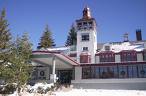
The Lodge at Cloudcroft, NM
We were shown to our guest room which faced the front. It was tucked into a dormer which meant the inner walls – covered with a Victorian printed wallpaper – were sloping. Tom and I were to share a four-poster queen bed while Katie had a window seat sleeping arrangement. We parked our bags – I heaved the Mary Poppins bag up onto a tall antique chest of drawers – and then we all went outside to explore.
The grounds were magnificent. We wandered onto the golf course. There were apple trees with little red and green crabapples weighing down their branches. I was from South Texas and had never seen apples growing on trees before although I was forty-four years old that summer! We walked around in the cool, crisp mountain air. It soon grew dark and our legs were tired from so much climbing, so we went inside for dinner.
In the dining room aptly named “Rebecca'” after the “ghost,” I had my first Spring Mix salad with raspberry vinaigrette. Back in Texas, we were still eating iceberg lettuce with Thousand Islands Dressing. The food and service were first class.

- “Rebecca”
The hotel was really capitalizing on the ghost of Rebecca theme. A painting of Rebecca hung in the restaurant. I asked the waiter if the rumors of a ghost were true. He said he had never seen the ghost himself but the chef had had some really weird supernatural encounters. He went and got the chef for me. The chef said that, on more than one occasion, knives had flown through the air of his kitchen right toward him. He was convinced the ghost was responsible. I chuckled and went back to my food.
After dinner, the others went upstairs to the room but I wandered into the gift shop. I browsed among the books where I found The Ghostly Register, by Arthur Myers. Chapter 43: “The Ghost Who Makes Phone Calls,” was devoted to the legend of Rebecca. The ghost they call Rebecca – no one has researched this – is believed to be the spirit of a chambermaid who was killed by her lumberjack lover when he found her in the arms of another in the early 1900s. Those who claim to have seen her wandering the halls of the Lodge describe her as a beautiful redhead who wears a long, flowing gown. Guests and employees have reported many unexplained happenings at the Lodge that they attribute to Rebecca – ashtrays that slide across tabletops unassisted, phones that ring yet no one is on the line, footsteps, and knockings on doors. She was often seen near Suite 101, the Governor’s Room. I bought the book and left.
I decided to conduct my own investigation of the ghost. This “ghost of maid killed by jealous lover” legend is attached to many hotels and I was sceptical that Rebecca was more than that. I wandered into the hallway of Suite 101. I hung around a while but everything seemed perfectly normal – no ectoplasm there – so I went upstairs to join the others. I found both Katie and Tom piled up their individual beds with books. I decided to get ready for bed and then join them.
After I’d changed into my nightgown, taken off my make-up, and washed my face, I was ready to climb up in bed alongside Tom with a good book. It was then that I remembered the juicy red apples in my Mary Poppins bag. I wanted one. I walked over to the chest of drawers.
Tom and Katie weren’t paying me any attention. They were still deeply absorbed in their reading. I grabbed my Mary Poppins bag and pulled it toward me. It was heavy. I got up on my tiptoes to peek inside the bag and tilted it toward me some so I’d see well enough to select a sweet red apple rather than one of Tom’s sour green ones. I found a nice red one, then rooted around inside some more until I’d found my book. I then pushed everything back down again in the bag and shoved it back in place on the dresser. I didn’t zip the bag shut this time, though; I left the mouth of it open.
I then turned and set my book on the bed, before padding off to the bathroom to wash my apple before eating it. I was surprised when I heard a couple of thuds behind me. Something had fallen on the floor. I turned to see two red apples rolling along the carpet behind me like bowling balls aimed right for my feet. I looked over at Tom first and then Katie but neither of them had moved a muscle. Nevertheless, it could have been a trick. I put my hands on my hips and asked, “Hey, who did that?”
“Who did what?” they both wanted to know.
“Threw those apples at me?” I pointed to the carpet where the two red apples now lay at rest.
“What are you talking about?” Katie asked. I told them what had happened, that I thought someone had thrown the apples at me.
They laughed. “Maybe you just left your bag open and they fell out,” volunteered Tom, wanting to get back to his reading.
I knew that wasn’t true. Those apples had definitely been hurled at me by someone or something, but I didn’t speak of the incident again that night. I didn’t want to scare Katie. Tom and Katie just resumed their reading and I joined them. When we turned out the lights, my heart beat hard in my chest, but I still didn’t reveal how frightening it was to be in the dark in that room in that hotel. But the next day, when we were checking out to head to Santa Fe, I took the lead and cancelled our reservations for the return trip. I wasn’t about to sleep another night under that roof. That place was definitely haunted. I didn’t know how that chef could show up to work each day knowing that each day might be his last, that he’d spend it dodging knives – or apples.






 I was just at Randall’s picking up some Haagen-Dazs chocolate ice cream for Katie, O’Doul’s for Tom, and mango sorbet for myself when I happened to glance at the magazine rack at the checkout stand. “Oprah’s Cocaine Relapse!” shouted the headline on the National Enquirer. “Stedman furious as her secret lover TELLS ALL. PLUS: THE SHOCKING VIDEO!”





 Lisa's History Room