
American actress Grace Kelly looks over her shoulder in Hollywood, California, March 1954. In April 1956, Kelly married Rainier III, Prince of Monaco, and became Her Serene Highness the Princess of Monaco. (“Grace Kelly: Floating on Chiffon,” Lisa’s History Room)
I was so excited to read in Vanity Fair that London’s Victoria & Albert Museum was featuring an exhibition of Grace Kelly‘s clothes. What a treat! I thought. Imagine all those beautiful 1950s dresses designed for actress Grace Kelly (1929-1982) together in one place. Of course I couldn’t get to London, I knew; I was recovering from spine surgery and we were building an addition to our house.
But what did that matter? I had my computer. With a few keystrokes and mouse clicks, I could cyber fashion stroll. I just assumed the V & A Museum would put the collection online as they had done with Queen Victoria and Prince Albert‘s jewelry collection. (See “Victoria & Albert: Art & Love & Teeth”)
I jumped to the museum website and found the exhibition: “Grace Kelly: Style Icon.” I got even happier after I read the promising blurb:
“Featuring dresses from her films including ‘High Society’ and ‘Rear Window,’ as well as the gown she wore to accept her Oscar in 1955, the display will examine Grace Kelly’s glamorous Hollywood image and enduring appeal.
It will also explore the evolution of her style as Princess Grace of Monaco, from the outfit she wore to her first meeting with Prince Rainier in 1955 to her haute couture gowns of the 1960s and ’70s by her favourite couturiers Dior, Balenciaga, Givenchy and Yves St Laurent.”
But much to my chagrin, I discovered that the exhibit is not posted online at the V & A. I was, at first, incredibly disappointed. In a mad haste, I scoured the Internet for images of the fashion display on newssites and blogs. I found a lot of articles but precious few images of the actual exhibit. But what I did find told a lot. To illustrate a point, here are two of those V & A showcase windows:

A mannequin displays the dress Grace Kelly wore in “The Swan.” (1956) The exhibit, “Grace Kelly: Style Icon,” is at the Victoria & Albert Museum in London from April 17- September 26, 2010
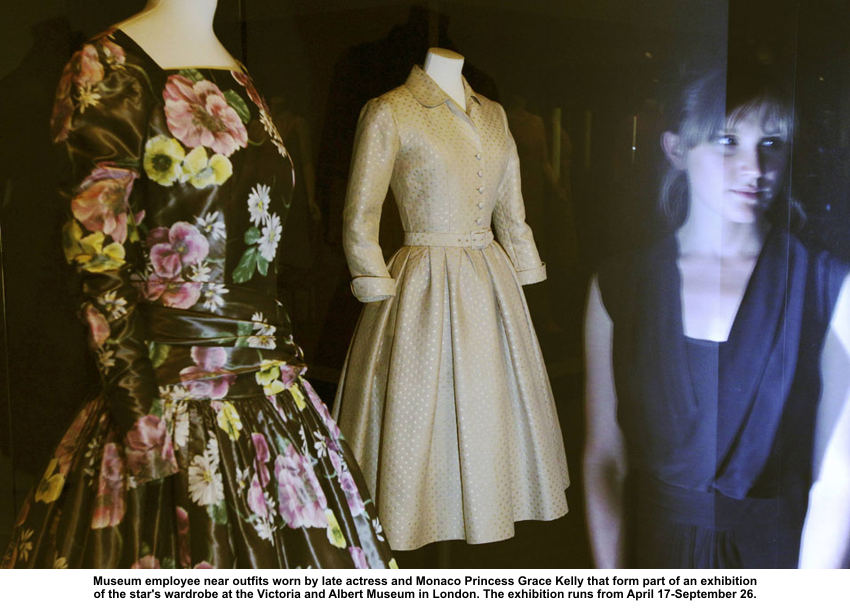
The exhibition at the Victoria & Albert Museum in London, “Grace Kelly: Style Icon,” includes dresses worn by Grace Kelly after she became Princess Grace of Monaco in 1956.
Yawn. Pretty dry stuff, huh? Dresses on mannequins have no sparkle. What they needed was Grace Kelly.

Grace Kelly as Lisa Fremont in Alfred Hitchcock’s 1954 thriller, “Rear Window.” (“Grace Kelly: Floating on Chiffon,” Lisa’s History Room)
So instead of trying to catalog for you all the dresses in the V & A, I have picked my personal favorite and shown it as worn by the eternally beautiful Grace Kelly. It is the Paris dress she wore as sophisticate Lisa Carol Fremont in the 1954 Alfred Hitchcock classic, “Rear Window.”
The dress with a fitted black bodice and deep V-cut bustline was designed for Kelly by Paramount Picture’s chief costume designer Edith Head. The full skirt falls to mid-calf, gathered and layered in white chiffon and tulle. From the nipped-in waist, a spray branch pattern falls playfully over the hip. Grace accessorized her high-fashion gown with white silk gloves, pearls, and a chiffon shoulder wrap.
To read the “Rear Window” script excerpt wherein “Lisa-Carol- Fremont” enters Jimmy Stewart‘s apartment wearing this outfit, click here.

Grace Kelly sits on steps in her “Paris” dress she wore in Alfred Hitchcock’s 1954 “Rear Window.” The gown had a light & airy quality with a slender waist and a beautiful skirt made from yards and yards of tulle and chiffon. The black and white confection was created by Paramount Pictures costume designer Edith Head. (“Grace Kelly: Floating on Chiffon,” Lisa’s History Room)
For more on Grace Kelly, click here.




 Lisa's History Room