Feeds:
Posts
Comments

Archive for the ‘EVENTS’ Category

The Confederacy 1861-1865 (orange)

The Confederacy 1861-1865 (orange)


THE PRICE OF THE CIVIL WAR

UNION
                                                                                                                                            

Soldiers                         2,500,000-2,750,000                                           

Soldiers wounded who survived     275,175                                                                         

Soldiers who lost their lives              360,222                                                                       

Civilians who lost their lives                   None         

CONFEDERATE                                                              

Soldiers                              750,000-1,250,000                                         

Soldiers wounded who survived     102,703                                                    

Soldiers who lost their lives              258,000                                                                       

Civilians who lost their lives                50,000   


The total cost of the war was $20 billion (approximately $250 billion in today’s money), or five times the total expenditure of the federal government from its creation in 1788 to 1865. (2)

(1) Map

(2)Fleming, Candace. The Lincolns: A Scrapbook Look at Abraham and Mary. (New York: Schwartz & Wade Books, 2008)

Read Full Post »

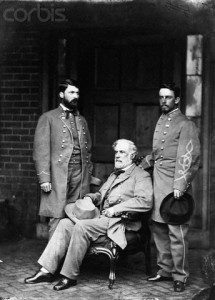
Confederate General Robert E. Lee, seated, with 2 of his officers, photographed by Mathew Brady in April, 1865, following Lee's surrender to General Ulysses S. Grant at the Appomattox Court House in Richmond, Virginia.

Confederate General Robert E. Lee, seated, with 2 of his officers, photographed by Mathew Brady in April, 1865, following Lee's surrender to General Ulysses S. Grant at the Appomattox Court House in Richmond, Virginia.

At daylight on April 10, 1865, the firing of 500 cannons spread the news throughout Washington, D.C.,  that the War Between the States was over and the Union preserved. The cannons were so loud that they broke windows on Lafayette Square, the neighborhood around the White House. (1) “Guns are firing, bells ringing, flags flying, bands playing, men laughing, children cheering – all, all jubilant,” wrote Secretary of the Navy Gideon Wells. (2)

Expecting the president to make a speech, several thousand people gathered outside the White House. President Lincoln was not sure what to say as he was planning on giving a formal address the following evening.Just then, his twelve-year-old son Tad appeared at a second-floor window, waving a captured Confederate flag. It gave the president an idea. He asked the Marine Band to play a favorite tune of his, “Dixie,” the unofficial Confederate anthem.

“I have always thought ‘Dixie” one of the best tunes I ever heard,” he told the surprised crowd. “It is good to show the rebels that with us they will be free to hear it again.”

True to the promise he made in his second inaugural address, Lincoln was already trying to bind up the nation’s wounds.
 
Now let’s hear Elvis Presley sing “Dixie.”

(1) White, Ronald C. A. Lincoln. (New York: Random House, 2009)

(2) Fleming, Candace. The Lincolns: A Scrapbook Look at Abraham and Mary. (New York: Schwartz & Wade, 2008)

Read Full Post »

Carolyn King Waller (b.1934)

Carolyn King Waller (b.1934)

My mother underwent a hip replacement last week. While waiting for Mom to be wheeled off to surgery, I had an opportunity to talk with both Mama (Carolyn) and Daddy (John) about their growing-up years in the thirties and forties.
Carolyn:You want to remember that in the 30s and later, the iceman brought ice to your doorstep. The garbage trucks would come by and the men would be standing in the truck beds knee-deep in garbage. It wasn’t very hygienic! Mother used to make me sugar and butter sandwiches. People ate a lot of cheap foods like butter beans, rice pudding, bread pudding. Think how cheap rice pudding would be. (My grandmother) Nona used to make cooked onions.
You would open a box of soap powder and you would find a little trinket in the flakes. There might be a dishcloth in it or a Shirley Temple spoon, or maybe a piece of depression glass. It cost 12 cents for a child to go to the movies and 30 cents for an adult. Think how cheap that was – to be transported into another world for two hours for only pennies! Hollywood stars would be dressed up (in the movies) in oh so fancy clothes. We didn’t have much money for clothes but we didn’t begrudge them (the stars) for that. don-winslow

The forties were a time of serial movies on Saturday afternoon. When you went to the movies on Saturday, you would get a serial thrown in. They were probably continuing week-to-week narratives, little short ones, about twenty minutes each. There was “Don Winslow in the Navy,” “The Green Hornet,” “The Green Lantern,” cowboy serials, “Zorro.”  They were always full of action. The serials came on at intermission. The serials had someone fighting against the enemy overseas or some other bad guys. The bad guys usually wore black hats; the good guys usually wore white hats. Our family wasn’t shallow but movies were our thing.

John A. Waller, Jr. (b.1930)

John A. Waller, Jr. (b.1930)


Lisa: Changing the subject, Dad, did you have a car when you went to UT in the early fifties?
John: My first car was the big white Oldsmobile that my parents had had before my wedding. They gave it to us before we got married. They’d bought it in 1947.
Carolyn: It had an automatic shift in the days when a lot of cars didn’t.
John: In 1937, my father had bought another car in Yoakum (Texas) that had an automatic shift. It was also an Oldsmobile. He didn’t buy another one for ten years, until he bought that big white one in 1947, the one he gave us. You couldn’t buy cars during the war years. All the metal, rubber and everything that had been used in car production went to the war vehicles.
Carolyn: In those days, everyone was on foot. Cars were useful, very important, if you had one. Drive-ins were a big deal. When you had a car, you went to a drive-in movie or a drive-up hamburger shop.
Lisa: Was gas rationed in the 40s?
Carolyn: Yes. There were different levels. Some people had As, some had Bs, and maybe Cs. When your grandparents passed away, Lisa, we found their ration books. They had saved them. The amount of gasoline rations you were issued depended upon your level of importance to the government. We had meatless Tuesdays. We cut down on our food consumption to save more “for the boys” (fighting the war). We had victory gardens to grow food for ourselves. In Hollywood, there had to be less fabric in the dresses so costumes were less sumptious. My mother’s cookbook at the time had recipes that were tailored to “the fighting forties.” They didn’t call for so much sugar and butter, or eggs, for that matter. They were more stringent recipes. We had sugar and meat coupons. Except for these cutbacks, we were really sheltered from the war.
John: It was all a newsreel war.
Carolyn: A gold star mother was someone in the community who had lost her son. Mrs. Pyle was one, maybe Mrs. Roscoe. Daddy and I didn’t pay any price.
John: I lived in Yoakum and they didn’t connect to anything.
Carolyn: I lived in Corpus Christi (Texas) where they had the largest naval station in the country. There may have been submarines in the Gulf of Mexico. We had black-out curtains. There was a rumor about a guy named Poenisch who was signaling Germans out on the water.
Lisa: Dad, back to your comment a while ago about World War II being “all newsreel war.”
John: That’s where we saw pictures of the war – at the movies. We saw newsreels that came on between the features. They were about 10 to 15 minutes long. Most of them were of the war, the battles. We saw pictures and heard the audio by Edward R. Murrow or Eric Severeid.
Carolyn: Oh, my gosh, he (Eric Sevareid) reported from the tops of burning buildings! Hollywood had been asked by the government to make happy propaganda. FDR asked the movie industry to do that. So we got movies like “30 Seconds Over Tokyo,” “So Proudly We Hail,” “Edge of Darkness,” “Bataan.”
best-years-of-our-livesJohn: After the war, there was “The Best Years of Our Lives.” That movie showed what it was really like for those soldiers coming home. They got the GI bill and went to college. That’s who I went to school with.

Carolyn: All through the war, we weren’t touched by the war personally, but we were affected by it because so many of the movies were about it. Oh, we can’t forget to mention “Casablanca.”

Read Full Post »

Carolyn King Waller

Carolyn King Waller

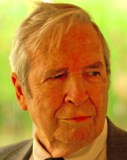
My mother Carolyn King Waller stopped by Lisa’s History Room this afternoon for a little chat. Carolyn was born in Corpus Christi, Texas, in 1934. She has a mind like a steel trap; her ability to recall stories from the past is legend.

Lisa: Thanks for stopping by today, Mom. Everyone knows that you love history. What would you say is your favorite period?
Carolyn: Probably the World War Two years, 1941 to 1945. And of course World War Two for other countries was longer that. 1941 to 1945 were America’s war years.
Lisa: And why is that your favorite period?
Carolyn: The fate of the world hung in the balance. It was a lot of drama – really, truly, good against evil.
Lisa: So it fascinates you.
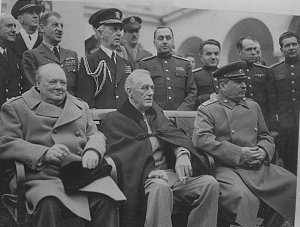
Carolyn: I’m not the only one…others are fascinated by it still…of course, we didn’t know about the Jews being exterminated, 6 million…then the Stalin thing…Stalin moved in from the east, we (the Allies) moved in from the west. The countries that Stalin occupied in the east became known as the countries behind the Iron Curtain. Churchhill coined the phrase. The poor people who had been under Germany were then under Russia! We didn’t really free them. The people in those countries had no freedom. We slowly woke up to who Stalin was. The Russians never left, including East Berlin, so World War II strengthened the Russians, it helped one problem, it created a worse one though, by increasing the strength of the Communists. Roosevelt was blamed for that but there wasn’t much he could do. It was said that Roosevelt gave too much away to Stalin at the 1945 Conference of Yalta,

1945 Conference at Yalta

1945 Conference at Yalta

but there really was very little he could do about it. They (the Communists) were there – they had occupied Eastern Europe – they had “boots on the ground.” We didn’t know then that Stalin had murdered millions of his own people, that he was a monster. In the early days, Truman even said, “I like Old Joe.”
Lisa: What else makes it an interesting period?
Carolyn: Outsized personalities of Hitler, Stalin, Roosevelt, and Churchhill – huge . Churchhill was a fabulous orator, Roosevelt knew about ships, had knowledge of the military, selected good generals. Hitler was a poor strategist; he entered all those countries at once. He told the generals what to do but he wasn’t good at military strategy. He was just a madman.
Lisa: To learn more, are there some books you would recommend?
Carolyn: Books about the period abound, certainly the biographies of those four men, stories of the war itself would be good.
Lisa: Does a particular book come to mind?
Carolyn: Kennedy’s thesis that became a book, While England Slept, No Ordinary Time, the Churchill bios by William Manchester – The Last LionA Man Called Intrepid
Lisa: What films capture the flavor and the truth of the war?
Carolyn: “The Best Years of Our Lives” showed the problems of returning servicemen from the war. “Edge of Darkness,” with Errol Flynn and Ann Sheridan depicts the Norwegian struggle. Norway was given away by the Quisling leader. The Norwegians had to fight Germany in an underground movement. There may be another movie, “A Moon is Down,” by John Steinbeck about occupied Norway, but I’ve not seen it.
Lisa: What else?
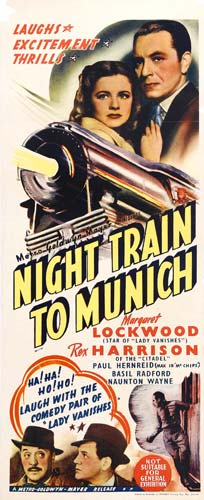
Carolyn: “Escape” which was a book by Ethel Vance, with Robert Taylor and Norma Shearer; “Night Train to Munich,” with Rex Harrison; and, of course, “Casablanca; “Ministry of Fear,” with Ray Milland; “Cloak and Dagger,” with Gary Cooper and Lily Palmer,night-train-to-munich “Watch on the Rhine,” with Bette Davis and Paul Lucas, and “OSS,” with Alan Ladd. All of those are great movies.
Lisa: What was it like to be a young girl in the war years?
Carolyn: In elementary school, our room would get the American flag for the week if our class bought the most war stamps and bonds that week. The classes competed to have the flag on display at the front of the room. It was a big deal. I was at Fisher School two years. Stamps were ten cents, bonds were $18.75 redeemable in ten years for $25. You had a book of stamps and you would try to fill the book with stamps. You would turn in a certain amount of stamps to redeem for a bond. That paid for the war! My grandparents sold cattle during the war years and they gave me money to do it because I was always a big stamp buyer. The government was smart to do that. It was an easy way for the government to get money from the citizens to finance, to fight the war. So many (citizens) had schoolchildren. While boys – women and men were fighting and dying in the war around the world – I was a young girl busy doing cartwheels in the front yard and joining little clubs – I was totally isolated. I didn’t know anyone who died in the war.
Lisa: Changing the subject, you wanted to say something about (actress) Carole Lombard.

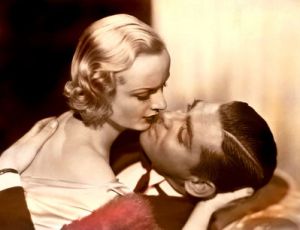
Carole Lombard and Clark Gable

Carole Lombard and Clark Gable

Carolyn: Yes. Japan attacked us on Dec. 7, 1941. In January 1942 Carole Lombard went on a war bond tour – to Indiana I think. She wanted to get home to see (her husband and actor) Clark Gable afterward, in a hurry, because they had had a fight over Lana Turner. She insisted on flying out to California late at night when it was dark and foolish to fly over the Rockies. She should have waited for a better plan but she insisted on flying out. She crashed in her plane in the Rockies. She was only 33. All they found of her were her earrings. Clark went to the scene and was distraught. He was always a good drinker, but he isolated himself for a few days afterward or so and drank heavily before he came back out. Roosevelt said she (Lombard) was one of our first casualties of the war or maybe even first hero. Before she had left, she had said to Clark Gable, “Pappy, you need to join this man’s army (meaning the United States Army).” After she died, Gable did just that; he enlisted. He was about 41. He didn’t need to sign up. They were not drafting men of his age. But he was distraught and he did it. He was made a captain or something at the top – he became brass right away – he was too important to be just a regular fellow. He may have been in the Army but he was still a celebrity.
Lisa: Was Clark Gable decorated?
Carolyn: He was stationed in Great Britain, he was an officer, he may have been in some forays over Germany.
Lisa: What will we be talking about during your next visit to Lisa’s History Room?
Carolyn: What should we talk about? Should we talk about history?
Lisa: Well, if you had something you wanted to tell, what would it be?
Carolyn: I’d tell about the depression years. We had butter beans at Mother’s, and (my grandmother) Nona cooked cheap things, rice pudding, bread pudding, onions….the hobos, I don’t want to say that, the homeless people, they would come to the back door. Nona would give them a plate of food and they would to go and sit out under a tree in the backyard and eat their food. People weren’t afraid of other people back then.
Lisa: Okay, save those stories for next time. Thank you so much for stopping by today.
Carolyn: Well, bless your heart, you make me feel like a celebrity!

Read Full Post »

« Newer Posts