Feeds:
Posts
Comments

Archive for the ‘LITERATURE, EDUCATION, & REFORM’ Category

victorian-silhouetteIn Nellie Bly’s book, Ten Days in a Mad-House (see category, “Nellie Bly,” for related posts), Nellie Bly described various women she met in the Blackwell Island Women’s Lunatic Asylum. She was confined to Hall 6 with 45 of the least dangerous women in the institution. While some of them were certifiably “crazy,” (her words), many, she felt, had been wrongly locked up. A Frenchwoman, for example, named Josephine Despreau, fell sick in a boarding house and the woman of the house called in the police. They arrested her and took her to the station-house. She didn’t understand the proceedings because of the language barrier and the judge paid no attention to her protests. She was locked up in the insane asylum in no time.

Well into the twentieth century, it was easy to get a woman locked up in a mental institution. It was not unheard of for a man to tire of his wife in favor of another woman and get his wife declared insane and committed to an insane asylum. I was remarking upon this horror the other day and my mother told me that my great uncle Sam P did this very thing to his wife Helen. He had her committed to an asylum in San Antonio. Helen found a way out, though, and slipped away to Corpus Christi to live with her sister.

Do any of you have any asylum stories to share?

Read Full Post »

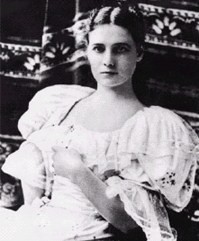
Nellie Bly (1864-1922)

Nellie Bly (1864-1922)

I’ve been thinking about the very different lives of reporter Nellie Bly and Rosemary Kennedy. Although over fifty years separated these women, both found themselves at the age of 23 at the mercy of mental health “professionals.” Nellie Bly placed herself in a dangerous lunatic asylum as an investigative journalist because she was desperate to land a job in a world that didn’t welcome female professionals. How else was an uneducated woman to earn a living in 1887?

Bly was the thirteenth of her wealthy father’s fifteen children, her mother being her father’s second wife. When Bly was six, her father died, failing to make specific provisions for Nellie, her mother, and her two brothers. Like many other great women, Nellie Bly (like Annie Oakley) took it upon herself to find a way to take care of her family. She ran a boarding house with her mother and marveled that her uneducated brothers were able to find jobs as clerks and drummers yet, because she was an uneducated woman, she could only aspire to be a chambermaid or washer-woman. Thus it was Nellie’s poverty and the absence of a father that lead her to have herself committed, at the age of 23, to an insane asylum.

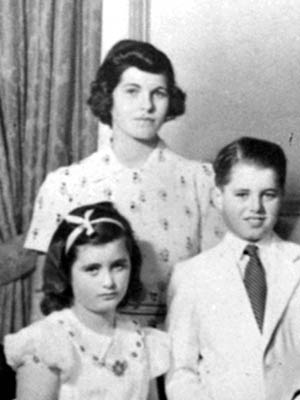
But the converse was true of Rosemary Kennedy. Rosemary landed in a mental institution because she was rich and had a father. She had the misfortune to be born “mildly mentally retarded, into a family dominated by her driven and ruthlessly ambitious father,” Joseph P. Kennedy. Rosemary had been living in a convent to keep her out of the public eye, but, as she developed as a young woman, she had begun sneaking out to see boys, and Kennedy was worried that she might damage his famous family’s reputation.

Rosemary Kennedy (back) (1918-2005), with sister Jean and brother Robert

Rosemary Kennedy (back) (1918-2005), with sister Jean and brother Robert

In an attempt to settle her down, her father, without telling his wife, used his money and powerful connections to arrange for his 23-year-old learning-disabled daughter Rosemary to undergo experimental brain surgery, one of the first prefrontal lobotomies ever performed. The operation took place in 1941, but, according to the historian Doris Kearns Goodwin, “something went terribly wrong.” Rosemary emerged from surgery not better, but far worse. She regressed to a state of helpless infancy and was confined to a mental asylum for the rest of her life until her death in 2005. Nellie Bly’s story, though, has a happy ending. She walked out of the asylum a free woman and an international celebrity.

To read more on the Kennedys on this site, scroll down the right sidebar to “Categories – People – Kennedys.”

Read Full Post »

victorian-letters-dover-clip-art-freeellie Bly was put on the island boat and sent to Blackwell’s Island. For ten days, she experienced firsthand the horrors of being locked up in cruel and inhumane conditions.  Upon her arrival, she was fed a disgusting meal of pink watery tea, prunes, and bread that was dirty and black and mostly dried dough. She found a spider in the slice given her. She didn’t eat it. Later she learned that the nurses didn’t like it when you didn’t eat your food. They might beat you for that.

After sitting in that long, freezing dining hall on bare yellow benches for what seemed an eternity, Bly and the other women in her ward were marched in two lines into a freezing cold, wet bathroom. As everyone looked on, the nurses stripped Bly of every bit of her clothing. They took away her dress, her skirts, her shoes, her stockings, and her hat. She then was forced to bathe in an ice-cold tub and be scrubbed by one of the craziest women in the ward.

“My teeth chattered and my limbs were goose-fleshed and blue with cold,” Nellie wrote later of the experience. “Suddenly I got, one after the other, three buckets of water over my head –  ice-cold water, too, into my eyes, my ears, my nose and my mouth.”

The nurses then put her, dripping wet, into a short flannel slip and locked her in an individual cell for the night. She couldn’t sleep. She kept picturing what would happen should a fire break out in the asylum. Every door was locked individually and bars covered the high windows. Should the building burn, there was no way the nurses or doctors could possibly unlock each door before the flames would engulf the building. She and the others would roast to death.

The asylum was spotlessly clean but it wasn’t the nurses who kept it so. The patients did all the work. There was little to distract the patients’ mind from the terrible cold and gnawing hunger. There were no books. The inmates did enjoy their short walks around the beautiful grounds. It was on one of those walks that Nellie Bly passed the kitchen and got a glimpse at the sort of food being prepared for the nurses and doctors: melons and grapes and all sorts of fruits, beautiful white bread and nice meats.

Bly complained to the doctors about the thin clothing issued to the patients, the intolerable cold, and the inedible food, but nothing came of it. It was only after her release ten days later that Nellie Bly would be able to draw attention to the neglect and abuse of people with mental disorders and others unfortunate enough to be sentenced to the asylum. Her expose of the conditions within the Lunatic Asylum, published in the World and later in book form,  Ten Days in a Mad-House , caused a sensation. Nellie Bly became an instant celebrity. madhouse-cvr

The public demanded to know how Nellie Bly had managed to hoodwink four physicians into believing she was insane. A grand jury launched an investigation into the claims made in Bly’s report and recommended the changes she had proposed, prompting an $850,000 increase in the budget of the Department of Public Charities and Corrections for the treatment of the insane.

nellie-bly-signature1

Read Full Post »

charles-dickens2One day, during my stay in New York, I paid a visit to the different public institutions on Long Island, or Rhode Island: I forget which. One of them is a Lunatic Asylum. The building is handsome; and is remarkable for a spacious and elegant staircase. The whole structure is not yet finished, but it is already one of considerable size and extent, and is capable of accommodating a very large number of patients.
blackswells-island-lunatic-asylum

I cannot say that I derived much comfort from the inspection of this charity.The different wards might have been cleaner and better ordered; I saw nothing of that salutary system which had impressed me so favourably elsewhere; and everything had a lounging, listless, madhouse air, which was very painful. The moping idiot, cowering down with long dishevelled hair; the gibbering maniac, with his hideous laugh and pointed finger; the vacant eye, the fierce wild face, the gloomy picking of the hands and lips, and munching of the nails: there they were all, without disguise, in naked ugliness and horror. In the dining room, a bare, dull, dreary place, with nothing for the eye to rest on but the empty walls, a woman was locked up alone. She was bent, they told me, on committing suicide. If anything could have strengthened her in her resolution, it would certainly have been the insupportable monotony of such an existence. The terrible crowd with which these halls and galleries were filled, so shocked me, that I abridged my stay within the shortest limits, and declined to see that portion of the building in which the refractory and violent were under closer restraint.

I have no doubt that the gentleman who presided over this establishment at the time I write of, was competent to manage it, and had done all in his power to promote its usefulness: but will lit be believed that the miserable strife of Party feeling is carried even into this sad refuge of afflicted and degraded humanity? Will it be believed that the eyes which are to watch over and control the wanderings of minds on which the most dreadful visitation to which our nature is exposed has fallen, must wear the glasses of some wretched side in Politics? Will it be believed that the governor of such a house as this, is appointed, and deposed, and changed perpetually, as Parties fluctuate and vary, and as their despicable weathercocks are blown this way or that? A hundred times in every week, some new most paltry exhibition of that narrow-minded and injurious Party Spirit, which is the Simoom of America, sickening and blighting everything of wholesome life within its reach, was forced upon my notice; but I never turned my back upon it with feelings of such deep disgust and measureless contempt, as when I crossed the threshold of this madhouse.

http://nyc10044.com/timeln/dickens.html

Read Full Post »

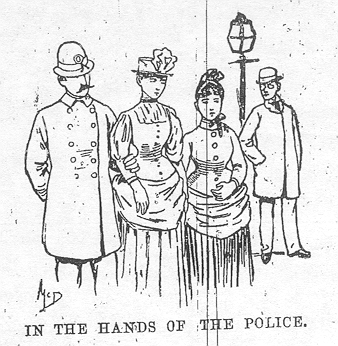
Nellie Bly could have won an Academy Award for her impersonation of a lunatic. On the morning of Saturday, September 24, 1887, within twenty-four hours of checking into the Temporary Home for Females at No. 84 Second Avenue, the police were called to escort “Nellie Brown” to the Essex police station. The assistant matron of the boardinghouse told the police that “Nellie Brown” had so terrified her female boarders with her crazy rantings that they feared being murdered in her beds. Bly claimed that all the women in the house were crazy. She had forgotten who she was, she said, and lost her trunks. She acted confused, vague, but not dangerous.
nellie-bly-in-the-hands-of-the-police1

The police took Bly before Judge Duffy who ordered her sent to Bellevue Hospital for examination, where Dr. William C. Braisted, head of the insane pavilion there, said Bly was “undoubtedly insane.” (1) There she passed two freezing cold nights, remembering that “all night long we were kept awake by the talk of the nurses and their heavy walking through the uncarpeted halls.” Nellie, being Nellie, complained to the nurses and the doctors about the lack of heat in the institution and the poor conditions. She was told that she could expect no kindness in the place as it was a charitable institution!

The stay at Bellevue was temporary though. The next day – Monday – a boat was expected. It would take Nellie Bly away permanently to Blackwell’s Island Lunatic Asylum for Women.

Just think. The speed of the thing was dizzying. On Thursday Nellie Bly had been sitting in the offices of the New York World contemplating the assignment of posing as an insane woman to gain admittance into an institution. It seemed an impossible hurdle – to be declared insane and committed for life to an insane asylum. Yet it was a mere three days later and Nellie Bly – a completely normal person – was being committed for life to an insane asylum – on the notorious Blackwell’s Island. How many other unfortunates had also suffered this fate?

(1) Kroeger, Brooke. Nelly Bly. (New York: Random House, 1994)

Next: Nellie being Nellie

Read Full Post »

Nellie Bly accepted the assignment. The task was frightening – to get herself committed to an asylum, to live among the lunatics for a week or so, then to write an expose on the conditions there – and she was nervous. But not about her skills as a writer. Her knack for including the telling detail made her articles compelling reading. No, she was nervous because she did not think she could pull off convincing the doctors that she was insane.

Bly had never known a crazy person. Just how did a crazy person look, she wondered.

nellie-practices-insanity4“So I flew to the mirror and examined my face,” she wrote later. “I remembered all I had read of the doings of crazy people, how first of all they have staring eyes, and so I opened mine as wide as possible and stared unblinkingly at my own reflection.” She began to sweat nervously, which unfortunately took the curl out of her Victorian bangs. Over and over again, she practiced her crazy face in the mirror. She ended up staying up all night, rehearsing her new role, thinking about her new mission, and reading scores of ghost stories to put her in a lunatic frame of mind.

When morning came, she bathed, bid her soap and toothbrush a fond farewell, and put on nondescript clothing. Then she went out into the street in search of a boarding house where she could begin her charade as the little lost and nutty Nellie Brown from Cuba.

Next: Inside the Madhouse

Read Full Post »

nellie-blyIt had been four months since she’d left Pittsburgh for New York yet Elizabeth Jane Cochran, or “Nellie Bly,” as her byline read, still hadn’t landed a job as a newspaper reporter. She had left the Pittsburgh Dispatch because she was tired of being assigned to the ladies’ pages – writing the society column, reviewing operas, and reporting on the latest women’s fashions.

It was now September of 1887. Bly was running out of money – and then she lost her purse, losing the little bit of money she had left. “I was penniless,” she wrote later, yet she still was not willing to return her former position in Pittsburgh, an industrial city so ugly, said a writer for the Atlantic Monthly, that it was “like looking into hell with the lid off.” New York was the center of the publishing world, a world dominated by men, a fact not lost on Bly. She had to be clever, very clever, to convince a newspaper why they should hire her, a woman, and not a man.

So Bly made up a list of clever story ideas, sure to boost any newspaper’s circulation. Then she borrowed cabfare from her landlady and headed to Park Row, home to the city’s newspaper offices. She managed to talk her way into the office of the managing editor of the New York World Colonel John Cockerill. She took out her list of ideas. She offered to sail steerage class from Europe to America so she could report firsthand the experiences of an immigrant.

Cockerill didn’t like her idea, but he must have recognized Bly’s potential, because he proposed an even wilder assignment. Why didn’t Bly fake insanity, he asked, and get herself committed to the Women’s Lunatic Asylum? As an undercover agent, Bly could witness for herself and later report on the rumored abuses suffered by the inmates at the hands of a sadistic staff.

The notorious Women’s Lunatic Asylum was set on the 120-acre sliver of land called Blackwell’s Island in the East River. It was surrounded by prisons and charity institutions. If Bly accepted the assignment, she would be asking for trouble. It could be dangerous. Bly had never been around crazy people before. Could she pull it off? What if she got sent to Blackwell’s Island, got locked up in the asylum with a bunch of lunatics and couldn’t get out?

http://en.wikipedia.org/wiki/Nellie_Bly

Kroeger, Brooke. Nellie Bly. (New York: Random House, 1994)

http://www.pbs.org/wgbh/amex/world/

Next: Nellie decides.

This is a reblog.

Read Full Post »


Available at your online booksellers, Amazon, Barnes & Noble, and other booksellers served by Ingram Distributors, booksellers receiving deep discounts. Or place an order at your local bookstore.

A separate Study Guide is also available.

This study guide provides intelligent discussion questions for book clubs, history instruction, or private study

Read Full Post »

Readers: Although Julia Ward Howe is not mentioned in my soon-to-be-published history, When People Were Things, her husband is. Although Julia’s Civil War activism is not included in the book, I want to give you a snippet view here.

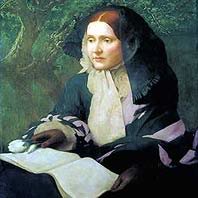
Julia Ward Howe (1819-1910)

Portrait of Julia Ward Howe, by John Elliott, ca. 1925. National Portrait Gallery/Wikimedia Commons

In 1843, red-haired New York heiress Julia Ward married Dr. Samuel Gridley Howe who had founded the Perkins School for the Blind. She was 24; he was 42. Julia gave birth to their first child while they honeymooned in Europe. She called her husband, “Chev.” They had six children and lived in Boston and Rhode Island. Theirs was not a happy union. Chev disapproved of Julia’s writing and did all he could to thwart it. In 1853, she published her first volume of poetry, Passion-Flowers, anonymously and without her husband’s knowledge. She continued to publish works that often critiqued women’s roles in marriages and society and caused controversy. Her husband was troubled by her writing as it often contained pointed references to her unhappy and stultifying marriage. He did not approve of women having a career outside the home.

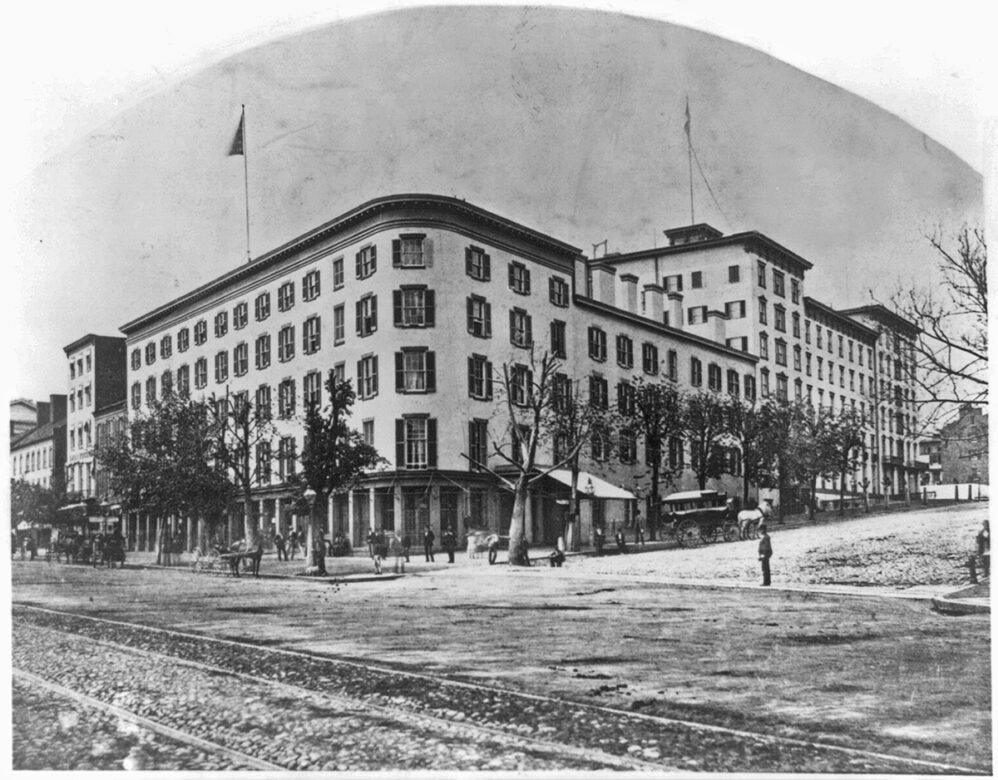
In November 1861, the first year of Abraham Lincoln’s presidency and while the Civil War was raging, Julia and Chev traveled to Washington and met Abraham Lincoln,  who, Julia wrote, “was laboring…under a terrible pressure of doubt and anxiety.” Dr. Howe was on the board of the U.S. Sanitary Commission that supported wounded and sick soldiers; during his stay, he would meet with the USSC founder Dorothea Dix. The Howes lodged at Willard’s Hotel on Pennsylvania Avenue.

The Willard Hotel in Washington, D.C., during the Civil War Years, Library of Congress

From their room, Julia saw a billboard advertisement for “an agency for embalming and forwarding the bodies of those who had fallen in the fight or who had perished by fever.”  This image stayed with her.

On a visit to the huge military camps stationed in the national capital, she heard soldiers singing the song, “John Brown’ Body,” originally about a Scotsman but had taken on new meaning in reference to the insurrectionist at Harper’s Ferry. New verses were often being added:

Old John Brown’s body is a-mouldering in the dust,
Old John Brown’s rifle is red with blood-spots turned to rust,
Old John Brown’s pike has made its last, unflinching thrust,
His soul is marching on!

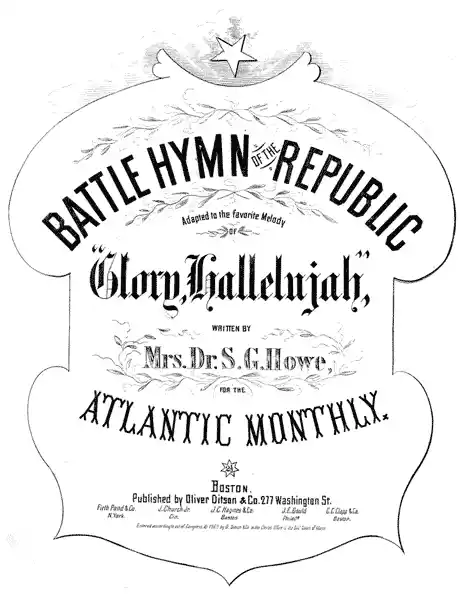
A friend urged Julia to write “some good words for that stirring tune.” That evening, she tried, but the words did not come to her. The next morning at the graying first light, she woke up in her bed at Willard’s and the words of the poem began to flow. She jumped up, grabbed paper and an old stump of a pencil, and scrawled down the words without even looking down at the paper, then fell back to sleep. This is how “The Battle Hymn of the Republic” was born, which she sold to the Atlantic Monthly for $4 in February. Her version links the Union cause to God’s vengeance at the Day of Judgment.

Here are some verses from the first published version:

Mine eyes have seen the glory of the coming of the Lord,
He is trampling out the vintage where the grapes of wrath are stored;
He hath loosed the fateful lightning of His terrible swift sword:
His truth is marching on.

(Chorus)
Glory, glory, hallelujah!
His truth is marching on.

I have seen Him in the watch-fires of a hundred circling camps,
They have builded Him an altar in the evening dews and damps;
I can read His righteous sentence by the dim and flaring lamps:
His day is marching on.

(Chorus)
Glory, glory, hallelujah!
His truth is marching on.

Before long, the song caught on and became the favorite of the Union troops and its unofficial wartime anthem. Julia Ward Howe became somewhat of a celebrity and became a suffragist.


Read Full Post »

Charles Dickens (aged 30). This portrait of Charles Dickens was painted by the American artist Francis Alexander (1800-1880) early in 1842, shortly after Dickens arrived in Boston at the start of his first visit to North America.

After returning from his 1842 visit to America, Charles Dickens (1812-1870) read a disturbing government report on child labor in the United Kingdom titled the Report of the Children’s Employment Commission. He read testimonies of little girls working as seamstresses, six hours a day, six days a week, and rooming above the factory floor. Girls told of dragging coal carts through tight underground passages over eleven-hour days.

A child laborer known as a “hurrier” is shown harnessed to a coal corve. Hurriers were required to drag an empty coal cart down from the shaft bottom along passageways between 24 to 30 inches high and return with a full load from the coal face. One child would be harnessed to the front of the corve, while another would follow behind, pushing the load with their hands and their heads. Most hurriers would have large septic calluses on their legs, hands and knees and many were bald as a result of pushing corves up steep inclines with their heads. Their bodies were often ‘old’ and broken before they reached adulthood.

Factory bosses used children to climb into the insides of industrial machinery to clear a jam, sometimes with fatal consequences. These were not isolated incidents but common. Families were poor and hungry and they took what work they could find, even if it meant sending a child as young as five to work.

Dickens at the Blacking Warehouse, From a drawing by Fred Bernard. Reproduced in “The Dickens Country” by kind permission of Messrs. Chapman and Hall

It is believed that, at the age of twelve,  Charles Dickens had been forced to drop out of school, sell his books, and go to work at the dirty, rat-infested Warren’s Blacking Warehouse, a shoe polish factory, near Charing Cross leading from the Strand to the Thames, where Charles typed up and labeled countless pots of shoe-blacking. Dickens’ father was locked up in a debtors’ prison, taking with him his wife and youngest children, and young Charles was expected to support his family at this grinding toil.  The pay was meager, only a few shillings a week. Young Dickens worked ten-hour days and saw his family only on Sundays. This he endured for three years, a most painful episode in his young life.

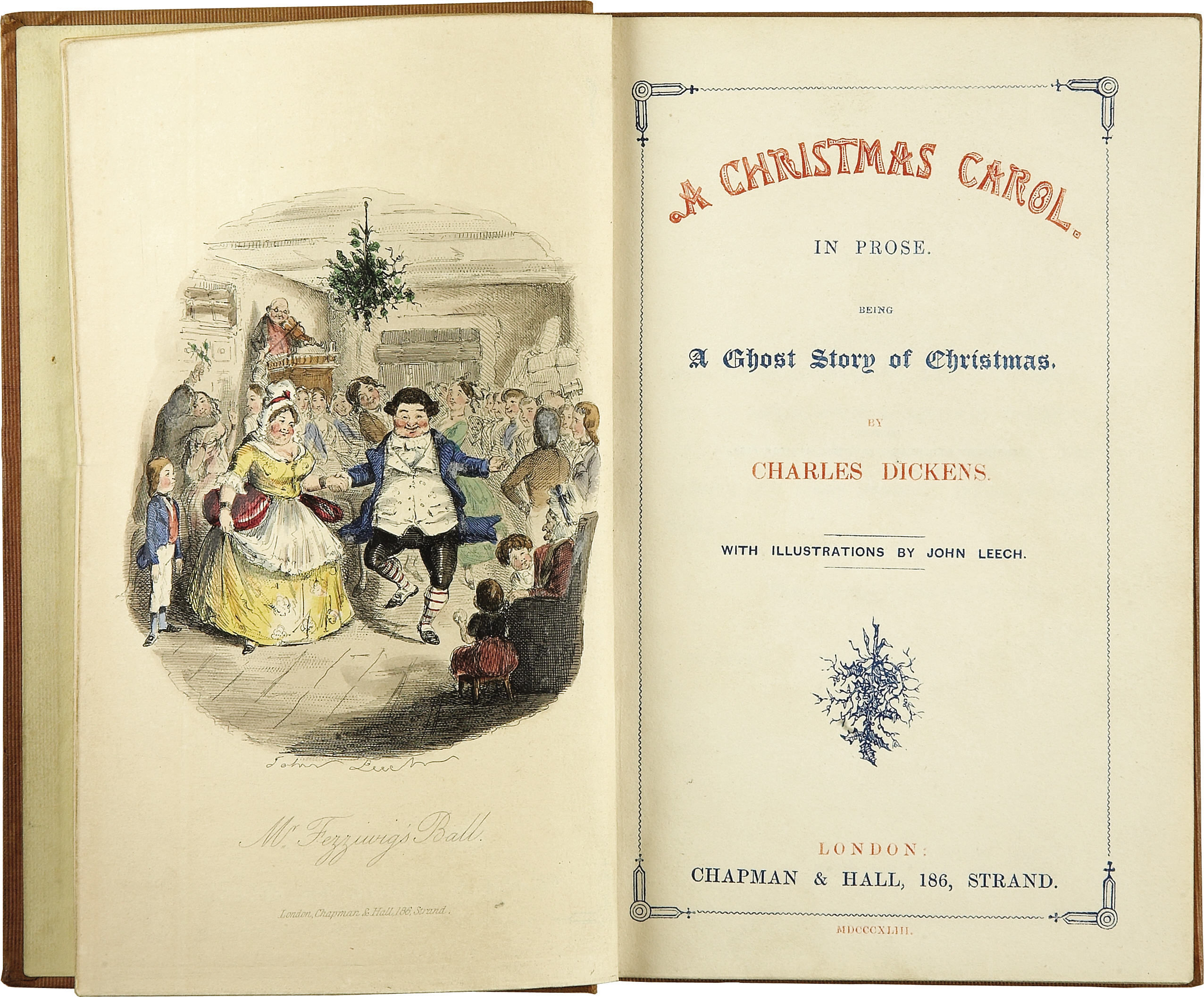
Influenced by his youth and a recent visit to the Field Lane Ragged School for street children, Dickens decided to shine a light on uneven workforce wages by writing a novella. The story came to him over six weeks as he took his nighttime strolls through London, walking fifteen or twenty miles a night, sometimes weeping, sometimes laughing. The result was a masterpiece called A Christmas Carol, published on December 19, 1843, a morality tale pointing out the benefits of compassion and the terrible cost of miserliness. In one scene, men and women, bosses and workers, young and old, dance and drink merrily, feast, and celebrate the joys of Christmas together. The book was a runaway bestseller.


John Leech, Public domain, via Wikimedia Commons

Readers: For more on Charles Dickens, click here.

Read Full Post »


51965c031ce44.image_

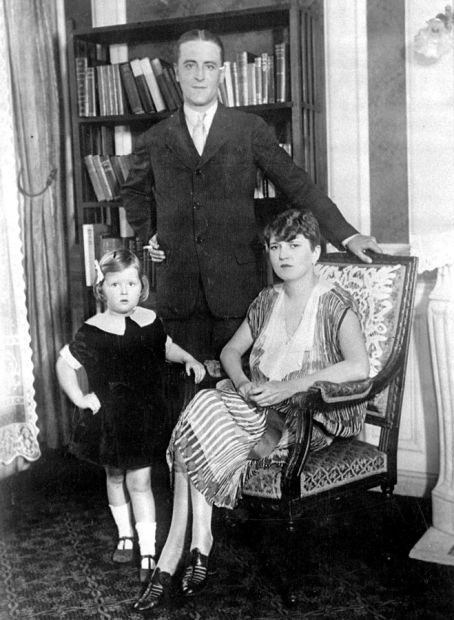
The Fitzgeralds in their Paris apartment, 1926. “Scottie,” age 5, Scott, and Zelda

Zelda Fitzgerald‘s health improved greatly following an appendectomy in June of 1926 in the American hospital in Neuilly outside of Paris. Unfortunately, the same could not be said of her husband, American writer F. Scott Fitzgerald (1896-1940). Although his recently-published novel, The Great Gatsby (1925), had received mostly positive reviews from literary critics, it was not selling well.


il_794xn.1994892106_o3k1While Zelda (1900-1948) was still hospitalized, Sara Mayfield, Zelda’s childhood friend from Montgomery, Alabama, ran into Scott in Paris. She was having drinks with the son of the Spanish ambassador to the United States and Michael Arlen, whose novel, The Green Hat, was creating a sensation abroad. Scott joined them at their table. At first, the conversation flowed pleasantly. Scott complimented Arlen on his literary success.  A half hour and more drinks later, the conversation turned to the writing of Ernest Hemingway. Arlen did not think highly of it. Scott considered Hemingway his great friend and a great writer. Scott pounced on Sara’s friend, accusing Arlen of being

a finished second-rater that’s jealous of a coming first-rater.”

Someone diffused the situation and steered Scott off the subject. Then Scott was on his way to the hospital to see Zelda and asked Sara Mayfield if she would join him. She agreed. First, however, he decided he wanted to have dinner. He wanted to find Hemingway who may have returned from seeing the running of the bulls in Pamplona, Spain. He and Sara stopped at Harry’s New York Bar. Things turned nasty quickly. A newspaper man asked Scott if he was promoting Hemingway. Scott somehow got offended and wanted to punch the newspaper man. Fortunately, someone interceded and stopped him.

Sara and Scott never did get around to visiting Zelda. Scott got roaring drunk and passed out in the fresh food market, Les Halles.

More and more, Scott’s nights and days were passed in this way: no work done, drinking, and talking with friends, passing out and being put into a taxi and sent home alone.”

Once Zelda was sufficiently recovered from her surgery, the Fitzgeralds were back in the South of France in the area known as the French Riviera for the rest of that summer.

scottandzeldapic

The Fitzgeralds ca. 1927. photo courtesy Mary A. Doty.

One evening in August, they were dining with two other American expatriates, Sara and Gerald Murphy  in the hills above the Mediterranean near Nice, France in St. Paul-de-Vence at La Colombe D’Or.

St. Paul-de-Vence is located where you see the red marker, approximately 20 km southwest of Nice in the hills.

St. Paul-de-Vence, South of France

La Colombe d’Or was a quaint and popular roadside bistro frequented by artists like Picasso, who sometimes paid for his meal with drawings. The open-air terrace restaurant is set on the edge of the ramparts of the ancient Roman hilltop town of Saint-Paul-de-Vence.  

That August evening, the Murphys had reserved a table for four on the elevated stone terrace overlooking the Loup Valley, two hundred feet below.

Midway through the meal, Gerald noticed that the famous American dancer, Isadora Duncan (1878-1927), was sitting at a table nearby along with three of her admirers. Gerald pointed her out to Scott and he and Sara told Scott who she was.

Now 48 years old, Isadora was no longer the lithe young dancer who had revolutionized the dance world by eschewing the rigidity of traditional ballet. In her heyday as a dancer who toured the globe, Isadora Duncan abandoned the plié, stiff-toed pointe shoes, and the tutu, preferring free form movement—skipping about in meadows and on beaches, barefoot, bare-legged, fluttering her arms about, wearing loose and flowing Greek tunics with long scarves trailing and billowing behind her.

Isadora dances for Ital war relief fund

Isadora Duncan dances for the Italian War Relief Fund during World War I. (Photo by George Rinhart/Corbis via Getty Images) 1917

Now 48 years old, Isadora was hugely fat and her dissipated life was legend. Her hair was dyed with henna.

Nevertheless, Isadora Duncan still had star power. Scott, enamored of fame, rushed over to introduce himself to her. He crouched at her side. He praised her artistry. Knowing that Scott was a writer, she divulged to him that she had a contract to write her memoirs; she had received a cash advance. As a result, she was being pressured to complete and submit the manuscript to her editor and, frankly, she was stuck. Scott offered to help. She wrote down her hotel and room number and handed this note to Scott. Scott was still fawning at her feet. Isadora reached down and began running her hands through his hair. She called him a centurion, her protective soldier.

At this point, Zelda, observing this scene, stood up on her chair, and, without warning, leaped over the table—and over Gerald, who was sitting with his back to the valley view—and dove into the darkness beyond, down the marble steps, below the terrace. (Zelda was a proficient diver and swimmer.)

I was sure she was dead,”

recalled Gerald.

Shortly, Zelda reappeared. She had fallen down a stone staircase than ran down the hillside. Her knees and dress were bloody. Otherwise, she was remarkably all in one piece. Sara grabbed her napkin, flew to Zelda’s side, and began wiping away the blood. Gerald’s first thought was

that it had not been ugly. I said that to myself over and over again.”

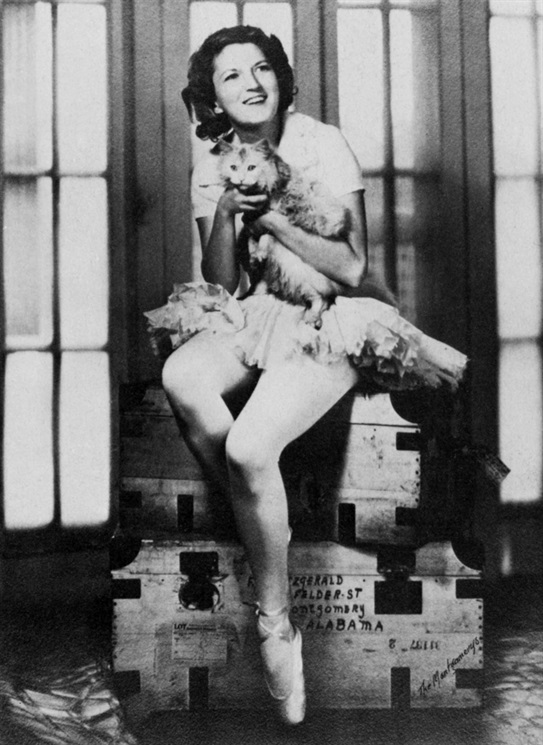
Zelda Fitzgerald’s behavior would grow more and more peculiar and yet she would live another twenty-two years. In the fall of 1927, she returned to her childhood study of ballet and it became an obsession. She would practice 6-8 hrs a day to the point of exhaustion and a weight loss of 15 pounds.
dbdd3d82-d1b0-4df0-92b4-93e6b4fdaccd

Zelda in ballet costume, 1929.

In 1930, she suffered a mental breakdown and was hospitalized in Paris. From then on, she would drift in and out of various mental institutions in Switzerland, France, and the United States. She endured grueling and often inhumane and certainly experimental treatment for her diagnosis of “schizophrenia.” She would make progress and then exit the institution before, reliably, suffering setbacks and needing to be readmitted to the hospital. Her mental health spiraled downhill.

091116_r19020_p646

Fitzgerald, in his own words, “just couldn’t make the grade as a hack” writing Hollywood scripts for MGM. Illustration by Barry Blitt for the New Yorker

Meanwhile, Scott’s party drinking had exploded into full-blown alcoholism. He found it harder and harder to write in those gin-soaked years. But their daughter, Scottie, had expenses and Zelda’s hospitalizations cost a fortune so he had to write to make money. He wrote until the end of his days, although suffering ill health all the while. He died of a heart attack in Hollywood at the age of 44.

Isa Duncan 1903

Isadora Duncan wearing a signature neck scarf

After having met Scott Fitzgerald on the terrace of La Colombe D’Or, Isadora Duncan would live another full year. On the night of September 14th, 1927, she was riding in a open-top car with a friend in Nice, France, when the long, silk scarf she was wearing—her signature look was her long, silk scarf— became entangled in the spoke of one of the rear wheels, breaking her neck, dragging her backwards, and killing her instantly.

According to dispatches from Nice, Duncan was hurled in an extraordinary manner from an open automobile in which she was riding and instantly killed by the force of her fall to the stone pavement.”

Upon learning of Duncan’s tragic death by strangulation, the poet and Nazi collaborator Gertrude Stein acidly remarked:

 affectations can be dangerous”

Sources:

Vaill, Amanda. Everybody Was So Young (1998).

Bruccoli, Matthew J. Some Sort of Epic Grandeur: The Life of F. Scott Fitzgerald (1981).

Milford, Nancy. Zelda (1970).

Taylor, Kendall. The Gatsby Affair: Scott, Zelda, and the Betrayal that Shaped an American Classic (2018).

O’Neill, Frances; Rennie, David Alan. F. Scott Fitzgerald in Provence-A Guide (2018).

The New York Times. 1927-09-15

Read Full Post »

articleinline

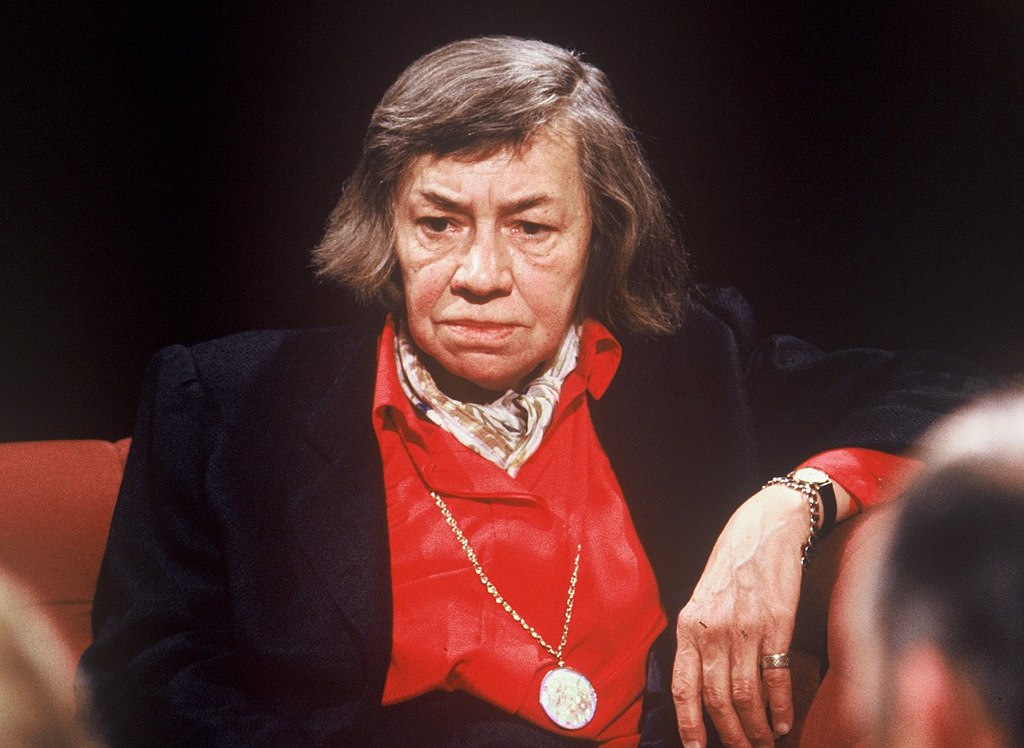
Novelist Patricia Highsmith, ca. 1950, Swiss Literary Archives, Bern.

Here is a transcription of a page from one of the journals of American novelist and short story writer Patricia Highsmith (1921-1995).

6/1/50 I am interested in the murderer’s psychology and also in the opposing planes, drives of good and evil (construction and destruction) whereby a slight deflection one can be made the other, and all the power of a strong mind and body be deflected to murder or destruction! It is simply fascinating!

…For perhaps even love by having its head persistently bruised, can become hate. For the curious thing yesterday. I felt quite close to murder, too, as I went to see the house of the woman who almost made me love her when I saw her a moment in December, 1948. Murder is a kind of making love, a kind of possessing. Is it not, too, a way of getting complete and passionate attention, for a moment, from the object of one’s affections? To arrest her suddenly, my hands upon her throat (which I should really like to kiss) as if I took a photograph, to make her in an instant cool and rigid as a statue.

And yesterday, people stared at me…wherever I went, in the trains, the bus, on the sidewalk. I thought, does it show in my face?

Now, more than twenty years after her death, Highsmith’s secret life will become public, as her estate prepares to publish hundreds of pages like this one from her personal diaries which also include her drawings and watercolors. Spanning nearly 60 years, these memoirs—56 spiral-bound notebooks, totaling some 8,000 pages—were found after Highsmith’s death, tucked away behind sheets and towels in a linen closet in her home in Switzerland.

In editing the diaries and notebook, Anna von Planta aims to offer an unvarnished look at the controversial author. Highsmith embraced strong anti-Jewish sentiments, cavalierly dismissing the Holocaust as the “semicaust” because some Jews were spared. Liveright Publishing plans to release the diaries in a single edition in the U.S. in 2021. Von Planta hopes the volume will “show how Patricia Highsmith became Patricia Highsmith” (for those who want to know).

Patricia Highsmith is known for her psychological thrillers, including Strangers on a Train (1950) and The Talented Mr. Ripley (1955). Both books were made into movies and increased her fame.

Prickly and eccentric, Highsmith was a mystery even to her friends and lovers. She found no pleasure in men. She was a chronic alcoholic and her hostility toward people grew as her condition worsened.

Patricia Highsmith appearing on the British TV program, “After Dark,” June 18,1988, Open Media Ltd.

She preferred animals:

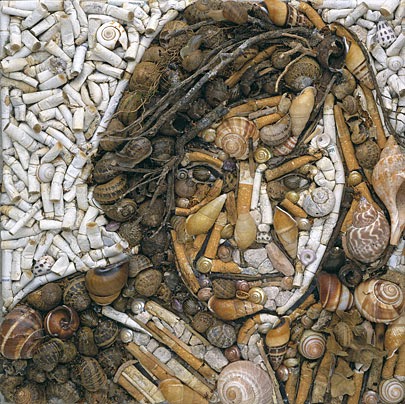
Highsmith loved cats, and she bred about three hundred snails in her garden at home in Suffolk, England. Highsmith once attended a London cocktail party with a “gigantic handbag” that “contained a head of lettuce and a hundred snails” which she said were her “companions for the evening.” wiki

“Patricia Highsmith,” composed of snail shells and cigarette butts, from blog,  “Book Dirt“. Art by Jason Mecier.

Read Full Post »

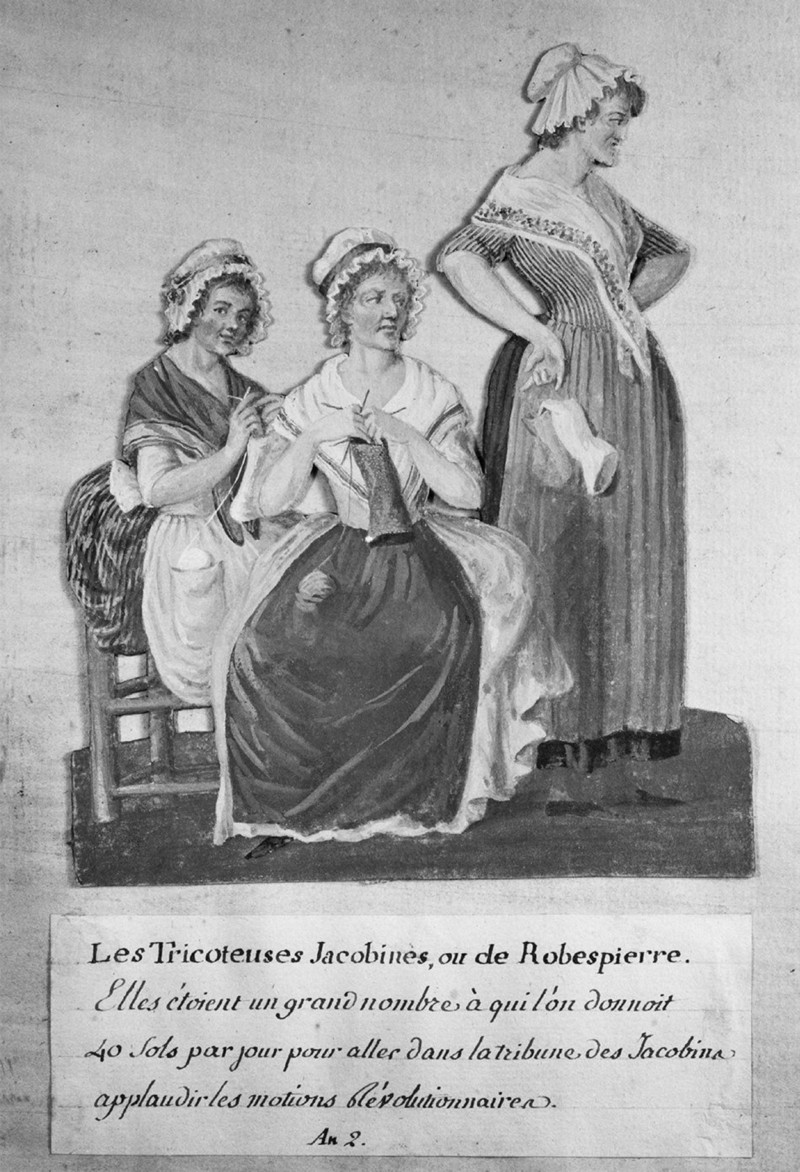
The knitting women of the French Revolution. Pierre-Etienne Lesueur’s Les Tricoteuses Jacobines, 1793. (Wikimedia)

At the start of the French Revolution, the market women of Paris, hungry for bread, marched by the thousands to Versailles to confront King Louis XVI and his government over rising food prices and food shortages. Surprising everyone, their demands were met and, in addition, they convinced the royal family—including Queen Marie Antoinette—to relocate to the French capital city. Working class women had never before demonstrated such political clout. These women were hailed as sisters of the Revolution and were invited to important political events. These “mothers of the revolution,”  or “bonnes citoyennes,” became overnight heroines for the cause of liberty. They came to be known as the knitting women, or tricoteuses  (pronounced trick uh TUZZ).

Over time, though, the tricoteuses grew swollen with power and inflamed by the fury of the Revolution. They became rowdy and blood-thirsty, harassing aristocrats in the street, insulting them and urging the radical sans-culottes, or lower class militants, to carry out dreadful atrocities against them. The tricoteuses were like the Greek furies that punished culprits they thought were guilty by hounding them relentlessly.

The French Revolution lasted ten years. Before it was over, it descended into an all-out savage bloodbath known as the Reign of Terror (1793-1794). In just that one year period, 17,000 French people were executed. Shown here are rabid revolutionaries parading shorn heads on pikes. (wikipedia)

The behavior of the tricoteuses became so dangerous that they became a liability to the more authoritarian revolutionary government. On May 21, 1793, the women were banished from government proceedings. Later that week, they were forbidden from forming any political assembly. The tricoteuses were reduced to hanging around the guillotine.

The Tricoteuses of the Guillotine on the Steps of the Church of Saint-Roch, 16th October 1793. Henri Baron (Pinterest)

They were the ghoulish women who sat and knitted while the public executions took place during the French Revolution (1789-1799). Many knitted liberty caps, their sharp needles clackety-clacking, while head after head fell beneath the blade and into the basket.

A French man is transported to the guillotine to be beheaded. In the upper right hand corner of the picture, the tricoteuses jeer, bellow, hurl accusations at him, and call for his immediate execution. Etching from Harper’s Weekly, August 1881, from a painting by Carl Piloty, “The Girondists.”

Charles Dickens popularized the tricoteuses in The Tale of Two Cities (1859), set in London and Paris before and during the French Revolution and the Reign of Terror. One of the main villains of the novel is Madame Defarge, a tricoteuse, a French Revolution fanatic obsessed with the extermination of real and imagined enemies of the Revolution. She knits and her knitting secretly encodes the names of people to be killed.

The tricoteuse Madame DeFarge (r.) confronts Miss Pross over the whereabouts of the Evrémonde family. Scene from the novel, A Tale of Two Cities, by Charles Dickens, 1859. Image by Fred Barnard, 1870s (wikipedia)


**Read more about the French Revolution and Marie Antoinette here.

Sources:
wiki: "Reign of Terror"
wiki: "tricoteuse"
The Telegraph: "QI: How Knitting was Used as Code in WW2"
Timeline: "Horror Spectators: The Lady Revolutionaries who Calmly Knit During Executions"
Geri Walton: "Tricoteuses: Knitting Women of the Guillotine"


Read Full Post »

Photo Card No.101, Dancer Josephine Baker posing with a cheetah wearing a collar, photograph by Piaz Studios of Paris, Early 1930's. © Victoria and Albert Museum, London

American entertainer Josephine Baker (1906-1975) with Chiquita. ca. early 1930s. Courtesy of Victoria and Albert Museum.

Ernest Hemingway called her “the most sensational woman anyone ever saw.” Pablo Picasso painted her, seeking to capture her alluring beauty, saying she had “legs of paradise.” She was Josephine Baker, the glamorous cabaret star that took Paris by storm during the Jazz Age of the 1920s and 30s. In her signature stage act, she appeared onstage wearing only high heels and a skirt made of bananas. She danced and sang with erotic frenzy and wild abandon. She was often accompanied by her pet cheetah, Chiquita, who wore a diamond collar and often escaped into the orchestra pit, terrifying the musicians and adding to the overall sensation of the moment.

Josephine Baker was the first person of color to become a worldwide entertainer and star in a major motion picture (“ZouZou,” 1934). Although born in St. Louis, Missouri, in 1937, she married a French man and became a French citizen.

josephine-baker1In 1939, France declared war on Nazi Germany for its invasion of Poland. Within nine months, the Nazis invaded France. Baker was recruited by the Deuxiéme Bureau, the French Military Intelligence, as an “honorable correspondent.” She was so well-known and popular that even the Nazis were hesitant to cause her harm. She made the perfect spy. As an entertainer, she had good excuses for traveling, which allowed her to smuggle secret orders and maps written in invisible ink on her musical sheets. On some occasions, Baker would smuggle secret photos of German military installations out of enemy territory by pinning them to her underwear. To operatives in the French Resistance as well as U.S. and British agents, she relayed information on German troop movements she had gleaned from conversations she overheard between officials with whom she mingled following her performances or at embassy and ministry parties. She also exposed French officials working for the Germans.  She hid Jewish refugees and weapons in her 24-room château in the South of France.

Her steadfast work for the French Resistance helped Baker to rise to the rank of lieutenant in the Free French Air Force. After the war, Baker was awarded the Croix de Guerre and the Rosette de la Résistance for her invaluable intelligence work in aid of her adopted country. She was made a Chevalier of the Légion d’honneur by General Charles de Gaulle.

Read more about Josephine Baker here on Lisa’s History Room.

Sources:
http://artdaily.com/news/18219/Josephine-Baker--at-The-National-Portrait-Gallery#.W7Ta2WhKiM8
https://abcnews.go.com/Politics/top-spies-suspect/story?id=15528916
https://www.vogue.com/article/josephine-baker-90th-anniversary-banana-skirt
https://en.wikipedia.org/wiki/Josephine_Baker
Josephine Baker
https://www.bedsider.org/features/450-talented-seductive-courageous-getting-to-know-josephine-baker http://mentalfloss.com/article/23148/5-things-you-didnt-know-about-josephine-baker


Read Full Post »

Roald Dahl (1916-1990), one of the world's best storytellers for children, among illustrations for his books by Quentin Blake. Undated photo.

Roald Dahl (1916-1990), one of the world’s best storytellers for children, among illustrations for his books by Quentin Blake. Undated photo.

British children’s writer Roald Dahl ate chocolates and sweets “pretty much every mealtime,” remembers daughter Ophelia Dahl:

“He…was fascinated by the cross section of the Mars bar – the layers of chocolate, caramel and nougat. He would never just bite it, but always cut it and have a look at it like it was a section of the Earth.” (1)

Mars bar with wrapper

After dinner, whether dining alone or entertaining guests, Dahl would pass around a little red plastic box full of Mars Bars, Milky Ways, Maltesers, Kit Kats and much more.

He knew the history of all the sweets and could tell you exactly when they were invented. 1937 was a big year when Kit Kats (his favorite), Rolos, and Smarties (his dog, Chopper’s favorite) were invented. He wrote a history of chocolate, lecturing schoolchildren to commit such dates to memory such as 1928 when “Cadbury’s Fruit and Nut bar popped up on the scene,” (2) saying,

“Don’t bother with the Kings and Queens of England. All of you should learn these dates instead. Perhaps the Headmistress will see from now on that it becomes part of the major teaching in this school.” (3)

chocolate ad

Roald Dahl as a teenager at Repton, UK. Undated photo.

Roald Dahl as a teenager at Repton, UK. Undated photo.

According to Dahl, the Golden Years of Chocolate were 1930-1937. In 1930, Roald Dahl was 14 years old. He was a student at Repton, a prestigious boys’ boarding school in England. It was a harsh environment: those in authority were more interested in controlling than educating the students. In Boy: Tales of Childhood, Dahl writes :

“By now, I am sure you will be wondering why I lay so much emphasis upon school beatings….The answer is that I cannot help it. All through my school life I was appalled by the fact that masters and senior boys were allowed literally to wound other boys, and sometimes quite severely. I couldn’t get over it. I never have got over it. It would, of course, be unfair to suggest that all masters were constantly beating the daylights out of all the boys in those days. They weren’t. Only a few did so, but that was quite enough to leave a lasting impression of horror upon me.”


Chocolate with cubesIronically, it was at this difficult period that chocolate became Dahl’s passion. Near Repton was a Cadbury chocolate factory. Every so often, Cadbury would send each schoolboy a sampler box of new chocolates to taste and grade. They were using the students – “the greatest chocolate bar experts in the world” to test out their new inventions.
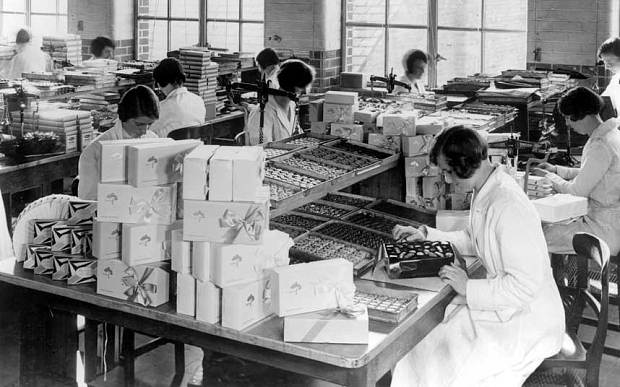
This was when Dahl’s imagination took flight. He pictured factories with inventing rooms with pots of chocolate and fudge and “all sorts of other delicious fillings bubbling away on the stoves.” (4)

Cadbury chocolate factory workers, UK, 1932

Cadbury chocolate factory workers, UK, 1932

“It was lovely dreaming those dreams….[and] when I was looking for a plot for my second book for children, I remembered those little cardboard boxes and the newly-invented chocolates inside them, and I began to write a book called Charlie and the Chocolate Factory.”

Charlie and the Chocolate Factory by Roald Dahl, 1964.

Charlie and the Chocolate Factory by Roald Dahl, 1964.

For the record, Roald Dahl did not like chocolate cake or chocolate ice cream. He said,

“I prefer my chocolate straight.”

(1) The Daily Mail

(2) Dahl, Roald. “The Chocolate Revolution,” Sunday Magazine. September 7, 1997.

(3) The Roald Dahl Museum

(4) Dahl, Roald. Boy: Tales of Childhood. New York: Puffin Books, 1984.

Read Full Post »

Older Posts »