One day, during my stay in New York, I paid a visit to the different public institutions on Long Island, or Rhode Island: I forget which. One of them is a Lunatic Asylum. The building is handsome; and is remarkable for a spacious and elegant staircase. The whole structure is not yet finished, but it is already one of considerable size and extent, and is capable of accommodating a very large number of patients.
I cannot say that I derived much comfort from the inspection of this charity.The different wards might have been cleaner and better ordered; I saw nothing of that salutary system which had impressed me so favourably elsewhere; and everything had a lounging, listless, madhouse air, which was very painful. The moping idiot, cowering down with long dishevelled hair; the gibbering maniac, with his hideous laugh and pointed finger; the vacant eye, the fierce wild face, the gloomy picking of the hands and lips, and munching of the nails: there they were all, without disguise, in naked ugliness and horror. In the dining room, a bare, dull, dreary place, with nothing for the eye to rest on but the empty walls, a woman was locked up alone. She was bent, they told me, on committing suicide. If anything could have strengthened her in her resolution, it would certainly have been the insupportable monotony of such an existence. The terrible crowd with which these halls and galleries were filled, so shocked me, that I abridged my stay within the shortest limits, and declined to see that portion of the building in which the refractory and violent were under closer restraint.
I have no doubt that the gentleman who presided over this establishment at the time I write of, was competent to manage it, and had done all in his power to promote its usefulness: but will lit be believed that the miserable strife of Party feeling is carried even into this sad refuge of afflicted and degraded humanity? Will it be believed that the eyes which are to watch over and control the wanderings of minds on which the most dreadful visitation to which our nature is exposed has fallen, must wear the glasses of some wretched side in Politics? Will it be believed that the governor of such a house as this, is appointed, and deposed, and changed perpetually, as Parties fluctuate and vary, and as their despicable weathercocks are blown this way or that? A hundred times in every week, some new most paltry exhibition of that narrow-minded and injurious Party Spirit, which is the Simoom of America, sickening and blighting everything of wholesome life within its reach, was forced upon my notice; but I never turned my back upon it with feelings of such deep disgust and measureless contempt, as when I crossed the threshold of this madhouse.
Archive for the ‘Charles Dickens’ Category
Nellie Bly: Charles Dickens’ Visit to Blackwell’s Island Asylum 1842 – Part 4
Posted in Charles Dickens, Mental Institutions, Nellie Bly, PEOPLE, tagged biographies of journalists, biographies of women, Blackwell's Island, Charles Dickens, insane asylum, lunatic asylum, mental illness, Nellie Bly on March 14, 2026| 5 Comments »

Charles Dickens Writes a Christmas Story
Posted in Charles Dickens, PEOPLE, tagged A Christmas Carol, child labor england, scrooge on October 17, 2024| Leave a Comment »

Charles Dickens (aged 30). This portrait of Charles Dickens was painted by the American artist Francis Alexander (1800-1880) early in 1842, shortly after Dickens arrived in Boston at the start of his first visit to North America.
After returning from his 1842 visit to America, Charles Dickens (1812-1870) read a disturbing government report on child labor in the United Kingdom titled the Report of the Children’s Employment Commission. He read testimonies of little girls working as seamstresses, six hours a day, six days a week, and rooming above the factory floor. Girls told of dragging coal carts through tight underground passages over eleven-hour days.

A child laborer known as a “hurrier” is shown harnessed to a coal corve. Hurriers were required to drag an empty coal cart down from the shaft bottom along passageways between 24 to 30 inches high and return with a full load from the coal face. One child would be harnessed to the front of the corve, while another would follow behind, pushing the load with their hands and their heads. Most hurriers would have large septic calluses on their legs, hands and knees and many were bald as a result of pushing corves up steep inclines with their heads. Their bodies were often ‘old’ and broken before they reached adulthood.
Factory bosses used children to climb into the insides of industrial machinery to clear a jam, sometimes with fatal consequences. These were not isolated incidents but common. Families were poor and hungry and they took what work they could find, even if it meant sending a child as young as five to work.

Dickens at the Blacking Warehouse, From a drawing by Fred Bernard. Reproduced in “The Dickens Country” by kind permission of Messrs. Chapman and Hall
It is believed that, at the age of twelve, Charles Dickens had been forced to drop out of school, sell his books, and go to work at the dirty, rat-infested Warren’s Blacking Warehouse, a shoe polish factory, near Charing Cross leading from the Strand to the Thames, where Charles typed up and labeled countless pots of shoe-blacking. Dickens’ father was locked up in a debtors’ prison, taking with him his wife and youngest children, and young Charles was expected to support his family at this grinding toil. The pay was meager, only a few shillings a week. Young Dickens worked ten-hour days and saw his family only on Sundays. This he endured for three years, a most painful episode in his young life.
Influenced by his youth and a recent visit to the Field Lane Ragged School for street children, Dickens decided to shine a light on uneven workforce wages by writing a novella. The story came to him over six weeks as he took his nighttime strolls through London, walking fifteen or twenty miles a night, sometimes weeping, sometimes laughing. The result was a masterpiece called A Christmas Carol, published on December 19, 1843, a morality tale pointing out the benefits of compassion and the terrible cost of miserliness. In one scene, men and women, bosses and workers, young and old, dance and drink merrily, feast, and celebrate the joys of Christmas together. The book was a runaway bestseller.
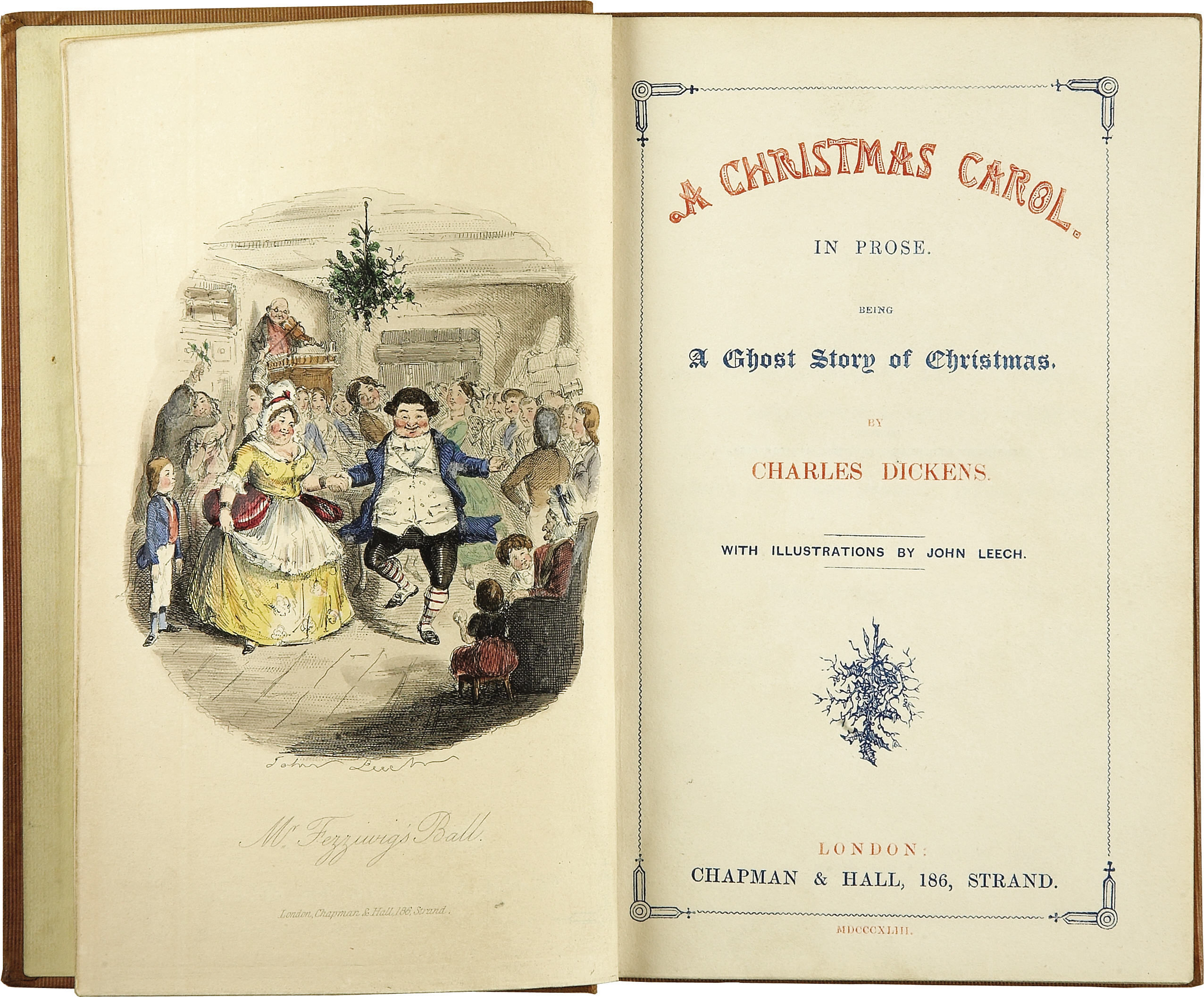
John Leech, Public domain, via Wikimedia Commons
Readers: For more on Charles Dickens, click here.
The Tricoteuses of the French Revolution
Posted in Charles Dickens, EVENTS, French Royalty, King Louis XVI, LITERATURE, EDUCATION, & REFORM, Queen Marie Antoinette, ROYALTY/NOBILITY, The French Revolution, tagged A Tale of Two Cities, Charles Dickens, knitting women, louis xvi, Madame DeFarge, Marie Antoinette, sans-culottes, The French Revolution, the guillotine, the women's march on versailles, tricoteuses, Versailles on November 3, 2018| 7 Comments »
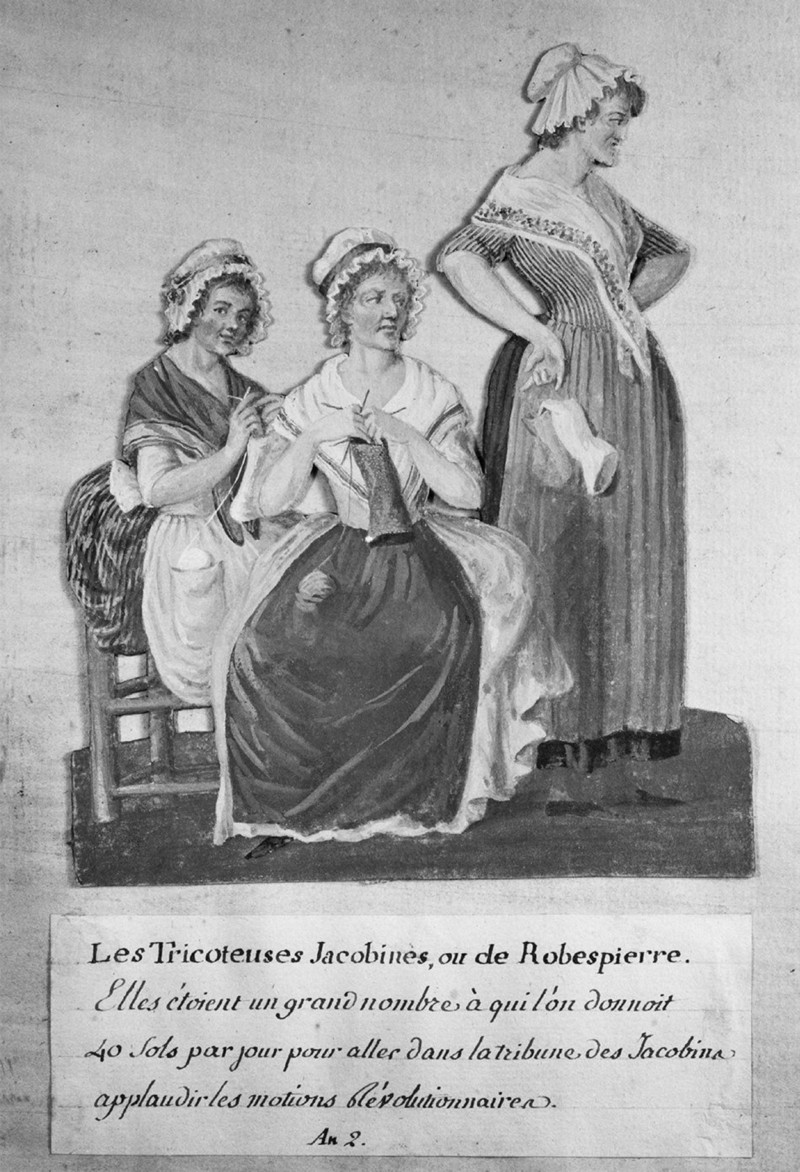
The knitting women of the French Revolution. Pierre-Etienne Lesueur’s Les Tricoteuses Jacobines, 1793. (Wikimedia)
At the start of the French Revolution, the market women of Paris, hungry for bread, marched by the thousands to Versailles to confront King Louis XVI and his government over rising food prices and food shortages. Surprising everyone, their demands were met and, in addition, they convinced the royal family—including Queen Marie Antoinette—to relocate to the French capital city. Working class women had never before demonstrated such political clout. These women were hailed as sisters of the Revolution and were invited to important political events. These “mothers of the revolution,” or “bonnes citoyennes,” became overnight heroines for the cause of liberty. They came to be known as the knitting women, or tricoteuses (pronounced trick uh TUZZ).
Over time, though, the tricoteuses grew swollen with power and inflamed by the fury of the Revolution. They became rowdy and blood-thirsty, harassing aristocrats in the street, insulting them and urging the radical sans-culottes, or lower class militants, to carry out dreadful atrocities against them. The tricoteuses were like the Greek furies that punished culprits they thought were guilty by hounding them relentlessly.

The French Revolution lasted ten years. Before it was over, it descended into an all-out savage bloodbath known as the Reign of Terror (1793-1794). In just that one year period, 17,000 French people were executed. Shown here are rabid revolutionaries parading shorn heads on pikes. (wikipedia)
The behavior of the tricoteuses became so dangerous that they became a liability to the more authoritarian revolutionary government. On May 21, 1793, the women were banished from government proceedings. Later that week, they were forbidden from forming any political assembly. The tricoteuses were reduced to hanging around the guillotine.

The Tricoteuses of the Guillotine on the Steps of the Church of Saint-Roch, 16th October 1793. Henri Baron (Pinterest)
They were the ghoulish women who sat and knitted while the public executions took place during the French Revolution (1789-1799). Many knitted liberty caps, their sharp needles clackety-clacking, while head after head fell beneath the blade and into the basket.

A French man is transported to the guillotine to be beheaded. In the upper right hand corner of the picture, the tricoteuses jeer, bellow, hurl accusations at him, and call for his immediate execution. Etching from Harper’s Weekly, August 1881, from a painting by Carl Piloty, “The Girondists.”
Charles Dickens popularized the tricoteuses in The Tale of Two Cities (1859), set in London and Paris before and during the French Revolution and the Reign of Terror. One of the main villains of the novel is Madame Defarge, a tricoteuse, a French Revolution fanatic obsessed with the extermination of real and imagined enemies of the Revolution. She knits and her knitting secretly encodes the names of people to be killed.

The tricoteuse Madame DeFarge (r.) confronts Miss Pross over the whereabouts of the Evrémonde family. Scene from the novel, A Tale of Two Cities, by Charles Dickens, 1859. Image by Fred Barnard, 1870s (wikipedia)
**Read more about the French Revolution and Marie Antoinette here.

Sources:
wiki: "Reign of Terror"
wiki: "tricoteuse"
The Telegraph: "QI: How Knitting was Used as Code in WW2"
Timeline: "Horror Spectators: The Lady Revolutionaries who Calmly Knit During Executions"
Geri Walton: "Tricoteuses: Knitting Women of the Guillotine"
Charles Dickens: Ragged Factory Boy
Posted in Charles Dickens, PEOPLE, Queen Victoria & Prince Albert, tagged biographies of writers, Charles Dickens, Charles Dickens childhood, John Dickens, Marshalsea Prison, Oliver Twist, Queen Victoria, Victorian child labor, Warren's Blacking Factory on December 19, 2009| 5 Comments »

Charles Dickens at writing desk
By the time Charles Dickens turned ten, his family had lived in six different houses, each poorer than the one before. Although Charles’ father John Dickens was employed as a clerk in the Navy Pay Office, he lived well beyond his means. Plus, the family kept growing; there were eight children in all, which meant many mouths to feed.
Then, in 1822, John Dickens was transferred to London and the family followed. Things went rapidly downhill. John Dickens was soon in debt up to his eyeballs. He informed Charles that he no longer could afford to send him to school. This broke Charles’ heart. The headmaster at his school had already recognized Charles’ special intelligence and imagination and Charles wanted to be a man of letters.
To pay the butcher and the baker, Charles was sent with armloads of books to sell at the pawnshop. Charles was humiliated and heartbroken. Gone were the wonderful hours in his little attic room in Chatham, reading tales of heroes like Robinson Crusoe and Peregrine Pickle. Now he was forced to part with his beloved stories, his only escape from the drudgery of his life. The books were soon followed by all the household goods, sold in an attempt to pay off the family’s debts, and keep John Dickens out of debtors’ prison.

In this 1840 engraving, 'Love Conquered Fear,' fictional character Michael Armstrong, a boy adopted by the mill owner, is shown embracing his brother Edward who is one of the ragged factory boys working amongst the spinning mules. By Michael's foot, a child can be seen crawling out from under a mule, employed to keep the floor under the mules dust and fiber free to minimise risk of fire. These poor boys often suffered horrific injuries when crushed by the moving machinery. From Frances Trollope's ''The Life and Adventures of Michael Armstrong'' London 1840.
Then, in “an evil hour for me,” Charles was offered work at Warren’s Blacking Factory at six shillings a week, or about $1.40. Charles’ parents jumped at the offer. Charles remembers:
“It is wonderful [shocking] to me how I could have been so easily cast away at such an age….My mother and father were quite satisfied. They could hardly have been more so if I had been twenty years of age, distinguished at a grammar-school, and going to Cambridge.”
No one – no neighbors, friends, or family members reached out to save Charles from this terrible fate. So, on Feb. 9, 1824, at the tender age of twelve, he entered the business world to earn wages for the family. From eight in the morning until eight at night, six days a week, Charles worked alongside rough boys in a dark room covering pots of boot polish and gluing on labels. The work conditions were appalling:
“The blacking-warehouse was the last house on the left-hand side of the way, at old Hungerford Stairs. It was a crazy, tumble-down old house, abutting of course on the river, and literally overrun with rats. Its wainscoted rooms, and its rotten floors and staircase, and the old gray rats swarming down in the cellars, and the sound of their squeaking and scuffling coming up the stairs at all times, and the dirt and decay of the place,rise up visibly before me, as if I were there again. The counting-house was on the first floor, looking over the coal-barges and the river.”

- Victorian children are shown working in a cotton mill. At the beginning of British Queen Victoria’s reign (1837), many children worked in factories for cheap wages. Some workers were as young as five. Few citizens questioned the practice of employing children at the time as there were no laws to protect them. The novels of British author Charles Dickens (1812-1870) with their depiction of poverty did much to bring about positive social change and improve the living conditions of the poor.
For more on Victorian child labor, click here.
Readers: For more on Charles Dickens, scroll down the right sidebar: Categories/People/Charles Dickens. Enjoy!
Why Dickens Wrote A Christmas Carol
Posted in Charles Dickens, PEOPLE, tagged A Christmas Carol, A Christmas Carol edited manuscript, biographies of writers, Charles Dickens, Dickensian England, John Leech, Manhattan, Marley's Ghost, Martin Chuzzlewit, Morgan Library and Museum, Nicholas Nickleby, the New York Times, The Pickwick Papers on December 14, 2009| Leave a Comment »

Old Fezziwig's Christmas Eve Ball from "A Christmas Carol" by Charles Dickens (1843)
The Morgan Library and Museum in Manhattan owns the entire handwritten manuscript of A Christmas Carol by Charles Dickens. The 66-page manuscript written in 1843 bears all of Dickens’ edits in his own hand. “He worked on it with loving care, doing much more rewriting than usual.” (1) The original story is written in light blue ink. Edits are in thick, black ink.
One edit is visible on page 12, where Scrooge encounters Marley’s ghost, and chalks up the vision to indigestion. Dickens originally wrote “a spot of mustard” then changed it to read: a “blot of mustard.”
The manuscript is exhibited each holiday season but, alas, only one page is put on view each year, under glass. This year, however, the Morgan has allowed the New York Times to photograph and display the entire handwritten treasure online at
http://www.nytimes.com/interactive/2009/11/30/nyregion/dickens-christmas-carol-pages.html
The Morgan challenges readers to go online and study the manuscript and submit what they think is the most interesting edit in the work. The contestant judged to have submitted the most intriguing edit will be invited as the newspaper’s guest to afternoon tea at the Morgan.
What motivated Charles Dickens to write his classic holiday ghost story?
“At the time A Christmas Carol was written, Dickens feared for his future. He had six children to feed, a large house in London to maintain, and a lavish lifestyle. Christmas was approaching.
Yet Martin Chuzzlewit, the work he was then producing, a few chapters at a time, was not selling as well as earlier installments of The Pickwick Papers or Nicholas Nickleby. Bitterly, he confided to a friend that his bank account was bare….
Conjuring up what Dickens himself described as a “ghost of an idea,”…he got to work. The 6,000 copies printed in time for Christmas sold out. But because he had splurged on hand-colored drawings by John Leech, one of England’s leading illustrators, the project was a financial bust.
Fortunately for Dickens, his quickie book went on to become a classic.” (2)
(1) Stanley, Diane and Vennema, Peter. Charles Dickens: The Man Who Had Great Expectations. New York: Morrow Junior Books, 1993.
(2) “Dickens the Editor To Dickens the Writer: Make it Sell.” The New York Times. A29. December 2, 2009.
Readers: Check out these other related posts:
“Grip the Raven” about Dickens’ pet raven
“Nellie Bly: Charles Dickens’ Visit to Blackwell Island Asylum 1842”
Dickens: Marley’s Ghost
Posted in Charles Dickens, PEOPLE, tagged A Christmas Carol, Arthur Rackham illustrations, chain forged in life, Charles Dickens, John Leech illustrations, Marley's Ghost on December 9, 2009| Leave a Comment »

The ghost of Jacob Marley visits Ebenezer Scrooge in Charles Dickens' A Christmas Carol (1843); Illustration by Arthur Rackham (1915)
“‘Mercy! [Scrooge] said. ‘Dreadful apparition, why do you trouble me?’
“Man of the worldly mind!’ replied the Ghost, ‘do you believe in me or not?’
‘I do,’ said Scrooge; ‘I must. But why do spirits walk the earth, and why do they come to me?’
‘It is required of every man,’ the Ghost returned, ‘that the spirit within him should walk abroad among his fellow-men, and travel far and wide; and, if that spirit goes not forth in life, it is condemned to do so after death. It is doomed to wander through the world – oh, woe is me! – and witness what it cannot share, but might have shared on earth, and turned to happiness!’
Marley's Ghost by John Leech (1843) from A Christmas Carol by Charles Dickens (1943)
Again the spectre raised a cry, and shook its chain and wrung its shadowy hands.
‘You are fettered,’ said Scrooge, trembling. ‘Tell me why?’
‘I wear the chain I forged in life,’ replied the Ghost. ‘I made it link by link, and yard by yard; I girded it on of my own free will, and of my own free will I wore it. Is its pattern strange to you?’
Scrooge trembled more and more.
‘Or would you know,’ pursued the Ghost, ‘the weight and length of the strong coil you bear yourself? It was full as heavy and as long as this seven Christmas Eves ago. You have labored on it since. It is a ponderous chain!'”

Grip the Raven
Posted in Charles Dickens, Edgar Allan Poe, PEOPLE, tagged Barnaby Rudge, Charles Dickens, Daniel Maclise, Edgar Allan Poe, gothic literature, Grip the Raven, Literature, pet raven, Poe Bicentennial, Poetry, stuffed animals, The Free Library in Philadelphia, The Raven on February 17, 2009| 10 Comments »

The Eldest Children of Charles Dickens with Their Pet Raven "Grip" by Daniel Maclise, 1841
In yesterday’s post , I mentioned Grip the Raven, author Charles Dickens’ pet bird that was the inspiration for Edgar Allan Poe’s poem, “The Raven.” Dickens’ children loved the bird Grip although he did bite their ankles. At his children’s request, Dickens included Grip as a character in one of his books, Barnaby Rudge (1841). Dickens had three pet ravens, all named Grip. Grip I died in 1841, possibly because he ate lead chips scraped off a wall being repainted at the Dickens home. Dickens had the bird preserved and mounted in a glass case for display in his study. After Dickens’ death, a Poe collector acquired Grip I and donated him to the Free Library of Philadelphia where it remains today.
Dickens was saddened by Grip’s death. On March 12, 1841, he wrote the following letter to his friend, Daniel Maclise, who provided illustrations for his books and portraits of Dickens and his family, including the one on the left here featuring the eldest four of Dickens’ nine children: Charley, Mamie, Katey, and Walter. Dickens wrote:
Mr. Dear Maclise,
You will be greatly shocked and grieved to hear that the Raven is no more… On the clock striking twelve he appeared slightly agitated, but he soon recovered, walked twice or thrice along the coach-house, stopped to bark, staggered, exclaimed “Halloa old girl!” (his favorite expression) and died. The children seem rather glad of it. He bit their ankles but that was play…”
You might well ask why Grip the Raven is part of an Edgar Allan Poe Collection in Philadelphia. Toward the end of his life, Poe was a paid literary critic. In this role, he reviewed Dickens’ Barnaby Rudge, in which Grip the Raven plays a part. When Grip makes his first noise in the book, one of the characters says, “What was that — tapping at the door?” The answer is “‘Tis someone knocking softly at the shutter.” Poe’s criticism of Barnaby Rudge was that, although he liked the book overall, he felt that the raven’s “croaking might have been prophetically heard in the course of the drama.”
Four years later, Poe published his most famous work, the poem “The Raven,” which gave the raven a more central role. It features a tapping and talking raven who flies into a man’s room and perches on a bust of Pallas Athena. Dickens’ raven could speak many words and had many comic turns, including the popping of a champagne cork, but Poe emphasized the bird’s darker “devil-bird”qualities. His bird spoke only one word, “Nevermore.” Poe’s raven may have represented a messenger from hell or the after-life, mirroring the gloom and foreshadowing the doom of the troubled narrator who misses his beloved Lenore.
The Ravenverse 1
Once upon a midnight dreary, while I pondered, weak and weary,
Over many a quaint and curious volume of forgotten lore,
While I nodded, nearly napping, suddenly there came a tapping,
As of some one gently rapping, rapping at my chamber door.
“‘Tis some visitor,” I muttered, “tapping at my chamber door-
Only this, and nothing more….”verse 3
Presently my soul grew stronger; hesitating then no longer,
“Sir,” said I, “or Madam, truly your forgiveness I implore;
But the fact is I was napping, and so gently you came rapping,
And so faintly you came tapping, tapping at my chamber door,
That I scarce was sure I heard you”- here I opened wide the door;-
Darkness there, and nothing more.verse 4
Open here I flung the shutter, when, with many a flirt and flutter,
In there stepped a stately Raven of the saintly days of yore;
Not the least obeisance made he; not a minute stopped or stayed he;
But, with mienof lord or lady, perched above my chamber door-
Perched upon a bust of Pallas just above my chamber door-
Perched, and sat, and nothing more.1884 Illustration from "The Raven" by Gustave Dore
verse 5Then this ebony bird beguiling my sad fancy into smiling,
By the grave and stern decorum of the countenance it wore.
“Though thy crest be shorn and shaven, thou,” I said, “art sure no craven,
Ghastly grim and ancient Raven wandering from the Nightly shore-
Tell me what thy lordly name is on the Night’s Plutonian shore!”
Quoth the Raven, “Nevermore.”Edgar Allan Poe1845


Blog Stats
- 9,882,994 hits
Welcome!
"There is properly no history, only biography." Ralph Waldo Emerson-
Recent Posts
- Mama Remembers World War II April 1, 2026
- Nellie Bly: Just Have Her Committed – Part 7 March 29, 2026
- Nellie Bly and Rosemary Kennedy – Part 6 March 24, 2026
-
Josephine Baker

Frida Kahlo

Jackie Kennedy Onassis

Jackie Kennedy
The Kennedys

Abraham and Mary Todd Lincoln

Queen Victoria
Princess Diana
Princess Margaret

Audrey Hepburn

The Romanovs

Catherine, Princess of Wales

The Duke and Duchess of Windsor

-

New book available online at Amazon, Barnes and Noble, and any sites served by Ingram Distributors. see home page for early reviews. Princess Grace (Kelly)

Restless Corpses

The Beatles

Elizabeth Taylor & Richard Burton

Bob Mackie Designs

Elvis Presley

Categories
- EVENTS
- PEOPLE
- ART, PHOTOGRAPHY, FASHION, & DESIGN
- alexander calder
- Amelia Jenks Bloomer
- Andy Warhol
- Annie Leibovitz
- Anthony Armstrong-Jones
- Bob Mackie
- Buckminster Fuller
- Cecil Beaton
- Charles Dana Gibson
- Claude Monet & Camille Doncieux
- Coco Chanel
- Diana Vreeland
- Diego Rivera
- Dina Vierny, muse
- Edith Head
- Elsa Schiaparelli
- Frida Kahlo
- Isamu Noguchi
- John Singer Sargent
- Nickolas Muray
- Oleg Cassini
- Pablo Picasso
- Phillipe Halsman
- Pierre-Auguste Renoir
- Richard Avedon
- Salvador Dali
- Stanley Tretick
- the Bertha
- EXPLORATION & PIONEERING
- LITERATURE, EDUCATION, & REFORM
- Agatha Christie
- Annie Sullivan
- Arthur Conan Doyle
- Barbara Cartland
- Charles Dickens
- Claire Boothe Luce
- Dr. Martin Luther King
- Edgar Allan Poe
- Ernest Hemingway
- F. Scott Fitzgerald
- Frederick Douglass
- Gertrude Stein
- Harriet Beecher Stowe
- Helen Keller
- Julia Ward Howe
- Langston Hughes
- Mark Twain
- Maya Angelou
- Nellie Bly
- Patricia Highsmith
- Roald Dahl
- Robert Louis Stevenson
- Sojourner Truth
- Walt Whitman
- William Shakespeare
- Zelda Fitzgerald
- MEDICINE
- MUSIC & DANCE
- Amy Winehouse
- Beatles, the
- Bob Dylan
- Carly Simon
- Cat Stevens
- Eddie Fisher
- Elvis
- Frank Sinatra
- George Balanchine
- Gordon Waller (Peter & Gordon)
- Isadora Duncan
- James Brown
- James Taylor
- Josephine Baker
- Julia Ward Howe
- Kris Kristofferson
- LInda Ronstadt
- Mamas and the Papas, the
- Margot Fonteyn
- Michael Jackson
- Mick Jagger
- Miley Cyrus
- Ninette de Valois
- Sadler's Wells Ballet
- Sonny & Cher
- Tanaquil Le Clercq
- Whitney Houston
- Yoko Ono
- POLITICS & GOV'T
- Abraham and Mary Todd Lincoln
- Adolf Hitler
- Allan Pinkerton
- Amelia Jenks Bloomer
- Anne Frank
- Arnold Schwarzenegger and Maria Shriver
- Asia Booth Clarke
- Barack and Michelle Obama
- Benjamin Franklin
- Boston Corbett
- Carla Bruni & Nicolas Sarkozy
- Charles DeGaulle
- Clara Barton
- Clara Harris
- Corazon Aquino
- Corrie Ten Boom
- Diet Eman
- Douglas MacArthur
- Dr. Martin Luther King Jr.
- Dr. Mary E. Walker
- Elizabeth Cady Stanton
- Elizabeth Smith Miller
- Eva Peron
- General George McClellan
- Governor Jerry Brown
- Harriet Lane
- Harriet Tubman
- Imelda and Ferdinand Marcos
- Izola Ware Curry
- Jimmy Carter
- John Warner
- John Wilkes Booth
- Joseph Goebbels
- Julius Streicher
- Kennedys, the
- Lee Harvey Oswald
- Leon Trotsky
- Lucy Lambert Hale
- Lyndon Johnson & Lady Bird
- Major Henry Rathbone
- Mao Zedong
- Margaret Thatcher
- Mayor Jane Byrne
- Mike Dukakis
- Muammar el-Qaddafi
- Nancy Pelosi
- Osama Bin Laden
- Otto von Bismarck
- Patty Hearst
- Ronald Reagan (& Nancy)
- Rosa Parks; Malcolm X
- Teddy Roosevelt
- World War II
- RELIGION
- ROYALTY/NOBILITY
- British Royal Family/Nobles
- Crown Princess Vicky
- Duke and Duchess of Windsor, the
- King George IV
- King George V
- King George VI
- Marchioness of Milford Haven
- Prince Charles of Wales and Camilla, Duchess of Cornwall
- Prince Philip, Duke of Edinburgh
- Prince William & Catherine, Duke & Duchess of Cambridge
- Princess Diana
- Princess Margaret
- Queen Alexandra & King Edward VII
- Queen Elizabeth II
- Queen Elizabeth the Queen Mum
- Queen Mary (of Teck)
- Queen Victoria & Prince Albert
- Sarah, the Duchess of York (Fergie)
- Victoria
- Dutch Royal Family
- French Royalty
- German Royal Family
- Greek Royal Family
- Saudi Arabia Royal Family
- The Grimaldis of Monaco
- The Romanovs of Russia
- British Royal Family/Nobles
- SPORTS
- STAGE & SCREEN
- Annie Oakley
- Audrey Hepburn
- Brigitte Helm
- Carol Burnett
- Carole Lombard
- Cary Grant
- Cher
- Clara Bow
- Clark Gable
- Claudette Colbert
- Doris Day
- Dorothy Hale
- Edward G. Robinson
- Edwin Booth
- Elizabeth Taylor
- Gene Hackman
- Gene Tierney
- General Tom Thumb
- Grace Kelly
- Howard Hughes
- Humphrey Bogart
- James Dean
- Jean Harlow
- Julia Pastrana
- Katharine Hepburn
- Lucille Ball
- Lucille Mulhall
- Marcel Marceau
- Marilyn Monroe
- Marlon Brando
- Montgomery Clift
- Natalie Wood
- Oprah Winfrey
- P.T. Barnum
- Paul Newman
- Richard Burton
- Rita Hayworth
- Robert Redford
- Roy Rogers & Dale Evans
- Shirley Temple
- Sue Mengers
- Tom Cruise
- Veronica Lake
- Warren Beatty
- William Holden
- ART, PHOTOGRAPHY, FASHION, & DESIGN
- TOPICS
Goodreads
-
-

Buy it!


 Lisa's History Room