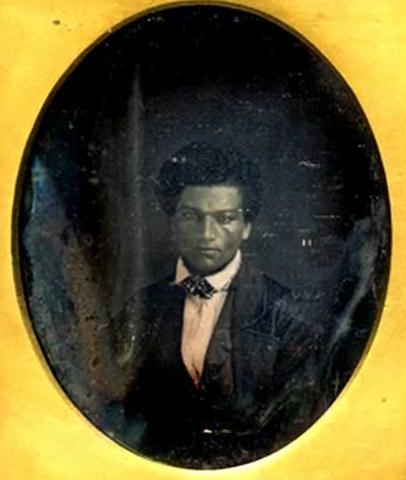
The American abolitionist, Frederick Douglass, in a rare photo taken c. 1840, around the time he became a runaway slave.
Frederick Douglass (1817-1895)
The following is an excerpt from the Narrative of the Life of Frederick Douglass, an American Slave (1845), which includes recollections of Douglass’ experiences on a Maryland plantation:
“To describe the wealth of Colonel Lloyd [his master] would be almost equal to describing the riches of Job. He kept from 10-15 house servants. He was said to own a thousand slaves, and I think this estimate quite within the truth. Colonel Lloyd owned so many that he did not know them when he saw them; nor did all the slaves of the out-farms know him. It is reported of him, that, while riding along the road one day, he met a colored man, and addressed him in the usual manner of speaking to colored people on the public highways of the South:
‘Well, boy, whom do you belong to?’
“To Colonel Lloyd,’ replied the slave.
‘Well, does the colonel treat you well?’
‘No, sir,’ was the ready reply.
‘What, does he work you too hard?’
‘Yes, sir.’
‘Well, don’t [sic] he give you enough to eat?’
‘Yes, sir, he gives me enough, such as it is.’
The colonel, after ascertaining where the slave belonged, rode on; the man also went on about his business, not dreaming that he had been conversing with his master. He thought, said, and heard nothing more of the matter, until two or three weeks afterwards. The poor man was then informed by his overseer that, for having found fault with his master, he was now to be sold to a Georgia trader….
It is partly in consequence of such facts that slaves, when inquired of as to their condition and the character of their masters, almost universally say they are contented, and that their masters are kind. The slaveholders have been known to send in spies among their slaves, to ascertain their views and feelings in regard to their condition. The frequency of this has had the effect to establish among the slaves the maxim that a still tongue makes a wise head.”
Where is the Jim Crow section
On this merry-go-round,
Mister, cause I want to ride?
Down South where I come from
White and colored
Can’t sit side by side.
Down South on the train
There’s a Jim Crow car.
On the bus we’re put in the back–
But there ain’t no back
To a merry-go-round!
Where’s the horse
For a kid that’s black?
It wasn’t like young Langston Hughes to get into trouble. But, in 1914, when his seventh-grade teacher moved him and the other African-American students into a separate row in class, he got angry. So he put cards that read “JIM CROW ROW” on the black kids’ desks. He was soon expelled. But a protest rose up among the parents and Langston was eventually allowed to return to school. He had fought back and won a victory: separate seating in his school was no longer permitted.
Although Langston Hughes attended school with whites in Kansas, he wasn't allowed to play sports of join clubs. Signs throughout town read: "No Coloreds Allowed" and facilities for whites and blacks were separate. This anti-black caste system was known as Jim Crow Laws and operated mostly in the Southern United States between 1877 and the mid-1960s. It was used to keep blacks as second-class citizens.
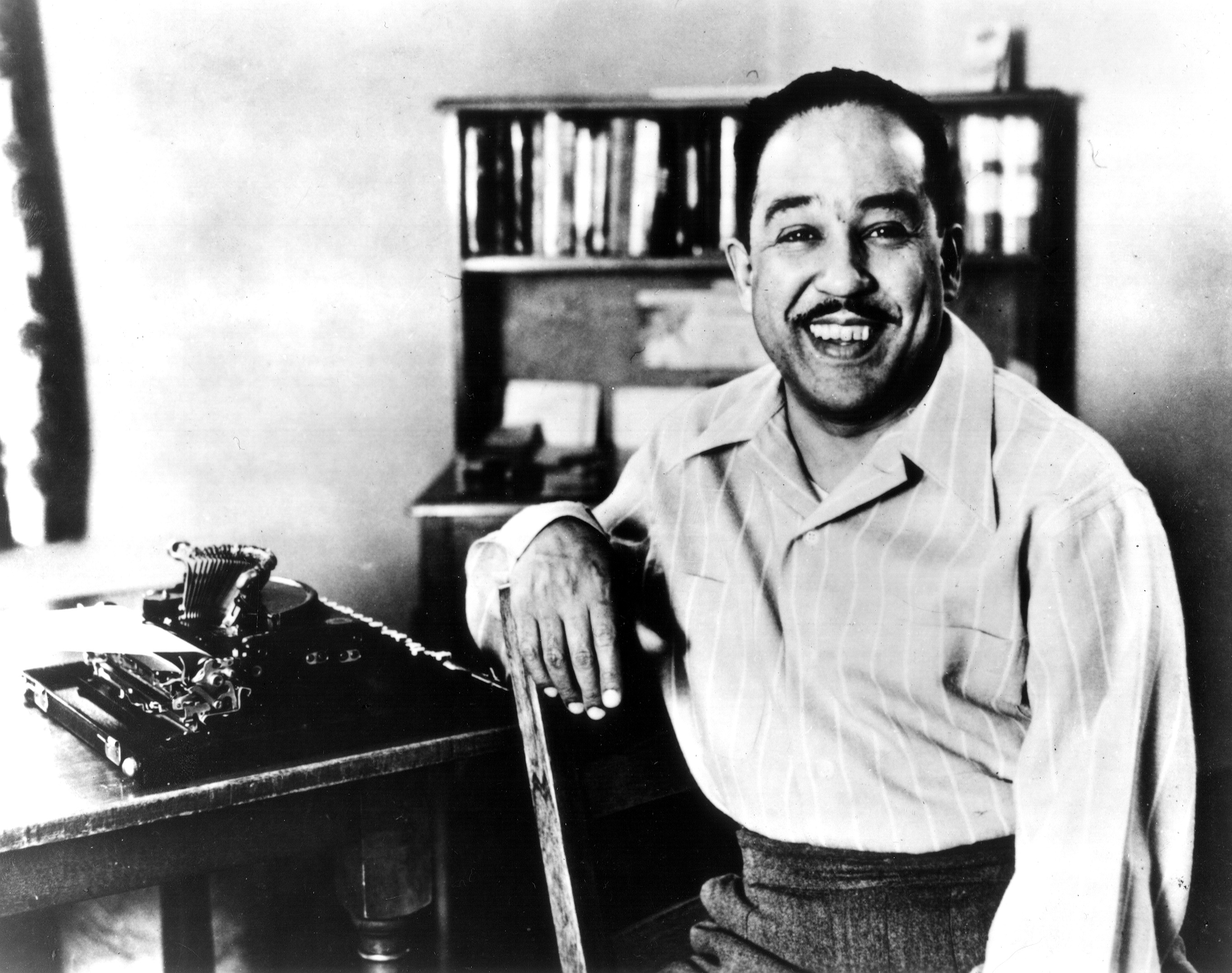
Langston Hughes (1902-1967) was an African-American poet, novelist, columnist, short story writer, and playwright. His exceptional literary talents were recognized early in life; he was elected class poet at his Lincoln, Illinois elementary school.
Langston Hughes scoffed at the “honor” of the position:
“I was a victim of a stereotype. There were only two of us Negro kids in the whole class and our English teacher was always stressing the importance of rhythm in poetry. Well, everyone knows — except us — that all Negroes have rhythm, so they elected me as class poet.”
Langston is best associated with the American literary movement known as the Harlem Renaissance (1920s-1930s) and was one of the pioneers of a new literary form, jazz poetry.
Langston wrote his first jazz poem when he was in high school in Cleveland: “When Sue Wears Red.” Here it is:
By the time Charles Dickens turned ten, his family had lived in six different houses, each poorer than the one before. Although Charles’ father John Dickens was employed as a clerk in the Navy Pay Office, he lived well beyond his means. Plus, the family kept growing; there were eight children in all, which meant many mouths to feed.
Then, in 1822, John Dickens was transferred to London and the family followed. Things went rapidly downhill. John Dickens was soon in debt up to his eyeballs. He informed Charles that he no longer could afford to send him to school. This broke Charles’ heart. The headmaster at his school had already recognized Charles’ special intelligence and imagination and Charles wanted to be a man of letters.
To pay the butcher and the baker, Charles was sent with armloads of books to sell at the pawnshop. Charles was humiliated and heartbroken. Gone were the wonderful hours in his little attic room in Chatham, reading tales of heroes like Robinson Crusoe and Peregrine Pickle. Now he was forced to part with his beloved stories, his only escape from the drudgery of his life. The books were soon followed by all the household goods, sold in an attempt to pay off the family’s debts, and keep John Dickens out of debtors’ prison.
In this 1840 engraving, 'Love Conquered Fear,' fictional character Michael Armstrong, a boy adopted by the mill owner, is shown embracing his brother Edward who is one of the ragged factory boys working amongst the spinning mules. By Michael's foot, a child can be seen crawling out from under a mule, employed to keep the floor under the mules dust and fiber free to minimise risk of fire. These poor boys often suffered horrific injuries when crushed by the moving machinery. From Frances Trollope's ''The Life and Adventures of Michael Armstrong'' London 1840.
“It is wonderful [shocking] to me how I could have been so easily cast away at such an age….My mother and father were quite satisfied. They could hardly have been more so if I had been twenty years of age, distinguished at a grammar-school, and going to Cambridge.”
No one – no neighbors, friends, or family members reached out to save Charles from this terrible fate. So, on Feb. 9, 1824, at the tender age of twelve, he entered the business world to earn wages for the family. From eight in the morning until eight at night, six days a week, Charles worked alongside rough boys in a dark room covering pots of boot polish and gluing on labels. The work conditions were appalling:
“The blacking-warehouse was the last house on the left-hand side of the way, at old Hungerford Stairs. It was a crazy, tumble-down old house, abutting of course on the river, and literally overrun with rats. Its wainscoted rooms, and its rotten floors and staircase, and the old gray rats swarming down in the cellars, and the sound of their squeaking and scuffling coming up the stairs at all times, and the dirt and decay of the place,rise up visibly before me, as if I were there again. The counting-house was on the first floor, looking over the coal-barges and the river.”
Victorian children are shown working in a cotton mill. At the beginning of British Queen Victoria’s reign (1837), many children worked in factories for cheap wages. Some workers were as young as five. Few citizens questioned the practice of employing children at the time as there were no laws to protect them. The novels of British author Charles Dickens (1812-1870) with their depiction of poverty did much to bring about positive social change and improve the living conditions of the poor.
Then, two weeks later, John Dickens was arrested and thrown into Marshalsea Prison, where he had to stay until his debts were paid. Charles’ mother and his seven siblings were allowed to live there with him, everyone living in one room, except, alas, Charles. The blacking factory was too far from the prison for Charles to get back before the gates were shut at night. Charles was sent to live in a cheap boarding house. After work he wandered the dark streets of the big city, utterly alone, totally miserable, shabbily dressed, anticipating a dinner of bread and cheese in an empty room.
Those days were so crushingly painful for Charles that, years later, when he was a grown man with a family of his own, he could not walk those same streets without being reduced to tears. As a writer, Dickens filled his books with people and places from those bitter days, offering a social commentary that improved the lives of the poor. The novel Oliver Twist (1839), for example, shocked readers with its depiction of poverty and crime in Jacob’s Island, resulting in an actual clearing of the slum.
Old Fezziwig's Christmas Eve Ball from "A Christmas Carol" by Charles Dickens (1843)
The Morgan Library and Museum in Manhattan owns the entire handwritten manuscript of A Christmas Carol by Charles Dickens. The 66-page manuscript written in 1843 bears all of Dickens’ edits in his own hand. “He worked on it with loving care, doing much more rewriting than usual.” (1) The original story is written in light blue ink. Edits are in thick, black ink.
One edit is visible on page 12, where Scrooge encounters Marley’s ghost, and chalks up the vision to indigestion. Dickens originally wrote “a spot of mustard” then changed it to read: a “blot of mustard.”
The manuscript is exhibited each holiday season but, alas, only one page is put on view each year, under glass. This year, however, the Morgan has allowed the New York Times to photograph and display the entire handwritten treasure online at
The Morgan challenges readers to go online and study the manuscript and submit what they think is the most interesting edit in the work. The contestant judged to have submitted the most intriguing edit will be invited as the newspaper’s guest to afternoon tea at the Morgan.
What motivated Charles Dickens to write his classic holiday ghost story?
“At the time A Christmas Carol was written, Dickens feared for his future. He had six children to feed, a large house in London to maintain, and a lavish lifestyle. Christmas was approaching.
Yet Martin Chuzzlewit, the work he was then producing, a few chapters at a time, was not selling as well as earlier installments of The Pickwick Papers or Nicholas Nickleby. Bitterly, he confided to a friend that his bank account was bare….
Conjuring up what Dickens himself described as a “ghost of an idea,”…he got to work. The 6,000 copies printed in time for Christmas sold out. But because he had splurged on hand-colored drawings by John Leech, one of England’s leading illustrators, the project was a financial bust.
Fortunately for Dickens, his quickie book went on to become a classic.” (2)
(1) Stanley, Diane and Vennema, Peter. Charles Dickens: The Man Who Had Great Expectations. New York: Morrow Junior Books, 1993.
(2) “Dickens the Editor To Dickens the Writer: Make it Sell.” The New York Times. A29. December 2, 2009.
The ghost of Jacob Marley visits Ebenezer Scrooge in Charles Dickens' A Christmas Carol (1843); Illustration by Arthur Rackham (1915)
“‘Mercy! [Scrooge] said. ‘Dreadful apparition, why do you trouble me?’
“Man of the worldly mind!’ replied the Ghost, ‘do you believe in me or not?’
‘I do,’ said Scrooge; ‘I must. But why do spirits walk the earth, and why do they come to me?’
‘It is required of every man,’ the Ghost returned, ‘that the spirit within him should walk abroad among his fellow-men, and travel far and wide; and, if that spirit goes not forth in life, it is condemned to do so after death. It is doomed to wander through the world – oh, woe is me! – and witness what it cannot share, but might have shared on earth, and turned to happiness!’
Marley's Ghost by John Leech (1843) from A Christmas Carol by Charles Dickens (1943)
Again the spectre raised a cry, and shook its chain and wrung its shadowy hands.
‘You are fettered,’ said Scrooge, trembling. ‘Tell me why?’
‘I wear the chain I forged in life,’ replied the Ghost. ‘I made it link by link, and yard by yard; I girded it on of my own free will, and of my own free will I wore it. Is its pattern strange to you?’
Scrooge trembled more and more.
‘Or would you know,’ pursued the Ghost, ‘the weight and length of the strong coil you bear yourself? It was full as heavy and as long as this seven Christmas Eves ago. You have labored on it since. It is a ponderous chain!'”
Last night, just before bed, Katie called me outside to look at the moon. I didn’t want to do it; I was tired, but she insisted, so I went. She took me into the backyard and pointed at the corner of the yard, behind the live oak near my bedroom.
“Up there!” she said. “See it?”
Well, I didn’t, but she made me keep looking. She scooted me to the right and had me stand on my toes. I craned my neck to see. Then I finally saw it, a full moon hung low in the sky, just over the roof, stuck in the live oak branches, like an errant volleyball. The moon was more white than yellow, not very big, and veiled in smoky haze. With the live oak branches scratching the moon, cloaked in night mist, it looked like a scene right out of a scary vampire movie . It was spooky. But what intrigued me more was the look that moon looked down and gave me.
Yes, there was a face in the moon – the face of a woman. For just an instant, that moon’s face smiled down on me in a Cheshire Cat kind of way. Then a thin cloud floated across the moon and the face was gone forever.
The Cheshire Cat from Alice in Wonderland. The cat disappeared, little by little, but the smile was the last to go
I am not alone. The poet Robert Louis Stevenson (1850-1894) also saw a woman in the moon.
The Moon
The moon has a face like the clock in the hall;
She shines on thieves on the garden wall,
On streets and fields and harbour quays,
And birdies asleep in the forks of the trees.
The squalling cat and the squeaking mouse,
The howling dog by the door of the house,
The bat that lies in bed at noon,
All love to be out by the light of the moon.
But all of the things that belong to the day
Cuddle to sleep to be out of her way
And flowers and children close their eyes
Till up in the morning the sun shall arise.
from A Child’s Garden of Verses by Robert Louis Stevenson
Romeo wears a mask to disguise himself so he may enter his father's enemy's ball. Romeo is played by Leonard Whiting in Franco Zeffirelli's masterpiece film, "Romeo and Juliet," made in 1968 with Olivia Hussey starring as Juliet.
Yesterday, I cut my finger with a knife. My daughter asked me, “Is it bad, Mom?” I thought of the street fight scene from “Romeo and Juliet” when Mercutio gets wounded. Romeo says to Mercutio, “Courage, man. The hurt cannot be much.”
Read today’s post to discover Mercutio’s famous response.
“Romeo and Juliet” by William Shakespeare, 1595
Our story so far: Sixteen-year-old Romeo Montague and his friends – in disguise – boldly crash a masquerade party at the home of Romeo’s father’s enemies, the Capulets. There Romeo meets and falls in love with an enchanting young lady. We know that it is Juliet, the 13-year-old daughter of Lord Capulet.
Romeo, watching Juliet dance, asks a servant her name:
“Who is that lady who gives richness to the hand of that knight by simply holding it?”
Unbeknownst to Romeo, Tybalt, Juliet’s cousin, hears Romeo’s voice and recognizes it as the son of his sworn enemy, Lord Montague. He swears revenge, although the ruler of the city has forbidden any more bloodshed between the two rival families.
Romeo approaches Juliet and they kiss. Romeo does not know that he was seen by Tybalt. Here is that scene from the 1968 Franco Zeffirelli version of “Romeo and Juliet.”
Several scenes later, the two lovers secretly wed.
Act III, Scene I. A public place…
Meanwhile, Romeo’s two best friends, Benvolio, a good-natured guy, and Mercutio, a sassy, hot-headed fellow, are bored, out walking the streets with nothing to do and missing their lovesick friend, Romeo.
Benvolio urges Mercutio to go inside. He senses that the Capulets also might be out, idly about, and up to no good. Neither Benvolio nor Mercutio know that Tybalt saw Romeo at the Capulet ball and has sworn to kill him but the street fighting between the two families has been a long-standing problem. Benvolio pleads with Mercutio:
“I pray thee, good Mercutio, let’s retire. The day is hot, the Capulets abroad, and if we meet, we shall not [e]scape a brawl, for now, these hot days, is the mad blood stirring.”
An arrogant Mercutio laughs at Benvolio’s suggestion that he is a quarrelsome fellow and foolishly ignores his friend’s warning that trouble lies ahead….
Enter Tybalt and others.
Ben: By my head, here come the Capulets.
Mer: By my heel, I care not.
Tyb: [To his men] Follow me close, for I will speak to them. [To Mercutio and Benvolio] Gentlemen, good den. A word with one of you.
Mer: And but one word with one of us? Couple it with something; make it a word and a blow [a slash of your sword].
Tyb: You shall find me apt enough to that, sir, and you will give me occasion [good reason].
Mer: Could you not take some occasion without giving? [I’m sure you could find a reason without having it given to you].
Tyb: Mercutio, thou consortest [play around] with Romeo.
Mer: Consort? What, dost thou make us minstrels [silly musicians]? And thou make minstrels of us, look to hear nothing but discords [angry sounds]. Here’s my fiddlestick [sword]; here’s that shall make you dance. Zounds, consort! [By God’s wounds, Benvolio, do you hear these insults?]
Ben: We talk here in the public haunt of men. Either withdraw unto some private place and reason coldly of your grievances, or else depart. Here all eyes gaze on us.
Mer: Men’s eyes were made to look, and let them gaze. I will not budge for no man’s pleasure, I.
Enter Romeo who has just married Juliet. No one knows yet. He is now married to a Capulet and thus, unknown to Tybalt, his cousin by marriage.
Tyb: Well, peace be with you, sir. Here comes my man [meaning Romeo].
Mer: But I’ll be hanged, sir, if he wear your livery [uniform]. Marry, [Indeed], go before to field [leave town to fight], he’ll be your follower! Your worship in that sense may call him man.
Tyb: Romeo, the love I bear thee can afford no better term than this: thou art a villain. [villain is the nicest name I can call you, I hate you so.]
Rom: [not wanting to fight] Tybalt,the reason that I have to love thee doth much excuse the appertaining rage to such a greeting. Villain am I none. Therefore farewell. I see thou knowst me not. [as your cousin; you haven’t heard the news.]
Tyb: Boy, this shall not excuse the injuries that thou hast done me; therefore turn and draw.
Rom: I do protest I never injured thee, But love thee better than thou canst devise till thou shalt know the reason of my love; And so, good Capulet, which name I tender as dearly as mine own, be satisfied.
Mercutio is incensed that Romeo returns Tybalt’s insults with loving words, so draws his own sword to defend Romeo.
Mer: O calm, dishonorable, vile submission! Alla stoccata [At the thrust] carries it away. Tybalt, you ratcatcher, will you walk?
Tyb: What wouldst thou have with me?
Mer: Good King of Cats, nothing but one of your nine lives….
Tyb: I am for you. [Draws.]
Rom: Gentle Mercutio, put thy rapier up.
Mer: Come, sir, your passado! [a forward thrust of the sword as the foot steps forward]
They fight.
Rom: Draw, Benvolio; beat down their weapons. Gentleman, for shame! Forbear this outrage! Tybalt, Mercutio, the Prince expressly hath forbid this bandying in Verona streets. Hold, Tybalt! Good Mercutio!
Romeo steps between them. Tybalt, under Romeo’s arm, stabs Mercutio. Tybalt runs away.
Mer: I am hurt. A plague o’ both your houses! [Curse the Capulets and Montagues.] I am sped [done for]! Is he gone and hath nothing?
Ben: What, art thou hurt?
Mer: Ay, ay, a scratch, a scratch. Marry, ’tis enough. Where is my page? Go, villain, fetch a surgeon.
The page exits.
Rom:Courage, man. The hurt cannot be much.
Mer:No, ’tis not so deep as a well, nor so wide as a church door; but ’tis enough, ’twill serve.Ask for me tomorrow, and you shall find me a grave man. I am peppered [mortally wounded], I warrant, for this world. A plague o’ both your houses! …Why the devil came you between us? I was hurt under your arm.
Rom: I thought all for the best.
Mer: Help me into some house, Benvolio, or I shall faint. A plague o’ both your houses! They have made worms’ meat of me. I have it, and soundly, too. Your houses!
Exit, supported by Benvolio. Mercutio dies.
Here is the fight scene from Zeffirelli’s 1968 film, “Romeo and Juliet.” The clip opens with a wet-haired Mercutio challenging Tybalt to a duel. Tybalt wears a red cap and orange vestments.
Readers: For more “Talk Like Shakespeare Today” posts, click here.
Dorothy Hale and Isamu Noguchi at the premiere of “Four Saints in Three Acts,” February 7, 1934, Hartford, Connecticut
In 1934, the socialite and actress Dorothy Hale took a road trip through Connecticut with two old friends, writer Clare Boothe Luce and sculptor Isamu Noguchi. They drove in a special car Noguchi had designed with his drinking buddy, futuristic inventor Buckminster Fuller. The car was called the Dymaxion.
The Dymaxion Car
Buckminster Fuller with his portrait by Isamu Noguchi, 1929, photo by Noguchi
The 20-foot long aluminum-bodied Dymaxion car caused a traffic jam wherever it went. This was between the two world wars when cars were sedans and pick-up trucks. “Bucky” Fuller’s car was shaped like a teardrop and ran on three wheels. It went 90 m.p.h. and was fuel-efficient at 30 m.p.g. The 3-wheeler made a 360-degree turn on a dime. A periscope that came out of the roof gave extra visibility. It seated eleven passengers.
It was the car of the future – for a while. Unfortunately, only three Dymaxion cars were ever produced. Orchestra conductor Leopold Stokowski bought one. Amelia Earhart was interested in investing. Financing was a problem and Fuller was running out of cash.
Aviator Amelia Earhart
Any hope of putting the Dymaxion in full-scale production dried up quickly when the car was involved in a fatal accident at the 1933 Chicago World’s Fair. Another car was blamed for the crash but that didn’t stop the negative publicity for the Dymaxion.
Sadly, only one of the Dymaxions exists today. You can view the restored exterior of the car at the National Automobile Museum in Reno, Nevada. Disappointingly, though, the car windows are painted opaque from the inside to prevent you looking inside. Evidently, the inside was in very bad shape when the car was acquired and little information exists as to its original look in order to guide the museum restoration artists. The rumor is that the car had been used as a chicken coop somewhere in the Midwest before it was discovered, which explains the wrecked state of the interior!
View this youtube video to see the amazing turning radius of the Dymaxion. While you’re viewing, keep a lookout for Amelia Earhart in the back seat.
Olivia Hussey and Leonard Whiting in Zeffirelli's 1968 film, "Romeo and Juliet." The scene is at the Capulets' ball, before Romeo and Juliet know each other's identity.
Juliet: O, Romeo, Romeo! Wherefore art thou Romeo?
is probably the most well-known Shakespeare line of all time – and the most misunderstood. The line is from “Romeo and Juliet,” Act II. Scene II.
To give Juliet’s words some context, let’s start at the beginning. Our play takes place in 16th Century Verona in Northern Italy. It’s evening. Young Juliet Capulet’s parents are giving a fancy dress ball where Juliet meets and kisses the dreamiest guy. But the young man mysteriously slips away from her before she can get his name. Quickly, Juliet pulls her nurse (nanny) aside, points toward the fleeing young man, and asks her nurse:
Juliet: What’s he that follows there, that would not dance?
Nurse: I know not.
Juliet: Go ask his name….
Nurse: His name is Romeo, and a Montague, The only son of your great enemy.
Juliet: My only love, sprung from my only hate!
Juliet despairs that she has fallen in love with a Montague, the son of her father’s sworn enemy. Juliet goes upstairs to her bedroom to undress for bed. Then she walks onto the balcony that overlooks the dark orchard to collect her thoughts.
Olivia Hussey as Juliet in the balcony scene from Zeffirelli's 1968 film, "Romeo and Juliet."
Juliet is distraught that an age-old feud between her family (the Capulets) and Romeo’s (the Montagues) should keep her from having a relationship with Romeo. She wants to know: Why – for what purpose – is he Romeo???? Why is he not named Jack Sprat – anything! – but the name of my father’s enemy’s son? She is not asking where Romeo is.
Juliet:O Romeo, Romeo! Wherefore [why] art thou Romeo? [Why is your name Romeo, the name of my father’s enemy’s son?]
Deny thy father and refuse thy name!
Or, if thou wilt not, be but sworn my love,
And I’ll no longer be a Capulet.
Meanwhile, unbeknownst to fair Juliet talking to herself up on the balcony, Romeo has leapt over the orchard wall and is hiding amongst the trees, spying on Juliet.
Leonard Whiting in Zeffirelli's "Romeo and Juliet." As Romeo, he is hiding in the Capulet orchard, eavesdropping on Juliet on the balcony.
Romeo hears what Juliet is saying and whispers to himself:
Romeo: Shall I hear more, or shall I speak at this?
She does not hear him and continues speaking.
Juliet: ‘Tis but thy name that is my enemy.
Thou art thyself, though not a Montague.
What’s Montague? It is nor hand, nor foot,
Nor arm, nor face, nor any other part
Belonging to a man. O, be some other name!
What’s in a name? That which we call a rose
By any other name would smell as sweet.
So Romeo would, were he not Romeo called,
Retain that dear perfection which he owes
Without that title. Romeo, doff thy name;
And for that name, which is no part of thee,
Take all myself.
Romeo: (speaking out from the orchard) I take thee at thy word.
Call me but love, and I’ll be new baptized;
Henceforth I never will be Romeo.
Click below to see the balcony scene from Zeffirelli’s “Romeo and Juliet.” It won Academy Awards for Best Cinematography and Best Costume Design.
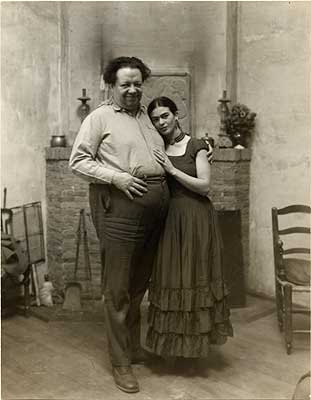
By the summer of 1938, Frida Kahlo was on her way to being discovered as an artist in her own right, rather than only being referred to as the wife of famed Mexican muralist Diego Rivera. That summer, actor and art collector Edward G. Robinson had traveled to Mexico City just to see her paintings and had paid $200 each for four of them. Frida was thrilled. She had sold only a few of her paintings so far and had been content to just give them away. She later wrote of the Robinson sale:
“For me it was such a surprise that I marveled and said, “This way I am going to be able to be free; I’ll be able to travel and do what I want without asking Diego for money.”
She and Diego had become increasingly estranged because of his many illicit extramarital affairs, including one with Frida’s sister Cristina. Frida was heartsick by Diego’s infidelities and retaliated by having multiple affairs of her own, with both men and women. Despite their discord, they remained deeply in love. Frida and Diego made up one of those married couples who could neither stay together nor apart. By the summer of 1939, they would be divorced – only to remarry a year later.
“Self-Portrait Dedicated to Leon Trotsky (Between the Curtains)” by Frida Kahlo, 1937
That November, Frida Kahlo traveled to New York City for her first one-person exhibition of her paintings, held at the Julien Levy Gallery, confident in her new status as celebrated artist. As always, her exotic Zapotec clothing and heavy jewelry created a buzz in the press. Her show was a great success. Time magazine noted that “the flutter of the week in Manhattan was caused by the first exhibition of paintings by famed muralist Diego Rivera’s…wife, Frida Kahlo.” Frida Kahlo’s hand, bedecked with huge rings, adorned a cover of Vogue.
Notables such as artist Georgia O’Keeffe attended the gallery exhibit as did playwright and former editor of the fashion magazine Vanity Fair Clare Boothe Luce.
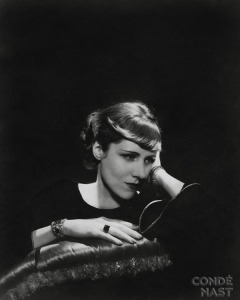
Claire Boothe Brokaw (Luce) (1903-1987) as photographed by Cecil Beaton for the August 1934 issue of Vanity Fair
Luce remembered the occasion well:
“The exhibition was crowded. Frida Kahlo came up to me through the crowd and at once began talking about Dorothy’s suicide [Dorothy Hale was a friend of both Kahlo and Luce’s].…Kahlo wasted no time suggesting that she do a recuerdo of Dorothy. I did not speak enough Spanish to understand what the word recuerdo meant….I thought Kahlo would paint a portrait of Dorothy in the style of her own self-portrait [dedicated to Trotsky][see above], which I bought in Mexico….
Suddenly it came to me that a portrait of Dorothy by a famous painter friend might be something [Dorothy’s] poor mother might like to have. I said so, and Kahlo thought so, too. I asked the price, Kahlo told me, and I said, ‘Go ahead. Send the portrait to me when it is finished. I will then send it on to Dorothy’s mother.’”
Dorothy Hale was a sometime actress, Ziegfeld showgirl, and socialite. Hale’s life had gone downhill seven years earlier after her husband Gardner Hale was killed when his car drove off a 500 foot cliff in Santa Maria, California. Hale’s career as an actress was drying up; she was failing her screen tests. She was in severe financial trouble and living on charity from friends. On October 20, 1938, Hale assembled her close friends for a party at her New York apartment and announced that she was taking a long trip. The farewell party lasted until the wee hours of the morning. Hale stayed up writing good-bye letters to her friends and drinking the last of the vodka. A little before 6 a.m. on the 21st, Hale put on her black velvet dress and pinned on it a corsage of small yellow roses sent to her by the sculptor Isamu Noguchi. She then climbed onto the windowsill of her luxury high-rise apartment suite and jumped to her death.
“The Suicide of Dorothy Hale” by Frida Kahlo, 1938/39
From the encounter between Luce and Kahlo at the gallery exhibit arose one of Frida Kahlo’s most shocking and controversial paintings, “The Suicide of Dorothy Hale” (1938/39). Kahlo painted Dorothy Hale as she jumped, fell, and landed, dead and bloody, on the concrete walk outside her apartment building. Blood-red lettering at the bottom of the retablo details the tragedy in Spanish:
“In New York City on the 21st of October 1938, at 6:00 in the morning, Dorothy Hale committed suicide by throwing herself from a very high window in the Hampshire House. In her memory, this portrait was executed by Frida Kahlo.”
Luce recalls the horror she felt when the painting was delivered to her home and she first laid eyes on it.
“[W]hen I pulled the painting out of the crate…I felt really physically sick. What was I going to do with this gruesome painting of the smashed corpse of my friend, and her blood dripping down all over the frame? I could not return it – across the top of the painting there was an angel waving an unfurled banner which proclaimed in Spanish that this was ‘The Suicide of Dorothy Hale, painted at the request of Clare Boothe Luce, for the mother of Dorothy’. I would not have requested such a gory picture of my worst enemy, much less of my unfortunate friend.”
Luce wanted to have the painting destroyed, but was dissuaded by friends. Instead, she had sculptor and friend Noguchi paint over the angel with the banner and gave the painting to a friend.
Luce couldn’t have known at the time that Kahlo was in a desperate state of mind as she always was when she was afraid of losing Diego. At the time she painted “The Suicide of Dorothy Hale,” Kahlo herself was having repeated thoughts of committing suicide.
READERS: For more posts on Frida Kahlo, click here.
William Shakespeare as we have come to know him in Martin Droeshout's 1623 engraving for the First Folio
Today is William Shakespeare’s 445th birthday. In honor of the occasion, Chicago Mayor Richard Daley wants us all to celebrate by using the Bard’s words, declaring that today is “Talk Like Shakespeare Day.” The official website offers some suggestions as to how you can talk like Shakespeare:
Instead of you, say thou. Instead of y’all, say thee.
Rhymed couplets are all the rage.
Men are Sirrah, ladies are Mistress, and your friends are all called Cousin.
Instead of cursing, try calling your tormenters jackanapes or canker-blossoms or poisonous bunch-back’d toads.
Don’t waste time saying “it,” just use the letter
“t” (’tis, t’will, I’ll do’t).
Use verse for lovers, prose for ruffians, songs for clowns.
When in doubt, add the letters “eth” to the end of verbs (he runneth, he trippeth, he falleth).
To add weight to your opinions, try starting them with methinks, mayhaps, in sooth or wherefore.
When wooing ladies: try comparing her to a summer’s day. If that fails, say “Get thee to a nunnery!”
When wooing lads: try dressing up like a man. If that fails, throw him in the Tower, banish his friends and claim the throne.
This newly-discovered painting, known as the Cobbe, purports to be a portrait of William Shakespeare (reported in March, 2009)
William Shakespeare (1564-1616) also made his mark upon our vocabulary and many common expressions had their origin in his plays. The following is a smattering:
"Ophelia" by John Everett Millais. Hamlet was in love with Ophelia, whose death by drowning may have been a suicide. In the play, Hamlet's mother, Queen Gertrude, laments her death, strewing her grave with flowers, and saying: Sweets to the sweet: farewell!I hoped thou shouldst have been my Hamlet's wife;I thought thy bride-bed to have deck'd, sweet maid,And not have strew'd thy grave.
“Hamlet”
in my mind’s eye
to the manner born
the primrose path
it smells to heaven
there’s the rub
the dog will have his day
method in his madness
neither a borrower nor a lender be
“Othello”
the green-eyed monster
who steals my purse steals trash
a foregone conclusion
wear my heart on my sleeve
Lincoln assassin John Wilkes Booth, Edwin Booth, and Junius Booth, Jr. appear in a production of Shakespeare's "Julius Caesar," 1864. Although Shakespeare did not coin the word assassin, which means hash eater, the first recorded use of the word assassination occurred in his play, "Macbeth." Assassin John Wilkes Booth was a skilled and popular Shakespearean actor.
“Julius Caesar”
it was Greek to me
a dish fit for the gods
masters of their fates
the dogs of war
“1 Henry IV”
give the devil his due
the better part of valor is discretion
“2 Henry IV”
he has eaten me out of house and home
the weaker vessel
“Macbeth”
the milk of human kindness
a sorry sight
“As You Like It”
that was laid on with a trowel
too much of a good thing
“Romeo and Juliet”
what’s in a name?
a fool’s paradise
wild goose chase
“King Lear”
the wheel is come full circle
Leslie Howard as Romeo and Norma Shearer as Juliet in the 1936 film, "Romeo and Juliet." Romeo had been hiding in the garden when Juliet came out on the balcony and began her famous soliloquoy: "Romeo, Romeo, wherefore art thou Romeo?"
“Anthony and Cleopatra”
my salad days
“The Merry Wives of Windsor”
throw cold water on it
“Love’s Labor Lost”
out of the question
play fast and loose
“The Merchant of Venice“
my own flesh and blood
“Richard II”
a spotless reputation
“The Comedy of Errors”
something in the wind
“The Tempest”
we are such stuff as dreams are made on
“Troilus and Cressida”
good riddance
“The Comedy of Errors”
neither rhyme nor reason
“The Merry Wives of Windsor”
what the dickens
Readers: For more “Talk Like Shakespeare Today” posts, click here.












 Lisa's History Room
