Feeds:
Posts
Comments
Lady Diana Spencer reads a romance novel by her favourite author, Barbara Cartland. Diana is probably 16. Photo ca. 1977

Lady Diana Spencer reads a romance novel by her favorite author, Barbara Cartland. Diana is probably 16 years old. Photo ca. 1977

Princess Diana (1961-1997) loved to read romantic fiction. She devoured novels by British author Barbara Cartland, of which there was an endless and steady supply. In her lifetime, Cartland (1901-2000) is credited with having written 723 books. In 1983 alone, she wrote 23 of them. She holds The Guinness Book of World Records for writing the most books in a single year.

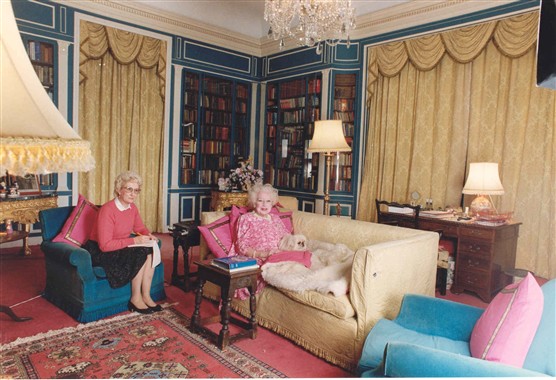
Reclining on a chaise lounge at her home, Cartland dictated her hundreds of stories to her secretary. They both wore pink. Pink was Cartland’s signature color.

British romance novelist Barbara Cartland dictates stories to her secretary while relaxing with one of her Pekinese pets.

British romance novelist Barbara Cartland dictates stories to her secretary Jean Smith while relaxing at home in Camfield Place in Essendon, U.K.

Cartland, self-styled as the “Queen of Romance,” was a celebrity favorite with journalists as she was always holding forth on topics of the day, and sometimes saying outrageous and unprintable things such as speculating on the private parts of the exiled Duke and Duchess of Windsor.

She was well-known for her flamboyant appearance, resembling a fairy queen with cotton candy hair. Her dresses were ultra-girly, adorned with feathers, frills, flounces, fluff, and froth. She was heavily perfumed and glittered with jewels. Her thick make-up was more suited to the stage, and the end result was often clown-like. To achieve a more youthful look, she pulled back her cheeks with the application of sticking plaster (which, sadly, often showed). Her “forests of false eyelashes” were legendary, jet black, and preposterous. Her secret? In 1959, she wrote to a fan that, instead of mascara:

I use Meltonian black shoe cream for my eyelashes.” (1)

Barbara Cartland up close and personal

Barbara Cartland up close

In her writing as well as her appearance, Cartland was an accomplished illusionist. Her books were fairy tales of the most fantastic nature. In them, the young virgin heroine – usually with an exotic name like Vada, Lalitha, Syringa, Fenella, Kamala, or Anthea – always marries Prince Charming. They live happily ever after. They never quarrel, they don’t have affairs, and they certainly don’t divorce.

More than one of Diana's Spencer's acquaintances remarked on her dreamy nature. Photo ca. 1977

More than one of Diana’s Spencer’s acquaintances remarked on her dreamy nature. Photo ca. 1977

Not so in the Spencer household. From her earliest years, Princess Diana’s parents had had a troubled marriage, and her home was a scene of violent quarrels. Diana’s mother, Frances, felt as if her husband Johnnie Spencer, Viscount Spencer, treated her like a brood mare, sending her to fertility experts to explain why she had given birth to three girls in a row. He wanted a male heir to carry on the royal family line. Diana listened behind the door when her parents had a shouting match and her sister turned up the record player volume.

Frances did give birth to a boy, Charles, but the breach in the marriage had become, by then, an unbridgeable chasm.

When Diana was six, her mother left her four children and husband to pursue an affair in London with Peter Shand Kydd, also married. In 1968, she divorced Diana’s father, Johnnie Spencer, who, surprisingly for the times, was granted custody of the children. It is not surprising once you know that a surprise witness at the divorce hearing provided the damning testimony that decided in his favor. Testifying to Johnnie’s superior parenting skills was Frances’s own mother, Lady Fermoy, testifying against her daughter.

Three months after the divorce, Frances married Kydd and they moved to Scotland. With her two older sisters away at boarding school, only Diana and her younger brother Charles remained behind at Park House on the Queen’s royal Sandringham estate. Her father holed up, silently, in his study, abandoned.

The spirit of gaiety was gone from Park House along with Frances’s furniture.” (2)

A Hazard of Hearts (1948) by Barbara Cartland

A Hazard of Hearts (1948) by Barbara Cartland

Cartland’s novels provided young Diana Spencer with an escape into a fantasy dream world. Diana came to believe in the magical rescue power of princes, waiting for her prince to ride up and take her away to her own happy ending. Her life view was shaped by this unreality and it would pitch her into a cold marriage to a man whose heart already belonged to another.

No fairy tale is complete without a wicked stepmother, and, in July, 1976, Diana got one. Her name was Raine, Countess Dartmouth. By this time, the Spencers had moved into the family’s stately home of Althorp, as Diana’s grandfather had died, passing the earldom on to Johnnie. He became the 8th Earl Spencer and Diana became Lady Diana. Raine began an extensive remodeling of Althorp, proving unpopular with Diana and her siblings, who hated their new (wicked) stepmother, calling her “Acid Raine.” Johnnie, however, became very happy after his marriage to Raine.

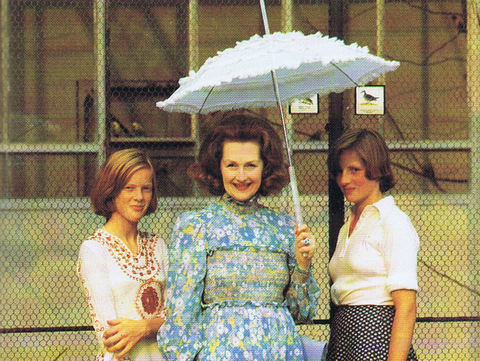
Princess Diana, at right, stands with stepmother, Raine, Countess Spencer, middle, and a friend. Undated photo, ca. 1977

Princess Diana, at right, stands with stepmother, Raine, Countess Spencer, middle, and a friend. Undated photo, ca. 1977

Now that you have seen this photo of Raine (above), you will not find it hard to believe that her mother was Barbara Cartland, Diana’s favorite novelist! That made Cartland Diana’s stepgrandmother. She learned of Diana’s love for her books and sent them to Diana by the cartload.

In 1977, Diana moved into Coleherne Court in South Kensington, London. Her roommates remember that she always got up before the meal was finished to clear the table. She hated dirty dishes. Diana loved to do the washing and ironing of shirts for friends. Her big sister Sarah paid her to clean her apartment. Diana was Cinderella, sweeping the hearth free of ashes.

Diana first revealed her crush on Prince Charles when on a ski holiday with friends in Val Claret in the French Alps. She surprised her friends one evening, saying that she was going to marry Charles AKA Prince Charming. According to those who knew her well, Diana kept herself chaste for her husband on their wedding night. (3)

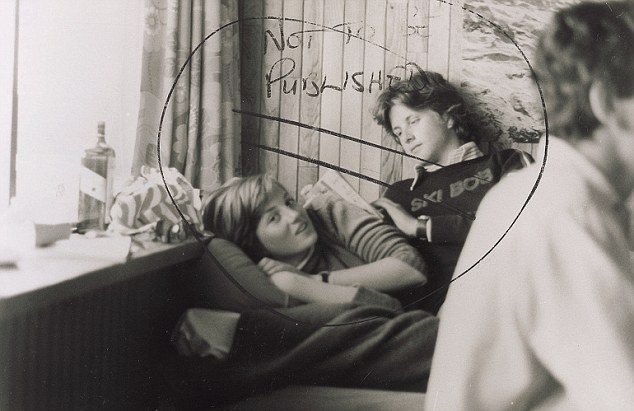
Oxford student Adam Russell sits with Lady Diana Spencer. They are vacationing with a group in the French Alps. Russell is said to have had a ‘galumphing’ crush on Diana. Nothing, however, happened between them. According to royal author Andrew Morton, Mr Russell went travelling for a year, and when he returned to the UK in 1980 and told a friend that he liked Diana, he was told: ‘You’ve only got one rival, the Prince of Wales’. Read more: http://www.dailymail.co.uk/news/article-2257321/Revealed-Mystery-rival-Prince-Charles-pictured-relaxing-Lady-Diana-1979-Old-Etonian-aristocrat-Adam-

Oxford student Adam Russell sits with Lady Diana Spencer. They are vacationing with a group in the French Alps. Russell is said to have had a ‘galumphing’ crush on Diana. Nothing, however, happened between them. According to royal author Andrew Morton, Mr Russell went travelling for a year, and when he returned to the UK in 1980 and told a friend that he liked Diana, he was told: ‘You’ve only got one rival, the Prince of Wales’. Source: The Daily Mail

And Lady Diana did indeed marry Prince Charles on July 29, 1981. Her fairy tale unfolded as she had imagined. Her father gave her away. She wore a confection of a dress with a 25 foot-long train. She rode to St. Paul’s Cathedral in a carriage. She became Her Royal Highness, Diana, Princess of Wales. When Charles became King one day, she would become his queen, and their son, a king, too.

Prince Charles and Princess Diana smile for their wedding photo. July 1981

Prince Charles and Princess Diana smile for their wedding photo. July 1981

As we all know, Diana’s life with Charles did not have a happy ending. Her marriage was miserable, ending in a nasty divorce (1996) which led to her disastrous loneliness and tragic death (1997). Diana’s story was a fractured fairy tale of the worst imaginable kind.

By the way, stepmother Raine attended the royal wedding. However, stepgrandmother Barbara Cartland – the fairy queen who nurtured this fairy tale of Diana’s – did not attend.  Someone – maybe the Queen’s sister, Princess Margaret – considered her an embarrassment and did not want her there. We don’t know if she wasn’t invited OR was offered an invitation but declined because her seat was behind a column! Anyway, not being present at Diana’s wedding proved to be the biggest humiliation of Barbara Cartland’s life.

In 1993, Barbara Cartland remarked:

The only books Diana ever read were mine, and they weren’t terribly good for her.” (2)

In 1996, Cartland had figured out why the marriage had failed:

Of course, you know where it all went wrong. She wouldn’t do oral sex.”

Hell hath no fury like a woman scorned….

For more about Princess Diana, click here.

(1)

(2) Brown, Tina. The Diana Chronicles. New York: Doubleday, 2007.

(3)

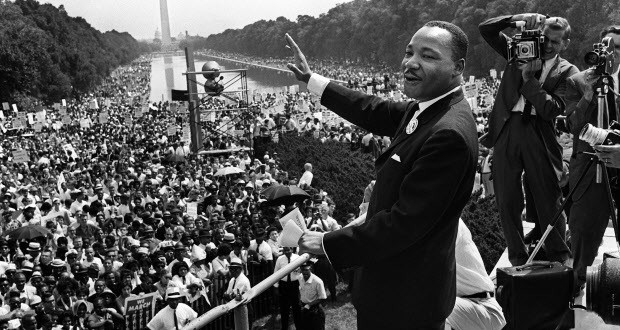
Dr. Martin Luther King, Jr., at the March on Washington, August 28, 1963. Credit:-/AFP/Getty Images

Dr. Martin Luther King, Jr., at the March on Washington, August 28, 1963. Credit:-/AFP/Getty Images

On Aug. 28, 1963,  Dr. Martin Luther King, Jr. stood on the steps of the Lincoln Memorial and delivered his rousing, “I Have a Dream” speech to over 250,000 civil rights supporters gathered for the March on Washington. The speech calls for an end to racism in America. It was considered by many to be the most important speech of the Twentieth Century and helped advance President John F. Kennedy‘s important civil rights legislation then in Congress.

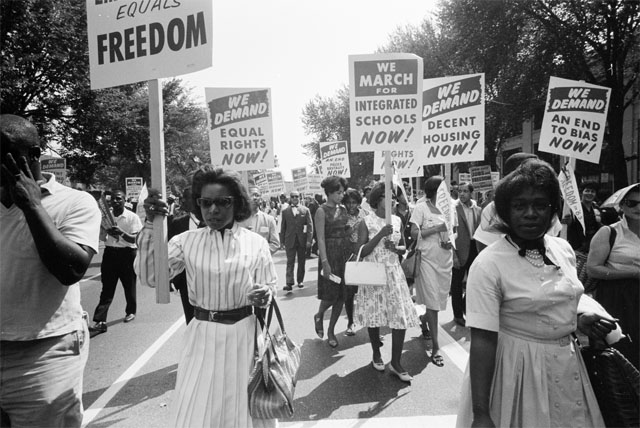
At the March on Washington, August 1963, peaceful African-Americans called for decent jobs with equal pay.

At the March on Washington, August 1963, peaceful African-Americans called for decent jobs with equal pay.

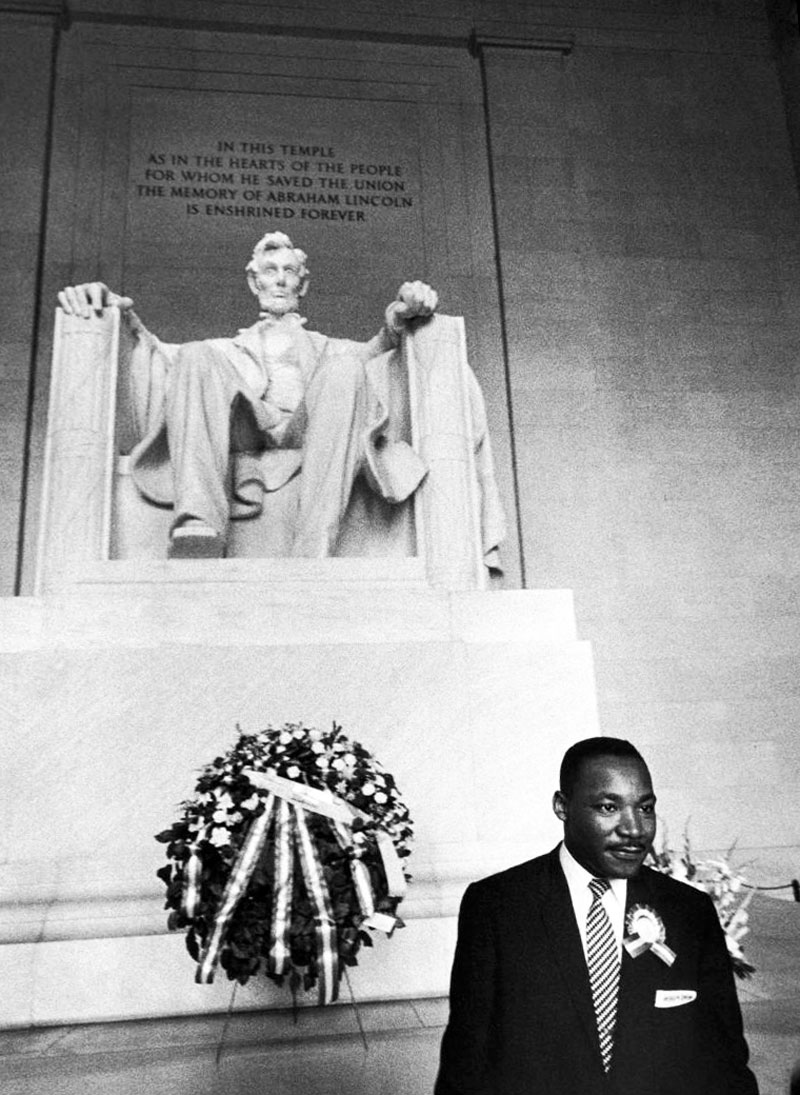
Dr. King timed his March on Washington to coincide with the 100th anniversary of Abraham Lincoln‘s signing of the Emancipation Proclamation which freed millions of American black slaves in 1863.

Dr. Martin Luther King, Jr. stands in front of the statue of President Abraham Lincoln at the Lincoln Memorial, Washington, D.C. ca. 1963

Dr. Martin Luther King, Jr. stands in front of the statue of President Abraham Lincoln at the Lincoln Memorial, Washington, D.C. ca. 1963

His opening lines in his speech evoke the Gettysburg Address by President Lincoln:

Five score years ago, a great American, in whose symbolic shadow we stand today, signed the Emancipation Proclamation. This momentous decree came as a great beacon light of hope to millions of Negro slaves who had been seared in the flames of withering injustice. But one hundred years later, the Negro still is not free. It came as a joyous daybreak to end the long night of captivity.” 

Dr. King asked for justice to be made a reality for all of God’s children.

We can never be satisfied as long as the Negro is the victim of the unspeakable horrors of police brutality. We can never be satisfied, as long as our bodies, heavy with the fatigue of travel, cannot gain lodging in the motels of the highways and the hotels of the cities….

We can never be satisfied as long as our children are stripped of their selfhood and robbed of their dignity by signs stating “For Whites Only”. We cannot be satisfied as long as a Negro in Mississippi cannot vote and a Negro in New York believes he has nothing for which to vote. No, no, we are not satisfied, and we will not be satisfied until justice rolls down like waters and righteousness like a mighty stream. “(1)

He spoke of his dream.

I have a dream that one day this nation will rise up and live out the true meaning of its creed: ‘We hold these truths to be self-evident: that all men are created equal.’


I have a dream that one day on the red hills of Georgia, the sons of former slaves and the sons of former slave owners will be able to sit down together at a table of brotherhood.'”

***

Fast forward to August 28, 2013, the 50th anniversary of Dr. King’s March on Washington and his landmark speech. 

Anderson Cooper of CNN is interviewing African-American writer Maya Angelou (1928-2014). They reflect on the state of Dr. King’s dream. Maya Angelou knew Dr. King and was part of the struggle for civil rights change in this country.

Cooper: Do you believe that the arc of history is moving in the right direction? President Obama, recently, when he was talking about Trayvon Martin, he said that he looks at his daughters and that his daughters’ generation is better than his generation was. Do you believe that?

Angelou: Yes, I do. I know that there was a time when people were lynched with everybody’s agreement – not everybody – but with the “Might’s” agreement. The might was white and white was might and so people were lynched.

I grew up in a village in Arkansas where a man was lynched and the skin of his body – after being lynched and burned – the skin was taken off in skin the size of a postage stamp and given to people as mementoes.

You can’t do that in the United States today. I mean you can lynch people and murder people in many ways but you can’t do it in the city square.

Cooper: Hmm.

Angelou: You see? We are better. Not nearly enough. Not nearly enough. But we come and we have to admit that. Because, Mr. Cooper, if we don’t, young people will say, ‘You mean to tell me, with the lives and deaths of Dr. Martin Luther King and Malcolm X and Rosa Parks and the Kennedys, then there’s no point in me trying, because those people were bigger than life.’ So we have to say, ‘You have come a long way.’

***

President Barack Obama spoke from the Lincoln Memorial steps to honor the half-century anniversary of Dr. Martin Luther King, Jr.’s iconic speech, “I Have a Dream.” August 28, 2013.

Our first African-American president was on hand at the Fiftieth Anniversary of the March on Washington Celebration. Like Dr. King, President Barack Obama is a great orator. In his speech to those gathered at the Lincoln Memorial, he echoed Maya Angelou’s sentiment in regard to the civil rights movement, progress, and where America stands.

To dismiss the magnitude of this progress, to suggest as some sometimes do that little has changed, that dishonors the courage and the sacrifice of those who paid the price to march in those years.”

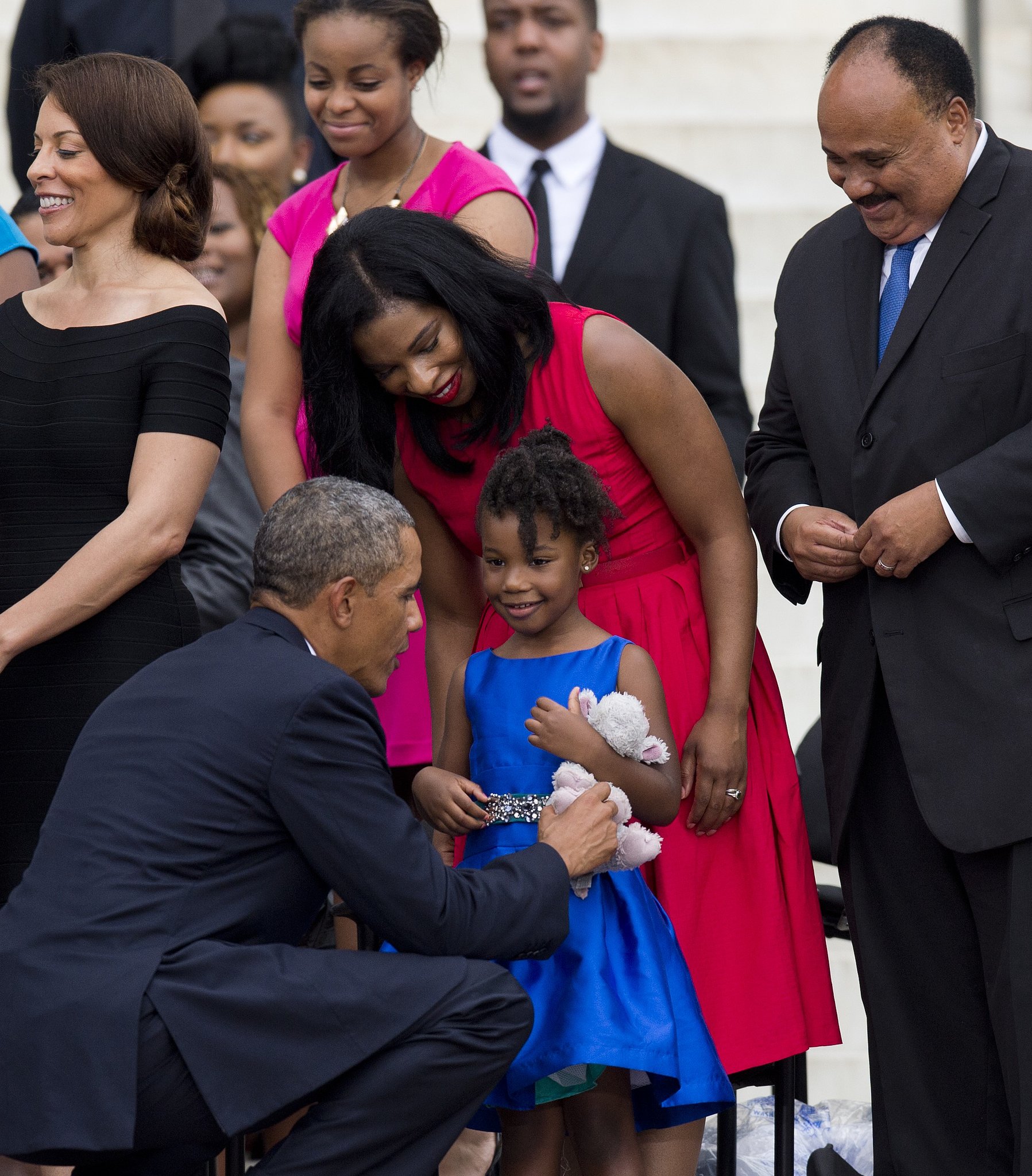
Members of Dr. King’s family, including his then 5-year-old granddaughter, Yolanda King, were present as bells rang at 3 p.m. to mark the historical moment.

President Obama greets Yolanda King, age 5, Dr. Martin Luther King, Jr.'s granddaughter at the 50th Anniversary of the March on Washington. August 28, 2013. Credit; Getty Images

President Obama greets Yolanda King, age 5, Dr. Martin Luther King, Jr.’s granddaughter at the 50th Anniversary of the March on Washington. August 28, 2013. Credit; Getty Images

For more on Maya Angelou, click here.

Maya Angelou (Undated photo)

Maya Angelou (Undated photo)

American writer Maya Angelou (1928-2014) had deep political ties with the Clintons. In 1993, she read her poem, “Pulse of the Morning” at Bill Clinton’s inauguration. Both she and Bill were from Arkansas. In 2008, she supported Hillary Clinton in the Democratic primary race for the U.S. presidency against Barack Obama, a fellow African-American. It was a tough decision.

Maya Angelou campaigns for Democratic Presidential Candidate Hillary Clinton prior to the crucial Pennsylvania Primary, 2008. Even though Ms. Angelou walks with a cane, you can see that she is a towering figure at 6 feet tall.

Maya Angelou campaigns for Democratic Presidential Candidate Hillary Clinton prior to the crucial Pennsylvania Primary, 2008. Even though Ms. Angelou walks with a cane, you can see that she is a towering figure at 6 feet tall.

However, when Hillary dropped out of the race, Maya swiftly endorsed Barack Obama.

When she was asked to introduce Michelle Obama at a rally in North Carolina, she consulted her good friend TV hostess Obama Winfrey:

I knew she had socialized with them. I asked her, ‘What is Mrs. Obama like? What should I expect?’

Oprah said simply and without hesitation, ‘She’s the real deal.'”

The Obamas and Maya Angelou grew very close. She referred to Michelle Obama as one of her “she-roes.”

When she was interviewed followed Obama’s November ’08 victory, Maya was asked by the BBC World Service for her reaction:

My reaction can be described as thrilled – I am thrilling – but in the classic sense of the word. It used to mean having a physical reaction, you know – BRRRR!!!! – like that! (giggle) – where the whole body responds. Well, this is happening. Even my hair is happy!”

When Maya Angelou died this past Wednesday, President Obama called her a “fierce friend.” Obama’s sister, Maya Soetoro-Ng, was named after Angelou.

Maya Angelou receives a Medal of Freedom from President Obama at the White House in Washington in this February 15, 2011 file photo. U.S. author and poet Maya Angelou has died at age 86 in North Carolina.. REUTERS/Larry Downing/Files

Maya Angelou receives a Medal of Freedom from President Obama at the White House in Washington in this February 15, 2011 file photo. REUTERS/Larry Downing/Files


First Lady Michelle Obama and Maya Angelou on stage at BET Honors 2012 at the Warner Theatre on January 14, 2012 in Washington, DC. Photo from Amanda Wills at Mashable

For more on Maya Angelou, click here.


Back in the 1950s, writer Maya Angelou was singing and dancing her way across Europe and America to appear in clubs, movies, and plays.

African-American writer Maya Angelou died this week at age 86. Starting Friday, May 31, 2014, the Schomburg Center for Research in Black Culture in Harlem, New York City, will showcase a collection of her papers, manuscripts and letters. Maya Angelou is no stranger to the Schomburg Center. In 1991, the Schomburg expanded to include a new addition and Ms. Angelou was a guest at the opening.

The Schomburg Center, Harlem, New York.

The Schomburg Center, Harlem, New York.

The 1991 expansion of the Schomburg Center was the Langston Hughes Building. The structure is named after African-American poet Langston Hughes, the leader of the Harlem Renaissance. Maya Angelou met him in California once when he came to hear her sing.

Poets Maya Angelou and Langston Hughes hang out. Undated, prob. ca. 1960s.

Poets Maya Angelou and Langston Hughes hang out. Undated, prob. ca. 1960s.

The Langston Hughes Building contains an auditorium that seats 340 guests. Although impressive, the auditorium is of no interest to us here. It is the lobby that draws our attention.

The lobby is spacious, elegant, and flooded with natural light streaming through its many tall windows. The windows look out onto a garden but the real conversation piece is the floor. Embedded in the terrazzo tile  is a design honoring the poetry of Langston Hughes. “Rivers” was inspired by Hughes’ well-known poem, ” A Negro Speaks of Rivers.” This type of design is called a cosmogram, as it treats mystical themes of nature and the meaning of life. Blue rivers snake through rust-colored clay, evoking the Earth.

The Langston Hughes Building lobby at the Schomburg Center, New York City

The Langston Hughes Building lobby at the Schomburg Center, New York City

The design is pleasing, with its tribal symbols and poetic quotes. Looking closer even, we see that there is a fish shape in the middle. Inside the fish is a quote from the poem.

A quote from "A Negro Speaks of Rivers," by Langston Hughes appears in the cosmogram in the Langston Hughes Building Lobby.

A quote from “A Negro Speaks of Rivers,” by Langston Hughes appears in the cosmogram in the Langston Hughes Building Lobby.

If we had superpowers and could see through the tile of the fish and underneath the floor, we would discover that there is something buried there. It is a vessel, made of metal, and, fittingly, we think later, shaped like a book. It is sealed. If we were to open it, which we won’t (and can’t), we would discover that it contains the cremated ashes of Langston Hughes himself. So the cosmogram, besides being beautiful, is useful. It is a tomb.

So, at the 1991 opening of the Langston Hughes Building, guests filled up the lobby and turned it into a dance floor. Someone cranked up the music and everyone boogied down. And this is how Maya Angelou and others ended up doing the proverbial dance on a friend’s grave.

The Schomburg Center for Research in Black Culture in Harlem observed the 89th birthday of the poet Langston Hughes and the beginning of Black History Month on Thursday night.  Mr. Hughes's ashes were buried beneath the floor of the auditorium, and in an African Custom of ancestral return, the  writers Amiri Baraka and Maya Angelou danced atop them. Published NYT Metro, Saturday, Feb. 22, 1991 CREDIT:  Chester Higgins, Jr/The New York Times

In February 1991, the Schomburg Center for Research in Black Culture in Harlem observed the 89th birthday of the poet Langston Hughes and the beginning of Black History Month. Mr. Hughes’s ashes are buried beneath the floor of the auditorium, and in an African Custom of ancestral return, the writers Amiri Baraka and Maya Angelou danced atop them.
Published NYT Metro, Saturday, Feb. 22, 1991
CREDIT: Chester Higgins, Jr/The New York Times


For more on Maya Angelou, click here.

Actor Richard Burton (1925-1984)

Actor Richard Burton (1925-1984)

“Which one?” he asked, when actor Richard Burton was told in 1957 that his father had died.  It was an odd question, but a legitimate one. Richard, indeed, did have more than one father. Was it his birth father, the poor Welsh coal miner, who had died? Or, was it his foster father, the British schoolmaster and BBC producer who taught Richard how to be a fine Shakespearean actor?

It was his birth father who had died. He was Richard Jenkins, 81, and he had died of a cerebral hemorrhage. Locally, in the coal pits and pubs, he was known as Dic Bach. His seven boys and four girls called him “Dadi Ni.” Richard Burton, named Richard Walter Jenkins at birth, was named after his father. When young Richard was born in 1925, his father was 49, his mother, Edith, 42. Edith would live only two more years; she would die giving birth to Richard’s younger brother, Graham.  As a result, at the tender age of two, Dadi Ni sent Richard away permanently to live with his older sister, Cecilia, and her violent miner of a husband in the nearby town of Port Talbot. Only occasionally did Dadi Ni come to visit Richard.

Graham and Richard (1925-1984) were the only Jenkins boys to escape the mines. The Jenkins brothers, Tom, Ifor, Will, David, and Verdun

grew tall like their mother, rugged and strong like their father, and [they] went down to the mines like their ancestors before them,” recalled Richard Burton’s sister, Hilda Jenkins Owens. (1)

Richard’s father Dic Jenkins often worked from 6:30 a.m. to 7:30 p.m., six days a week, seeing the sun only on Sundays. Miner’s work was hell and Dic was a “right terror for his booze,” said one of the miners who had grown up in the village of Pontrhydyfen with the Jenkins.

Only his size, tiny, couldn’t be 5’2″ out of his boots. But drink! Bloody hollow legs!” (1)

The village was full of pubs – the Bird in Hand, Heart of Oak, Boar’s Head, Miners’ Arms, British Lion – and most of the miners went there, where the drinking was “tremendous and cheap.”

Dic Jenkins was severally alcoholic, going on drinking binges that lasted for days. Once he was burned in a mine fire. His daughters rubbed olive oil on his burned arms, which were then bandaged to his chest so he couldn’t use them at all. Even that didn’t stop him from drinking. He went straight to the pub and had pints of bitter poured directly down his throat. That night, walking home drunk from the pub, his arms strapped to his side, he was attacked and horribly beaten by an old enemy. His teeth were knocked out and he was thrown over a wall. He wasn’t found until the next morning. He survived and loved to tell the tale at the local pubs, again, over pints and pints of bitter.

Actor Richard Burton (l.), laughs with his father, Richard Jenkins, and brother Ifor Jenkins, 1953.

Actor Richard Burton (l.), laughs with his father, Richard Jenkins, and brother Ifor Jenkins, 1953.

Fortunately, when Richard was a teenager, his schoolmaster, Philip Burton, recognized his talent as an actor. Philip Burton became Richard’s foster father, adopting Richard as his ward, teaching him how to speak English without a Welsh accent, to use a knife and fork, and to dress and speak like an educated man. He taught him to read the classics. Richard left his sister’s house and moved in with Philip Burton.

Burton served as a navigator during WW2 in the British RAF. Here is shown as a RAF cadet, age 18.

Burton served as a navigator during WW2 in the British RAF. Here is shown as a RAF cadet, age 18. His eyesight was too poor to allow him to be a pilot.


In 1943, Richard changed his surname from Jenkins to Burton. Under Philip Burton’s tutelage, Richard Burton made his London stage debut at 18, and won a scholarship to Oxford. From them on, Richard would refer to Philip as his father.

Richard Burton did not attend his birth father’s funeral. Dic Jenkins had not approved of Richard’s choice of profession. He was actually very insulting about it. They did not have a close relationship.

Richard Burton had cast off his birthright, changed his name. He had escaped the mines. He had become an international film star, an accomplished stage actor, and had married perhaps the most beautiful woman in the world, actress Elizabeth Taylor.

During the filming of Cleopatra, Elizabeth Taylor and Richard Burton find each other. The island of Ischia, Italy, 1962© Bert Stern, courtesy of Staley-Wise Gallery, New York

During the filming of Cleopatra, Elizabeth Taylor and Richard Burton find each other. The island of Ischia, Italy, 1962© Bert Stern, courtesy of Staley-Wise Gallery, New York

And yet he could not escape his inheritance from Dic Jenkins –  a propensity for heavy drinking. In 1984 at age 58, Richard Burton would die – like his father – of a cerebral hemorrhage, his physical deterioration hastened by years of excess alcohol consumption. He had begun drinking alcohol regularly at the age of eleven. He used to boast that he could drink a half gallon of cognac or a fifth of whiskey during one night’s stage performance.

In 1980, Richard Burton appeared on the Dick Cavett show and spoke frankly about his personal struggle with alcohol:

(1) Kashner, Sam and Schoenberger, Nancy. Furious Love: Elizabeth Taylor, Richard Burton, and the Marriage of the Century. New York: HarperCollins Publishers, 2010.

For more on Richard Burton, click here.


Shirley Temple with her mother Gertrude

Shirley Temple with her mother Gertrude

In the 1930s, American child actress Shirley Temple (1928-2014) was a megastar. Everything she did became big news. In October 1936

“the world gasped as a bulletin flashed over the Reuters wire: ‘Shirley Temple has been sent to bed with a slight fever resulting from a cold.'” (1)

It should come as no surprise that her mother, Gertrude Temple, was the architect of Shirley’s phenomenal success. From birth, Shirley was a treasured child. Her mother had longed for a daughter but had, by 1927, produced only sons. Her husband, on the advice of his doctor, submitted to having his tonsils removed, heeding the old wives’ tale that it would increase his chances of fathering a girl. It did; Shirley was born ten months later, on April 23, 1928.

When Shirley was three, Gertrude enrolled her in dancing, acting, and singing lessons at Ethel Meglin’s Dance Studio in Los Angeles. Her big break into movies came in November 1931 when casting director Charles Lamont paid a visit to the studio and spotted adorable Shirley with her Mary Pickford-like curls. Lamont cast her in a series of one-reel short films called “Baby Burlesks” to be produced by the Educational Films Corporation. The films featured toddlers spouting mature adult lines while dressed in diapers from the waist down and adult clothes from the waist up.

Shirley Temple (third from right) and her fellow castmates from Baby Burlesks in an ad for Baby Ruth candy bars, a stipulation in her contract with Educational Films Corporation. 1933/34

Shirley Temple (third from right) and her fellow castmates from Baby Burlesks in an ad for Baby Ruth candy bars, a stipulation in her contract with Educational Films Corporation. 1933/34

Shirley was to be paid $10 a day  – on shooting days, that is. Weeks of rehearsals were unpaid. Gertrude was paid $5 on shooting days to act as Shirley’s manager (and hairdresser).

When it was Shirley’s cue to perform, Gertrude whispered in her ear, “Sparkle, Shirley, Sparkle!” and she did. Gertrude taught her to round her little mouth in surprise, to cock her head sideways, knowingly, and to arch her tiny eyebrows – signature Shirley Temple moves.

Gertrude let nothing stand in the way of Shirley’s future. In January 1931, filming had begun on the very first of the “Baby Burlesks” films called “Runt Page” when Shirley fell ill with a cold (no doubt from overwork in rehearsals at age 3) that developed into a severe ear infection. Gertrude took her to the hospital to have Shirley’s eardrum lanced and stayed up with her all night.  Gertrude asked the producer for a rest for Shirley but he said they were to be at the studio the next morning or Shirley would be replaced. To coax Gertrude further, he promised her that if Shirley did well in “Runt Page,” he would cast her as the star in the series. That next day, Shirley spent twelve hours in the studio. (2)

Shirley Temple (r.) in her first film, "Runt Page," 1933

Shirley Temple (r.) in her first film, “Runt Page,” 1933

Even if the actors were running around in diapers, the set of “Baby Burlesks” hardly resembled a nursery. If the children didn’t behave according to Charles Lamont’s wishes, he

kept a soundproof black box, six feet on each side, containing a block of ice. An offending child was locked within this dark, cramped interior and either stood uncomfortably in the cold, humid air, or had to sit on the ice. Those who told their parents about this torture were threatened with further punishment. (2)”

When Shirley told her mother about the black box, her mother dismissed the story as a “fanciful tale.” (2)

Here is Shirley Temple starring in “War Babies,” one of the Baby Burlesks film shorts.

(1) The Telegraph obituary of Shirley Temple Black

(2) Kasson, John F. The Little Girl Who Fought the Great Depression: Shirley Temple and 1930s …New York: W.W. Norton and Company, Inc., 2014.


Audrey Hepburn as Holly Golightly in 1961 film, Breakfast at Tiffany's

Audrey Hepburn as Holly Golightly in 1961 film, Breakfast at Tiffany’s

Actress Audrey Hepburn hated Danish pastries. However, as Holly Golightly in the 1962 film Breakfast at Tiffany’s, Audrey was required to nibble one outside the New York jewelry store Tiffany’s. She asked director Blake Edwards if she could lick an ice cream cone instead, but he said no.

Author Truman Capote wanted Marilyn Monroe to play the part of Holly Golightly. Marilyn wanted the role, too, but her dramatic advisor refused to allow her to play a “lady of the evening.” Capote was busily rewriting the script to suit Monroe, but she was eliminated. Capote was bitter when “Paramount doubled-crossed me in every way and cast Audrey. She was just wrong for that part.”

Audrey considered the film her best work. When she watched it, however, she couldn’t help thinking about why her character would have abandoned her cat and that Capote really wanted Marilyn Monroe for the part.

For more on Audrey Hepburn, click here.

Source: Paris, Barry. Audrey Hepburn. New York: Berkley Books, 1996.


In the early morning hours of August 6, 1922, crime novelist Agatha Christie and her husband, Archie Christie, sailed into Honolulu, Hawaii, on the Makura and hailed a taxi.

On their drive to the Moana Hotel, they passed between palm trees and hedges of hibiscus, red, pink, and white oleanders, and blue plumbago. At their hotel, the sea washed right up to the courtyard steps on Waikiki Beach.

They checked into their rooms. From their window, they saw surfers catching waves to shore. They hurriedly changed into their swimsuits to rush down, hire surfboards, and plunge into the sea.

Surfers at Waikiki Beach, Honolulu. Aug./Sept. 1922. Photograph by Agatha Christie

Surfers at Waikiki Beach, Honolulu. Aug./Sept. 1922. Photograph from Christie Archive

brit emp exh 1924 stamppThey had been looking forward to that moment since leaving England eight months earlier. In the interim, the Christies had traveled three-quarters around the world as part of a government trade mission to drum up interest in the 1924 British Empire Exhibition. Their travels had taken them from England to South Africa (where they were introduced to surfing), Australia, and New Zealand. They now had a month-long holiday in Hawaii – all to themselves – before they would rejoin the mission in Canada.

Surfing was much different in Hawaii than it had been in South Africa. The most obvious difference was the surfboard. In South Africa, the boards were short, curved, and made of light and thin wood.

Agatha Christie and a young naval attaché named Ashby stand on Muizenberg Beach, South Africa, following surf bathing, Jan.-March 1922

Agatha Christie and a young naval attaché named Ashby stand on Muizenberg Beach, South Africa, following surf bathing, Jan.-March 1922. Photograph from the Christie Archive

In Hawaii, however, they were great slabs of wood, ridiculously long and even more ridiculously heavy, made even heavier by the fact that, to find a decent wave to catch, a person had to paddle the board a long, long way out from shore to a reef where the waves broke.

Agatha Christie with her Hawaiian surfboard. Aug./Sept. 1922

Agatha Christie with her Hawaiian surfboard. Aug./Sept. 1922. Photograph from the Christie Archive

In South Africa, the waves broke close to shore and were gentle.

Modern day surfing in Muizenberg, South Africa

Modern day surfing in Muizenberg, South Africa

Then there was the matter of what to do when you caught the right wave. In South Africa, surfers rode the wave on their stomachs. In Hawaii, they rode it standing up.

Spotting the right wave to catch was tricky. Agatha recalls:

First you have to recognize the proper wave when it comes, and, secondly, even more important, you have to know the wrong wave when it comes, because if that catches you and forces you down to the bottom, heaven help you….”

On that first day, Agatha indeed caught “the wrong wave.” She and her board were separated and she was forced far underwater. She swallowed “quarts of salt water” and arrived on the surface gasping for breath. A young American retrieved her board for her, saying:

‘Say, sister, if I were you, I wouldn’t come out surfing  today. You take a nasty chance if you do. You take this board and get right into shore now.'”

She took his advice and, in time, Archie joined her. They were bruised, scratched, exhausted, but not defeated. Agatha was determined to become expert at surfing.

The second time she went in the water, the waves tore her long, silk bathing dress off her body. She covered herself and went into the hotel gift shop where she bought a “wonderful, skimpy, emerald green wool bathing dress, which was the joy of my life, and in which I thought I looked remarkably well. Archie thought I did, too.”

Agatha Christie, sunburned and relaxed. Waikiki Beach, Honolulu, Aug./Sept. 1922. Photograph from Agatha Christie Collection

Agatha Christie, sunburned and relaxed. Waikiki Beach, Honolulu, Aug./Sept. 1922. Photograph from the Christie Archive

In a few days, they moved to a more economical chalet across the road. They spent all their time on the beach or in town drinking ice cream sodas and buying medicines for sunburn. They learned to wear shirts on the beach as their backs were covered with blisters from sunburn.

Their feet were cut to ribbons from the coral so they bought leather boots to wear in the water.

After ten days, Agatha’s skills on a surfboard were improving. After

starting my run, I would hoist myself carefully to my knees on the board, and then endeavor to stand up. The first six times, I came to grief….[but] Oh, the moment of complete triumph on the day that I kept my balance and came right into shore standing upright on my board!”

Because of such vigorous paddling, Agatha developed a strain in her left arm. The pain was excrutiating and would wake her in the early morning hours. Nevertheless, Agatha continued to surf because there was

Nothing like it. Nothing like that rushing through the water at what seems to you a speed of about two hundred miles an hour….until you arrived, gently slowing down, on the beach, and foundered among the soft, flowing waves.”

Researcher Peter Robinson from the Museum of British Surfing says that Agatha Christie is probably one of the first British “stand-up surfers,” along with Edward, the Prince of Wales, who also surfed in Waikiki in 1920 and went on to become King Edward VIII of England for a year. Not to be outdone, let me remind my readers that Agatha Christie is literary royalty, being revered as the Queen of Crime. In 1971, she was made a Dame of the British Empire by Queen Elizabeth II at Buckingham Palace.

For more on Agatha Christie, click here.

Source: Christie, Agatha. The Grand Tour: Around the World with the Queen of Mystery. United Kingdom: HarperCollins Publishers, 2012

Frida Kahlo photographed by Nickolas Muray 1939. Friday wears ivory earrings given to her by artist Pablo Picasso.

Frida Kahlo photographed by Nickolas Muray outside her home, La Casa Azul, Coyoacán, Mexico. 1939

Because she was ill for so much of her adult life, artist Frida Kahlo (1907-1954) spent much of her time in bed. Her bedroom was upstairs in her home, La Casa Azul (The Blue House), in Coyoacán, outside Mexico City. As a result, her bedroom became her daily world. She gathered around her necessary things and things of beauty.

On the underside of the bed canopy a mirror was hung so that Frida could see herself. Lying in the bed, she could paint self-portraits using the wooden easel her mother gave her. Her paintbrushes, paints, and diary were nearby. She covered her headboard with photographs of loved ones and political idols: Marx, Engels, Lenin, Stalin, and Mao. In the bedroom were her toy collections, pre-Hispanic art pieces, Judas figures, and a diorama of mounted butterflies under glass. The room was fragrant with medicines and perfumes.

The room was both her haven and her prison.

Frida Kahlo's bed at La Casa Azul

Frida Kahlo’s bed at La Casa Azul


Frida Kahlo painting in bed. Undated photo

Frida Kahlo painting in bed. Undated photo

Source: Zamora, Martha. Frida Kahlo: The Brush of Anguish. San Francisco: Chronicle Books, 1990.

For more about Frida Kahlo, click here.

The Mysterious Affair at Styles by Agatha Christie (1920) introduces retired Belgian detective Hercule Poirot. This is Christie's first published book.

The Mysterious Affair at Styles by Agatha Christie (1920) introduces retired Belgian detective Hercule Poirot. This is Christie’s first published book.

It was all a bit of a lark! There they were, Archie and Agatha Christie, just trolling along, living their ordinary lives in their Battersea Park flat, with him working in London, her writing mystery novels at home, the two of them raising little Rosalind, poor as church mice, unable to afford any amusements, when, in late 1921, Archie’s old schoolmaster Major Belcher popped into their lives and changed everything.

Belcher had a new job. At dinner, he described it:

“‘You know this Empire Exhibition we’re having in eighteen months’ time? Well, the thing has got to be properly organized. The Dominions have got to be alerted,…to cooperate in the whole thing. I’m going on a mission – the British Empire Mission – going round the world, starting in January.

What I want is someone to come with me as financial adviser. What about you, Archie?…You’re just the man I want.'” (1)

-BritishEmpireExhibitionThe trade mission would last ten months, with first class accommodations in South Africa, Australia, New Zealand, and Canada. Even better, Belcher continued, Agatha could accompany Archie and, to top it off, he suggested that, on a stopover between duties in New Zealand and Canada, they pause in Hawaii for a month’s holiday.

At that point in their lives, on their tiny incomes, Archie and Agatha could only expect a two-week holiday once a year.  And now this offer! Round the world and Hawaii, too? All expenses paid and first class accommodations as representatives of Great Britain! (The British Empire was at the height of its territorial extent.) Who could say no to that?

Of course there were risks to consider, they reminded themselves. Money would be tight and Archie might not be able to get his old job back upon his return. They would be leaving two-year-old Rosalind with Agatha’s sister, mother, and nurse for almost a year and be essentially incommunicado except for the occasional telegram and letters carried by ships.

After considerable thought, though, they accepted Belcher’s generous offer. Archie quit his London job. A lot of luck had come their way and they would be fools to pass it up, they decided. They were young and adventurous; Archie was Colonel Christie, having served in the Royal Air Force in the First World War. Agatha was 31; Archie, 32. They have never been ones to play it safe, having eloped despite Archie’s mother’s objection to his marrying Agatha. They were due for a bit of fun.

They packed their steamer trunks (Agatha packed her swimsuit), closed up the flat, and kissed Rosalind goodbye. On January 20, 1922, the mission party left Southampton on the RMS Kildonan Castle.

RMS Kildonan Castle

RMS Kildonan Castle

The weather was atrocious and Agatha was confined to her cabin with seasickness until they reached the Portuguese isle of Madeira, west of Morocco. She was finally able to enjoy the rest of the (smoother) voyage south to the Cape of Good Hope, South Africa, snapping photo after photo of her travel companions.

Agatha Christie and Archie Christie on board the RMS Kildonan Castle. Jan.-Feb. 1922

Agatha Christie and Archie Christie on board the RMS Kildonan Castle. Jan.-Feb. 1922. Photo from the Christie Archive

Seventeen days later, the Kildonan Castle docked at Cape Town, South Africa. The V.I.P.s were greeted by the Deputy Trade Commissioner and shown to their rooms at the Mount Nelson Hotel.

The 1922 British Empire Exhibition Trade Mission with from l. to r. Colonel Archie Christie, Major Belcher, Secretary Bates, and Agatha Christie.

The 1922 British Empire Exhibition Trade Mission with from l. to r. Colonel Archie Christie, Major Belcher, Secretary Bates, and Agatha Christie. Photo from the Christie Archive

For the next two months, both Archie and Agatha were swept up in a whirl of meetings, lunches, teas, field trips, dinners, dances, bridge and golf games with government officials and local notables. It was always go-go-go!  Agatha visited a diamond mine in Kimberley, got misty at Victoria Falls, saw crocodiles and hippos swimming at Livingstone. But the thing she enjoyed most of all in South Africa was the sea bathing.

The Cape Peninsula, South Africa, where Cape Town is located

The Cape Peninsula, South Africa, where Cape Town is located. This is False Bay.

Whenever she and Archie and others could steal away, they took the train from Cape Town to Muizenberg on False Bay and went “surf bathing” – lying flat on a light, thin board and riding a wave to shore. Sometimes Agatha took a painful nose dive in the sand, but soon she got the hang of it.

Surf Bathing at Muizenberg ca. 1929

Surf Bathing at Muizenberg ca. 1929

Fish Hoek on False Bay was the place to get in a good swim. Many days, though, Agatha had to settle for bathing closer to their hotel in an outdoor seawater pool at Sea Point, on the Atlantic coast, where Agatha felt like a fish in an aquarium.

Agatha swims at Sea Point, February 1922.

Agatha swims at Sea Point, February 1922. Photo from the Christie Archive

In late February 1922, she and Archie were luncheon guests at Admiralty House in Simonstown on False Bay. Their hosts Admiral Sir William Goodenough and Lady Goodenough took them down to the pier to show them where they bathe. Agatha recalled:

“…and Lady G. looking down into the water said quietly: ‘Ah, I see the Octopus has gone. Such a fine fellow – about 5 ft. across.’

We bathed from the other side of the pier. I never care to bathe close to an octopus!”

cape-peninsula-map-smallAgatha wasn’t aware at the time, but there were far more dangerous animals lurking in the waters of False Bay than an octopus. Out in the middle of the bay was Seal Island, the home of the Cape fur seal, the favorite food of the Great White Shark. The Great White Shark is one of the most notorious and ferocious hunters on earth. False Bay has the highest number of Great White Sharks in the world. (2)

Two months passed. On May 6, 1922, Agatha and the B.E.E. mission folks were on the distant and strange Australian island of Tasmania. In her official capacity as Mrs. Christie, she passed that Saturday on dry land, without incident, creating local bonhomie by visiting a museum, attending the races, and playing bridge.

Meanwhile, back in Simonstown, South Africa, where her friends Admiral and Lady Goodenough lived, the ones with the octopus below their pier, where Agatha swam, a more terrible scene was being played out. That morning, a student from the University of Cape Town named Edward Pells decided to go for a swim in Simon’s Bay (off False Bay). The water was calm, translucent.General Botha in Simon's BayThe General Botha was moored in the harbor 300 meters off the end of the jetty and Pells decided to slowly swim around the training ship. He dove in. He was halfway to the ship when there was a swirl of water below him, followed by “what felt like the impact of a torpedo. Simultaneously he was seized by very powerful jaws…” The shark turned downwards into the depths, taking Pells with him. Pells pushed against the shark’s body, tearing himself free, but not before his stomach, thigh, and back were gashed and shredded by the shark’s teeth. He lunged fifteen feet to the surface of the water, the shark close by. He gasped for air.

Fortunately three Malay fishermen in a pram had witnessed the attack and made fast to his rescue. Pells could not speak, he could not call for help; he was in shock. They hauled Pells over the gunwale as the huge shark surfaced and bumped their boat, threatening to overturn it and them into the blood-tinged water.

Once to shore, Pells was rushed to the hospital where his blood was staunched and his wounds were stitched.

Great White Shark caught in Simon's Bay in 1922 MayMeanwhile, the shark was still cruising the bay. Two days would pass before a local fisherman would harpoon and kill it in a “battle royal,” then hang it by its tail from an old gum tree for all to witness. The shark was over 12 feet long (3.66 meters) and weighed over a thousand pounds (+453.6 kilograms). It was a Blue Pointer (Carcharodon carcharias) known as the Great White Shark. (3)

In her autobiography and letters, Agatha Christie mentions her disappointment that, in some places along the South African coast, “one had to bathe in an enclosure, netted off from the open sea.” There was a reason for that. Those outdoor swimming pools protected the swimmers from being eaten by sharks. From 1905 to 2013, there were 239 unprovoked shark attacks in South African waters and 53 were fatal. Compare those figures to the ones for the United Kingdom, Agatha’s home country. From 1847-2013, there were only two shark attacks, and neither were fatal.

The admiral and other South African government officials should have advised Agatha and her friends of the dangers of swimming in False Bay. Coming from England, they would not have dreamed of sharks being in the water.

Fortunately, when they were in Fiji later that August, they were forbidden to swim in the Pacific because of the danger of shark attack.

(1) Christie, Agatha. Agatha Christie: An Autobiography. New York: a Berkley book from G.P. Putnam’s Sons, 1977

(2)

(3)

Additional source: Christie, Agatha. The Grand Tour: Around the World with the Queen of Mystery. New York: HarperCollins Publishers, 2012.

For more on Agatha Christie, click here.

Crime author Agatha Christie loved to swim on the Devon Coast.

Crime author Agatha Christie loved to swim on the Devon Coast. Photo from the Christie Archive

Agatha Christie (1890-1976) never outgrew her childhood love of sea bathing. She spent her early years in the coastal town of Torquay, England, in Devon, on the English Channel. In summer, she swam in the sea practically every day, even if it rained or stormed. Not only locals like Agatha enjoyed Torquay’s beaches. Torquay [tor-kee] was a posh seaside resort, a popular winter and summer holiday destination for wealthy Europeans and royal personages. With its reputation for a healthful climate, the area is called the English Riviera.

a Great Western Railways travel poster illustrates the allure of the Devon Coast

A Great Western Railways travel poster illustrates the allure of the Devon Coast. Undated

When Agatha was a young girl, the beaches in Torquay were segregated by sex. The Torquay Council kept a strict watch on the propriety of sea bathing. In 1899, a bylaw stated that “no person of the male sex shall at any time bathe within 50 yards of a ladies’ bathing machine.” Men and boys swam at the Gentlemen’s Bathing Cove where there was no dress code. Men swam there in the nude or “in their scanty triangles,” Agatha recalled, “disport[ing] themselves as they pleased.” Women and girls were restricted to swimming at the Ladies’ Bathing Cove. Their beach was small and stony, and steeply sloping.

The Ladies' Bathing Cove, Torquay England, undated. Note the bathing machines at the shoreline.

The Ladies’ Bathing Cove, Torquay, England, where crime author Agatha Christie bathed in the sea. Note the bathing machines at the shoreline. Undated photo

The women swam in pantaloons and frilly dresses that covered them up.

A page from a Newcomb Endicott Company Spring Catalog, ca. 1910. Most women sewed their own bathing suits.

A page from a Newcomb Endicott Company Spring Catalog, ca. 1910. Most women sewed their own bathing suits.

Agatha loved going to the Ladies’ Bathing Cove with her family. Once there, Agatha’s mother and grannie would stake out a spot on the beach with their picnic things, but Agatha couldn’t wait to plunge into the surf. She changed into her swimsuit in one of the 8 bathing machines parked near the water’s edge. Bathing machines were private, portable changing rooms on wheels.

Once inside the machine, “an ancient man, of somewhat irascible temper” picked up the “gaily painted striped affair” and hauled it down the hill and into the water. Agatha exited the bathing machine, stepping down a short ladder into the chilly waters of the English Channel.

Swimmer exits the bathing machine in her Victorian swimsuit ca. 1905

Swimmer exits the bathing machine in her Victorian swimsuit ca. 1905

Agatha would then swim out to an anchored raft, pull herself up, and then sit upon it, sunning. Getting to the raft was a minor feat in itself, even though Agatha was a strong swimmer, because once in the water, her woolen swimsuit became completely sodden and heavy, making her sink under its weight. Women sewed weights in the skirt hems to keep them from rising up in the water, compounding the problem. It was a recipe for disaster: women sinking under the weight of cumbersome dresses, women who could not swim, crashing waves, no lifeguards, and water so frigid that limbs went numb and faces blue. Only some beaches had attendants to help women in the surf and ropes to hold onto.

Trivial matters like safety aside, what really occupied everyone’s mind at the Turn of the Century in England was protecting women’s modesty. The beach at the Ladies’ Bathing Cove was immensely private; it was completely invisible from the windows of the Torbay Yacht Club situated above it on the hill.

The beach may have been ultra-secluded but the sea around the raft was not. It was perfectly visible through the club windows. In her autobiography, Agatha wrote:

…[A]ccording to my father, a good many of the gentlemen spent their time with opera glasses enjoying the sight of female figures displayed in what they hopefully thought of as almost a state of nudity! I don’t think we can have been sexually very appealing in those shapeless garments.”

In 1903, when Agatha was 13, the Torquay Council approved mixed bathing on its beaches. Men and women could now frolic in the surf together at Tor Abbey Sands and Corbin’s Head Beach, as well as on the more aristocratic Meadfoot Beach, the one Agatha’s mother’s preferred.

Here is a mixed group of bathers photographed in Eastbourne around 1906. Mixed bathing in England became widely accepted at about this time.

Here is a mixed group of bathers photographed in Eastbourne around 1906. Mixed bathing in England became widely accepted at about this time.

Although allowing the sexes to mingle was considered to be a very progressive social move, ironically, it placed an even heavier burden on the women. In order to properly mix with men on the beach, Victorian standards of modesty dictated that women had to wear far more clothing than before! It was strictly forbidden for women to let their bare legs show. To caps, dresses, bloomers, and shoes, they added thick, black stockings. Agatha remembered the taboo against legs:

I really don’t know why legs were considered so improper: throughout Dickens there are screams when any lady thinks that her ankles have been observed. The very word was considered daring. One of the first nursery axioms was always uttered if you mentioned those pieces of your anatomy: 

‘Remember, the Queen of Spain has no legs.’

‘What does she have instead, Nursie?’

‘Limbs, dear, that is what we call them; arms and legs are limbs.'”

Women wearing Victorian swimwear and keeping their legs hidden from male view. 1905, origin unknown

Women wearing Victorian swimwear and keeping their legs hidden from male view. 1905, origin unknown

At first, Agatha’s mother insisted that Agatha wear stockings to the beach, but:

Three or four vigorous kicks when swimming, and my stockings were dangling a long way beyond my toes; they were either sucked off altogether or else wrapped round my ankles like fetters….”

907 studio photo of famous champion Australian swimmer and silent Hollywood film star, Annette Kellerman. Her contribution to women's liberation was her advocacy of a comfortable women's swimsuit.

1907 studio photo of famous champion Australian swimmer and silent Hollywood film star, Annette Kellerman. Her contribution to women’s liberation was her advocacy of a comfortable women’s swimsuit.

Australian swimmer, diver, and entertainer Annette Kellerman – “The Diving Venus” – set out to challenge legal restrictions on women’s bathing suits. She believed that swimming was the ideal exercise for women and that pantaloons and skirts prohibited free movement, allowing women only a dip, not a swim, in the life-giving sea. Kellerman was well-known in Britain. In 1904 she swam 26 miles of the River Thames, performed underwater ballet in a glass tank at the London Hippodrome, and tried (and failed) three times to swim the English Channel.

In 1907, preparing for a promotional coast swim, Kellerman was arrested for indecent attire on Revere Beach, Boston, in America. She was wearing one of her clinging, one-piece swimsuits that had no skirt, revealing her thighs.

Kellerman pleaded her case before the judge. Her swimsuit, she explained, was practical, not provocative. Swimming in a Victorian swimsuit with its

‘shoes, stockings, bloomers, skirts, corsets and a dinky little cap,’ she said, made as much sense as ‘swimming in lead chains.'”

The judge dismissed the case, accepting Kellerman’s arguments in favor of swimming as healthy exercise and against cumbersome bathing suits, provided she wore a robe until she entered the water. Her arrest made international headlines. It was the birth of Twentieth Century bathing suits for women; from then on, swimsuits began to be designed for more practical use.

Wearing modern one-piece suits inspired by swimmer Annette Kellerman, women bathers gather seaweed and laugh.  Aberystwyth, Cardiganshire in Wales, 1916

Wearing modern one-piece suits inspired by swimmer Annette Kellerman, women bathers gather seaweed and laugh. Aberystwyth, Cardiganshire in Wales, 1916

Source: Christie, Agatha. Agatha Christie: An Autobiography. New York: Berkley Books, 1977.

For more on Agatha Christie, click here.

Agatha at 16 in Paris. 1906

Agatha at 16 in Paris. 1906. Photo from the Christie Archive

Thinking back over her teenage years, English crime novelist Agatha Christie (1890-1976) wasn’t sure how long she had been at her finishing school in Paris. In her autobiography, she wrote:

I am hazy now as to how long I remained at Miss Dryden’s – a year, perhaps eighteen months, I do not think as long as two years.”

Upon one point, however, she was perfectly clear. It was during her stay at Miss Dryden’s that she discovered men:

Something happened to me at the sight of Rudy [an American college boy]….From that moment forward I stepped out of the territory of hero worship….I wanted to meet…lots of real young men – in fact, there couldn’t be too many of them.”

Girls and young women of this period believed, including Agatha, that in these packs of real young men lurked their future husband, commonly referred to as “Fate” or “Mr. Right.” She says:

You were waiting for The Man, and when the man came, he would change your entire life!…In the words of old nurses, nannies, cooks, and housemaids:

‘One day Mr. Right will come along.‘”

Back then, her name was Agatha Miller. When Agatha left finishing school (1907) and returned home to her mother in Torquay, England, her dream of becoming a concert pianist had faded, but not her desire to meet men – and lots of them. She was 17, and, in her own words, good-looking. She was tall and slender with masses of thick, wavy, and  golden hair – hair so long she could sit on it.

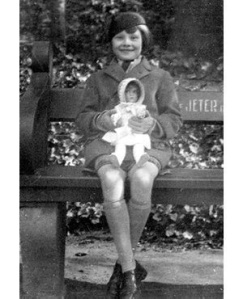
Agatha Christie as a child. She had fantastic hair.  Undated photo, ca. 1900

Agatha Christie as a child. She had fantastic hair. Undated photo, ca. 1900. Photo from the Christie Archive

She wore it up now, in the Grecian style, because, at 17, she was ready to “come out,” and that was the proper hairstyle for a girl going from a chrysalis to a butterfly.

Edwardian Era hairstyles had to be big and poufy to hold the enormous hats the Edwardians were so fond of.

Edwardian Era hairstyles had to be big and poufy to hold the enormous hats the Edwardians were so fond of.

This was the Edwardian Era (1901-1910) in England. It was traditional then for a girl of Agatha’s upper middle class status to mark the transition from girlhood to womanhood by “coming out.” A mother gave her daughter a dance. The daughter would “do a season” of parties in London. But as Agatha’s mother Clarissa was a widow and her wealth was a thing of the past,  there could be nothing like that for Agatha. So, the winter of 1910 they decided to go to Cairo, Egypt, where Agatha could ease her way into society (and meet men). Travel was relatively cheap then and they would lease their house out for extra income. They were going Agatha husband-hunting.

Clarissa Miller, Agatha Christie's mother, at her home in Torquay, England, before the start of the First World War (1914)

Clarissa Miller, Agatha Christie’s mother, at her home in Torquay, England, before the start of the First World War (1914). Photo from the Christie Archive

Mother and daughter set sail for Cairo where they would join other mothers and daughters with the same purpose. They were not disappointed. Three or four regiments were stationed in Cairo. There was polo matches to watch every afternoon and, five nights a week, there were dances in the hotels. Cairo was crawling with men – exciting ones, too.

Agatha and Clarissa stayed at the Gezirah Palace Hotel in Cairo for three glorious months. Agatha was so busy that she didn’t get as far as even falling slightly in love. Despite being a poor conversationalist, she had been popular among men of all ages and backgrounds, even an Austrian count, as she was both pretty and a great dancer. In the end, two men proposed marriage to her. (Men proposed very freely back then!) Her first suitor, a Captain Hibberd, never actually proposed marriage to Agatha. He timidly told Clarissa of his interest in Agatha. Clarissa didn’t even tell Agatha about it until they were sailing back to England, which made Agatha mad, as she liked to conduct her own love affairs. Agatha’s second marriage proposal came from a young man who was six-foot-five, a nice enough fellow, she admitted, but she didn’t love him, so she turned him down. Agatha would marry for love, as she was fully romantic.

British tourists pose in about 1910 at Giza outside Cairo, the Sphinx over their shoulders. Agatha Christie, too, visited this spot in 1910 but was not as interested in Egyptology and archaeology then as she would be in later years.

British tourists pose in about 1910 at Giza outside Cairo, the Sphinx over their shoulders. Agatha Christie, too, visited this spot in 1910 but was not as interested in Egyptology and archaeology then as she would be in later years.

Agatha returned to England with newfound confidence in herself – and still looking for “Mr. Right.” Over the next two years, she was courted by a string of eligible bachelors and became engaged to three of them. She spread her wings. She went up in an aeroplane. She visited a friend in Florence. She dreamed of becoming an opera singer but thought better of it. Then, one day, sick with the flu and stuck in bed, bored, she decided “to try her hand at a novel.” She began to write in earnest and, before long, she had formed the habit of writing stories.

Meanwhile, she was engaged to Reggie Lucy (who hated dancing and parties) when, in December of 1912, she was asked by some family friends to attend a dance being given for the members of the Garrison from Exeter. She reluctantly agreed. She traveled the 12 miles distance by train then car to Chudleigh.

Her friend Arthur Griffiths, who was stationed at that same Garrison in Exeter, wrote her to say that, sadly, he was not one of the officers able to attend the dance but to look out for a friend of his who was indeed going,

Christie by name….He’s a good dancer.”

Later, when Agatha was at the dance, she said:

Christie came my way quite soon in the dance. He was a tall, fair young man, with crisp curly hair, a rather interesting nose, turned up, not down, and a great air of careless confidence about  him….We got on together very well; he danced splendidly…I enjoyed the evening thoroughly.”

Ten days later, back in Torquay, Agatha was having tea with the Mellors across the street from her home. She and Max Mellor were practicing the tango. The phone rang. It was Agatha’s mother asking her to “Come home at once, will you, Agatha?” A young man was waiting for her in the parlor. Clarissa didn’t give his name.

Agatha was irritated at having to abandon her fun at the Mellors; she felt sure that her gentleman caller was a “rather dreary young naval lieutenant, the one who used to ask” her to read his poems. She left sulkily for home.

But it wasn’t the dreary young naval lieutenant standing nervously in the family drawing room. It was Archie Christie (1889-1962), the man from the dance.

Archibald_Christie_1915

Archibald Christie, 1915

He made up some lame excuse about having been in the neighborhood and deciding to look her up, but it was clear he was taken with Agatha. They chatted uncomfortably at first, then, after a few minutes, it got better. The afternoon wore on. Clarissa asked Archie to stay for a  “scratch dinner” of cold turkey, cheese, and salad. For the next several weeks it was like that, him arriving unexpectedly on his motorbike, spending the day, then motoring off “in a series of explosive bumps to Exeter.”

Agatha’s interest in fiancé Reggie Lucy was waning. Within a month, she broke that engagement and became engaged to Archie Christie. Now he was “Mr. Right.” They broke the news to Agatha’s mother. Clarissa knew that it would be hard for them, with Archie’s meager salary as a soldier and Agatha’s even more meager allowance of 100  pounds a year from her grandparents’ estate. She counseled then to wait, but did not object to the marriage. She could see that the two of them were terribly in love.

It was Archie’s mother Peg Hemsley who went and spoiled it all.

Agatha recalled the scene when Archie told his mother he was engaged to her:

‘Would she now be one of those girls that’s wearing one of these new-fangled Peter Pan collars?’

Rather uneasily Archie had to admit that I did wear Peter Pan collars. They were rather a feature of the moment.

1914 day dresses featuring Peter Pan collars.

1914 day dresses featuring Peter Pan collars.

We girls had at last abandoned the high collars to our blouses, which were stiffened by little zigzag bones, one up each side and one at the back, so as to leave red, uncomfortable marks on the neck. A day came when people determined to be daring and achieve comfort.

1911 Queen Mary with Ladies in Waiting. These women were not "Go-Ahead Girls"; they still wore the stiff collars of the Edwardians.

1911 Queen Mary with Ladies in Waiting. These women were not “Go-Ahead Girls”; they still wore the stiff collars of the Edwardians.

The Peter Pan collar was designed, presumably, from the turned-down collar worn by Peter Pan in Barrie’s play.

Maude Adams starred as Peter Pan in a 1905 British play. The collar on her costume, known as the Peter Pan collar, became popular.

Maude Adams starred as Peter Pan in a 1905 British play. The collar on her costume, known as the Peter Pan collar, became popular.

It fitted round the bottom of the neck, was of soft material, had nothing like a bone about it, and was heaven to wear.

1914 Dress featuring Peter Pan collar and a more relaxed dress line. Ladies were abandoning rigid clothing and corsets.

1914 Dress featuring Peter Pan collar and a more relaxed dress line. Ladies were abandoning rigid clothing and corsets.

It could hardly have been called daring. When I think of the reputation for possible fastness that we girls incurred, just by showing the four inches of neck from below the chin, it seems incredible….

Anyway, I was one of those go-ahead girls who, in 1912, wore a Peter Pan collar.

‘And she looks lovely in it,’ said the loyal Archie.

‘Ah, she would, no doubt,’ said Peg.”

Agatha Christie ca. 1926

Agatha Christie ca. 1926. Photo from the Christie Archive

Regardless of Peg’s disapproval, Archie and Agatha did marry – two years later. It was at Christmas and England was at war with Germany (1914). Archie was on leave; he was then a pilot with the Royal Flying Corps. They were staying at Bristol with his mother and stepfather. Archie decided that getting married was the only sensible thing to do. They hunted down the vicar and, outside the church, saw a friend of Agatha’s who agreed to witness the wedding. Agatha was wearing an ordinary coat and skirt with a small purple velvet hat, and hadn’t had time even to wash her hands and face. The ceremony was performed with only bride, groom, witness, vicar, and organist present. The newlyweds then had two days together before Archie returned to France and the dangerous business of being a fighter pilot in the First World War (July 1914-November 1918).

It would be six months before Agatha would see her husband again. She resumed volunteer work at the hospital in Torquay – and, more importantly, writing story after story at home, and seeing them published. In good time, Agatha Miller  – now Agatha Christie –  would be regarded as the world’s best-selling novelist, her literary success having been made possible despite “Mr. Right,” not because of him, contrary to what she had been brought up to believe.

Source: Christie, Agatha. Agatha Christie: An Autobiography. New York: Berkley Books, 1977.

"My Fair Lady" soundtrack poster. Miss Hepburn wears the Ascot ensemble.

“My Fair Lady” soundtrack poster

On June 19, 2011,the Ascot dress and hat worn by Audrey Hepburn in the 1964 Academy Award-winning film, “My Fair Lady,” sold at auction for an incredible $3.7 million. The ensemble was designed by Cecil Beaton and was sold from the Debbie Reynolds Collection. Originally, the actress Debbie Reynolds paid $100,000 for the outfit.

Worn by Miss Hepburn in the most memorable scene in the film, it is perhaps the most famous garment ever designed for a motion picture and, most assuredly, Mr. Beaton’s magnum opus.

Art designer Cecil Beaton checks Audrey Hepburn's Ascot costume on the set of "My Fair Lady," 1963

Art designer Cecil Beaton checks Audrey Hepburn’s Ascot costume on the set of “My Fair Lady,” 1963


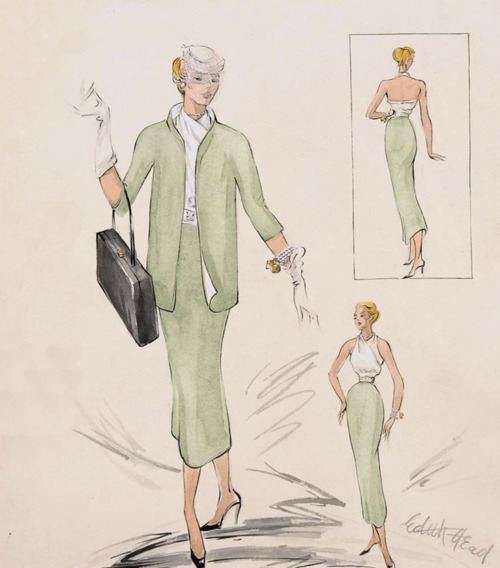
Cecil Beaton's sketch for Audrey Hepburn's Ascot costume, "My Fair Lady" (1964)

Cecil Beaton’s sketch for Audrey Hepburn’s Ascot costume, “My Fair Lady” (1964)

Audrey Hepburn as Eliza Doolittle at the Royal Ascot horse races. In the film, Eliza is every inch a refined English lady until the horserace tightens. Then she erupts in a stream of Cockney speech that threatens to blow her cover as a Covent Garden flower girl.

For more on Audrey Hepburn, click here.

Audrey Hepburn as Cockney flower seller in 1964 musical film, "My Fair Lady." Julie Andrews had played the lead in the Broadway play but producer Jack Warner wanted Audrey Hepburn as Eliza Doolittle for his film. Warner's film was to cost him $5 million. Audrey was well-known, talented, and her films never lost money. He wanted Audrey, not Julie. It caused quite a flap in the movie industry, with many feeling Julie Andrews should have had the role. Julie Andrew was then cast as Mary Poppins. That year, Audrey was snubbed at the Academy Awards, not even being nominated for her "My Fair Lady" performance. Julie Andrews won the Best Actress Oscar for "Mary Poppins."

Audrey Hepburn as Cockney flower seller in 1964 musical film, “My Fair Lady.” Julie Andrews had played the lead in the Broadway play but producer Jack Warner wanted Audrey Hepburn as Eliza Doolittle for his film. Warner’s film was to cost him $5 million. Audrey was well-known, talented, and her films never lost money. He wanted Audrey, not Julie. It caused quite a flap in the movie industry, with many feeling that singer Julie Andrews should have had the role. So Audrey was cast in “My Fair Lady.” Shortly Disney cast Julie Andrews in the musical spectacle, “Mary Poppins”. That year, Audrey was snubbed at the Academy Awards, not even being nominated for her “My Fair Lady” performance. Julie Andrews won the Best Actress Oscar for “Mary Poppins.”

In the 1964 Academy Award winning musical, “My Fair Lady,” linguistics professor Henry Higgins places a bet with his colleague Colonel Pickering. He boasts that, in six months time, he can transform a low-bred, disheveled Cockney flower seller named Eliza Doolittle into a duchess by teaching her to speak properly. Eliza is agreeable; she wants to speak better so she can get a job in a flower shop.

Eliza appears at Professor Higgins’ house to make arrangements for language lessons. Higgins’ housekeeper Mrs. Pearce escorts her into the library, where Higgins is discussing the possible experiment with Pickering.

Pickering: Won’t you sit down, Miss Doolittle?

Eliza (coyly): Oh, I don’t mind if I do. (She sits down on sofa.)

(Eliza offers to pay for voice lessons but Pickering wants to sponsor her.)

Eliza: Oh, you’re real good. Thank you, Captain.

Higgins (tempted, looking at her) It’s almost irresistible. She’s so deliciously low – so horribly dirty!

Eliza: Aoooow! I ain’t dirty: I washed my face and hands afore I come, I did.

Higgins: I’ll take it! I’ll make a duchess of this draggletailed gutter-snipe!

Eliza: Aoooooooow!

Higgins: (carried away): I’ll start today! Now! This moment! Take her away and clean her, Mrs. Pearce. Sandpaper if it won’t come off any other way. Is there a good fire in the kitchen?

Mrs. Pearce: Yes, but –

Higgins (storming on): Take all her clothes off and burn them. Ring up and order some new ones. Wrap her up in brown paper till they come.

Audrey Hepburn as Eliza Doolittle

Rex Harrison as Professor Henry Higgins

Wilfrid Hyde-White as Colonel Hugh Pickering

Mona Washbourne as Mrs. Pearce, Higgins’ housekeeper

Mrs. Pearce prepares the bath for Eliza.

Mrs. Pearce prepares the bath for Eliza.

Cecil Beaton, in charge of sets and costumes, recalls the day this scene was taped for “My Fair Lady”. He recalled it in his diary:

Wednesday, 21 August (1963)

…I wanted to congratulate Audrey (Hepburn) on her appearance, so went down on to the set for a word with her. I watched her being shot, listening to Higgins telling Pickering that, but for her appalling accent, Liza (sic: Eliza) could be passed off as a duchess. The play of expression on her face was such that one could almost see her brain at work with ideas that followed one another like a succession of pictures….

Thursday, 22 August (1963)

At lunch-time Audrey, wearing her dirty hair and face, came into my room to say ‘Ullow’. Every dawn Audrey has to have her hair covered with grease, then with a lot of brown Fuller’s Earth. The effect is really dirty, and psychologically must be very depressing. Tiring, too: it takes another hour to wash out the dirt before going home after the day’s shooting….

Audrey is remarkably disciplined: her memory never at fault, she appears on the set word  perfect, and she can give exactly the same performance over and over again. She confessed, however, that yesterday’s pea-shelling scene had been the greatest strain for she had to eat so many raw peas; at best, she does not care for them even when they are at their youngest and smallest, but having had to eat a bushel of huge Californian peas out of their inflated pods, she then went home to dinner and was served duck and green peas!

Tuesday, 27 August (1963)

On the set Audrey was still doing ‘Loverly’. Finding it difficult to work to different ‘play-backs’ she had been nervously taut most of the day. Now, by mid-afternoon, she was tired out. Her hairdresser was massaging the back of her neck: everyone sorry for her, and the atmosphere tense.

Cecil Beaton's costume design for character Eliza Doolittle in "My Fair Lady" musical film 1964

Cecil Beaton’s costume design for character Eliza Doolittle in “My Fair Lady” musical film 1964

Although Audrey practiced extensively to be able to sing in “My Fair Lady,” in the end it was decided that 90% of her vocal numbers would be dubbed with the voice of Marni Nixon. However, she did sing ‘Wouldn’t it be Loverly,’ shown in the following video:

For more on Audrey Hepburn, click here.

“My Fair Lady” movie trivia

“My Fair Lady” movie quotes


Audrey Hepburn 1953

Audrey Hepburn 1953

In 1954, British photographer and creative artist, Cecil Beaton, wrote this article for “Vogue” about a rising film star named Audrey Hepburn. Miss Hepburn was 25 and the newest sensation. She had just won the Academy Award for Best Actress for “Roman Holiday.”

It is always a dramatic moment when the Phoenix rises anew from its ashes. For if “queens have died young and fair,” they are also reborn, appearing in new guises which often create their own terms of appreciation. Even while the pessimists were predicting that no new feminine ideal could emerge from the aftermath of war, an authentic existentialist Galatea was being forged in the person of Miss Audrey Hepburn.

No one can doubt that Audrey Hepburn’s appearance succeeds because it embodies the spirit of today. She had, if you like, her prototypes in France – Damia, Edith Piaf, or Juliet Greco. But it took the rubble of Belgium [sicHolland] an English accent, and an American success to launch the striking personality that best exemplifies our new Zeitgeist [spirit of the age].

French waif

French waif

Nobody ever looked like her before World War II; it is doubtful if anybody ever did, unless it be those wild children of the French Revolution whose stride in the foreground of romantic canvases. Yet we recognize the rightness of this appearance in relation to our historical needs. And the proof is that thousands of imitations have appeared. The woods are full of emaciated young ladies with rat-nibbled hair and moon-pale faces.

Heron's eyes

Heron’s eyes

What does their paragon really look like? Audrey Hepburn has enormous heron’s eyes and dark eye-brows slanted towards the Far East. Her facial features show character rather than prettiness: the bridge of the nose seems almost too narrow to carry its length, which bares into a globular tip with nostrils startlingly like a duck’s bill. Her mouth is wide, with a cleft under the lower lip too deep for classical beauty, and the delicate chin appears even smaller by contrast with the exaggerated width of her jaw bones. Seen at the full, the outline of her face is perhaps too square; yet she intuitively tilts her head with a restless and perky asymmetry.

Madame Pompadour by Amedeo Modigliani, 1914.

Madame Pompadour by Amedeo Modigliani, 1914.

She is like a portrait by Modigliani where the various distortions are not only interesting in themselves but make a completely satisfying composite.

Beneath this child-like head (as compact as a coconut with its cropped hair and wispy monkey-fur fringe) is a long, incredibly slender and straight neck.

A rod-like back continues the vertical line of the nape, and she would appear exaggeratedly tall were it not for her natural grace.

1954 Sabrina dress

Audrey appears in a Givenchy dress from the 1954 movie, “Sabrina.”

Audrey Hepburn’s stance is a combination of an ultra fashion plate and a ballet dancer. Indeed, she owes a large debt to the ballet for her bearing and abandon in movement, which yet suggest a personal quality, an angular kinship with cranes and storks. She can assume almost acrobatic poses, always maintaining an innate elegance in her incredibly lithe torso, long, flat waist, tapering fingers and endless legs.

Audrey Hepburn was an accomplished ballerina. Undated photo, ca. 1954

Audrey Hepburn was an accomplished ballerina. Undated photo, ca. 1954

With arms akimbo or behind her back, she habitually plants her feet wide apart–one heel dug deep with the toe pointing skywards. And it is more natural for her to squat cross-legged on the floor than to sit in a chair.

Fratellini Poster

Fratellini Poster

Like the natural artist that she is Audrey Hepburn is bold and sure in her effects. There is no lack of vigor in her rejection of the softly pretty. She wears no powder, so that her white skin has a bright sheen. Using a stick of grease paint with a deft stroke, she draws heavy bars of black upon her naturally full brows; and almost in Fratellini fashion, liberally smudges both upper and lower eyelids with black.

To complete the clown boldness, she enlarges her mouth even at the ends, thus making her smile expand to an enormous slice from Sambo’s watermelon. The general public, in its acceptance of such an uncompromisingly stark appearance, has radically forsaken the prettily romantic or pseudo-mysterious heroines of only two decades ago.

1953 Audrey Hepburn grins upon receiving her Oscar for "Roman Holiday."

1953 Audrey Hepburn grins upon receiving her Oscar for “Roman Holiday.”

In clothing, this ingénue Ichabod wears a “junior miss” version of highwayman coats, clergyman cassocks, or students’ pants, overalls, scarfs.

Audrey Hepburn in loafers and scarf. Undated photo

Audrey Hepburn in loafers and scarf. Undated photo

Yet she is infinitely more soignée than most students, possessing, in fact, an almost Oriental sense of the exquisite.

Audrey Hepburn in the 1954 film, "Sabrina."

Audrey Hepburn in the 1954 film, “Sabrina.”

Barnardo's Boys were orphans

Barnardo’s Boys were orphans

And she is immaculately shod, whether in pumps, sandals, or court shoes. Audrey Hepburn is the gamine, the urchin, the lost Barnardo boy.

Audrey Hepburn from the 1954 film, "Sabrina"

Audrey Hepburn from the 1954 film, “Sabrina”

Sometimes she appears to be dangerously fatigued; already, at her lettuce age, there are apt to be shadows under the eyes, while her cheeks seem taut and pallid.

She is a wistful child of a war-chided era, and the shadow thrown across her youth underlines even more its precious evanescence. But if she can reflect sorrow, she seems also to enjoy the happiness life provides for her with such bounty.

It is a rare phenomenon to find a very young girl with such inherent “star quality.” As a result of her enormous success, Audrey Hepburn has already acquired the extra incandescent glow which comes as a result of being acclaimed, admired, and loved. Yet while developing her radiance, she has too much innate candor to take on that gloss of artificiality Hollywood is apt to demand of its queens.

Audrey Hepburn winks in sunlight. undated photo, ca. 1952

Audrey Hepburn winks in sunlight. undated photo, ca. 1952

Her voice is peculiarly personal. With its unaccustomed rhythm and sing-song cadence on a flat drawl, it has a quality of heartbreak. Though such a voice might easily become mannered, she spends much time in improving its musical range.

In fact, with the passing of every month, Audrey Hepburn increases in dramatic stature. Intelligent and alert, wistful but enthusiastic, frank yet tactful, assured without conceit and tender without sentimentality, she is the most promising theatrical talent to appear since the war. Add to this the remarkable distinction she emanates, and it is not rash to say she also gives every indication of being the most interesting public embodiment of our new feminine ideal.

US Vogue, November 01, 1954

 Click here for more on Audrey Hepburn.