Feeds:
Posts
Comments

Posts Tagged ‘British Royal Family/Nobles’

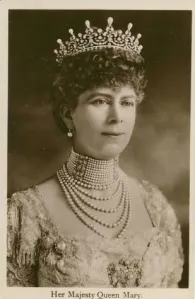
Shown in the photograph is Queen Mary (1867-1953), grandmother of Queen Elizabeth II. Queen Mary was a manic collector of jewelry and other fine pieces. During the reign of her husband, King George V (1865-1936), she vastly expanded the Royal Collection, often from the houses of friends. Mary is shown here wearing “the Girls of Great Britain and Ireland Tiara” which is also referred to as “Granny’s Tiara,” which she gave to Elizabeth in 1947, the year she married Prince Philip.

Shown in the photograph is Queen Mary (1867-1953), grandmother of Queen Elizabeth II. Queen Mary was a manic collector of jewelry and other fine pieces. During the reign of her husband, King George V (1865-1936), she vastly expanded the Royal Collection, often from the houses of friends. Mary is shown here wearing “the Girls of Great Britain and Ireland Tiara” which is also referred to as “Granny’s Tiara,” which she gave to Elizabeth in 1947, the year she married Prince Philip.

Queen Mary was Queen Elizabeth’s grandmother. She was married to George V. George V was the father of Queen Elizabeth’s father, King George VI, who preceded Queen Elizabeth on the throne.

Queen Mary got it wrong. One is supposed to “love people and use things.” She did the very opposite. Mary loved things and used people. The Queen had an “emotional lurch of the heart when she saw beautiful jewels,” but hated to pay for them. On seeing something she coveted, she said, “I’m caressing it with my eyes.” But it didn’t stop there. She acquired jewels, furniture, Faberge animals, watches, and gold musical boxes by means that ranged from begging to extortion to outright theft. She loved to visit India where the “maharajas handed out jewels like blackberries.” (1)

Antique dealers, jewellers, and estate owners locked away their valuables before Queen Mary came calling. If she spied a small silver vase or a china plate that she fancied, she would hint that she expected to be given it as a gift. At that point, the host or proprietor had no choice but to hand it over to the Queen. The Queen then instructed her chauffeur to put her new bauble in the car to add to the Royal Collection.

One day Queen Mary almost met her match. She was taking tea one late afternoon with Old Lady Hudson. The Queen began admiring a set of chairs that belonged to Lady Hudson. The chairs were painted by Angelica Kauffman. The Queen remarked that Lady Hudson’s chairs would go splendidly with the Kauffman table she owned. Lady Hudson no doubt smiled but did not offer her chairs to Queen Mary. The clock ticked on. Queen Mary continued to sip her tea. The sun went down. Queen Mary still showed no sign of getting up and departing.

More time passed. Finally, when the clock struck nine o’clock, Lady Hudson capitulated. She had held on valiantly, but, at the end, she was an old woman and she was ready for the Queen to go home. So  “the chairs went off in the royal Daimler.” (1)

At times, when Queen Mary wasn’t given something she desired, it is rumored she went ahead and stole it.

In the early  20th Century, wearing expensive jewelry was a way of defining status and Queen Mary was all about defining status – her status – as an elevated member of society. She was born the daughter of two royals who frittered away their money, infuriating their benefactress Queen Victoria, resulting in the whole family being tossed out of their apartments at Kensington Palace and run out of London. Mary ended up studying in Italy. Years passed and Mary returned to England. Queen Victoria cast her eye about looking for a suitable spouse for her grandson George, second in line for the throne. She selected Princess Mary, seeing in her “queen potential.” Upon the death of King Edward VII in 1910, George ascended the throne and Mary became his Queen.
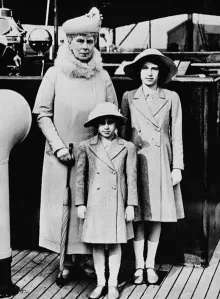
Queen Mary with granddaughters, the Princesses Margaret Rose and Elizabeth

Queen Mary with granddaughters, the Princess Margaret Rose and the future Queen Elizabeth II

Mary then set about to fulfill the potential seen in her by Queen Victoria and to become as royal as royal could be. She proceeded to outdazzle the royals around her, projecting such a flawless image of majesty that, to many, she ceased to be human. She was so decorated and gem-encrusted that, “at Lord Harewood’s wedding, a myopic E.M. Forster bowed to the iced and many-tiered cake under the impression that it was Queen Mary.” (1)

Queen Mary was so busy collecting, carrying out her royal duties, and hobnobbing with nobility that she had little time for motherhood, though she had borne six children. She had no passion for them. She left their care to cruel servants who pinched them. She did not kiss, cuddle, or hug her children. They were all starved of love, particularly her youngest child, John, born handicapped and epileptic. He was hidden away in a cottage with caregivers until his death at fourteen.

Upon her death from lung cancer in 1953, her son, David, Duke of Windsor, the former King Edward VIII, remarked:

I somehow feel that the fluids in her veins must always have been as icy-cold as they now are in death.
(1) Brendon, Piers and Whitehead, Phillip. The Windsors: A Dynasty Revealed. (London: Hodder & Stoughton, 1994)

Read Full Post »

Elizabeth II (Elizabeth Alexandra Mary; born 21 April 1926) is the queen regnant of sixteen independent states known as the Commonwealth realms: the United Kingdom of Great Britain and Northern Ireland, Canada, Australia, New Zealand, Jamaica, Barbados, the Bahamas, Grenada, Papua New Guinea, the Solomon Islands, Tuvalu, Saint Lucia, Saint Vincent and the Grenadines, Belize, Antigua and Barbuda, and Saint Kitts and Nevis. All together, these countries have a combined population, including dependencies, of over 129 million.

Elizabeth II (Elizabeth Alexandra Mary; born 21 April 1926) is the queen regnant of sixteen independent states known as the Commonwealth realms: the United Kingdom of Great Britain and Northern Ireland, Canada, Australia, New Zealand, Jamaica, Barbados, the Bahamas, Grenada, Papua New Guinea, the Solomon Islands, Tuvalu, Saint Lucia, Saint Vincent and the Grenadines, Belize, Antigua and Barbuda, and Saint Kitts and Nevis. All together, these countries have a combined population, including dependencies, of over 129 million.

It was June 24, 1953. Queen Elizabeth II was traveling to Scotland for the first time as Queen. In her coronation at Westminster Abbey 22 days earlier, Elizabeth had worshiped as an Anglican in the Church of England in her coronation robes. As Queen she was now the head of two churches, the Church of England and the Church of Scotland, which was Presbyterian. Having already been crowned in England, she now traveled to St. Giles Cathedral, the Mother Church of Presbyterianism, in Edinburgh, Scotland, to receive the ancient crown of Scotland.

When she arrived at the cathedral, the Queen was surrounded by the Scottish peerage in their velvet coats and coronets. Her husband, Prince Philip, was resplendently-dressed in a gold-braided uniform topped off by a plumed helmet. But when the crowd gathered at the ceremony got a look at Elizabeth, their new queen, they were shocked at how ordinary she looked. They had expected her to appear in her coronation robes. Instead she wore a simple gray blue coat, black leather shoes, and a gray blue felt hat. She looked just like a commoner! The most jarring part of her outfit was the big black purse she carried in the crook of her arm.

At the altar she stepped forward while the Duke of Hamilton and Brandon knelt before her in his coronation robes to proffer the crown of Scotland on a velvet cushion with gold tassels. As she (the Queen) reached toward him, her leather handbag, which was as large as a breadbox, almost hit him in the face. He quickly moved his head to avoid getting smacked by the royal purse. (1)

Since then, the Queen is rarely photographed without her purse tucked in the crook of her arm. She carries it with her throughout the day as she moves from room to room in Buckingham Palace. All tables and her desk at the palace are equipped with special hooks on which the Queen may hang her purse so that it may never be set on the floor. She never uses a clutch or a shoulderbag. Those bags would make it awkward in official duties of shaking hands and accepting flowers.

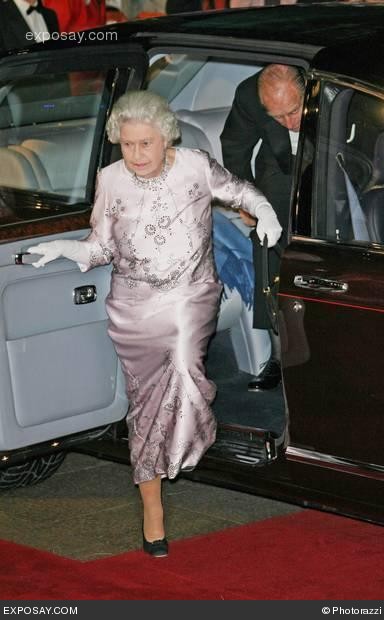
Queen Elizabeth (with black leather purse) and Prince Philip arrive at the Casino Royale World Premiere - Red Carpet - Nov. 14, 2006, London

Queen Elizabeth (with black leather purse) and Prince Philip arrive at the Casino Royale World Premiere – Red Carpet – Nov. 14, 2006, London

Enquiring minds want to know: just what does Queen Elizabeth carry in that purse? As it turns out, there is more to the royal purse than its meager contents. It doubles as a signal device. When the Queen is carrying out her royal duties at some function, she uses her purse to communicate with her servants. When she shifts the bag from one arm to another, for instance, it means she’s ready to leave. When at a banquet, if the Queen sets her purse on the floor, it’s another bad sign. She finds the conversation boring and wants to escape. However, if the royal bag dangles happily from the crook of her left arm, she is happy and relaxed. (2)

One thing that can always be found inside the Queen’s purse is an S-shaped metal meat hook that she can place on the edge of a piece of furniture and hang her purse on it. She always carries a metal make-up case given to her by Prince Philip as a wedding gift. She carries a collection of good luck charms, most of them gifts from her children, including dogs, horses, saddles, and horsewhips, reports the Daily Express, and photos of her children. She is never without her mints, chocolate drops for her corgi dogs, and a crossword or two snipped from the papers by her attendants.

Majesty magazine reports that the Queen carries a comb, a handkerchief, a small gold compact and a tube of lipstick in her handbag. On Sundays, she carries paper money to place in the collection plate at church.

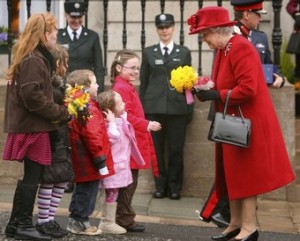
Britain's Queen Elizabeth II (R) receives flowers from children as she departs St Patrick's Cathedral in Armagh, Northern Ireland, March 20, 2008. The Queen handed out Maundy Thursday alms purses to 82 men and 82 women, the presentations are in recognition of their services to both church and community.

Britain’s Queen Elizabeth II (R) receives flowers from children as she departs St Patrick’s Cathedral in Armagh, Northern Ireland, March 20, 2008. The Queen handed out Maundy Thursday alms purses to 82 men and 82 women, the presentations are in recognition of their services to both church and community.

(1) Kelley, Kitty. The Royals. (New York: Warner Books, 1997)
(2) Dampier, Phil and Walton, Ashley. What’s In The Queen’s Handbag: And Other Royal Secrets. (Brighton, England: Book Guild, 2007)

For more on Queen Elizabeth, look in the left column under “Categories-People-Queen Elizabeth II.” I’ve written many posts on the Queen; I hope you enjoy them!

Read Full Post »

« Newer Posts