Harriet Lane, the single (orphaned) niece of bachelor President James Buchanan, served as the “first lady of the land” during his presidency (1857-1861). She was an accomplished hostess and a fashion trendsetter. This marble portrait, by William Henry Rinehart, highlights Lane’s bare shoulders above a deeply plunging neckline, a style she made fashionable when she altered her inauguration ball gown by lowering it two full inches. She added a strip of lace at the neckline, which is called a “Bertha,” which became a fast fad.
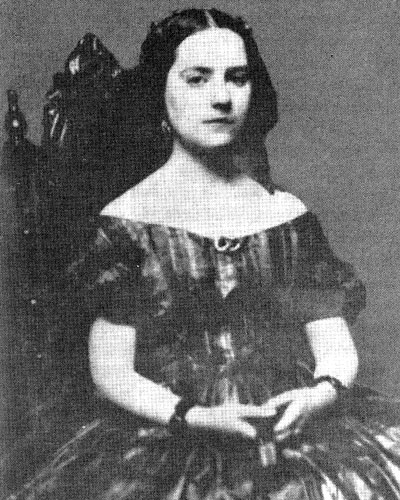
Harriet Lane (1830- 1903) in an 1860 photograph. She did not wear much jewelry or ruffles but was fond of floral headdresses and low necklines, that revealed her shoulders and toned arms.
Readers: I will be blogging about people from the American Civil War Era as I have written a new nonfiction history about those times, When People Were Things, to be published in late spring. Watch this space.
Readers: Although Julia Ward Howe is not mentioned in my soon-to-be-published history, When People Were Things, her husband is. Although Julia’s Civil War activism is not included in the book, I want to give you a snippet view here.
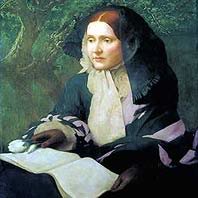
Julia Ward Howe (1819-1910)
Portrait of Julia Ward Howe, by John Elliott, ca. 1925. National Portrait Gallery/Wikimedia Commons
In 1843, red-haired New York heiress Julia Ward married Dr. Samuel Gridley Howe who had founded the Perkins School for the Blind. She was 24; he was 42. Julia gave birth to their first child while they honeymooned in Europe. She called her husband, “Chev.” They had six children and lived in Boston and Rhode Island. Theirs was not a happy union. Chev disapproved of Julia’s writing and did all he could to thwart it. In 1853, she published her first volume of poetry, Passion-Flowers, anonymously and without her husband’s knowledge. She continued to publish works that often critiqued women’s roles in marriages and society and caused controversy. Her husband was troubled by her writing as it often contained pointed references to her unhappy and stultifying marriage. He did not approve of women having a career outside the home.
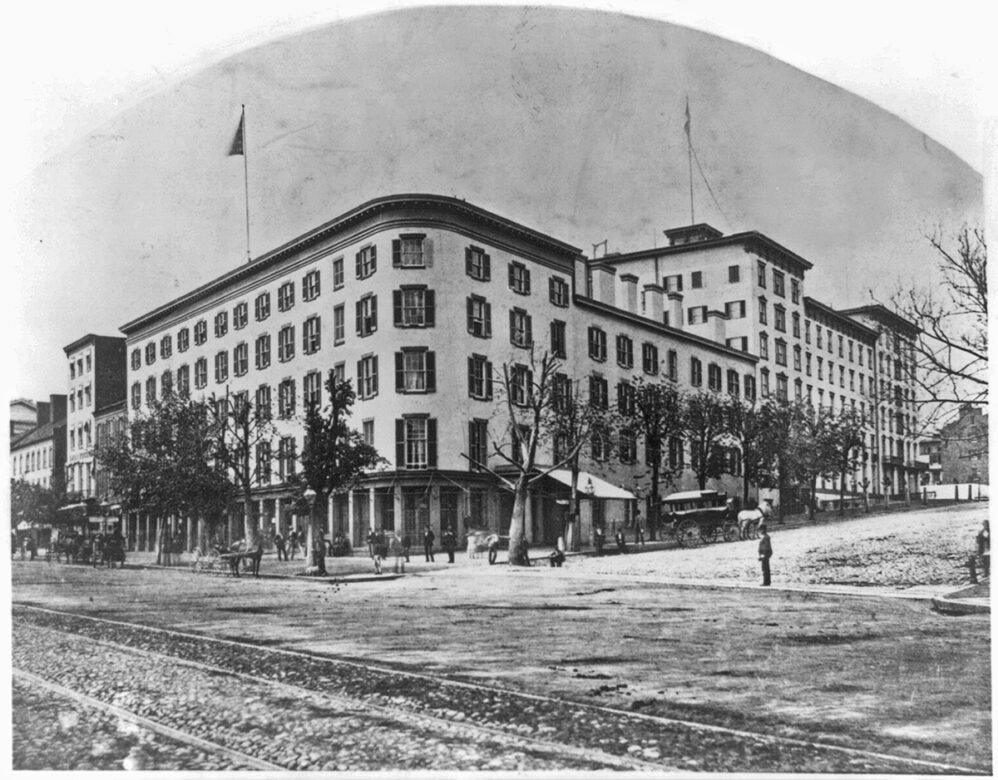
In November 1861, the first year of Abraham Lincoln’s presidency and while the Civil War was raging, Julia and Chev traveled to Washington and met Abraham Lincoln, who, Julia wrote, “was laboring…under a terrible pressure of doubt and anxiety.” Dr. Howe was on the board of the U.S. Sanitary Commission that supported wounded and sick soldiers; during his stay, he would meet with the USSC founder Dorothea Dix. The Howes lodged at Willard’s Hotel on Pennsylvania Avenue.
The Willard Hotel in Washington, D.C., during the Civil War Years, Library of Congress
From their room, Julia saw a billboard advertisement for “an agency for embalming and forwarding the bodies of those who had fallen in the fight or who had perished by fever.” This image stayed with her.
On a visit to the huge military camps stationed in the national capital, she heard soldiers singing the song, “John Brown’ Body,” originally about a Scotsman but had taken on new meaning in reference to the insurrectionist at Harper’s Ferry. New verses were often being added:
Old John Brown’s body is a-mouldering in the dust,
Old John Brown’s rifle is red with blood-spots turned to rust,
Old John Brown’s pike has made its last, unflinching thrust,
His soul is marching on!
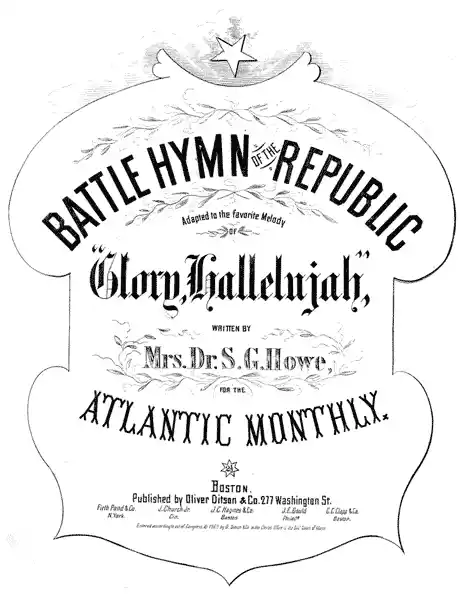
A friend urged Julia to write “some good words for that stirring tune.” That evening, she tried, but the words did not come to her. The next morning at the graying first light, she woke up in her bed at Willard’s and the words of the poem began to flow. She jumped up, grabbed paper and an old stump of a pencil, and scrawled down the words without even looking down at the paper, then fell back to sleep. This is how “The Battle Hymn of the Republic” was born, which she sold to the Atlantic Monthly for $4 in February. Her version links the Union cause to God’s vengeance at the Day of Judgment.
Here are some verses from the first published version:
Mine eyes have seen the glory of the coming of the Lord,
He is trampling out the vintage where the grapes of wrath are stored;
He hath loosed the fateful lightning of His terrible swift sword: His truth is marching on.
(Chorus)
Glory, glory, hallelujah!
Glory, glory, hallelujah!
Glory, glory, hallelujah! His truth is marching on.
I have seen Him in the watch-fires of a hundred circling camps,
They have builded Him an altar in the evening dews and damps;
I can read His righteous sentence by the dim and flaring lamps: His day is marching on.
(Chorus)
Glory, glory, hallelujah!
Glory, glory, hallelujah!
Glory, glory, hallelujah! His truth is marching on.
Before long, the song caught on and became the favorite of the Union troops and its unofficial wartime anthem. Julia Ward Howe became somewhat of a celebrity and became a suffragist.
When Mary and Abraham Lincoln moved into the White House in 1861, Mary was 42 years old, a time when women her age dressed in somber grays, dull browns, and boring blues. But not Mary Todd Lincoln. For her, expensive clothes were a mark of importance, of breeding. She proceeded to dress like a peacock, draping herself in bold blues, crimson, yellow, and royal purple, attracting a lot of unwanted attention and sparking criticism from the Washington social elite. Brought up among the overdressed ladies of Kentucky, her gowns and bonnets were ornamented with flowers, lace, dots, and bows sewn on yards of velvet, taffeta, and silk at a time of war when soldiers were going without blankets. Mary took her fashion cues from Eugenie, Empress of France, whose parties and clothes appeared in line drawings and detailed descriptions in one of Mary’s favorite magazines, Godey’s Lady’s Book. She was admonished for wearing low-necked dresses that revealed her “milking apparatus,” said one critic, and for the “flower beds which she carries on top of her head,” said another. A petite woman, the bell-shaped dresses overwhelmed her; hoops made her look shorter and squat.
Buoyed by a grandiose sense of self-importance coupled with her new position as the president’s wife, Mary demanded what she wanted. She expected everyone to do her bidding. She was surprised when clothing merchants sent her bills. The line between purchase and donation was fuzzy. Mary looked for donors to buy her gowns and hats, rewarding them with political favors. When she blew her four-year budget for White House renovations in under a year, she contrived several plots to secretly defray her debt. In one instance, she persuaded the White House gardener to sell manure from the stables at ten cents a wagonload. It raised more stink than cash. Her spending eventually came to light and became a national scandal. Lincoln was mortified and had to deal with it, all the while referring to it benignly as his beloved Mary’s silly “flub-a-dub.”
Now, back to what we were saying about Mary and her clothing:
It was an April evening in 1861. The Marine Band was playing a concert on the White House lawn. Mary and President Lincoln had invited many guests, among them Mary Cook Taft, wife of Horatio Taft, an examiner at the U.S. Patent Office. Mary Taft was wearing a delicate straw bonnet lavishly trimmed with pretty purple ribbons embroidered with little black figures. The bonnet had long strings which tied beneath her chin in a bow. Mary Taft’s teenage daughter, Julia, accompanied her to the promenade grounds that day and vividly recalled their costumes:
“My mother, of course, wore the bonnet, together with a purple and white silk over a moderate crinoline, and lavender kid gloves. I was dressed in white Swiss, much beruffled, but without hoop skirt or crinoline, which was an abiding grievance with me. But my hat…was very gratifying and almost compensated for the lack of crinoline.”
Women’s Fashions 1860
Mary and Julia walked around mingling with the other guests while the band played on. The national anthem brought those in chairs to their feet, men doffing their hats, and all standing in patriotic attention. At the close of the concert, the Taft women walked over to the south front where the presidential party was sitting, to pay their respects. Mary Lincoln could not take her eyes off Mary Taft’s bonnet. Julia recalled what happened next:
Julia Taft, undated photo
“After a few words of greeting, [Mrs. Lincoln] took my mother aside and talked with her for a moment. While I could not hear their conversation, I knew someway that they were talking about my mother’s bonnet and I was a bit puzzled at the look of amazement on my mother’s face. I did not see why my mother should look so surprised at a passing compliment from Mrs. Lincoln.”
Mary Lincoln wanted the purple strings off Mary Taft’s bonnet and asked for them. Mary Taft was angry—she loved her bonnet with its pretty purple ribbon— but what could she do? Mary Taft’s husband was a government appointee. Mrs. Lincoln could get him fired and then how would they pay for Julia’s private Washington school? So, begrudgingly, Mrs. Taft agreed to give up her ribbons to “Madam President” as Mary Lincoln requested to be called by the White House staff.
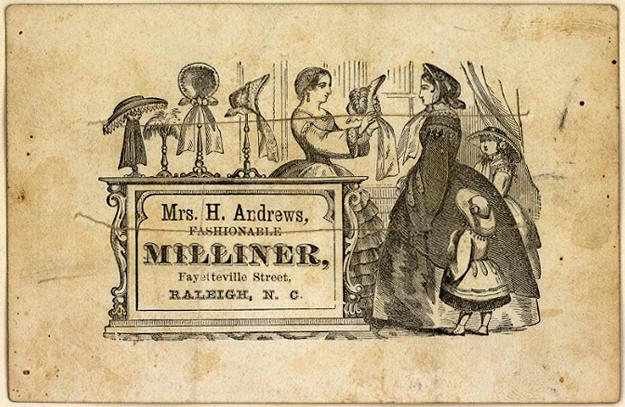
The Washington milliner Willian sent for Mary Taft’s bonnet, removing the purple ribbons for Mary Lincoln, and sending back Mary Taft’s bonnet with new lavender ribbon. Not long after this incident, Julia, who was often in the White House as a babysitter for her little brothers, Bud and Holly, the inseparable playmates of Tad and Willie Lincoln, caught sight of Mary Lincoln wearing a purple dress and a bonnet trimmed with her mother’s purple ribbons.
Mary Lincoln is shown with two of her four sons. Willie is to our left and Tad is to our right. Tad’s name is Thomas. He was so wiggly that he was nicknamed Tadpole. One of the Lincoln’s sons, Eddie, died when they had lived in Springfield. The eldest Lincoln boy, Robert, was studying at Harvard in 1860, the year this photo was taken.
Source: Bayne, Julia Taft. Tad Lincoln’s Father. Boston, Little, Brown, and Co., 1931.
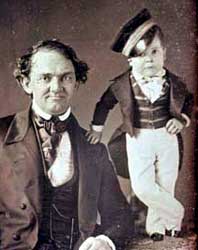
Showman P.T. Barnum (l) with his protegee, "General Tom Thumb" (born as Charles Sherwood Stratton). Daguerrotype by Samuel Root, 1850
The best known of circus pioneer P.T. Barnum‘s performers was Charles Sherwood Stratton (1838-1883), also known as General Tom Thumb. Stratton weighed 9 lbs. 8 oz. at birth, a bouncing baby boy for the time, but stopped growing at six months. When Barnum discovered him at the age of five, Stratton weighed only 15 lbs. and was 25 inches tall.
“The boy barely came up to the showman’s knees!” (1)
Barnum wasted no time signing up the boy as a sideshow attraction. His parents happily rented out their child for $7 a week plus room, board, and traveling expenses. Barnum installed the Strattons in a fancy New York City apartment above his museum of human curiosities. Barnum then began transforming Little Charlie into an international celebrity he christened “General Tom Thumb,” recalling the tiny fictional knight of King Arthur’s round table. The knight was so small, he rode a mouse and battled spiders.
1844 stereograph depicting General Tom Thumb as Napoleon. Although "Tom" was really six at the time, P.T. Barnum promoted him as a 13-year-old.
Barnum taught the little dwarf to dance, sing, and tell jokes while dressed in elaborate costumes as Cupid, Napoleon, and Frederick the Great. At five, Tom learned to drink wine and at seven he took up cigar smoking. Barnum billed Tom Thumb as the “smallest man alive.”
In 1844, Barnum took his young protege on a much-publicised European tour debut. Tom Thumb was a huge sensation, appearing before the crowned heads of Europe and visiting Queen Victoria not once, but twice. Audiences were enchanted with the man-boy whose charm combined innocence with pomposity. Over time, Tom made so many visits to royalty that Barnum had a special carriage built for him.
“Only 11″ high, it was painted blue and lined with silk. Drawn by ponies only 28″ tall, and driven by children dressed in livery, it caused a sensation wherever it went.”
Years went by and the money from Tom Thumb’s tours made him a rich man. “The Man in Miniature” moved to a specially-designed mansion for him and his parents in his hometown of Bridgeport, Connecticut.
Lavinia Warren (1841-1919), photo c. 1855-1865
It was said that, by the age of 19, Tom had been kissed by a million and a half girls.Soon, though, the United States was plunged into the Civil War and Tom wanted more than just kisses from strangers. He began looking for a wife. He found her in the diminutive form of another little person, the charming and very beautiful Lavinia Warren.
On February 10, 1863, the two were married at Grace Episcopal Church in New York City. The wedding was front page news. Billed as “the fairy wedding,” it was the social event of the season. People clamored for invitations, yet only two thousand people were invited.
"The Fairy Wedding" of General Tom Thumb (Charles Stratton) and Lavinia Warren. This is a reenactment of the ceremony staged by photographer Mathew Brady after the Feb. 10, 1863 event.On the left in each picture is the best man, George Washington Morrison Nutt, known as Commodore Nutt, who had courted Lavinia unsuccessfully; Tom Thumb; Lavinia, and Minnie Bump AKA Minnie Warren, Lavinia's younger and even more petite sister
As Tom and Lavinia made their way up the center aisle to the altar, only guests seated along the aisle could see them. Once they arrived at the chancel, women stood on tiptoes and a few climbed on chairs to witness the ceremony. Afterwards, P.T. Barnum staged a reception for the newlyweds at the Metropolitan Hotel. Barnum charged $75 a ticket. Although there was a demand for 15,000 tickets, only 5,000 were sold.
At the reception, the Strattons stood on a piano to receive their guests. Later on their honeymoon, they traveled to Washington, D.C., to the White House, where President Lincolngave them a fancy party. In the course of the evening, the president told General Tom Thumb that he had put him completely in the shade, as he [the General] was now the center of all attention.
(1) Fleming, Candace. The Great and Only Barnum: The Tremendous, Stupendous Life of Showman P.T. Barnum. New York: Schwartz & Wade Books, 2009.
Sojourner Truth (1797-1883), photograph by Mathew Brady c.1864
Born into slavery in New York, Isabella Baumfree (Sojourner Truth’s given name) was an abolitionist and women’s rights activist. She spoke Dutch until the age of nine when she was sold to a new owner along with a flock of sheep. Eventually freed, she became a devout Christian and began to travel and preach about freedom.
Asking the Lord for a new name to reflect her new life, she claimed “Sojourner” was given to her because she was to travel the land and “Truth” because she was to declare the truth to all people.
Sojourner Truth was a powerful speaker. Her most famous speech was delivered in 1851 at the Ohio Women’s Rights Convention. It is called “Ain’t I a Woman?” a slogan she adopted from a famous abolitionist image (See below.) The speech as shown here has been revised from the 19th century dialect in which she spoke.
When Sojourner got up to speak to the crowd, some men were present and they began to boo and hiss at her:
“Well, children, where there is so much racket, there must be something out of kilter. I think that ‘twixt the Negroes of the South and the women at the North, all talking about rights, the white men will be in a fix pretty soon. But what’s all this here talking about?
That man over there says that women need to be helped into carriages, and lifted over ditches, and to have the best place everywhere. Nobody ever helps me into carriages, or over mud-puddles, or gives me any best place! And ain’t I a woman? Look at me! Look at my arm! I have ploughed and planted, and gathered into barns, and no man could head me! And ain’t I a woman? I could work as much and eat as much as a man – when I could get it – and bear the lash as well! And ain’t I a woman? I have borne five children, and seen most all sold off to slavery, and when I cried out with my mother’s grief, none but Jesus heard me! And ain’t I a woman?”
Then they talk about this thing in the head; what’s this they call it? [member of audience whispers, “intellect”] That’s it, honey. What’s that got to do with women’s rights or Negroes’ rights? If my cup won’t hold but a pint, and yours holds a quart, wouldn’t you be mean not to let me have my little half measure full?
Abolition Movement poster
Then that little man in black there, he says women can’t have as much rights as men, ’cause Christ wasn’t a woman! Where did your Christ come from? Where did Christ come from? From God and a woman! Man had nothing to do with Him.If the first woman God ever made was strong enough to turn the world upside down all alone, these women together ought to be able to turn it back, and get it right side up again! And now they is asking to do it. The men better let them.
Obliged to you for hearing me, and now old Sojourner ain’t got nothing more to say.
The total cost of the war was $20 billion (approximately $250 billion in today’s money), or five times the total expenditure of the federal government from its creation in 1788 to 1865. (2)
President Lincoln and son "Tad" (Thomas) in a February 9, 1864 photograph by Anthony Berger of the Brady Studio.
April 11, 1865 became the official day of celebrating the end of the Civil War. An even larger crowd was assembled on the White House lawn than the night before. (See last post.) The band was playing triumphant music, people were waving banners and shouting, “Hoorah!” and calling out for President Lincoln to speak. It was evening, but Washington D.C., was blazing with light. The Capitol, other government buildings, the White House, and private homes were lit up from within to ring in the good news.
A great cheer went up from the crowd when the President appeared on the second-floor balcony to deliver his speech. There he stood patiently and quietly as waves of applause rolled toward him. Finally, the crowd settled down and Lincoln, holding a candle in his left hand and his notes in his right, prepared to speak. But the juggling of the candle and his manuscript instantly proved awkward for the president. So he gave the candle to his friend Noah Brooks to hold. Son Tad knelt at his feet to catch each fluttering page of his father’s notes as he dropped them.
The crowd was silent when Lincoln began:
“Reuniting our country is fraught with great difficulty…and we differ among ourselves as to the mode and manner and means of reconstruction….”
Lincoln continued in this same vein, spelling out in greater and more boring detail the plans he had for reuniting the torn nation. The crowd was somewhat taken aback by the president’s tone. This was not the speech they’d expected. They had come to hear a rousing speech, praising the Union troops for their bravery and sacrifice, but, instead their president was droning on with no merriment, skipping past the present and jumping into the future without pausing to savor victory. Not waiting for the end of the president’s speech, some members of the crowd drifted away no doubt to find a jazzier way to spend the celebration.
John Wilkes Booth (1838-1865)
One of the people in the crowd that day was the famous young actor and Southern sympathizer John Wilkes Booth. Along with him were drugstore clerk David Herold and former Confederate soldier Lewis Powell, also known as Lewis Payne. Just weeks earlier, these three men and five others had been planning to kidnap Lincoln and exchange him for Confederate P.O.W.s. But now that the Confederacy had collapsed, Lee had surrendered, and Rebel P.O.W.s were being released, there was no incentive to kidnap the president. Still, Booth wanted to act. He hated Lincoln and considered him a tyrant along the lines of Julius Caesar. He was determined to do something heroic in defense of the South and to punish Lincoln.
Booth was startled to hear what the President said next. Lincoln said something that no other president had ever said publicly. He told the crowd that he was in favor of granting some black men the right to vote, especially, “the very intelligent and those who served our cause as soldiers.” One hundred eighty thousand black men had served in the Union Army.
Booth went ballistic. He turned to his fellow co-conspirator Powell. “That means nigger citizenship. That is the last speech he will ever make,” he vowed. He begged Powell to shoot Lincoln then and there. When Powell said no, Booth proclaimed, “By God, I’ll put him through.”
Booth was true to his word. It was the last speech Lincoln ever made. Four days later, the president would be dead, killed by a bullet fired into his head by John Wilkes Booth.
Mary Todd Lincoln in mourning clothes, 1863. Even during the period in 1862 and 1863 when Mrs. Lincoln was in mourning for her son Willie and wore only black, she managed to go further into debt for new clothes. By 1864, she told Elizabeth Keckley: "The President glances at my rich dresses and is happy to believe that the few hundred dollars that I obtain from him supply all my wants. I must dress in costly materials. The people scrutinize every article that I wear with critical curiosity... If he is elected, I can keep him in ignorance of my affairs, but if he is defeated, then the bills will be sent." Only on January 1, 1865 did she completely shed her mourning attire.
After her son Willie’s death at age eleven on February 20, 1862, Mary Todd Lincoln went into deep mourning. She traded in her sparkling jewels, frilly white and colorful gowns, and flowered bonnets made fashionable by her icon the French EmpressEugénie (click to read earlier post) for widow’s weeds of dull black crepe. Her stylish White House parties were put to the side. Gaiety gave way to sadness. Mary had lost her favorite son, the perfect one, the one she considered most like her husband.
After Willie died, Mary’s youngest son, eight-year-old Tad, still tossed with the same typhoid fever that killed his brother. He lay critically ill nearby, but Mary, incapacitated by grief, would not and did not rush to his side to nurse him. Meanwhile, Willie’s embalmed body was laid out in the Green Room of the White House and his coffin was open. Mary mustered enough energy to place a sprig of laurel on Willie’s chest before retreating to her bedroom and shutting the door. She took to her bed, weeping and sobbing in such uncontrolled spasms that she became quite ill.
She did not come out of her bedroom to attend Willie’s funeral and never again entered the Green Room or the second floor guest room where Willie died. She rid the house of all of Willie’s toys and clothes and forbade his and Tad’s best friends, the Taft boys, from ever returning to the White House to play.
During Mary’s tormented period, Abraham, also heartbroken at his son’s death, sent for help. Two of Mary’s friends, a nurse, and Mary’s sister Elizabeth heeded the calling. One of the friends was the esteemed Washington seamstress Elizabeth Keckley. In memoirs she wrote with a ghostwriter six years later, she recalled a day when President Lincoln led his distraught wife (whom he called “Mother”) to the window, pointed to the lunatic asylum at a distance from the White House, and said,
“Mother, do you see that large white building on the hill yonder? Try and control your grief or it will drive you mad and we may have to send you there.”
The recently widowed Queen Victoria wearing mourning clothes at Balmoral, Scotland, 1863. She is riding "Fyvie" and is accompanied by her faithful servant John Brown. Her husband, Prince Albert, died in December of 1861 of typhoid fever or perhaps cancer of the stomach. For forty more years, the rest of Victoria's life, she wore black widow's weeds. Suspicion was aroused by Victoria's partiality to John Brown as a servant; most of the members of the Royal Household referred to him as "the Queen's stallion" and defamatory pamphlets referred to her as "Mrs. Brown." A 1997 film with Judy Dench titled "Mrs. Brown" was about their rumored love affair.
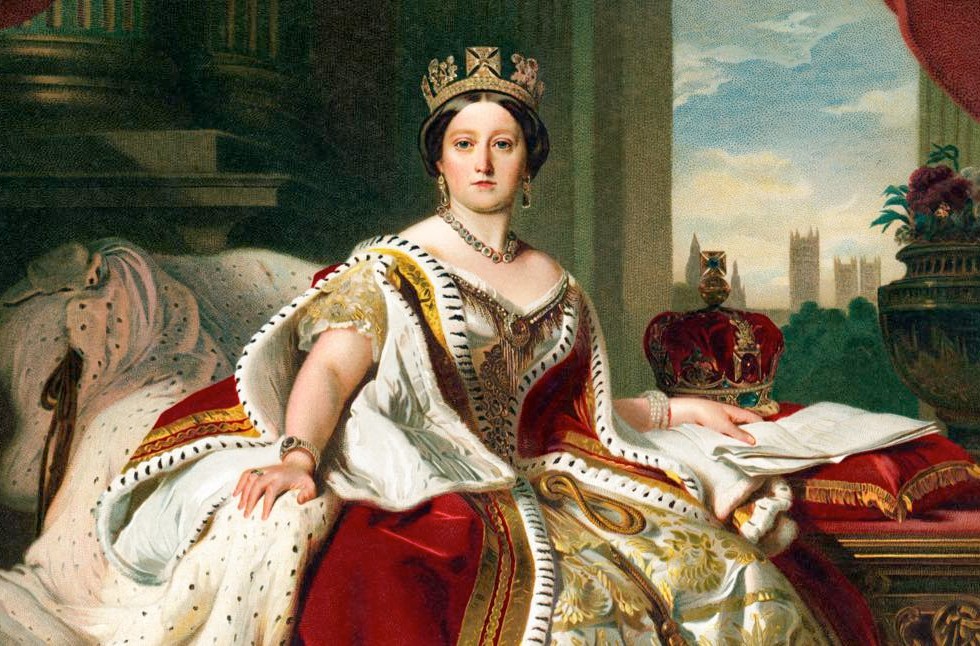
It was three weeks before Mary could even be persuaded to get up out of bed and put on her mourning clothes. Queen Victoria (1819-1901) now became the First Lady’s fashion model. Victoria’s husband Prince Albert had died unexpectedly just three months earlier and Victoria had plunged herself and her entire staff into the deep black dress of mourning. Following Victoria’s lead and further compounding her debt to clothing merchants (click to read an earlier post), Mary Lincoln ordered an entire new wardrobe of dull black crepe dresses, bonnets, and weeping veils.
For more than a year, six months longer than was called for in the mourning manuals of the day, Mary wore first-degree mourning. Her black crepe straw bonnet was so heavily veiled that she could not turn her head, which gave her an odd appearance as she was always facing forward. She became a very public mourner. She wanted to draw attention to her grief as if she was the only one who had lost a child at a time when Civil War soldiers were dying in record numbers from Mississippi to Maryland on the nation’s bloody battlefields. During her mourning, she cancelled the Saturday afternoon Marine Band Concerts held on the White House lawn, explaining that, “When we are in sorrow, quiet is necessary.” She bought black jet jewelry to accent her sooty “widow’s weeds” and used writing paper with the thickest margins of black.
Finally, in 1863, Mary ordered another new wardrobe, running up yet more bills, and moved into the stage known as half-mourning, exchanging her lusterless black for fabric in lavender, gray, and somber purples with a little touch of white at the wrist. (1)
Click here to access my related post, “The Madness of Mary Lincoln.” Also, for more posts on the Lincolns, view the drop down menu, “Categories,” in the left column, find at the top, Abraham and Mary Todd Lincoln, and click.
(1) Baker, Jean H. Mary Todd Lincoln: A Biography. (New York: W.W. Norton & Company, 1987)
April 14, 1865, was one of the happiest days of Abraham Lincoln’s life. It was Good Friday. General Robert E. Lee had surrendered five days earlier and the Civil War was over. The Union had been saved. Lincoln had a relaxing breakfast with his 21-year-old son Robert, whom he called “Bob,” who had just arrived for a visit. Robert Lincoln (1843-1926) had studied law at Harvard University until the closing weeks of the war when he joined the Union Army as part of General Ulysses Grant’s staff.
“Well, my son, you have returned safely from the front,” President Lincoln said. “The war is now closed, and we soon will live in peace with the brave men that have been fighting against us.” (1) He was eager to see the country heal and wanted no persecutions for the Confederacy, no “bloody work.” (2) Elizabeth Keckley, Mary Lincoln’s personal assistant, said that Lincoln’s face “was more cheerful than [she] had seen it for a long while.” (1)
At 11 a.m. he met with his regular cabinet and General Grant, who was concerned that not all of the Confederate forces under Johnston had surrendered to General Sherman. Lincoln told Grant not to worry, that good tidings were coming, “for he had last night the usual dream which he had preceding nearly every great and important event of the War.” He described the dream. He had seen himself on the water in some type of boat moving rapidly “towards an indefinite shore.” (1)
That afternoon, he took his usual carriage ride with Mary. Mary had never seen her husband so “cheerful,” she told a friend, “his manner was even playful. At three o’clock, in the afternoon, he drove out with me in the open carriage….I said to him, laughingly, ‘Dear Husband, you almost startle me by your great cheerfulness.'”
He replied, “And well I may feel so, Mary. I consider this day, the war, has come to a close….We must both, be more cheerful in the future – between the war and the loss of our darling Willie – we have both been very miserable.” As the carriage rolled toward the Navy Yard, Lincoln recalled happy memories of is old Springfield home and the adventures as a lawyer riding the circuit. He keenly felt the pressures of the presidency lifting and the future looking brighter.
Once back at the White House, Lincoln sat down and began reading a book, something humorous by John Phoenix. Mary kept calling him to dinner but he wouldn’t put the book down; he was totally absorbed – as always. Finally, Mary insisted he come to the table at once. They had to eat early, she reminded him, as they had plans to see Laura Keene perform in the play “Our American Cousin” at Ford’s Theatre that evening. It had been announced in the papers; they had to go. Lincoln preferred to stay home. He had no need for the escape of the theatre that day; he was already jubilant. But go he must, as he didn’t want to disappoint the people.
The morning edition of the National Republican had announced that Ulysses and Julia Grant would join the Lincolns in the president’s box for the play, but Julia didn’t want to go, saying she had her heart set on visiting their children in New Jersey. While that may have been true, it was more likely that it was an excuse to get out of an engagement with Mary Lincoln, whom she despised.
The Lincolns had a hard time finding a replacement for the Grants. Secretary of War Stanton and Secretary of the Treasury Chase also declined. Stanton had been trying for months to keep the president from exposing himself to the danger of such public places and both men thought the theatre a frivolity. It was decided that Clara Harris and her fiance, Major Henry Rathbone, would substitute for the Grants.
A little after eight o’clock, the carriage that would take Abraham and Mary to Ford’s Theatre rolled onto the front drive. Lincoln no doubt sighed. “I suppose it’s time to go,” he told Speaker Schuyler Colfax, “though I would rather stay.” He assisted Mary into the carriage and they took off.
(1) Goodwin, Doris Kearns. Team of Rivals. (New York: Simon & Schuster, 2005)
(2) Freedman, Russell. Lincoln: A Photobiography. (New York: Scholastic Inc., 1987)
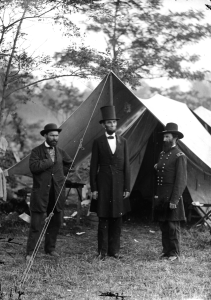
Allan Pinkerton, President Lincoln, and Major John A. McClernand in an 1862 photo by Alexander Gardner following the Battle of Antietam. Pinkerton was the head of Union Intelligence Services then. It was alleged that, in 1861, his Pinkerton Detective Agency uncovered an assassination plot against the president in Baltimore on his way to the inauguration. Thanks to Pinkerton's warning, Lincoln changed his travel itinerary and the plot was foiled. On the 3-story Chicago building of the Pinkerton Detective Agency, their logo, a black-and-white eye, says "We Never Sleep." This was the origin of the slang term for detective "private eye."
Since he stepped foot into the White House, President Lincoln was dogged by rumors of assassination and kidnapping. Threatening letters arrived on an almost daily basis. Lincoln stuffed them away in a bulging envelope marked ASSASSINATION. (1)
Abe’s friends were worried. “I long ago made up my mind that if anyone wants to kill me, he will do it,” he told a newspaper reporter. “If I wore a shirt of mail, and kept myself surrounded by a bodyguard, it would be all the same. There are a thousand ways of getting at a man if it is desired that he should be killed.”
Nevertheless, soldiers camped on the lawn of the White House, the cavalry escorted him on his afternoon carriage rides, and private detectives served as bodyguards.
In early April of 1865, just before the fall of Richmond and the end of the Civil War (and less than two weeks before his assassination), Lincoln had a troubling dream he related to friends:
“About ten days ago, I retired very late. I had been up waiting for important dispatches from the front. I could not have been long in bed when I fell into a slumber, for I was weary. I soon began to dream. There seemed to be a death-like stillness about me. Then I heard subdued sobs, as if a number of people were weeping. I thought I left my bed and wandered downstairs. There the silence was broken by the same pitiful sobbing, but the mourners were invisible. I went from room to room; no living person was in sight, but the same mournful sounds of distress met me as I passed along. I saw light in all the rooms; every object was familiar to me; but where were all the people who were grieving as if their hearts would break? I was puzzled and alarmed. What could be the meaning of all this? Determined to find the cause of a state of things so mysterious and so shocking, I kept on until I arrived at the East Room, which I entered.
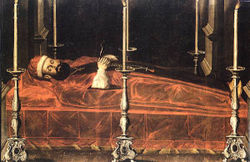
a catafalque is a raised platform supporting a body or coffin
There I met with a sickening surprise. Before me was a catafalque, on which rested a corpse wrapped in funeral vestments. Around it were stationed soldiers who were acting as guards; and there was a throng of people, gazing mournfully upon the corpse, whose face was covered, others weeping pitifully.
‘Who is dead in the White House?’ I demanded of one of the soldiers.
‘The President,’ was his answer; ‘he was killed by an assassin.’
Then came a loud burst of grief from the crowd, which woke me from my dream. I slept no more that night; and although it was only a dream, I have been strangely annoyed by it ever since.”
(1) Freedman, Russell. Lincoln: A Photobiography. (New York: Scholastic Inc., 1987)
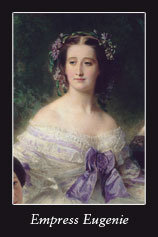
As mentioned in yesterday’s post, Mary Todd Lincoln slavishly followed the fashion lead of the Empress Eugénie, Empress Consort of France (1853-1871), the wife of Napoléon III, Emperor of the French. The empress’ style was reported in detail by the Vogue magazine of the day, Godey’s Lady’s Book. In 1860, age 32, the Empress Eugénie was considered one of the most beautiful women in Europe. At a ball, she outshone all other women. It was said that every man was in love with her. Her friend, the Princess de Metternich recalled that, on one occasion, the empress was
“attired in a white gown spangled with silver and dressed with her most beautiful diamonds. She had carelessly thrown over her shoulders a sort of burnous of white embroidered with gold, and the murmurs of admiration followed her like a trail of lighted gunpowder.”
In 1862, the Empress Eugénie set the fashion world on fire. She appeared at the races, one of the biggest social events of the year, without a shawl, a bold move for a society woman, especially for an empress. She was wearing an elegant, off-the-shoulder gown by the very up-and-coming couturier Charles Frederick Worth, an Englishman who had recently opened the haute couture shop, “The House of Worth,” in Paris. The empress did not want the lovely gown hidden from view. The world of fashion took note. “The streets of Paris were soon buzzing with ladies without shawls.”
From her childhood days, Mary Todd Lincoln adored being the center of male attention. Once she became the First Lady, she longed to become a fashion trend setter. Ignoring the dowdy style of the English Queen Victoria, she modeled herself after Empress Eugénie, sticking flowers in her hair and bodice, piling on the jewels, and opting for expensive gowns that dipped in the bust and shoulder. Husband Abraham Lincoln called Mary’s dresses her “cat-tails.” Mary tried hard to be fashionably dressed but she was generally displeased with the result; the hooped dresses and yards of fabric swamped her short frame and the excess jewelry and ornamentation was overwhelming.
Mary Todd Lincoln in a photograph by Mathew Brady, November 1861, in a heavy white silk dress onto which modiste Elizabeth Keckley had sewn 60 velvet bows and countless black dots.
Mary’s departure from the high-necked muslins worn by Western women brought swift condemnation from Oregon Senator James Nesmith, a guest at an 1862 East Room reception, who wrote to his wife of the 43-year-old “weak-minded Mrs. Lincoln and her sorry show of skin and bones. She had her bosom on exhibition, a flower pot on her head – There was a train of silk dragging on the floor behind her of several yards in length.” Mary Lincoln, continued the senator, who used to “cook Old Abe’s dinner and milk the cows,” now seemed eager “to exhibit her milking apparatus to public gaze.”
Mary’s plunging necklines caught Abe’s eye, too. “Whew,” he is quoted as saying, “our cat has a long tail tonight – if some of that tail was nearer the head, it would be in better style.”
(1) Baker, Jean H. Mary Todd Lincoln. (New York: W. W. Norton & Company, Inc., 1987)
When Mary and Abraham Lincoln moved into the White House in 1861, Mary was 42 years old, a time when women her age dressed in somber grays, dull browns, and boring blues. But not Mary Todd Lincoln. For her, expensive clothes were a mark of importance, of breeding. She proceeded to dress like a peacock, draping herself in bold blues, crimson, yellow, and royal purple, attracting a lot of unwanted attention and sparking criticism from the Washington social elite. Brought up among the overdressed ladies of Kentucky, her gowns and bonnets were ornamented with flowers, lace, dots, and bows sewn on yards of velvet, taffeta, and silk at a time of war when soldiers were going without blankets. Mary took her fashion cues from Eugenie, Empress of France, whose parties and clothes appeared in line drawings and detailed descriptions in one of Mary’s favorite magazines, Godey’s Lady’s Book. She was admonished for wearing low-necked dresses that revealed her “milking apparatus,” said one critic, and for the “flower beds which she carries on top of her head,” said another. A petite woman, the bell-shaped dresses overwhelmed her; hoops made her look shorter and squat.
Buoyed by a grandiose sense of self-importance coupled with her new position as the president’s wife, Mary demanded what she wanted. She expected everyone to do her bidding. She was surprised when clothing merchants sent her bills. The line between purchase and donation was fuzzy. Mary looked for donors to buy her gowns and hats, rewarding them with political favors. When she blew her four-year budget for White House renovations in under a year, she contrived several plots to secretly defray her debt. In one instance, she ordered the White House gardener into selling manure from the stables at ten cents a wagonload. It raised more stink than cash. Her spending eventually came to light and became a national scandal. Lincoln was mortified and had to deal with it, all the while referring to it benignly as his beloved Mary’s silly “flub-a-dub.”
Now, back to what we were saying about Mary and her clothing:
It was an April evening in 1861. The Marine Band was playing a concert on the White House lawn. Mary and President Lincoln had invited many guests, among them Mary Cook Taft, wife of Horatio Taft, an examiner at the U.S. Patent Office. Mary Taft was wearing a delicate straw bonnet lavishly trimmed with pretty purple ribbons embroidered with little black figures. The bonnet had long strings which tied beneath her chin in a bow. Mary Taft’s teenage daughter, Julia, accompanied her to the promenade grounds that day and vividly recalled their costumes:
“My mother, of course, wore the bonnet, together with a purple and white silk over a moderate crinoline, and lavender kid gloves. I was dressed in white Swiss, much beruffled, but without hoop skirt or crinoline, which was an abiding grievance with me. But my hat…was very gratifying and almost compensated for the lack of crinoline.”
Women’s Fashions 1860
Mary and Julia walked around mingling with the other guests while the band played on. The national anthem brought those in chairs to their feet, men doffing their hats, and all standing in patriotic attention. At the close of the concert, the Taft women walked over to the south front where the presidential party was sitting, to pay their respects. Mary Lincoln could not take her eyes off Mary Taft’s bonnet. Julia recalled what happened next:
Julia Taft, undated photo
“After a few words of greeting, [Mrs. Lincoln] took my mother aside and talked with her for a moment. While I could not hear their conversation, I knew someway that they were talking about my mother’s bonnet and I was a bit puzzled at the look of amazement on my mother’s face. I did not see why my mother should look so surprised at a passing compliment from Mrs. Lincoln.”
Mary Lincoln wanted the purple strings off Mary Taft’s bonnet and asked for them. Mary Taft was angry—she loved her bonnet with its pretty purple ribbon— but what could she do? Mary Taft’s husband was a government appointee. Mrs. Lincoln could get him fired and then how would they pay for Julia’s private Washington school? So, begrudgingly, Mrs. Taft agreed to give up her ribbons to “Madam President” as Mary Lincoln requested to be called by the White House staff.
The Washington milliner Willian sent for Mary Taft’s bonnet, removing the purple ribbons for Mary Lincoln, and sending back Mary Taft’s bonnet with new lavender ribbon. Not long after this incident, Julia, who was often in the White House as a babysitter for her little brothers, Bud and Holly, the inseparable playmates of Tad and Willie Lincoln, caught sight of Mary Lincoln wearing a purple dress and a bonnet trimmed with her mother’s purple ribbons.
Mary Lincoln is shown with two of her four sons. Willie is to our left and Tad is to our right. Tad’s name is Thomas. He was so wiggly that he was nicknamed Tadpole. One of the Lincoln’s sons, Eddie, died when they had lived in Springfield. The eldest Lincoln boy, Robert, was studying at Harvard in 1860, the year this photo was taken.
Source: Bayne, Julia Taft. Tad Lincoln’s Father. Boston, Little, Brown, and Co., 1931.
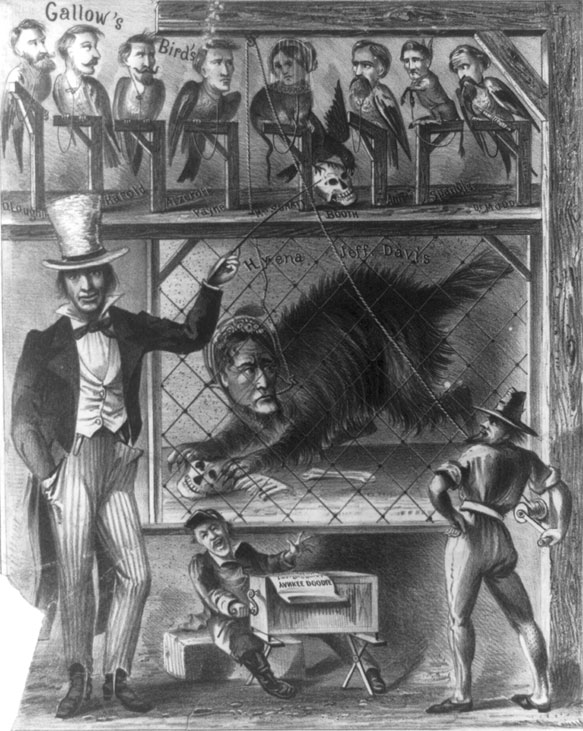
Issued in the wake of Lincoln’s assassination in April 1865, the political cartoon, “Uncle Sam’s Menagerie,” conveys the Northern hostility toward the conspirators, whom the public associated with former president of the Confederacy Jefferson Davis. Uncle Sam stands before a cage in which a hyena with the bonneted head of Jefferson Davis (1808-1889), president of the Confederacy, claws at a skull. Davis’ neck is in a noose, which will begin to tighten as a man at right turns the crank of a gallows. The bonnet on Davis’ head alludes to the embarrassing circumstances of his recent capture. As the Civil War drew to a close, Davis fled Richmond with his cabinet in early April 1865 and began a trek southward with federal troops in hot pursuit. While still weighing the merits of forming a government in exile, Davis was captured by Union soldiers near Irwinville, Georgia, in early May 1865. Whether by accident or design, Davis was wearing his wife’s dark gray short-sleeved cloak and black shawl when captured.
Below the caricature of Davis as a cross-dressing hyena, a man grinds out the song “Yankee Doodle” on a hand organ. Above, the Lincoln conspirators are portrayed as “Gallow’s Bird’s,” with their heads in nooses. From left to right they are: Michael O’Laughlin, David Herold, George Atzerodt, Lewis Paine, Mary Elizabeth Surratt, Samuel Arnold, Edman Spangler, and Dr. Samuel Mudd. At left, Uncle Sam points his stick at a skull “Booth,” on which sits a black crow. John Wilkes Booth was killed during a government raid on his hideout on April 26, 1865.









 April 14, 1865, was one of the happiest days of Abraham Lincoln’s life. It was Good Friday. General Robert E. Lee had surrendered five days earlier and the Civil War was over. The Union had been saved. Lincoln had a relaxing breakfast with his 21-year-old son Robert, whom he called “Bob,” who had just arrived for a visit.





 Lisa's History Room