Feeds:
Posts
Comments

Archive for the ‘PEOPLE’ Category

Michael Jackson as a child. Michael died today at age 50.

Michael Jackson as a child. Michael died today at age 50.

Watch this video of the Jackson 5 singing “I Want You Back” and “ABC” on the Ed Sullivan Show in 1970.

This is how we got to know him, Little Michael Jackson, a kid chocked-full of talent and fun. May he rest in peace.


Read Full Post »

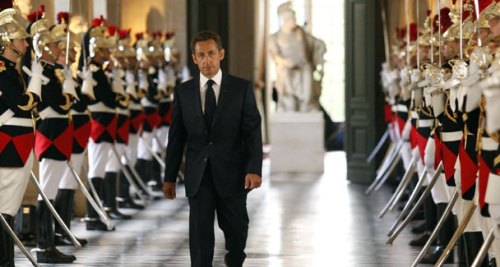
French President Nicolas Sarkost arrives at Versailles Palace on June 22, 2009, to address Parliament. H condemned the use of the burqa in France, calling it an unacceptable symbol of "enslavement."

French President Nicolas Sarkosy arrives at Versailles Palace on June 22, 2009, to address Parliament. He condemned the use of the burqa in France, calling it an unacceptable symbol of "enslavement."

On June 22, 2009, President Nicolas Sarkozy of France arrived at Versailles Palace to address legislators, the first presidential appearance before Parliament since 1875. To protect the independence of lawmakers, presidents had been barred from entering Parliament since Charles Louis-Napoléon Bonaparte’s reign. Reforms carried out by Sarkozy’s party last summer, though, opened the way for him to speak to Parliament. (1)

Mr. Sarkozy entered through rows of French guards with raised swords and plumed helmets, then delivered an American-style state-of-the-nation address. In a sober, far-ranging speech, he spoke about the economy and his vision for the future of France. He saved his strongest comments for the most hotly-debated social issue in France:  the burqa. The burqa is a Muslim head-to-toe garment that some women wear to cloak their bodies and faces. Sarkozy’s declaration, “The burqa is not welcome in France,” was met with enthusiastic applause.

Two Afghan Women Wearing Burqas

Two Afghan Women Wearing Burqas

“We cannot accept to have in our country women who are prisoners behind netting, cut off from all social life, deprived of identity,” Sarkozy told Parliament. “”That is not the idea that the French republic has of women’s dignity. The issue of the burqa is not a religious issue. It is a question of freedom and of women’s dignity,” Mr. Sarkozy said. The burka is not a religious sign. It is a sign of the subjugation, of the submission, of women.”

Mr Sarkozy gave his backing to the establishment of a parliamentary commission to study the burqa and methods to stem its spread. In 2004, France banned Islamic headscarves in its state schools. France is home to five million Muslims, the largest Muslim population in Western Europe.

Two women, one wearing the niqab, a veil worn by the most conservative Muslims that exposes only a woman's eyes, right, walk side by side, in the Belsunce district of downtown Marseille, central France, Friday June 19, 2009. The French government's spokesman says he favors the creation of a parliamentary commission to study the small but growing trend of burqa wear in France. Luc Chatel says the commission could possibly propose legislation aimed at banning the burqa and other fully covering garments worn by some Muslim women.

Two women, one wearing the niqab, a veil worn by the most conservative Muslims that exposes only a woman's eyes, right, walk side by side, in downtown Marseille, on June 19, 2009. In France, the terms burka and niqab are often used interchangeably – the former refers to a full-body covering worn largely in Afghanistan with a mesh screen over the eyes, while the latter is a full-body veil, often in black, with a gap for the eyes.A parliamentary commission may study the small but growing trend of burqa wear in France and could propose legislation aimed at banning the burqa and other fully covering garments worn by some Muslim women. The study aims to discover whether the women wear the burka by choice or out of fear.

(1) “Sarkozy Backs Drive to Eliminate the Burqa.” The New York Times, June 23, 2009.

Read Full Post »

Booth reward posterIt was April 24, 1865 – ten days since President Lincoln was assassinated – and his killer still remained at large. On the night of April 14, John Wilkes Booth had shot the president in the head, jumped on a horse, and slipped across the Potomac River undetected. He had disappeared into Maryland, a state that had stayed in the Union in the Civil War (which had ended just days earlier), but was sprinkled with Confederate spies. Speculation was that Booth would cross Maryland into Virginia with the help of fellow Confederate sympathizers.

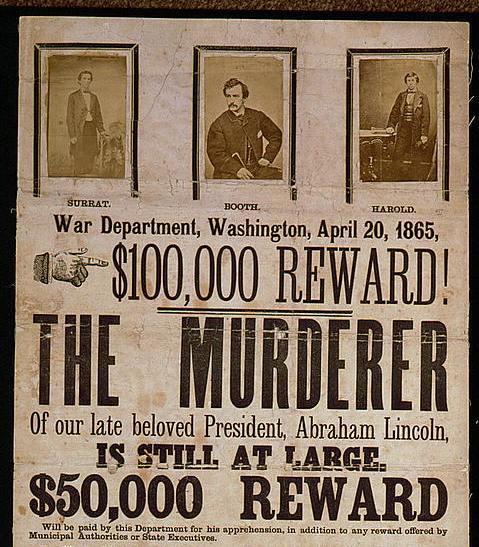
The 16th New York Cavalry was on Booth’s trail but no leads had resulted in his capture, despite a whopping $100,000 reward promised by the War Department. So on April 24, Major W.S. Hancock issued a new proclamation appealing to the black population of Washington, Maryland, and Virginia, for their help in the manhunt. Hancock calculated that Booth could not escape without encountering blacks. The following proclamation was printed on letter size handbills and distributed:

THE MURDER OF PRESIDENT LINCOLN.

APPEAL TO THE COLORED PEOPLE!

HEADQUARTERS MIDDLE MILITARY DIVISION

Washington, D.C., April 24, 1865

To the colored people of the District of Columbia and of Maryland, of Alexandria and the border counties of Virginia;

Your President had been murdered! He has fallen by the assassin and without a moment’s warning, simply and solely because he was your friend and the friend of our country. Had he been unfaithful to you and to the great cause of human freedom he might have lived. The pistol from which he met his death, though held by Booth, was fired by the hands of treason and slavery. Think of this and remember how long and how anxiously this good man labored to break your chains and to make you happy. I now appeal to you, by every consideration which can move loyal and grateful hearts, to aid in discovering and arresting his murderer. Concealed by traitors, he is believed to be lurking somewhere within the limits of the District of Columbia, of the State of Maryland, or Virginia. Go forth, then, and watch, and listen, and inquire, and search, and pray, by day and night, until you shall have succeeded in dragging this monstrous and bloody criminal from his hiding place….

Large rewards have been offered…and they will be paid for the apprehension of this murderer….But I feel that you need no such stimulus as this. You will hunt down this cowardly assassin of your best friend, as you would the murderer of your own father….

All information which may lead to the arrest of Booth, or Surratt, or Harold, should be communicated to these headquarters….

W.S. Hancock

Major General U.S. Volunteers

Commanding Middle Military Division


Read Full Post »

(Read “Imelda Marcos Almost Gets the Beatles Killed Part 1” first.)

Hear what the Fab Four had to say about their brush with death in Manila:


*For other related posts on this site, see:
“Imelda Marcos: 2000 Shoes”
“Ferdinand Marcos’ Restless Corpse”
“Imelda Being Imeldific*”

Read Full Post »

Imelda Marcos being Imeldific, June 20, 2009, Manila.

Imelda Marcos being Imeldific, June 20, 2009, Manila.

“Filipinos are brainwashed to be beautiful. We’re allergic to ugliness,”

said Imelda Marcos as as she greeted reporters this weekend in her swank two-story Manila penthouse. Approaching her 80th birthday on July 2, she complained about her lot in life, saying she is penniless and struggling to still look presentable. Her claim is hardly believable, since she and her husband, the late President of the Philippines Ferdinand Marcos, stashed away billions during his dictatorship. Meanwhile, a 22-carat diamond engagement ring still adorns the former beauty queen’s finger.

“Despite some 900 civil and criminal cases she had faced in Philippine courts since 1991 _ cases ranging from embezzlement and corruption to tax evasion _ she has emerged relatively unscathed and never served prison time. All but a handful of the cases have been dismissed for lack of evidence and a few convictions were overturned on appeal….

Imelda Marcos penniless yet jeweled

Imelda Marcos penniless yet jeweled

Imelda, her hair coifed and cheeks rouged, teared up as she complained she had to withdraw money from her husband’s meager war pension to post bail so she could travel to Singapore earlier this month for an eye checkup paid for by her children.“I was first lady for only 20 years. All the beautiful things I gave to the Philippines, am I being persecuted for that? I didn’t know you can inherit a crime from your husband.”

Her husband and his cronies allegedly amassed ill-gotten wealth estimated at $5 billion to $10 billion during Marcos’ 20 years in power, but the Presidential Commission on Good Government, created to recover the Marcos billions, says the government has only found cash and assets totaling $1.63 billion.

The assets include three separate sets of diamond tiaras, ruby brooches, emerald necklaces and other jewels.

She remains unashamed of her past, when she shopped in the world’s richest boutiques and launched lavish beautification projects at home in the midst of the Philippines’ extreme poverty.”

*Imeldific is a word coined after former First Lady Imelda Marcos. It means “ostentatious extravagance” as in this example:

She had a shoe collection that met Imeldific standards.

I’ve written more posts on the Marcoses:

“Ferdinand Marcos’ Restless Corpse”

“Imelda Marcos Almost Gets the Beatles Killed”

“Imelda Marcos: 2000 Shoes”

Read Full Post »

Barry Obama in 1980 when a freshman at Occidental College, photo by Lisa Jack (edited here)

Barry Obama in 1980 when a freshman at Occidental College, photo by Lisa Jack

“Barack Obama: The Freshman,” an exhibition of black-and-white photographs by Lisa Jack, is on view at M + B Gallery in Los Angeles. Lisa Jack took the photographs of the man who would be president when both were students at Occidental College (“Oxy”) in L.A in 1980.

Ms. Jack was scouting that year for people to pose for her photographic portrait project. One of her classmates suggested she call a guy named Barry.

“A friend of a friend was telling me about this really handsome guy, and he walked into the campus coffee shop,” she recalled. She asked him to pose and he agreed. They made arrangements to meet. “I photographed a lot of people and it was always interesting what they decided to wear to the shoot.” (1)

A teenage Barack Obama in a 1980 photo by Lisa Jack

A teenage Barack Obama in a 1980 photo by Lisa Jack

Mr. Obama brought along a leather bomber jacket, a Panama hat, and a pack of cigarettes and wore flared jeans. “Straw hats were not something people wore back then,” she added. “It was obvious that he really put some thought into how he wanted to convey himself.”

Friends remember that Barry Obama had clear-cut ideas about his own style. He grew his hair log, wore subdued square-cut Hawaiian shirts and wore sandals.

Ms. Jack hoped Barry would ask her out, but he did not. Although he was pleased with the photographs, they did not maintain contact. Ms. Jack forgot about the photos until the 2008 presidential campaign.

(1) “When He was Barry,” The New York Times, June 18, 2009.

Read Full Post »

In an interview with John Harwood of CNBC, President Obama swatted a fly, killing it. PETA condemned the president's fly murder.

In an interview with John Harwood of CNBC, President Obama swatted a fly, killing it. PETA condemned the president's fly murder.

The White House is currently experiencing a fly infestation. Flies are swarming the place, irritating everyone, even the president. During an East Room interview on last Tuesday, June 16, a very large fly was circling President Obama’s head, distracting him. The president stopped talking and watched the fly. When it landed on his hand, he studied it then swatted it, killing it dead. Then he brushed it off his hand onto the floor.

“That was pretty impressive, wasn’t it?” he asked the film crew, while glancing down at the dead fly on the floor. “I got the sucker.”

The New York Times dubbed the president, “The First Exterminator.” The scene was an instant youtube hit and made TV news around the world. People for the Ethical Treatment of Animals, though, were not amused, and condemned the Obama Fly Murder.

See the video below:

Read Full Post »

Dorothy Hale and Isamu Noguchi at the premiere of Four Saints in Three Acts, February 7, 1934, Hartford, Connecticut

Dorothy Hale and Isamu Noguchi at the premiere of “Four Saints in Three Acts,” February 7, 1934, Hartford, Connecticut

In 1934, the socialite and actress Dorothy Hale took a road trip through Connecticut with two old friends, writer Clare Boothe Luce and sculptor Isamu Noguchi. They drove in a special car Noguchi had designed with his drinking buddy, futuristic inventor Buckminster Fuller. The car was called the Dymaxion.

The Dymaxion Car

The Dymaxion Car

Buckminster Fuller with his portrait by Isamu Noguchi, 1929, photo by Noguchi

Buckminster Fuller with his portrait by Isamu Noguchi, 1929, photo by Noguchi

The 20-foot long aluminum-bodied Dymaxion car caused a traffic jam wherever it went.  This was between the two world wars when cars were sedans and pick-up trucks. “Bucky” Fuller’s car was shaped like a teardrop and ran on three wheels. It went 90 m.p.h. and was fuel-efficient at 30 m.p.g. The 3-wheeler made a 360-degree turn on a dime. A periscope that came out of the roof gave extra visibility. It seated eleven passengers.

It was the car of the future – for a while. Unfortunately, only three Dymaxion cars were ever produced. Orchestra conductor Leopold Stokowski bought one. Amelia Earhart was interested in investing. Financing was a problem and Fuller was running out of cash.

Aviator Amelia Earhart

Aviator Amelia Earhart

Any hope of putting the Dymaxion in full-scale production dried up quickly when the car was involved in a fatal accident at the 1933 Chicago World’s Fair. Another car was blamed for the crash but that didn’t stop the negative publicity for the Dymaxion.

Sadly, only one of the Dymaxions exists today. You can view the restored exterior of the car at the National Automobile Museum in Reno, Nevada. Disappointingly, though, the car windows are painted opaque from the inside to prevent you looking inside. Evidently, the inside was in very bad shape when the car was acquired and little information exists as to its original look in order to guide the museum restoration artists. The rumor is that the car had been used as a chicken coop somewhere in the Midwest before it was discovered, which explains the wrecked state of the interior!

View this youtube video to see the amazing turning radius of the Dymaxion. While you’re viewing, keep a lookout for Amelia Earhart in the back seat.

http://www.youtube.com/watch?v=YlLZE23EJKs&feature=related

For more on Dorothy Hale, see my most popular post, Frida Kahlo: The Suicide of Dorothy Hale.”

Read Full Post »

From The New York Times, June 15, 2009:

$431,000 Paid for Envelope and Its Stamp

An envelope from an 1873 letter bearing a scarce 90-cent stamp with Abraham Lincoln fetched more than $431,000 at an auction in New York City on Saturday.

The envelope, or cover, as collectors call used envelopes, was sold by Siegel Auction Galleries.

The 1873 letter bearing the scarce 90-cent Lincoln stamp

The 1873 letter bearing the scarce 90-cent Lincoln stamp

Known to collectors as the Ice House Cover, the envelope, which traveled by ship from New York to India, is the only one collectors have found still bearing the red and black stamp with Lincoln on it. Last traded publicly in 1943, then stolen and long thought to have been lost to philately, the cover was seized by the Federal Bureau of Investigation in 2006 and returned, after a court battle, to the heirs of J. David Baker, its last owner.

The letter was sent from a New England ice merchant to one of his ice warehouses in Calcutta, then part of Britain’s East Indies colony. It was franked with a total of $1.12, a large sum of money in those days, which paid the two-ounce foreign letter rate.

Markings on the envelope reveal that it traveled across the Atlantic, by train through Germany and Italy, by ship to Egypt and again from Suez to Bombay, and then by train across India. Before the advent of the Universal Postal Union the next year, the sum reflected rates negotiated between the United States and Britain to encourage growing international trade. Indeed, the commercial success of sending ice from winter ponds in Massachusetts to the sweltering cities of India was part of this progress.

90-cent Lincoln stamp issued in 1869. Image used was provided by photographer Mathew Brady.

This 90-cent Lincoln stamp was issued in 1869. The image was provided by famed Civil War photographer Mathew Brady.

Early collectors mainly sought to fill their albums with stamps that had been soaked off their envelopes, and an item like the Lincoln, issued in 1869 in a run of fewer than 50,000, would have been no exception. When, at the end of the 19th century, collectors began saving entire envelopes — on account of the fascinating tales they revealed about their trips through the world’s postal systems — it became apparent that covers with the Lincoln were no longer to be found.

In 1914, a New York collector traveling in India did come across one. He sold it to a dealer in New York for $50 or $100 — accounts vary — and by the 1960s it had been sold to Mr. Baker, a steel executive and prominent collector in Indianapolis, for $6,500.

One night in 1967, a prized group of about 250 rare covers, including the Ice House Cover, was stolen from his home. The F.B.I. found most of those covers a decade later, and Mr. Baker was able to buy them back from his insurance company. But the Ice House Cover was missing.

In early 2006, however, an elderly couple walked into a stamp shop in Chicago to ask about the value of some old envelopes they had found while cleaning the home of a deceased friend. The store owner recognized the Ice House Cover and alerted the police. After an investigation by the F.B.I. cleared the couple, the cover was returned by court order to Mr. Baker’s widow and daughter. In May, the Philatelic Foundation, a nonprofit organization in New York, examined the cover and declared it genuine.

The buyer on Saturday was Dr. Arthur K. M. Woo, who is renowned in philatelic circles for his worldwide exhibits of rare covers. He paid a total of $431,250, including buyer’s commission.

Read Full Post »

Italian Prime Minister Berlusconi greets Libyan leader Colonel Muammar Qaddafi, June 10, 2009, in Rome.

Italian Prime Minister Berlusconi greets Libyan leader Colonel Muammar Qaddafi, June 10, 2009, in Rome.

On Wednesday, June 10, 2009, Libyan leader Colonel Muammar el-Qaddafi landed at Rome’s airport to conduct business with the Italian government headed by Prime Minister Silvio Berlusconi. It was his first trip to Italy. The Libyan dictator received a “rock star welcome,” protested the Left-Wing Italian opposition party. (1)

Qaddafi arrived in Rome with a 300-strong retinue on 3 airbuses. He pitched his giant Bedouin tent in a park in the centre of Rome. Gone was the camel he’d taken with him to Paris.

With his peaked cap, red flashes, gold braid epaulettes, and an array of military decorations, a rather large black-and-white photograph was pinned to his chest. It featured the image of a Libyan resistance leader who was hanged by the Italians in 1931.

“This hanging is like the crucifixion of Christ for Christians,” said Qaddafi at the news conference.

Although Qaddafi was as showy as a peacock,  it was his trademark posse of female bodyguards who stole the show. Referred to as “Amazons” by the Italian news media, the 40 or so women are said to swear an oath to remain virgins and to never leave Qaddafi’s side. They wear matching camouflage fatigues and Kalashnikovs slung over their arms as well as make-up and fingernail polish.

Qaddafi's female bodyguards

Qaddafi's female bodyguards

Qaddafi speaks in Rome, June 12, 2009, receiving jeers and applause for often contradictory comments on women's rights

Qaddafi speaks in Rome, June 12, 2009, receiving jeers and applause for often contradictory comments on women's rights

Qaddafi  fancies himself a feminist. During his visit to Italy, he met with 700 Italian women from the business and cultural sectors. Flanked by his female bodyguards and wearing traditional robes, he criticized the Islamic world’s ill treatment of women where, he said, women are like pieces of furniture. In some Muslim countries, including Saudi Arabia, he pointed out, women are not even allowed to drive. Qaddafi had an opinion on that:

“If anything, it’s up to her husband, her brothers, or the father to give her permission,” Qaddafi said.

The remark drew loud boos from the audience. At the conclusion of his speech, Qaddafi reached out and grabbed a veil on one of the women in his entourage and wiped the sweat off his brow.

(1) “Qaddafi Pays a Business Call on Berlusconi,” New York Times, June 11, 2009.

Read Full Post »

"The Weaker Sex, by Charles Dana Gibson, 1903

"The Weaker Sex, by Charles Dana Gibson, 1903

“Illustrator Charles Dana Gibson’s (1867-1944) glamorous, winsome “Gibson girls” set the standard for female beauty in turn-of-the-century America. Here [in the above illustration], however, Gibson parodies his own creations, portraying his traditionally passive paradigms of womanhood as playfully assertive giants toying with a minuscule man.” (1)

(1) Library of Congress “Monstrous Craws & Character Flaws” Exhibit

Read Full Post »

In this 1934 Diego Rivera mural, "Man, Controller of the Universe," Leon Trotsky makes an appearance.

In this 1934 Diego Rivera mural, "Man, Controller of the Universe," Leon Trotsky makes an appearance.

In 1937, Frida Kahlo took a new lover. He was Leon Trotsky, the Russian revolutionary. When Frida met Trotsky, he was a man without a country. He had come to Mexico as a political refugee. He had been expelled from the Soviet Union by his archrival Josef Stalin. For nine years, Trotsky and his wife Natalia had lived in exile, searching in vain for political asylum in Turkey, France, and Norway, with no country wanting to admit them permanently, fearing reprisals from the Soviets (they threatened, for instance, to cancel their large exports of Norwegian herring).

Trotskyites all over the world were frantic with worry. Frida’s husband Diego Rivera, a well-known Communist and recent convert to Trotsky’s brand of Communism, came to the Trotskys’ rescue, intervening on their behalf with the Mexican government to grant them asylum in Mexico City.

Diego was hospitalized with eye and kidney problems when, on the morning of January 9, 1937,  the steamship carrying Trotsky and his wife arrived in Tampico harbor. Natalia Trotsky refused to disembark until she was sure she was safe and saw some familiar faces. She had lived for years surrounded by guards and under threat by assassination by Stalin’s agents. She was afraid to leave the boat. Finally a government cutter approached carrying a welcoming party of Mexican authorities, Communist party members, journalists, and Frida Kahlo, who was standing in for the ill Diego. (1)

Satisfied they were in safe hands, Trotsky and Natalia walked down the wooden pier to freedom. He, wearing tweed knickerbockers and a cap, and carrying a briefcase and a cane, walked with his chin held high, his stride that of a proud soldier. She, a little dowdy in a suit and looking worn and worried, watched her feet so as not to trip on the rought planks of the narrow dock. Just behind them walked Frida, lithe and exotic in her rebozo (shawl) and long skirt.” (1)

Natalia and Leon Trotsky arriving in Tampico, Mexico, January 9, 1937, greeted by artist Frida Kahlo, center.

Natalia and Leon Trotsky arriving in Tampico, Mexico, January 9, 1937, greeted by artist Frida Kahlo, center.

A train carried them to the capital where Rivera awaited them. The two great men, lovers of Communism, embraced, then all four drove quickly to Frida’s childhood home in Coyoacan called the Blue House. There the Trotskys would live rent-free, off and on for two years, with their every need and want attended to by Frida, Diego, Cristina Kahlo, friends, and Trotskyite party members who acted as guards, chauffeurs, escorts, and advisers.

Diego had the blue house turned into a fortress. The windows that faced the street were filled in with adobe bricks. Police stood guard during the day, Trotskyites by night. Diego even bought the property next door and connected the two buildings to provide a larger garden and a wing with a studio for Frida, as she would be the Trotskys’ chief  hostess.

"Fulang-Chang and I," by Frida Kahlo, 1937. At age 29, Frida was at her loveliest.

"Fulang-Chang and I," by Frida Kahlo, 1937. At age 29, Frida was at her loveliest.

It didn’t take long for both Frida and Trotsky to start making eyes at each other. Both were notorious for conducting extramarital love affairs. Trotsky and Frida spoke English to one another, which left Natalia guessing what they were saying, as she didn’t speak English (and Diego’s English was deplorable).

The two couples saw a lot of each other. Frida was openly flirtatious with Trotsky,  calling him “love”  and hoping to make Diego insanely jealous in retaliation for his affair with her sister Cristina (See previous post, “Frida Kahlo: I Can’t Live, if Living is Without You!”).

Trotsky slipped love letters into books he loaned Frida. By late spring of 1937, the two were immersed in a full-fledged love affair. They met secretly at Cristina Kahlo’s house, which Diego probably had bought her. Frida nicknamed Trotsky “Piochitas” (little goatee) for his white beard and called him also “el viejo,” as he was 58 years old while she was only 29.

By late July, though, the affair had fizzled out. Frida had proved to herself that she could still attract men and returned, as usual, to doting on Diego. The end may have come about, though, because Natalia and Diego discovered the affair (which could have been Frida’s intention all along).  Over time, Diego and Trotsky had several philosophical disagreements about Communism. Diego ceased to be a Trotskyite. Soon, the couples grew apart, although the Trotskys remained in Mexico, they moved out of the Blue House.

Frida, though, remained friends with Trotsky. She painted a self-portrait for him. The painting shows her standing between two curtains, holding a piece of paper that says in Spanish,

‘To Trotsky with great affection, I dedicate this painting November 7, 1937. Frida Kahlo, in San Angel, Mexico.’ The date was significant because it was both Trotsky’s birthday and the anniversary of the October Revolution, according to the Gregorian calendar.” (2)

"Self-Portrait Dedicated to Leon Trotsky Between the Curtains," by Frida Kahlo, 1937

"Self-Portrait Dedicated to Leon Trotsky Between the Curtains," by Frida Kahlo, 1937

Less than three years later, Trotsky was dead. On August 20, 1940, he was attacked in his home by an assassin sent by Stalin named Ramón Mercader, who buried the pick of an ice axe into Trotsky’s skull. Trotsky died the next day.

Leon Trotsky on his Deathbed, August 21, 1940

Leon Trotsky on his Deathbed, August 21, 1940

Frida was distraught. She called Diego in San Francisco to tell him the news.

“They killed old Trotsky this morning,” she cried. “Estupido! It’s your fault that they killed him. Why did you bring him?” (1)

Frida had met the assassin once in Paris and had invited him to her house in Coyoacan to dine, which placed her under suspicion. She was picked up by the Mexican police and interrogated for 12 hours, before being released, two days later, without charge.

(1) Herrera, Hayden. Frida: A Biography of Frida Kahlo. New York: Harper & Row Publishers, Inc., 1983.
(2)Zamora, Martha. Frida Kahlo: The Brush of Anguish. San Francisco, Chronicle Books, 1990.

READERS: For more posts on Frida Kahlo, click here.

Read Full Post »

Abraham Lincoln, February 5, 1865. He would live less than 3 more months.

Abraham Lincoln, February 5, 1865. He would live less than 3 more months.

It was the morning of Friday, April 14, 1865, the last full day of Abraham Lincoln’s life. It was a beautiful spring day. The president was looking forward to an evening at the theater. Plays relaxed him, expecially comedy. There were some who looked down on him for being a theater-goer. They considered it lowbrow entertainment, especially for the commander-in-chief. Who were they to deny Lincoln a few minutes away from his troubling thoughts?

But that was all behind him now. The War Between the States was over. The terrible suffering had come to an end. Abe and his wife, Mary, had lost two sons to illness. That afternoon, he and Mary took a leisurely carriage ride. They spoke of the future together. Abraham was very happy. He said to Mary:

“We must both be more cheerful in the future.”

Abraham Lincoln's carriage that took him, Mary, Major Rathbone, and Clara Harris to Ford's Theatre on the night of his assassination. The carriage is a 4-passenger barouche. When the doors are opened, steps unfold.

Abraham Lincoln’s favorite carriage. It was the carriage that took him, Mary, Major Henry Rathbone, and Clara Harris to Ford’s Theatre on the night of Lincoln’s assassination. The carriage is a 4-passenger barouche. When the doors are opened, steps unfold.

Major Henry Rathbone

Major Henry Rathbone

Shortly after their return to the White House, they dressed for the theater – Ford’s Theater – to see “Our American Cousin” starring Laura Keene. Mary and Abe had had a dickens of a time finding someone to attend the performance with them. They had invited 12 people and all had declined. It was Good Friday, the most solemn day on the Christian calendar, and not a day many folks sought entertainment. Most were busy, some disapproved of theater in general. The Grants – especially Julia, the General’s wife – could not stand the idea of being confined in a theater box with Mary and her explosive temper.

Clara Harris photographed by Mathew Brady, ca. 1860-68.

Clara Harris photographed by Mathew Brady, ca. 1860-68.

Finally, a young couple the Lincolns were fond of – Major Henry Rathbone and Clara Harris – accepted their invitation. Henry and Clara had just become engaged. Oddly enough, Clara was Henry’s stepsister. When Henry’s father died, his mother married Ira Harris, Clara’s father.

The two couples arrived at Ford’s Theater in the president’s carriage after the performance had already begun. As the four entered the presidential box, decorated with American flags and a painting of George Washington, the actors froze on stage. The orchestra struck up “Hail to the Chief.” The audience clapped, cheered, and waved.

“The president,” remembered one theater-goer, “stepped to the box-rail and acknowledged the applause with dignified bows and never-to-be-forgotten smiles.” (1)

The applause died down as the Lincolns, Clara and Henry took their seats. Abraham settled into a rocking chair Ford had brought up from his office especially for him. He sat on the far right of the box. To the left, Mary pulled her chair close to her husband’s, nestling up to him at one point, and slipping her arm through his. On the left side of the box, Clara sat in a stuffed chair. Henry sat on a small sofa behind her and in the back of the box. Mary fretted that Henry couldn’t see the stage well from the sofa and said so.

One of the biggest laughs in the play came in the third act when the male lead delivered this line:

“Don’t know the manners of good society, eh?” he paused. “Well, I guess I know enough to turn you inside out, old gal – you sockdologizing old mantrap.”

This line always got a big laugh. Tonight was no exception. The audience – including the president – laughed and clapped. They made so much noise that only the people in the box heard the crack of a gunshot, as actor John Wilkes Booth had planned. Booth had crept into the presidential box and, with a derringer, shot the president in the back of the head.

an image of the Lincoln assassination showing, from left to right, Clara Harris, Mary Todd Lincoln, Major Henry Rathbone, President Abraham Lincoln, and John Wilkes Booth

The “Assassination of President A Lincoln” showing, from left to right, Clara Harris, Mary Todd Lincoln, Major Henry Rathbone, President Abraham Lincoln, and John Wilkes Booth

The rest was blue gunsmoke and confusion. The president was slumped forward in his chair with no visible wound. He looked as if he was sleeping. Henry grabbed the gunman who held his gun in one hand and a dagger in the other. Booth dropped the gun and slashed Henry in the arm and the head. Because of Henry’s interference, Booth was unable to make a clean jump out of the presidential box onto the stage below.  Booth caught his foot as he jumped, landing on the stage at a weird angle, and breaking his leg. Henry shouted into the audience, “Stop that man!” Clara yelled, “The president has been shot!”

John Wilkes Booth flees across the stage of Ford's Theater after having assassinated President Lincoln. He shouts "sic semper tyrannis!" (thus always to tyrants" and, perhaps, "The South is avenged."

John Wilkes Booth flees across the stage of Ford’s Theater after having assassinated President Lincoln. He shouts, “Sic semper tyrannis!” (Latin for “Thus it shall ever be for tyrants,” the Virginia state motto) and, perhaps also, “The South is avenged.”

Though Henry was weak from loss of blood and his wounds were serious, the president’s wound was mortal. By the next morning, the president was dead.

Henry survived the attack and, in 1867, he and Clara were married. They had three children. But all was not well with Henry. Perhaps because of his head wound, his mental health rapidly deteriorated. He heard voices and believed he was being persecuted and tortured. He became jealous of his wife’s attention to their children. Clara lived in utter terror of what Henry might do.

Eighteen years after Lincoln’s assassination, Henry Rathbone reenacted Booth’s brutal attack on President Lincoln – within his own home. Armed with knife and pistol, Henry attacked his family, murdering Clara with a pistol, trying to kill his children, then stabbing himself.  He lived and was declared insane. He was institutionalized in Germany for the rest of his life.

(1) Fleming, Candace. The Lincolns: A Scrapbook Look at Abraham and Mary. New York: Random House, Inc., 2008.

Read Full Post »

Boston Corbett (1832-?) photographed in 1865

Boston Corbett (1832-?) photographed in 1865

The man who killed John Wilkes Booth was as mad as a hatter. His name was Boston Corbett. Actually, his name was not originally Boston Corbett, but Thomas T. Corbett. He became a reborn evangelical Christian while in Boston which he took as his new name. He began to wear his hair long like Jesus. He became a religious fanatic.  Those who knew him said he was “different.”  Boston Corbett was as mad as a hatter.

Boston Corbett was as mad as a hatter because he was a hatter – at a time when mercury was used in the felt hatmaking process. Hatmakers breathed the mercury vapors which caused mercury poisoning. Mercury damages the nervous system, producing symptoms such as drooling, twitching, paranoia, hallucinations, and agitation. It was probably mercury poisoning that caused the mental problems that dogged Corbett all his days.

"The Mad Hatter's Tea Party." ="Though he did not create the expression "mad as a hatter," author Lewis Carroll did create the eccentric character in his book, Alice in Wonderland (illustrations by Sir John Tenniel), first released in London in 1865, coincidentally, the year Lincoln was assassination. The hatter in the book is an eccentric fellow with wacky ideas and incoherent speech, attributes attributed to hatters of the day. Mercury was used in hatmaking and its poisonous vapors caused neurological damage on the hatters.

"The Mad Hatter's Tea Party." Though he did not create the expression "mad as a hatter," author Lewis Carroll did create the eccentric character of the hatter in his book, Alice in Wonderland (illustrations by Sir John Tenniel), first released in London in 1865, coincidentally, the year Lincoln was assassinated. The hatter in the book is an eccentric fellow with wacky ideas and incoherent speech, characteristics attributed to many hatters of the day, suffering from mercury poisoning. Mercury was used in hatmaking and its poisonous vapors caused debilitating neurological damage to the hatters, resulting in a complete mental breakdown.

As I was saying, Corbett’s job – daily breathing in the noxious mercury fumes while he made felt hats – was making him go insane. By July 16, 1858, Corbett had become so insane that he picked up a pair of scissors, took off his pants, and castrated himself. After doing the strange deed, he nonchalantly dressed again and went out to a prayer meeting, where he ate heartily and then took a walk. Corbett did, however, end up seeing a doctor to receive treatment for his self-mutilation. (1)

At the outbreak of the Civil War, Corbett enlisted in the Union army. He reenlisted three times and was made sergeant. In the days following President Lincoln’s assassination, he was selected as one of the 26 soldiers in the 16th New York Cavalry commissioned to pursue and capture the fugitive assassin John Wilkes Booth. On April 26, 1865, Corbett and the others cornered Booth and his coconspirator David Herold in a tobacco barn on Richard Garrett’s Virginia farm. Herold  gave himself up.

Lincoln assassin John Wilkes Booth

Lincoln assassin John Wilkes Booth

Booth refused to surrender, so the soldiers set the barn on fire, hoping to smoke him out. Corbett watched Booth through a large crack in the barn wall. As Booth moved about inside the burning barn, Corbett stuck his Colt revolver through the crack and aimed at the unsuspecting Booth, a full 12 feet away. Corbett’s bullet struck Lincoln’s killer in the neck, puncturing his spinal cord. Booth did not die at once.

When Corbett was questioned about his unilateral decision to kill rather than to capture Booth alive, he replied:

“God Almighty directed me.”

 
Back in Washington, Corbett was placed under technical arrest, but Secretary of War Edwin Stanton refused to prosecute the man many considered a hero. Stanton said, “The rebel is dead. The patriot lives.” Corbett collected $1653.85 in reward money.

Famous now, Corbett returned to the hat trade, first in Boston then in Connecticut and New Jersey. Further exposure to mercury caused his already volatile and erratic behavior to escalate. He got into frequent arguments which involved flashing his revolver in men’s faces.

He grew paranoid.

Then, in 1878, he made a radical life change. He moved to Kansas to live in a dugout; his home was nothing more than a hole in a hill with a stone front and a patchwork roof. He lived simply, sleeping on a homemade bed. He bought a flock of sheep. He began to give religious lectures that invariably turned into incoherent rants. He kept a number of firearms.

Improbably, in 1887, Corbett was appointed assistant doorkeeper to the Kansas House of Representatives in Topeka. Shortly after his appointment, he got crosswise with some men, pulled out a gun, threatened them, and got arrested. He was declared insane and sent to the Topeka Asylum for the Insane.

But he didn’t stay there. A little over a year later, he stole a horse that had been left at the asylum entrance and escaped. Little is known about where he went after that. Some say Mexico. He may have become a traveling salesman for a medicine company in Oklahoma Territory and Texas. No one knows what became of the man who killed John Wilkes Booth. That may forever remain a mystery.

(1) The actual hospital record can be read on page 59 of Lincoln and Kennedy: Medical & Ballistic Comparisons of their Assassinations by Dr. John K. Lattimer.

Read Full Post »

John Wilkes Booth assassinates President Abraham Lincoln at Ford's Theater in Washington, D.C., on April 14, 1865. The Confederacy had fallen five days earlier.

John Wilkes Booth assassinates President Abraham Lincoln at Ford's Theater in Washington, D.C., on April 14, 1865. The Confederacy had fallen five days earlier.

John Wilkes Booth, assassin of President Lincoln, 1838-1865. Born into a famous acting family, his father named him after an English rebel and encouraged in him an anti-establishment nature.

John Wilkes Booth, assassin of President Lincoln, 1838-1865. Born into a famous acting family, his father named him after an English rebel and encouraged in him an anti-establishment nature.

For 12 days, Lincoln assassin John Wilkes Booth was a fugitive, successfully eluding Union manhunters who were combing the countryside south of Washington, D.C.,  in search of him. With a painful broken left leg, Booth rode and walked through Maryland, rowed across the Potomac River, and landed in Virginia. He hid in underbrush, Confederate safe houses, and pine thickets. But time was running out on him when he reached Virginia’s shores. Booth had committed the most foul crime, the murder of our president. Abraham Lincoln had been dead for 11 days then. The country was plunged into deep mourning. The people -from both the North and South – agitated for justice. The Union manhunters hot on Booth’s trail were not turning back, not until they’d brought in their prey – dead or alive.

They finally caught up with Booth and his assassination coconspirator Davey Herold at 2 a.m. on April 26, 1865. Union cavalry surrounded a tobacco barn at Richard Garrett’s farm outside Port Royal, Virginia, where Booth and Herold were inside sleeping. They were 60 miles south of Ford’s Theater in Washington.

Booth's escape route

Booth's escape route

Herold quickly surrendered, marching out of the barn and submitting to being tied to a tree. But Booth refused to come out of the barn. Gathering straw and brush, the soldiers set the barn on fire. Still Booth would not surrender. Through knotholes and cracks in the barn’s walls, the soldiers watched him moving around inside the barn, hobbling around on a crutch, holding a carbine. By sunrise, though, Booth was dead, killed by a shot fired through his neck by soldier Boston Corbett aiming through the barn walls and acting on his own accord. Booth did not die instantly but lingered near death lying on the grass near a locust tree. He was later moved to the porch of the Garrett farmhouse, where he died.

Lincoln assassin John Wilkes Booth was pronounced dead at 7:15 A.M. April 26, 1865. He was not killed instantly. He lingered near death on the grass then later on the porch of the Garrett farmhouse in Virginia (illustrated here). After his death, a search of his body turned up a pair of revolvers, a belt and holster, a knife, some cartridges, a file, a war map of the southern states, a spur, a pipe, a Canadian bill of exchange, a compass with a leather case, a signal whistle, an almost burned-up candle, photos of five women - four actresses (Alice Grey, Helen Western, Effie Germon, and Fanny Brown) and his fiancée, Lucy Hale (the daughter of ex-Senator John P. Hale from New Hampshire), and an 1864 date book kept as a diary.

Lincoln assassin John Wilkes Booth was pronounced dead at 7:15 A.M. April 26, 1865. After his death, a search of his body turned up a pair of revolvers, a belt and holster, a knife, some cartridges, a file, a war map of the Southern states, a spur, a pipe, a Canadian bill of exchange, a compass with a leather case, a signal whistle, an almost burned-up candle, photos of five women - four actresses (Alice Grey, Helen Western, Effie Germon, and Fanny Brown) and his fiancée, Lucy Hale (the daughter of ex-Senator John P. Hale from New Hampshire), and an 1864 date book kept as a diary.

By 8:30 a.m., Booth’s limp body was sewn into a horse blanket, placed on a plank serving as a stretcher, and loaded onto a wagon that was then driven to Belle Plain. From there, it was loaded onto a steamship then a tugboat and transported up the Potomac to the Washington Navy Yard. There  it was transferred to the anchored ship, the Montauk. Booth’s remains were laid on a bench. The horse blanket was removed, and a tarp was placed over the corpse. Many witnesses were gathered to identify the body:
140px-John_Wilkes_Booth_wanted_poster_new

One of these people was Dr. John Frederick May. Some time prior to the assassination, Dr. May had removed a large fibroid tumor from Booth’s neck. Dr. May found a scar from his operation on the corpse’s neck exactly where it should have been. Booth’s dentist, Dr. William Merrill, who had filled two teeth for Booth shortly before the assassination, pried open the corpse’s mouth and positively identified his fillings.

Charles Dawson, the clerk at the National Hotel where Booth was staying, examined the remains, saying “I distinctly recognize it as the body of J. Wilkes Booth – first, from the general appearance, next, from the India-ink letters, ‘J.W.B.,’ on his wrist, which I had very frequently noticed, and then by a scar on the neck. I also recognize the vest as that of J. Wilkes Booth.” …Seaton Munroe, a prominent Washington attorney who knew Booth, viewed the body and said that he “was very familiar with his (Booth’s) face and distinctly recognize it.” Alexander Gardner, a well-known Washington photographer, and his assistant, Timothy H. O’Sullivan, were also among those called to the Montauk to identify Booth’s corpse. (1)

As for the tattoo, it was on John Wilkes Booth’s left hand. His sister, Asia Booth Clarke, wrote about it in her published memoirs, The Unlocked Book, John Wilkes Booth, a Sister’s Memoir. Asia felt her brother possessed both great charm and physical beauty, including his hands:

“He had perfectly shaped hands, and across the back of one he had clumsily marked, when a little boy, his initials in India ink.” (2)

Though innocent of any crime, Asia’s husband was one of a hundred people rounded up and imprisoned after the Lincoln assassination, implicated by association with John Wilkes Booth. After her husband’s release from jail and exoneration from criminal activity, Asia, her husband, and their children (8 total, 2 of whom became actors) emigrated to England, away from the unwanted notoriety brought about by her brother’s heinous crime.

(1) Abraham Lincoln’s Assassination
(2) Steers, Edward, Jr. Blood on the Moon. Lexington: University Press of Kentucky, 2001.

Read Full Post »

« Newer Posts - Older Posts »