Mao Zedong as cult figure in Chinese propaganda poster
Mao Zedong (Tse-Tung) (1893-1976) was a Chinese Communist leader noted for his 1949 establishment of the People’s Republic of China. He led the PRC until his death. Chairman Mao “cast himself as a revolutionary leader but whose conduct and attitudes reminded one of China’s emperors.” Through disastrous economic policies and periodic purges of his political enemies, Mao was responsible for the unnecessary deaths of millions of Chinese citizens.
To shore up his power base of poor peasants, Mao targeted wealthy capitalists as enemies. In 1951, the Chinese government trained tens of thousands of workers to spy upon their fellow citizens. Workers informed on bosses, wives on husbands, and children on parents, mostly in an attempt to protect themselves from government reprisals. The media joined in on the attack, making accusations. Many people were arrested, a few killed, most fined, and some imprisoned. All were terrified and humiliated. There were at least 200 to 300,000 suicides. So many people jumped to their deaths from Shanghai skyscrapers that they got the nickname “parachutes.”
Then, in January 1958, Mao Zedong launched his economic growth plan, “The Great Leap Forward.” Farm workers were organized into people’s communes. All private food production was banned. Livestock and farm implements became property of the commune.
Mao then ordered the implementation of new agricultural techniques – untested and unscientific. The program was ill-managed and corrupt. Food production began to decline. Then, compounded by drought in some areas and floods in others, the production of wheat dropped dangerously low. The result: a food shortage so severe that millions of peasants starved to death. Mao acknowledged the deaths by occasionally abstaining from eating meat. (2)
(1) MacFarquhar, Roderick and Schoenhals, Michael. Mao’s Last Revolution. Boston: Harvard University Press, 2006.
(2) Li Zhi-Sui. The Private Life of Chairman Mao. New York: Random House, Inc., 1994.
A photograph of Ronald Reagan as a young child. He is standing between his mother and older brother, Neil. Notice his Dutchboy haircut, from which he got the nickname, "Dutch."
This is an excerpt from a CNN.com transcript, “A Look at Reagan’s Early Years,” which aired June 10, 2004, five days after the death of Ronald Reagan, the 40th President of the United States. Reagan died at the age of 93, after suffering from Alzheimer’s Disease for more than a decade:
PHILLIPS (voice-over): Ronald Wilson Reagan (February 6, 1911 – June 5, 2004) was born in an apartment above a bank in this small town. Tampico, Illinois, known for beautiful farm country and great pie. Life here hasn’t changed much.
Ronald was the second son born to Nell and Jack Reagan, the first, Neil, was born two years earlier. Mary Ellen Goldson’s father delivered Ronald in this room.
UNIDENTIFIED FEMALE: Ronald got the name Dutch because when he was born, his father said, he looks just like a Dutchman. He was a big baby, chubby.
PHILLIPS: They would become childhood playmates.
UNIDENTIFIED FEMALE: But it was fun with the ghost stories and the hide & go seek, cops & robbers. That was a lot of fun.
PHILLIPS: Ronald Reagan’s young life was centered on his mother, Nell. He adored her, and she was his moral guide. Dorothy Carlson remembers that bond.
DOROTHY CARLSON, REAGAN’S CHILDHOOD FRIEND: He had good Christian values, had a good Christian upbringing. His mother was a wonderful woman, and he attended Sunday school and church regularly. And living in a small town where everyone is friendly and knows everybody, I think it makes a difference in city living. And you have more of a care and concern for people, and I don’t think he ever forgot it.
KAGAN: Nell also passed to Dutch her love of the dramatic. Reagan would recall [that] he felt [that] performing was his mother’s first love. Nell taught her son [that] God had a plan for him. She taught him how to dream, and to expect those dreams to come true.
Ronald Reagan stands on the diving board in the Little 19 (Illinois private colleges) swim meet held at St. Viator in this March 22, 1930 file photo.
LOU CANNON, REAGAN BIOGRAPHER: I think that Reagan’s mother was the key to his development, to his maturation, to his successes as an adult human being.
PHILLIPS: Reagan’s paternal ancestors hailed from Tiperary, Ireland. His father, Jack, a shoe salesman, was a staunch Irish- Catholic Democrat, who hated bigotry and racism, supported working people and taught his sons the same. He was also an alcoholic.
CANNON: If you’re the child of an alcoholic, you see things you don’t want to remember, and you certainly don’t want to tell anybody. Its main impact on Reagan was to create a kind of inward part of him that was a very, very important part of his character.
PHILLIPS: But it was Nell Reagan who would teach her son tolerance.
CANNON: The biggest thing that you did was that she taught Reagan and his brother to come to terms with the alcoholism of his father, which was very, very hard on Reagan.
PHILLIPS: Also hard on young Dutch was his nomadic boyhood. The family moved often through several small towns in Illinois before settling in Dixon, a prodominantly working class farm town of 8,000 people.
CANNON: In these first four, five, six years, they moved all the time, and so Reagan didn’t have — form these friendships that you form with other children if you grow up in the same place.
PHILLIPS: Reagan was just nine years old when the family moved to Dixon. He thought Dixon was heaven, and liked to describe his childhood as a rare Huck Finn/Tom Sawyer existence, simple life, simple times.
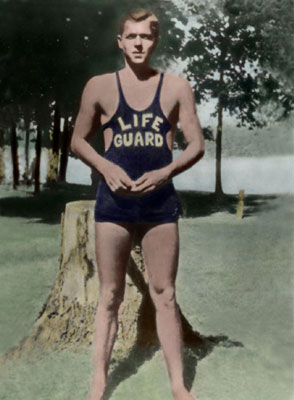
In his seven years as a lifeguard, Ronald Reagan saved 77 lives and a set of false teeth. (1931 photo)
Dutch was a short, skinny shy kid who wore thick, horn-rimmed glasses and was only an average student. But as he reached his teens, a summer job would become a defining experience in his life, forever changing his self-image.
(on camera): Ronald Reagan was 15 years old when he became a lifeguard here at Lowell Park on the Rock River. And as the story goes, when his shift was up and swimmers didn’t want to get out, he would toss pebbles from here and yell “River Rat!!!” But that’s not the only way to get swimmers out of the water. In seven summers as a lifeguard, he would go on to save 77 lives [and notched a mark on a wooden log for every life he saved, he said in an interview].
(voice-over): Helen Lotten remembers something else Reagan saved.
UNIDENTIFIED FEMALE: One time while he was a lifeguard, a man came up to him that had been swimming and he said, ‘Will you please dive in? I’ve lost my false teeth.’ He said, ‘I dove in and I can’t find them.’ So Dutch dove in several times, and he got them, he got them and he gave them to him, and the man was so pleased he gave him $10. And he [Reagan] said, ‘That was the first time I was ever paid for doing anything.’
PHILLIPS: Ronald Reagan loved being a lifeguard. He would recall his days on Rock River with great pride.
Biographer Edmund Morris said in an interview that being a lifeguard left Reagan with a lifelong desire to save people.
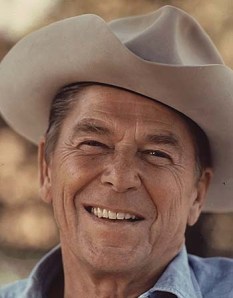
Ronald Reagan in a cowboy hat, circa 1976
In the last years of his life, Ronald Reagan, while suffering from the debilitating mental effects of Alzheimer’s, had the same “slow, unstoppable energy” of his youth. He remained active in these post-presidency years, taking walks through parks near his California home and on beaches, playing golf regularly, riding horses, and visiting his office in nearby Century City. (1) At his home, he would tirelessly rake leaves from the pool for hours, not knowing that the leaves were secretly being replenished by the Secret Service men. (2)
(1) Wikipedia. Ronald Reagan.
(2) Morris, Edmund. Dutch: A Memoir of Ronald Reagan. New York: Random House, Inc., 1999.
Here is part 5 0f 5 of the 1996 A & E “Biography” series on Eva Peron, “Evita: The Woman Behind the Myth.” Halfway through the tape, you will get an eyeful of Evita.
William Shakespeare as we have come to know him in Martin Droeshout's 1623 engraving for the First Folio
Today is William Shakespeare’s 445th birthday. In honor of the occasion, Chicago Mayor Richard Daley wants us all to celebrate by using the Bard’s words, declaring that today is “Talk Like Shakespeare Day.” The official website offers some suggestions as to how you can talk like Shakespeare:
Instead of you, say thou. Instead of y’all, say thee.
Rhymed couplets are all the rage.
Men are Sirrah, ladies are Mistress, and your friends are all called Cousin.
Instead of cursing, try calling your tormenters jackanapes or canker-blossoms or poisonous bunch-back’d toads.
Don’t waste time saying “it,” just use the letter
“t” (’tis, t’will, I’ll do’t).
Use verse for lovers, prose for ruffians, songs for clowns.
When in doubt, add the letters “eth” to the end of verbs (he runneth, he trippeth, he falleth).
To add weight to your opinions, try starting them with methinks, mayhaps, in sooth or wherefore.
When wooing ladies: try comparing her to a summer’s day. If that fails, say “Get thee to a nunnery!”
When wooing lads: try dressing up like a man. If that fails, throw him in the Tower, banish his friends and claim the throne.
This newly-discovered painting, known as the Cobbe, purports to be a portrait of William Shakespeare (reported in March, 2009)
William Shakespeare (1564-1616) also made his mark upon our vocabulary and many common expressions had their origin in his plays. The following is a smattering:
"Ophelia" by John Everett Millais. Hamlet was in love with Ophelia, whose death by drowning may have been a suicide. In the play, Hamlet's mother, Queen Gertrude, laments her death, strewing her grave with flowers, and saying: Sweets to the sweet: farewell!I hoped thou shouldst have been my Hamlet's wife;I thought thy bride-bed to have deck'd, sweet maid,And not have strew'd thy grave.
“Hamlet”
in my mind’s eye
to the manner born
the primrose path
it smells to heaven
there’s the rub
the dog will have his day
method in his madness
neither a borrower nor a lender be
“Othello”
the green-eyed monster
who steals my purse steals trash
a foregone conclusion
wear my heart on my sleeve
Lincoln assassin John Wilkes Booth, Edwin Booth, and Junius Booth, Jr. appear in a production of Shakespeare's "Julius Caesar," 1864. Although Shakespeare did not coin the word assassin, which means hash eater, the first recorded use of the word assassination occurred in his play, "Macbeth." Assassin John Wilkes Booth was a skilled and popular Shakespearean actor.
“Julius Caesar”
it was Greek to me
a dish fit for the gods
masters of their fates
the dogs of war
“1 Henry IV”
give the devil his due
the better part of valor is discretion
“2 Henry IV”
he has eaten me out of house and home
the weaker vessel
“Macbeth”
the milk of human kindness
a sorry sight
“As You Like It”
that was laid on with a trowel
too much of a good thing
“Romeo and Juliet”
what’s in a name?
a fool’s paradise
wild goose chase
“King Lear”
the wheel is come full circle
Leslie Howard as Romeo and Norma Shearer as Juliet in the 1936 film, "Romeo and Juliet." Romeo had been hiding in the garden when Juliet came out on the balcony and began her famous soliloquoy: "Romeo, Romeo, wherefore art thou Romeo?"
“Anthony and Cleopatra”
my salad days
“The Merry Wives of Windsor”
throw cold water on it
“Love’s Labor Lost”
out of the question
play fast and loose
“The Merchant of Venice“
my own flesh and blood
“Richard II”
a spotless reputation
“The Comedy of Errors”
something in the wind
“The Tempest”
we are such stuff as dreams are made on
“Troilus and Cressida”
good riddance
“The Comedy of Errors”
neither rhyme nor reason
“The Merry Wives of Windsor”
what the dickens
Readers: For more “Talk Like Shakespeare Today” posts, click here.
In a previous post, “The Strange Case of Patty Hearst: Part 1,” I wrote about the kidnapping of wealthy media heiress Patty Hearst by the Symbionese Liberation Army and her participation in their robbery of the Hibernia Bank in San Francisco on April 15, 1974. When the attorney general viewed a videotape of the bank robbery, identifying Patty as one of the five robbers, he issued a warrant for her arrest as a material witness. What Patty’s parents and all of America wanted to know: had this well-brought-up young lady really crossed over and joined her captors in their radical notion of justice? Or was Patty brainwashed and acting in fear of her life?
A month later, SLA members William and Emily Harris walked into Mel’s Sporting Goods in Englewood, California, to buy supplies for their safe house. While Emily paid at the register, William shoplifted some socks. A security guard noticed and attempted to arrest William Harris by placing a handcuff on his left wrist. They struggled and a .38-caliber handgun fell from William Harris’ waistband. Patty Hearst, on armed lookout from across the street in a red Volkswagen van, produced a semi-automatic rifle and started shooting out the store’s overhead sign. Shots cracked the concrete and shattered the window, and one of them ricocheted and slashed the forehead of the owner, Mrs. Huett. Everyone inside Mel’s took cover and William and Emily made their getaway with Patty behind the wheel of the van. They soon abandoned the van and took refuge in their safehouse at 1466 54th Street in Los Angeles.
From a parking ticket found inside the glove box of the abandoned van, the L.A.P.D. was able to locate the safe house. The next day, May 17, 400 L.A.P.D. officers along with the Federal Bureau of Investigation, California Highway Patrol, and Los Angeles Fire Department surrounded the neighborhood. They descended upon the hideout and conducted a live televised raid. It was one of the largest shootouts in police history with a reported total of over 9,000 rounds being fired by both the police and the SLA members who chose not to surrender. Six members of the SLA were killed, probably as a result of a combination of multiple gunshot wounds, smoke inhalation from the burning house, and burns. Among the dead was the SLA’s leader, Donald DeFreeze, an African American ex-convict who called himself General Field Marshal Cinque and Willie Wolfe, who was reported to be Patricia Hearst’s lover and called himself Cujo. Patty Hearst was not in the house during the siege. She and several other fugitives had seen the news coverage of the Mel’s Sporting Goods incident on TV the night before and fled.
Patty and the others remained on the run for over a year, crisscrossing the country and surviving by conducting small thefts. Authorities following the trail of SLA member Kathleen Soliah were eventually lead to the Harrises and Patty. On April 21, 1975, Kathleen Soliah (nee Sara Jane Olson) had robbed a bank in Carmichael, California, during which a mother of four was murdered and a young pregnant bank teller was kicked in the belly and later had a miscarriage. Patty had been Kathleen Soliah’s getaway driver.
1975 photo of Patty Hearst, handcuffed, in custody
Patty was finally arrested on September 18, 1975 at her apartment in the outer Mission District of San Francisco. As she was led away, Patty gave a clenched fist salute and listed her occupation on police papers as “urban guerrilla.” Patty Hearst’s mother, Catherine, expressed confidence that her daughter would not face imprisonment: “I don’t believe Patty’s legal problems are that serious. After all, she’s primarily a kidnap victim. She never went off and did anything of her own free will.”
Patty Hearst was brought to trial in 1976, represented by famed attorney F. Lee Bailey. (Read about the trial here.) Despite her claim that she had been tortured, raped, and brainwashed into submission by the SLA, the jury found it hard to believe her. She was convicted of armed robbery and sentenced to seven years in prison. After serving two years, President Jimmy Carter commuted her sentence. She married her bodyguard Bernard Shaw. In 2001, she received a full pardon from President Bill Clinton.
Patty Hearst with French bulldog Shann's Legally Blonde, winner of the 2008 "Best of Opposite Sex," Westminster Kennel Club
She now lives with her husband and two children, Gillian and Lydia. She raises French bulldogs that win red ribbons at Westminster Kennel Club competitions.
Before they took off on their World Tour in June of 1966, the Beatles had put the finishing touches on their new album, “Revolver.” Click below to hear the song that would prove prescient of the “Fab Four’s” horrible experience in Manila – “Taxman.”
Monday, July 4, 1966
Manila, the Philippines, the second stop for the Beatles on their 1966 World Tour
The Manila Hotel
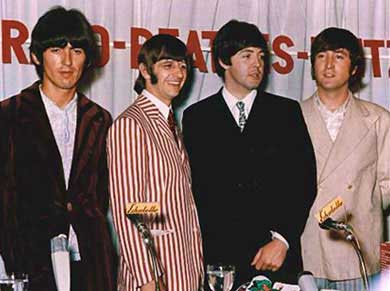
The Beatles: (l. to r.) George Harrison, Ringo Starr, Paul McCartney, John Lennon. ca. 1966
Manila, The Philippines:
Early in the morning, Tony Barrow, the Beatles’ publicist, and Vic Lewis, their booking agent, were awakened by sharp raps on the door of their suite. Two grim-looking men in military uniforms saluted and introduced themselves as the official reception committee from Malacañang Palace, the residence of President Ferdinand and First Lady Imelda Marcos.* They’d come to make final arrangements for the Beatles’ visit to the Palace for a luncheon hosted by the First Lady. (1)
Dictator Ferdinand Marcos with wife Imelda at his 1965 inauguration in the Philippines.
Neither Barrow nor Lewis knew what they were talking about. No one had told them that the Beatles were expected to make a presidential visit. The Beatles – John Lennon, Paul McCartney, George Harrison, and Ringo Starr – were sleeping, they explained, and couldn’t be disturbed. The band had just flown in from an exhausting concert in Tokyo. The “Fab Four” needed their rest, as they were schedule to give both afternoon and evening concerts in Manila that very day. Barrow and Lewis promised to pass along the request to Brian Epstein, the Beatles’ manager.
“This is not a request,” insisted the two men, one, a general, and the other, a commander, in the Philippine Army.
First Lady of the Philippines Imelda Marcos was a former beauty queen. Here she models a traditional gown. She regarded herself as a goddess and was used to having her way. 1963
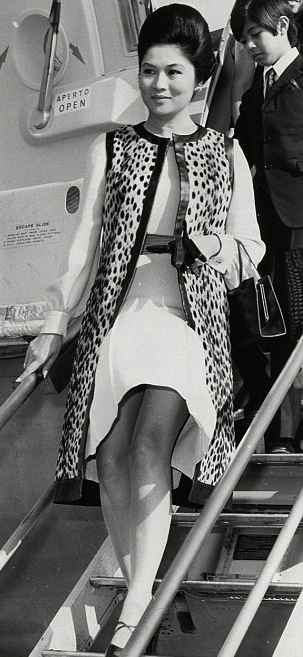
Fashion icon Imelda Marcos descends from a flight with her son Bong Bong. Undated photo
That afternoon, the Beatles performed their hits songs to an audience of 35,000. Afterwards, Tony Barrow and others in the Beatle’s entourage filed into Brian Epstein‘s suite to watch coverage of the concert on the evening news. They were pleased to discover that every channel featured scenes of screaming, swooning fans caught up in Beatlemania. However, Channel 5, one of the country’s major networks, ran additional footage not seen on the other channels. The scene showed the First Lady at the Palace with her disappointed luncheon guests, 200 children. The voice-over said, “The children began to arrive at ten. They waited until two….The place cards for the Beatles at the lunch table were removed.” Imelda Marcos was very mad as she and her guests filed into the grand dining room without their guests of honor. The spin was that the Beatles had deliberately snubbed the President and Mrs. Marcos by not showing up.
Brian Epstein went into full damage control mode. He issued a hastily written apology to the First Couple and called an interview with Channel 5 in his hotel suite, in which he professed complete ignorance of the invitation and praised the Marcoses. An hour later, the interview was broadcast but Brian’s appearance was blacked-out by static interference. That’s when everyone started to get nervous.
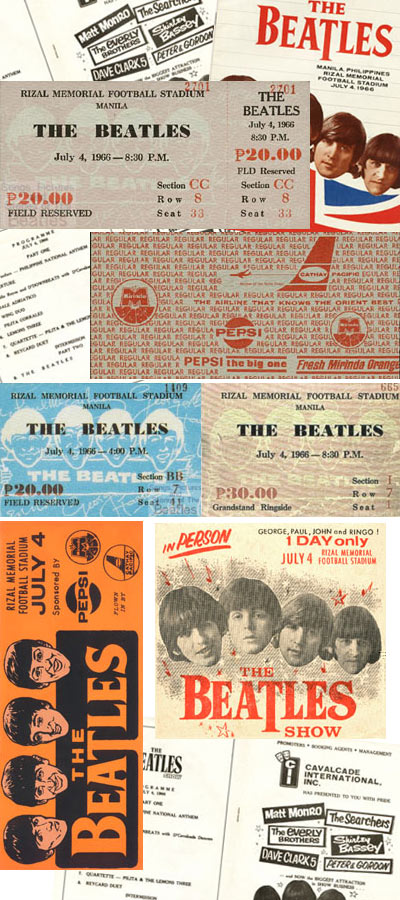
ticket stubs to the Beatles July 4, 1966 concerts in Manila
Worry soon turned to panic. After their evening show, the Beatles noticed that their police escort had disappeared. When their car pulled up to the Manila Hotel, the gates were locked against them. While they sat their in the idling car, wondering how they were going to get up to their suite, several dozen “organized troublemakers” attacked their car, banging on the windows, rocking it back and forth, and shouting threats in several languages. Vic Lewis shouted at the driver: “Drive on! Go through the people and smash the gates down!” The driver obeyed. At the entrance, everyone in the Beatles’ entourage ran into the hotel with the angry mob snapping at their heels.
Shortly, an official appeared at Vic Lewis’ suite demanding payment of local taxes. Lewis produced a contract stating that someone else – the promoter – had that responsibility, not the Beatles. This was brushed aside. Until all taxes were paid, said the taxman, no one in the Beatles party was being allowed to leave the country. When the man left, Lewis found Barrow. “We’ve got to get out of here – now.” He called the bell hop for help with the luggage.
The manager told Lewis that no one would be coming to help. “The whole hotel is going on strike. They think you’ve insulted President Marcos.” Bomb and death threats were telephoned to the deluged British Embassy and to the four Beatles’ hotel suite.
The next morning, Paul had seen the newspaper headlines blaring BEATLES SNUB PRESIDENT. The Beatles had known nothing of the invitation. “Oh, dear,” he thought. “We’ll just say we’re sorry.” About then “things started to get really weird,” recalled Ringo. He and John were hanging out in their bathrobes when a roadie popped his head in their room and shouted, “Come on! Get out of bed! Get packed – we’re getting out of here.”
Everyone in the entourage grabbed amplifiers and suitcases and made for the main elevators, but they were turned off. They had to take the service lift down. The halls were dark and lined with staff who shouted at them in Spanish and English. It was very frightening. When they got downstairs to check out, the front desk was deserted. Even their cars were gone. Someone managed to get a Town Car and everyone squeezed in and made for the airport.
But the airport route was sabotaged. Soldiers were stationed at intersections and roads were closed. Finally, they found a back road that led to the airport. The airport was deserted. “The atmosphere was scary,” remembered Tony Barrow, “as if a bomb was due to go off.” Once the Beatles got on the escalator, the power was shut off. As the Beatles moved through the terminal, little bands of demonstrators appeared, grabbing at them and trying to hit them.
Mobs rough up the Beatles at the Manila airport. John Lennon is at upper corner, right. July 6, 1966
They checked in for their flight as quickly as possible then were herded into a lounge “where an abusive crowd and police with guns had also gathered.” The cops began to shove the Beatles back and forth. It was impossible to tell the thugs from the military police. According to Ringo, “they started spitting at us, spitting on us.” The Beatles hid among a group of nuns and monks huddled by an alcove. Other members of their entourage, though, were kicked and beaten.
Finally, everyone was allowed to run across the tarmac to the plane. Vic Lewis felt sure he’d get a bullet in the back. The Beatles were terrified they’d be killed before they entered the safety of the airplane. Paul said, “When we got on the plane, we were all kissing the seats. It was feeling as if we’d found sanctuary. We had definitely been in a foreign country where all the rules had changed and they carried guns. So we weren’t too gung-ho about it at all.” Ringo remembered being afraid of going to jail. Ferdinand Marcos was a dictator (who, in a few years, would declare martial law in the Philippines.)
Everyone was poised for the plane to take off when the authorities came back on board and detained Tony Barrow for thiry minutes. For the plane to be allowed to take off with the Beatles on it, Tony was forced to pay a “leaving Manila tax” that amounted to the full amount of money the Beatles had made in their concerts before 80,000 fans.
Once the plane lifted off and everyone was safely in the air, all the anger of the past 24 hours boiled over. The Beatles blamed Brian for the debacle. He’d obviously received the invitation in Japan, ignoring it or misleading the Philippine authorities.
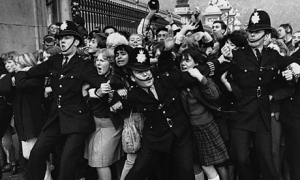
Beatlemania. October 1965, London, England, UK. Policemen struggle to restrain young Beatles fans outside Buckingham Palace as The Beatles receive their MBEs (Member of the British Empire) in 1965.
By the time the Beatles had landed in India, they had made a command decision. This would be their last tour. They were never going to go on another tour again. Never again, swore John, was he going to risk his life for a stadium filled with screaming 13-year-old girls.
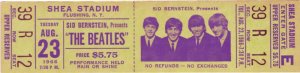
Brian said, “Sorry, lads, we have got something fixed up for Shea Stadium. If we cancel it you are going to lose a million dollars.” So they played New York’s Shea Stadium later that summer. It was the first stop on their U.S. tour, their final tour as the Beatles.
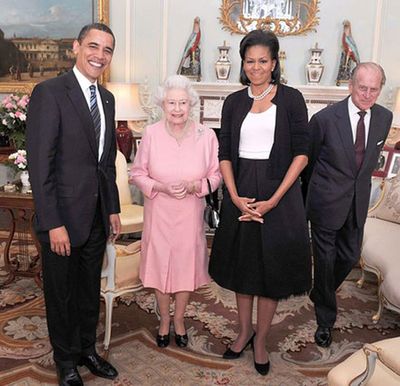
The Obamas being received at Buckingham Palace by Queen Elizabeth II
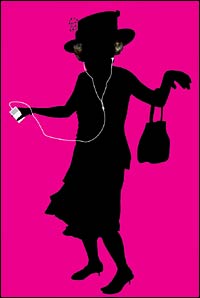
The Huffington Post is taking a survey on the purpose of Queen Elizabeth’s bag. Don’t forget to vote. Here is a close-up of Queen Elizabeth receiving Michelle Obama at Buckingham Palace on April 1. Inquiring minds want to know:
Why does the Queen carry her purse around her own home?
I’ve been blogging about the Obamas and their state visit to London and Buckingham Palace. There has been much discussion on and offline as to whether or not Michelle Obama was out of line when she touched the Queen. Royal protocol dictates that no one touches the Queen.
In my recent post, “Michelle Obama Hugs Queen Elizabeth,” I gave the first report of the touchy-feely action in royal quarters – that Michelle initiated the contact by placing her hand on the Queen’s back. Now, though, according to Vanity Fair Online, it may have been Queen Elizabeth who started the touching by slipping her right hand around Michelle’s waist. (The New York Times confirmed this on April 3.)
‘A mutual and spontaneous display of affection and appreciation,’ was how a Buckingham Palace spokesman hastened to describe it.
Queen Elizabeth and Michelle Obama at Buckingham Palace
As I mentioned in my recent post, “President Barack and Michelle Obama Give Queen Elizabeth an IPod,” the Obamas have visited Buckingham Palace and met with Queen Elizabeth and Prince Philip. As the two couples mingled with other diplomats in London for the Group of 20 Meeting, First Lady Michelle Obama reached out and touched the Queen on her back. The Queen responded warmly, wrapping her right arm around Michelle’s waist. Those listening to the two women say that the Queen remarked on how tall Michelle is. They also were looking down and talking about their shoes.
Everyone’s buzzing about this historic moment: Michelle Obamatouched the Queen! Royal protocol demands that no one touch the Queen. Even her royal consort, Prince Philip, must walk several paces behind her when the two are in public.
First Lady Jacqueline Kennedy and General Charles DeGaulle at a dinner at Versailles, France, June 1, 1961.
All this attention to the Obamas and their first visit to Europe as the First Couple takes me back to 1961 when President John Fitzgerald and Jacqueline (pronounced JAK LEEN’) Bouvier Kennedy made a state visit to France. Jackie Kennedy mesmerized the French with her style and elegance. She spoke fluent French and boasted a paternal French bloodline (Bouvier). Jackie was so charming that she even won the heart of President Charles DeGaulle, a man not easily conquered. At a dinner at the Elysee Palace, DeGaulle talked extensively to Jackie, then turned to President Kennedy and said, “Your wife knows more French history than any French woman.”
Jackie Kennedy so upstaged John on their trip overseas that the President joked, “I am the man who accompanied Jacqueline Kennedy to Paris.” Upon the Kennedys’ return to America, their popularity soared. The American public – and the rest of the world – had fallen in love with Jackie. To this day, she remains an American idol.
In my last post, “What’s Playing on Queen Elizabeth’s iPod?“, I reported that President Barack and Michelle Obama had given the Queen a new, full-loaded iPod as a gift. The royal monarch, who turns 73 on the 21st of this month, gave the Obamas a signed portrait of herself.
Obviously, the Obama team didn’t do extensive research when selecting an iPod as a gift for the Queen, not that there’s anything wrong with giving her an iPod. It’s just that she doesn’t need one! She already has an iPod. She bought one for herself back in 2005. Australian news outlet Fairfax Digital carried the June 17, 2005 announcement on its website:
Britain’s Queen Elizabeth II has dipped into the royal purse to snap up an iPod, a report said today.
Britain’s biggest-selling daily The Sun said the 79-year-old sovereign had bought a six-gigabyte silver model for £169 ($400.05).
The pocket-sized digital music players can hold up to 10,000 downloaded songs.
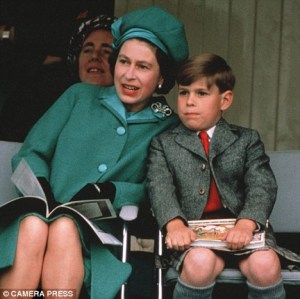
Queen Elizabeth II with son Prince Andrew when he was 7.
Queen Elizabeth’s second son Prince Andrew, fourth in line to the throne, was reported to be behind the move, having bought his mother a mobile phone and taught her how to use it in 2001.
“The Queen loves music and was impressed by how small and handy the iPod is,” a royal insider told The Sun.
“Obviously it is quite complicated to download songs, but I’m sure one of the courtiers will do it for her.
“Prince Andrew will probably also help out because he’s a real dab hand with gadgets.”
In London for the Group of 20 Meeting (see last post), President Barack and Michelle Obama visited Buckingham Palace yesterday. The Obamas gave Queen Elizabeth and Prince Philip a fully-loaded engraved iPod, with music and videos.
According to the Associated Press, the following songs were loaded onto Queen Elizabeth’s iPod:
“Oklahoma!”
“If I Loved You,” Jan Clayton, “Carousel”
“You’ll Never Walk Alone,” Jan Clayton, “Carousel”
“There’s No Business Like Show Business,” Ethel Merman, “Annie Get Your Gun”
“Once in Love with Amy (Where’s Charley?),” Ray Bolger
“Some Enchanted Evening,” “South Pacific”
“Diamonds Are a Girl’s Best Friend,” Carol Channing, “Gentlemen Prefer Blondes”
“Getting to Know You,” Gertrude Lawrence, “The King and I”
“Shall We Dance?” Gertrude Lawrence, “The King and I”
“I Could Have Danced All Night,” Julie Andrews, “My Fair Lady”
“I’ve Grown Accustomed to Her Face,” Rex Harrison, “My Fair Lady”
“The Party’s Over (Bells Are Ringing),” Judy Holliday
“Maria,” “West Side Story”
“Tonight,” “West Side Story”
“Seventy Six Trombones,” “The Music Man”
“Everything’s Coming up Roses,” Ethel Merman, “Gypsy”
“The Sound of Music”
“Try to Remember,” Jerry Orbach, “The Fantasticks”
“Camelot,” Richard Burton
“If Ever I Would Leave You,” Robert Goulet, “Camelot”
“Hello, Dolly!” Carol Channing
“If I Were a Rich Man,” Zero Mostel, “Fiddler on the Roof”
“People,” Barbra Streisand, “Funny Girl”
“On a Clear Day (You Can See Forever),” John Cullum
“The Impossible Dream,” Richard Kiley, “Man of La Mancha”
“Mame,” Charles Braswell
“Cabaret,” Liza Minnelli
“Aquarius, Ronald Dyson, “Hair’
“Send in the Clowns,” Judy Collins, “A Little Night Music”
“All That Jazz,” Chita Rivera, “Chicago”
“One,” “A Chorus Line”
“Tomorrow,” Andrea McArdle, “Annie”
“Don’t Cry for Me Argentina,” Patti LuPone, “Evita”
“And I Am Telling You I’m Not Going,” Jennifer Holliday, “Dreamgirls”
“Memory,” Elaine Paige, “Cats”
“The Best of Times,” George Hearn, “La Cage Aux Folles”
“I Dreamed a Dream,” Aretha Franklin, “Les MisDerables”
“The Music of the Night,” Michael Crawford, “The Phantom of the Opera”
“As If We Never Said Goodbye,” Elaine Paige, “Sunset Blvd.”
“Seasons of Love,” “Rent”
The Obamas met Queen Elizabeth and her husband, Prince Philip, at Buckingham Palace on Wednesday, April 1. The two couples exchanged gifts. The Obamas gave the queen an engraved iPod. The Queen’s new music player came already loaded with some Broadway show tunes and videos of her 2007 visit to Washington and Virginia. The Obamas also gave the Queen a rare songbook signed by the composer Richard Rodgers. The British royals gave signed silver-framed portraits of themselves to the Obamas, their standard gift for visiting dignitaries.
The Obamas Visit Buckingham Palace. Note that the Queen has that purse on her arm although she is at home!
If you enjoyed this post, you might also like the following:
Patricia Hearst shown with then fiancee Steven Weed
It was January 20, 2001, President Bill Clinton’s last day in office. In his last official act, Clinton granted a full pardon to a number of Americans, among them the notorious Patty Hearst, who had served two years for a bank robbery conviction.
Twenty seven years earlier, on February 4, 1974, Patty Hearst made headlines when she was abducted from her Berkeley, California, apartment which she shared with fiancee Steven Weed. Shots were fired and Weed was roughed up. Patty, wearing only her nightgown, was carried out front and stuffed into the trunk of a white getaway car. Her kidnappers were the radical urban guerrilla group, the Symbionese Liberation Army (SLA). Patty, a 19-year-old college sophomore, was the daughter of rich West Coast publishing tycoon Randolph Hearst. After Patty’s abduction, the SLA released a statement in which it called her kidnapping the “serving of an arrest warrant on Patricia Campbell Hearst.” It warned that any attempt to rescue Hearst would result in her execution. The message ended with: “DEATH TO THE FASCIST INSECT THAT PREYS UPON THE LIFE OF THE PEOPLE.”
The SLA had kidnapped the media heiress to increase news attention on their cause: their demand for the release of two imprisoned SLA members, Joseph Remiro and Russell Little, serving life terms for murder. Remiro and Little had been found guilty of killing Oakland school board member Marcus Foster, whom they detested for his idea of requiring Oakland school kids to carry identification cards. The SLA considered Foster to be a “fascist.” Foster was killed by the SLA as he walked out of a school board meeting. The hollow-point bullets they used to kill Dr. Foster had been packed with cyanide.
Patty’s abduction was sensational news around the world. At a time of student unrest and radical causes, Patty Hearst was an average though privileged girl who had given neither the law nor her family any real trouble. At first, through tapes given to the news media, the SLA demanded the Hearst family arrange for the release of Remiro and Little in exchange for Patty’s freedom. When that proved impossible, they demanded that the Hearst distribute millions of dollars in food to the needy as ransom. After the Hearsts donated over $6 million to the poor of the San Francisco Bay Area, the SLA refused to let Patty go, claiming the donated food had been inferior. Inexplicably, all negotiations ceased.
Patty Hearst (b. 1954) from a Symbionese Liberation Army photo
Over the next few weeks, the Hearsts received several tapes of Patty’s voice. More and more Patty began to expouse the cause of her captors. The Hearsts believed Patty was being forced to say these things, but then they received a photo of her with a carbine rifle in her arms, standing next to the seven-headed cobra, which was the SLA’s symbol. Then, on April 3, 1974, Patty is heard on a new audiotape saying: “I have been given the choice of being released…or joining the forces of the Symbionese Liberation Army and fighting for my freedom and the freedom of all oppressed people. I have chosen to stay and fight.” Patty also said that she had assumed the new name “Tania,” after the nom de guerre of revolutionary Che Guevera’s girlfriend. Patty had joined her captors.
Twelve days later, policemen were examining security camera footage of the Hibernia Bank robbery that day in San Francisco. The hold-up gang had shot two bystanders and gotten away with over $10,000. To their surprise, they recognized the face of missing girl Patty Hearst among the hold-up gang. She was brandishing a carbine and yelling orders like she was one of them. A warrant was issued for her arrest as a material witness. Opinion was divided: was Patty a willing participant or was she being forced to participate in the robbery against her will?
Shortly afterward, an audiotape was released by the SLA on which Hearst can be heard to say:
“Greetings to the people, this is Tania. Our actions of April 15 forced the Corporate State to help finance the revolution. As for being brainwashed, the idea is ridiculous beyond belief. I am a soldier in the People’s Army.”
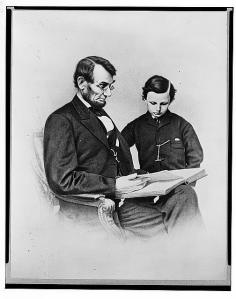
President Lincoln and son "Tad" (Thomas) in a February 9, 1864 photograph by Anthony Berger of the Brady Studio.
April 11, 1865 became the official day of celebrating the end of the Civil War. An even larger crowd was assembled on the White House lawn than the night before. (See last post.) The band was playing triumphant music, people were waving banners and shouting, “Hoorah!” and calling out for President Lincoln to speak. It was evening, but Washington D.C., was blazing with light. The Capitol, other government buildings, the White House, and private homes were lit up from within to ring in the good news.
A great cheer went up from the crowd when the President appeared on the second-floor balcony to deliver his speech. There he stood patiently and quietly as waves of applause rolled toward him. Finally, the crowd settled down and Lincoln, holding a candle in his left hand and his notes in his right, prepared to speak. But the juggling of the candle and his manuscript instantly proved awkward for the president. So he gave the candle to his friend Noah Brooks to hold. Son Tad knelt at his feet to catch each fluttering page of his father’s notes as he dropped them.
The crowd was silent when Lincoln began:
“Reuniting our country is fraught with great difficulty…and we differ among ourselves as to the mode and manner and means of reconstruction….”
Lincoln continued in this same vein, spelling out in greater and more boring detail the plans he had for reuniting the torn nation. The crowd was somewhat taken aback by the president’s tone. This was not the speech they’d expected. They had come to hear a rousing speech, praising the Union troops for their bravery and sacrifice, but, instead their president was droning on with no merriment, skipping past the present and jumping into the future without pausing to savor victory. Not waiting for the end of the president’s speech, some members of the crowd drifted away no doubt to find a jazzier way to spend the celebration.
John Wilkes Booth (1838-1865)
One of the people in the crowd that day was the famous young actor and Southern sympathizer John Wilkes Booth. Along with him were drugstore clerk David Herold and former Confederate soldier Lewis Powell, also known as Lewis Payne. Just weeks earlier, these three men and five others had been planning to kidnap Lincoln and exchange him for Confederate P.O.W.s. But now that the Confederacy had collapsed, Lee had surrendered, and Rebel P.O.W.s were being released, there was no incentive to kidnap the president. Still, Booth wanted to act. He hated Lincoln and considered him a tyrant along the lines of Julius Caesar. He was determined to do something heroic in defense of the South and to punish Lincoln.
Booth was startled to hear what the President said next. Lincoln said something that no other president had ever said publicly. He told the crowd that he was in favor of granting some black men the right to vote, especially, “the very intelligent and those who served our cause as soldiers.” One hundred eighty thousand black men had served in the Union Army.
Booth went ballistic. He turned to his fellow co-conspirator Powell. “That means nigger citizenship. That is the last speech he will ever make,” he vowed. He begged Powell to shoot Lincoln then and there. When Powell said no, Booth proclaimed, “By God, I’ll put him through.”
Booth was true to his word. It was the last speech Lincoln ever made. Four days later, the president would be dead, killed by a bullet fired into his head by John Wilkes Booth.
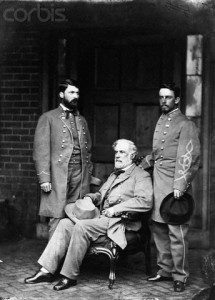
Confederate General Robert E. Lee, seated, with 2 of his officers, photographed by Mathew Brady in April, 1865, following Lee's surrender to General Ulysses S. Grant at the Appomattox Court House in Richmond, Virginia.
At daylight on April 10, 1865, the firing of 500 cannons spread the news throughout Washington, D.C., that the War Between the States was over and the Union preserved. The cannons were so loud that they broke windows on Lafayette Square, the neighborhood around the White House. (1) “Guns are firing, bells ringing, flags flying, bands playing, men laughing, children cheering – all, all jubilant,” wrote Secretary of the Navy Gideon Wells. (2)
Expecting the president to make a speech, several thousand people gathered outside the White House. President Lincoln was not sure what to say as he was planning on giving a formal address the following evening.Just then, his twelve-year-old son Tad appeared at a second-floor window, waving a captured Confederate flag. It gave the president an idea. He asked the Marine Band to play a favorite tune of his, “Dixie,” the unofficial Confederate anthem.
“I have always thought ‘Dixie” one of the best tunes I ever heard,” he told the surprised crowd. “It is good to show the rebels that with us they will be free to hear it again.”
True to the promise he made in his second inaugural address, Lincoln was already trying to bind up the nation’s wounds.
Now let’s hear Elvis Presley sing “Dixie.”
(1) White, Ronald C. A. Lincoln. (New York: Random House, 2009)
(2) Fleming, Candace. The Lincolns: A Scrapbook Look at Abraham and Mary. (New York: Schwartz & Wade, 2008)




 In a previous post, “
 From a parking ticket found inside the glove box of the abandoned van, the L.A.P.D. was able to locate the safe house. The next day, May 17,













 Lisa's History Room

