Feeds:
Posts
Comments

Archive for the ‘POLITICS & GOV'T’ Category

Uncle Sam's Menagerie

Uncle Sam's Menagerie

Issued in the wake of Lincoln’s assassination in April 1865, the political cartoon, “Uncle Sam’s Menagerie,” conveys the Northern hostility toward the conspirators, whom the public associated with former president of the Confederacy Jefferson Davis. Uncle Sam stands before a cage in which a hyena with the bonneted head of Jefferson Davis (1808-1889), president of the Confederacy, claws at a skull. Davis’ neck is in a noose, which will begin to tighten as a man at right turns the crank of a gallows. The bonnet on Davis’  head alludes to the embarrassing circumstances of his recent capture. As the Civil War drew to a close, Davis fled Richmond with his cabinet in early April 1865 and began a trek southward with federal troops in hot pursuit. While still weighing the merits of forming a government in exile,  Davis was captured by Union soldiers near Irwinville, Georgia, in early May 1865. Whether by accident or design, Davis was wearing his wife’s dark gray short-sleeved cloak and black shawl when captured.  

Below the caricature of Davis as a cross-dressing hyena, a man grinds out the song “Yankee Doodle” on a hand organ. Above, the Lincoln conspirators are portrayed as “Gallow’s Bird’s,” with their heads in nooses. From left to right they are: Michael O’Laughlin, David Herold, George Atzerodt, Lewis Paine, Mary Elizabeth Surratt, Samuel Arnold, Edman Spangler, and Dr. Samuel Mudd. At left, Uncle Sam points his stick at a skull “Booth,” on which sits a black crow. John Wilkes Booth was killed during a government raid on his hideout on April 26, 1865.

Read Full Post »

Eva Duarte de Peron, First Lady of Argentina (1946-1952)

Eva Duarte de Peron, First Lady of Argentina (1946-1952)

At 8:52 p.m. on the night of July 26, 1952, all radio broadcasts in Argentina were interrupted for an emergency announcement: First Lady Eva Peron – “the Spiritual Leader of the Nation” – was dead of cancer at 33. All activity came to an abrupt halt. Movies stopped playing. Shops closed. Restaurants were emptied of patrons. Argentina went into mourning.

The enormous public display of grief took the government by surprise. Crowds gathered outside the official presidential residence, congesting the streets for ten blocks in any direction. In a panic to be near Eva Peron’s body when it was being moved, eight people were crushed to death in the pressing throngs and 2,000 were treated for injuries at area hospitals. The streets of Buenos Aires were overflowing with tall stacks of flowers laid in remembrance for the people’s beloved Evita. Although she never held an official political office, Eva Peron (1919-1952) was eventually given an official funeral worthy of a head of state. To the poor of Argentina, Senora Evita was a saint.

The Body of Eva Peron Being Carried Through the Honor Guard to the building of the General Labor Federation in Buenos Aires to Lie in State (Aug. 13, 1952)

The Body of Eva Peron Being Carried Through the Honor Guard to the building of the General Labor Federation in Buenos Aires to Lie in State (Aug. 13, 1952)

Before Eva had died, her husband, Argentine President Juan Domingo Peron (1895-1974), had contacted the famed embalmer, Dr. Pedro Ara, whose work was referred to as “the art of death,” to preserve Eva’s body. Dr. Ara’s technique of replacing the corpse’s blood with glycerine, which preserved all organs, created a lifelike appearance. Eva weighed only eighty pounds at death and was severely burned from radiation treatments but Dr. Ara was able to recreate her former beauty and give her an embalmment equal to that of Lenin. It has been suggested that Dr. Ara fell in love with Eva’s body. Plans were made to build a marble monument to Evita’s honor larger than the Statue of Liberty. During the construction her embalmed body lay in state for two years.

Then President Peron was overthrown and the body of Eva Peron stolen. For sixteen years, the whereabouts of Eva’s body remained a mystery. Juan fled to Spain in exile. Finally, in 1971, Eva’s body was discovered in a grave under a false name outside of Rome. It was exhumed and flown to Spain where Juan Peron kept the corpse in an open casket on the dining room table in his villa. Juan was now married to third wife Isabel who combed the corpse’s hair in a daily devotion and, at Juan’s request, was rumored to occasionally lie inside the coffin next to Evita to absorb some of her political magic.

In 1974, Juan returned to power as president of Argentina. Upon his death, wife Isabel succeeded him. Isabel returned Eva’s body to Argentina where it was briefly displayed next to Juan’s body.

Bodies of Juan and Eva Peron Lying in State (c. 1974-76)

Bodies of Juan and Eva Peron Lying in State (c. 1974-76)

Isabel was overthrown in 1976. The new military leaders had Eva Peron’s body safely buried in the Duarte family tomb under three plates of steel in the Recoleta Cemetery in Buenos Aires. The tomb was said to be secure enough to withstand a nuclear attack or a restless corpse.

Now read “Eva Peron’s Restless Corpse Part 2.”


Read Full Post »

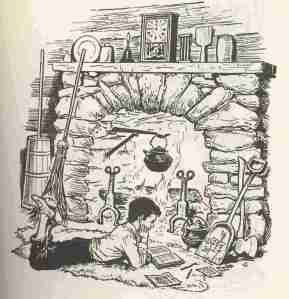
drawing of Abraham Lincoln as a boy

drawing of Abraham Lincoln as a boy

Today I want to get it just right. It is our precious Abe Lincoln’s 200th birthday. I want to choose just the right thing to say about him in this blog that does the great man justice, that gives us a look into his fine soul.

When I think of Lincoln, I think of his honesty, yes, his courage, of course, but mainly what comes to mind is his unfailing kindness – to Mary, his wife, when she was yelling at him while he was president and under the most terrific strain from the Civil War. He just shrugged off her verbal and sometimes physical assaults, picked up Willie or Tad and put them on his shoulders, and walked out of the room. He did not utter a harsh word at her. During his presidency, the White House was open to Civil War veterans and widows who wanted to meet with Lincoln. He would never refuse to see a one of them though he was terribly overworked, with little staff to help him run the country.

His kindness for the weakest among us showed up early in his youth. It is believed that his father Thomas Lincoln was ashamed that Abe was sensitive and fond of books, storytelling, and poetry, considering such interests “soft.” Thomas Lincoln felt contempt to discover such sentimentality in his own son. Lincoln and his father never were close. They remained isolated from one another from the time of Lincoln’s mother’s death when Abe was 9. The bad blood between them was never resolved. When Thomas Lincoln lay dying, Abraham refused a request to visit his father’s sickbed and did not attend his father’s funeral.

The following anecdote from Lincoln’s boyhood illustrates how his heart ached for the unfortunate:

He was always the champion of the helpless, no matter how humble the object of any ill-treatment might be. One day he came and caught a group of mischievous boys putting live coals on a poor mud-turtle’s back. The lads, and several girl friends, laughed to see the turtle moving slowly and aimlessly about in its surprise and misery. When Abe Lincoln saw what was going on he dashed into the group in a frenzy of wrath, snatched the shingle from the ringleader’s hand, dashed the burning coals off the poor turtle’s back, then began beating the boys with the thin board. When he had scattered them right and left, according to one of the girls who witnessed the sudden scene, “he preached against such cruelty” and, with angry tears in his deep gray eyes, told the snickering offenders that a terrapin’s or “an ant’s life is as sweet to it as ours is to us.” (1)

This boy champion of the underdog grew into a man and the 16th President of the United States of America. As a boy, he freed the turtle; as a man, he freed the slaves. Lincoln famously declared,

If slavery is not wrong, nothing is wrong.  

Happy 200th Birthday, Abe Lincoln.

(1) Whipple, Wayne. The Heart of Lincoln. (Philadelphia: George W. Jacobs & Co., 1915)

Read Full Post »

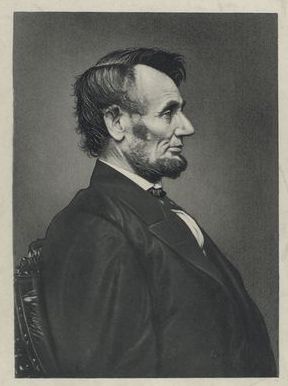
Taken by Alexander Gardner on February 9, 1864. This photograph would serve as the image that engraver Victor David Brenner would use to create the bas relief of Lincoln used on the penny.

Abraham Lincoln (1809-1865)Taken by Alexander Gardner on February 9, 1864, this photograph served as the image engraver Victor David Brenner would use to create the bas relief of Lincoln found on the 1909 penny.

It is President Teddy Roosevelt we have to thank for giving us the first Lincoln penny. Until the Lincoln penny debuted in 1909, no likeness of an actual person had appeared on a “regular-denomination circulating United States coin.” Too monarchial, deemed our first head of state, George Washington. Emperors, kings, and other authority figures had long stamped coins with their images to declare their power. Young America was done with that kind of governing. So the Mint Act of 1792 dictated that American coins would instead be “an impression emblematic of liberty.”

As a result, the coin designs of liberty – depicted by goddesses, mainly- grew “dowdy and uninspired.” President Roosevelt complained to his secretary of the treasury that, “Our coinage is artistically of atrocious hideousness.” So Roosevelt directed him to stamp the image of Lincoln on the one-cent piece to commemorate Lincoln’s 100th birthday.

It was done. When the Lincoln penny was released into circulation, it was a hit with the American people. Long lines formed at banks and Treasury buildings in New York, Washington, Boston, and other cities to snap up the new coins. In Philadelphia, some of the pennies were sold for 25 cents. It had been 44 years since Lincoln was assassinated. He was an icon. People were excited that they recognized the face on the coin.

Of course, as Lincoln himself remarked, you can’t please all the people all the time. Some people grumbled about the new coin, Confederate veterans, of course, plus the New York Times, calling it “another ill-considered freak of Mr. Roosevelt’s will.”

Nowadays, the complaints about the penny are different. There are some people who want to get rid of the penny altogether. Due to the rising price of metal, the cost of making the “copper-coated zinc corpus” (1.4 cents) now exceeds its face value.

Read Full Post »

Lincoln statue at the Lincoln Memorial

Lincoln statue at the Lincoln Memorial

Tucked into the massive central hall of the Lincoln Memorial sits an imposing marble statue of Abraham Lincoln. Over Lincoln’s head is inscribed:

IN THIS TEMPLE

AS IN THE HEARTS OF THE PEOPLE

FOR WHOM HE SAVED THE UNION

THE MEMORY OF ABRAHAM LINCOLN

IS ENSHRINED FOREVER 


The statue stands over 19 feet tall. Lincoln is shown in a seated position, but, if he could get up, he would stand 28 feet tall. He wears an expression of firm determination, eyes fixed rather sadly looking out onto the National Mall toward the Washington Monument.  Sculptor Daniel Chester French (1850-1931) began work on his design for the statue in 1915, making many bronze and plaster models. The sculptor consulted photographs by the well-known Civil War photographer Mathew Brady and used Lincoln’s life mask as well as casts of Lincoln’s own hands as models.

Lincoln's left hand

Lincoln's left hand

Now look at both of Lincoln’s hands. There’s a popular legend that Lincoln is shown using manual sign language to sign his initials, with his left hand shaped like the letter “A” and his right hand to form an “L.”  The National Park Service denies that this is the case. There is no evidence that Daniel Chester French intended for Lincoln’s hands to be formed into sign language letters. Nevertheless, it’s possible. Believers point out that a National Geographic Society publication states that French had a son who was deaf  – and French himself knew sign language.  He would have had good reason to do so, too, to honor Lincoln, as it was President Lincoln who signed into law the ability for Gallaudet University, a school for the deaf, to grant college degrees.

Lincoln's right hand

Lincoln's right hand

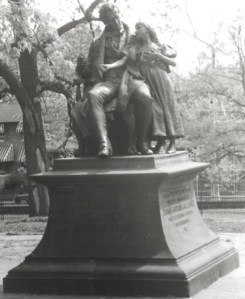
There are those who say French did shape Lincoln’s hands in this fashion on purpose yet others insist he didn’t. There is, however, evidence he could have. French had used sign language  in his sculptures before. In his 1889 portrait of deaf educator Thomas Gallaudet shown with his first student, Alice Cogswell, Gallaudet uses his right hand to make the sign for the letter “A” as Alice, too, makes the “A” sign with her right hand.

Thomas Gallaudet sculpture by Daniel Chester French

Thomas Gallaudet sculpture by Daniel Chester French

Read Full Post »

penny

penny-with-lincoln-memorial

In one week, the nation will celebrate the 200th birthday of our most revered president, Abraham Lincoln (February 12, 1809 – April 14, 1865). To commemorate the birthday of our 16th president and the issuing of the first penny a century ago, the U.S. Mint is issuing four new pennies. The “heads” side of the penny bearing Lincoln’s image remains the same while the “tails” side will alternate four new designs which represent the four major aspects of President Lincoln’s life:

Birth and early childhood in Kentucky (1809-1816)
Formative years in Indiana (1816-1830)
Professional Life in Illinois (1830-1861)
Presidency in Washington, DC (1861-1865)

Click here to see the unveiling of the images of the new coins at a ceremony held last September in Washington, D.C.

I hadn’t intended to write about Abe Lincoln today. Rather, for days now, I’ve gorged myself reading about his wife Mary, hoping soon to come to the end of the book and Internet material on her and get down to blogging. Well that is an impossible task. There is no end of Lincolnology. At last count, there were upward of 15,000 books about Abe and Mary, more than about any other person except Jesus.

A visit to the official website of the Lincoln Bicentennial assures me that I can blog all year on the Lincolns and be in step with the rest of the country, as celebrations and exhibits go on for the next eleven months.

While I was googling the image of the Lincoln Memorial which I present here, I got all misty-eyed.

Lincoln statue within the Lincoln Memorial

Lincoln statue within the Lincoln Memorial

What a great man Abraham Lincoln was. After reading about his life with Mary, I come away with even more admiration. What a difficult woman Mary was and so selfish, too (see my Feb. 3, 2009 blog below). I’ll give her credit for her abolitionist efforts but what a drag she was on our president during the darkest time of our nation’s history! She was jealous of his time away from her. He was running the country!

When I was in elementary school, February was the month we celebrated two presidents’ birthdays – Lincoln’s on the 12th and Washington’s on the 22nd. This was before there was an official “Presidents’ Day,” a day set aside to celebrate the birth of all presidents and before February became “Black History Month.” My teachers would always have a beautiful bulletin board displayed with a calendar, white doilies with red hearts for Valentine’s Day, and black cardboard cut-outs of Lincoln’s and Washington’s silhouettes. I love February.

I learned that Lincoln was poor and lived in a log cabin, that he was humble, gave speeches outdoors, and chopped firewood. We heard the Mason Weems fable that Washington could not lie to his father about chopping down a cherry tree.
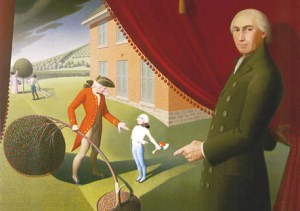
washington_cherry-tree

My birthday comes two days after Washington’s. As a result, I’ve always had cherry pie instead of cake for my special dessert, because of George chopping down that cherry tree. On one birthday, my grandmother Mimi made cherry tarts for my guests and me and we went to the movies to see Lucille Ball and Bob Hope in the comedy, “Fancy Pants.”

Back to the Lincoln penny, isn’t it ironic that a president who grew up “friendless, uneducated, penniless…” should find himself commemorated on a penny? Happy Early Birthday, Abe. You rock.

5-lincoln-m

Read Full Post »

Ty, the company that makes Beanie Babies, is honoring First Lady Michelle Obama’s wishes and dropping the names “Marvelous Malia” and “Sweet Sasha” from its Ty Girlz collection. CEO Ty Warner still maintains that the dolls weren’t intended to look like Malia and Sasha Obama. The dolls will be renamed Mariah and Sydney.

Read Full Post »

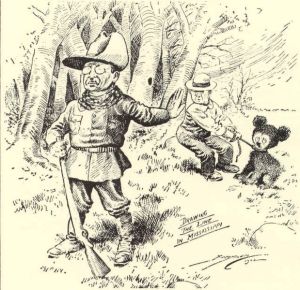
11/16/1902 Washington Post cartoon by Clifford Berryman, "Drawing the Line in Mississippi"

11/16/1902 Washington Post cartoon by Clifford Berryman, "Drawing the Line in Mississippi"

Everyone knows that the teddy bear is named after the twenty-sixth president of the United States, Theodore “Teddy” Roosevelt, but they may not know why.

It happened in November of 1902. Teddy Roosevelt was on a bear-hunting trip through Louisiana and Mississippi. It was an “exasperating” hunt, said Roosevelt, and after five days, he never got a shot. Out of pity, his companions corraled and roped a bear for his prey. But Roosevelt refused to kill a defenseless animal. The press printed the story and the public applauded their president’s restraint. But the story really caught fire when a political cartoon appeared on the front page of the Washington Post two days later, with cartoonist Clifford Berryman portraying Roosevelt as “turning away with disgust, with sloped rifle,” from a “very black bear being roped around the neck by a very white catcher.” (1)

Berryman was commenting on Roosevelt’s race relations. Roosevelt thought that “negroes” as a group were far inferior to whites. He, however, also believed that individual blacks could rise to social heights. In 1901, he became the first president to invite a black man to the White House when he sat down to dinner with African-American educator Booker T. Washington.

Anyway, whether or not the readers of the Post picked up on Berryman’s allegory is not what we remember today. What is recalled is that the cartoon sparked a full-scale teddy bear craze. (2) The public fell in love with the cartoon bear. People wrote and begged Berryman to draw more “bear cartoons,” which he did. In subsequent cartoons, he made the bear rounder, smaller, and cuter, and thus all the more endearing with its prickly pear ears,  imploring eyes, and scraggly fur.

Skip to a candy and toy shop in Brooklyn. Shop owner  Morris Michtom had seen Berryman’s cartoon. He asked his wife Rose to create a stuffed bear like the one in the cartoon.

That night, Rose cut and stuffed a piece of plush velvet into the shape of a bear, sewed on shoe button eyes and handed it to Morris to display in the shop window. He labeled it, “Teddy’s bear.” (3)

To Michtom’s surprise, not just one but a dozen customers wanted to buy the bears. Michtom received Roosevelt’s permission to use his name on his product and began the mass production of the cuddly toy bears which sold for $1.50.

Oregon family c.1900 with prized family teddy bear

Oregon family c.1900 with prized family teddy bear

Today the teddy bear craze is still going strong and we think of teddy bears as being toys for children. But, back at the beginning, women bought the teddy bears for themselves, made them clothes they read about in Ladies’ Home Journal, and carried them with them everywhere.

(1) Morris, Edmund. Theodore Rex. Random House: New York, 2001.
(2) History.com: http://www.history.com/home.do
(3) Jewish Virtual Library: www.jewishvirtuallibrary.org

Read Full Post »

Ty, the maker of Beanie Babies, is introducing two new Ty Girlz dolls named Marvelous Malia and Sweet Sasha

Ty Girlz dolls named Marvelous Malia and Sweet Sasha

The Obama Girls are hot and Ty, the maker of Beanie Babies, is riding the wave. They just came out with two new dolls, Marvelous Malia and Sweet Sasha, that are obviously modeled after the two new First Daughters, though the toy company denies it . However, the soft brown-skinned dolls appear to be the only African-American ones in the 30-doll Ty Girlz collection.
These little dolls are darling. Kids are going to love them. They will be infinitely more fun to play with than the presidential paper dolls Dover produces.
Dover Publications

Dover Publications

Read Full Post »

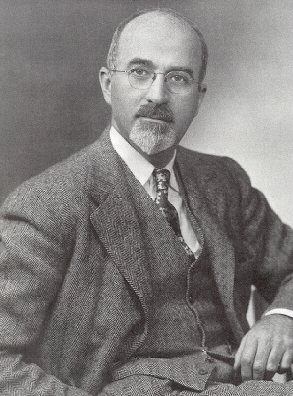
Dr. Walter Freeman, the ice pick lobotomist

Dr. Walter Freeman, the ice pick lobotomist

I’d fully intended to move away from the subject of insane asylums and talk about a cowgirl from Oklahoma by the name of Lucille Mulhall. But I cannot in good conscience leave the subject without telling what I’ve learned about the barbaric brain surgeon responsible for Rosemary Kennedy’s lobotomy, the operation that permanently incapacitated her at the young age of 23. Rosemary had been acting in an agitated behavior, according to her father, Joseph P. Kennedy, throwing fits and showing interest in boys, and he sought an operation to settle her down. Two doctors were in the operating room that day in 1941: Dr. Walter Freeman, the director of the laboratories at St. Elizabeth’s Hospital in Washington, D.C., together with his partner, James W. Watts, MD, from the University of Virginia.

Dr. Freeman was obsessed with finding a cure for mental illness. In the day before psychiatric drugs, mentally ill patients were shuttered away in institutions like St. Elizabeth’s. Shock therapy, pioneered in the thirties, though not completely successful, had effectively reduced some psychiatric symptoms in agitated patients, rendering them calmer for a time following treatment. Psychiatrists like Dr. Freeman wanted to find the locus of mental illness of the brain. They understood that there were regions of the brain and were looking for surgical answers instead of just locking people up for life. Freeman, however, was not a surgeon but a neurologist. He was wildly ambitious and longed to achieve the lasting fame of his grandfather, a pioneer brain surgeon, once the president of the American Medical Association. Freeman was determined to find a procedure that would root out the defect in the brain that he believed responsible for mental illness.

Freeman discovered the work of a Portuguese neurologist named Egas Moniz who had performed a radical new operation on a group of 20 mental patients. By taking small corings of their brains, Moniz asserted, it had been possible to rid a third of these patients of their symptoms. Moniz didn’t explain why this worked. He had a crude notion that people “who are mentally ill are sort of obsessed, he called them fixed ideas. And that these fixed ideas probably resided in some way in the frontal lobes.”

Along with Dr. Watts, Freeman began to perform lobotomies, or surgeries on the frontal lobes. After several operations, Dr. Freeman called his operation a success. According to Edward Shorter, Medical Historian, “Freeman’s definition of success is that the patients are no longer agitated. That doesn’t mean that you’re cured, that means they could be discharged from the asylum, but they were incapable of carrying on normal social life. They were usually demobilized and lacking in energy. And they were that on a permanent basis.” Many had to be retaught how to use the toilet. They were definitely not the same persons they were before the operation.

Why didn’t the medical establishment stop Drs. Freeman and Watts from performing this radical and untested procedure? This was back in the day when it was considered unethical for doctors to criticize their peers – plus, Dr. Freeman manipulated the press in his favor. He proclaimed he’d found a cure for mental illness. Soon he was receiving glowing reviews. The Washington Star called prefrontal lobotomy “One of the greatest surgical innovations of this generation.” The New York Times called it “surgery of the soul,” and declared it “history making.”

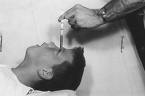
It gets worse. Freeman decided that there was a simpler way to get into the brain than through the top of the skull, as he had done with Rosemary Kennedy. He decided that the skull was thinner behind the eye and that he could make an incision there with an ice pick. Freeman “would hammer the ice pick into the skull just above the tear duct and wiggle it around.”

transorbital lobotomy

transorbital lobotomy

He began to travel around the nation in his own personal van, which he called his “lobotomobile”, hawking this new procedure which he performed with a gold ice pick, and training other doctors in his methods. He even performed a few lobotomies in hotel rooms. Before he was stopped and the lobotomy discredited, Walter Freeman had performed over 3,500 lobotomies. His medical license was revoked when one of his patients died during a lobotomy. Nevertheless, he continued to tour the country in his lobotomobile, visiting his former patients, until his death from cancer in 1972.

Read Full Post »

Releasing Lunatics from their Chains (Robert-fleury)

Releasing Lunatics from their Chains (Robert-fleury)

I was recalling something my grandmother told me about a “field trip” she and her sister Maurine took to Austin, Texas, back in the 1920’s. Both Grandmother and Aunt Maurine were young and single, living in Lufkin, Texas. They had heard all about the state lunatic asylum and wanted to see it for themselves. I think they were hoping to spot a flesh and blood lunatic. The trip was a real highlight.

The two took the train all alone from East Texas to Austin to visit the asylum.

 “It’s lucky they weren’t captured,” says my sister Loise.

I’ve seen the maps of Austin from those days. The important buildings are marked, including the University of Texas, the State Capital, and the State Lunatic Asylum.  True, the Lunatic Asylum was a garden spot and people other than my relatives were drawn to it for good reasons. But I think novels like Jane Eyre give us an insight into attitudes toward the mentally ill. They were weird, scary, and dangerous.

Evidently the Texas State Lunatic Asylum was ahead of its time in its compassionate approach toward the mentally ill. The asylum movement in America and Europe at that time “strived to provide a healthy diet, exercise, fresh air, adequate rest, a strict daily routine, social contact, and a kind but firm approach,” according to the website of the Texas Dept. of State Health Services (1). No longer flogging the patient or tossing cold water on him, the treatment for the mentally ill in the first half of the twentieth century was still far from humane. 

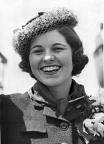
Rosemary Kennedy

Rosemary Kennedy

In 1941, Joseph Kennedy authorized a frontal lobotomy for his beautiful special needs daughter Rosemary, who was proving to be a bit of an embarrassment to him when she tripped curtseying to the Queen of England.

According to Dr. Watts, a surgeon assisting in the lobotomy of Rosemary Kennedy: 

“We went through the top of the head, I think she was awake. She had a mild tranquilizer. I made a surgical incision in the brain through the skull. It was near the front. It was on both sides. We just made a small incision, no more than an inch.” The instrument Dr. Watts used looked like a butter knife. He swung it up and down to cut brain tissue. “We put an instrument inside,” he said. As Dr. Watts cut, Dr. Freeman put questions to Rosemary. For example, he asked her to recite the Lord’s Prayer or sing “God Bless America” or count backwards. … “We made an estimate on how far to cut based on how she responded.” … When she began to become incoherent, they stopped.” (2)

1. http://www.dshs.state.tx.us/mhhospitals/AustinSH/ASH_About.shtm

2. http://en.wikipedia.org/wiki/Rosemary_Kennedy

NEXT: Stunt reporter for THE NEW YORK WORLD Nellie Bly writes TEN DAYS IN A MAD-HOUSE

Read Full Post »
« Newer Posts