Feeds:
Posts
Comments

Archive for the ‘British Royal Family/Nobles’ Category

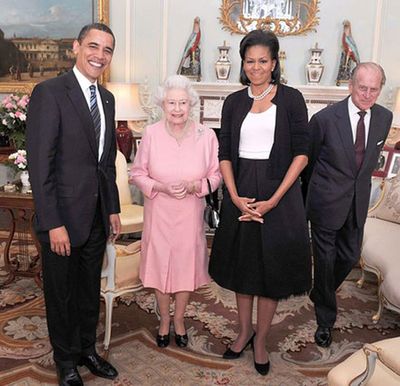
The Obamas being received at Buckingham Palace by Queen Elizabeth II

The Obamas being received at Buckingham Palace by Queen Elizabeth II

The Huffington Post is taking a survey on the purpose of Queen Elizabeth’s bag. Don’t forget to vote. Here is a close-up of Queen Elizabeth receiving Michelle Obama at Buckingham Palace on April 1. Inquiring minds want to know:

Why does the Queen carry her purse around her own home?

For more on the Queen’s handbag habit, read another post on this blog, “What’s in Queen Elizabeth’s Purse?”

Read Full Post »

Michelle Obama with Queen Elizabeth

Michelle Obama with Queen Elizabeth

I’ve been blogging about the Obamas and their state visit to London and Buckingham Palace. There has been much discussion on and offline as to whether or not Michelle Obama was out of line when she touched the Queen. Royal protocol dictates that no one touches the Queen.

In my recent post, “Michelle Obama Hugs Queen Elizabeth,” I gave the first report of the touchy-feely action in royal quarters – that Michelle initiated the contact by placing her hand on the Queen’s back. Now, though, according to Vanity Fair Online, it may have been Queen Elizabeth who started the touching by slipping her right hand around Michelle’s waist. (The New York Times confirmed this on April 3.)

‘A mutual and spontaneous display of affection and appreciation,’ was how a Buckingham Palace spokesman hastened to describe it.

Read Full Post »

Queen Elizabeth and Michelle Obama at Buckingham Palace

Queen Elizabeth and Michelle Obama at Buckingham Palace

 As I mentioned in my recent post, “President Barack and Michelle Obama Give Queen Elizabeth an IPod,” the Obamas have visited Buckingham Palace and met with Queen Elizabeth and Prince Philip. As the two couples mingled with other diplomats in London for the Group of 20 Meeting, First Lady Michelle Obama reached out and touched the Queen on her back. The Queen responded warmly, wrapping her right arm around Michelle’s waist. Those listening to the two women say that the Queen remarked on how tall Michelle is. They also were looking down and talking about their shoes.

Everyone’s buzzing about this historic moment: Michelle Obama touched the Queen! Royal protocol demands that no one touch the Queen. Even her royal consort, Prince Philip, must walk several paces behind her when the two are in public.

First Lady Jacqueline Kennedy and General Charles DeGaulle at a dinner at Versailles, France, June 1, 1961.

First Lady Jacqueline Kennedy and General Charles DeGaulle at a dinner at Versailles, France, June 1, 1961.

All this attention to the Obamas and their first visit to  Europe as the First Couple takes me back to 1961 when President John Fitzgerald and Jacqueline (pronounced JAK LEEN’) Bouvier Kennedy made a state visit to France. Jackie Kennedy mesmerized the French with her style and elegance. She spoke fluent French and boasted a paternal French bloodline (Bouvier). Jackie was so charming that she even won the heart of President Charles DeGaulle, a man not easily conquered. At a dinner at the Elysee Palace, DeGaulle talked extensively to Jackie, then turned to President Kennedy and said,  “Your wife knows more French history than any French woman.”

Jackie Kennedy so upstaged John on their trip overseas that the President joked, “I am the man who accompanied Jacqueline Kennedy to Paris.” Upon the Kennedys’ return to America, their popularity soared. The American public – and the rest of the world – had fallen in love with Jackie. To this day, she remains an American idol.

Read Full Post »

Apple iPod

Apple iPod

Oops!!! Someone on the Obama team goofed.

In my last post, “What’s Playing on Queen Elizabeth’s iPod?“, I reported that President Barack and Michelle Obama had given the Queen a new, full-loaded iPod as a gift. The royal monarch, who turns 73 on the 21st of this month, gave the Obamas a signed portrait of herself.

Obviously, the Obama team didn’t do extensive research when selecting an iPod as a gift for the Queen, not that there’s anything wrong with giving her an iPod. It’s just that she doesn’t need one! She already has an iPod. She bought one for herself back in 2005. Australian news outlet Fairfax Digital carried the June 17, 2005 announcement on its website:

Britain’s Queen Elizabeth II has dipped into the royal purse to snap up an iPod, a report said today.

Britain’s biggest-selling daily The Sun said the 79-year-old sovereign had bought a six-gigabyte silver model for £169 ($400.05).

The pocket-sized digital music players can hold up to 10,000 downloaded songs.

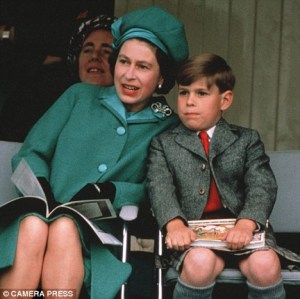
Queen Elizabeth II with son Prince Andrew when he was 7.

Queen Elizabeth II with son Prince Andrew when he was 7.

Queen Elizabeth’s second son Prince Andrew, fourth in line to the throne, was reported to be behind the move, having bought his mother a mobile phone and taught her how to use it in 2001.

“The Queen loves music and was impressed by how small and handy the iPod is,” a royal insider told The Sun.

“Obviously it is quite complicated to download songs, but I’m sure one of the courtiers will do it for her.

“Prince Andrew will probably also help out because he’s a real dab hand with gadgets.”

Read Full Post »

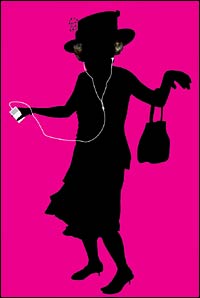
Queen Elizabeth Jiving to Her New IPod

Queen Elizabeth Jiving to Her New IPod

In London for the Group of 20 Meeting (see last post), President Barack and Michelle Obama visited Buckingham Palace yesterday. The Obamas gave Queen Elizabeth and Prince Philip a fully-loaded engraved iPod, with music and videos.

According to the Associated Press, the following songs were loaded onto Queen Elizabeth’s  iPod:

“Oklahoma!”
“If I Loved You,” Jan Clayton, “Carousel”
“You’ll Never Walk Alone,” Jan Clayton, “Carousel”
“There’s No Business Like Show Business,” Ethel Merman, “Annie Get Your Gun”
“Once in Love with Amy (Where’s Charley?),” Ray Bolger
“Some Enchanted Evening,” “South Pacific”
“Diamonds Are a Girl’s Best Friend,” Carol Channing, “Gentlemen Prefer Blondes”
“Getting to Know You,” Gertrude Lawrence, “The King and I”
“Shall We Dance?” Gertrude Lawrence, “The King and I”
“I Could Have Danced All Night,” Julie Andrews, “My Fair Lady”
“I’ve Grown Accustomed to Her Face,” Rex Harrison, “My Fair Lady”
“The Party’s Over (Bells Are Ringing),” Judy Holliday
“Maria,” “West Side Story”
“Tonight,” “West Side Story”
“Seventy Six Trombones,” “The Music Man”
“Everything’s Coming up Roses,” Ethel Merman, “Gypsy”
“The Sound of Music”
“Try to Remember,” Jerry Orbach, “The Fantasticks”
“Camelot,” Richard Burton
“If Ever I Would Leave You,” Robert Goulet, “Camelot”
“Hello, Dolly!” Carol Channing
“If I Were a Rich Man,” Zero Mostel, “Fiddler on the Roof”
“People,” Barbra Streisand, “Funny Girl”
“On a Clear Day (You Can See Forever),” John Cullum
“The Impossible Dream,” Richard Kiley, “Man of La Mancha”
“Mame,” Charles Braswell
“Cabaret,” Liza Minnelli
“Aquarius, Ronald Dyson, “Hair’
“Send in the Clowns,” Judy Collins, “A Little Night Music”
“All That Jazz,” Chita Rivera, “Chicago”
“One,” “A Chorus Line”
“Tomorrow,” Andrea McArdle, “Annie”
“Don’t Cry for Me Argentina,” Patti LuPone, “Evita”
“And I Am Telling You I’m Not Going,” Jennifer Holliday, “Dreamgirls”
“Memory,” Elaine Paige, “Cats”
“The Best of Times,” George Hearn, “La Cage Aux Folles”
“I Dreamed a Dream,” Aretha Franklin, “Les MisDerables”
“The Music of the Night,” Michael Crawford, “The Phantom of the Opera”
“As If We Never Said Goodbye,” Elaine Paige, “Sunset Blvd.”
“Seasons of Love,” “Rent”

Read Full Post »

 
The Obamas met Queen Elizabeth and her husband, Prince Philip, at Buckingham Palace on Wednesday, April 1. The two couples exchanged gifts. The Obamas gave the queen an engraved iPod. The Queen’s new music player came already loaded with some Broadway show tunes and videos of her 2007 visit to Washington and Virginia.  The Obamas also gave the Queen a rare songbook signed by the composer Richard Rodgers. The British royals gave signed silver-framed portraits of themselves to the Obamas, their standard gift for visiting dignitaries.

The Obamas Visit Buckingham Palace. Note that the Queen has that purse in her arm although she is at home!

The Obamas Visit Buckingham Palace. Note that the Queen has that purse on her arm although she is at home!

If you enjoyed this post, you might also like the following:

“Queen Elizabeth’s Grandmother Had the Gimmies”
“What’s in Queen Elizabeth’s Purse?”
“What’s Playing on Queen Elizabeth’s iPod?”

Read Full Post »

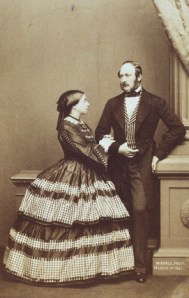
British Queen Victoria and Prince Albert, 1861

British Queen Victoria and Prince Albert, 1861

Queen Victoria was devastated by the death of her husband Prince Albert in December, 1861.* She mourned him for the rest of her life, forty full years, wearing only black and virtually becoming a hermit.

The following passage describes the extreme measures the Queen took to preserve her royal consort’s memory. This scene takes place in Windsor Castle on the day after Albert has died of  (possibly) typhoid fever. Albert’s body lies in state for visitation:

On the first morning of her widowhood, she went into the Blue Room to gaze upon her beloved husband’s features. Warned by her doctors not to kiss them, she kissed his clothes instead. She had every part of the room photographed so that it could be preserved exactly as it had been at that moment of the night, ten minutes to eleven on 14 December 1861, when her own life had been shattered….

Bust of Prince Albert, Minton & Co. from the original sculpture portraits by Carlo Marochetti (1805 - 67), England, Original sculpture 1851, made 1862.

Bust of Prince Albert, Minton & Co. from the original sculpture portraits by Carlo Marochetti (1805 - 67), England, Original sculpture 1851, made 1862.

She gave orders for Albert’s dressing gown and fresh clothes to be laid each evening on his bed and for a jug of steaming hot water to be placed on his washstand. Between the two beds in the room a marble bust of him was placed; above it she had his portrait hung, wreathed with evergreens; and almost every day fresh flowers were strewn beneath it on the pillows. The glass from which he had taken his last dose of medicine was kept on the table beside it where it remained for more than forty years. On his writing table his blotting book lay open with his pen upon it as though it were waiting for him to pick up. Guests at Windsor were required to write their names in his visitors’ book as well as in the Queen’s, ‘as before’….She had herself photographed gazing up at his bust; and she went to bed each night clasping one of his nightshirts and with a cast of his hand close enough for her to touch it with her fingers. (1)

*See a related post on this blog, “Mary Lincoln Goes Goth,” and read how Queen Victoria got her notorious nickname, “Mrs. Brown.”

(1) Hibbert, Christopher. Queen Victoria: A Personal History. (New York: Basic Books, 2000)

Read Full Post »

Mary Todd Lincoln in mourning clothes, 1863. Even during the period in 1862 and 1863 when Mrs. Lincoln was in mourning for her son Willie and wore only black, she managed to go further into debt for new clothes. By 1864, she told Elizabeth Keckley: "The President glances at my rich dresses and is happy to believe that the few hundred dollars that I obtain from him supply all my wants. I must dress in costly materials. The people scrutinize every article that I wear with critical curiosity... If he is elected, I can keep him in ignorance of my affairs, but if he is defeated, then the bills will be sent."3 Only on January 1, 1865 did she completely shed her mourning attire.

Mary Todd Lincoln in mourning clothes, 1863. Even during the period in 1862 and 1863 when Mrs. Lincoln was in mourning for her son Willie and wore only black, she managed to go further into debt for new clothes. By 1864, she told Elizabeth Keckley: "The President glances at my rich dresses and is happy to believe that the few hundred dollars that I obtain from him supply all my wants. I must dress in costly materials. The people scrutinize every article that I wear with critical curiosity... If he is elected, I can keep him in ignorance of my affairs, but if he is defeated, then the bills will be sent." Only on January 1, 1865 did she completely shed her mourning attire.

After her son Willie’s death at age eleven on February 20, 1862,  Mary Todd Lincoln went into deep mourning. She traded in her sparkling jewels, frilly white and colorful gowns, and flowered bonnets made fashionable by her icon the French Empress Eugénie (click to read earlier post) for widow’s weeds of dull black crepe. Her stylish White House parties were put to the side. Gaiety gave way to sadness. Mary had lost her favorite son, the perfect one, the one she considered most like her husband.

After Willie died, Mary’s youngest son, eight-year-old Tad, still tossed with the same typhoid fever that killed his brother. He lay critically ill nearby, but Mary, incapacitated by grief, would not and did not rush to his side to nurse him. Meanwhile, Willie’s embalmed body was laid out in the Green Room of the White House and his coffin was open. Mary mustered enough energy to place a sprig of laurel on Willie’s chest before retreating to her bedroom and shutting the door. She took to her bed, weeping and sobbing  in such uncontrolled spasms that she became quite ill.

She did not come out of her bedroom to attend Willie’s funeral and never again entered the Green Room or the second floor guest room where Willie died. She rid the house of all of Willie’s toys and clothes and forbade his and Tad’s best friends, the Taft boys, from ever returning to the White House to play.

During Mary’s tormented period, Abraham, also heartbroken at his son’s death, sent for help. Two of Mary’s  friends, a nurse, and Mary’s sister Elizabeth heeded the calling. One of the friends was the esteemed Washington seamstress Elizabeth Keckley. In memoirs she wrote with a ghostwriter six years later, she recalled a day when President Lincoln led his distraught wife (whom he called “Mother”) to the window, pointed to the lunatic asylum at a distance from the White House, and said,

 “Mother, do you see that large white building on the hill yonder? Try and control your grief or it will drive you mad and we may have to send you there.”
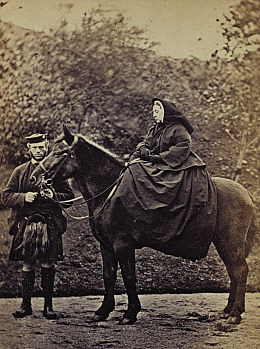
The recently widowed Queen Victoria wearing mourning clothes at Balmoral, Scotland, 1863. She is riding "Fyvie" and is accompanied by her faithful servant John Brown. Her husband, Prince Albert died in December of 1861 of typhoid fever or perhaps cancer of the stomach. For forty more years, the rest of Victoria's life, she wore black widow's weeds. Suspicion was aroused by Victoria's partiality to John Brown as a servant; most of the members of the Royal Household referred to him as "the Queen's stallion" and defamatory pamphlets referred to her a "Mrs. Brown." A 1997 film with Judy Dench titled "Mrs. Brown" was about the possible love affair.

The recently widowed Queen Victoria wearing mourning clothes at Balmoral, Scotland, 1863. She is riding "Fyvie" and is accompanied by her faithful servant John Brown. Her husband, Prince Albert, died in December of 1861 of typhoid fever or perhaps cancer of the stomach. For forty more years, the rest of Victoria's life, she wore black widow's weeds. Suspicion was aroused by Victoria's partiality to John Brown as a servant; most of the members of the Royal Household referred to him as "the Queen's stallion" and defamatory pamphlets referred to her as "Mrs. Brown." A 1997 film with Judy Dench titled "Mrs. Brown" was about their rumored love affair.

It was three weeks before Mary could even be persuaded to get up out of  bed and put on her mourning clothes. Queen Victoria (1819-1901) now became the First Lady’s fashion model. Victoria’s husband Prince Albert had died unexpectedly just three months earlier and Victoria had plunged herself and her entire staff into the deep black dress of mourning. Following Victoria’s lead and further compounding her debt to clothing merchants (click to read an earlier post), Mary Lincoln ordered an entire new wardrobe of dull black crepe dresses, bonnets, and weeping veils.

For more than a year, six months longer than was called for in the mourning manuals of the day, Mary wore first-degree mourning. Her black crepe straw bonnet was so heavily veiled that she could not turn her head, which gave her an odd appearance as she was always facing forward. She became a very public mourner. She wanted to draw attention to her grief as if she was the only one who had lost a child at a time when Civil War soldiers were dying in record numbers from Mississippi to Maryland on the nation’s bloody battlefields.  During her mourning, she cancelled the Saturday afternoon Marine Band Concerts held on the White House lawn, explaining that, “When we are in sorrow, quiet is necessary.”  She bought black jet jewelry to accent her sooty “widow’s weeds” and used writing paper with the thickest margins of black.

Finally, in 1863, Mary ordered another new wardrobe, running up yet more bills, and moved into the stage known as half-mourning, exchanging her lusterless black for fabric in lavender, gray, and somber purples with a little touch of white at the wrist. (1)


Click here to access my related post, “The Madness of Mary Lincoln.” Also, for more posts on the Lincolns, view the drop down menu, “Categories,” in the left column, find at the top, Abraham and Mary Todd Lincoln, and click.

(1) Baker, Jean H. Mary Todd Lincoln: A Biography. (New York: W.W. Norton & Company, 1987)

Read Full Post »

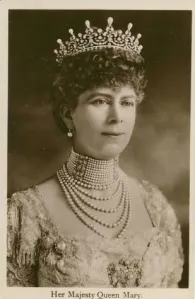
Shown in the photograph is Queen Mary (1867-1953), grandmother of Queen Elizabeth II. Queen Mary was a manic collector of jewelry and other fine pieces. During the reign of her husband, King George V (1865-1936), she vastly expanded the Royal Collection, often from the houses of friends. Mary is shown here wearing “the Girls of Great Britain and Ireland Tiara” which is also referred to as “Granny’s Tiara,” which she gave to Elizabeth in 1947, the year she married Prince Philip.

Shown in the photograph is Queen Mary (1867-1953), grandmother of Queen Elizabeth II. Queen Mary was a manic collector of jewelry and other fine pieces. During the reign of her husband, King George V (1865-1936), she vastly expanded the Royal Collection, often from the houses of friends. Mary is shown here wearing “the Girls of Great Britain and Ireland Tiara” which is also referred to as “Granny’s Tiara,” which she gave to Elizabeth in 1947, the year she married Prince Philip.

Queen Mary was Queen Elizabeth’s grandmother. She was married to George V. George V was the father of Queen Elizabeth’s father, King George VI, who preceded Queen Elizabeth on the throne.

Queen Mary got it wrong. One is supposed to “love people and use things.” She did the very opposite. Mary loved things and used people. The Queen had an “emotional lurch of the heart when she saw beautiful jewels,” but hated to pay for them. On seeing something she coveted, she said, “I’m caressing it with my eyes.” But it didn’t stop there. She acquired jewels, furniture, Faberge animals, watches, and gold musical boxes by means that ranged from begging to extortion to outright theft. She loved to visit India where the “maharajas handed out jewels like blackberries.” (1)

Antique dealers, jewellers, and estate owners locked away their valuables before Queen Mary came calling. If she spied a small silver vase or a china plate that she fancied, she would hint that she expected to be given it as a gift. At that point, the host or proprietor had no choice but to hand it over to the Queen. The Queen then instructed her chauffeur to put her new bauble in the car to add to the Royal Collection.

One day Queen Mary almost met her match. She was taking tea one late afternoon with Old Lady Hudson. The Queen began admiring a set of chairs that belonged to Lady Hudson. The chairs were painted by Angelica Kauffman. The Queen remarked that Lady Hudson’s chairs would go splendidly with the Kauffman table she owned. Lady Hudson no doubt smiled but did not offer her chairs to Queen Mary. The clock ticked on. Queen Mary continued to sip her tea. The sun went down. Queen Mary still showed no sign of getting up and departing.

More time passed. Finally, when the clock struck nine o’clock, Lady Hudson capitulated. She had held on valiantly, but, at the end, she was an old woman and she was ready for the Queen to go home. So  “the chairs went off in the royal Daimler.” (1)

At times, when Queen Mary wasn’t given something she desired, it is rumored she went ahead and stole it.

In the early  20th Century, wearing expensive jewelry was a way of defining status and Queen Mary was all about defining status – her status – as an elevated member of society. She was born the daughter of two royals who frittered away their money, infuriating their benefactress Queen Victoria, resulting in the whole family being tossed out of their apartments at Kensington Palace and run out of London. Mary ended up studying in Italy. Years passed and Mary returned to England. Queen Victoria cast her eye about looking for a suitable spouse for her grandson George, second in line for the throne. She selected Princess Mary, seeing in her “queen potential.” Upon the death of King Edward VII in 1910, George ascended the throne and Mary became his Queen.

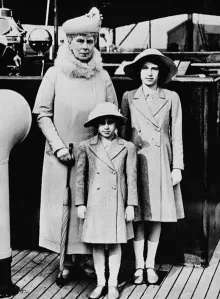
Queen Mary with granddaughters, the Princesses Margaret Rose and Elizabeth

Queen Mary with granddaughters, the Princess Margaret Rose and the future Queen Elizabeth II

Mary then set about to fulfill the potential seen in her by Queen Victoria and to become as royal as royal could be. She proceeded to outdazzle the royals around her, projecting such a flawless image of majesty that, to many, she ceased to be human. She was so decorated and gem-encrusted that, “at Lord Harewood’s wedding, a myopic E.M. Forster bowed to the iced and many-tiered cake under the impression that it was Queen Mary.” (1)

Queen Mary was so busy collecting, carrying out her royal duties, and hobnobbing with nobility that she had little time for motherhood, though she had borne six children. She had no passion for them. She left their care to cruel servants who pinched them. She did not kiss, cuddle, or hug her children. They were all starved of love, particularly her youngest child, John, born handicapped and epileptic. He was hidden away in a cottage with caregivers until his death at fourteen.

Upon her death from lung cancer in 1953, her son, David, Duke of Windsor, the former King Edward VIII, remarked:

I somehow feel that the fluids in her veins must always have been as icy-cold as they now are in death.
(1) Brendon, Piers and Whitehead, Phillip. The Windsors: A Dynasty Revealed. (London: Hodder & Stoughton, 1994)

Read Full Post »

Elizabeth II (Elizabeth Alexandra Mary; born 21 April 1926) is the queen regnant of sixteen independent states known as the Commonwealth realms: the United Kingdom of Great Britain and Northern Ireland, Canada, Australia, New Zealand, Jamaica, Barbados, the Bahamas, Grenada, Papua New Guinea, the Solomon Islands, Tuvalu, Saint Lucia, Saint Vincent and the Grenadines, Belize, Antigua and Barbuda, and Saint Kitts and Nevis. All together, these countries have a combined population, including dependencies, of over 129 million.

Elizabeth II (Elizabeth Alexandra Mary; born 21 April 1926) is the queen regnant of sixteen independent states known as the Commonwealth realms: the United Kingdom of Great Britain and Northern Ireland, Canada, Australia, New Zealand, Jamaica, Barbados, the Bahamas, Grenada, Papua New Guinea, the Solomon Islands, Tuvalu, Saint Lucia, Saint Vincent and the Grenadines, Belize, Antigua and Barbuda, and Saint Kitts and Nevis. All together, these countries have a combined population, including dependencies, of over 129 million.

It was June 24, 1953. Queen Elizabeth II was traveling to Scotland for the first time as Queen. In her coronation at Westminster Abbey 22 days earlier, Elizabeth had worshiped as an Anglican in the Church of England in her coronation robes. As Queen she was now the head of two churches, the Church of England and the Church of Scotland, which was Presbyterian. Having already been crowned in England, she now traveled to St. Giles Cathedral, the Mother Church of Presbyterianism, in Edinburgh, Scotland, to receive the ancient crown of Scotland.

When she arrived at the cathedral, the Queen was surrounded by the Scottish peerage in their velvet coats and coronets. Her husband, Prince Philip, was resplendently-dressed in a gold-braided uniform topped off by a plumed helmet. But when the crowd gathered at the ceremony got a look at Elizabeth, their new queen, they were shocked at how ordinary she looked. They had expected her to appear in her coronation robes. Instead she wore a simple gray blue coat, black leather shoes, and a gray blue felt hat. She looked just like a commoner! The most jarring part of her outfit was the big black purse she carried in the crook of her arm.

At the altar she stepped forward while the Duke of Hamilton and Brandon knelt before her in his coronation robes to proffer the crown of Scotland on a velvet cushion with gold tassels. As she (the Queen) reached toward him, her leather handbag, which was as large as a breadbox, almost hit him in the face. He quickly moved his head to avoid getting smacked by the royal purse. (1)

Since then, the Queen is rarely photographed without her purse tucked in the crook of her arm. She carries it with her throughout the day as she moves from room to room in Buckingham Palace. All tables and her desk at the palace are equipped with special hooks on which the Queen may hang her purse so that it may never be set on the floor. She never uses a clutch or a shoulderbag. Those bags would make it awkward in official duties of shaking hands and accepting flowers.

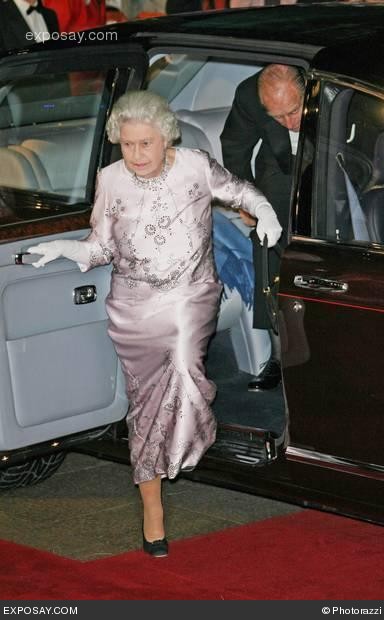
Queen Elizabeth (with black leather purse) and Prince Philip arrive at the Casino Royale World Premiere - Red Carpet - Nov. 14, 2006, London

Queen Elizabeth (with black leather purse) and Prince Philip arrive at the Casino Royale World Premiere – Red Carpet – Nov. 14, 2006, London

Enquiring minds want to know: just what does Queen Elizabeth carry in that purse? As it turns out, there is more to the royal purse than its meager contents. It doubles as a signal device. When the Queen is carrying out her royal duties at some function, she uses her purse to communicate with her servants. When she shifts the bag from one arm to another, for instance, it means she’s ready to leave. When at a banquet, if the Queen sets her purse on the floor, it’s another bad sign. She finds the conversation boring and wants to escape. However, if the royal bag dangles happily from the crook of her left arm, she is happy and relaxed. (2)

One thing that can always be found inside the Queen’s purse is an S-shaped metal meat hook that she can place on the edge of a piece of furniture and hang her purse on it. She always carries a metal make-up case given to her by Prince Philip as a wedding gift. She carries a collection of good luck charms, most of them gifts from her children, including dogs, horses, saddles, and horsewhips, reports the Daily Express, and photos of her children. She is never without her mints, chocolate drops for her corgi dogs, and a crossword or two snipped from the papers by her attendants.

Majesty magazine reports that the Queen carries a comb, a handkerchief, a small gold compact and a tube of lipstick in her handbag. On Sundays, she carries paper money to place in the collection plate at church.

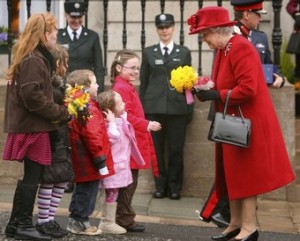
Britain's Queen Elizabeth II (R) receives flowers from children as she departs St Patrick's Cathedral in Armagh, Northern Ireland, March 20, 2008. The Queen handed out Maundy Thursday alms purses to 82 men and 82 women, the presentations are in recognition of their services to both church and community.

Britain’s Queen Elizabeth II (R) receives flowers from children as she departs St Patrick’s Cathedral in Armagh, Northern Ireland, March 20, 2008. The Queen handed out Maundy Thursday alms purses to 82 men and 82 women, the presentations are in recognition of their services to both church and community.

(1) Kelley, Kitty. The Royals. (New York: Warner Books, 1997)
(2) Dampier, Phil and Walton, Ashley. What’s In The Queen’s Handbag: And Other Royal Secrets. (Brighton, England: Book Guild, 2007)

For more on Queen Elizabeth, look in the left column under “Categories-People-Queen Elizabeth II.” I’ve written many posts on the Queen; I hope you enjoy them!

Read Full Post »

The Nubian Giraffe, by Jacques-Laurent Agasse (c.1827), depicts one of the three giraffes sent to Europe by Mehmet Ali Pasha. This one was received by George IV in London. The gentleman shown in the top hat is Edward Cross, operator of the menagerie at Exeter Exchange and then Royal Surrey Gardens. Also shown are the giraffe's Egyptian attendants, and, in the background, the Egyptian cows that supplied the young giraffe with milk.

The Nubian Giraffe, by Jacques-Laurent Agasse (c.1827), depicts one of the three giraffes sent to Europe by Mehmet Ali Pasha. This one was received by George IV in London. The Egyptian cows in the background supplied the young giraffe with milk.

In my last two posts, I wrote about Charles Dickens and his pet raven, Grip. Upon Grip’s death in 1841, Charles Dickens couldn’t bear to part with his beloved pet so he had him stuffed and mounted in a glass case to display in his study. Dickens was one of many Brits caught up in the pet preservation craze popularized by King George IV of England (1762-1830).

George IV is credited with establishing a private zoo at the Sandpit Gate at the Windsor Great Park at Windsor Castle. His menagerie consisted of such exotics as “wapiti, sambur, zebus, gnus, quaggas,…’corine’ antelopes, llamas, wild swine, emus, ostriches, parrots, and waterfowl. There was also an ‘enormous tortoise.'” (1) The showpiece of his collection, however, was a female Nubian giraffe, or “cameleopard,” as it was sometimes called. A diplomatic gift from Mehmit Ali, Pasha of Egypt, this young specimen arrived in London on August 11, 1827, along with several cows that provided her with milk. The gift giraffe was only 18 months old yet ten and a half feet in height. She was the first giraffe ever seen in England. Till she arrived, “there was a general belief that descriptions of the giraffe were partly fabulous.” (2)

The State of the Giraffe, 1829, a caricature print by William Heath, showing George IV and Lady Conyngham trying to lift the giraffe by pulley

The State of the Giraffe, 1829, a caricature print by William Heath, showing George IV and Lady Conyngham trying to lift the giraffe by pulley

From the beginning, there was trouble. An artist commissioned to paint the giraffe’s portrait noticed that her lower limbs seemed deformed from injuries. Investigation revealed that, on part of her journey from Senaar to Cairo, she was borne on the back of a camel, the wounds being caused because her legs were lashed together under the camel’s body. (1) At Windsor Castle, she was much doted on and continued to live on cow’s milk. After two years, though, she became very debilitated from those early wounds and exercise became painful and hard.  Someone came up with a plan to keep her moving. A gigantic triangle on wheels was constructed in which “the creature was somehow secured each day and trundled round her paddock, the hooves just touching the ground.” (1)

Despite the kind treatment, giraffes are accustomed to the warm, open savannahs of Africa, not the cold and wet confines of a British zoo. Two years after her arrival on the continent, the giraffe died, having only grown 18 inches while in captivity. It is said that King George IV had been obsessed with his giraffe and was distraught over her death. He commissioned the taxidermist John Gould to stuff his recently deceased pet giraffe.

 The stuffer to the Zoological Society, Mr. Gould, has had the performing of his duty…Soon after the giraffe expired, De Ville, the modellist, was ordered down to Windsor, by His Majesty, and took a cast of the animal. From this cast a wooden form was manufactured, on which the skin of the animal is now placed, and which preserves its beauty in an extraordinary degree.

The Times, April 15, 1830

Pet preservation is still alive and well in the twenty-first century – stuffed is out, though, and freeze-dried is in.

(1) Kisling, Vernon N. From Zoo and Aquarium History.
(2) Thomas, William John: White, William: Doran, John; Turle, Henry Frederick. Notes and Queries.

Read Full Post »
« Newer Posts