Feeds:
Posts
Comments

Archive for the ‘STAGE & SCREEN’ Category

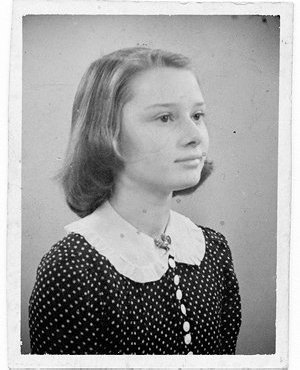
Audrey Hepburn (ca. 1935-37, perhaps in Brussels, age 6-8)

Audrey Hepburn (ca. 1935-37, perhaps in Brussels, age 6-8)

It was May 9, 1940, and Audrey Kathleen Hepburn (Ruston) had just turned eleven years old. She was living in Holland with her mother, her two older brothers, and other relatives. Her father lived in London. Her parents were divorced.

To celebrate Audrey’s birthday, her mother, Dutch Baroness Ella van Heemstra Ruston, had bought tickets for her and Audrey to see a performance by the great English dance troupe, The Sadler’s Wells Ballet. The company was touring Holland, France, and Belgium. Audrey’s town of Arnhem was to be one of their stops.

Audrey (1929-1993) had been living in Holland for only nine months. Previously, she had been in boarding school in England. But, in September 1939, Hitler invaded Poland. All at once, England was no longer a safe place for a little girl, as it had declared war on Germany. At her mother’s request, Audrey’s father scooped up Audrey from her school and put her on a big orange plane to Holland (also known as the Netherlands), where her mother’s family lived. Holland intended to stay neutral in the war with Germany and was considered a safe place for riding out the conflict.

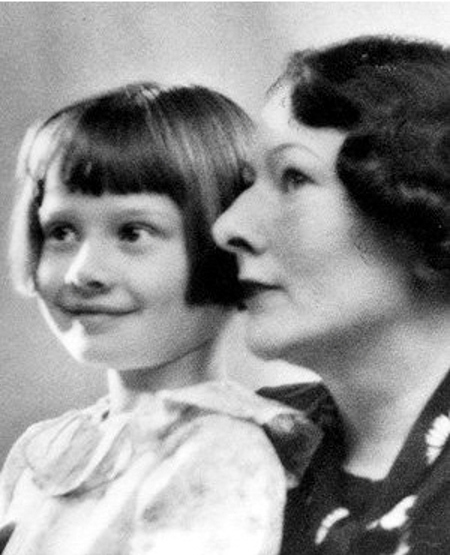
Audrey Hepburn and her mother Ella, Baroness van Heemstra Hepburn-Ruston, ca. 1936.

Audrey Hepburn and her mother Ella, Baroness van Heemstra Hepburn-Ruston, ca. 1936.

Audrey had not seen her dad since that day at the airport. She missed him so! Her parents’ divorce had left an aching hole in her heart. But on this particular May day, Audrey was not sad. She was looking forward to the ballet! Her mother had given her more than one reason to smile:

My mother had our little dressmaker make me a long taffeta dress. It went all the way to the ground, and it rustled. There was a little round collar, a little bow here, and a little button in front. The reason she got me this, at great expense, was that I was to present a bouquet of flowers at the end of the performance to…the director of the company.”

The evening finally arrived. Audrey wore her beautiful new long dress and got to see the famous Margot Fonteyn dance in “Horoscope” and “Façade” by choreographer Frederick Ashton. It was marvelous.

Margot Fonteyn in the Polka from Ashton's Facade, 1940. Fonteyn was the principal dancer of the Royal Ballet Company for 20 years.

Margot Fonteyn as the Polka from Ashton’s Facade, 1940. Fonteyn was the principal dancer of the Royal Ballet Company (originally the Sadler’s Wells) for 20 years.

Afterwards, Audrey’s mother took the stage and gave a formal thanks to the troupe first in Dutch, then in English. Next was Audrey’s big moment. To her surprise, her bouquet of tulips and roses was hurriedly accepted. A quick supper followed, as the dancers hustled about afterward, gathering up their props and costumes, to get on their bus to leave Arnhem that very evening. According to the British consul, there was suspicious German military activity nearby. The dancers didn’t want to get stuck in Holland if the Germans did attack and closed off the borders.

As Audrey’s head lay on the pillow that night, the Germans invaded Holland, Belgium, and Luxembourg. The Dutch were totally shocked. They never dreamed Hitler would attack them, his “Dutch cousins”! Just the night before, matter of fact, Hitler had made a radio broadcast, promising to all who listened that he had no plans whatsoever of attacking Holland. For five days, the Germans came down on the Dutch with the force of Hell. They never bothered issuing a formal declaration of war either.

 German parachutists invading the Netherlands, May 10-15, 1940

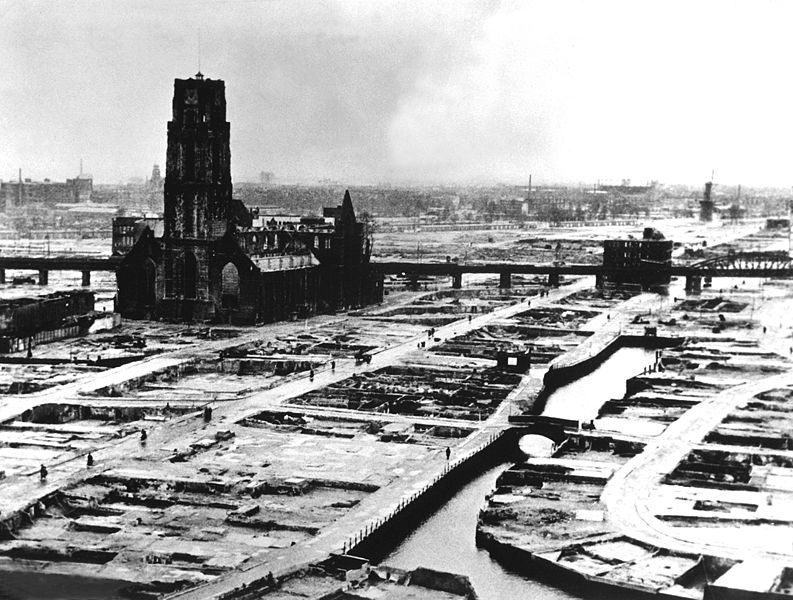
This is the city center of Rotterdam, Holland, following the German Blitz of May 14, 1940. A ceasefire was already in progress but the Nazis bombed anyway.

They blasted the city of Rotterdam with an air attack that killed 1,000 Dutch civilians and left 85,000 homeless (accounts vary as to the exact number).

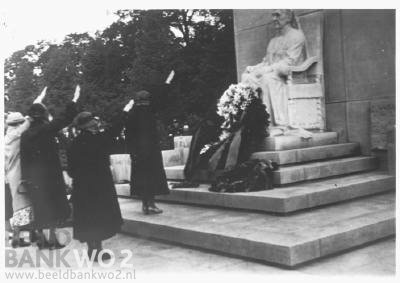
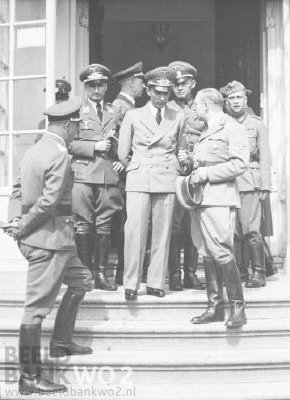
Incendiary bombs were dropped on the Hague. Nazi troops tore through Audrey’s town of Arnhem, looting and despoiling as they pleased. The Germans threatened to bomb every Dutch city until they were demolished until Holland surrendered. The Dutch military, though terribly outnumbered, fought back anyway, but they were no match for the conquering horde, and were forced to surrender. After five days, Holland capitulated. It would be occupied by the Nazis for five very long years. The Germans wanted to take over the world and destroy the Jewish population.

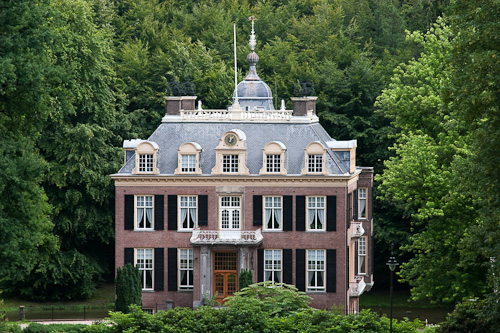
At first, Audrey’s family was allowed to remain at their regal ancestral home, Castle Zypendaal (or Zijpendaal). Audrey Hepburn’s mother’s family was of Dutch nobility.

Audrey Hepburn's mother's family was of Dutch nobility. This is one of their homes, the Castle Zypendaal in Arnhem.

Audrey Hepburn’s mother’s family was of Dutch nobility. This is one of their homes, the Castle Zypendaal in Arnhem.

Over the next ten months, the van Heemstra bank accounts, securities, and jewelry would be confiscated by the Nazis. Rations were imposed on food and fuel which were soon in short supply for the suffering Dutch people. Food became completely nonexistent during the Hunger Winter of 1944 as the Germans cut off all imports of foods to punish the Dutch Resistance (secret group that fought back against the Nazis from inside Holland). During that time, Audrey confessed to eating bread made from flour from tulip bulbs and grass to keep from starving to death like 20,000 other Dutch citizens did that winter.

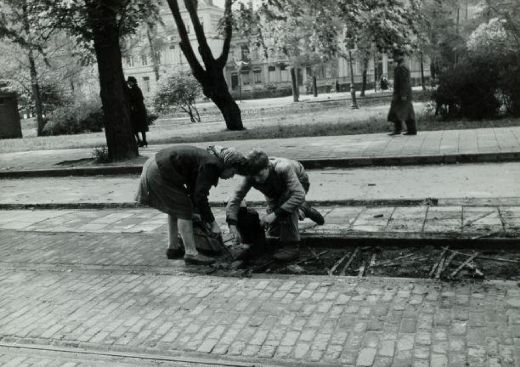
The Hunger Winter, 1944-45. Wood is taken from the tram rail in Holland to burn as fuel.

The Hunger Winter, 1944-45. Wood is taken from the tram rail in Holland to burn as fuel.

The German occupiers spread anti-English sentiment, banning the import of British jams and biscuits and outlawing the Girl and Boy Scouts. The Germans hoped they could whip the Dutch into a hatred for the English and recruit them in the battle against Britain.

Audrey Hepburn-Ruston was an English name and Audrey spoke English. She carried a British passport. With the Nazis cracking down on the English, the Baroness was worried. Quickly, Audrey’s mother gave Audrey a new identity as a little Dutch girl. For the war years, the Baroness changed her daughter’s name to Edda van Heemstra. Audrey – now Edda – took Dutch language lessons so she could pass as Dutch and not be arrested for being English. Audrey did not risk speaking English for the rest of the war.

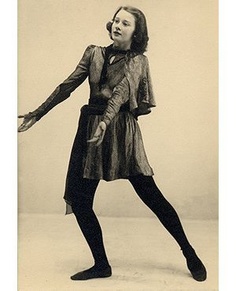
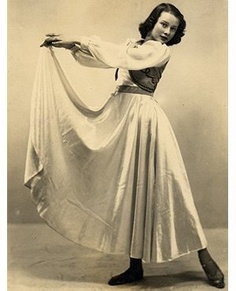
Audrey Hepburn at a dance recital, 1944, Arnhem Conservatory, Holland (age 15)

Audrey Hepburn at a dance recital, 1944, Arnhem Conservatory, Holland (age 15)

Audrey was keen to be a famous ballet dancer and her mother was the quintessential stage mom. In 1941, Ella sent Audrey to the Arnhem Conservatory to study dance. It was then that Audrey decided that she wanted to grow up to become a ballerina. Her dream was to

“wear a tutu and dance at Covent Garden.”

Her mother made her ballet slippers from scraps of felt, as materials became scarcer and scarcer, since the Nazis took the best for themselves, always.

As a child of war, Audrey learned to cope with hunger, fear, and deprivation through art, music, and dance. Soon, though, she and some other dancers began staging private, secret dance shows to raise money for the Dutch Resistance.

I designed the dances myself. I had a friend that played the piano, and my mother made the costumes. They were very amateurish attempt – but…it amused people.”

The recitals were given in houses with windows and doors closed, and no one outside knew what was going on. Afterward, money was collected and turned over to the Dutch Resistance. To keep from being discovered, the audiences did not clap.

“The best audience I ever had made not a single sound at the end of my performance.”

Audrey Hepburn during a dance recital in Arnhem, Holland, 1944

Audrey Hepburn during a dance recital in Arnhem, Holland, 1944

Sometimes at these “black performances,” resistance workers attended. They gave the young performers money and folded messages to be stuffed into the children’s shoes and transported the next day to resistance workers. The children risked death to save the lives of resistance workers and Audrey was one of these children.

One winter day, Audrey was walking along a city street when three truckloads full of German soldiers toting rifles stopped suddenly. The soldiers ordered all the girls in their sight to line up and get in the trucks. Audrey did as she was told. As the trucks drove off, Audrey kept saying the Lord’s Prayer to herself in Dutch. Then the convoy stopped unexpectedly. Some soldiers jumped out and began abusing some Jews. Audrey said:

“I remember hearing the dull sound of a rifle butt hitting a man’s face. And I jumped down, dropped to my knees, and rolled under the truck. I then skittered out, hoping the driver would not notice me – and he didn’t.”

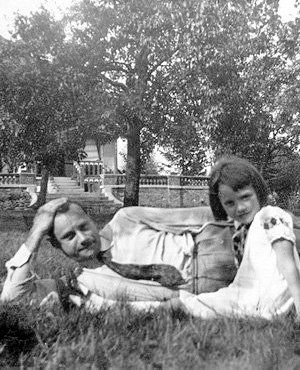
Audrey with father, preNazi Occupation, ca. 1934-35, age 5-6

Audrey with father, preNazi Occupation, ca. 1934-35, age 5-6

And where was Audrey’s father all this time? He was arrested in England and accused of peddling Nazi propaganda for the notorious leader of the British Union of Fascists, Sir Oswald Mosley. He remained under house arrest for the duration of the war on the Isle of Man with other suspected Nazi sympathizers.

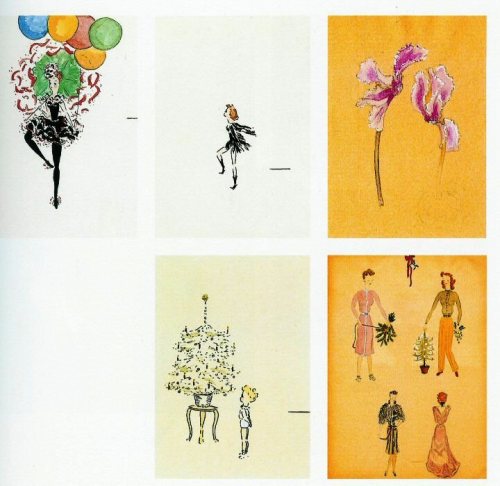
Below are some beautiful drawings Audrey made during the war.

Audrey Hepburn's childhood artwork

Audrey Hepburn’s childhood artwork

Read Full Post »

Natalie Wood (1938-1981) January 2013 autopsy report says death may not have been solely accidental

Natalie Wood (1938-1981) January 2013 autopsy report says death may not have been solely accidental

From the Daily Beast:

FOUL PLAY? Wood Autopsy Hints at Assault

“A year after the LAPD reopened the 1981 drowning case of Natalie Wood, a new autopsy report suggests the late actress may have been assaulted before she plunged into the Pacific Ocean. The coroner has amended Wood’s cause of death from accidental drowning to “drowning and other undetermined factors,” detailing bruises on her body that “appeared fresh” along with scratches down her legs. It remains unclear whether the abrasions resulted from falling off the dinghy, attempting to climb back on, or something potentially darker. There were also conflicting statements as to when Wood went missing and whether or not she had a confrontation with her husband, Robert Wagner.”

Read more from the Los Angeles Times.

For more on Natalie Wood on this blog, click here.

Read Full Post »

Elizabeth Taylor in costume as “Cleopatra,” from the 1963, 20th Century Fox production of the same name

Yet another iconic item worn by actress Elizabeth Taylor is on the auction block – a wig she wore in the 1963 film, “Cleopatra.” Ms. Taylor wore many different hairdos in the movie and British wigmaster Stanley Hall made three wigs for each style. The wig for sale is made of real human hair, medium brown, and is adorned with hanging braids and gold beads.

Elizabeth Taylor is photographed with some props from the 1963 film, “Cleopatra.”

In the movie, Ms. Taylor’s character wears this particular wig when she tries to convince Julius Caesar, played by Rex Harrison, to accept supreme control of the empire. (1) The wig is being sold by Heritage Auctions of Dallas, Texas, and is set to fetch around $11,000.

Elizabeth Taylor in the arms of Richard Burton, from the movie, “Cleopatra,” 1963.

It was during the 1962 filming of “Cleopatra” in Rome that 30-year-old Elizabeth Taylor fell madly in love with her other male costar and onscreen lover, Richard Burton, 36, cast as Mark Antony. The two were both married to others at the time.

At the time, Ms. Taylor was already a big film star being paid the unprecedented amount of a million dollars to play Cleopatra. Mr. Burton, however, who was Welsh, was a Shakespearean stage actor largely unknown outside of England.

Richard Burton (l), talks with Eddie Fisher and his wife Elizabeth Taylor on the Cinecitta set in Rome, early 1962.

When people began to whisper that perhaps Ms. Taylor and Mr. Burton were conducting an illicit affair, the couple denied the accusations. So uncontrollable was their love and lust, that their affair was

“bloody obvious,” to use Burton’s term – so flagrantly on display. (2)

When the director of “Cleopatra” shouted “Cut!” at the end of love scenes, Taylor and Burton would continue to kiss.

They carried on on the movie set, film lot, in their private villas, and took their love to town – to the Via Veneto. But they were not safely in America, where  there was a time-honored tradition not to pry into the private lives of public people and where the studio would have squelched any unflattering press. They were in Rome – the land of the paparazzi.

The Italian “paparazzi” were a new style of journalist. These young, Vespa-riding photographers with cameras with zoom lenses slung around their neck were hungry for a money-making photo that would reveal the affair to the waiting world. With a pack mentality, they were ruthlessly intent upon snapping photos of the jetset enjoying La Dolce Vita, the sweet life, popularized in the film of that same name. And Liz and Dick were getting hot and heavy on the Via Veneto.

From February thru July, paparazzi stalked Taylor and Burton’s every move, hoping for that money-making photo that would expose the lovers to the world. And they got them, too, forcing both Liz and Dick to deal with their respective spouses.

Liz Taylor and Richard Burton emerge from the restaurant Tre Scalini in the Piazza Navona, spring, 1962.

The Burton-Taylor Affair – “Le Scandale,” as Burton termed it – created international interest and thus, international coverage.

Richard Burton leans in for a kiss from Elizabeth Taylor on the Cinecitta sound stage, circa March 30, 1962. Paparazzo Elio Sorci hid under a car across from the movie lot all day to snap this photo which came to be known as the “kissing picture.” It blew the lid off the Taylor-Burton affair, appearing in first the Italian papers before making its way to New York.

The public, it seemed, had an unquenchable appetite to follow the drama. Gone were the days when American readers of Photoplay and Modern Screen were content to read fictional accounts of their favorite movie stars generated by the big movie studios.

Elizabeth Taylor gazes into the eyes of her true love, Richard Burton, as they sail off the Amalfi Coast where the filming of “Cleopatra” was wrapping up. June, 1962. Marcello Geppetti, photographer.

It is hard to overstate the excitement caused at the time by Elizabeth and Richard’s grand passion. Everyone was following the saga, even First Lady Jackie Kennedy, who asked the publicist Warren Cowan in early 1963,

“Warren, do you think Elizabeth Taylor will marry Richard Burton?”(3)

Richard Burton and Elizabeth Taylor in the glow of their love, caught by paparazzo on a yacht off the coast of Ischia in the Bay of Naples, June 1962.

Initially, the pair were condemned by the press for their public adultery until publishers woke up and realized how much the “Liz and Dick” machine increased tabloid, newspaper, magazine, and book sales.

Photoplay July 1962. Everyone had an opinion about the Taylor Burton affair.

Note to readers: Today also begins the first auction at Christie’s, New York, of  The Collection of Elizabeth Taylor, which I was privileged to view on December 3, 2011. (2)

(1) Source: The Guardian

(2) “Remembering Liz (1932-2011),” Life Commemorative, 2011.

(3) Kashner, Sam and Schoenberger, Nancy. Furious Love: Elizabeth Taylor, Richard Burton, and the Marriage of the Century. New York: HarperCollins Publishers, 2010.

Readers: For more on Elizabeth Taylor on Lisa’s History Room, click here.

Read Full Post »

Actress Elizabeth Taylor had stunning beauty. She was such a gorgeous little girl that, when people would see her for the first time, they would gasp in astonishment, staring at her sapphire eyes wreathed in thick black lashes and the shiny black hair framing her porcelain face.  “What a pretty child !” they would exclaim, prompting the well-rehearsed Elizabeth to curtsey and smile.

Elizabeth Taylor in “Lassie Come Home,” 1943.

But Elizabeth was not always gorgeous, said her mother, Sara Taylor, a former stage actress. She considered Elizabeth to be quite an ugly baby when born in London on February 27, 1932.

Sara Taylor cradles her newborn daughter, the future movie queen Elizabeth Taylor (1932-2011)

At first glance at her newborn, Sara was repulsed:

“As the precious bundle was placed in my arms, my heart stood still. There inside the cashmere shawl was the funniest-looking baby I had ever seen. Her hair was long and black. Her ears were covered with thick black fuzz, and inlaid into the sides of her head….”(1)

Baby Elizabeth’s arms, shoulders, and back were covered with a thick downy pelt called lanugo, not uncommon in newborns.

“The infant looked like a little monkey,” remembered Viennese art dealer and family friend Ernest Lowy. (2)

Compounding the problem, Elizabeth’s eyes were screwed tightly shut. For ten days, the doctor tried to pry them open unsuccessfully, finding only the whites visible. Then one day, Baby Elizabeth suddenly snapped open her eyes and gazed up at her new mother. Sara found herself gazing down into two pools of deep violet fringed by thick black lashes – double rows of lashes! Then the baby smiled. Sara considered this a special greeting from her daughter and told the nurse so. The nurse chuckled, reminding Mrs. Taylor that infants can’t express emotion:

“That was no smile,” the nurse indicated, “only a little gas.” (3)

Elizabeth Taylor in profile, ca. 1934

The dark fuzz fell off and a swan emerged.

Elizabeth Taylor didn’t begin to walk until she was 16 months old. She is shown here with one of the many dogs for which she cared during her lifetime. ca.1934-35


As a young girl, Elizabeth Taylor had a big head on a little body. “What a podge!” she remarked, upon seeing a young photo of herself. 1934.


Peter Lawford and Elizabeth Taylor in this publicity shot for "Julia Misbehaves" (1948). In this unretouched 1950 publicity photo, one can see La Liz's arms were covered in a dark and velvety down, in keeping with her being a beautiful brunette.

Peter Lawford and Elizabeth Taylor in this publicity shot for “Julia Misbehaves” (1948). In this unretouched 1950 publicity photo, one can see La Liz’s arms were covered in a dark and velvety down, in keeping with her being a beautiful brunette.


(1) Ladies’ Home Journal,  March- April 1954.

(2) Heymann, C. David. Liz: An Intimate Biography of Elizabeth Taylor. New York: Simon & Schuster, Inc., 1995, 2011.

(3)  Walker, Alexander. Elizabeth: The Life of Elizabeth Taylor. New York: Grove Press, 1990, 1997.

Readers: For more on Elizabeth Taylor on Lisa’s History Room, click here.

Read Full Post »

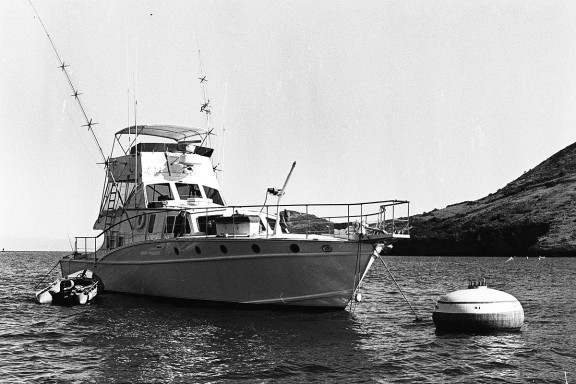
Robert Wagner and Natalie Wood aboard their yacht the Splendour. Undated photo.

Robert Wagner and Natalie Wood aboard their yacht the Splendour. Undated photo.

According to a witness whose account has never been disclosed, Hollywood star Natalie Wood  was screaming for help as she drowned in 1981.

Retired stockbroker Marilyn Wayne said she tried to report the star’s ‘last desperate cries for help’ but was ignored.

Los Angeles police last week said ‘substantial new evidence’ has led them to reopen their investigation into the death 30 years ago this week.

Learn more at the Daily Mail Online.

Readers: For more on Natalie Wood on Lisa’s History Room, click here.

Read Full Post »

Natalie Wood was born "Natalia Nikolaevna Zakharenko" on July 20, 1938, to Russian immigrant parents. She began acting in Hollywood movies at the age of 4. She died by drowning at the age of 43 during the production of "Brainstorm" (1983) with Christopher Walken.

How did actress Natalie Wood, famous for her star turn in Rebel Without a Cause and West Side Story, end up drowning off Santa Catalina Island, California, in 1981 while boating with actor husband Robert Wagner and costar Christopher Walker? Though officially ruled an accident at the time, the circumstances that led to her death and the nature of her tumble off the yacht the Splendour she owned with Wagner have remained one of Hollywood’s darkest mysteries.

Robert Wagner bends over to kiss flowers that cover the casket of his wife Natalie Wood during her graveside ceremonies on December 2, 1981. If Wagner discovered that his wife was missing from their yacht around midnight, why did he wait over an hour to use the ship's radio to call for help? These and other questions surrounding Woods' death remain unanswered.

Today, 30 years later, the Los Angeles Sheriff’s Department has announced that it is reopening the case of Natalie Woods’ drowning due to “credible information” from multiple sources. One source is Dennis Davern, who was the boat captain of the Splendour that dark and fateful night, a night full of boozing and yelling and tragedy. Davern now says that he lied in his original statement to the police and that Robert Wagner is responsible for Wood’s death.

"Splendour," the yacht owned by Natalie Wood and Robert Wagner

Learn more at MSNBC.

Readers: For more on Natalie Wood on Lisa’s History Room, click here.

Read Full Post »

British American screenstar Elizabeth Taylor (1932-2011) as a young girl.

Just after actress Elizabeth Taylor was born, her parents were ushered into the doctor’s office and told that their newborn daughter had a mutation. 

 “Well, that sounded just awful,” her mother Sara Taylor said later,”a mutation.”

The mutation was not a deformity, however. It meant that little Elizabeth was born with double rows of eyelashes.

Elizabeth Taylor, age 10

Sara breathed a little easier to learn that.

“I thought,well, now, that doesn’t sound so terrible at all.”

Elizabeth’s eyes were stunning – large and blue, rimmed by deep, thick lashes. When caught in the light, the color of her eyes was almost violet. (1)

Elizabeth Taylor had luminous beauty - and double rows of eyelashes.

Double rows of eyelashes are usually the result of a mutation at FOXC2 , a gene that influences all kinds of tissue development in embryos. FOXC2 mutations are thought to be responsible for, among other things, lymphedema-distichiasissyndrome , a hereditary disease that can cause disorders of the lymphatic system, in addition to double eyelashes.

The eyelash mutation isn’t always as cosmetically enhancing as Taylor’s turned out to be — the extra eyelashes can sometimes grow inward and damage the cornea. In addition, seven percent of people with lymphedema-distichiasis syndrome also suffer from congenital heart disease.

Coincidentally, Taylor herself had a history of heart problems. In 2009, Taylor underwent surgery to repair a leaky heart valve. Her death on March 23, 2011, was attributed to congestive heart failure.

In April 2010, Elizabeth Taylor launched a new line of perfume "Violet Eyes": "This sensual perfume is inspired by her iconic eye color; it is feminine, captivating, sophisticated and intriguing. Filled with a bouquet of the flowers Elizabeth Taylor loves, the composition is both modern and mysterious."

Source:  Slate

Readers, for more on Elizabeth Taylor at Lisa’s History Room, click here.

Read Full Post »

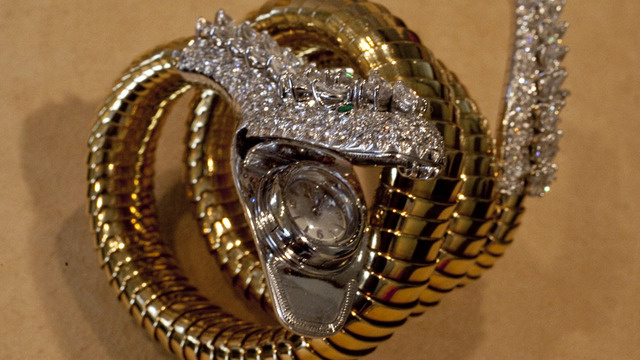
Elizabeth Taylor on the Rome set of the film, "Cleopatra," 1962, where she began her scandalous affair with costar Richard Burton. Dame Liz wears her diamond ring from her late husband Mike Todd and the diamond, emerald, and gold bangle watch by Bulgari, Jaeger-LeCoultre

Christie’s auction house is selling screen sensation Elizabeth Taylor’s complete jewelry collection in New York City on Dec. 13-16, 2011. Among the pieces to be sold is the diamond, emerald, and gold “snake” brackelet watch by Bulgari, ca. 1961, shown below:

This cobra bangle watch by Bulgari, estimated at $12,000-15,000, is to be sold at Christie's auction of the Elizabeth Taylor Collection, Dec. 13, 2011.

Readers: For more on The Collection of Elizabeth Taylor Auction by Christie’s, click here and here.

Readers: For more on Elizabeth Taylor here at Lisa’s History Room, click here.

Read Full Post »

Princess Charlene beams with joy at her new husband, Prince Albert II of Monaco, following the religious blessing of their marriage.

July 4, 2011

The Daily Mail:

“The new Princess Charlene of Monaco tried to flee home to South Africa three times before her ‘arranged marriage’ to Prince Albert, it was alleged yesterday.

The former Charlene Wittstock, 33, reportedly made her first escape attempt when she travelled to Paris in May to try on her wedding dress.

The allegations, which are surprising considering she went ahead with the wedding on Saturday, emerged in the French newspaper Le Journal du Dimanche , It went on to report that later in May, Charlene made a second apparent attempt to escape during the Monaco Formula 1 Grand Prix.

Monaco Grand Prix along the Monaco Harbor.

A month before their royal wedding, Charlene Wittstock and Prince Albert II of Monaco attend a dinner following the Monaco Formula 1 Grand Prix. May 31, 2011.

Then, last week, royal officials are said to have confiscated her passport en route to Nice airport via the helicopter service that runs between the Mediterranean principality and France. She was then persuaded to go on with the marriage.

‘Several sources have confirmed that an arrangement was reached between the future bride and groom,’ reported Le Journal du Dimanche.”

The reports followed confirmation by palace sources while the wedding was in full swing that Prince Albert, 53, was due to have DNA tests because of claims by at least one woman that he has fathered another illegitimate child. He already has a 19-year-old daughter and six-year-old son. Le Journal du Dimanche quoted Monaco “policy advisers” among those discussing “two illegitimate children -one already born, the other to come.” (The Vancouver Sun)

Jazmin Grace Grimaldi, the child of Prince Albert II of Monaco and Tamara Rotolo, was born in Palm Springs, California, on March 4, 1992.

Alexandre "Alex" Coste is the natural son of HSH Prince Albert II of Monaco and former flight attendant from the African Republic of Togo Nicole Coste. He was born on August 24, 2003.

“Sources said the Monaco palace had hoped the glitzy wedding – attended by a host of celebrities and European royalty – would ‘overshadow’ new claims about secret children fathered by Albert.

The Monaco Palace

Instead, Charlene was in floods of tears at one point, while her 53-year-old husband looked on impassively.

Princess Charlene weeps at the religious ceremony blessing her marriage to Prince Albert II of Monaco.

Meanwhile, the reception that followed provoked ridicule with tacky features such as a giant wedding cake that towered over the couple and a mirrored dance floor.

Monaco's Prince Albert II and Princess Charlene cut a small cake while standing by their enormous (leaning?) wedding cake at the Gala Dinner at the Opera Garnier in Monaco, July 2, 2011. Pink Proteas flowers from Princess Charlene's native South Africa adorn the many-tiered confection. The wedding cake was redcurrant and vanilla. Charlene is radiant in her second Armani gown of the day.

Among the guests were Prince and Princess Michael of Kent, actor Roger Moore and Topshop boss Sir Philip Green and his wife, Tina.

Fireworks light the sky over the Monte Carlo Casino after the gala dinner to celebrate the wedding of Prince Albert II to Charlene Wittstock of South Africa. July 2, 2011

Tomorrow the couple are due to fly to South Africa on honeymoon, presenting Charlene with her best chance yet of ‘escaping’ Monaco.”

Source: The Daily Mail

Readers, for more on the Monaco Royals, Princess Albert II and Princess Charlene, on Lisa’s History Room, click here.

Read Full Post »

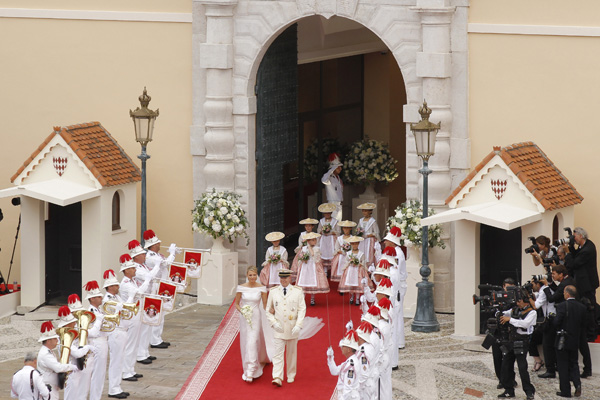
Newlyweds Prince Albert II and Princess Charlene of Monaco depart from the Monaco palace after their religious wedding ceremony, Saturday, July 2, 2011. (AP Photo/Benoit Tessier, Pool)

Charlene Wittstock's Armani gown worn for the religious ceremony took 2,500 hours to prepare as "kilometers" of platinum-coated thread was sewn into 430 yards of off-white silk. Charlene's broad swimming champion's shoulders bore the weight of 40,000 Swarovski crystals, 20,000 mother of pearl tear drops, and 30,000 golden stones.

Princess Charlene's wedding gown had two trains. The skirt of the gown folded out to a shorter train, while the crossover neckline extended into a longer train on top.

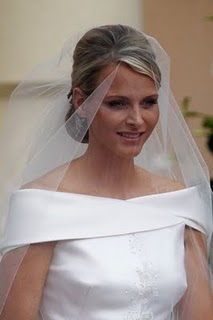
Princess Charlene chose a light veil of off white tulle that rested on her head from the back.

Charlene anchored her wedding veil with an elaborate curving diamond hairpiece, possibly loaned by her new sister-in-law, Princess Caroline.


Readers: For more on Prince Albert and Princess Charlene here on Lisa’s History Room, click here.

Readers: For stories about Princess Grace of Monaco on Lisa’s History Room, click here.

Read Full Post »

Albert Alexandre Louis Pierre Grimaldi, born March 14, 1958, at the Prince’s Palace in Monaco, is the second child born to Prince Rainier III and Princess Grace.On April 6, 2005, Prince Rainier III died and Hereditary Prince Albert became Albert II, Sovereign Prince of Monaco.


Princess Grace of Monaco holds 2 of her children in this early 1960 photo: Princess Caroline, 3, and Prince Albert, 22 mos. Caroline and Albert were born 14 months apart.

Princess Grace, seated, and her husband, Prince Rainier III, pose for a family portrait with their 3 children: baby Princess Stephanie, Princess Caroline, and Prince Albert II. ca. 1965.

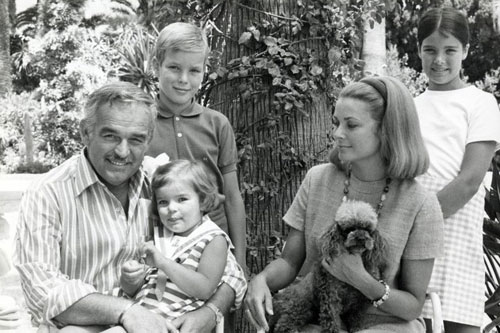
The Grimaldis smile for the camera: Prince Rainier holds Princess Stephanie with blue-eyed Prince Albert looking on from behind. Dark-haired beauty Princess Caroline flanks her mother, Princess Grace on our right. photo ca. 1967.

Prince Albert was adored by his mother, Princess Grace of Monaco. undated photo

READERS: For more on the Grimaldis of Monaco and the Royal Wedding, click here.

Read Full Post »

Center, Prince Albert of Monaco and his fiancé Charlene Wittstock pose with the band The Eagles, performing in Monaco to celebrate the wedding of Albert and Charlene. June 30, 2011.

Prince Albert of Monaco and Charlene Wittstock of South Africa are scheduled to wed today in Monte Carlo despite revelations in the French Press earlier in the week that the never-before-married Prince Albert, 53, may have fathered a third love child. Upon learning of the Le Monde article, Miss Wittstock, 20 years Albert’s junior, reportedly tried to flee the tiny Riviera principality.

As reported in The Daily Mail, “the couple’s lawyers have furiously denied a rift, while police have claimed that Miss Wittstock even

had her passport confiscated at the Nice airport to stop her getting on a flight.” 

Despite this hiccup, the wedding is going ahead as planned. The engaged couple put on a happy show of unity last night as they attended a concert by The Eagles. The free show was held at Monaco’s stadium and attracted thousands of fans from the principality and neighboring areas.

The wedding nuptials include a civil ceremony today and a Catholic Church ceremony tomorrow. 

In this June 2011 photo for Vogue magazine, Charlene Wittstock shows off her impressive physique. She was a South African Olympic swimmer who will become Princess Charlene of Monaco on Friday, July 1, 2011, when she weds Prince Albert of Monaco. Prince Albert is the son of the late Grace Kelly, American film actress, and Prince Rainier III of Monaco.

Charlene Wittstock stands on a precipice in Monaco.
To see a gallery of Charlene Wittstock photos at the Daily Beast, click here.  

The nuptials at Monte Carlo may rival the British royal wedding in lavishness and excess. While newlyweds William and Kate, the Duke and Duchess of Cambridge, are unable to attend the festivities because they are currently in Canada on a North American tour, the guest list is still expected to be impressive. Shrouded in secrecy, it is rumored to include crowned heads of Europe, politicians, and glitterati such as international supermodel Naomi Campbell, German haute couture designer Karl LagerfeldFrench President Nicolas Sarkozy and his wife, First Lady Carla Bruni.

Musician and former model Carla Bruni is expecting her second child, her first with Sarkozy.

The June 2011 issue of French magazine Elle features First Lady of France Carla Bruni Sarkozy with her growing pregnancy bump. Carla Bruni is a former model, and has graced the cover of Elle many times.

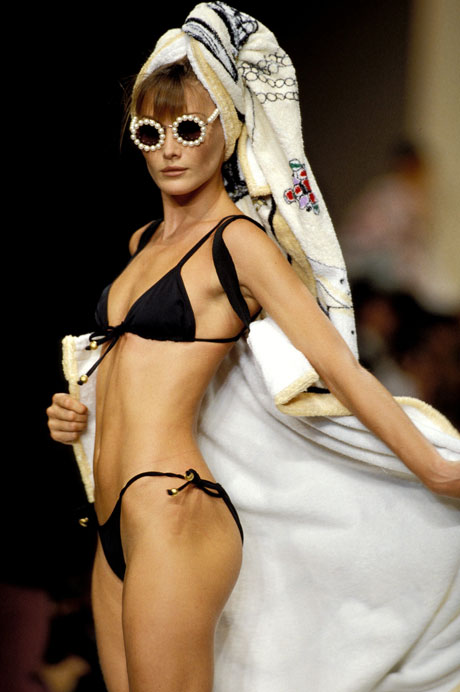
Before she was the First Lady of France: Carla Bruni models a designer bikini and pearl-rimmed sunglasses.

READERS: For more on Lisa’s History Room about Carla Bruni, click here  


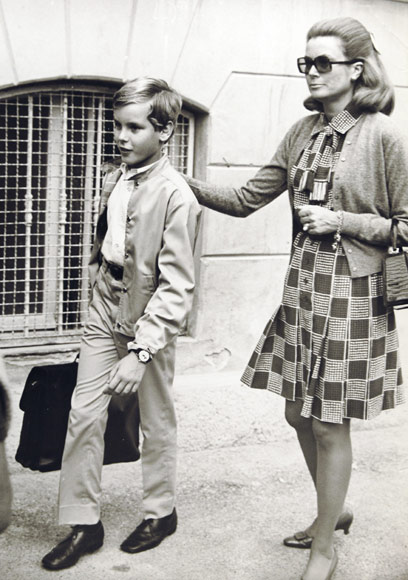
In the photo above, Prince Albert’s mother, Princess Grace of Monaco, is shown climbing the stairs of the Princely Palace in Monaco, ca. 1960. Princess Grace is the Hollywood actress Grace Kelly who gave up her film career to marry Rainier III, Prince of Monaco, in 1956. Together they raised three children: Caroline, Princess of Hanover, Albert II, Prince of Monaco, and Princess Stéphanie of Monaco.

Readers: For more on Lisa’s History Room about Princess Grace, click here.

Read Full Post »

Next month, Kate Middleton makes the cover of the UK magazine “Tatler. ” This February 2011 issue  is a royal special, commemorating the engagement of Ms. Middleton to Prince William.

The cover montage of four brilliantly-colored photos of Ms. Middleton are reminiscent of American pop artist Andy Warhol‘s 1962 silkscreen prints of  movie star Marilyn Monroe.

 Warhol began experimenting with making mass-produced images of famous people in August 1962 when Marilyn Monroe committed suicide. This method became Warhol’s signature style and made him very rich and famous.

This publicity shot of Marilyn Monroe by Gene Korman for the film “Niagara,” made in 1953 was used by Pop Artist Andy Warhol to create his famous 1962 silkscreen prints of the actress, following her suicide by overdose.

This 1962 silkscreen print by Andy Warhol shows the repetitive image of Marilyn Monroe in bright shades of canary yellow, aqua blue, and shocking pink. These tiny prints are still worth millions of dollars.

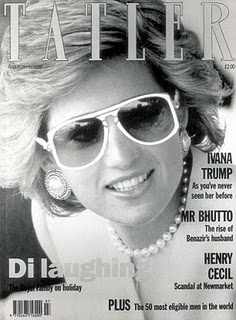
Princess Diana (1961-1997) was often featured on the cover of "Tatler." This is from 1990.

Readers: For more on Kate Middleton and Princess Diana on this blog, click here.

Readers: For more on Marilyn Monroe on this blog, click here.

Read Full Post »

On January 6, 1956, the long leading story on page one of the New York Times read:   

PRINCE OF MONACO TO WED GRACE KELLY

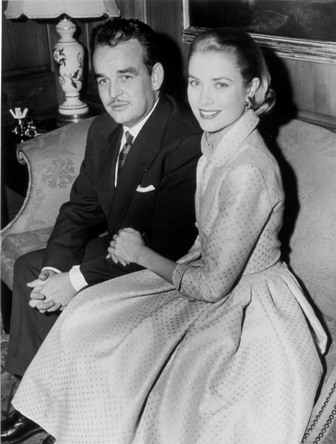
Prince Rainier of Monaco and Grace Kelly of Philadelphia announce their engagement on January 5, 1956.

The fairytale romance was front page news! It had captured the public imagination “to the point of intoxication.” (1) There was to be a wedding – a royal wedding ! It would be the “Wedding of the Century,” it was predicted.

Grace Patricia Kelly was an Academy-Award-winning actress and America’s #1 box office star. Prince Rainier was Europe‘s most eligible bachelor. It was a marriage made in heaven – it seemed.  Behind the scenes, though, a rather down-to-earth business arrangement had preceded the finalizing of the engagement.

The public was swept away by such a whirlwind courtship. After all,  Grace and the Prince barely knew one another. Just the previous May, the two had met at a Paris-Match publicity shoot at the Prince’s palace in Monaco.  They had exchanged polite words, nothing more. But after that chance encounter, Rainier and Grace began a vigorous correspondence. For the next seven months, letter flew back and forth across the Atlantic.

The Royal Palace at Monaco

Over the course of time, Grace and Rainier discovered that they had much in common – their Roman Catholicism particularly and their dissatisfaction with their lives. Both were looking to get married and start a family. 


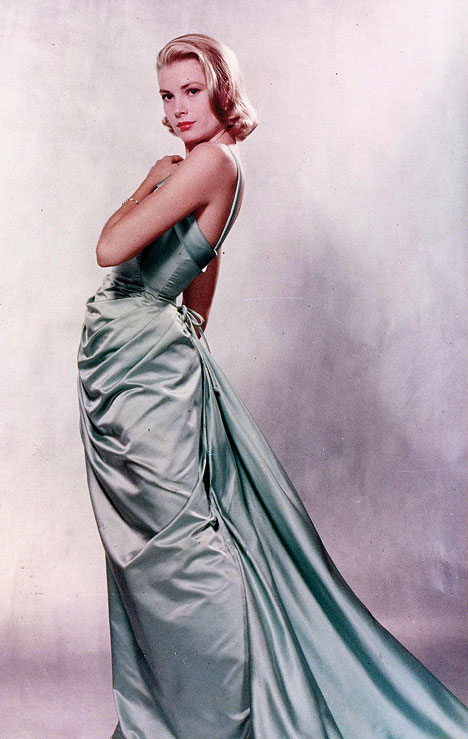
Grace Kelly, Life magazine, ca. 1955.

The two were nothing more than pen pals when the Prince, his doctor, and his priest arrived at the home of Grace’s parents, Jack and Margaret Kelly, in Philadelphia on Christmas night, 1955. Grace had flown in from Hollywood for the special dinner visit. Bear in mind, Grace had not laid eyes on the Prince since the spring.  Three days later, they were engaged, with Grace’s parents’ approval.

Before Rainier and Grace could officially announce their engagement, though, there were several obstacles to overcome – matters of state, as Grace was marrying into the House of Grimaldi. First, Grace had to submit to a physical exam to determine if she could bear children – heirs to the throne of Monaco. She passed the fertility test.

Secondly, it was the custom among the European aristocracy for the bride’s family to pay the groom a dowry. Jack Kelly, an Irish millionaire whose family was the cream of Philadelphia society, flew into a rage at the very idea. In the end, though, as the marriage of his daughter was thrown in jeopardy, he agreed to pay the Prince a dowry of $2 million.

Finally, Grace had to accept that, in the event of a divorce, any children of the marriage would remain in Monaco with their father.

(1) Glatt, John. The Royal House of Monaco. New York: St. Martin’s Press, 1998.

Readers, for more on Grace Kelly on this blog, click here.


Read Full Post »

Actress Natalie Wood (1938-1981) in an undated photo

“Ever since I was knee high,” Natalie Wood would say later, “I  was waiting for my break.”

Natalie’s mother – whom she called “Mud” – had convinced Natalie that the only thing that mattered in life was to be a great actress. Mud had moved her family to Hollywood for the sole purpose of getting Natalie (1938-1981) into pictures. By the time Natalie was six, though, she had been paraded by Mud in front of scores of casting directors who paid her no mind.

In February 1945, Mud managed to get Natalie a screen test for “Tomorrow is Forever,” a picture directed by Irving Pichel. Natalie was one of six pretty little girls to audition for the role of a traumatized German war orphan named Margaret. In the film, Margaret has several heartrending scenes, one of which was chosen for the screen test. The scene called for Margaret to cry.

“She [Natalie] played the scene and it was not very good,” recalled Pichel. Natalie had not been able to cry. She didn’t get the part.

Mud became frantic that Natalie didn’t get the part. “My mother got mad and said, ‘What do you mean, you didn’t cry?'” recalled Natalie. That night at home, Mud commanded Natalie to phone Pichel and beg for a second chance. Pichel was moved by Natalie’s call and agreed to another screen test.

Mud then set her mind to preparing Natalie to cry on cue. She enlisted the aid of Natalie’s older sister, Olga, as coach. Olga remembered her drama teacher instructing the class to think of something sad when they needed to cry. Olga told Natalie to remember the day their dog was hit by a truck. Horrorstruck, Natalie relived the nightmare of her puppy being crushed to death.

 “I got her to cry,” recalls Olga.

Olga’s technique was not lost on Mud.

Both Mud and Olga were at the studio for Natalie’s second screen test. Before the camera rolled, Olga whispered to Natalie to think about their little dog dying, coaxing Natalie to cry. Then, even worse, her mother pulled the sobbing Natalie to the side where no one could see, and,

‘took a live butterfly out of a jar and tore the wings off it.'” (1)

Natalie became hysterical at her mother’s sadistic act, which only she had witnessed. Mud then grabbed Natalie by the hand, shouting at the crew, “She’s ready,” and propelled the screaming Natalie in front of the cameras. The cameras rolled.

Pichel, unaware of Olga and Mud’s behind-the-scenes brutality, recalled that Natalie’s tears that day “seemed to come from the depth of some divine despair.”

Natalie Wood’s 1946 publicity shot for “Tomorrow is Forever”

Natalie got the part, which allowed her to act alongside such Hollywood greats as Orson Welles and Claudette Colbert.

In a short time, Mud’s determination and Natalie’s talent achieved Mud’s desired result: Natalie Wood became a star. At the age of seven, she was supporting her family.

In 1947, she rocketed to superstardom as Susan Walker in the Christmas classic, “Miracle on 34th Street.” A few months after the film’s release, Natalie Wood was so popular that Macy’s  invited her to appear in the store’s annual Thanksgiving Day parade. She would star in 20 films as a child.

(1) Finstad, Suzanne. Natasha: The Biography of Natalie Wood. New York: Three Rivers Press, 2001. This story was recounted by Natalie Wood to actor Robert Redford twenty years later.

American actors Robert Redford and Natalie Wood, ca. 1965-66. They starred in two films together, Inside Daisy Clover and This Property is Condemned.

Readers, for more on Natalie Wood on Lisa’s History Room, click here.

Read Full Post »

« Newer Posts - Older Posts »