Feeds:
Posts
Comments

Archive for the ‘STAGE & SCREEN’ Category


American movie actress Grace Kelly (1929-1982) had an encounter with a “Bust Inspector” during the production of the 1954 film Rear WindowHowever, this “BI” was not a censor dispatched by the Motion Pictures Production Code crew (See “Elizabeth Taylor and the Bust Inspector.”) The person attempting to meddle with Grace’s bust was none other than the film’s director: Alfred Hitchcock. Grace recalled: 

“At the rehearsal for the scene in Rear Window when I wore a sheer nightgown, Hitchcock called for [Paramount costume designer] Edith Head. He came over here and said, ‘Look, the bosom is not right, we’re going to have to put something in there.’ He was very sweet about it; he didn’t want to upset me, so he spoke quietly to Edith.

 When we went into my dressing room and Edith said, ‘Mr. Hitchcock is worried because there’s a false pleat here. He wants me to put in falsies.’ Well, I said, ‘You can’t put falsies in this, it’s going to show and I’m not going to wear them.’ And she said, ‘What are we going to do?’

 So we quickly took it up here, made some adjustments there, and I just did what I could and stood as straight as possible – without falsies. When I walked out onto the set Hitchcock looked at me and at Edith and said, ‘See what a difference they make?'”

Grace Kelly wears a silky negligee in a movie still from the 1954 murder-mystery, “Rear Window.” Costume designer Edith Head recalled Kelly giggling upon spotting her reflection in the mirror. “Why, I look like a peach parfait!” she said.

Readers: For more on Grace Kelly (Princess Grace of Monaco), click here.

Read Full Post »

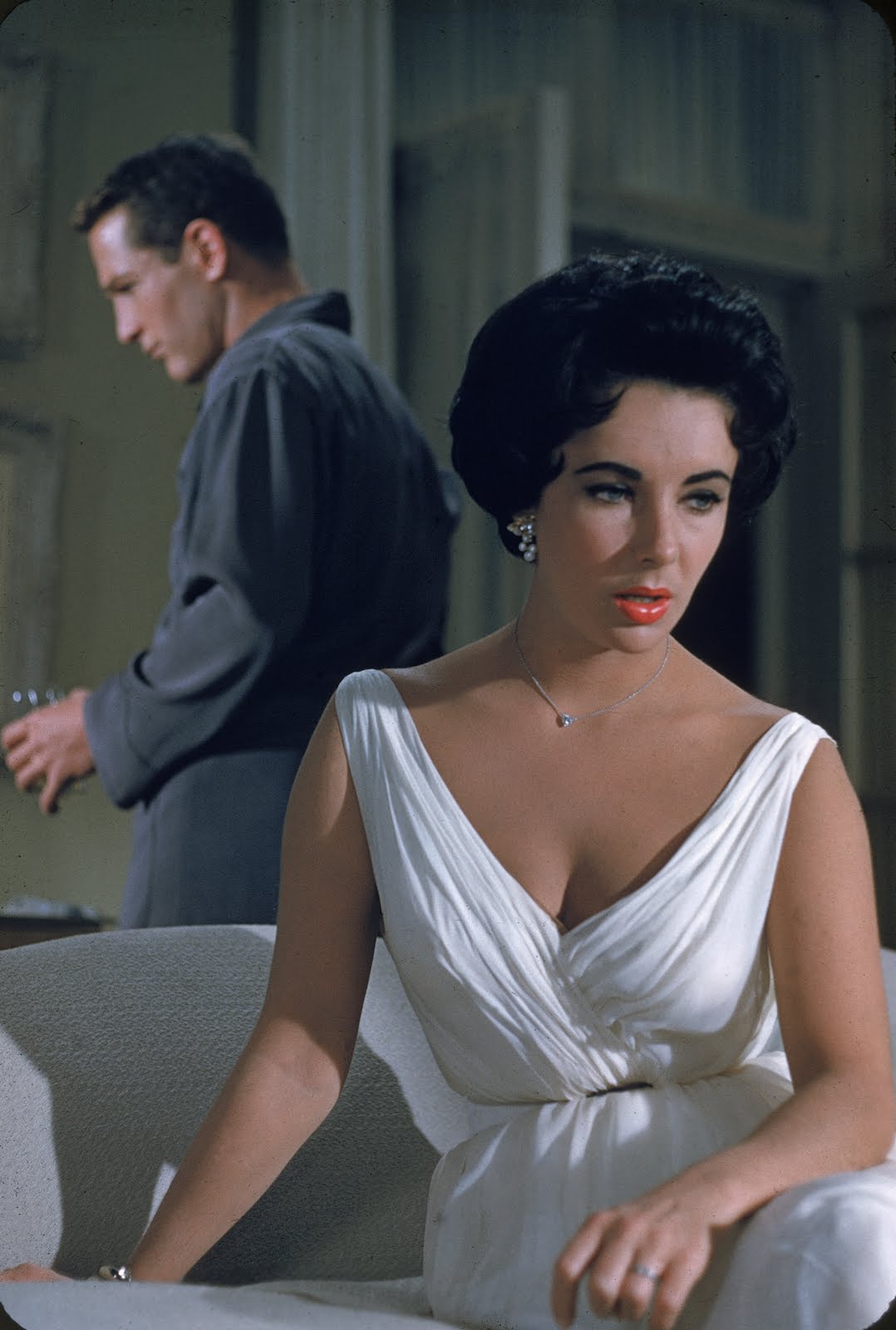
Elizabeth Taylor sizzes as "Maggie the Cat" in the 1958 film, "Cat on a Hot Tin Roof."

From 1930-1968, the Motion Picture Production Code spelled out clearly what was acceptable conduct to be shown in Hollywood movies. When  British-born actress Elizabeth Taylor (b. 1932) appeared as Maggie the Cat in the 1958 movie version of Tennessee Williams’ Pulitzer Prize-winning play, Cat on a Hot Tin Roof, the movie censors dogged the set.

“It’s hard to believe how strictly we were supervised in those days when it came to anything involving sex,” recalled Elizabeth. “It wasn’t just homosexuality that was concealed; heterosexual behavior was subject to almost as many restrictions.”

One day when she was on camera for a wardrobe test, an “inspector” showed up.

When a BI (Bust Inspector, if you can believe it) appeared, he took one look at me and called for a stepladder. He climbed up, peered down, and announced that I needed a higher-cut dress, too much breast was exposed.”

To satisfy the BI, the costume designer Helen Rose pinned Elizabeth’s bodice with a brooch. But as soon as the BI left, that brooch came off and Elizabeth Taylor’s legendary cleavage was bared. (1)

Paul Newman and Elizabeth Taylor have more bitter conversation in a still from the 1958 film, "Cat on a Hot Tin Roof."

(1) Kashner, Sam and Schoenberger, Nancy. Furious Love. New York: Harper Collins, 2010.

Readers, for more on Elizabeth Taylor, click here.

Read Full Post »

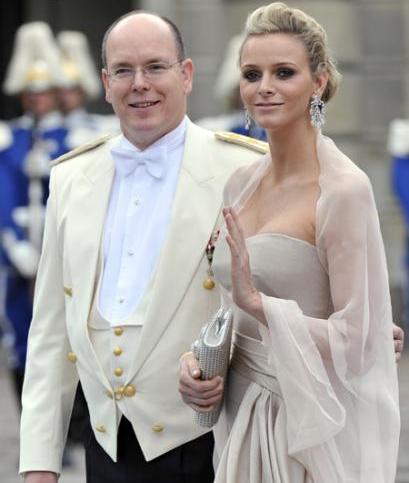
Prince Albert of Monaco is engaged to former South African Olympic swimmer Charlene Wittstock. (Lisa's History Room)

Prince Albert of Monaco is engaged to Charlene Wittstock, a former Olympic swimmer from South Africa. He is 52, she, 32. Ms. Wittstock will become the first crown princess since the 1982 death of Prince Albert’s mother, Princess Grace of Monaco. Princess Grace was the former American film star, Grace Patricia Kelly.

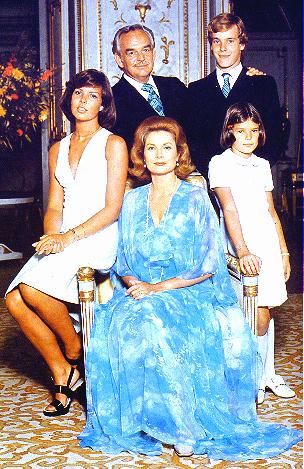
In this 1974 photo, Princess Grace of Monaco, center, poses with her husband, Prince Rainier III, and their three children. From left to right: Princess Caroline, Prince Albert, and Princess Stephanie. At the time, Princess Grace and Prince Rainier III were the reigning monarchs of the ancient royal House of Grimaldi. Both Princess Grace and Prince Rainier III are deceased. Today their son Prince Albert is the reigning prince.

Perez Hilton calls the announcement a

Pretty big deal considering Albert was a notorious bachelor, causing Parliament to change the constitution in 2002 to allow one of his sisters’ sons to take the throne if he doesn’t produce an heir!

He does have two children, but they were born out of wedlock so they are not allowed to assume the throne.

Looks like Charlene better get ready to make some babies!”

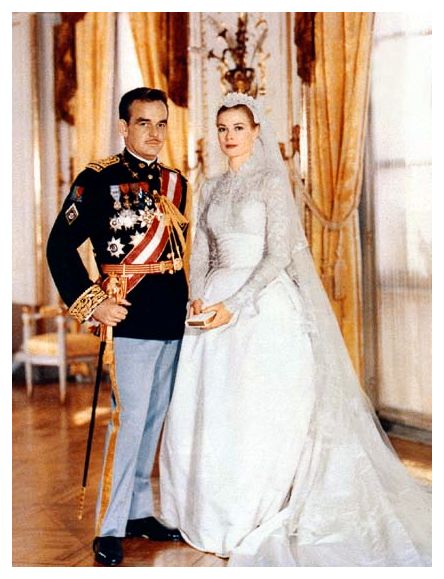
Palace protocol dictates that couples must wait at least six months between the announcement of the engagement and the wedding day. Expect a big “to-do” since this will be the first royal wedding of a reigning prince in Monaco since 1956 when Grace Kelly retired from filmmaking to wed Albert’s father, Prince Rainier III.

Prince Rainier III of Monaco weds American film star and fashion icon Grace Kelly. They wed twice; the civil ceremony was held on April 18, 1956, followed the next day by a religious one. Her Serene Highness the Princess of Monaco, commonly referred to as "Princess Grace," retained both American and Monegasque citizenships.

READERS: Continue the story with “Prince Albert of Monaco: A THIRD Love Child?”

READERS: For more on Grace Kelly here on Lisa’s History Room, click here.

Read Full Post »

Richard Burton and Elizabeth Taylor photographed on the set of “Cleopatra” in Rome. Life Magazine, April 13, 1962

During the 1962 filming of “Cleopatra” in Rome, Elizabeth Taylor and Richard Burton began a very public affair. The two were both married to other people at the time. The scandal made headlines worldwide and was met with moral outrage.

After five months in Rome, filming moved to the island of Ischia, Italy, off the Amalfi Coast, with the paparazzi in hot pursuit. It was on Ischia that the scenes on Cleopatra’s barge were shot. The following candid photos of Elizabeth Taylor sunbathing and swimming were taken by celebrity portrait photographer Bert Stern.

Elizabeth Taylor and Richard Burton relax in Ischia, Italy, in June 1962, during the filming of the "Cleopatra" barge scenes.

Elizabeth Taylor on location for "Cleopatra" off the coast of Ischia, Italy, June 1962

That same month, the Hollywood stars visited the neighboring island of Capri as guests of entertainer Dame Gracie Field at her exclusive hotel, La Canzone Del Mare. The hotel’s name – “Singer of the Sea” – is a reference to the incredible view over the rocks below where the mythological sirens were said to have lured sailors to their deaths. The photo shown here is being shown publicly for the first time in an auction of Field’s scrapbooks

Elizabeth Taylor and Richard Burton arrive on the island of Capri in June 1962. The screen stars, who were both married, were guests at Dame Gracie Field’s exclusive hotel on Capri, La Canzone Del Mare.


Rumours of their relationship had been sizzling since filming of Cleopatra began the year before, but exploded that June when the scandalised Vatican accused them of ‘erotic vagrancy’ and the U.S. government threatened to ban them from the country. In the photograph, however, they look as though they haven’t a care in the world as they stroll side by side to the waterfront, him holding a cigarette in a casual white top and trousers, Taylor standing beside him in a one-piece bathing suit and cap, their hands almost brushing together.”

After the picture “Cleopatra” was completed filming the next month (July 1962), Taylor and Burton would continue their off-screen romanace. Another two and a half years would elapse before they would divorce their respective spouses and be free to marry one another. After their March 1964 wedding in Montreal at the Ritz Carlton, “the Burtons” would continue to captivate the public’s attention for the rest of the sixties, grabbing headlines, making movies together, throwing glamorous parties, having nasty public arguments, buying ridiculously large and expensive jewels and yachts, jetting here and there, and hobnobbing with royalty like the exiled Duke and Duchess of Windsor and other glitterati. 

But by 1970, the glitter had worn off the golden couple. Their endless and needless spending and self-indulgence were wearisome and tacky. Their film reviews were terrible and their relationship was worse. They made each other miserable. They were in bad health. Both drank heavily and Elizabeth liked pills.  They would divorce each other only to remarry, then divorce again.   

Readers: For more on Elizabeth Taylor, click here.

Read Full Post »

Elizabeth Taylor and Richard Burton tie the knot in Montreal on March, 1964.

Since they began their affair on the movie set of “Cleopatra” in January, 1962, Richard Burton delighted in giving bride Elizabeth Taylor extravagant jewels.

The Taylor-Burton Diamond

One of the most famous pieces Burton gave Taylor is the pear-shaped, 69.42 carat Taylor-Burton Diamond. Fifth husband Richard Burton bought the diamond from Cartier in 1969 after a Sotheby’s auction, paying over $1 million for it. Burton agreed to allow the jeweler to display the jewel for a limited period in New York and Chicago, beginning on November 1. Crowds of more than 6,000 a day circled the store’s Fifth Avenue shop in New York to “gawk at a diamond as big as the Ritz.”

Meanwhile, Taylor had Cartier remount the stone as a pendant suspended from a V-shaped necklace of graduated pear-shaped diamonds, mounted in platinum. Elizabeth admitted that even for her the Cartier Diamond – now called the Taylor-Burton Diamond – was too big to wear as a ring.

The Taylor-Burton Diamond hangs from a diamond necklace created by Cartier.

Elizabeth is no stranger to heavy rings. She wears the Krupp Diamond on her left hand almost every day and has worn it in most if not all of her films and TV appearances since she bought it in 1968 for $305,000. The stone weighs 33.19 carats.

Liz Taylor's everyday ring: The Krupp Diamond

The Krupp Diamond, Liz Taylor’s everyday ring

Elizabeth chose to debut the Taylor-Burton Diamond at Princess Grace of Monaco’s  fortieth birthday bash at L’Hermitage in Monte Carlo. Princess Grace, formerly known as film star Grace Kelly (1929-1982), who would officially turn 40 on November 12, 1969, wanted to share this special occasion with sixty of her closest friends. Many of them were celebrities she knew from her film days like Rock Hudson, the Taylor-Burtons, and David and Hjordis Niven.

Film star Grace Kelly marries Prince Rainier III of Monaco in Monte Carlo, April 1956 and becomes Her Serene Highness The Princess of Monaco.

Princess Grace’s invitations were designed like horoscopes and the party was to have a Scorpio theme – as that was Grace’s astrological sign. Grace was a lifelong believer in astrology, and often called a Hollywood astrologer for a personal daily horoscope. (1)

Princess Grace of Monaco (center) is flanked by her 2 sisters on the day of her fortieth birthday party. Monte Carlo, Monaco. November 15, 1969.

Meanwhile, Elizabeth Taylor (b. 1932) planned her big entrance to Princess Grace’s party. Aside from choosing her wardrobe and hairstyle, she and Richard decided that the Taylor-Burton Diamond required more then ordinary security:

First, the diamond was flown from New York to Nice in the company of two security guards, who delivered it to Elizabeth Taylor and her husband aboard their yacht, the Kalizma. The Burtons were then escorted to the party with their security guards, who were armed with machine guns as added protection.” (2) 

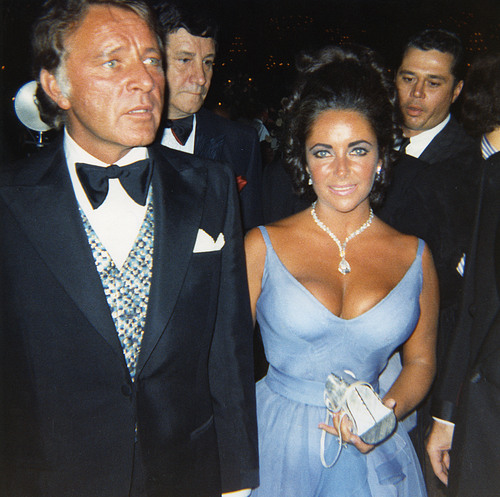
Richard Burton and Elizabeth Taylor arrive at Princess Grace’s 40th birthday party, Monaco, November, 1969. Notice that Liz Taylor wears a robe in keeping with the party’s Scorpio theme, the Princess’s astrological sign. On her left hand she wears the Krupp Diamond. The necklace pendant is the Taylor-Burton Diamond. November, 1969 (“Bling-Bling, Bang-Bang: Elizabeth Taylor Attends Princess Grace’s Scorpio Ball,” Lisa’s History Room)

Princess Grace of Monaco with Richard Burton at her 40th birthday party, Monaco, November 1969

Princess Grace of Monaco, 1969

Although it was Grace’s birthday, Elizabeth Taylor clearly upstaged the princess, dazzling all the guests with her new jewel and her beauty. After the ball, Grace wrote friend Judy Balaban Quine that she found it hard to take her eyes off Elizabeth, whom she considered

 “unbearably beautiful.”

Turning forty, added Grace, was equally unbearable. (1)

Richard Burton escorts wife Elizabeth Taylor to the April 1970 Academy Awards. Elizabeth wears the Taylor-Burton Diamond necklace and an Edith Head chiffon gown.

After the Taylor-Burton divorce in 1978, Elizabeth sold the diamond for $5 million, pledging to use part of the profit to build a hospital in Botswana (which, my mother tells me, blew away).

(1) Glatt, John. The Royal House of Monaco: Dynasty of Glamour, Tragedy, and Scandal. New York: St. Martin’s Press, 1997.
(2) Taylor, Elizabeth. Elizabeth Taylor: My Love Affair with Jewelry. New York: Simon & Schuster, 2002.

Read Full Post »

American actress Grace Kelly looks over her shoulder in Hollywood, California, March 1954. In April 1956, Kelly married Rainier III, Prince of Monaco, and became Her Serene Highness the Princess of Monaco. (“Grace Kelly: Floating on Chiffon,” Lisa’s History Room)

I was so excited to read in Vanity Fair that London’s Victoria & Albert Museum was featuring an exhibition of Grace Kelly‘s clothes. What a treat! I thought. Imagine all those beautiful 1950s dresses designed for actress Grace Kelly (1929-1982) together in one place. Of course I couldn’t get to London, I knew; I was recovering from spine surgery and we were building an addition to our house.

But what did that matter? I had my computer. With a few keystrokes and mouse clicks, I could cyber fashion stroll. I just assumed the V & A Museum would put the collection online as they had done with Queen Victoria and Prince Albert‘s jewelry collection. (See “Victoria & Albert: Art & Love & Teeth”)

I jumped to the museum website and found the exhibition: “Grace Kelly: Style Icon.” I got even happier after I read the promising blurb:

“Featuring dresses from her films including ‘High Society’ and ‘Rear Window,’ as well as the gown she wore to accept her Oscar in 1955, the display will examine Grace Kelly’s glamorous Hollywood image and enduring appeal.

It will also explore the evolution of her style as Princess Grace of Monaco, from the outfit she wore to her first meeting with Prince Rainier in 1955 to her haute couture gowns of the 1960s and ’70s by her favourite couturiers Dior, Balenciaga, Givenchy and Yves St Laurent.”

But much to my chagrin, I discovered that the exhibit is not posted online at the V & A. I was, at first, incredibly disappointed. In a mad haste, I scoured the Internet for images of the fashion display on newssites and blogs. I found a lot of articles but precious few images of the actual exhibit. But what I did find told a lot. To illustrate a point, here are two of those V & A showcase windows:  

A mannequin displays the dress Grace Kelly wore in “The Swan.” (1956) The exhibit, “Grace Kelly: Style Icon,” is at the Victoria & Albert Museum in London from April 17- September 26, 2010

The exhibition at the Victoria & Albert Museum in London, “Grace Kelly: Style Icon,” includes dresses worn by Grace Kelly after she became Princess Grace of Monaco in 1956.

Yawn. Pretty dry stuff, huh? Dresses on mannequins have no sparkle. What they needed was Grace Kelly.

Grace Kelly as Lisa Fremont in Alfred Hitchcock’s 1954 thriller, “Rear Window.” (“Grace Kelly: Floating on Chiffon,” Lisa’s History Room)

So instead of trying to catalog for you all the dresses in the V & A, I have picked my personal favorite and shown it as worn by the eternally beautiful Grace Kelly. It is the Paris dress she wore as sophisticate Lisa Carol Fremont in the 1954 Alfred Hitchcock classic, “Rear Window.”

The dress with a fitted black bodice and deep V-cut bustline was designed for Kelly by Paramount Picture’s chief costume designer Edith Head. The full skirt falls to mid-calf, gathered and layered in white chiffon and tulle. From the nipped-in waist, a spray branch pattern falls playfully over the hip. Grace accessorized her high-fashion gown with white silk gloves, pearls, and a chiffon shoulder wrap.

To read the “Rear Window” script excerpt wherein “Lisa-Carol- Fremont” enters Jimmy Stewart‘s apartment wearing this outfit, click here.

Grace Kelly sits on steps in her “Paris” dress she wore in Alfred Hitchcock’s 1954 “Rear Window.” The gown had a light & airy quality with a slender waist and a beautiful skirt made from yards and yards of tulle and chiffon. The black and white confection was created by Paramount Pictures costume designer Edith Head. (“Grace Kelly: Floating on Chiffon,” Lisa’s History Room)

For more on Grace Kelly, click here.

Read Full Post »

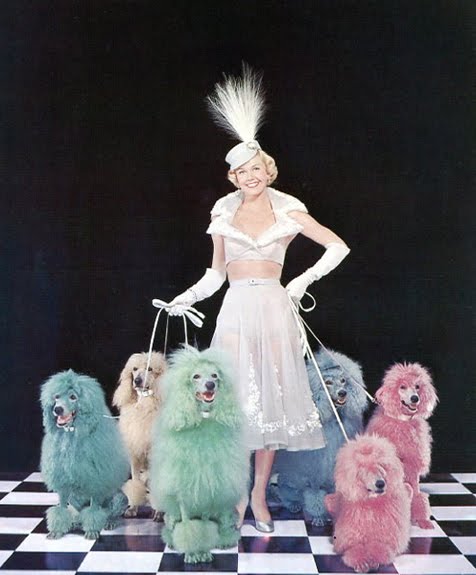
To promote the film, "April in Paris," Doris Day appeared on a 1952 Collier's magazine cover with six dyed poodles.

Doris Day appears on the cover of Collier's 1952 magazine to promote her new film, "April in Paris." With her are 6 dyed poodles. Poodles became the most popular dog in the 1950s, when poodle skirts made their debut.

In post WWII America, the poodle dog became the rage. It went from being the 25th most popular dog in 1946 to No. 1 in 1960. All of a sudden, poodles

…were chic; they stood for modernity and sophistication, which anyone could shoot for, whether they were rich or just wanted to appear a la mode. Teenage girls wore stylish poodle skirts decorated with felt-appliqued French poodles wearing rhinestone collars; ladies bought handbags with embroidered poodles on the side and decorated their powder rooms with wallpaper that had pictures of poodles strolling down the Champs-Elysees. (1)

In the fifties, every glamorous movie star had a poodle – or was photographed with one.

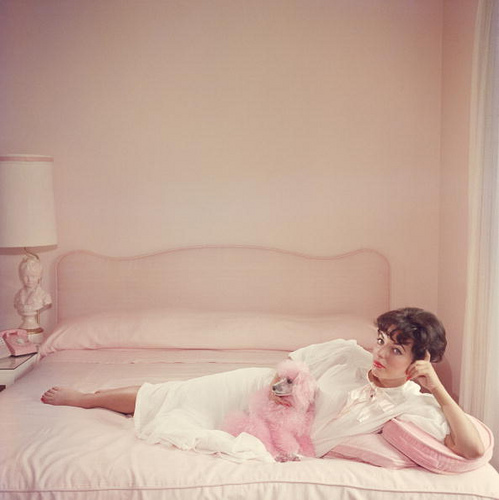
Actress Joan Collins with her dyed pink poodle

Although they are not French, poodles came to be called “French poodles,”  recalled for their clever antics in French circuses. Thus, Americans bought poodles and gave them French names like Fifi, Gigi, and Pierre. They also took them to fancy groomers:

To gaze upon a standard (full-size) poodle in a “Miami Sweetheart” cut with centered fur hearts on hips and back, pantaloon legs sculpted lathe-smooth, tassel ears, a Van Buren mustache drooping from its muzzle, a ribboned topknot, and a wagging pompon tail, parading along the boulevard in a rhinestone collar at the end of a jeweled lead, is to see an animal that has become a walking, barking work of art.

Then the poodle enthusiasts went a step further. They attempted to make an animal that was already cute even cuter. They began to use vegetable dyes to dye the dogs to match their owners’ houses, moods, and outfits. Movie actress Doris Day epitomized this fad when she appeared in the movie, “April in Paris,” with six dyed poodles on leashes.

Read Full Post »

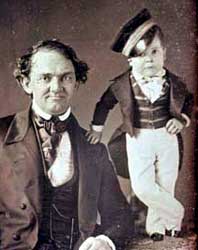
Showman P.T. Barnum (l) with his protegee, "General Tom Thumb" (born as Charles Sherwood Stratton). Daguerrotype by Samuel Root, 1850

The best known of circus pioneer P.T. Barnum‘s performers was Charles Sherwood Stratton (1838-1883), also known as General Tom Thumb. Stratton weighed 9 lbs. 8 oz. at birth, a bouncing baby boy for the time, but stopped growing at six months. When Barnum discovered him at the age of five, Stratton weighed only 15 lbs. and was 25 inches tall. 

“The boy barely came up to the showman’s knees!” (1) 

Barnum wasted no time signing up the boy as a sideshow attraction. His parents happily rented out their child for $7 a week plus room, board, and traveling expenses. Barnum installed the Strattons in a fancy New York City apartment above his museum of human curiosities. Barnum then began transforming Little Charlie into an international celebrity he christened “General Tom Thumb,” recalling the tiny fictional knight of King Arthur’s round table. The knight was so small, he rode a mouse and battled spiders. 

1844 stereograph depicting General Tom Thumb as Napoleon. Although "Tom" was really six at the time, P.T. Barnum promoted him as a 13-year-old.

Barnum taught the little dwarf to dance, sing, and tell jokes while dressed in elaborate costumes as Cupid, Napoleon, and Frederick the Great. At five, Tom learned to drink wine and at seven he took up cigar smoking. Barnum billed Tom Thumb as the “smallest man alive.”  

In 1844, Barnum took his young protege on a much-publicised European tour debut. Tom Thumb was a huge sensation, appearing before the crowned heads of Europe and visiting Queen Victoria not once, but twice. Audiences were enchanted with the man-boy whose charm combined innocence with pomposity. Over time, Tom made so many visits to royalty that Barnum had a special carriage built for him. 

“Only 11″ high, it was painted blue and lined with silk. Drawn by ponies only 28″ tall, and driven by children dressed in livery, it caused a sensation wherever it went.” 

Years went by and the money from Tom Thumb’s tours made him a rich man. “The Man in Miniature” moved to a specially-designed mansion for him and his parents in his hometown of Bridgeport, Connecticut. 

Lavinia Warren (1841-1919), photo c. 1855-1865

It was said that, by the age of 19, Tom had been kissed by a million and a half girls.Soon, though, the United States was plunged into the Civil War and Tom wanted more than just kisses from strangers. He began looking for a wife. He found her in the diminutive form of another little person, the charming and very beautiful Lavinia Warren

On February 10, 1863, the two were married at Grace Episcopal Church in New York City. The wedding was front page news. Billed as “the fairy wedding,” it was the social event of the season. People clamored for invitations, yet only two thousand people were invited. 

"The Fairy Wedding" of General Tom Thumb (Charles Stratton) and Lavinia Warren. This is a reenactment of the ceremony staged by photographer Mathew Brady after the Feb. 10, 1863 event.On the left in each picture is the best man, George Washington Morrison Nutt, known as Commodore Nutt, who had courted Lavinia unsuccessfully; Tom Thumb; Lavinia, and Minnie Bump AKA Minnie Warren, Lavinia's younger and even more petite sister


As Tom and Lavinia made their way up the center aisle to the altar, only guests seated along the aisle could see them. Once they arrived at the chancel, women stood on tiptoes and a few climbed on chairs to witness the ceremony. Afterwards, P.T. Barnum staged a reception for the newlyweds at the Metropolitan Hotel. Barnum charged $75 a ticket. Although there was a demand for 15,000 tickets, only 5,000 were sold. 

At the reception, the Strattons stood on a piano to receive their guests. Later on their honeymoon, they traveled to Washington, D.C., to the White House, where President Lincoln gave them a fancy party. In the course of the evening, the president told General Tom Thumb that he had put him completely in the shade, as he [the General] was now the center of all attention. 

(1) Fleming, Candace. The Great and Only Barnum: The Tremendous, Stupendous Life of Showman P.T. Barnum. New York: Schwartz & Wade Books, 2009.

Read Full Post »

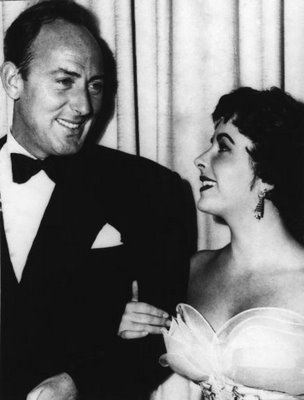
Elizabeth Taylor with husband #2: Michael Wilding: Married 21 February 1952, Divorced 30 January 1957

On May 12, 1956, Anglo-American film actress Elizabeth Taylor and her second husband Michael Wilding threw a dinner party at their Beverly Hills home. It was a bad night for a party. For the first thing, it was foggy and the Wildings lived up a long and winding road in Benedict Canyon. For the second thing, the Wildings’ marriage was on the rocks. Elizabeth was having an affair and Michael’s out-of-control drinking had led to several indiscretions with other women. 

The guest of honor was to be Father George Long, a hip priest who ran with the Hollywood set. Rock Hudson and his new wife Phyllis Gates were invited. So was Kevin McCarthy, who was then making “Invasion of the Body Snatchers.” 

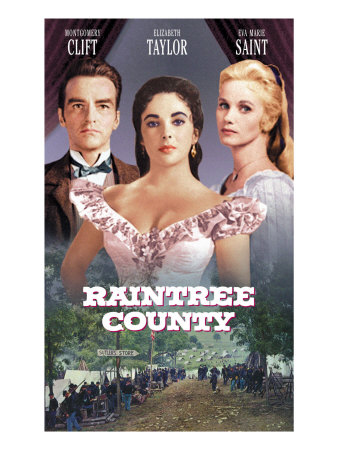
Montgomery Clift was another actor on the guest list. That spring, he and Elizabeth were shooting the MGM Civil War melodrama, “Raintree County.” 
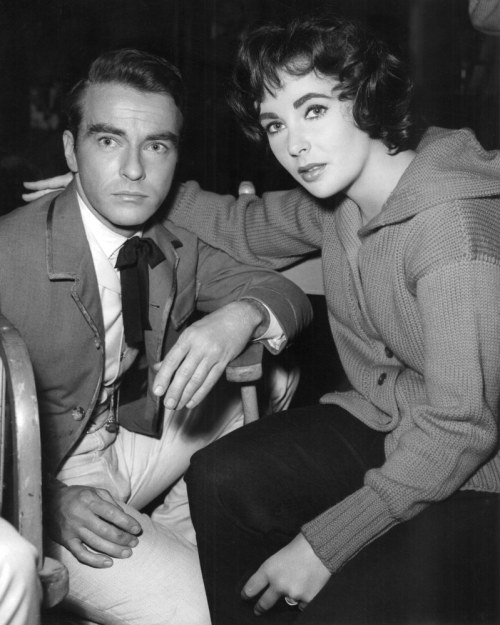
Montgomery Clift and Elizabeth Taylor in "Raintree County" (1957)

(Elizabeth had just finished filming “Giant” which would be released in October of that same year.) 

Elizabeth Taylor and Rock Hudson in "Giant" (1956)

Monty and Elizabeth had become best friends in 1951 during the filming of “A Place in the Sun.” Monty affectionately referred to Elizabeth as “Bessie Mae.” She was his confidante. Monty Clift was a rising star, known for his sensitive and brooding portrayals of troubled young men. He was very intense and deeply serious about acting. 
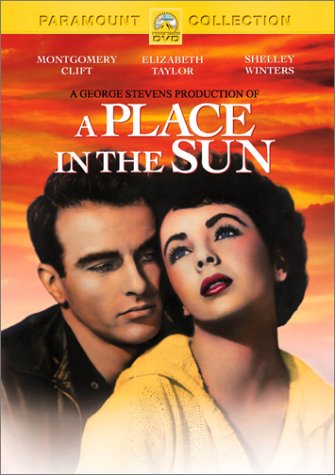
"A Place in the Sun" (1951) with Montgomery Clift and Elizabeth Taylor

At first Monty declined the invitation at Liz’s. He was awkward being around the Wildings while their marriage was so bad. But he changed his mind and agreed to join the group for dinner, leasing a car and driving up the mountain road to the Wildings’ house. 

The party turned out to be a terrific bore. The guest of honor didn’t even show. Michael Wilding wasn’t feeling well and spent the evening lounging on the couch, saying virtually nothing to the company and acting aloof. That made Elizabeth nervous so she was unusually chatty. Monty grumbled about the way the MGM director Edward Dmytryk was shooting everything in “Raintree County” in giant close-ups. He was depressed and angry. He sensed the film would be a colossal disaster. 

The party broke up about midnight with Monty and Kevin bidding each other goodbye in the driveway and taking off down the road Elizabeth called a “cork twister.” Kevin was in the lead. Within minutes, Kevin was back at Elizabeth’s house, ringing the bell. Monty Clift had had a serious car accident. His car had struck a utility pole as he rounded one of the hairpin turns in the fog. Elizabeth shrieked and demanded that Kevin immediately take her to the scene. 

Montgomery Clift, Elizabeth Taylor, and Eva Marie Saint in "Raintree County" (1957)

Since the 1950, many unflattering things have been written about Elizabeth Rosemond Taylor who is now a Dame of the British Empire, and much of it was justified. (She tended to steal people’s husbands.) But what was to happen next on that foggy stretch of midnight road below her house was to be Elizabeth’s finest hour. 

She and Kevin arrived at the wreck:

“Monty’s car was demolished, an ‘accordion-pleated mess,’ Elizabeth said. A 4,800 transformer, knocked off the pole by the impact, had narrowly missed hitting the car. McCarthy thought his friend was dead. ‘The doors were so jammed that we couldn’t get to him,’ he said.” (1)  

Broken glass was everywhere – but that didn’t faze Elizabeth. She climbed in the car through a back window.  

“‘Adrenaline does something to you,’ she remembered.” 

Elizabeth hauled herself over the bloody seat. Monty’s motionless body lay beneath the steering wheel. His face was barely recognizable. 

“‘It was like pulp,’ she remembered.” 

Elizabeth called out to Monty. He reacted to her voice and indicated to her that he was choking. Several of his teeth had broken off and had lodged in the back of his throat. Reaching inside his mouth, Elizabeth pulled the teeth out, one by one. Elizabeth saved his life. Monty could once again breathe.

It was nearly an hour before an ambulance arrived and, with it, a handful of frenzied photographers. Elizabeth positioned herself between the stretcher carrying Monty and the photographers’ cameras. “She was remarkable,” said McCarthy. She told the photographers that if they so much as snapped one photo of Monty’s bloodied face, she’d never allow her to take another photo of her. (That would never do. Elizabeth Taylor was one of Hollywood’s top actresses and would become one of the most photographed women in the world.) The photographers backed off.

The car accident left Elizabeth with persistent nightmares. She couldn’t get Monty’s bloody face out of her mind.

“It would come up like a balloon in front of me at night.” 
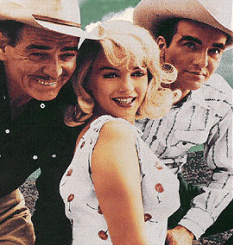
"The Misfits" (1961) stars Clark Gable, Marilyn Monroe, and Montgomery Clift

Understandably, filming on “Raintree County” was put on hold as Monty underwent a long hospitalization and painful facial reconstruction. Despite these efforts, Monty never looked as beautiful as before. His face remained scarred and partially paralyzed. This was the beginning of Monty’s long and deadly slide into alcohol and drug addiction. He became a wrecked man.

Marilyn Monroe, who appeared alongside Monty in the 1961 film, “The Misfits,”  described him as 

“the only person I know who is in worse shape than I am.” 

Monty’s post-accident career has been called “the longest suicide in Hollywood history.” In 1966, ten years after his car accident, Montgomery Clift died alone in his New York apartment while watching “The Misfits” on TV. He was only 45. 

(1) Mann, William J. How to Be a Movie Star: Elizabeth Taylor in Hollywood. New York: Houghton Mifflin Harcourt Publishers, 2009.

Read Full Post »

President John F. Kennedy and singer Frank Sinatra at the 1961 Inaugural Gala

Singer and film star Frank Sinatra (1915-1998) grew up poor and lower class in Hoboken, New Jersey. Once he made it big in showbiz (thanks to help from his Mafia cronies), he obsessed about fitting in with the upper class. He wormed his way into politics, using his Hollywood star power to campaign and fundraise for Democratic heavyweights such as Franklin Roosevelt and John F. Kennedy. In attaching himself to men of honor, Sinatra hoped to achieve the respectability he craved.

Sinatra had cultivated a relationship with President Kennedy through movie star Peter Lawford, who was married to the president’s sister, Pat.

Pat Kennedy Lawford and British actor Peter Lawford

In March 1962, the president was scheduled to fly to Southern California. Peter Lawford asked Sinatra to be the president’s host at his Palm Springs estate. Sinatra was thrilled. He went straight to work. At his own expense, Sinatra installed a helicopter pad, cottages for the Secret Service, and even a flagpole for the presidential flag.

But the president’s brother Bobby Kennedy wasn’t having it. He was the Attorney General of the United States at the time. When he heard about his brother Jack’s proposed stay at Sinatra’s, he went ballistic. Bobby was making the “most single-minded attack on organized crime in American history” and could not abide Jack associating with someone with mob connections. (1) Peter was the one chosen to tell Sinatra that the president would not be staying with him.

Sinatra did not take the news well. He had a notoriously explosive temper:

“Sinatra vented his spleen by destroying the concrete landing pad with a sledgehammer. He applied a different kind of sledgehammer to his friendship with Peter and Pat [Lawford], banning them from his company….Jack ended up staying at the home of Bing Crosby. Marilyn Monroe flew down to be with the president, spending the night in his bedroom….”

Peter Lawford, Frank Sinatra, and Marilyn Monroe ca. 1961-62

(l. to r.) Peter Lawford, Frank Sinatra, Marilyn Monroe, ca. 1961-62

…and Frank Sinatra became a Republican.

(1) Leamer, Laurence. The Kennedy Women: The Saga of an American Family. New York: Fawcett Books, 1994.

For more on Sinatra, check out “Sinatra: Pants on Fire!”

Read Full Post »

Elizabeth Taylor as "Cleopatra" (1963)

Elizabeth Taylor as Queen of the Nile in "Cleopatra" (1963)

There’s a delicious new Elizabeth Taylor biography on the market: How to Be a Movie Star: Elizabeth Taylor in Hollywood by William Mann. I’ve been reading juicy excerpts online. The book is so good, so rich in scandalous detail, that I’ve ordered a copy to be sent to my doorstep.

I’m devouring the chapter on the early 1962 filming of “Cleopatra,” when Elizabeth famously ditches husband #4 Eddie Fisher for her Welsh costar Richard Burton. Author Mann paints Elizabeth Taylor as quite the pampered diva, ensconced in her Italian villa, filming in Rome by day. Her butler, for example, was one of many charged with satisfying her every frivolous need.

An example: Elizabeth was a pack-a-day smoker – despite the fact that she was recovering from pneumonia and a tracheotomy that had seriously delayed the movie’s production and almost cost Elizabeth her life. Nevertheless, she smoked, and with a cigarette holder. She never used the same holder twice.

“Fresh ones – at least ten a day –  had to be at the ready, and they had to be color-coded. A green dress called for a matching holder – and Madame changed outfits quite frequently as her moods shifted. Every morning Oates [her butler] prepared a box of cigarette holders based on what Elizabeth would be wearing that day and evening, and not only did the holders have to match her outfits, they couldn’t clash with the tablecloth.” (1) 

Richard Burton as Mark Antony with Elizabeth Taylor as Queen of the Nile in "Cleopatra" (1963)

Richard Burton as Marc Antony with Elizabeth Taylor in "Cleopatra" (1963)

But Richard Burton wasn’t dazzled by Liz’s Hollywood fame. Twentieth Century Fox was paying her $1 million to play the Queen of the Nile in their production. Elizabeth Taylor was the highest-paid actress of the day – but Richard Burton called her “Lumpy” – and to her face. She was intrigued by his dismissive attitude toward him.

Burton was a heavy drinker.  In his first big scene with Taylor, he appeared on the set with a terrible hangover. Elizabeth, although the mother of 3 children at the time, with an adoption of a fourth child in the works, had never been particularly maternal. Yet when she saw how sick Burton was, she felt an overwhelming need to take care of him. It was the turning point. They began a hot-and-heavy and very public romance.

Rumors seeped out and crossed the Atlantic, creeping into gossip columns by Hedda Hopper and Dorothy Kilgallen, scandalizing the film industry and the public who were just recovering from Liz’s latest romantic acquisition, when she stole the married Eddie Fisher from actress wife Debbie Reynolds.

In early 1958, Fisher embraces wife Reynolds in Las Vegas, though his eye seems to be on Taylor, his best friend Mike Todd's wife. In March, Todd dies in a plane crash, and Fisher soon leaves Reynolds for Taylor.

In early 1958, Fisher embraces wife Reynolds in Las Vegas, though his eye seems to be on Taylor, his best friend Mike Todd's wife. In March, Todd dies in a plane crash, and Fisher soon leaves Reynolds for Taylor.

Meanwhile, back on the “Cleopatra” set, Eddie Fisher learned of his wife’s affair. Their marriage had already been on shaky ground but was not yet in complete tatters. He wanted to salvage it. On February 5, at the suggestion of his  wife’s secretary, he took Elizabeth shopping. He chartered a flight to Paris. The international press followed their every move, as the former nightclub crooner Fisher and his gorgeous celebrity wife visited Parisian fashion houses such as Yves St. Laurent, Chanel, and Dior, where Eddie wrote check after check for gowns, jewels, and furs for his flagrantly unfaithful wife. Eddie Fisher once said,

“To keep Elizabeth happy, you have to give her a diamond before breakfast every morning.”

Delighted with her new trinkets, Elizabeth promised Fisher she would stop seeing Burton. A rupture was temporarily averted; they flew back to Rome.

Two weeks passed yet things did not go better for Fisher. Liz did not keep her word. She continued seeing Burton. On February 17, 1960, drinking heavily, Elizabeth swallowed 14 sleeping pills and passed out cold.  She was hospitalized for what was considered a suicide attempt. She was distraught over her personal life. She could not make the break with Burton. She had fallen head-over-heels in love with him.

A little over a week later, she turned thirty, and her parents flew to Rome for the celebration. Shortly afterward, Burton confronted her in front of Fisher and told her she must choose between her two men. On the spot, she chose Burton. Richard divorced his wife of 13 years, Sybil Burton. In 1964, Elizabeth divorced Fisher and married Richard Burton.

Richard Burton escorts wife Elizabeth Taylor in an Edith Head evening gown, 1970
Richard Burton escorts wife Elizabeth Taylor to the 1970 Oscars. Taylor wears an Edith Head gown that matches her violet eyes and displays her assets, particularly her own 69-carat, pear-shaped Cartier diamond — which later became known as the Taylor-Burton diamond.

Twice married, twice divorced to one another, the love affair between Elizabeth Taylor and Richard Burton remains one of the most famous – and tempestuous – of the Twentieth Century.

(1) Mann, William J. How to Be a Movie Star: Elizabeth Taylor in Hollywood. New York: Houghton Mifflin Harcourt, 2009.

Read Full Post »

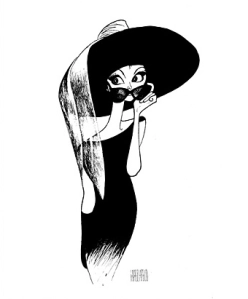
"Audrey Hepburn with Hat," drawing by Al Hirschfeld

"Audrey Hepburn with Hat," drawing by Al Hirschfeld

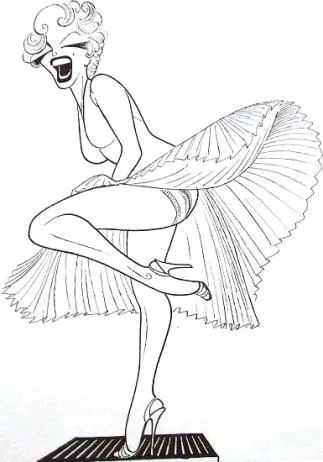
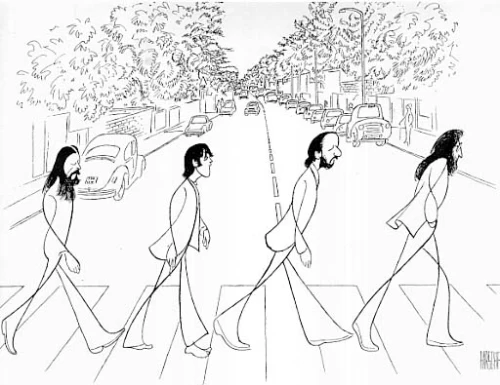
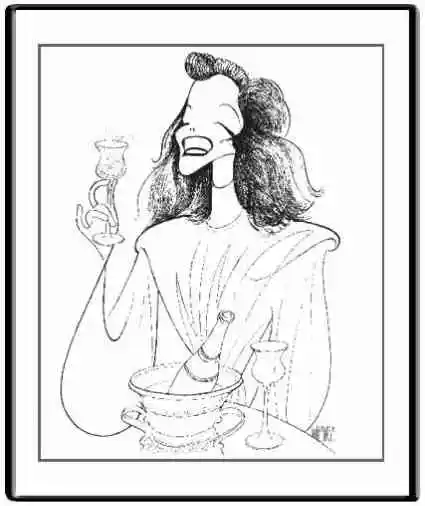
Albert “Al” Hirschfeld ( 1903 – 2003) was an American caricaturist best known for his simple black and white satirical portraits of celebrities. He had the unique ability to capture a person’s likeness with few and simple lines. His eight-decade career included drawing the entire casts of Broadway plays to include alongside reviews in The New York Times and illustrating the covers of newstand TV Guide issues.

Hirschfeld achieved additional fame  for hiding the name of his daughter, Nina, in most of his drawings. The name “Nina” would be scrawled in the lace of a sleeve, the locks of an actress’s wavy hair, or somewhere in the background. On occasion, “Nina” would show up more than once in a drawing. In those cases, Hirschfeld would then add a number next to his signature, designating how many times “Nina” would appear. On a few rare occasions, Hirschfeld would write “Nina” flopped, creating a reverse image of the name.


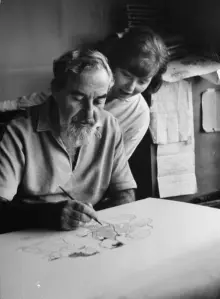
Al Hirschfeld with daughter Nina, 1961

Al Hirschfeld with daughter Nina, 1961

“Though Nina was a popular feature in his illustrations, with many enjoying the game of searching for them, on more than one occasion Hirschfeld would lament that the gimmick had overshadowed his art. On occasion he did try to discontinue the practice, but such attempts always generated harsh criticism. Nina herself was reportedly somewhat ambivalent about all the attention.

In…[an] interview with The Comics Journal, Hirschfeld confirmed the urban legend that the U.S. Army had used his cartoons to train bomber pilots with the soldiers trying to spot the NINAs much as they would spot their targets. Hirschfeld told the magazine he found the idea repulsive, saying that he felt his cartoons were being used to help kill people. In his 1966 anthology The World of Hirschfeld, he included a drawing of Nina which he titled ‘Nina’s Revenge.’ That drawing contained no Ninas. There were, however, two Als and two Dollys (‘The names of her wayward parents’).”

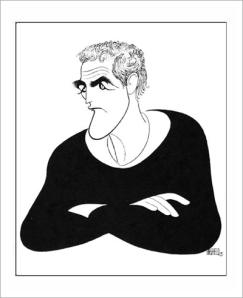
Paul Newman, drawing by Al Hirschfeld

Paul Newman, drawing by Al Hirschfeld


Marilyn Monroe, drawing by Al Hirschfeld

Marilyn Monroe, drawing by Al Hirschfeld


The Beatles "Abbey Road," drawing by Al Hirschfeld

The Beatles "Abbey Road," drawing by Al Hirschfeld


Katharine Hepburn by Hirschfeld

Katharine Hepburn by Hirschfeld


Cary Grant by Hirschfeld

Cary Grant by Hirschfeld

To see more Hirschfelds, click here.

Read Full Post »

Lucy Ricardo eyes Bill Holden at the Brown Derby in the "I Love Lucy" episode, "L.A. at Last!"

Lucy Ricardo eyes Bill Holden at the Brown Derby in the "I Love Lucy" episode, "L.A. at Last!"

*Readers: If you haven’t already done so, read “I Love Lucy: Lucy Meets Bill Holden, Part 1” before continuing. 

In my last post, I revealed that my absolute favorite “I Love Lucy” episode is

 “L.A. at Last!”

and showed you a video of the first half, the famous scene when Lucy and the Mertzes spy actor Bill Holden in the Brown Derby.

 The second half of the show takes place in Lucy and Ricky‘s Hollywood hotel room.

Click here to continue with “I Love Lucy: Lucy Meets Bill Holden, Part 3”


Read Full Post »

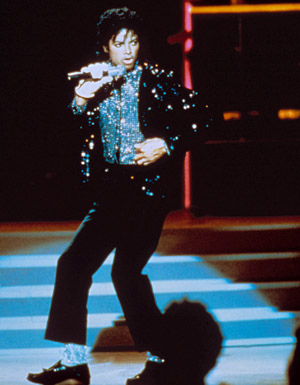
Michael Jackson unveiled his moonwalk dance on March 25, 1983, when he performed his hit song, "Billie Jean," on the TV special, Motown 25: Yesterday, Today, Forever

Michael Jackson unveiled his moonwalk dance on March 25, 1983, when he performed his hit song, "Billie Jean," on the TV special, Motown 25: Yesterday, Today, Forever

I was 29 years old when Michael Jackson and his brothers blew through Texas with their 1984 summer Victory Tour. It was July. I was a fifth-grade school teacher during the regular year. During the summer I was waiting tables at the Night Hawk Steakhouse. Michael Jackson’s record-setting album and video, “Thriller,” was a huge hit.

On Fridays during the school year, I gave my students a treat. At lunchtime, I ordered out for pizza. Then I rolled a TV on a tall stand into my classroom, turned out the lights, shut the blinds, and showed my students the “Thriller” video. We got up out of our chairs and danced. Michael Jackson gave us the chills. We just couldn’t get enough of his energy.

Back to the Victory Tour. It was July 15, 1984 – a Sunday – and I’d just finished my wait shift at the Night Hawk. I clocked out then jumped into my un-air-conditioned Honda and headed South to my apartment. I turned on the radio. The announcer was talking about how exciting the Victory Tour was. Michael Jackson was in Dallas! He had performed Friday and Saturday nights. He was to perform just one more night at Texas Stadium before continuing on his tour. Hasting’s on the Drag across from U.T. still had tickets.

I exited IH 35 and headed straight to Hastings, bought a ticket, raced home, changed clothes, and hit IH 35 for Dallas. When I got there, I realized what a crummy seat I had. The concert started and the lights went down real low, low enough, I discovered, for me to jump over a concrete wall, hunker down, and slither all the way down to the wheelchair section at the front of the stage undetected. A mother sitting in a front row seat gestured to me to come over. She was holding a child in her arms and offered me the empty seat to her right. I took it. I watched the show from a front row seat.

The show was great.  Michael Jackson performed all the songs from the tour, but what I most remember was watching him moondance to “Billie Jean.” Wow. He didn’t sing “Thriller,” which confused me at the time. Now I understand that he didn’t think the choreography translated well into a stage song.

Curtis Jerome Haynes

Curtis Jerome Haynes

On a previous post, I’ve written about Marcel Marceau‘s influence on Michael Jackson’s moonwalk (“Michael Jackson and the Moonwalk“). Here’s a video sent to me via an old friend, musician Curtis Jerome Haynes, showing the origins of the moonwalk. Some of the “Origins of the Moonwalk” dancers featured in the video are Cab Calloway, Fred Astaire, and Sammy Davis, Jr.

In reference to the youtube clip shown below, Curtis Haynes writes that, 

Missing from the montage are James Brown, the Nicholas Brothers, and Marcel Marceau.”

Thanks, Curtis!

Readers, for more on this blog on Michael Jackson, click here.

Read Full Post »

Madame X at the Met

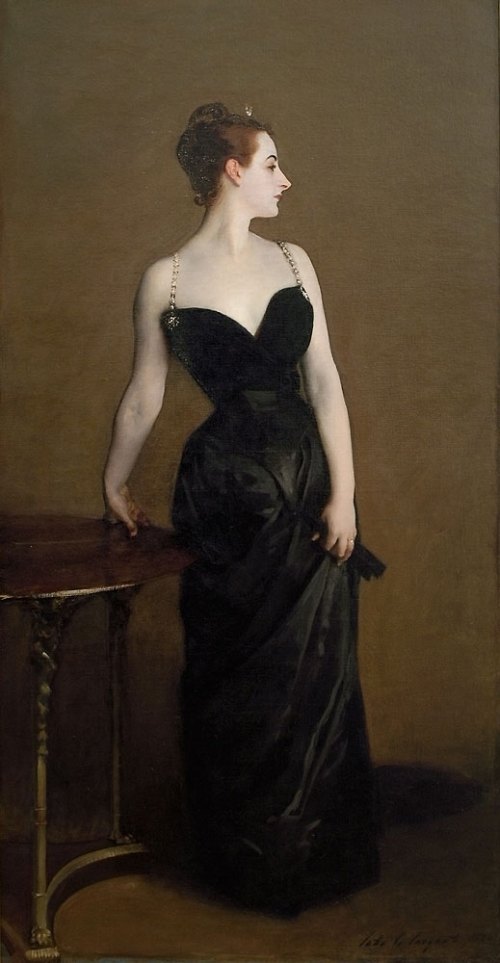
"Madame X" by American portrait painter John Singer Sargent, 1884

"Madame X" by American portrait painter John Singer Sargent, 1884

In the Metropolitan Museum of New York hangs a seven-foot tall portrait of a rather pale woman in a black velvet evening dress held up by sparkly straps. “Madame X” was painted by the American society painter John Singer Sargent.  The subject of the painting is Madame Virginie Gautreau, a professional beauty, who moved in the top tiers of Paris society and was often mentioned in the scandal sheets for her numerous dangerous indiscretions and passion for self-display. It was 1884 and Madame Gautreau was the Talk of Paris.

It was only a year earlier that John Singer Sargent had met her at a party. Once he laid eyes on her, he knew at once he must paint a portrait of her as an homage to her beauty – and a boost to his lagging career.  He felt that if he painted her, all Parisian society women would flock to his studio demanding that he paint their portraits. Sargent sent word to Madame Gautreau that she must sit for a portrait; she consented, realizing that a rising tide lifts all boats. She, too, needed the publicity to maintain her social superiority. Once they agreed, Sargent began to paint,  devoting himself to capture the “strange, weird, fantastic, curious beauty of that peacock-woman, Mme. Gautreau,” noted one observer.

Madame Gautreau was rumored to take great pains to be beautiful:

Gautreau achieved her affected, highly artificial look with hennaed hair, heavily penciled brows, rouged ears and powdered skin. She was rumored to mix her powder with mauve tint and to ingest arsenic wafers to make her skin more translucent, giving it even more of a bluish-purple tint.

Not all thought she was lovely to look at. She had her detractors. Some said her white pallor and icy charm made her resemble a cadaver.

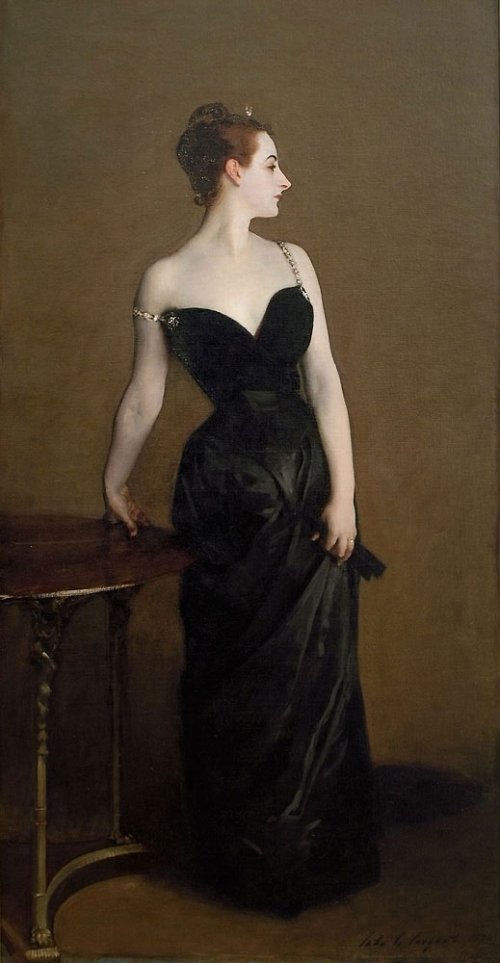
"Madame X" is shown as it must have originally appeared

"Madame X" is shown as it must have originally appeared

The painting that hangs in the Met today, “Madame X,” however, is not the same Madame X as the one that Sargent painted in 1884 and exhibited in Paris. That image no longer exists. We can only speculate what it looked like. The painting shown to the right here is what it may have looked like. That original, the one exhibited in Paris in 1884, showed Madame Gautreau’s dress with the right strap suggestively falling off her shoulder. (Compare to the painting at the top, the one at the Met. Her right strap, you’ll notice, sits firmly in place.)

When exhibited in Paris, the painting “with the falling strap” created an instant sensation but not in the way Sargent and Gautreau had hoped:


No sooner had the doors of the Palais de l’Industrie in the Champs-Élysées opened on May 1, 1884, than a crowd gathered in front of ”Madame X.” People hooted and pointed the tips of their umbrellas and canes at the painting. ”Look! She forgot her chemise!*” was heard over and over again. The critics were no kinder. ”Of all the undressed women at the Salon this year, the most interesting is Madame Gautreau . . . because of the indecency of her dress that looks like it is about to fall off,” wrote a critic for L’Artist. (*A chemise is a woman’s undergarment, a smock, that is worn under clothing and next to the skin. In that day, a French lady always wore a chemise under a dress.)

The painting was considered too provocative; sex pervaded it. Not even an actress, it was remarked, would wear a dress that shockingly low-cut and snug! And that strap! A little imagination conjured up a scene in which a slight struggle with a lover might knock Madame X’s right strap completely off her shoulder leading to… ! Paris was abuzz with the scandal. Madame Gautreau’s mother demanded that Sargent withdraw the painting from the exhibit. He refused.

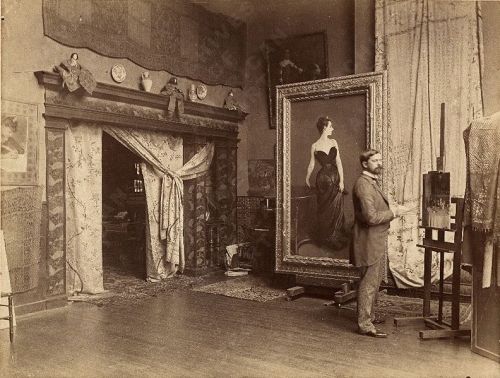
John Singer Sargent in Paris studio 1885 with the revised painting of Madame X

John Singer Sargent in Paris studio 1885 with the revised painting of Madame X

The painting, considered a beloved masterpiece today but pornographic by 1884 Parisian standards of decency, was trashed by the Paris critics so badly that Sargent, having lived in Paris for a decade then, was eventually forced to move to London to continue his profession. Sargent revised the painting to show the gown’s right strap securely in place. It is this retouched painting that hangs in the New York Metropolitan today.

Zip ahead to 1938 and the Upper East Side of Manhattan. Dorothy Hale was wearing her Madame X dress when she jumped to her death from her penthouse apartment. To learn more, read “Frida Kahlo: The Suicide of Dorothy Hale.”

"The Suicide of Dorothy Hale" by Frida Kahlo, 1938/39

"The Suicide of Dorothy Hale" by Frida Kahlo, 1938/39

Read Full Post »
« Newer Posts - Older Posts »