Feeds:
Posts
Comments

Archive for the ‘TOPICS’ Category

victorian-silhouetteIn Nellie Bly’s book, Ten Days in a Mad-House (see category, “Nellie Bly,” for related posts), Nellie Bly described various women she met in the Blackwell Island Women’s Lunatic Asylum. She was confined to Hall 6 with 45 of the least dangerous women in the institution. While some of them were certifiably “crazy,” (her words), many, she felt, had been wrongly locked up. A Frenchwoman, for example, named Josephine Despreau, fell sick in a boarding house and the woman of the house called in the police. They arrested her and took her to the station-house. She didn’t understand the proceedings because of the language barrier and the judge paid no attention to her protests. She was locked up in the insane asylum in no time.

Well into the twentieth century, it was easy to get a woman locked up in a mental institution. It was not unheard of for a man to tire of his wife in favor of another woman and get his wife declared insane and committed to an insane asylum. I was remarking upon this horror the other day and my mother told me that my great uncle Sam P did this very thing to his wife Helen. He had her committed to an asylum in San Antonio. Helen found a way out, though, and slipped away to Corpus Christi to live with her sister.

Do any of you have any asylum stories to share?

Read Full Post »

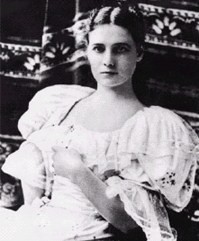
Nellie Bly (1864-1922)

Nellie Bly (1864-1922)

I’ve been thinking about the very different lives of reporter Nellie Bly and Rosemary Kennedy. Although over fifty years separated these women, both found themselves at the age of 23 at the mercy of mental health “professionals.” Nellie Bly placed herself in a dangerous lunatic asylum as an investigative journalist because she was desperate to land a job in a world that didn’t welcome female professionals. How else was an uneducated woman to earn a living in 1887?

Bly was the thirteenth of her wealthy father’s fifteen children, her mother being her father’s second wife. When Bly was six, her father died, failing to make specific provisions for Nellie, her mother, and her two brothers. Like many other great women, Nellie Bly (like Annie Oakley) took it upon herself to find a way to take care of her family. She ran a boarding house with her mother and marveled that her uneducated brothers were able to find jobs as clerks and drummers yet, because she was an uneducated woman, she could only aspire to be a chambermaid or washer-woman. Thus it was Nellie’s poverty and the absence of a father that lead her to have herself committed, at the age of 23, to an insane asylum.

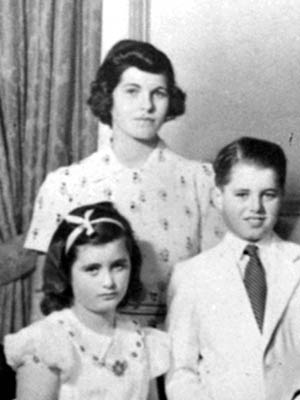
But the converse was true of Rosemary Kennedy. Rosemary landed in a mental institution because she was rich and had a father. She had the misfortune to be born “mildly mentally retarded, into a family dominated by her driven and ruthlessly ambitious father,” Joseph P. Kennedy. Rosemary had been living in a convent to keep her out of the public eye, but, as she developed as a young woman, she had begun sneaking out to see boys, and Kennedy was worried that she might damage his famous family’s reputation.

Rosemary Kennedy (back) (1918-2005), with sister Jean and brother Robert

Rosemary Kennedy (back) (1918-2005), with sister Jean and brother Robert

In an attempt to settle her down, her father, without telling his wife, used his money and powerful connections to arrange for his 23-year-old learning-disabled daughter Rosemary to undergo experimental brain surgery, one of the first prefrontal lobotomies ever performed. The operation took place in 1941, but, according to the historian Doris Kearns Goodwin, “something went terribly wrong.” Rosemary emerged from surgery not better, but far worse. She regressed to a state of helpless infancy and was confined to a mental asylum for the rest of her life until her death in 2005. Nellie Bly’s story, though, has a happy ending. She walked out of the asylum a free woman and an international celebrity.

To read more on the Kennedys on this site, scroll down the right sidebar to “Categories – People – Kennedys.”

Read Full Post »

victorian-letters-dover-clip-art-freeellie Bly was put on the island boat and sent to Blackwell’s Island. For ten days, she experienced firsthand the horrors of being locked up in cruel and inhumane conditions.  Upon her arrival, she was fed a disgusting meal of pink watery tea, prunes, and bread that was dirty and black and mostly dried dough. She found a spider in the slice given her. She didn’t eat it. Later she learned that the nurses didn’t like it when you didn’t eat your food. They might beat you for that.

After sitting in that long, freezing dining hall on bare yellow benches for what seemed an eternity, Bly and the other women in her ward were marched in two lines into a freezing cold, wet bathroom. As everyone looked on, the nurses stripped Bly of every bit of her clothing. They took away her dress, her skirts, her shoes, her stockings, and her hat. She then was forced to bathe in an ice-cold tub and be scrubbed by one of the craziest women in the ward.

“My teeth chattered and my limbs were goose-fleshed and blue with cold,” Nellie wrote later of the experience. “Suddenly I got, one after the other, three buckets of water over my head –  ice-cold water, too, into my eyes, my ears, my nose and my mouth.”

The nurses then put her, dripping wet, into a short flannel slip and locked her in an individual cell for the night. She couldn’t sleep. She kept picturing what would happen should a fire break out in the asylum. Every door was locked individually and bars covered the high windows. Should the building burn, there was no way the nurses or doctors could possibly unlock each door before the flames would engulf the building. She and the others would roast to death.

The asylum was spotlessly clean but it wasn’t the nurses who kept it so. The patients did all the work. There was little to distract the patients’ mind from the terrible cold and gnawing hunger. There were no books. The inmates did enjoy their short walks around the beautiful grounds. It was on one of those walks that Nellie Bly passed the kitchen and got a glimpse at the sort of food being prepared for the nurses and doctors: melons and grapes and all sorts of fruits, beautiful white bread and nice meats.

Bly complained to the doctors about the thin clothing issued to the patients, the intolerable cold, and the inedible food, but nothing came of it. It was only after her release ten days later that Nellie Bly would be able to draw attention to the neglect and abuse of people with mental disorders and others unfortunate enough to be sentenced to the asylum. Her expose of the conditions within the Lunatic Asylum, published in the World and later in book form,  Ten Days in a Mad-House , caused a sensation. Nellie Bly became an instant celebrity. madhouse-cvr

The public demanded to know how Nellie Bly had managed to hoodwink four physicians into believing she was insane. A grand jury launched an investigation into the claims made in Bly’s report and recommended the changes she had proposed, prompting an $850,000 increase in the budget of the Department of Public Charities and Corrections for the treatment of the insane.

nellie-bly-signature1

Read Full Post »

charles-dickens2One day, during my stay in New York, I paid a visit to the different public institutions on Long Island, or Rhode Island: I forget which. One of them is a Lunatic Asylum. The building is handsome; and is remarkable for a spacious and elegant staircase. The whole structure is not yet finished, but it is already one of considerable size and extent, and is capable of accommodating a very large number of patients.
blackswells-island-lunatic-asylum

I cannot say that I derived much comfort from the inspection of this charity.The different wards might have been cleaner and better ordered; I saw nothing of that salutary system which had impressed me so favourably elsewhere; and everything had a lounging, listless, madhouse air, which was very painful. The moping idiot, cowering down with long dishevelled hair; the gibbering maniac, with his hideous laugh and pointed finger; the vacant eye, the fierce wild face, the gloomy picking of the hands and lips, and munching of the nails: there they were all, without disguise, in naked ugliness and horror. In the dining room, a bare, dull, dreary place, with nothing for the eye to rest on but the empty walls, a woman was locked up alone. She was bent, they told me, on committing suicide. If anything could have strengthened her in her resolution, it would certainly have been the insupportable monotony of such an existence. The terrible crowd with which these halls and galleries were filled, so shocked me, that I abridged my stay within the shortest limits, and declined to see that portion of the building in which the refractory and violent were under closer restraint.

I have no doubt that the gentleman who presided over this establishment at the time I write of, was competent to manage it, and had done all in his power to promote its usefulness: but will lit be believed that the miserable strife of Party feeling is carried even into this sad refuge of afflicted and degraded humanity? Will it be believed that the eyes which are to watch over and control the wanderings of minds on which the most dreadful visitation to which our nature is exposed has fallen, must wear the glasses of some wretched side in Politics? Will it be believed that the governor of such a house as this, is appointed, and deposed, and changed perpetually, as Parties fluctuate and vary, and as their despicable weathercocks are blown this way or that? A hundred times in every week, some new most paltry exhibition of that narrow-minded and injurious Party Spirit, which is the Simoom of America, sickening and blighting everything of wholesome life within its reach, was forced upon my notice; but I never turned my back upon it with feelings of such deep disgust and measureless contempt, as when I crossed the threshold of this madhouse.

http://nyc10044.com/timeln/dickens.html

Read Full Post »

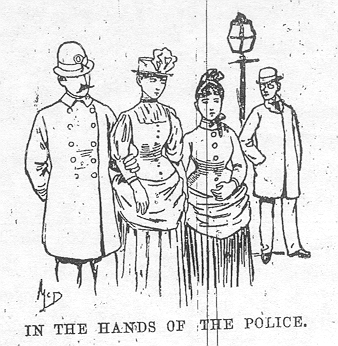
Nellie Bly could have won an Academy Award for her impersonation of a lunatic. On the morning of Saturday, September 24, 1887, within twenty-four hours of checking into the Temporary Home for Females at No. 84 Second Avenue, the police were called to escort “Nellie Brown” to the Essex police station. The assistant matron of the boardinghouse told the police that “Nellie Brown” had so terrified her female boarders with her crazy rantings that they feared being murdered in her beds. Bly claimed that all the women in the house were crazy. She had forgotten who she was, she said, and lost her trunks. She acted confused, vague, but not dangerous.
nellie-bly-in-the-hands-of-the-police1

The police took Bly before Judge Duffy who ordered her sent to Bellevue Hospital for examination, where Dr. William C. Braisted, head of the insane pavilion there, said Bly was “undoubtedly insane.” (1) There she passed two freezing cold nights, remembering that “all night long we were kept awake by the talk of the nurses and their heavy walking through the uncarpeted halls.” Nellie, being Nellie, complained to the nurses and the doctors about the lack of heat in the institution and the poor conditions. She was told that she could expect no kindness in the place as it was a charitable institution!

The stay at Bellevue was temporary though. The next day – Monday – a boat was expected. It would take Nellie Bly away permanently to Blackwell’s Island Lunatic Asylum for Women.

Just think. The speed of the thing was dizzying. On Thursday Nellie Bly had been sitting in the offices of the New York World contemplating the assignment of posing as an insane woman to gain admittance into an institution. It seemed an impossible hurdle – to be declared insane and committed for life to an insane asylum. Yet it was a mere three days later and Nellie Bly – a completely normal person – was being committed for life to an insane asylum – on the notorious Blackwell’s Island. How many other unfortunates had also suffered this fate?

(1) Kroeger, Brooke. Nelly Bly. (New York: Random House, 1994)

Next: Nellie being Nellie

Read Full Post »

Nellie Bly accepted the assignment. The task was frightening – to get herself committed to an asylum, to live among the lunatics for a week or so, then to write an expose on the conditions there – and she was nervous. But not about her skills as a writer. Her knack for including the telling detail made her articles compelling reading. No, she was nervous because she did not think she could pull off convincing the doctors that she was insane.

Bly had never known a crazy person. Just how did a crazy person look, she wondered.

nellie-practices-insanity4“So I flew to the mirror and examined my face,” she wrote later. “I remembered all I had read of the doings of crazy people, how first of all they have staring eyes, and so I opened mine as wide as possible and stared unblinkingly at my own reflection.” She began to sweat nervously, which unfortunately took the curl out of her Victorian bangs. Over and over again, she practiced her crazy face in the mirror. She ended up staying up all night, rehearsing her new role, thinking about her new mission, and reading scores of ghost stories to put her in a lunatic frame of mind.

When morning came, she bathed, bid her soap and toothbrush a fond farewell, and put on nondescript clothing. Then she went out into the street in search of a boarding house where she could begin her charade as the little lost and nutty Nellie Brown from Cuba.

Next: Inside the Madhouse

Read Full Post »

nellie-blyIt had been four months since she’d left Pittsburgh for New York yet Elizabeth Jane Cochran, or “Nellie Bly,” as her byline read, still hadn’t landed a job as a newspaper reporter. She had left the Pittsburgh Dispatch because she was tired of being assigned to the ladies’ pages – writing the society column, reviewing operas, and reporting on the latest women’s fashions.

It was now September of 1887. Bly was running out of money – and then she lost her purse, losing the little bit of money she had left. “I was penniless,” she wrote later, yet she still was not willing to return her former position in Pittsburgh, an industrial city so ugly, said a writer for the Atlantic Monthly, that it was “like looking into hell with the lid off.” New York was the center of the publishing world, a world dominated by men, a fact not lost on Bly. She had to be clever, very clever, to convince a newspaper why they should hire her, a woman, and not a man.

So Bly made up a list of clever story ideas, sure to boost any newspaper’s circulation. Then she borrowed cabfare from her landlady and headed to Park Row, home to the city’s newspaper offices. She managed to talk her way into the office of the managing editor of the New York World Colonel John Cockerill. She took out her list of ideas. She offered to sail steerage class from Europe to America so she could report firsthand the experiences of an immigrant.

Cockerill didn’t like her idea, but he must have recognized Bly’s potential, because he proposed an even wilder assignment. Why didn’t Bly fake insanity, he asked, and get herself committed to the Women’s Lunatic Asylum? As an undercover agent, Bly could witness for herself and later report on the rumored abuses suffered by the inmates at the hands of a sadistic staff.

The notorious Women’s Lunatic Asylum was set on the 120-acre sliver of land called Blackwell’s Island in the East River. It was surrounded by prisons and charity institutions. If Bly accepted the assignment, she would be asking for trouble. It could be dangerous. Bly had never been around crazy people before. Could she pull it off? What if she got sent to Blackwell’s Island, got locked up in the asylum with a bunch of lunatics and couldn’t get out?

http://en.wikipedia.org/wiki/Nellie_Bly

Kroeger, Brooke. Nellie Bly. (New York: Random House, 1994)

http://www.pbs.org/wgbh/amex/world/

Next: Nellie decides.

This is a reblog.

Read Full Post »

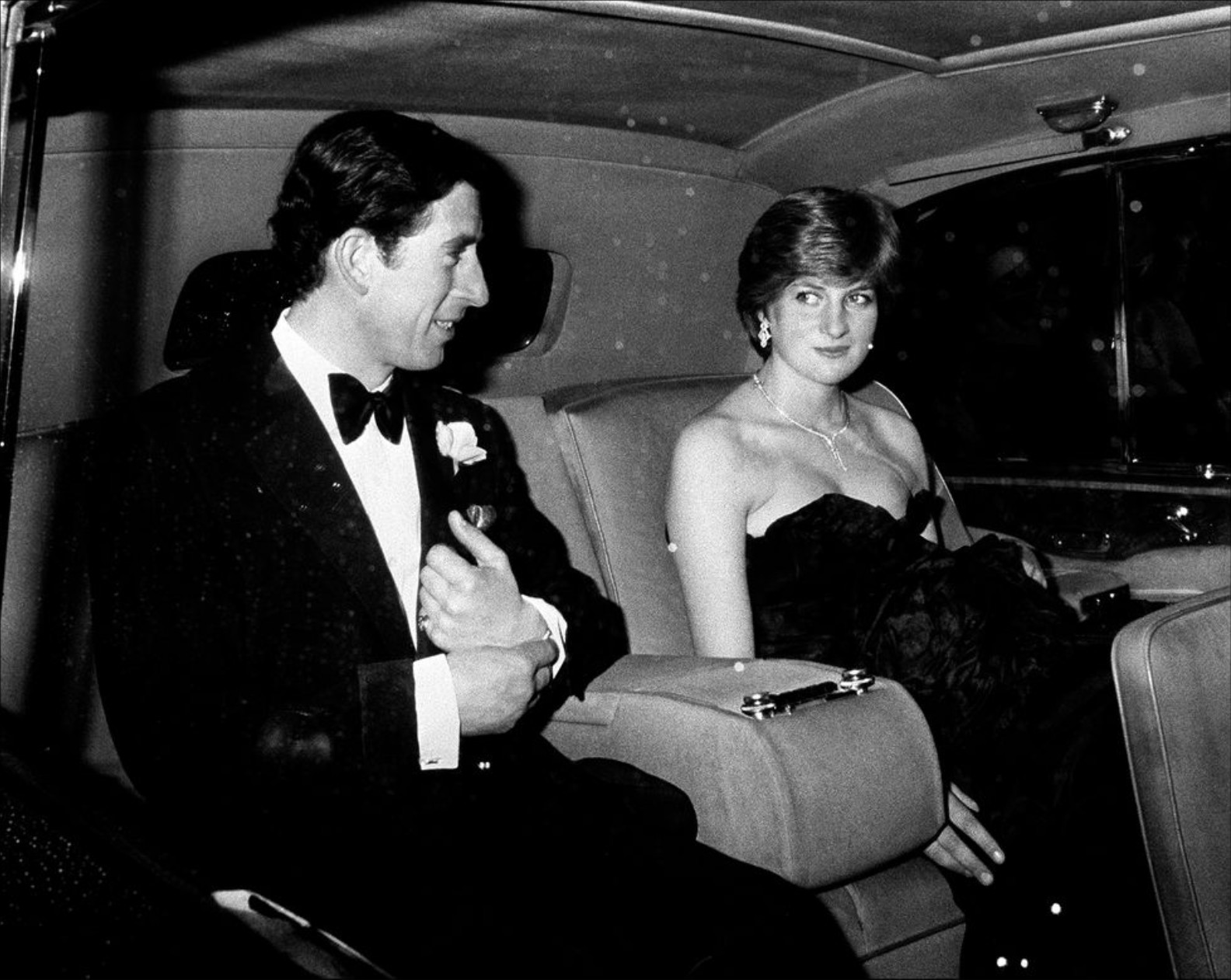
The Prince of Wales and his new fiancée, Lady Diana Spencer, arrive at Goldsmith Hall in London for a charity recital, March 9, 1981.

Lady Diana Spencer, 19, arrived at her first official event since the announcement of her engagement to Charles, the Prince of Wales, wearing a black Emanuel evening gown and her mother’s diamond necklace. Charles, 33, had scolded Diana for wearing black, a color the Royal Family reserved for somber occasions.

Diana's dress at the Goldsmith Hall.

Lady Diana Spencer wowed the world with this black taffeta strapless dress worn to accompany Prince Charles to Goldsmiths’ Hall in London on March 9, 1981.  She stepped out of their car and into a sea of flashbulbs as photographers jockeyed for position to photograph the alluring princess-to-be.


Diana was noticeably uncomfortable in her little black dress and told Princess Grace of Monaco, also in attendance, that the dress she was wearing was two sizes too small.

Lady Diana, Princess Grace of Monaco, and Prince Charles mingle at a music event, London, 1981. photo credit: Tim Graham, HBO.

Princess Grace, who had been the Oscar-winning American actress Grace Kelly before her 1956 marriage to Rainier III, Prince of Monaco, knew just how Diana was feeling.

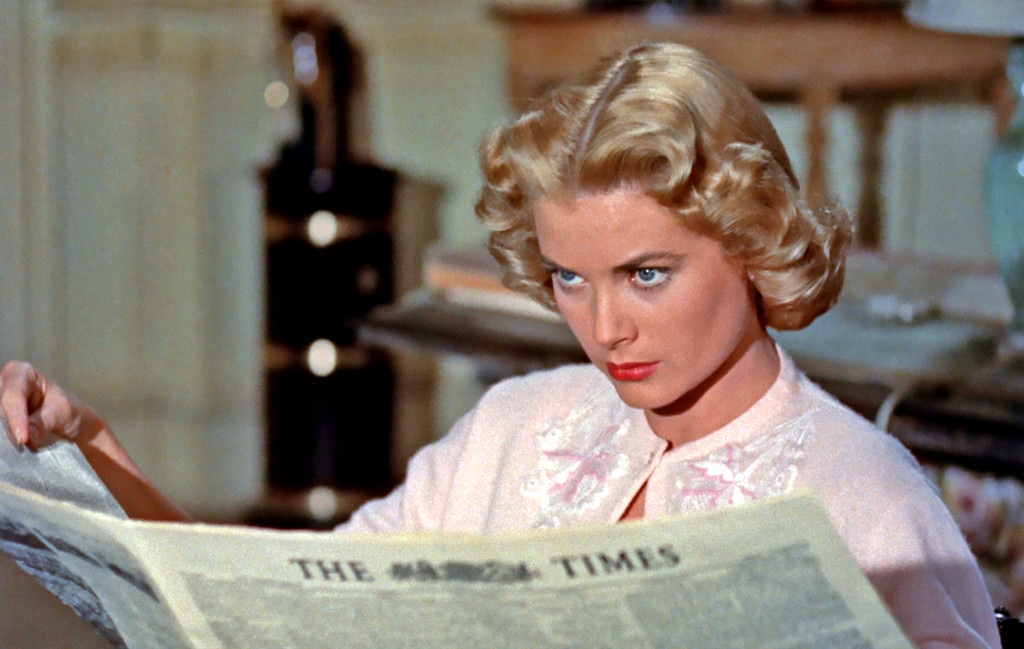
Grace Kelly from the 1954 Hitchcock thriller, “Dial M for Murder.”

Grace had also been an outsider when she married into the House of Grimaldi, the reigning house of Monaco since 1297. Princess Grace pulled Lady Diana aside and they excused themselves into the ladies’ room for private chat. Diana expressed her fears for the future and her feeling of awkwardness in her new role. Grace, who had been royal now for 25 years, patted Diana’s cheeks tenderly and replied:

Don’t worry, it’ll only get worse.

The images of the future royal bride stepping out of a limousine in a black gown with a plunging neckline made newspaper headlines round the world and established Diana as the most glamorous member of the royal family.  Dress designer Elizabeth Emanuel said of Diana’s appearance that night: “The transformation was incredible. She arrived looking like the nursery school teacher she was, but now she looked like a movie star. We gave her the dress, made a little shawl to go with it so she could cover up on the night and away she went….We hadn’t considered the fact that when Diana bent over – as she would have to do when getting out of the car – she would show quite a lot of cleavage. We just thought she looked fabulous.” (1)

Her low-cut outfit apparently raised eyebrows among the royal inner circle too, as she recollected: “I was quite big-chested then and they all got frightfully excited.” Diana continued: “It was a horrendous occasion… I didn’t know whether to go out of the door first. I didn’t know whether your handbag should be in your left or right hand. I was terrified, really ‒ at the time everything was all over the place. I remember that evening so well. I was terrified ‒ nearly sick.” (2)

Eighteen months later, Princess Grace suffered a stroke behind the wheel of her car, and died in a horrific car crash in Monaco. Prince Charles did not understand why Princess Diana was so hellbent on attending Grace’s funeral; he did not understand that she felt a connection to the late Princess, that their lives were parallel. He was against it so Diana appealed to Queen Elizabeth, her mother-in-law, who granted her request. Diana attended the funeral, which was held at the Cathedral of Our Lady Immaculate in Monaco-Ville on September 18, 1982.

Princess Diana represented Queen Elizabeth II at the funeral of Princess Grace of Monaco, 1982.

(1) MSPMint, “Lady Diana Spencer Accompanies Prince Charles to Goldsmiths’ Hall in that ‘LBD’…Little Black Dress,” The Princess Diana News Blog.

(2) Morton, Andrew. Diana: Her True Story ‒ In Her Own Words, excerpted in Harpers’ Bazaar.

Readers, for more on this blog on Grace Kelly, click here.

Readers, for more on this blog on Princess Diana, click here.

Read Full Post »

Clara Bow, silent film star, known as the “It Girl.”

In 1929-1933, movies with sound, the “talkies,” replaced silent films. In 1929, Paramount actress Clara Bow retained her position as queen of Hollywood and was still a top-box office draw, though she, like other silent film stars, did not transition well to the new form. Bow said:

“I hate talkies … they’re stiff and limiting. You lose a lot of your cuteness, because there’s no chance for action, and action is the most important thing to me.” (1)

She did not like the sound of her Brooklyn accent in the talkies and became anxious over her career, especially now that the directors expected her to talk and sing. She took refuge in sedatives. (2) As Bow’s star faded, another’s rose: Jean Harlow.

Jean Harlow had her first speaking role in Clara Bow’s movie, the Saturday Night Kid (1929).

Although Jean Harlow had only a bit part in “The Saturday Night Kid,” she made quite a sensation when she appeared on the set wearing a clingy, black crocheted dress, with that platinum blonde hair. Reportedly, Clara Bow ordered her off the set:

“Who’s gonna see me nexta her?”(3)

Hollywood sex symbol, Jean Harlow (1911-1937)

By 1932, Jean Harlow was at the peak of her stardom. Gone were Bow’s “It Girl” looks with ultra-thin and dark eyebrows with downward curved tails. Starlets who wanted to make it in Hollywood now had to resemble Harlow with her iconic, half moon brows. That meant shaving their eyebrows, and drawing in carefully-pencilled crescent shaped ones.

In 1933, Lucille Ball arrived in Hollywood and promptly shaved and pencilled her brows to appear in Sam Goldwyn’s picture, “Roman Scandals,” as a slave girl.

Lucille Ball in “Roman Scandals” (1933)

To the end of her days, Lucille Ball regretted shaving her eyebrows, as they never grew back. The first thing she did in the morning was grab her eyebrow pencil and pencil in her brows.

Lucille Ball, ca. 1940

Fast forward to the 97th Academy Awards, March 2025, to singer Miley Cyrus walking the red carpet with her long, waving tresses and glam girl looks. According to Vogue, it was her bleached eyebrows that stole the show:

They’re not your typical bleached brows, as there’s no bright blonde or platinum shade. Instead, these brows match the soft blonde hue in her hair to give that “barely there” effect. Modern approach to the bleached-brow look. (4)

Miley Cyrus debuts her new look at the March 2, 2025 Academy Awards.


(1) Goldbeck, Elisabeth. “The Real Clara Bow,” Motion Picture Classic, September 1930.

(2) Brady, Kathleen. Lucille: The Life of Lucille Ball, 45.

(3) Longworth, Karina. “The Bombshell,” Slate.

(4) Noble, Audrey. “Miley Cyrus Debuts Barely There Brows at the 2025 Oscars,” Vogue.

Read Full Post »

Cicadas are due any day now to descend upon the whole state of Illinois. It’s a small mercy that the bugs are not locusts.

Early Kansas settlers had a rough time of it. For the first twenty years of Kansas settlement, homesteaders had to battle hot winds, drought, raids from native Americans, and hailstorms to save their crops. But the year 1874 promised to be different. “In the spring of 1874,” wrote Mrs. Everett Rorabaugh, “the farmers began their farming with high hopes, some breaking the sod for sod corn, others…sowing spring wheat, corn, and cane, and with plenty of rain everyone… [was] talking about the bumper crop they were going to have….”

Rocky Mountain Locust, or grasshopper

Rocky Mountain Locust, or grasshopper

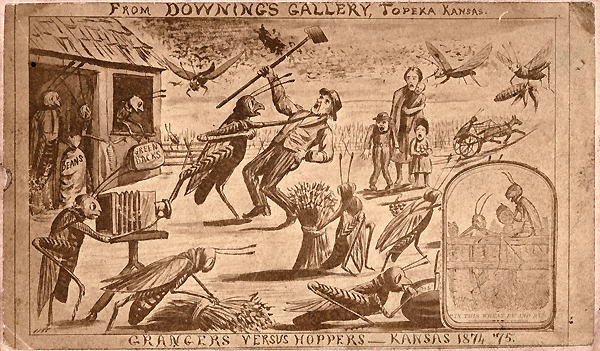
But, by July, happy anticipation had turned to despair in when hordes of crop-eating grasshoppers descended upon Kansas. “August 1, 1874,” explained Mary Lyon, “is a day that will always be remembered…For several days there had been quite a few hoppers around, but this day, there was a haze in the air and the sun was veiled….They began, toward night, dropping to earth, and it seemed as if we were in a big snowstorm where the air was filled with enormous-sized flakes.” (1) The snowflake-like appearance was due to the whitish wings of the grasshopper, or Rocky Mountain locust.

The grasshoppers then dropped to the ground, crawling over the fields in a solid body, eating every green thing that was growing. Hillsides looked as if water were running down them the hoppers were so thick. They devastated the crops. When they had eaten the fields bare, leaving not a sprig of grass, they would pile up by fence posts and eat the bark off the posts.

Wishful Thinking

Wishful Thinking

“They devoured every green thing but the prairie grass,” continued Mary Lyon. “They ate the leaves and young twigs off our young fruit trees, and seemed to relish the green peaches on the trees, but left the pit hanging….I thought to save some of my garden by covering it with gunny sacks, but the hoppers regarded that as a huge joke, and…ate their way through. The cabbage and lettuce disappeared the first afternoon….The garden was soon devoured.”

When the grasshoppers had cleared the land of vegetation, they ate the clothes drying on the clotheslines and curtains hanging in the windows. Adelheit Viets remembered the day the grasshoppers came to her farm. “The storm of grasshoppers came one Sunday. I remember that I was wearing a dress of white with a green stripe. The grasshoppers settled on me and ate up every bit of green stripe in that dress before anything could be done about it.” (1)

1874 The Year of the Locust

The insect hordes moved into barns and houses. Besides devouring food in cupboards, barrels, and bins, they attacked anything made of wood. They particularly craved sweaty things, eating the handles of pitchforks and the leather harnesses of horses.

300px-book_littlehousebanksofpcIn her book, On the Banks of Plum Creek, Laura Ingalls Wilder recalls the creepy feeling of the huge grasshoppers clinging to her clothes, writhing and squishing beneath her bare feet and the sound of “millions of jaws biting and chewing” as they destroyed her family’s fields in Minnesota. (2) The stench of the oily insects was hideous.

When the grasshoppers were done, they rose with a humming that sounded like distant thunder, casting a shadow on the ground for a few seconds just as a cloud does when passing between you and the sun. Then they moved on, relentlessly in search of food. As they made their way cross-country, they landed on railroad tracks, making the tracks so slippery that the wheels of the train would only spin and an hour’s sweeping was needed to move their bodies out of the way.

Grasshoppers warming themselves on railroad tracks did stop trains but not exactly like this.

Grasshoppers warming themselves on railroad tracks did stop trains but not exactly like this.

By September, the plague had moved eastward out of Kansas, leaving a state devastated by insects. The corn crop was nearly gone and the wheat crop substantially damaged. Gardens and fruit trees were totaled. Water in ponds, streams, and wells were polluted. Cows and chickens that had gorged on the grasshoppers became useless as food as did fish caught in streams. The meat smelled and tasted like grasshoppers. Chickens ate so many of the hoppers that egg yolks were red. Without a crop and livestock, pioneer farmers were destroyed.

Although Kansas governor Thomas A. Osborn pledged to provide relief to needy citizens, angry and discouraged pioneers fled Kansas by the hundreds in trains and by covered wagon. “In God we trusted; in Kansas we busted,” was a popular slogan painted on the sides of the wagons headed back east. For those who stayed behind, state governments and the U.S. Army distributed food rations to affected Kansans as wells as to others in the Dakota and Colorado territories, Minnesota, Iowa, and Nebraska, other places caught in the path of the grasshopper migration.

Families also needed clothes, many having only flour sacks to wear. So the government distributed old Civil War uniforms. For years after the grasshopper plagues, pioneer women and men could still be seen wearing these military uniforms while out working in their fields. (3)

grasshopper-swarmLocust plagues long haunted American farmers, and they may do so again. In the 19th Century, black clouds of Rocky Mountain locusts swept across the plains almost every summer, leaving only stubble where crops once stood.

Inset map: The 1874 swarm (shown in red) was the largest ever recorded: 1,800 miles long and 110 miles wide, it caused the equivalent of $650 million of damage. Other grasshopper species probably did not swarm, although they experienced major infestations in 1855, 1864, and 1866.

Large map: The U.S. Department of Agriculture releases a “Grass-
hopper Hazard Map” every year showing where infestations
are most likely to occur in the coming summer. In some areas,
grasshopper populations can reach densities of more than 200
per square yard. (Map by Matt Zang, 2003)

(1) Stratton, Joanna L. Pioneer Women: Voices From the Kansas Frontier. (New York: Simon & Schuster, 1981)
(2) “Looking Back at the Days of the Locust,” New York Times, April 23, 2002.
(3) The ‘Hopper Plague of ’74,” True West, August 1990

(4) https://www.historynet.com/1874-the-year-of-the-locust/

Read Full Post »

Henry Fonda and Gene Tierney gaze at one another in "Rings on Her Fingers" (1942)

Henry Fonda and Gene Tierney (1920-1991) gaze at one another in “Rings on Her Fingers” (1942)

On Sunday, December 7, 1941, actress Gene Tierney, age 21, and film star Henry Fonda were filming “Rings on Her Fingers” on Catalina Island, 22 miles off the southern California coast.

The cameras were getting ready to roll when a man came running down the beach screaming:

“The Japanese have bombed Pearl Harbor! “

Pearl Harbor was in Hawaii, just west across the Pacific from Catalina. Catalina was a dangerous place to be. No one knew exactly what was happening – or what would happen next – just as Americans felt as the events of 9/11 unfolded. Everyone had to get off that island. Since the attack on Pearl Harbor had come without warning and a formal declaration of war by the Japanese, the American people were in shock. They expected more attacks, possibly on California.

Gene Tierney, her husband Oleg Cassini, costar Henry Fonda and the rest of the film’s cast and crew piled into a boat and sailed hurriedly for the mainland. It was a nervous crossing. Rumors flew that the waters had been sabotaged with mines.

random-wallpapers-pearl-harbor-attack-wallpaper-36838

On December 7, 1941, Pearl Harbor was attacked by 353 Japanese fighter planes, bombers, and torpedo planes in two waves, launched from six aircraft carriers. All eight U.S. Navy battleships were damaged, with four being sunk. All but one (Arizona) were later raised, and six of the eight battleships were returned to service and went on to fight in the war. The Japanese also sank or damaged three cruisers, three destroyers, an anti-aircraft training ship, and one minelayer. 188 U.S. aircraft were destroyed; 2,403 Americans were killed and 1,178 others were wounded. (2)

The next day, the U.S. declared war on Japan. Days later, Germany and Italy declared war on the U.S. Overnight, the United States was plunged into war in both the Pacific and the Atlantic Oceans.

The U.S. government enlisted the help of Hollywood stars to aid the war effort by boosting morale at home. Americans were urged to plant backyard “victory gardens” – vegetable patches – to help feed civilians at home. Suddenly, farm production was heavily burdened by having to feed millions of military personnel, as well as coping with fewer men on the farms.

War is expensive. The U.S. government encouraged people to buy War Bonds. You could purchase a $25 War Bond for $18.75. The government used that money to help pay for tanks, planes, ships, uniforms, weapons, medicine, food, and for the military.  Ten years from the time you purchased your War Bond you could redeem it and get $25.

Gene Tierney did her part for the war effort, whether it was planting a “victory garden,” promoting war bonds, or entertaining the troops.

Gene T tends her own "victory garden," in Fort Riley, Kansas, where her husband is stationed in the army.  She is pregnant with her first child, Daria. 1943. (photo courtesy Lou and Mary Jo Mari)

Gene Tierney tends her own “victory garden,” in Fort Riley, Kansas, where her husband is stationed. 1943. (photo courtesy Lou and Mary Jo Mari)

Gene Tierney encouraged Americans to buy war bonds.

Gene Tierney appeared in posters and went on campaign drives to encourage Americans to buy war bonds.

Gene Tierney took time to entertain the troops at the Hollywood Canteen. From 1942-45, three million service personnel on leave – men and women, black and white – would pass through the doors of that converted barn to rub elbows with the stars. On any given night, Bob Hope might be on the stage cracking jokes while Rita Hayworth made sandwiches, Harry James played trumpet, or Hedy Lamarr danced with the soldiers.

Film star Shirley Temple gives cookies to the soldiers at the Hollywood Canteen. Ca. 1942-45.

Shirley Temple passes out cookies at the Hollywood Canteen. Ca. 1942-45.

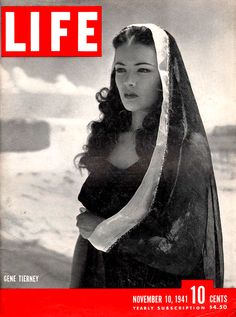
During the war years, Gene Tierney was at the height of her popularity. Her image graced countless magazine covers.Gene T Life Mag Nov. 10, 1941 Shanghai Gesture wardrobe gene-tierney-movie-stars-parade-magazine-cover-1940-s_i-G-54-5494-2D3WG00Z March 1946 mag cover tierney april 1943

Gene Tierney smiles broadly while husband, Oleg Cassini, looks away. ca. 1945

Gene Tierney smiles broadly while husband, Oleg Cassini, looks away. ca. 1945

Gene’s best pictures were made in the forties. Her beauty was extraordinary then. Her presence on screen was fresh and captivating. She had expressive green eyes, high cheekbones, lustrous, dark hair, and a sensual full mouth that revealed, when parted, an unexpected yet terribly endearing overbite. (Her contract with 24th Century Fox forbid her from correcting the crooked teeth.)

American film actress Gene Tierney. ca. 1941

American film actress Gene Tierney. ca. 1941

And she could act. She was only 23 when she appeared in “Laura” (1944), directed by Otto Preminger, a stunning film noir masterpiece, so richly layered with plot twists and great casting (Dana Andrews, Vincent Price, Judith Anderson, Clifton Webb) that you can enjoy it again and again. It is her signature film. Also fantastic are “The Razor’s Edge” with Tyrone Power (1946) and “The Ghost and Mrs. Muir” with Rex Harrison (1947). All three are available to rent on Amazon Instant Video. She plays against type – still classy in manner, yes, but devious in heart – in the film she received an Academy Award nomination for: “Leave Her to Heaven” (1945).

Gene Tierney smolders as "Laura." (1944),

Gene Tierney is smoldering as “Laura” (1944), one of my top five favorite films of all time. Gripping.

In the spring of 1943, Gene finished filming “Heaven Can Wait” in Hollywood. She was expecting her first child and, gratefully, not yet showing signs of pregnancy. She had kept that a secret for fear of being replaced in the film. She longed to be with husband Oleg in Kansas, where he was stationed in the army.

Before leaving Los Angeles and starting her maternity leave, Gene decided to make one last appearance at the Hollywood Canteen. So, that night, Gene showed her support of American troops by signing autographs, mingling with the crowd, and shaking hands. The troops were homesick and sad; a little stardust lightened their load.

A few days after that visit, Gene woke up with red spots covering her arms and face. She had the German measles, or rubella. In 1943, there was no vaccine to prevent contracting the measles. That would not be available for 22 more years. Obstetricians advised patients to avoid crowds in their first four months of pregnancy, to avoid contracting the measles. At the time, it was believed that measles was a harmless childhood disease.

Little did Gene know at the time, but, just two years earlier,

“…[B]y studying a small cluster of cases in Australia, [eye doctor] Dr. N. M. Gregg first noted that the rubella virus could cause cataracts, deafness, heart deformities and mental retardation [in an unborn child].” (3)

Of course, this was before TV and Internet gave us 24/7 news cycles that would have immediately alerted the public to this critical finding. Gene didn’t know that her small act of kindness at the Canteen would have tragic and long-term consequences for both her and her baby’s health.

After a week of doctor-ordered rest, Gene rested, got better, then packed her bags for Fort Riley, Kansas, to join Oleg. The next several months were devoted to making her Junction City home ready for the baby and being a couple.

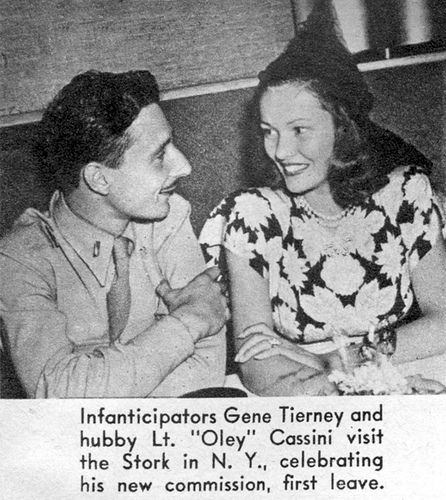
Gene Tierney and husband Oleg Cassini celebrate the birth of their first child with a night out in New York City at the Stork Club. Mid 1943.

Gene Tierney and husband Oleg Cassini await the birth of their first child with a celebratory night out in New York City at the Stork Club. Mid 1943.

By the fall, Gene was living in Washington, D.C., while Oleg was awaiting orders in Virginia. On the morning of October 15, 1943, Gene gave birth to a premature baby girl, weighing only two and a half pounds. Oleg flew to Washington and joined his wife at Columbia Hospital. They named their baby “Daria.”

Doctors informed them that Daria was not in good shape. She was premature and going blind. She had cataracts in both eyes. After reviewing Gene’s medical chart, the doctors concluded that Gene’s measles were responsible for the baby’s defects. They cited the studies done by the Australian eye doctor, Dr. Gregg.

Daria continued to have health problems and delayed development. She had no inner ear fluid and became deaf. It was clear that she suffered from mental retardation. Gene and Oleg hoped against hope that a doctor somewhere could cure Daria. But, after consulting one specialist after another (much of it paid for by Howard Hughes), they had to face the fact that Daria was permanently disabled and needed more care than they were capable of giving her at home.

When Daria was about two years old, Gene got an unexpected jolt. She was at a tennis function. A fan approached her.

“Ms. Tierney, do you remember me?” asked the woman.

Gene had no memory of having met the stranger. She shook her head and replied, “No. Should I?”

The woman told Gene that she was in the women’s branch of the Marines and had met Gene at the Hollywood Canteen.

Gene never would forget what the woman said next.

“By the way, Ms. Tierney, did you happen to catch the German measles after that night I saw you at the Canteen?”

The woman revealed that she had had the measles herself at the time but had broken quarantine just to see Gene at the Canteen.

Gene was dumbstruck. That woman had given her the measles! She was the sole cause of Daria’s disabilities. Gene said nothing. She just turned and walked away.

When Daria was four, Oleg and Gene made the difficult decision to institutionalize Daria (1943-2010). Daria spent most of her life at the ELWYN, an institution for specially disabled in Vineland, NJ.

Gene Tierney never fully recovered from the blow that Daria was disabled. Although she gave birth to another daughter that was healthy, her marriage to Oleg ended in divorce, and her mental health began to deteriorate. She couldn’t concentrate. On the movie set, she would forget her lines. She began to fall apart and live a life of “stark misery and despair,” said ex-husband Oleg.

In much of the 1950s, Gene went from one mental health facility to another seeking help with her bouts of high and low moods and suicidal thoughts. She received 27 shock treatments, destroying even more of her memory. It is believed that Gene Tierney suffered from bipolar depression during a time when effective treatment for that disease was in its infancy.

If Daria had been born after 1965, Gene Tierney would have been vaccinated against the German measles and Daria would have been born healthy.

Currently, in Mexico and California, there is an outbreak of measles due to the antivaccination movement. Some parents in the western part of the United States have decided not to vaccinate their children due to unfounded worries about it causing autism. These few anti-vaxers are putting our whole population at risk.

Make no mistake. Measles is a highly contagious disease and is anything but harmless:

“Symptoms of measles include fever as high as 105, cough, runny nose, redness of eyes, and a rash that begins at the head and then spreads to the rest of the body. It can lead to inflammation of the brain, pneumonia and death.” (4)

AND

“Worldwide, 242,000 children a year die from measles, but it used to be near one million. The deaths have dropped because of vaccination, a 68 percent decrease from 2000 to 2006.

“The very success of immunizations has turned out to be an Achilles’ heel,” said Dr. Mark Sawyer, a pediatrician and infectious disease specialist at Rady Children’s Hospital in San Diego. “Most of these parents have never seen measles, and don’t realize it could be a bad disease so they turn their concerns to unfounded risks. They do not perceive risk of the disease but perceive risk of the vaccine.” (5)

Postscript: In 1962, Dame Agatha Christie published the detective fiction, The Mirror Crack’d from Side to Side, using the real-life tragedy of Gene Tierney as the basis for her plot.

SOURCES:

(1) Vogel, Michelle. Gene Tierney: A Biography. Jefferson, North Carolina: McFarland & Co., 2005.

(2) wiki: Attack on Pearl Harbor

(3) Altman, M.D., Lawrence K. “The Doctor’s World; Little-Known Doctor Who Found New Use For Common Aspirin.The New York Times, July 9, 1991.

(4) LA Times

(5) New York Times


Read Full Post »

My husband, Tom Rogers, and I at our wedding banquet. 1986

My husband, Tom Rogers, and I smile for the camera at our wedding banquet at Green Pastures, Austin, Texas. 1986

Me 1988

I wasn’t thrilled when I learned I had to have a Caesarean section, especially in view of the fact that my doctor had not discovered my baby was breeched until I was already dilated nine centimeters and after he had already given me a spinal block. I was 33, somewhat of a late mother, maybe even a reluctant mother. I was a terrible chicken where childbirth was concerned. I had not rushed into having a child. The fear of having to have a Caesarean kept me back. Now my baby was trying to come out through my back and I had no choice but to submit to the knife.

Not only did I have to have a Caesarean that day in July 1988, but, because of the spinal block, the doctor would not give me any more anesthesia, so I had to go into the operating room wide awake. In a little freak-out, I made the doctor erect a tent over my abdomen so I could not see what he was doing in the surgery. I guess I didn’t want to see them cut me.

My husband was there. He sat on a stool beside me and, with characteristic keen intent, watched the whole thing. What I remember most is the way it felt to have those masked people putting their hands into my stomach and digging around. I felt like a giant purse that they were digging around in, looking for a cigarette or something that had drifted to the bottom among tobacco and gum wrappers and dust. After a while, they must have found what they were looking for, because, after endless tugging and pushing and clawing, they reached deep down and pulled out a little baby, my little baby, my baby girl. She had a shriveled face that looked just like my mother-in-law’s.

“Helen!” I exclaimed, calling out my mother-in-law’s name.

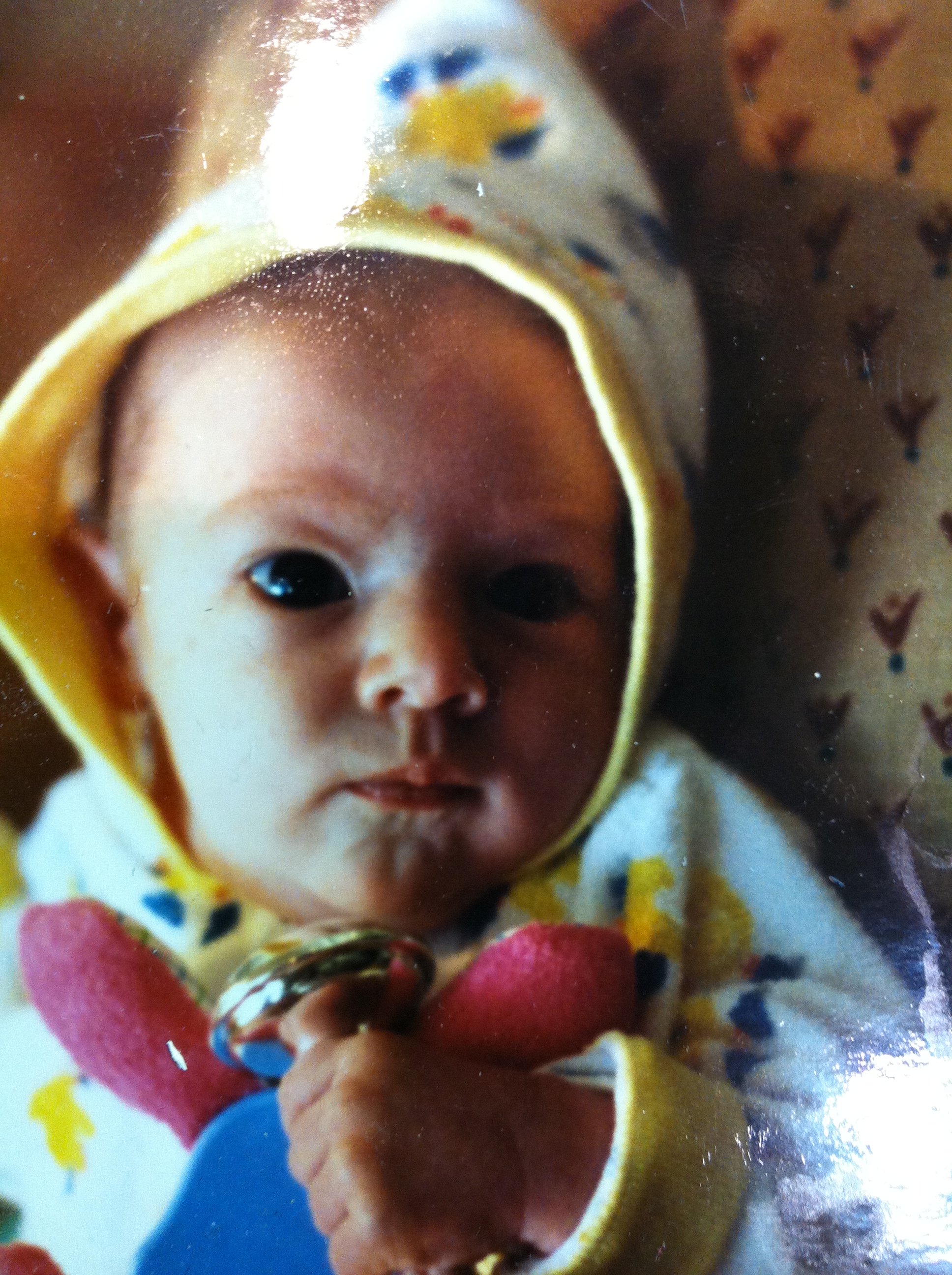
Katie Rogers at one month. 1988

Katie Rogers, born healthy, pictured at one month. 1988

If it had been 129 years earlier, in 1859, and not 1988, with modern medicine, there would not have been a Caesarean for me. My daughter Katie might have thrashed around inside of me until I bled to death and she suffocated.

“[A Caesarean] was long considered an extreme measure, performed only when the mother was already dead or considered to be beyond help. In Great Britain and Ireland, the mortality rate [in mothers] in 1865 was 85%.” (1)

Princess Vicky 1859

Queen Victoria of Great Britain (1819-1901) was sure that arranging marriages for her children and grandchildren in the royal houses of Europe would insure a lasting peace; after all, the countries would be tied by blood and relatives would never fight each other. Her first “power pairing” was the marriage of her eldest child, Victoria (“Vicky”), the Princess Royal, with Prince Frederick of Prussia, the cream of the German royal houses:

“As the royal couple departed London at the end of January [1858] during a heavy snowfall, the populace of that city still turned out onto the streets to cheer and chant, “God save the Prince and Bride! God keep their lands allied!”

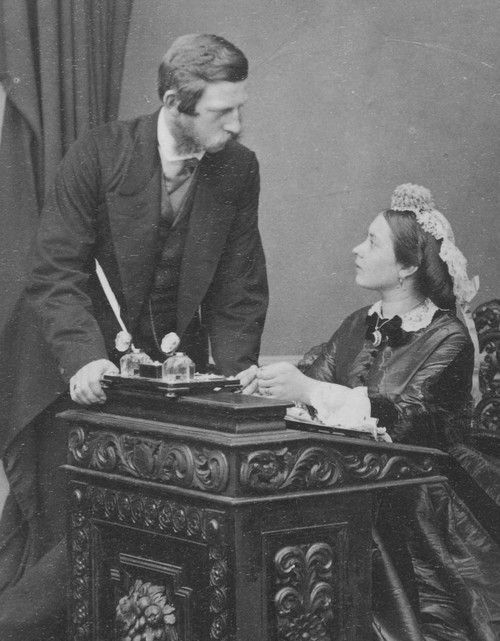
Frederick III of Prussia and his wife Princess Vicky. Undated photo, Ca early to mid1860s.

Frederick III of Prussia and his wife Princess Vicky. Undated photo, Ca early to mid1860s.

Twelve months later, Princess Vicky was in labor with her first child. Her mother had sent Scottish doctor Sir James Clark to Berlin to assist the German obstetrician Eduard Martin and, specifically, to administer to Vicky the “blessed chloroform,” the new miracle drug that the Queen had discovered and that had so eased the pain of her last two deliveries (children #8 and 9).

However, chloroform was not to be the solution for her daughter. For Vicky,

“The entire experience was ghastly….[D]espite the fact that she inhaled chloroform for hours on end, the birth was extremely painful….Dr. Martin had to work under her long flannel skirt so that royal decency prevailed.” (2)

The chloroform, “two-thirds of a bottle,” rendered Vicky insensible to help the doctors, who found themselves in a deadly position. The baby was coming out bottom first, in breech position, with its arms stretched over its head. The umbilical cord was being crushed by the head in the birth canal. The odds were stacked against a successful vaginal delivery: In that same year in Germany, 98% of breech births were stillborn. The doctors would not take a knife to a royal princess; besides, a Caesarean would have killed her. It would be another 40 years before that procedure would be performed in a clinic.

Dr. Martin reached into the birth canal and pulled the baby’s legs out. Then he reached deep inside to pull the left arm through and pull the body out by rotating it. The motion pulled the baby out but the “nerve complex in the neck was torn” and the baby suffered from fetal asphyxia. (3)

The baby lay motionless. The doctor’s report said that, “the baby was seemingly dead to a high degree.” Vicky was exhausted. It had been ten hours since her waters broke.

Then the baby cried.

“It’s alive and it’s a prince!” her mother-in-law wrote Queen Victoria.

The newborn boy was a royal prince and second in line to the Prussian throne. His name was Wilhelm, William in English, as he was half-English, half-German in blood.

Three days would pass before a nursemaid would mention that there was a mysterious crease between Wilhelm’s left shoulder and arm. The left arm was permanently paralyzed, caused by the pressure exerted on the shoulder during the delivery.

Treatment for Wilhelm

Vicky was devastated that her son, heir to the Prussian throne, should be handicapped. To be Prussian in 1859 was to be independent, manly, and warlike, not weak and crippled. Prussian men, like the statesman Otto von Bismarck, fought duels often with the intent to get slashed across the cheek (preferably the left one), get a clean-cut wound that gaped wide into a beautiful scar, rub salt into it to make it stand out, then boast how you got it.

An 1896 picture of a German Corpsstudent (Adolf Hoffmann-Heyden, 1877-1964), showing an extensive fresh fencing scar and some minor old ones, badges of honor at the time.

An 1896 picture of a German Corpsstudent (Adolf Hoffmann-Heyden, 1877-1964), showing an extensive fresh fencing scar and some minor old ones, badges of honor at the time.

“The idea of his remaining a cripple haunts me,” Vicky wrote Queen Victoria regarding Wilhelm.

Vicky was determined to fix Wilhelm’s left arm, to make it work, to make him fit to be a king, in the Prussian way. Of course, she and the doctors didn’t know that his arm was permanently maimed and useless and that nothing could be done to change that. The nerves were so damaged that the muscles didn’t work. At adulthood, his left arm would be six inches shorter than his right and his hand smaller. His left arm locked stiff at the elbow. The condition is known as Erb’s Palsy.

(Kaiser) Wilhelm II of Prussia and Germany and his grandmother, Queen Victoria of Great Britain. Note that Wilhelm's paralyzed left arm is hidden from sight. 1860s

(Kaiser) Wilhelm II of Prussia and Germany and his grandmother, Queen Victoria of Great Britain. Note that Wilhelm’s paralyzed left arm is hidden from sight. 1860s

In Germany in 1859, there was a lot of alternative medical experimentation. When Wilhelm was six months old, his doctors began applying an odd poultice to his left arm. In his presence, they slaughtered a live hare (big rabbit) and tied the flesh of the dead animal, still warm, to the baby’s left arm, hoping that the vitality of the animal would transfer to Wilhelm. This they did twice a week for years.

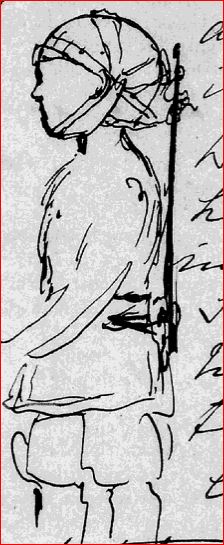
Later, they discovered that Wilhelm’s head was tilting, so they created “Wilhelm’s Machine,” as his mother called it: a barbaric, head stretching device that consisted of a metal rod run up his back, attached at the waist by a belt with a harness that strapped across his head. At the back of his head was a screw they tightened to stretch the head up straight.

The "head stretching machine" was used to correct Kaiser Wilhelm's torticollis: his head was pulled to one side by a birth defect. The drawing is by his mother, Princess Vicky of Prussia, in a letter sent to her mother Queen Victoria. 1860s

The “head stretching machine” was used to correct Kaiser Wilhelm’s torticollis: his head was pulled to one side by a birth defect. The drawing is by his mother, Princess Vicky of Prussia, in a letter sent to her mother Queen Victoria. 1860s

They galvanized his left arm periodically with electric jolts. They cut muscles in his neck. They applied stretching machines to his arm.

They tied his good arm behind him to try to force the left one to work. Of course it didn’t.

His mother made him ride a pony a lot. He would fall off because he had a poor sense of balance, maybe due to the ear infections he had frequently, or because of brain damage at birth.

While his mother’s intent was to prepare Wilhelm to be fit for the throne, these barbaric and medieval procedures had only served to traumatize and depress Wilhelm.

Kaiser Wilhelm II and his mother, Princess Vicky of Prussia. Ca. 1871.

Kaiser Wilhelm II and his mother, Princess Vicky of Prussia. Ca. 1871.

The camera had just been invented and photographs were the rage. The public wanted to see its future king. But Wilhelm’s disability was an embarrassment, something to hide. In photographs, props such as capes, swords, gloves, books, and guns were used to disguise the withered arm. Sometimes he held the left arm up with the right hand.

 Kaiser Wilhelm II, age 4, visits his beloved "Granny" (Queen Victoria) at her Scottish estate at Balmoral. Someone has costumed him carefully so as not to reveal his lame left arm. 1863.

Kaiser Wilhelm II, age 4, visits his beloved “Granny” (Queen Victoria) at her Scottish estate at Balmoral. Someone has costumed him carefully so as not to reveal his lame left arm. 1863.

By the age of 12, Vicky stopped trying to find a cure.As Vicky had more children, she showered her love on her new children, rejecting her damaged son. He suffered deeply. He became filled with rage and prone to violent tantrums.

Kaiser Wilhelm on his 10th birthday, 1869. The gloves are used in an attempt to make his left arm look longer. After seeing the print, it was ordered destroyed but one coy remained.

Kaiser Wilhelm on his 10th birthday, 1869. The gloves are used in an attempt to make his left arm look longer. After seeing the print, it was ordered destroyed but one copy remained.

Wilhelm began to hate the English. His mother was English. An English doctor had crippled him. As he grew up, he would become more and more Prussianized. He would reject the liberal democratic principles favored by his parents and fall under the influence of his German tutor and Otto von Bismarck in favor of aggressive, autocratic rule finding power in military force.

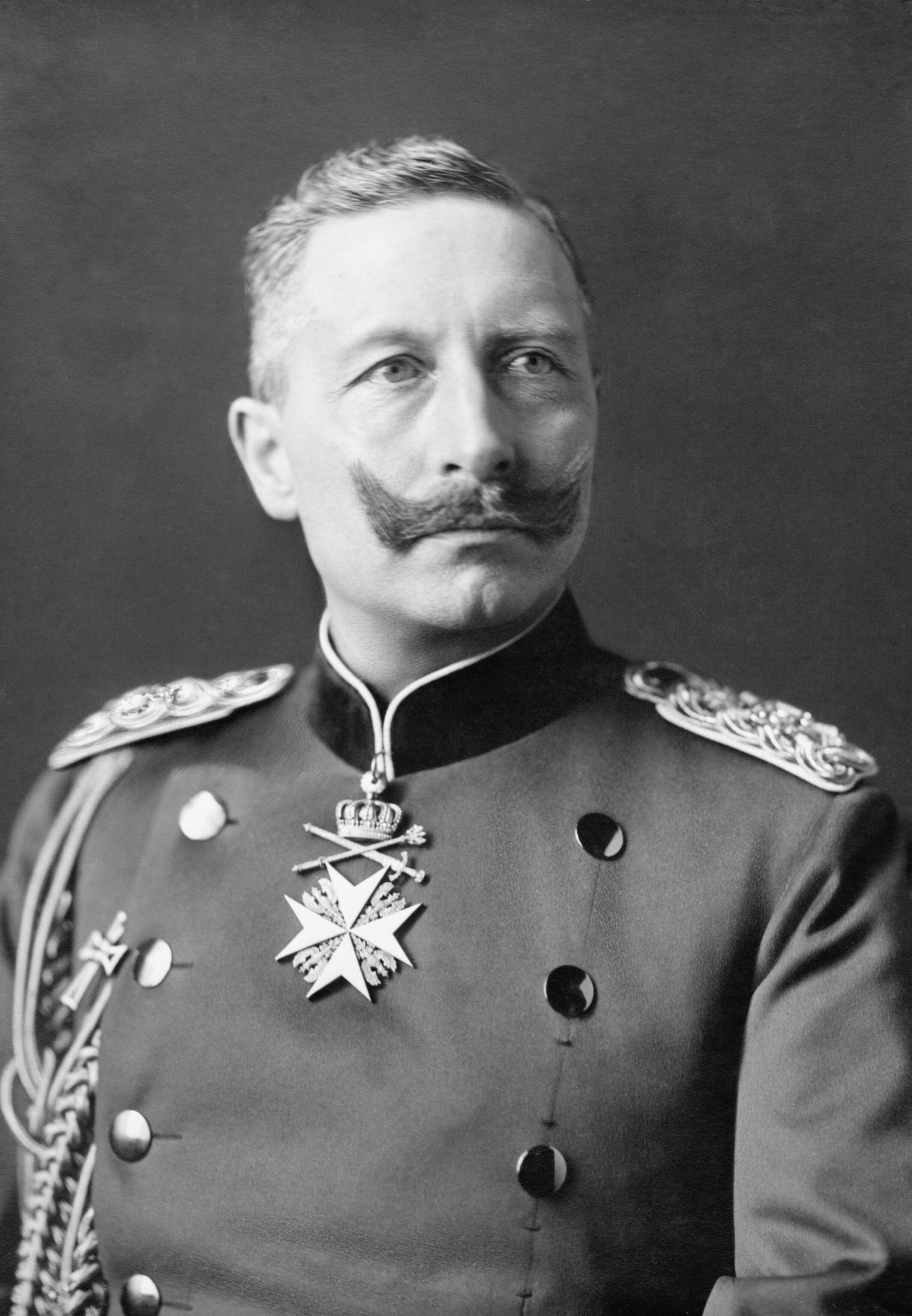
Kaiser Wilhelm II of Germany and Prussia, 1902

Kaiser Wilhelm II of Germany and Prussia, 1902

In 1914, he would have his revenge on his mother and England because, by then, he would be the world leader, Kaiser (Emperor, King) Wilhelm II of Prussia and Germany (1859-1941), whose bellicose (bellicose: demonstrating aggression and willingness to fight) policies would help to bring about World War I.  Three royal cousins –  the leaders of Russia, England, and Germany – would be at terrible war with one another.

Queen Victoria, called “the Grandmother of Europe,” had not lived to see her matchmaking plan to unite Europe through royal marriages fall far afield of its mark. Tens of millions of people would die because of Kaiser Wilhelm and Europe would be devastated. Relatives, history has shown, do fight against one another.

(1) wiki: Caesarean Delivery

(2) Rohl, John. The Kaiser and His Court: Wilhelm II and the Government of Germany. Cambridge: Cambridge University Press, 1997 .

(3) Rohl, John. Kaiser Wilhelm: A Concise Life. Cambridge: Cambridge University Press, 2014.


Read Full Post »

Corrie’s father turned on the old table radio to warm it up. Corrie felt that the small, portable one would have worked just fine, but her father insisted on using this old one. It was to be a major broadcast, he said, and the old radio had an elaborate speaker. The prime minister of the Netherlands was to address the Dutch nation.

It was 9:15 on a Thursday night, an hour when Corrie, Father, and Corrie’s sister Betsie normally would be heading upstairs to bed. As was their custom, they had already said their prayers and read a passage from the Bible. But, this evening, they would stay up a little later.

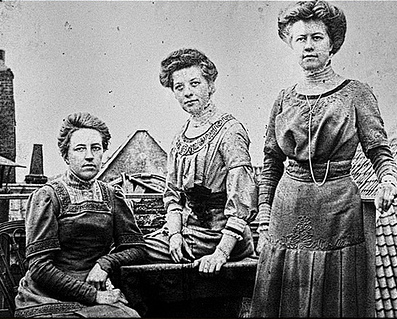
Corrie, Betsie, and Nollie Ten Boom

Corrie, Betsie, and Nollie Ten Boom

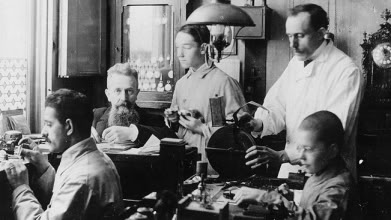
The Ten Boom family lived above their watch shop in Haarlem in the Netherlands (Holland).

Casper Ten Boom in watch shop

Casper Ten Boom in watch shop

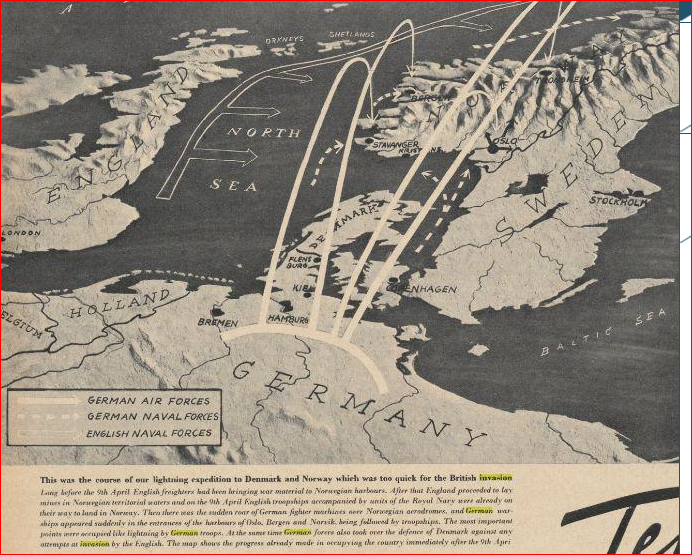
It was May 9, 1940. World War II was raging in Europe. The aggressive German army had invaded and occupied Poland, Norway, and Denmark. As a result, England and France had declared war on Germany. The Netherlands, however, did not and would not enter the conflict. They had declared their neutrality, the same as they had done in the first world war. Germany had respected their neutrality then and would do so again, they expected.

But every day fresh rumors reached their ears of an impending German invasion. Would Holland be drawn into the war? To calm these fears, the German Nazis repeatedly pledged goodwill to the people of the Netherlands. Many times Corrie had heard Hitler himself on the radio, promising the Dutch people that he would not invade their country.

Finally, it was 9:30, and time for the prime minister’s speech. The Ten Booms pulled their wooden, high-backed chairs closer to the radio, leaning in to listen, tense.

The parlor of the Ten Boom house in Haarlem, the Netherlands

The parlor of the Ten Boom house in Haarlem, the Netherlands

The prime minister’s voice filtered over the air waves. Tonight, it was pleasant and soothing. He told the Dutch people that there was no reason to worry. There would be no war. He knew it for a fact. He had spoken to people in high places.

In spite of the prime minister’s encouraging words, The Ten Booms were not comforted. The broadcast ended. They went upstairs to bed.

Five hours later and 37 miles south down the coast, 19 year old Diet (Deet) Eman woke up to noise outside her bedroom window. It was about 3 in the morning. It sounded as if someone was beating a rug. It was a steady, staccato sound – “pop-pop-pop” – only much faster. Deet lived in The Hague, Netherlands, where Queen Wilhelmina and her government were established.

Diet Eman was 19 years old when the Germans invaded the Netherlands.

Diet Eman was 19 years old when the Germans invaded the Netherlands

“This is crazy!” She thought. “Some idiot is beating rugs right now, and it’s pitch dark outside.” It’s true it was Friday morning and Friday was the day of the week that Dutch women typically beat rugs. But who would beat rugs at three in the morning?

What Diet heard was the first sound of the war. The Germans had invaded the Netherlands. The skies were filled with German parachutists falling. German Stukas dive-bombed the airfield, wiping out the Dutch biplanes. Diet’s sister’s fiancé, part of the weak Dutch army, was killed that day in the German bombing.

German parachutists attack the Netherlands May 10-14, 1940

German parachutists attack the Netherlands May 10-14, 1940

The Dutch people had been caught off guard. So many times they had readied for invasion only to discover it was a false alarm. Over time, they had grown complacent, caught in the net of Nazi lies and deception.

Some of the invading German soldiers crossed the border and parachuted from planes in disguise. They wore Dutch, French, and Belgian military uniforms and carried machine guns. Their disguises allowed them to roam freely behind the Dutch lines. It was Hitler’s idea to deceive and infiltrate the enemy; the Dutch army would be confused and not know who to shoot, the French and the Belgians being their allies. Dutch Nazis met them upon arrival and aided their sabotage activities. Other German soldiers dressed up as nuns, bicyclists, priests, peasants, and schoolboys in order to move undetected among the Dutch population. They seized key strongholds like water controls and bridges to pave the way for the German infantry.

Peace talks were underway when the Germans went ahead and ruthlessly bombed Rotterdam, the Netherlands. This was the message: If the Netherlands doesn't surrender, we will do what we did to Rotterdam to every one of the Dutch cities until you surrender.

Peace talks were underway when the Germans went ahead and ruthlessly bombed Rotterdam, the Netherlands. This was the message: If the Netherlands doesn’t surrender, we will do what we did to Rotterdam to every one of the Dutch cities until you surrender.

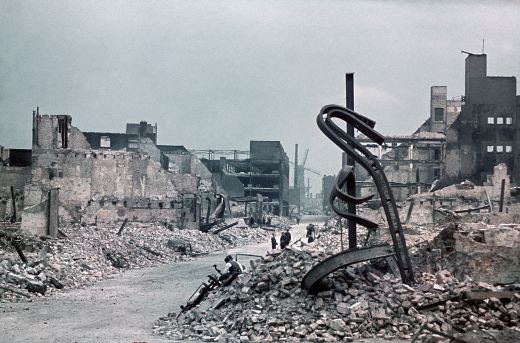
The German blitzkrieg crushed the Dutch defenses in five days, allowing the Germans to turn their attention then to invading France. On May 14, 1940, the Netherlands surrendered and the German occupation began in earnest. Germans moved swiftly to prepare Dutch airbases to send missiles to destroy England.

With the May 1940 occupation of Holland, Germany is poised to attack England.

With the May 1940 occupation of Holland, Germany is poised to attack England.

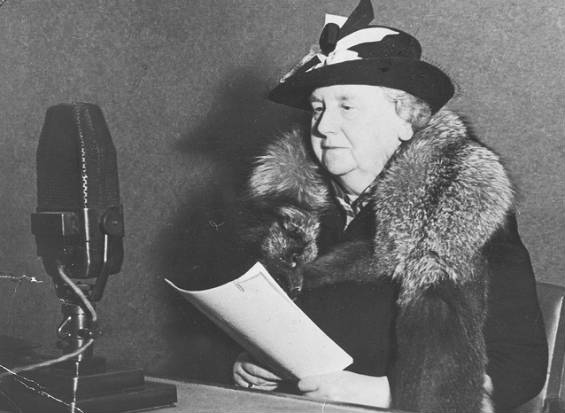
Queen Wilhelmina broadcasts over the BBC to her people in the Netherlands during WWII.
However, Queen Wilhelmina had foiled the Nazi plot to kidnap her and escaped, by boat, to England, where she set up a government in exile. Thanks to the BBC radio network, she was able to speak to her people for the next five years over the radio, urging them to resist the Germans.

It was revealed that the Nazis who had been trained to capture her – but had failed – had taken lessons in how to correctly address royalty. After capturing her, the plan went, a German general would come calling, a bouquet of flowers in hand, and attempt to persuade her to call off all resistance activity.

Read Full Post »

Texas pioneers John Holland Jenkins and Mary Jane Foster Jenkins

Texas pioneers John Holland Jenkins and Mary Jane Foster Jenkins

John Holland Jenkins (1822-1890) fought for Texas for 30 years. At age 13, he joined General Ed Burleson’s First Regiment in the Texas Revolution of 1836. Once the Mexicans were driven back, Jenkins returned to Bastrop, Texas, where he quickly earned a reputation as an Indian fighter. He became a Texas Ranger and, later, a Confederate soldier.

In later life, Jenkins became an author of an invaluable memoir, Recollections of Early Texas. Read today with 21st Century eyes, Jenkins’ accounts of gritty frontier days may come across to some as politically incorrect, especially in regard to native Americans. When the book was printed in 1958, Texas folklorist J. Frank Dobie wrote a foreword, somewhat predicting a backlash:

“Johnny Jenkins seems to consider it his duty to put down the truth – whether it is complimentary or not.”

Here is Jenkins’ account of an experience with a group of Tonkawa Indians, one of the many tribes of Plains Indians still roaming Texas when the Anglo settlers arrived in the Mid-19th Century. While some historians dispute that the Tonkawas, like the coastal Karankawas, were cannibals, Jenkins does not:

“There was a cowardly tribe among us, the Tonkawas, who were at peace with the whites, but hated all other Indians of every tribe. Only a short time before this, a band of Wacoes had killed five of them while out hunting, and, of course, this increased their hatred toward [the Waco] Indians. Hearing that I had killed one of their enemies [a Waco], they came in a body, thirty of them, and insisted that I should go with them and show them the dead warrior.

As we went, their excitement and speed increased, and every now and then they would trot on faster than ever, while I trotted with them, determined to keep up and see what they intended doing. When they discovered the body, they seemed wild with delight or frenzy. They sprang upon the body, scalped him, cut off both legs at the knees, both hands at the wrists, pulled out his fingernails and toenails, strung them around their necks, and then motioned for me to move aside. Seeing they meant further violence to the body, already horribly mutilated, I demanded why I must move. They said, ‘We must shoot him through the head for good luck….’

I moved aside, and they shot….They then went back to the house and camped, getting me to furnish them some beef. They boiled their beef, and the hands and feet of the dead Waco together…. Upon inquiry, I found they intended having a dance, and would feed their squaws on the hands and feet of the dead Indian, believing that this would make them bring forth brave men who would hate their enemies and be able to endure hardness and face dangers.

They erected a pole, to which they attached the scalp, hands, and feet of the Waco, and then with horrible yells and gestures, all danced around it, while the squaws constantly danced up to the pole and took bites from the hands and feet and then would go back and dance again. They would prolong these dances three, five, and sometimes ten days.”

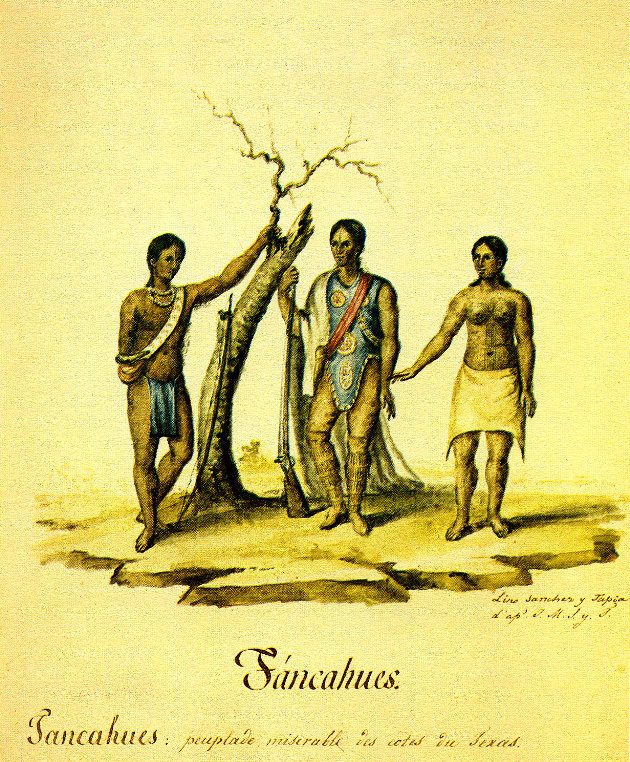
The Tonkawas had a Plains Indian culture, subsisting mainly on buffalo and small game until the Apaches and Comanches began pushing them from their hunting grounds. The Tonkawas then became a destitute culture, scavenging for food. They befriended the Anglo settlers who came to Central Texas in the mid-19th Century, relying on them for food, supplies, and an alliance against their Indian enemies. The Tonkawas wore little clothing. The women went topless and tattooed themselves extensively. They painted black stripes on their mouths, noses, and backs, and painted concentric circles around their breasts. Painting by the Berlandier Expedition, 1828.

Readers: You might enjoy other frontier tales also on this website. Scroll down the right sidebar to Categories/Frontier Tales. Enjoy!

Read Full Post »

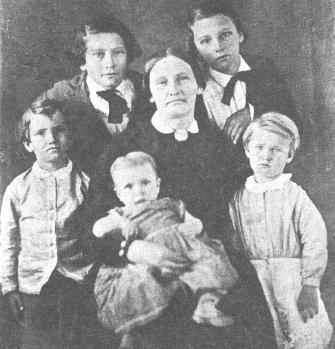
In this 1851, Texas pioneer Mary Adams Maverick is shown with 5 of her children. In 21 years, she bore 10 children. Four died of illness before reaching the age of 8. Her first-born, Sam, Jr., lived to be 98.

In this 1851 photograph, Texas pioneer Mary Adams Maverick is shown with 5 of her children. In 21 years, she bore 10 children. Four died of illness before reaching the age of 8. Her first-born child, however, lived to be 98!

On August 4, 1836, Mary Ann Adams Maverick (1818-1898) married Samuel A. Maverick, in Mary’s hometown of Tuskaloosa, Alabama. Mary was 18: Sam, 33. Sam had recently returned from Texas where he had fought in the Texas Revolution.

For the next several months, the newlyweds traveled throughout the South, visiting relatives, before arriving at Sam’s family home in South Carolina. There, on May 14, 1837, Mary gave birth to their first child, a boy.

Sam’s father did everything in his power to induce his son and family to settle with him in South Carolina. “Father Maverick” offered Sam and Mary a plantation complete with mills, vineyards, orchards, lands, and shops. Or, if a plantation wasn’t their fancy, he offered instead a new style house and improvements.

But Father Maverick’s efforts were “all in vain,” wrote Mary in her memoirs,

“for my husband dreamed constantly of Texas, and said: ‘We must go back.'” (1)

Sam wanted to build his land empire in the new Republic of Texas.

In October 1837, Mary, Sam, and their baby boy left South Carolina for Alabama. For the next six weeks, they – and their 10 “negroes” – stayed with Mary’s family while they made final preparations for their long overland journey to Texas.

“December 7, 1837, we set off for Texas. With heavy hearts, we said goodbye to Mother, and my brothers and sister. Mother ran after us for one more embrace. She held me in her arms and wept aloud, and said: ‘Oh, Mary, I will never see you again on Earth.’ I felt heartbroken and often recalled that thrilling cry; and I have never beheld my dear Mother again.” (1)

 
(1) Green, Rena Maverick (ed.). Memoirs of Mary A. Maverick. The Alamo Printing Co., San Antonio, 1921.

Read Full Post »

Older Posts »