Jackie and President Jack Kennedy land at Orly Airport, Paris, on May 31, 1961
It was May 31, 1961, when Air Force One, carrying AmericanPresident John and First Lady Jackie Kennedy, landed on the tarmac at Orly Airport in Paris. The president was less than five months into his term of office and this was his first European stop. The Kennedys were greeted by French President Charles DeGaulle and Madame DeGaulle. The contrast between the trim and stylist Americans and their “grizzled” counterparts was striking.
“As soon as the crowds pressed against the airport fences spotted Jackie in her navy-blue silk suit and black velvet pillbox hat, they broke into a rhythmic chant: ‘Vive Jacqui! Vive Jacqui!’ (1)
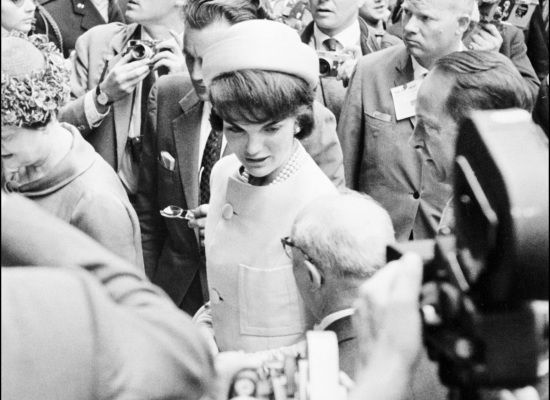
First Lady Jackie Kennedy is greeted warmly by Parisians on May 31, 1961. Her style was understated: a wool suit, double strand of pearls, and her trademark pillbox hat. The French were captivated by "Zhak-kee."
Hundreds of thousands of people followed their motorcade through the streets of Paris, waving little French and American flags as the open limousine carrying Jack and DeGaulle passed by. When the second car appeared, carrying Jackie and Madame DeGaulle, the crowd sent up a wild roar. Later, during an official luncheon at the Palais de L’Elysée, Jackie chattered away in French about Louis XVI, the Bourbons, and French geography. DeGaulle turned to Jack Kennedy and said:
“‘Your wife knows more French history than any Frenchwoman!’ [He then] turned back to Jackie and did not take his eyes off her for the rest of the meal.” (1)
The Hall of Mirrors at Versailles
The next night was the big event of the three-day visit: a candlelit supper in the Hall of Mirrors at the Palais de Versailles. Jackie wanted to look extra good. But to look good, Jackie had to “feel good” – and Jackie didn’t. She suffered from migraines and depression since her C-section 6 months earlier. Jack didn’t feel good either. His back pain was agonizing. That’s why, on this trip to Europe, Jack had brought along not just his extra-firm horsehair mattress but New York physician Max Jacobson. Presidential photographer and friend Mark Shaw had referred President Kennedy to Dr. Jacobson. Jacobson’s “miracle injections” instantly stopped Jack Kennedy’s pain. Jack didn’t know what was in the shots – only that they worked.
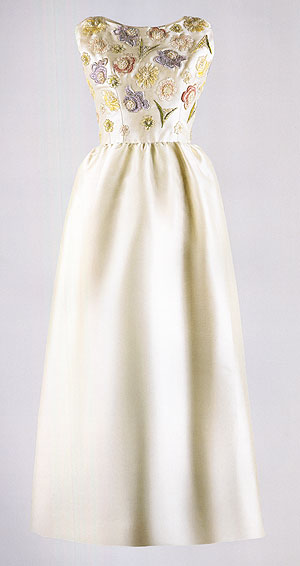
First Lady Jackie Kennedy wore this graceful Givenchy gown to the June 1, 1961 dinner at the Palace of Versailles.
The night of the Versailles dinner, Max visited Jack Kennedy at the Palais des Affaires Estrangères. Jack occupied a suite of rooms called “the King’s Chamber” in the elegant 19th Century palace on the Quai d’Orsay. The president soaked his back in “a gold-plated bathtub the size of a pingpong table” (2) then Max gave him his customary injection. Max then ambled down the long hallway to the Queen’s Chamber and was admitted to Jackie’s bedroom.
“Jackie sat in front of a mirror, being fussed over by Alexandre, the famous Parisian hairdresser, and a bevy of his assistants….In another part of the room, Jackie’s maid was laying out two different gowns for the evening – one an American design by Oleg Cassini, and the other a French creation by Hubért de Givenchy. Earlier, Jackie had planned to wear the Cassini [Jack preferred her to wear American clothes], but then she was not so sure.” (2)
Alexandre finished with Jackie’s hair and left the room so she could slip into her gown. But first Jackie motioned to Max. She was ready for her shot. The short, dark-haired man with the red cheeks and German accent reached into his black doctor’s bag and withdrew a syringe.
“He injected his magic elixir into her buttock. She was ready for Versailles. She took one last look at the two ball gowns hanging side-by-side…and chose the one she knew would attract the more favorable reaction from the French press [and play up her French bloodline]. She slipped into the Givenchy….” (2)
Jackie Kennedy dazzled French President Charles DeGaulle at this June 1, 1961, dinner in the Hall of Mirrors at the Palace of Versailles. 150 guests ate a 6-course dinner served on Napoleon's gold-trimmed china. Jackie sported an elaborate topknot with a diamond tiara. Her rhinestone-studded white satin gown with embroidered bodice was by French designer Givenchy.
Jackie dazzled everyone at the dinner, and it is no wonder. Dr. Jacobson’s shots were a mixture of amphetamines, vitamins, painkillers, and human placenta. (3) The mysterious physician referred to his particular brand of therapy as “miracle tissue regeneration.”
“You feel like Superman,” said writer Truman Capote, one of the high-profile clients who experienced instant euphoria from Dr. Feelgood’s injections of ‘speed.’ “You’re flying. Ideas come at the speed of light. You go 72 hours straight without so much as a coffee break….Then you crash….” (2)
The crash for Dr. Jacobson came in 1969 when his patient and Kennedy friend Mark Shaw died at the young age of 47 due to “acute and chronic intravenous amphetamine poisoning.” The Bureau of Narcotic and Dangerous Drugs discovered that Dr. Jacobson was buying huge quantities of amphetamines in order to deliver high level amphetamine doses to his clients. “Miracle Max” and many of his clients had become amphetamine addicts. Dr. Jacobson’s medical license was revoked in 1975.
(1) Spoto, Donald. Jacqueline Bouvier Kennedy Onassis: A Life. New York: St. Martin’s Press, 2000.
(2) Klein, Edward. All Too Human: The Love Story of Jack and Jackie Kennedy. New York: Simon & Schuster Inc., 1996.
(3) Leaming, Lawrence. The Kennedy Women: The Saga of An American Family. New York: Random House, 1994.
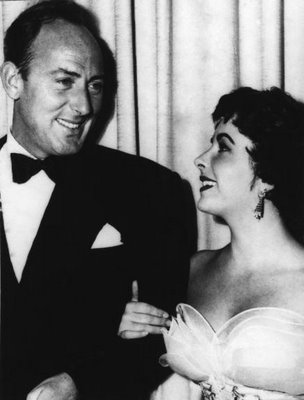
Elizabeth Taylor with husband #2: Michael Wilding: Married 21 February 1952, Divorced 30 January 1957
On May 12, 1956, Anglo-American film actress Elizabeth Taylor and her second husband Michael Wilding threw a dinner party at their Beverly Hills home. It was a bad night for a party. For the first thing, it was foggy and the Wildings lived up a long and winding road in Benedict Canyon. For the second thing, the Wildings’ marriage was on the rocks. Elizabeth was having an affair and Michael’s out-of-control drinking had led to several indiscretions with other women.
The guest of honor was to be Father George Long, a hip priest who ran with the Hollywood set. Rock Hudson and his new wife Phyllis Gates were invited. So was Kevin McCarthy, who was then making “Invasion of the Body Snatchers.”
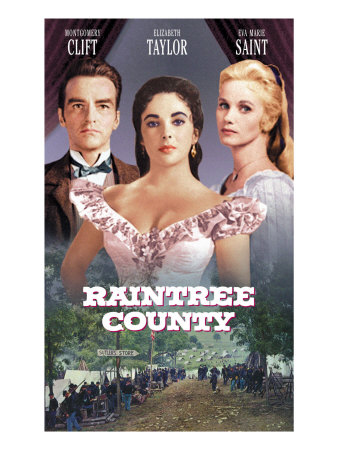
Montgomery Clift was another actor on the guest list. That spring, he and Elizabeth were shooting the MGM Civil War melodrama, “Raintree County.”
Montgomery Clift and Elizabeth Taylor in "Raintree County" (1957)
(Elizabeth had just finished filming “Giant” which would be released in October of that same year.)
Elizabeth Taylor and Rock Hudson in "Giant" (1956)
Monty and Elizabeth had become best friends in 1951 during the filming of “A Place in the Sun.” Monty affectionately referred to Elizabeth as “Bessie Mae.” She was his confidante. Monty Clift was a rising star, known for his sensitive and brooding portrayals of troubled young men. He was very intense and deeply serious about acting.
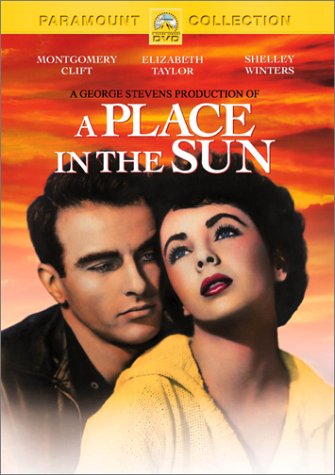
"A Place in the Sun" (1951) with Montgomery Clift and Elizabeth Taylor
At first Monty declined the invitation at Liz’s. He was awkward being around the Wildings while their marriage was so bad. But he changed his mind and agreed to join the group for dinner, leasing a car and driving up the mountain road to the Wildings’ house.
The party turned out to be a terrific bore. The guest of honor didn’t even show. Michael Wilding wasn’t feeling well and spent the evening lounging on the couch, saying virtually nothing to the company and acting aloof. That made Elizabeth nervous so she was unusually chatty. Monty grumbled about the way the MGM director Edward Dmytryk was shooting everything in “Raintree County” in giant close-ups. He was depressed and angry. He sensed the film would be a colossal disaster.
The party broke up about midnight with Monty and Kevin bidding each other goodbye in the driveway and taking off down the road Elizabeth called a “cork twister.” Kevin was in the lead. Within minutes, Kevin was back at Elizabeth’s house, ringing the bell. Monty Clift had had a serious car accident. His car had struck a utility pole as he rounded one of the hairpin turns in the fog. Elizabeth shrieked and demanded that Kevin immediately take her to the scene.
Montgomery Clift, Elizabeth Taylor, and Eva Marie Saint in "Raintree County" (1957)
Since the 1950, many unflattering things have been written about Elizabeth Rosemond Taylor who is now a Dame of the British Empire, and much of it was justified. (She tended to steal people’s husbands.) But what was to happen next on that foggy stretch of midnight road below her house was to be Elizabeth’s finest hour.
She and Kevin arrived at the wreck:
“Monty’s car was demolished, an ‘accordion-pleated mess,’ Elizabeth said. A 4,800 transformer, knocked off the pole by the impact, had narrowly missed hitting the car. McCarthy thought his friend was dead. ‘The doors were so jammed that we couldn’t get to him,’ he said.” (1)
Broken glass was everywhere – but that didn’t faze Elizabeth. She climbed in the car through a back window.
“‘Adrenaline does something to you,’ she remembered.”
Elizabeth hauled herself over the bloody seat. Monty’s motionless body lay beneath the steering wheel. His face was barely recognizable.
“‘It was like pulp,’ she remembered.”
Elizabeth called out to Monty. He reacted to her voice and indicated to her that he was choking. Several of his teeth had broken off and had lodged in the back of his throat. Reaching inside his mouth, Elizabeth pulled the teeth out, one by one. Elizabeth saved his life. Monty could once again breathe.
It was nearly an hour before an ambulance arrived and, with it, a handful of frenzied photographers. Elizabeth positioned herself between the stretcher carrying Monty and the photographers’ cameras. “She was remarkable,” said McCarthy. She told the photographers that if they so much as snapped one photo of Monty’s bloodied face, she’d never allow her to take another photo of her. (That would never do. Elizabeth Taylor was one of Hollywood’s top actresses and would become one of the most photographed women in the world.) The photographers backed off.
The car accident left Elizabeth with persistent nightmares. She couldn’t get Monty’s bloody face out of her mind.
“It would come up like a balloon in front of me at night.”
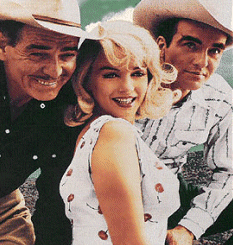
"The Misfits" (1961) stars Clark Gable, Marilyn Monroe, and Montgomery Clift
Understandably, filming on “Raintree County” was put on hold as Monty underwent a long hospitalization and painful facial reconstruction. Despite these efforts, Monty never looked as beautiful as before. His face remained scarred and partially paralyzed. This was the beginning of Monty’s long and deadly slide into alcohol and drug addiction. He became a wrecked man.
Marilyn Monroe, who appeared alongside Monty in the 1961 film, “The Misfits,” described him as
“the only person I know who is in worse shape than I am.”
Monty’s post-accident career has been called “the longest suicide in Hollywood history.” In 1966, ten years after his car accident, Montgomery Clift died alone in his New York apartment while watching “The Misfits” on TV. He was only 45.
(1) Mann, William J. How to Be a Movie Star: Elizabeth Taylor in Hollywood. New York: Houghton Mifflin Harcourt Publishers, 2009.
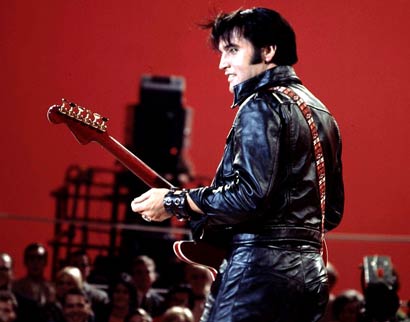
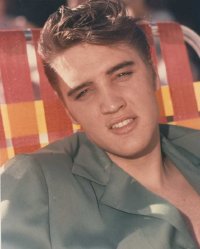
Elvis 1968 from his "1968 Comeback Special" on ABC TV
Today is Elvis’ 75th birthday. Happy Birthday, Elvis. We love you.
Elvis loved Christian gospel music. Here he is singing “Oh, Happy Day.”
Song : Oh, Happy Day
Oh happy day
Oh happy day
Oh happy happy day;
Oh happy day, When Jesus washed
Oh when he washed
When Jesus washed
He washed my sins away!
Oh happy day
Oh happy day
Oh happy day
Oh happy day
When Jesus washed
Oh when he washed
When Jesus washed
He washed my sins away!
Oh happy day
Oh happy day
He taught me how
He taught me
Taught me how to watch
He taught me how to watch
and fight and pray
fight and pray
yes, fight and pray
And he’ll rejoice
and He’ll, and He’ll
rejoice in things we say
and He’ll rejoice in things we say
things we say
yes, things we say
Oh happy day, Oh happy day
Oh happy day, Oh happy day
Oh happy day
Oh happy day
Oh happy day, Oh happy day
When Jesus washed
Oh when he washed
He washed my sins away, He taught me how
to watch, fight and pray
fight and pray
Oh happy day, Oh happy day
When Jesus washed
Oh when he washed
He washed my sins away, We´ll live rejoicing
ev´ry day, ev´ry day
Oh happy day, Oh happy day
When Jesus washed
Oh when he washed
He washed my sins away
Check out Part one of my Birthday Tribute to Elvis: Viva Elvis!
Readers, for more posts on Elvis, scroll down the right sidebar to Categories/People/Elvis. Enjoy!
The Presleys, 1937: Gladys, Elvis, and Vernon. It's ironic that Elvis is wearing such a grown-up boy's hat. Soon he would discover that he was a more responsible person than his father. By the time Elvis was in his early twenties, he would be the sole breadwinner for the rest of his life for himself and his parents.
I couldn’t let the day go by without saying at least a few words about Elvis. Today is his 75th birthday and I am watching a TCM marathon of Elvis shows. On the tube, paused so I could blog, is “Viva Las Vegas.” I just watched Elvis perform the title song. It’s obvious that the director asked him to tone down his sexy moves; there’s barely a suggestion of hip action. But wow can he wiggle that torso and strut like the rooster that he was.
Elvis' birthplace on the Old Saltillo Road in Tupelo, Mississippi
I’ve been doing some reading about Elvis again, reminding myself what most of us know about his legendary rise from rags to riches. His parents Vernon and Gladys Presley were dirt poor. Vernon couldn’t keep a job very long. He was a drinker. He was 17, Gladys was 21 when they eloped and moved in with his parents. Eighteen months later, their son Elvis was born on January 8, 1935, in a two-room house in Tupelo, Mississippi, a house Vernon built just for the birthing. The house had no indoor plumbing or electricity.
Elvis had an identical twin brother, Jessie Garon, who was stillborn. Thirty-five minutes later at 4 a.m., Elvis Aron (later Aaron) was born.
This is a photo of the memorial headstone for Jessie Garon Presley in the Meditation Garden at Elvis' Graceland mansion in the city of Memphis, Tennessee. Jessie Garon was the twin brother of Elvis Presley who was born and died on January 8, 1935 in the Presleys' two-room shack in Tupelo, Mississippi. The Presleys could not afford to pay the $10 doctor bill for delivering Elvis and Jessie. Jessie Garon Presley was buried in a shoebox in an unmarked grave in Priceville Cemetery in Tupelo. This memorial headstone was placed in the Meditation Garden at Graceland shortly after Elvis was re-interred there in October 1977.
Elvis was told from the beginning that he was special. God had spared his life while Jessie had died. Gladys became an overly protective parent from the get-go. Elvis remained her only child, though she miscarried another child about ten years later. Both she and Vernon doted on Elvis. Gladys walked Elvis to school every day until he entered high school. She made him carry his own fork and spoon so he wouldn’t pick up any germs from using cutlery once used by others.
Vernon was a terrible breadwinner. He couldn’t keep a job, probably because of his drinking. When Elvis was three, Vernon received payment for a pig from his farmer landlord Orville Bean. Vernon decided that he hadn’t been paid enough for the pig so he altered the amount of payment on the check. He was arrested for forgery and sent to prison for under a year. Interestingly, Orville Bean was instrumental in securing an early release for Vernon.
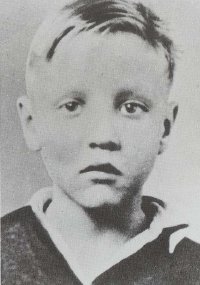
Elvis Presley at age 4 in 1939. He was a blonde. He later dyed his hair to look like screen actor Tony Curtis.
Meanwhile, with Vernon in prison, Gladys and Elvis had no income. They lost their home and had to move in with relatives. The experience so traumatized little Elvis that he began to sleepwalk.
And so it went. For the first twenty-one years of his life, Elvis lived a hand-to-mouth existence. Elvis, Gladys, and Vernon moved from place to place living sometimes with relatives, or living on public assistance in substandard dwellings, cheek-to-jowl. When Elvis was a teenager, Vernon moved them into such a crummy apartment complex that they had to share the bathroom with the other tenants. The bathroom was disgusting. Elvis refused to bathe there and ended up getting cleaned up at the high school or not at all.
There was never enough to eat. It’s possible an usher at a movie theatre where Elvis worked got fired for giving Elvis food.
The family moved to keep just one step ahead of their creditors or the police. Vernon ran moonshine while picking up an odd job here or there. He never made enough money to take care of his family because he didn’t stay with the job. Vernon was frequently absent from home. Elvis and Gladys grew closer at those times and Elvis was definitely the man of the house. Gladys could count on him. Early on, Elvis began to refer to his parents as “his babies.”
Elvis keenly felt the responsibility of taking care of his mother. They were very close. They spoke to one another in baby talk. Elvis called his mother “Sat’n.” Gladys was as impulsive as Vernon was reckless. Gladys was everything to Elvis and he to her.
Elvis’ musical talent was cultivated in the rich gospel tradition of the Southern Christian Church. The Presleys might have been poor but they could still go to church. They faithfully attended the Assembly of God church in Tupelo where Pentecostal worship was practiced. Dance was not allowed by the church, but those Pentecostals sure loved to sing. The experience formed his musical foundation. Elvis recalled watching the preacher belting out a tune and wildly jumping up on the piano. The preacher’s passion for music was electric – and Elvis was paying attention.
Vernon, Elvis, and Gladys Presley, 1945. Elvis was 10. In a year, he'd receive his first guitar - though he wanted a bicycle.
Elvis’ musical talent was first recognized by his fifth-grade teacher, Oleta Grimes, who, coincidentally, was the daughter of Orville Bean. She heard the moving way Elvis sang the sad ballad “Old Shep” and brought him to the attention of the school principal, who entered Elvis into a talent contest at the Mississippi-Alabama Fair and Dairy Show. Wearing a cowboy suit and standing on a chair, Elvis, without accompaniment, sang a sad song about a boy’s love for his dog. He won second place and received a free pass to ride all the rides at the fair.
Watch a youtube recording of Elvis singing “Old Shep,” 1956 below:
Shortly after that, Elvis asked his parents to give him a bicycle. Gladys was afraid for his safety so she bought him a bicycle instead. A preacher from the Assembly of God church where they were faithful members, family members, and friends pitched in to give Elvis informal guitar lessons. He soon learned to play the piano. By 7th grade, Elvis took his guitar along with him to school.
Elvis as a teenager
One night during Elvis’ high school years, Vernon upped and moved the family from Tupelo to Memphis, Tennessee, where Elvis’ subsequent visits to Beale Street exposed him to jazz and blues and more rockabilly. Elvis began to work on his image. He didn’t wear jeans like the other boys in school; jeans were what poor people wore (and overalls), and Elvis definitely did not want to be poor. He always had a job in high school and saw that he dressed well. He wore dress pants, often in his favorite colors, pink and black. He sometimes sported a black bolero jacket. He bought his flashy clothes at Lansky Brothers on Beale Street. He wore his collar up, his hair longer than the others. He dyed it black, slicking it back with thick gunk. He let his sideburns grow long. In the eleventh grade, the coach kicked Elvis off the football team for refusing to cut his hair (1952).
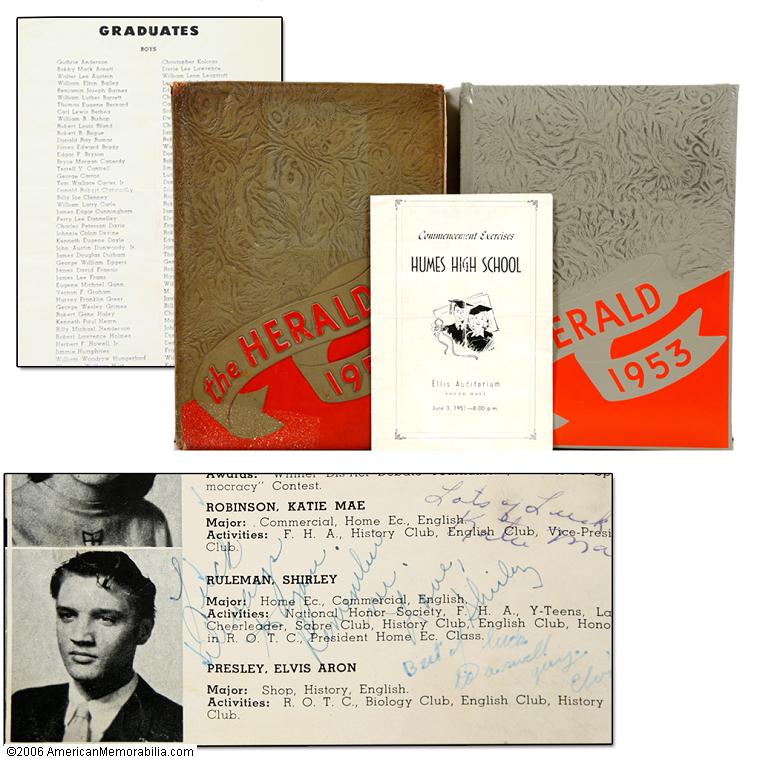
Elvis Presley's senior photo
Elvis worked as an usher at the Suzore #2 Movie Theatre which let him watch a lot of shoes. In his 1953 Hume High School senior picture, you can see that Elvis has put a permanent wave in his hair. He was copying Tony Curtis, who was the biggest star of his day. He had just completed the mega-hit, “Houdini.”
Music was Elvis’ passion. He was determined to express himself, his individuality, through his wild clothes and hair and, eventually, his music. He hung out at record shops. He visited Sun Records which had its home in Memphis. In his senior year, Elvis began to pick up local gigs with established local bands. He entered local music contests. Elvis wanted to make something of himself. Then, in 1956, he made it – big. The hot new talent went to New York to do a recording session.
"The Kiss," 1956, shows Elvis Presley, 21 years old, baby-faced, and barely legal, kissing an unknown woman, as photographed by fledgling freelance photographer Alfred Wertheimer. RCA had hired Wertheimer to shoot publicity for their hot new young talent coming to New York for a recording session and a television appearance with steve Allen. Elvis doesn't seem to mind the intrusive camera.
Elvis loved to read and was especially wild for Marvel Comics. He admired Captain Marvel. In his Las Vegas live performances, he often wore jumpsuits with lightning bolts as his trademark – like Captain Marvel. Captain Marvel and his lightning bolt exuded power and success.
Elvis Presley "That's All Right"/"Blue Moon of Kentucky" 78 (Sun 209, 1954). This was Elvis' first record. It was produced in 78 r.p.m.
From the most humble beginnings to the dizzying heights of fame and fortune rose Elvis Aaron Presley. He continues to fascinate – and to sell records. He remains the best-selling solo artist in the history of popular music. Gifted at vocals, guitar, and piano, he was known as the King of Rock and Roll, or simply The King. Elvis didn’t like to be called The King. He felt it was sacreligious. Elvis had talent, good looks, charm, sensuality, and a genuinely good sense of humor. He was the star of 44 films – not very good films, I grant you, but very popular ones – countless live concerts and TV performances, and has sold over 1 billion records. He was nominated for 14 Grammy Awards, winning 3, and inducted into 4 Halls of Fame.
Now that I’ve done my part in paying tribute to the Great Elvis, who left us so much joy with his unmatchable voice and moves, I can return to watching “Viva Las Vegas!” But not without saying, “Viva Elvis!”
TMZ has obtained a never-before published photograph which appears to show John F. Kennedy on a boat filled with naked women — it’s a photo that could have altered world events.
We believe the photo was taken in the mid-1950s. It shows two naked women jumping off the boat and two more naked women sunning on the top deck. Just below the top deck — a man appearing to be John F. Kennedy is lying on a deck, sunning himself.
a never-before published photograph that appears to show John F. Kennedy on a boat filled with nude women (TMZ)
TMZ had multiple experts examine the photo — all say there is no evidence the picture was Photoshopped. The original print — which is creased — was scanned and examined for evidence of inconsistent lighting, photo composition and other forms of manipulation. The experts all concluded the photo appears authentic.
Professor Jeff Sedlik, a forensic photo expert, says the print appears to be authentic. Sedlik says the photo is printed on paper consistent with what was used in the 1950s. The emulsion on the surface of the print has numerous cracks — the result of aging and handling.
There are numerous articles and books on President John F. Kennedy which mention a 2-week, Mediterranean boating trip that JFK — then a Senator — took in August, 1956, with his brother Ted Kennedy and Senator George Smathers. The trio reportedly entertained a number of women on the yacht. Jackie Kennedy was pregnant at the time and was rushed to the hospital while JFK was on the boat. Doctors performed an emergency C-section, but the infant was stillborn.
Forensic analyst Sedlik superimposed an image of Kennedy taken at the Democratic National Convention in August 1956, just days before Kennedy went on the Mediterranean cruise. Sedlik says the features from the two pics almost precisely sync up. TMZ has also had two Kennedy biographers examine the photo — they also believe JFK is in the picture.
The photo was eventually given to a man who owned a car dealership on the East coast. The man kept it in a drawer for years, and would brag to friends he had an image of JFK on a boat with naked women. The man died 10 years ago and one of his sons inherited the photo.
Had the photo surfaced when John F. Kennedy ran for President in 1960, it could have torpedoed his run, and changed world history.
By the time Charles Dickens turned ten, his family had lived in six different houses, each poorer than the one before. Although Charles’ father John Dickens was employed as a clerk in the Navy Pay Office, he lived well beyond his means. Plus, the family kept growing; there were eight children in all, which meant many mouths to feed.
Then, in 1822, John Dickens was transferred to London and the family followed. Things went rapidly downhill. John Dickens was soon in debt up to his eyeballs. He informed Charles that he no longer could afford to send him to school. This broke Charles’ heart. The headmaster at his school had already recognized Charles’ special intelligence and imagination and Charles wanted to be a man of letters.
To pay the butcher and the baker, Charles was sent with armloads of books to sell at the pawnshop. Charles was humiliated and heartbroken. Gone were the wonderful hours in his little attic room in Chatham, reading tales of heroes like Robinson Crusoe and Peregrine Pickle. Now he was forced to part with his beloved stories, his only escape from the drudgery of his life. The books were soon followed by all the household goods, sold in an attempt to pay off the family’s debts, and keep John Dickens out of debtors’ prison.
In this 1840 engraving, 'Love Conquered Fear,' fictional character Michael Armstrong, a boy adopted by the mill owner, is shown embracing his brother Edward who is one of the ragged factory boys working amongst the spinning mules. By Michael's foot, a child can be seen crawling out from under a mule, employed to keep the floor under the mules dust and fiber free to minimise risk of fire. These poor boys often suffered horrific injuries when crushed by the moving machinery. From Frances Trollope's ''The Life and Adventures of Michael Armstrong'' London 1840.
“It is wonderful [shocking] to me how I could have been so easily cast away at such an age….My mother and father were quite satisfied. They could hardly have been more so if I had been twenty years of age, distinguished at a grammar-school, and going to Cambridge.”
No one – no neighbors, friends, or family members reached out to save Charles from this terrible fate. So, on Feb. 9, 1824, at the tender age of twelve, he entered the business world to earn wages for the family. From eight in the morning until eight at night, six days a week, Charles worked alongside rough boys in a dark room covering pots of boot polish and gluing on labels. The work conditions were appalling:
“The blacking-warehouse was the last house on the left-hand side of the way, at old Hungerford Stairs. It was a crazy, tumble-down old house, abutting of course on the river, and literally overrun with rats. Its wainscoted rooms, and its rotten floors and staircase, and the old gray rats swarming down in the cellars, and the sound of their squeaking and scuffling coming up the stairs at all times, and the dirt and decay of the place,rise up visibly before me, as if I were there again. The counting-house was on the first floor, looking over the coal-barges and the river.”
Victorian children are shown working in a cotton mill. At the beginning of British Queen Victoria’s reign (1837), many children worked in factories for cheap wages. Some workers were as young as five. Few citizens questioned the practice of employing children at the time as there were no laws to protect them. The novels of British author Charles Dickens (1812-1870) with their depiction of poverty did much to bring about positive social change and improve the living conditions of the poor.
Then, two weeks later, John Dickens was arrested and thrown into Marshalsea Prison, where he had to stay until his debts were paid. Charles’ mother and his seven siblings were allowed to live there with him, everyone living in one room, except, alas, Charles. The blacking factory was too far from the prison for Charles to get back before the gates were shut at night. Charles was sent to live in a cheap boarding house. After work he wandered the dark streets of the big city, utterly alone, totally miserable, shabbily dressed, anticipating a dinner of bread and cheese in an empty room.
Those days were so crushingly painful for Charles that, years later, when he was a grown man with a family of his own, he could not walk those same streets without being reduced to tears. As a writer, Dickens filled his books with people and places from those bitter days, offering a social commentary that improved the lives of the poor. The novel Oliver Twist (1839), for example, shocked readers with its depiction of poverty and crime in Jacob’s Island, resulting in an actual clearing of the slum.
Old Fezziwig's Christmas Eve Ball from "A Christmas Carol" by Charles Dickens (1843)
The Morgan Library and Museum in Manhattan owns the entire handwritten manuscript of A Christmas Carol by Charles Dickens. The 66-page manuscript written in 1843 bears all of Dickens’ edits in his own hand. “He worked on it with loving care, doing much more rewriting than usual.” (1) The original story is written in light blue ink. Edits are in thick, black ink.
One edit is visible on page 12, where Scrooge encounters Marley’s ghost, and chalks up the vision to indigestion. Dickens originally wrote “a spot of mustard” then changed it to read: a “blot of mustard.”
The manuscript is exhibited each holiday season but, alas, only one page is put on view each year, under glass. This year, however, the Morgan has allowed the New York Times to photograph and display the entire handwritten treasure online at
The Morgan challenges readers to go online and study the manuscript and submit what they think is the most interesting edit in the work. The contestant judged to have submitted the most intriguing edit will be invited as the newspaper’s guest to afternoon tea at the Morgan.
What motivated Charles Dickens to write his classic holiday ghost story?
“At the time A Christmas Carol was written, Dickens feared for his future. He had six children to feed, a large house in London to maintain, and a lavish lifestyle. Christmas was approaching.
Yet Martin Chuzzlewit, the work he was then producing, a few chapters at a time, was not selling as well as earlier installments of The Pickwick Papers or Nicholas Nickleby. Bitterly, he confided to a friend that his bank account was bare….
Conjuring up what Dickens himself described as a “ghost of an idea,”…he got to work. The 6,000 copies printed in time for Christmas sold out. But because he had splurged on hand-colored drawings by John Leech, one of England’s leading illustrators, the project was a financial bust.
Fortunately for Dickens, his quickie book went on to become a classic.” (2)
(1) Stanley, Diane and Vennema, Peter. Charles Dickens: The Man Who Had Great Expectations. New York: Morrow Junior Books, 1993.
(2) “Dickens the Editor To Dickens the Writer: Make it Sell.” The New York Times. A29. December 2, 2009.
The ghost of Jacob Marley visits Ebenezer Scrooge in Charles Dickens' A Christmas Carol (1843); Illustration by Arthur Rackham (1915)
“‘Mercy! [Scrooge] said. ‘Dreadful apparition, why do you trouble me?’
“Man of the worldly mind!’ replied the Ghost, ‘do you believe in me or not?’
‘I do,’ said Scrooge; ‘I must. But why do spirits walk the earth, and why do they come to me?’
‘It is required of every man,’ the Ghost returned, ‘that the spirit within him should walk abroad among his fellow-men, and travel far and wide; and, if that spirit goes not forth in life, it is condemned to do so after death. It is doomed to wander through the world – oh, woe is me! – and witness what it cannot share, but might have shared on earth, and turned to happiness!’
Marley's Ghost by John Leech (1843) from A Christmas Carol by Charles Dickens (1943)
Again the spectre raised a cry, and shook its chain and wrung its shadowy hands.
‘You are fettered,’ said Scrooge, trembling. ‘Tell me why?’
‘I wear the chain I forged in life,’ replied the Ghost. ‘I made it link by link, and yard by yard; I girded it on of my own free will, and of my own free will I wore it. Is its pattern strange to you?’
Scrooge trembled more and more.
‘Or would you know,’ pursued the Ghost, ‘the weight and length of the strong coil you bear yourself? It was full as heavy and as long as this seven Christmas Eves ago. You have labored on it since. It is a ponderous chain!'”
L-R: Actor Robert Wagner, his wife Natalie Wood (1938 - 1981) and host Frank Sinatra (in eyepatch) pose together during a surprise 21st birthday party held for Wood at Romanoff's, Hollywood, California, July 20, 1959. (Photo by Murray Garrett/Getty Images)
It was New Year’s Eve, 1958, and Peter and Pat Kennedy Lawford were celebrating at a private party at Romanoff’s in Beverly Hills, a popular spot with Hollywood stars. The Lawfords sat at the most prestigious table in the room with Frank Sinatra, Natalie Wood, and Robert Wagner. Pat was dazzled by Sinatra’s charm and basked in his attention. Sinatra was thrilled to be in the presence of the sister of the fast-rising Senator John F. Kennedy of Massachusetts.
Host Frank Sinatra (L) wears an eyepatch, laughing with actor Peter Lawford and his wife Patricia Kennedy (1924 - 2006) during a surprise 21st birthday party held for actor Natalie Wood at Romanoff's, Hollywood, California, July 20, 1959. (Photo by Murray Garrett/Getty Images)
Pat had only known Sinatra since August, when she met him at a dinner party at the home of Gary and Rocky Cooper. Since then, Sinatra had swept the Lawfords up into his orbit.
“Sinatra suddenly stood at the center of Pat’s and Peter’s lives.” [1]
Sinatra had become such a fixture in Pat’s world that, by the time she gave birth on November 4, she decided to give new baby Victoria the middle name of Francis, in honor of her newest and dearest friend, Francis Albert Sinatra.
The Lawfords not only saw Frank at least twice during the week, but, on many weekends – at Frank’s insistence – they made the 120-mile drive from their Santa Monica home to his Palm Springs estate. The Lawfords always kept the same bedroom at Sinatra’s Rancho Mirage compound. Frank made the Lawfords so at ease that they left some of their casual clothing in the bedroom closet.
Back at Romanoff’s, the new year was blowing in chilly and Pat was wearing a low-cut gown. As the night worn on, she and Natalie grew weary. But Sinatra didn’t want the night to end. He suggested they move the party to his place – two-and-half hours away at Rancho Mirage! Pat gasped at the dread thought. It was only a fifteen minute drive from Romanoff’s to her home!
Peter Lawford recalls the evening:
Teen idol Frank Sinatra, caricature by Al Hirschfeld
When [Sinatra] went to the gents’ room, the girls said that it was too chilly to go that night. They preferred driving in the morning, but then we said, ‘Who’s going to tell him?’ Knowing his temper, Pat out and out refused to say anything, and Natalie didn’t even want to be in the same room when he was told. Finally, R.J. [Robert Wagner] insisted that I be the one to do it, so when Frank got back to the table, I explained as gracefully as I could that we’d prefer joining him in the morning.
Well, he went absolutely nuts. ‘If that’s the way you want it, fine,’ he said, slamming his drink on the floor and storming out of the restaurant.
I rang him up the next morning and his valet…answered and whispered hello. He said that Frank was still asleep because he hadn’t gotten to bed until five a.m. Then he said, ‘Oh, Mr. Lawford. What happened last night? I better tell you that he’s pissed. Really pissed off. He went to your closet and took out all the clothes that you and your wife keep here and ripped them into shreds and then threw them into the swimming pool.’ That gives you an idea of Frank’s temper….” (2)
Evidently, Frank first tried to make a bonfire of the Lawford’s clothes. But the fire wouldn’t get going, so, frustrated, he tossed everything in the pool. (1)
Peter was distraught at the loss of his favorite aged blue jeans. Pat consoled him. “We’ll age another pair. Just make sure you don’t take them down to Frank’s.” (1)
(1) Leamer, Laurence. The Kennedy Women: The Saga of an American Family. New York: Random House Publishing Group, 1994.
(2) Kelley, Kitty. His Way: The Unauthorized Biography of Frank Sinatra. New York: Bantam Books, 1986.
President John F. Kennedy and singer Frank Sinatra at the 1961 Inaugural Gala
Singer and film star Frank Sinatra (1915-1998) grew up poor and lower class in Hoboken, New Jersey. Once he made it big in showbiz (thanks to help from his Mafia cronies), he obsessed about fitting in with the upper class. He wormed his way into politics, using his Hollywood star power to campaign and fundraise for Democratic heavyweights such as Franklin Roosevelt and John F. Kennedy. In attaching himself to men of honor, Sinatra hoped to achieve the respectability he craved.
Sinatra had cultivated a relationship with President Kennedy through movie star Peter Lawford, who was married to the president’s sister, Pat.
Pat Kennedy Lawford and British actor Peter Lawford
In March 1962, the president was scheduled to fly to Southern California. Peter Lawford asked Sinatra to be the president’s host at his Palm Springs estate. Sinatra was thrilled. He went straight to work. At his own expense, Sinatra installed a helicopter pad, cottages for the Secret Service, and even a flagpole for the presidential flag.
But the president’s brother Bobby Kennedy wasn’t having it. He was the Attorney General of the United States at the time. When he heard about his brother Jack’s proposed stay at Sinatra’s, he went ballistic. Bobby was making the “most single-minded attack on organized crime in American history” and could not abide Jack associating with someone with mob connections. (1) Peter was the one chosen to tell Sinatra that the president would not be staying with him.
Sinatra did not take the news well. He had a notoriously explosive temper:
“Sinatra vented his spleen by destroying the concrete landing pad with a sledgehammer. He applied a different kind of sledgehammer to his friendship with Peter and Pat [Lawford], banning them from his company….Jack ended up staying at the home of Bing Crosby. Marilyn Monroe flew down to be with the president, spending the night in his bedroom….”
(l. to r.) Peter Lawford, Frank Sinatra, Marilyn Monroe, ca. 1961-62
…and Frank Sinatra became a Republican.
(1) Leamer, Laurence. The Kennedy Women: The Saga of an American Family. New York: Fawcett Books, 1994.
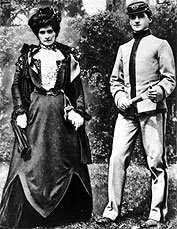
“Overparenting had been around long before Douglas MacArthur’s mom Pinky moved with him to West Point in 1899 and took an apartment near the campus, supposedly so she could watch him with a telescope to be sure he was studying.” (1)
Prior to his acceptance at West Point in 1898, Douglas MacArthur had been rejected twice due to curvature of the spine. Once he was finally accepted, his mom Pinky was not about to let him flunk out. She packed her bags, left her family in San Antonio, Texas (where her husband, also a military man, was stationed), moved across the country, and checked into a hotel suite overlooking the West Point Academy grounds forty miles north of distant New York City. Pinky MacArthur was determined that her son would be a success. (Her middle son had died six years earlier.)
MacArthur did not disappoint his mother. In 1903, he graduated first in his class of 93. Brig. General Douglas MacArthur then went on to become superintendent of West Point in 1922.
U.S. General Douglas MacArthur smoking his corncob pipe
Douglas MacArthur (1880-1964) continued his meteoric rise in service to his country. He fought in three major wars – World War I, World War II, Korean War – and was one of only five men ever to rise to the rank of General of the Army. For his leadership in the defense of the Philippines in World War II, he was awarded the Medal of Honor – a decoration for which he had twice previously been nominated. Allied forces under General MacArthur’s strategic command brought about the surrender of Japan. (3)
To see the full list of MacArthur’s decorations, click here.
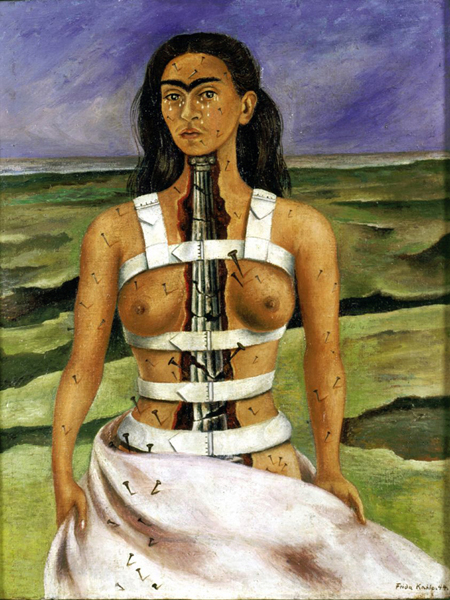
"The Broken Column," by Frida Kahlo (1944). This self-portrait shows the artist's spine as a broken Ionic column. By 1944, Frida's health had deteriorated to such a degree that she had to wear a steel corset to sit up. Her persistent health problems stemmed from childhood polio, a traffic accident, and botched spinal surgeries.
For her entire adult life, artist Frida Kahlo (1907-1954) suffered unbearable pain from her spine and foot. (See “Frida’s First Bad Accident.”) She endured over thirty surgeries to correct the problem (in both Mexico and the U.S), was subjected to batteries of tests, X-rays, and spinal taps, given blood transfusions, physical therapy, and strong medicine . Yet, despite such extreme measures, Frida’s health continued to deteriorate.
After 1944, Frida’s doctors prescribed months of bed rest, encasing her tortured body in a succession of plaster or steel corsets that helped her to sit or stand. Frida described these corsets and the treatments that accompanied them as “punishment.”
“There were twenty-eight corsets in all–one made of steel, three of leather, and the rest of plaster. One…allowed her neither to sit nor to recline. It made her so angry that she took it off, and used a sash to tie her torso to the back of a chair in order to support her spine.
There was a time when she spent three months in a nearly vertical position with sacks of sand attached to her feet to straighten out her spinal column. Another time, Adelina Zendejas, visiting her in the hospital after an operation, found her hanging from steel rings with her feet just able to touch the ground. Her easel was in front of her. “We were horrified,” Zendejas recalls. “She was painting and telling jokes and funny stories….”
Yet another gruesome tale comes from Frida’s friend the pianist Ella Paresce. A Spanish doctor who knew nothing about orthopedics put a plaster corset on Frida….”[D]uring the night, the corset began to harden, as it was supposed to do. I happened to be spending the night there in the next room, and about half past four or five in the morning, I heard a crying, nearly shrieks. I jumped out of the bed and went in, and there was Frida saying she couldn’t breathe!….The corset had hardened…so much that it pressed her lungs. It made pleats all around her body. So I tried to get a doctor. Nobody would pay any attention at that hour…so…I took a razor blade…and made about a two-inch cut [in the cast over her chest] so that she could breathe….[S]he painted the corset, which is still visible in the museum in Coyoacán.” (1)
Diego kisses Frida at the ABC Hospital 1950
In the photo here, Mexican muralist Diego Rivera tenderly kisses his wife Frida Kahlo at the Hospital Ingles ABC in Mexico City, 1950. Frida’s botched spinal fusion of 1946 began the “calvary that would lead to the end,” said her friend Cachucha Miguel N. Lira. Her leg was in constant pain. Four toes on her right foot had turned black; gangrene had set in. An amputation was advised. Frida spent a year in the hospital. In the photo, notice that Frida had painted the Communist symbols, a hammer and sickle on her plaster corset. Visitors also signed Frida’s corsets and decorated them with feathers, mirrors, photographs, pebbles, and ink. When Frida’s doctors removed her paints from her sick room, instead, she used lipstick and iodine to paint her cast. (1)
(1) Herrera, Hayden. Frida: A Biography of Frida Kahlo.New York: HarperCollins Publishers Inc., 1983.
READERS: For more posts on Frida Kahlo, click here.
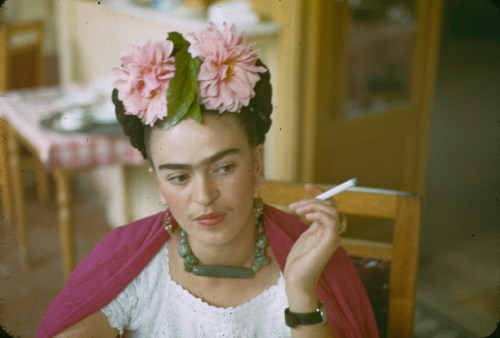
Frida Kahlo, New York, 1939, photo by Nicholas Muray. She sits on a white bench, wearing traditional Mexican clothes in the heavily ornamented and embroidered style that became her signature.
“Frida was often heard to say, ‘I look like a lot of people and a few things,’ as if everything that made up her personal appearance was a matter of chance. In fact, it was quite the opposite. Dressing each day was an almost ceremonial affair during which she would try innumerable combinations of blouses and skirts. Her clothes were always immaculately clean and freshly ironed; she was meticulous about the appearance of her pleated petticoats, pure white and starched. She wore native Mexican costumes long after her sophisticated friends had given up this nationalistic gesture, in part for the long skirts that hid her thin leg [from childhood polio] and orthopedic shoe [from a bus accident]….
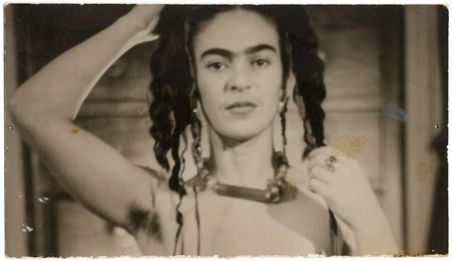
Frida selected her jewelry each day with equal care, especially the rings she wore on the fingers of both hands. She meticulously applied her make-up and painted her fingernails, sometimes purple, green, or orange….Only a little over 5′ 2″ tall, she seemed taller bcause of the heightening effect of her long skirts, accentuated even more by her elegantly long neck and her upswept hairdo with bows and flowers arranged on top of her head. Her olive skin was covered with a light fuzz; her upper lip had a pronounced moustache, which she made obvious in her self-portraits. The heavy dark eyebrows that grew together across her forehead she turned into a trademark….
When she was finally finished dressing, she looked “like a princess, like an empress’….Scrupulously clean and heavily perfumed…” (1)
Frida Kahlo smoking, photo by her friend and lover, Nickolas Muray, ca. 1940
Frida was a heavy smoker and is often photographed holding a lit, unfiltered cigarette. She seldom smiled for the camera – with good reason. The few photos that have caught her laughing reveal blackened teeth.
(1) Zamora, Martha. Frida Kahlo: The Brush of Anguish. San Francisco: Chronicle Books, 1990.
READERS: For more posts on Frida Kahlo, click here.
Mexican artist Frida Kahlo as photographed by New York art dealer, Julien Levy (1938)
“I am not sick. I am broken. But I am happy as long as I can paint.”
To Julien Levy, who prepared Frida Kahlo‘s 1938 New York art exhibition, Frida wrote (in English):
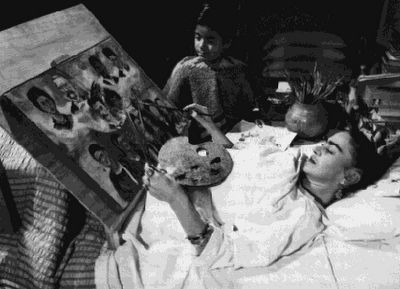
“I never thought of painting until 1926, when I was in bed on account of an automobile accident. I was bored as hell in bed with a plaster cast (I had a fracture in the spine and several in other places), so I decided to do something. I stoled [sic] from my father some oil paints, and my mother ordered for me a special easel because I couldn’t sit down [she means “sit up”], and I started to paint.” (1)
Frida Kahlo paints in bed.
(1) Herrera, Hayden. Frida: A Biography of Frida Kahlo. New York: HarperCollins Publishers, Inc., 1983.
READERS: For more posts on Frida Kahlo, click here.


















 Lisa's History Room