Elvis Presley (1935-1977) in August 1969, the beginning of his Las Vegas concert years
From 1969 to 1977 were Elvis’ concert years. When performing in Las Vegas, he stayed at the International (now Hilton) Hotel, occupying the penthouse suite, room 3000. The suite was located on the 30th floor and stretched across the entire top floor.
Elvis was not alone in this sprawling suite. From the beginning of his stardom, Elvis had been accompanied by a core group of hangers-on that came to be known as the “Memphis Mafia.” By the seventies, Elvis was spending day and night with his party animal buddies, cousins from Memphis and Army buddies whose common bond was service to “the King” and who hung around him for the money, clothes, cars, and leftover girls. What began in the fifties as a group of a few guys following in Elvis’ wake had swelled into a greedy crowd.
As Elvis’ fame spread and his addiction to prescription drugs deepened, Elvis became ever more sealed off from the real world and exceedingly dependent upon the Memphis Mafia. According to Patrick Humphries, these men “acted as Elvis’ bodyguards, babysitters, drug procurers, girl-getters, mates and carbuyers.” Elvis was emotionally unstable and dangerous to himself and others, especially when there were guns lying around.

Elvis after a Las Vegas Concert, with Linda Thompson, March 21, 1976. He would then die of an apparent drug overdose in August, 1977.
Actress, songwriter, and former Miss Tennessee USA Linda Thompson dated Elvis during those days. In an interview with Andrew Hearn, she recounts a frightening incident when Elvis got a little trigger happy:
I’d just happened to have come out of the shower at the Las Vegas Hilton, the presidential suite, and he [Elvis] was lying on the sofa. In those days, they had these huge bull’s eye advertisements. Vegas came alive when Elvis was there and they had these billboards, posters, and placards. So he had one of these enormous bull’s eye things in the suite and he decided that he would just shoot for the target. It was a kind of cardboard cut-out of his name with this bull’s eye…like hit the mark, come see Elvis…whatever. So, Elvis pulled out his gun and shot at the bull’s eye and the bullet went through the wall, which was adjacent to my bathroom. It went through the wall, then through the toilet paper holder, which was metal, out through a mirrored door and shattererd it. I was standing at the sink and I heard ting, ting, and the sound of glass breaking. I felt the air behind my leg. When I looked down, there was a bullet hole in the door behind me. I opened that door and there was another shattered glass door and a bullet lying there.
I knew exactly what was happening. James Caughley came in and said, “Linda, are you okay?” and I said, Yeah, what the ____ was that?” and he said that it was just Elvis having a little target practice.” (1)
These shootings were common occurrences. Elvis had a stockpile of weapons and liked to shoot things. He once shot his car when it wouldn’t start. He shot up small appliances, and, on occasion, large ones. He shot at chandeliers and light switches. But what he became well-known for was shooting at the TV every time the singer Robert Goulet came on a program, as some claim.
Why did Elvis shoot out the TV set when Goulet appeared? Did he hate Goulet as a person or a singer, or both?
 It is believed that Elvis hated Robert Goulet, best known for his portrayal of the dashing Prince Lancelot in the Broadway musical production of “Camelot” in 1960. Some say Elvis despised Robert Goulet because he didn’t sing with feeling. Others blame the bad blood on a letter Elvis received when he was in the Army in Germany (1958-1960). His hometown girlfriend, Anita Wood (see previous post, “The Elvis Sandwich“) had written him a letter, telling her how she was doing. She was, at the time, performing with Buddy Hackett and Robert Goulet. She stupidly allowed Robert Goulet to write a postscript at the bottom of her letter to Elvis in which Goulet told Elvis not to worry about Anita as he was looking after her. Elvis became green with jealousy and was incensed with Goulet. (2)
Or was Elvis resentful of Goulet because Goulet was his rival on the music scene when Elvis returned home from Germany? After all, after Goulet’s triumph in “Camelot,” he was called the next great matinee idol. In 1961, the New York Daily News Magazine called Goulet “just the man to help stamp out rock ‘n’ roll.” Judy Garland described the suave Goulet as a living 8-by-10 glossy. He had blue bedroom eyes, and female fans would toss him their room keys during his concerts.
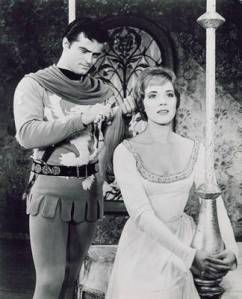
Yet even another possibility exists for Elvis’ dislike of Goulet. On May 25, 1965, Goulet mangled the lyrics to “The Star-Spangled Banner” at the Muhammed Ali-Sonny Liston heavyweight championship fight. He replaced the lyrics “dawn’s early light” with “dawn’s early night” and “gave proof through the night” with “gave proof through the fight.” Although Goulet had been born in Massachusetts, his parentage was French-Canadian, and people were outraged that he didn’t know the words of the United States National Anthem. His gaffe was widely reported and he never lived the incident down.
Robert Goulet (1933-2007) had heard about Elvis shooting out TVs whenever he saw him singing on a television program. Goulet insisted, though, that Elvis bore him no ill will and was actually his friend. He dismissed the assertion that Elvis shot out the TV only when he came on it to sing. He claimed that Elvis shot the TV when other singers like Mel Torme and Frank Sinatra came on. Goulet did not think he was the select target.
On August 14, 2004, right in the middle of Elvis week, Goulet was in Memphis, Tennessee, Elvis’ hometown and the site of Graceland, Elvis’ home, and sat down for an interview with Christopher Blank of the Memphis Commercial Appeal newspaper:
“The 70-year-old entertainer Robert Goulet is in Memphis to play King Arthur in “Camelot” at the Orpheum Theater through Sunday. Since it’s Elvis Week, we asked Goulet about his part in a well-known anecdote about Elvis: The king of rock and roll was known to aim a gun at his television when he saw something there that displeased him.
THE COMMERCIAL APPEAL: And now I’ve got to ask you what my colleagues say is going to be the hardest question.
GOULET: I’m not Jewish. I’m not gay.
CA: No, those are easy.
GOULET: (Laughs.)
CA: You know Memphis is an Elvis town and you factor into a local legend.
 GOULET: When he shot the television set? He also shot 50 other people. They told me that he had about a hundred sets in the basement. And he’d shoot the ___ thing out – you know he was on pills and he didn’t know quite what he was doing and he’d BANG! and they’d look at each other and say, “Get another set!” They mention me all the time. I don’t know why. I remember once we sat together backstage for two hours. And he was a charming, delightful, delightful man. And at one point I said, “That’s a beautiful ring you have there.” He said “You like it?” I said, “It’s beautiful!”
He took it off his hand and put it on mine. He gave me his ring. And years later all the jewelry I had in my house – I trust everybody. I was brought up to believe that you cannot steal, cheat or lie and I’ve been stolen from, cheated or lied to all of my life. And so jewelry – who needs it? But this one was something special to me and it’s gone.
CA: Somebody took it?
GOULET: I hired a guy to take care of my house when I was gone. I’m so naive it’s ridiculous. ‘Cause, you know, when we hire people today we do a background check. I didn’t do that. . . . I was in Dallas doing something and I got a call from LAPD (Los Angeles Police Department). “We have a Stutz Blackhawk, silver, with gold trim with RGG license plate?” I said “You have it? How do you have it?” “Well, we saw this guy going through Watts driving this car with the window open throwing out hundred dollar bills.” He had taken all my jewelry and everything else I had of import and taken my car and driven it down to L.A. But all my good stuff is just gone, finished. It’s all part of dying.
CA: So tell me a little more about the Elvis connection. We write so much about Elvis here. What was your reaction when you heard he’d shot the TV?
GOULET: The point is I knew he was not himself so therefore it wasn’t anything to do with me. He shot out Mel Torme. He shot out Frank. But I get all the credit.”
(2) West, Sonny. Elvis: Still Taking Care of Business. Chicago: Triumph Books, 2007.


 Ike Hoover served in the White House for over forty-two years, ultimately becoming Chief Usher in charge of the day-to-day operations of the presidential mansion.