Feeds:
Posts
Comments

Posts Tagged ‘biographies of women’

Elizabeth Taylor as "Cleopatra" (1963)

Elizabeth Taylor as Queen of the Nile in "Cleopatra" (1963)

There’s a delicious new Elizabeth Taylor biography on the market: How to Be a Movie Star: Elizabeth Taylor in Hollywood by William Mann. I’ve been reading juicy excerpts online. The book is so good, so rich in scandalous detail, that I’ve ordered a copy to be sent to my doorstep.

I’m devouring the chapter on the early 1962 filming of “Cleopatra,” when Elizabeth famously ditches husband #4 Eddie Fisher for her Welsh costar Richard Burton. Author Mann paints Elizabeth Taylor as quite the pampered diva, ensconced in her Italian villa, filming in Rome by day. Her butler, for example, was one of many charged with satisfying her every frivolous need.

An example: Elizabeth was a pack-a-day smoker – despite the fact that she was recovering from pneumonia and a tracheotomy that had seriously delayed the movie’s production and almost cost Elizabeth her life. Nevertheless, she smoked, and with a cigarette holder. She never used the same holder twice.

“Fresh ones – at least ten a day –  had to be at the ready, and they had to be color-coded. A green dress called for a matching holder – and Madame changed outfits quite frequently as her moods shifted. Every morning Oates [her butler] prepared a box of cigarette holders based on what Elizabeth would be wearing that day and evening, and not only did the holders have to match her outfits, they couldn’t clash with the tablecloth.” (1) 

Richard Burton as Mark Antony with Elizabeth Taylor as Queen of the Nile in "Cleopatra" (1963)

Richard Burton as Marc Antony with Elizabeth Taylor in "Cleopatra" (1963)

But Richard Burton wasn’t dazzled by Liz’s Hollywood fame. Twentieth Century Fox was paying her $1 million to play the Queen of the Nile in their production. Elizabeth Taylor was the highest-paid actress of the day – but Richard Burton called her “Lumpy” – and to her face. She was intrigued by his dismissive attitude toward him.

Burton was a heavy drinker.  In his first big scene with Taylor, he appeared on the set with a terrible hangover. Elizabeth, although the mother of 3 children at the time, with an adoption of a fourth child in the works, had never been particularly maternal. Yet when she saw how sick Burton was, she felt an overwhelming need to take care of him. It was the turning point. They began a hot-and-heavy and very public romance.

Rumors seeped out and crossed the Atlantic, creeping into gossip columns by Hedda Hopper and Dorothy Kilgallen, scandalizing the film industry and the public who were just recovering from Liz’s latest romantic acquisition, when she stole the married Eddie Fisher from actress wife Debbie Reynolds.

In early 1958, Fisher embraces wife Reynolds in Las Vegas, though his eye seems to be on Taylor, his best friend Mike Todd's wife. In March, Todd dies in a plane crash, and Fisher soon leaves Reynolds for Taylor.

In early 1958, Fisher embraces wife Reynolds in Las Vegas, though his eye seems to be on Taylor, his best friend Mike Todd's wife. In March, Todd dies in a plane crash, and Fisher soon leaves Reynolds for Taylor.

Meanwhile, back on the “Cleopatra” set, Eddie Fisher learned of his wife’s affair. Their marriage had already been on shaky ground but was not yet in complete tatters. He wanted to salvage it. On February 5, at the suggestion of his  wife’s secretary, he took Elizabeth shopping. He chartered a flight to Paris. The international press followed their every move, as the former nightclub crooner Fisher and his gorgeous celebrity wife visited Parisian fashion houses such as Yves St. Laurent, Chanel, and Dior, where Eddie wrote check after check for gowns, jewels, and furs for his flagrantly unfaithful wife. Eddie Fisher once said,

“To keep Elizabeth happy, you have to give her a diamond before breakfast every morning.”

Delighted with her new trinkets, Elizabeth promised Fisher she would stop seeing Burton. A rupture was temporarily averted; they flew back to Rome.

Two weeks passed yet things did not go better for Fisher. Liz did not keep her word. She continued seeing Burton. On February 17, 1960, drinking heavily, Elizabeth swallowed 14 sleeping pills and passed out cold.  She was hospitalized for what was considered a suicide attempt. She was distraught over her personal life. She could not make the break with Burton. She had fallen head-over-heels in love with him.

A little over a week later, she turned thirty, and her parents flew to Rome for the celebration. Shortly afterward, Burton confronted her in front of Fisher and told her she must choose between her two men. On the spot, she chose Burton. Richard divorced his wife of 13 years, Sybil Burton. In 1964, Elizabeth divorced Fisher and married Richard Burton.

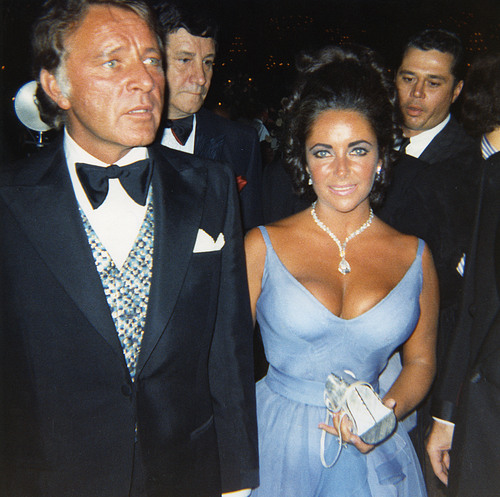
Richard Burton escorts wife Elizabeth Taylor in an Edith Head evening gown, 1970
Richard Burton escorts wife Elizabeth Taylor to the 1970 Oscars. Taylor wears an Edith Head gown that matches her violet eyes and displays her assets, particularly her own 69-carat, pear-shaped Cartier diamond — which later became known as the Taylor-Burton diamond.

Twice married, twice divorced to one another, the love affair between Elizabeth Taylor and Richard Burton remains one of the most famous – and tempestuous – of the Twentieth Century.

(1) Mann, William J. How to Be a Movie Star: Elizabeth Taylor in Hollywood. New York: Houghton Mifflin Harcourt, 2009.

Read Full Post »

The Obama Family, the first official White House portrait shot by photographer Annie Leibovitz, Sept. 1, 2009

The Obama Family, the first official White House portrait shot by photographer Annie Leibovitz, Sept. 1, 2009

The White House has released the first official – and wonderful! – family portrait of President Barack Obama and his family. The photograph, taken by famed celebrity photographer Annie Leibovitz, was shot in the Green Room of the White House on September 1, 2009. It shows a happy First Family, from left to right, the President, his younger daughter Natasha (Sasha), wife Michelle, and older daughter Malia Ann.

The Lovely Michelle Obama

The Lovely Michelle Obama

For those of you who can’t get enough of Michelle Obama’s fashion sense, visit the blog “Mrs. O.”

Read Full Post »

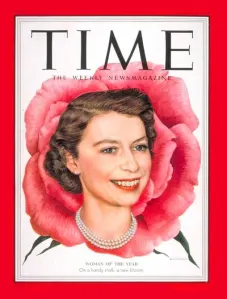
TIME magazine's 1952 Woman of the Year: Queen Elizabeth II of England (Jan. 5, 1953 cover)

TIME magazine's 1952 Woman of the Year: Queen Elizabeth II of England (Jan. 5, 1953 cover)

In February 1952, Princess Elizabeth was touring Kenya with her husband Prince Philip, the Duke of Edinburgh when she received the bad news that her father, King George VI of Great Britain, had passed away. Thus, at the tender age of 25, Elizabeth ascended the throne to become Queen of the United Kingdom, Canada, Australia, New Zealand, South Africa, Pakistan, and Ceylon. She took the title Queen Elizabeth II although she was not a descendant of Queen Elizabeth I (1533-1603), who was the last Tudor queen. Queen Elizabeth II belongs to the Royal House of Windsor, formerly known as Saxe-Coburg and Gotha.

During the Queen’s reign, there have been 11 U.S. presidents. Queen Elizabeth II has met every one of them except Lyndon B. Johnson. She met Harry Truman before she became queen and Herbert Hoover when he was a former president.

Here is a photo gallery of Queen Elizabeth II and 12 U.S. Presidents:

The Queen with President Barack Obama in 2009

The Queen with President Barack Obama in 2009

The Queen with President George W. Bush in 2003

The Queen with President George W. Bush in 2003

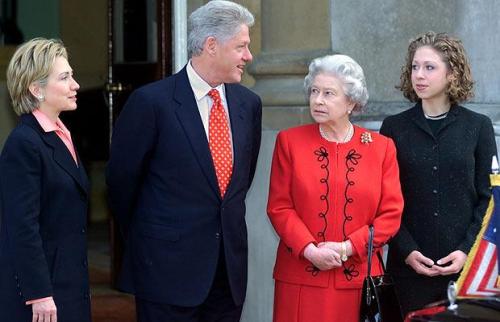
The Queen with President Bill Clinton in 2000

The Queen with President Bill Clinton in 2000

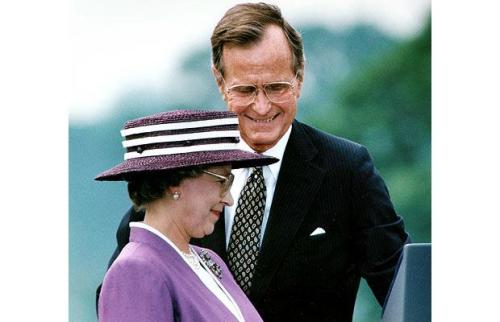
The Queen with President George H. Bush in 1991

The Queen with President George H. Bush in 1991

The Queen with President Ronald Reagan in 1982

The Queen with President Ronald Reagan in 1982

The Queen with President Jimmy Carter in 1977

The Queen with President Jimmy Carter in 1977

The Queen with President Gerald Ford in 1976

The Queen with President Gerald Ford in 1976

The Queen with President Nixon 1970

The Queen with President Richard Nixon in 1970

The Queen and Prince Philip with President John and Jackie Kennedy (early 1960s)

The Queen with President John F. Kennedy in 1961

The Queen with former President Herbert Hoover in 1957

The Queen with former President Herbert Hoover in 1957

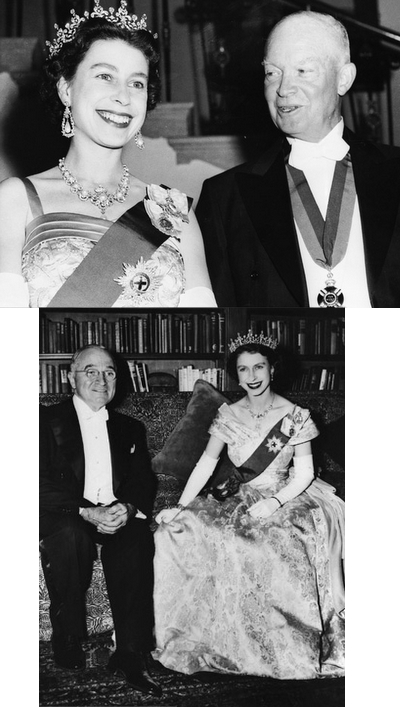
The Queen with Presidents Dwight Eisenhower (top) and Harry Truman (1950s)

The Queen with Presidents Dwight D. Eisenhower (top) in 1957 and Harry Truman (bottom) in 1951

Readers, for more on the Queen, scroll down the right sidebar to “Categories” – “People” – “Queen Elizabeth II”

Read Full Post »

i-love-lucy-fourth-seasonReaders: Read the two previous posts before continuing:

 “I Love Lucy: Lucy Meets Bill Holden, Part 1”

“I Love Lucy: Lucy Meets Bill Holden, Part 2”

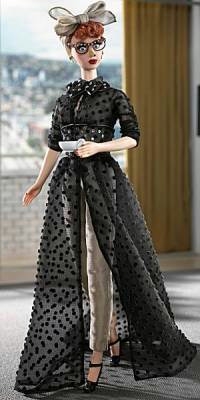
Doll maker Mattel has immortalized some of Lucy’s most famous roles by creating a line of collector Barbies. Mattel no longer makes the dolls but they are widely available for sale. One of the most popular dolls is the one shown below.

Lucy "L.A. at Last" Barbie doll by Mattel.

"I Love Lucy Barbie doll by Mattel: "L.A. at Last"

“Hooray for Hollywood! At least that’s what Lucy thinks in the episode L.A. at Last™. But after a disastrous encounter with William Holden at the famed Brown Derby Restaurant, she’s not so sure. Especially when Ricky invites Holden up to their hotel room to meet his biggest fan, Lucy. Mortified by her previous encounter, Lucy runs to the bedroom and disguises herself with glasses, scarf, and an oversized putty nose, which she manages to catch on fire, and then comically extinguishes in a cup of coffee! Lucy wears an authentic re-creation of the episode’s costume, which includes a black chiffon coatdress with black dots over a tan jumpsuit. Silvery dots adorn her waistband and a large bow at the collar to coordinate with her dangling earrings. She has rooted eyelashes underneath tortoiseshell glasses that rest on an over-sized, protruding nose. Curls of her signature-red hair peek out from the tan kerchief that completes her disguise.” (Mattel)

Read Full Post »

Lucy Ricardo eyes Bill Holden at the Brown Derby in the "I Love Lucy" episode, "L.A. at Last!"

Lucy Ricardo eyes Bill Holden at the Brown Derby in the "I Love Lucy" episode, "L.A. at Last!"

*Readers: If you haven’t already done so, read “I Love Lucy: Lucy Meets Bill Holden, Part 1” before continuing. 

In my last post, I revealed that my absolute favorite “I Love Lucy” episode is

 “L.A. at Last!”

and showed you a video of the first half, the famous scene when Lucy and the Mertzes spy actor Bill Holden in the Brown Derby.

 The second half of the show takes place in Lucy and Ricky‘s Hollywood hotel room.

Click here to continue with “I Love Lucy: Lucy Meets Bill Holden, Part 3”


Read Full Post »

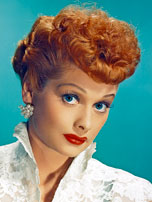
Lucy Ricardo from the popular, long-running, 1950s television comedy "I  Love Lucy"

Zany Lucy Ricardo (played by Lucille Ball) from the immensely popular, long-running, classic 1950s television comedy "I Love Lucy"

Everybody has a favorite “I Love Lucy” episode and this is mine:

“L.A. at Last!”*

Lucy’s husband Ricky Ricardo is filming a picture out in L.A. and has taken Lucy and the Mertzes out to California with him. This scene opens with Lucy, Fred, and Ethel out star hunting. They are having lunch at the Brown Derby, a popular haunt for Hollywood movie stars.

As the three await their meal, Ethel mouth drops open. She is astonished to discover heartthrob William Holden being seated at the next booth. A video excerpt from “L.A. at Last!” is posted at the bottom of this post. When you view it, notice that Bill Holden asks the waiter to bring him a Cobb Salad. The Cobb Salad – now famous – was invented by the owner of the Brown Derby.

The original Brown Derby at 9537 Wilshire Boulevard. It was a landmark restaurant in Los Angeles, which was frequented by celebrities during the Golden Age of Hollywood. It was an example of novelty architecture, known for being physically shaped like a brown derby hat, for being the birthplace of the Cobb salad (which was named for the Cobbs, the owners of the Derby), and the home of hundreds of caricatures of celebrities.

The original Brown Derby at 9537 Wilshire Boulevard was a landmark restaurant in Los Angeles, which was frequented by celebrities during the Golden Age of Hollywood. It was an example of novelty architecture, known for being physically shaped like a brown derby hat and for being the birthplace of the Cobb salad (which was named for the Cobbs, the owners of the Derby), and the home of hundreds of caricatures of celebrities.

Audrey Hepburn and William Holden from "Sabrina," 1954.

Audrey Hepburn and William Holden from "Sabrina," 1954. The next year, "Bill" Holden makes a guest appearance on the "I Love Lucy" show. This episode, "L.A. at Last!" still in reruns, is one of the all-time favorites. At the time of the filming, Bill Holden was filming "The Country Girl" with Grace Kelly.

Now enjoy 6 minutes of Lucille Ball’s comic genius. 

Now, for part 2, click here:

 “I Love Lucy: Lucy Meets Bill Holden, Part 2”


“I Love Lucy” Episode 114 – Filmed 12/2/54; aired 2/7/55

Read Full Post »

The Duchess of Windsor filled her empty life by buying expensive clothes and getting the Duke to buy her costly jewels. She was always immaculately dressed and never casual. In 1935, she made the Paris Couture best-dressed list and remained there for 40 years.

Wallis, the Duchess of Windsor (1896-1986), is remembered for her stylishness. She filled her empty life by buying expensive clothes from the big Paris fashion houses like Chanel and getting the Duke to buy her costly jewels from Cartier. The Duchess of Windsor was always immaculately dressed and never casual. In 1935, she made the Paris Couture best-dressed list and remained there for 40 years.

In my previous post, “Coco Chanel, Nazi Lovers, and the Windsor Set,” I described the wave of attention the Duke and Duchess of Windsor received when they settled in Paris in the late thirties. A glamorous social set of fashion designers, Nazi sympathizers, American heiresses, British ex-pats, and assorted other idle rich people welcomed the Windsors and became a sort of parallel court for the displaced royals. This French upper-crust group was dubbed “the Windsor Set.” The press buzzed about them like bees around a hive. All  their comings and goings, designer clothes, fancy homes, and elegant soirees were endlessly photographed and reported in the society columns of the day.

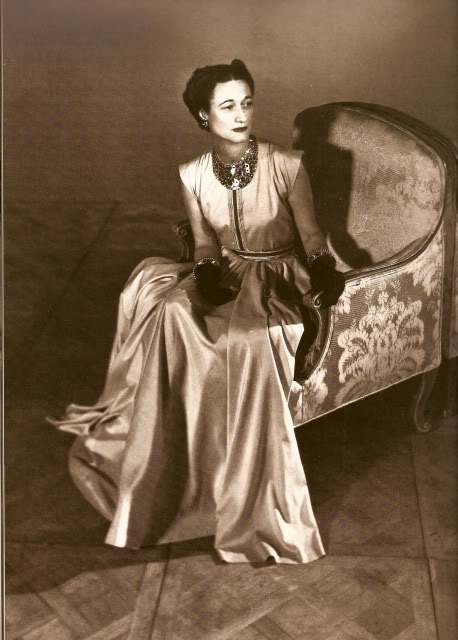
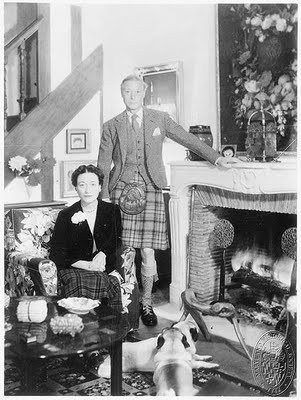
The Duchess and Duke of Windsor at hone

The Duchess and Duke of Windsor at home

At the center of this new social whirl was the Duchess of Windsor. She had never gotten over being snubbed by the British Royal Family and being barred from getting the attention she felt she and the Duke deserved.

Wallis had always been obsessed with her appearance. She knew she wasn’t a great beauty, having once said,

” Nobody ever called me beautiful, or even pretty.”

What she lacked in looks, she made up for in other ways. She selected simple, well-tailored clothes that accented her slim, almost boyish figure. Against this plain backdrop, she dripped with sometimes enormous jewels, sometimes mixing real gems with costume pieces, the real things being given to her by the Duke. Her taste ran to big colorful stones and yellow gold. She amassed a huge collection of jewelry which was sold at auction in 1987 for a record-shattering $50 million. “An 18-karat-gold cigarette case from Cartier—engraved with a map of Europe and set with 37 gems to mark the couple’s premarital holidays—sold for more than $290,000; Elizabeth Taylor phoned in a bid of $623,000 and snagged a diamond brooch.”

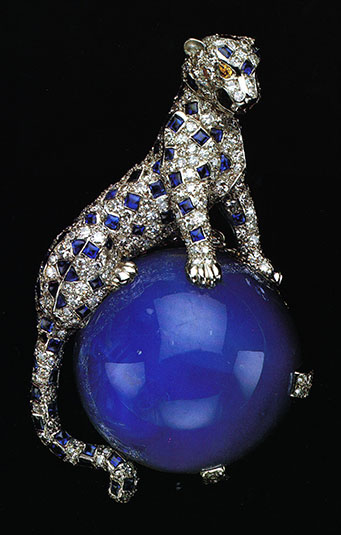
In 1949, the Duchess of Windsor acquired this diamond and sapphire panther pin from Cartier. The panther is crouched in a life like pose on a large perfect round cabochon star sapphire weighing 152.35 carats. This panther pin was one of the Duchess' favorite pieces which she frequently wore. It created an envy among other jewelry collectors and a demand for Cartier to produce more panther pieces. Today, the panther is a Cartier icon. The Duchess of Windsor's animal pieces became her signature.

In 1949, the Duchess of Windsor acquired this diamond and sapphire panther pin from Cartier. The panther is crouched in a life like pose on a large perfect round cabochon star sapphire weighing 152.35 carats. This panther pin was one of the Duchess' favorite pieces which she frequently wore. It created an envy among other jewelry collectors and a demand for Cartier to produce more panther pieces. Today, the panther is a Cartier icon. The Duchess of Windsor's animal pieces became her signature.

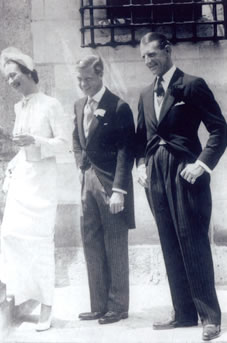
Wallis and Edward with best man Edward "Fruity" Metcalf at their royal wedding, June 3, 1937, at the Chateau de Cande, Mont, France

Wallis and Edward with best man Edward "Fruity" Metcalfe at their royal wedding, June 3, 1937, at the Chateau de Candé, Mont, France

Necklaces, bracelets, lapel pins – she had them all. The only gap in her jewelry collection was rings. The Duchess hated her hands. She thought they were big and ugly. (Notice the black gloves in the first photo above). Acclaimed British photographer Cecil Beaton photographed the Windsors many times. He took their wedding photos at the Chateau de Candé. Beaton remembered of that session that Wallis

“twisted and twirled her rugged hands. She laughed a square laugh, protruded her lower lip. Her eyes were excessively bright, slightly froglike, also wistful.”


Read Full Post »

Wallis Warfield marries the former King Edward VIII of Britain on June 3, 1937, in France. The day before the wedding, the Prince's brother, the new British king, George VI, sent him a letter granting him and Wallis new titles: the Duke and Duchess of Windsor. The titles were hollow; there was no dominion of Windsor to rule. Even worse: the King's letter contained a bomb - the Prince, despite his abdication of the throne, could continue to "hold and enjoy...the title, style or attribute of Royal Highness," but his bride, the Duchess, could not, nor could any of their offspring. She, though a duchess, was denied what her sister-in-laws would enjoy - that her name would be preceded by the magic initials 'H.R.H.' "What a damnable wedding present!" Windsor shouted. (J.Bryan III and Charles J.V. Murphy,

Wallis Warfield (Simpson) marries the former King Edward VIII of Britain on June 3, 1937, in France, after he gave up the British throne to be with her. Wallis Warfield Simpson was an American divorcee. For the King to have married her and tried to install her as his Queen would have precipitated a constitutional crisis in Great Britain....The wedding day dawned bright and sunny. It was Wallis' third wedding; her dress was not white but blue. Blue was also the mood. The day before the wedding, the former king's brother, the new British king, George VI, sent Edward a letter granting him and Wallis new titles: the Duke and Duchess of Windsor. The titles were hollow; there was no dominion of Windsor to rule. Even worse: the King's letter contained a bomb - the former king, now titled the Duke, despite his abdication of the throne, could continue to "hold and enjoy...the title, style or attribute of Royal Highness," but his bride, the Duchess, could not, nor could any of their offspring. She, though a duchess, was denied what her sister-in-laws would enjoy - that her name would be preceded by the magic initials 'H.R.H.' At her entrance, no women had to curtsey, no men to bow. She would not be referred to as "Her Highness" but with the lower form of "Her Grace." "What a damnable wedding present!" Windsor shouted upon reading the King's letter. (Bryan III, J. and Murphy, Charles J.V., The Windsor Story. New York: Dell, 1979.)

In 1937, after King Edward VIII had given up the British throne to marry his American divorcee, Wallis Warfield Simpson, the two tiny, trim party animals were exiled to France, where they were doomed to live a life of idle nothingness. They were given the new but hollow titles of the Duke and Duchess of Windsor. Accustomed to a lifetime of adulation and privilege yet denied a kingdom, the Duke (and the Duchess), set about creating an imaginary realm of their own that would given them the validation they craved as royals. This new kingdom:

“…was a region whose borders were outlined in society pages, peopled mostly by glamorous nobodies lucky enough to have been born into wealth. It was an ornamental place, whose citizens, according to Andrew Bolton, the curator of ”Blithe Spirit” [a past costume exhibit at the Metropolitan Museum], were unsurpassed ”in the beauty, elegance and craftsmanship” of their dress. For self-indulgence, they were also hard to beat.”

The people who congregated around the Duke and Duchess were dubbed the “Windsor set.” They were all-consumed with the photographic image.

“They arranged those lives to suit the lens. Voluntarily estranged from the real aristocracy, the Duke of Windsor, with the aid of his wife, the former Wallis Warfield Simpson, set up a parallel court composed of people like Elsie de Wolfe, the interior decorator and social arbiter; Mona Bismarck, a gorgeous adventuress who was the daughter of a stableman on a Kentucky horse farm; and Daisy Fellowes, whose fortune derived from sewing machines and who had the distinction of being one of the first people on record to alter her nose surgically.”

the Duke and Duchess of Windsor at home with their precious pug dogs. The Duchess, the former Wallis Warfield Simpson, often appeared in her stylish best in public with a pug tucked under one arm. It became a fashion trend - to carry a dog around with you when away from home.

the Duke and Duchess of Windsor at home with their precious pug dogs. The Duchess, the former Wallis Warfield Simpson, often appeared in her stylish best in public with a pug tucked under one arm. It became a fashion trend - to carry a dog around with you when away from home.

Granted, the Windsors were despicable people, dining with Adolf Hitler in 1937 and hobnobbing with fellow Nazi sympathizers and British ex-pats Oswald Mosley and wife Diana Mitford. Nevertheless, the Duke and Duchess – and their fancy friends – obsessed with clothing,  had tremendous style.

Adolf Hitler kisses the hand of the Duchess of Windsor as her husband the Duke looks on, admiringly. The Duke and Duchess of Windsor visited Germany in 1937 before WWII broke out across Europe. They were outspoken supporters of Nazi fascism and suspected of spying for Germany. At the beginning of the war, the Windsors were whisked out of France to safe haven in the Bahamas, where the Duke served out the war years as governor. There he could do Britain little harm - and he was less likely of being kidnapped by the Germans who were reportedly interested in installing him as a puppet king in a conquered Great Britain under German rule.

Adolf Hitler kisses the hand of the Duchess of Windsor as her husband the Duke looks on, admiringly. The Duke and Duchess of Windsor visited Germany in 1937 before WWII broke out across Europe. They were outspoken supporters of Nazi fascism and suspected of spying for Germany. At the beginning of the war, the Windsors were whisked out of France to safe haven in the Bahamas, where the Duke served out the war years as governor. There he could do Britain little harm - and he was less likely of being kidnapped by the Germans who were reportedly interested in installing him as a puppet king in a conquered Great Britain under German rule.

Fashion designer Gabrielle "Coco" Chanel (French, 1883-1971) at Lido Beach in 1936

Fashion designer Gabrielle "Coco" Chanel (French, 1883-1971) at Lido Beach in 1936

"Evening Dress," 1938. Gabrielle ("Coco") Chanel. Black Silk Net with Polychrome Sequins. The Metropolitan Museum of ARt, New York. Special Exhibit: "Blithe Spirit: The Windsor Set" The decoration of sequined fireworks on this evening dress, which was worn by the Countess Madeleine de Montgomery to Lady Mendl's seventy-fifth birthday party in 1939, is a fitting climax to le beau monde of the 1930s. It was the end of an era when, on Sept. 1, 1939, Parisians heard an early-morning radio announcemen from Herr Hitler in German, at once translated into French, that "as of this moment, we are at war with Poland." The thirties were over; the Second World War had begun.

"Evening Dress," 1938. Gabrielle ("Coco") Chanel. Black Silk Net with Polychrome Sequins. The Metropolitan Museum of Art, New York. Special Exhibit: "Blithe Spirit: The Windsor Set" The decoration of sequined fireworks on this evening dress, which was worn by the Countess Madeleine de Montgomery to Lady Mendl's seventy-fifth birthday party in 1939, is a fitting climax to le beau monde of the 1930s. It was the end of an era when, on Sept. 1, 1939, Parisians heard an early-morning radio announcement from Herr Hitler in German, at once translated into French, that "as of this moment, we are at war with Poland." The thirties were over; the Second World War had begun.

The Windsors were famous for their elegant Paris dinner parties, creating a demand for expensive clothes and jewels for them and their guests. Thus, the prewar years in France from 1935-1940 were rich in the decorative arts, putting trendy fashion designers front and center. It was a time when Gabrielle “Coco” Chanel was “rethinking the suit” to allow for the way women really move and Elsa Schiaparelli* was designing lobster dresses with surrealist Salvador Dali.*

Then Hitler invaded Poland and World War II shattered the fantasy world of endless cocktail parties and silk and organza gowns made to order. The Germans invaded and occupied France.

Shockingly, Coco Chanel spent the war years living at the Ritz in Paris with a Nazi officer. After the war was over, Chanel was arrested by the free French for suspicion of collaborating with the Nazis. She purportedly offered this explanation for sleeping with the enemy:

 “Really, sir, a woman of my age cannot be expected to look at his passport if she has a chance of a lover.”

It is generally believed that Winston Churchill  intervened with the French government, convincing them to let his old friend Coco Chanel escape to Switzerland rather than be paraded through the streets of Paris with her head shaved like other female Nazi collaborators.

Women accused of being Nazi collaborators are humiliated after the liberation of France, 1944. © Hulton-Deutsch Collection/Corbis

Women accused of being Nazi collaborators are humiliated after the liberation of France, 1944. © Hulton-Deutsch Collection/Corbis

Jackie Kennedy in her pink Chanel suit and pillbox hat, riding through Dallas in a motorcade just minutes before a sniper kills her husband, President John F. Kennedy

Fast forward 19 years. It's November 22, 1963. Jackie Kennedy,* in her pink Chanel suit and pillbox hat, is riding through Dallas in a motorcade just minutes before a sniper kills her husband, President John F. Kennedy

*For more on the Kennedys on this blog, please see right sidebar – Categories – People  – the Kennedys.
See “Wallis, the Duchess of Windsor,” which follows this blog post.

Read Full Post »

Mackenzie Phillips says she had sex with her dad

The Mamas and the Papas, from left to right: Michelle Phillips, John Phillips (in tube), Denny Doherty, and Mama Cass Elliot. The sixties pop rock band is remembered for its sweet harmony and enchanting melodies.
Father and Daughter, John and MacKenzie Phillips, in 1998.

Father and Daughter, John and MacKenzie Phillips, in 1998.

Associated Press

Wed Sep 23, 12:37 pm ET

CHICAGO – Former child star Mackenzie Phillips said Wednesday her father, John Phillips, who was a leader of the 1960s pop group the Mamas and the Papas, raped her when she was a teenager and that her sexual relationship with him later became what she termed “consensual.”

Mackenzie Phillips writes in her new book, High on Arrival, that she had sex with her father on the night before she was to get married in 1979 at age 19, according to People magazine.

“On the eve of my wedding, my father showed up, determined to stop it,” writes Phillips, who was 19 and a heavy drug user at the time. “I had tons of pills, and Dad had tons of everything too. Eventually I passed out on Dad’s bed.”

“My father was not a man with boundaries. He was full of love, and he was sick with drugs. I woke up that night from a blackout to find myself having sex with my own father.”

She told “The Oprah Winfrey Show” in an interview that aired Wednesday that her siblings “definitely have a problem with this.” Winfrey also read a statement from Genevieve Waite, John Phillips’ wife at the time of the alleged abuse and Mackenzie’s stepmother that said he was “incapable, no matter how drunk or drugged he was, of having such a relationship with his own child.”

At far right, MacKenzie Phillips from a publicity photo for the 80s TV sitcom, "One Day at a Time." MacKenzie Phillips is best known for her roles as an emotionally troubled and rebellious teenager.

At far right, MacKenzie Phillips from a publicity photo for the 80s TV sitcom, “One Day at a Time.” MacKenzie Phillips is best known for her roles as an emotionally troubled and rebellious teenager.

Phillips, who starred on TV’s “One Day at a Time,” said the sexual relationship with her father lasted a decade and ended when she became pregnant and didn’t know who had fathered the child. She had an abortion, which her father paid for, and “and I never let him touch me again.”

Phillips told Winfrey that she first tried cocaine when she was 11 years old. Her father did drugs with her, taught her to roll joints and injected her with cocaine. Phillips said she’s been clean for a year after pleading guilty to possessing cocaine and entering a drug treatment program.

Phillips said the sexual relationship, although she believes it became consensual, was “an abuse of power” and “a betrayal” on her father’s part. She said she forgave John Phillips on his deathbed.

“I can’t be the only one this has happened to,” Phillips said. “Someone needs to put a face on consensual incest.”

Here is a video of the Mamas and the Papas singing “California Dreaming.” MacKenzie Phillips’ father, John Phillips – “Papa John” –  plays guitar, wearing a fur hat. The other band members are Michelle Phillips (at the time, John Phillips’ wife and MacKenzie’s stepmother), Mama Cass Elliot, and Denny Doherty.

 Click here for more on the wild and reckless lives of John and Michelle Phillips.

Read Full Post »

American Royalty: President John and Jackie Kennedy stroll the White House grounds.

American Royalty: President John and Jackie Kennedy stroll the White House grounds.

It was a star-studded event. It was Saturday, May 19, 1962, and the young, dashing, and popular U.S. President John F. Kennedy was turning 45. The Democratic Party held a huge fundraiser at New York’s Madison Square Garden. The birthday salute was televised before a national audience and 15,000 people had paid for seats to catch the show live at the Garden. The cream of American show business turned out to pay homage to Kennedy – Ella Fitzgerald, Peggy Lee, Jack Benny, Henry Fonda, Harry Belafonte. Greek opera diva Maria Callas was also there. Actor Peter Lawford, the president’s brother-in-law, served as master-of-ceremonies. But the pièce de résistance – the showstopper – was the performer who sang the finale – sexpot and film star Marilyn Monroe.

First Lady Jackie Kennedy riding horses with her children at their Middleburg, Virginia, retreat "Glen Ora." Jackie grew up surrounded by horses and was an accomplished equestrian. President John Kennedy did not share her passion for horse shows and riding. He was allergic to horse fur. November 19, 1962.

First Lady Jackie Kennedy riding horses with her children at their Middleburg, Virginia, retreat “Glen Ora.” Jackie grew up surrounded by horses and was an accomplished equestrian. President John Kennedy did not share her passion for horse shows and riding. He was allergic to horse hair. November 19, 1962.

It seemed that everyone was there – except the honoree’s wife – Jackie Kennedy. The president attended the ceremony without the First Lady at his side. When Jackie had learned that Marilyn was to be performing at the benefit, she decided she was not about to attend. She instead became a last-minute participant in the Loudoun Hunt Horse Show at Glen Ora, her weekend home.  Jackie knew that her husband and Marilyn Monroe were lovers – and Jackie was not about to have her nose rubbed into it in front of a national audience.

Marilyn Monroe (1926-1962) was wild for Jack Kennedy. She accepted the invitation to appear in New York in violation of her contract with Twentieth-Century Fox – and their relationship was already at its breaking point. Production on her latest film, “Something’s Got to Give,” had been on start/stop for months due to Marilyn’s chronic tardiness and absence.  Marilyn was in a narcotics and booze nosedive and living on impulse. She was in hot pursuit of Jack Kennedy and nothing would get in her way. She was scheduled to sing “Happy Birthday” to the president.

Marilyn Monroe in "Gentleman Prefer Blondes" (1963)

Marilyn Monroe in “Gentleman Prefer Blondes” (1953)

“A manic energy propelled her….” wrote Barbara Leaming in Marilyn Monroe:

“All weekend, the white-carpeted, unfurnished rooms at Fifth Helena echoed with Marilyn’s whispery voice. She lay in the tub singing “Happy Birthday.” She sat on the living room floor, endlessly tape recording and listening to herself….” (1)

Then, ignoring the studio’s stern warning, Marilyn flew from Hollywood to New York with Peter Lawford, singing on the airplane. She continued to practice once in her New York apartment. Those who listened said her interpretation grew sexier, more and more outrageous. Friend Paula Strasberg warned that it verged on self-parody.

Finally, the night of the performance arrived. Backstage, Marilyn got into her costume – a flesh-toned slip of a dress by Jean-Louis sewn with 2500 rhinestones. The gown was so snug Marilyn had to be sewn into it. Paralyzed with stage fright, Marilyn kept ignoring her cue to appear on stage. She hung back, drowning her fears in alcohol, before Milt Ebbins shoved her onto the stage.

“She walked like a geisha….” (1)

“The figure was famous and, for one breathless moment, the 15,000 people in Madison Square Garden thought they were going to see all of it. Onto the stage sashayed Marilyn Monroe, attired in a great bundle of white mink. Arriving at the lectern, she turned and swept the furs from her shoulders. A slight gasp rose from the audience before it was realized that she was really wearing a skintight flesh-toned gown.” (2)

Marilyn Monroe at the microphone singing "Happy Birthday, Mr. President," at President John F. Kennedy's birthday bash, May 19, 1962.

Marilyn Monroe at the microphone singing “Happy Birthday, Mr. President,” at President John F. Kennedy’s birthday bash, May 19, 1962.

When she came down in that flesh-colored dress, without any underwear on…” said Hugh Sidey of Time, “you could just smell lust. I mean, Kennedy went limp or something. We all were just stunned to see this woman.”

“What an ass…what an ass,” whispered Kennedy.

“Happy…Birthday…to you,” Marilyn began to sing [whisper]. (3)

Her rendition of “Happy Birthday, Mister President” – was soft, seductive, and pathetic. The 35-year-old Marilyn was high as a kite (and wearing a wig that was slipping). Columnist Dorothy Kilgallen called it nothing less than:

 “…making love to the President in the direct view of forty million Americans.”

President John F. Kennedy speaks to the audience at Madison Square Garden at his 45th birthday bash, May 19, 1962.

President John F. Kennedy speaks to the audience at Madison Square Garden at his 45th birthday bash, May 19, 1962.

At the end of the performance, a noticeably-embarrassed President Kennedy took to the stage and announced disingenuously:

“I can now retire from politics after having had Happy Birthday sung to me in such a sweet wholesome way.”  (2)

At an after-party, a photographer caught President Kennedy and brother Robert Kennedy hovering over Marilyn in the library, still wearing the see-through dress Marilyn called “skin and beads.” 

Bobby Kennedy, Marilyn Monroe, and President John Kennedy gather following Monroe's iconic performance of "Happy Birthday, Mr. President," at Madison Square Garden, May 19, 1962. Marilyn is still wearing the gown she wore in the performance which she referred to as "skin and beads."

Bobby Kennedy, Marilyn Monroe, and President John Kennedy gather following Monroe’s iconic performance of “Happy Birthday, Mr. President,” at Madison Square Garden, May 19, 1962. Marilyn is still wearing the gown she wore in the performance which she referred to as “skin and beads.” The auction house Christie’s later sold this dress for $1.2 million, the most money ever paid for a dress.

Kennedy’s Ambassador to the United Nations, Adlai Stevenson, was at the party and saw Marilyn’s “skin and beads” dress. He later wrote to Mary Lasker:

“I didn’t see the beads!”

Greek opera diva Maria Callas laughs it up with Marilyn Monroe at President Kennedy's 45th birthday bash at Madison Square Garden, May 19, 1962. Marilyn Monroe was President Kennedy's lover. Maria Callas was the off-and-on lover of Aristotle Onassis, Jackie Kennedy's 2nd husband.

Greek opera diva Maria Callas (1923-1977) laughs it up with blonde bombshell Marilyn Monroe at President Kennedy’s 45th birthday bash at Madison Square Garden, May 19, 1962. First Lady Jackie Kennedy did not attend the celebration. Marilyn Monroe was President Kennedy’s lover when Jackie was Mrs. Kennedy. Maria Callas was the clandestine lover of Aristotle Onassis when Jackie was Mrs. Onassis.

Jackie Kennedy watched Marilyn’s performance on TV the next day. She was livid. The rumors about Jack and Marilyn were flying. Jackie called up sister-in-law Ethel Kennedy and complained that she just knew Bobby had staged the prank. Jackie ordered Jack to stop seeing Marilyn. (4) Jack also sent word to the press that there was nothing to the rumors of an extramarital affair between him and Marilyn Monroe, which, we know, was a lie.

President Kennedy broke off the relationship with Marilyn. Her performance at Madison Square Garden became her last public appearance. Marilyn became profoundly affected by the break-up with the President and her loss of  other men, including ex-husband Arthur Miller, who had recently remarried.

As a result, the summer following the Madison Square Garden show,  Marilyn dove deeper and deeper into a downward spiral of drugs and alcohol, storm and stress, and depressed isolation. Out of necessity, the production of her film, “Something’s Got to Give” came to a halt, because the star was a “no-show” on the set.

 The movie was never finished. On August 5, Marilyn Monroe – born Norma Jeane Baker – was found dead in her home from a drug overdose – an apparent suicide – and the world was shocked.

Goodbye, Norma Jean

Goodbye, Norma Jeane

(1) Leaming, Barbara. Marilyn Monroe. New York: Three Rivers Press, 1998.

(2) Smith, Sally Bedell.Grace and Power: The Private World of the Kennedy White House. New York: Random House, Inc., 2004. (excerpted from a Time magazine article)

(3) Klein, Edward. All Too Human: The Love Story of Jack and Jackie Kennedy. New York: Pocket Books, 1996.

(4) Taraborrelli, J. Randy. Jackie Ethel Joan. New York: Warner Books, Inc., 2000.

*Readers: I’ve written many posts on Jackie O and the Kennedys. Please look in the right sidebar – Categories – People – the Kennedys. Enjoy!

Read Full Post »

Jackie Kennedy holds son John F. Kennedy, Jr., born November 25, 1960, 16 days after his father, John F. Kennedy won the presidential election. He was nicknamed "John-John." Three years later on his own birthday, John F. Kennedy, Jr., would salute his father's coffin at his funeral.

Jackie Kennedy holds son John F. Kennedy, Jr., born November 25, 1960, 16 days after his father, John F. Kennedy won the presidential election. He was nicknamed “John-John.” Three years later on his own birthday, John F. Kennedy, Jr. would salute his father’s coffin at his funeral.

Jacqueline Kennedy Onassis (1929-1994) is remembered for many things, her fashion statements, her redecoration of the White House, her brave young face at the 1963 funeral of her slain husband President John F. Kennedy. There were many things she cared about. But what mattered to her most in life was raising her two children, John F. Kennedy, Jr., and Caroline Kennedy (Schlossberg), to be good people. She said:

“If you bungle raising your children, I don’t think whatever else you do matters very much.”

She wanted so much for her children to lead normal lives. But, in the aftermath of JFK‘s assassination, it proved to be an impossible dream. She tried to continue living in their Georgetown home but tour buses added it to their route and reporters mobbed them on their doorstep. The crowds were too much to bear.

“The world is pouring terrible adoration at the feet of my children,” she’d once confided to her decorator Billy Baldwin, “and I fear for them, for this awful exposure. How can I bring them up normally?” (1)

Jackie ended up moving them all to New York where, to her dismay, she discovered her children weren’t being invited for playdates and parties by their school friends. It turned out that their parents were intimated by the Kennedy children’s fame.

Jackie Kennedy, wife of then-Senator John F. Kennedy, reads a bedtime story to daughter, Caroline, at the family home in Hyannisport, Massachusetts. Jackie Kennedy loved books and passed this joy on to her children. September 13, 1960

Jackie Kennedy, wife of then-Senator John F. Kennedy, reads a bedtime story to daughter, Caroline, at the family home in Hyannisport, Massachusetts. Jackie Kennedy loved books and passed this joy on to her children. September 13, 1960

In the post-JFK years, Jackie wasn’t just mobbed by tourists and reporters. The beautiful and charming young widow was besieged by male suitors, among them author Philip Roth, Frank Sinatra, Marlon Brando, and director Mike Nichols. Jackie’s friend and White House advisor Letitia Baldrige said that, even in the pre-JFK years, “she [Jackie] had more men per square inch than any woman I’ve ever known.”

Jackie Kennedy Onassis with husband Ari Onassis on June 5, 1969, at New York's Kennedy Airport

Jackie Kennedy Onassis with husband Ari Onassis on June 5, 1969, at New York’s Kennedy Airport

By 1968, Jackie’s most serious – and unlikely –  suitor was Greek shipping tycoon Aristotle Onassis, “Ari,” for short. Whereas Jackie was cultured, sleek, and classy, Onassis was short, paunchy, and often rumpled and vulgar. Plus, he was 23 years Jackie’s senior. The Kennedy clan despised him. JFK’s younger brother, Robert “Bobby” Kennedy, who was running for president that year, urged Jackie to break off her relationship with Onassis. She promised him that she would put off talk of marriage until after the presidential election.

Then, on June 5, 1968,  just moments after winning the California primary, Bobby Kennedy was assassinated. Jackie was devastated – and terrified.

I despise America,” a distraught Jackie told a friend. “If they are killing Kennedys, my children are the No. 1 targets. I want to get out of this country.”

She did, on October 20, when, in a small private ceremony, she wed Ari Onassis on the Greek isle of Skorpios. She was 39; he was 62. (1)

Readers, I’ve written several posts on the Kennedy family. Scroll down the sidebar to the right: Categories – Kennedys. Among them are:
“How to Be Jackie O”
“Did Jackie Love Bobby Best?”

Read Full Post »

Italian-born fashion designer Elsa Schiaparelli in the 1930s

Italian-born fashion designer Elsa Schiaparelli in the 1930s

Between the two world wars, fashion design was dominated by two extraordinary pioneers, Gabrielle Chanel and Elsa Schiaparelli (1890-1973). Whereas Coco Chanel was a craftswoman who considered dressmaking a profession, Schiaparelli, on the other hand, regarded her work as art and herself as an artist.  

Schiaparelli’s designs were heavily influenced by artists in the dada and surrealist movements, particularly by Salvador Dali.  While Chanel’s clothes were known for their simplicity, Schiaparelli’s were known for their daring.

“Shocking-pink” was Schiaparelli’s signature color. She described hot pink as “life-giving, like all the light and the birds and the fish in the world put together, a color of China and Peru but not of the West.”

Schiaparelli shoe-hat which debuted in her Fall-Winter 1937-38 collection

Schiaparelli shoe-hat which debuted in her Fall-Winter 1937-38 collection

The designs Schiaparelli created in collaboration with Dali are among her best known. One of her most memorable designs created with Dali is known as the “shoe-hat” (shown here). Note that the hat is shaped like a woman’s high-heeled shoe, with the heel standing straight up and the toe tilted over the wearer’s forehead. The heel is of a shocking-pink color. This hat was worn by Singer sewing machine heiress Daisy Fellowes, among others.

Daisy Fellowes was one of Schiaparelli’s best clients. Fellowes was a French-American heiress with a taste for expensive jewels and clothes and a reputation for cutting remarks. “Though a footnote today, for nearly 50 years, Fellowes, the daughter of a French duke and granddaughter of the sewing-machine magnate Isaac Merritt Singer, was the trans-Atlantic fete set’s No. 1 bad girl.” She was also editor in chief of French Harper’s Bazaar, a philanthropist who donated her salary to an orphanage, and the author of a few sexy romance novels.

movie siren Mae West (1893-1980) by Miguel Covarrubias, 1928, for the New Yorker

a caricature of the American movie actress, the provocative Mae West (1893-1980) by Miguel Covarrubias, 1928, for the New Yorker magazine

Among other jewels purchased at Cartier‘s shop at 13 rue de la Paix in Paris, Fellowes owned a stunning 17.27ct pink diamond  called the Tête de Belier (Ram’s Head). It was Fellowes’ pink diamond that inspired the color known as shocking-pink or hot pink. Elsa Schiaparelli took note of the diamond, using shocking pink for the box design of her 1937 perfume which she named “Shocking.” The packaging of the box, designed by Leonor Fini, was also notable for the bottle in the shape of a woman’s torso. The shape was inspired by another of Schiaparelli’s celebrity clients, the American screen actress Mae West.

The Lobster Dress by Elsa Schiaparelli

The Lobster Dress by Elsa Schiaparelli

Another of the Schiaparelli/Dali designs is the iconic “Lobster Dress” which debuted in Schiaparelli’s Summer/Fall 1937 Collection. The Lobster dress is a simple white silk evening dress with a crimson waistband featuring a large lobster painted (by Dali) onto the skirt.It is rumored that Dali wanted to apply real mayonnaise to the lobster on the dress but that Schiaparelli objected.

Dali’s lobster design for Schiaparelli was then interpreted into a fabric print by the leading silk designer Sache. It was famously worn by Wallis Warfield Simpson in a series of photographs by Cecil Beaton taken at the Château de Candé shortly before her marriage to Edward VIII. (shown here)

Wallis Simpson, the Duchess of Windsor (1895-1986), photo Cecil Beaton (1904-80). UK, early 20th century.

Wallis Simpson, the Duchess of Windsor (1895-1986), photo Cecil Beaton (1904-80). UK, early 20th century.

 Dali had been incorporating lobsters into his mixed media creations since 1934, most famously with “Lobster Telephone” (1936).

"Lobster Telephone," by Salvador Dali, 1936

"Lobster Telephone," by Salvador Dali, 1936

To see more of Schiaparelli’s fashion designs, click here.

A modern room with touches of Schiaparelli pink in the two chairs and flowers in foreground

A modern room with touches of Schiaparelli pink in the two chairs and flowers in foreground

Read Full Post »

This post is dedicated to my faithful and kind readers in the Philippines – such good people. May God bless Tita Cory.

This just in from the Associated Press:

Corazon Aquino, Philippines president, dead at 76

By HRVOJE HRANJSKI, Associated Press Writer Hrvoje Hranjski, Associated Press Writer –

Fri Jul 31, 7:08 pm ET

Former Philippine President Corazon Aquino, who is suffering from colon cancer, have her picture taken with students before a mass and tribute to herself and her late husband Benigno "Ninoy" Aquino Jr. in Quezon City, Metro Manila, August 17, 2008

Former Philippine President Corazon Aquino, who was undergoing treatment for colon cancer, had her picture taken with students before a mass and tribute to herself and her late husband Benigno "Ninoy" Aquino Jr. in Quezon City, Metro Manila, August 17, 2008. Corazon Aquino died on August 1, 2009.

MANILA, Philippines – Former President Corazon Aquino, who swept away a dictator with a “people power” revolt and then sustained democracy by fighting off seven coup attempts in six years, died on Saturday, her son said. She was 76.

The uprising she led in 1986 ended the repressive 20-year regime of Ferdinand Marcos and inspired nonviolent protests across the globe, including those that ended Communist rule in eastern Europe.

But she struggled in office to meet high public expectations. Her land redistribution program fell short of ending economic domination by the landed elite, including her own family. Her leadership, especially in social and economic reform, was often indecisive, leaving many of her closest allies disillusioned by the end of her term.

Still, the bespectacled, smiling woman in her trademark yellow dress remained beloved in the Philippines, where she was affectionately referred to as “Tita (Auntie) Cory.”

Former President Corazon Aquino's favorite color was all around Metro Manila on Saturday as the nation mourned the death of its beloved first female president and hero of the People Power revolt that restored democracy in the country.

Yellow - Former President Corazon Aquino's favorite color - was all around Metro Manila on Saturday as the nation mourned the death of its beloved first female president and hero of the People Power revolt that restored democracy in the country. Even streetsweepers went about their chores with yellow ribbons tied around their heads in respect to "Cory" Aquino.


“She was headstrong and single-minded in one goal, and that was to remove all vestiges of an entrenched dictatorship,” Raul C. Pangalangan, former dean of the Law School at the University of the Philippines, said earlier this month. “We all owe her in a big way.”

Her son, Sen. Benigno “Noynoy” or Aquino III, said his mother died at 3:18 a.m. Saturday (1918 GMT Friday).

Aquino was diagnosed with advanced colon cancer last year and confined to a Manila hospital for more than a month. Her son said the cancer had spread to other organs and she was too weak to continue her chemotherapy.

Supporters have been holding daily prayers for Aquino in churches in Manila and throughout the country for a month. Masses were scheduled for later Saturday, and yellow ribbons were tied on trees around her neighborhood in Quezon city.

President Gloria Macapagal Arroyo, who is on an official visit to the United States, said in a statement that “the entire nation is mourning” Aquino’s demise. Arroyo declared a period of national mourning and announced a state funeral would be held for the late president.

TV stations on Saturday were running footage of Aquino’s years together with prayers while her former aides and supporters offered condolences.

“Today our country has lost a mother,” said former President Joseph Estrada, calling Aquino “a woman of both strength and graciousness.”

Even the exiled Communist Party founder Jose Maria Sison, whom Aquino freed from jail in 1986, paid tribute from the Netherlands.

Aquino’s unlikely rise began in 1983 when her husband, opposition leader Benigno “Ninoy” Aquino Jr., was assassinated on the tarmac of Manila’s international airport as he returned from exile in the United States to challenge Marcos, his longtime adversary.

The killing enraged many Filipinos and unleashed a broad-based opposition movement that thrust Aquino into the role of national leader.

“I don’t know anything about the presidency,” she declared in 1985, a year before she agreed to run against Marcos, uniting the fractious opposition, the business community, and later the armed forces to drive the dictator out.

Maria Corazon Cojuangco was born on Jan. 25, 1933, into a wealthy, politically powerful family in Paniqui, about 75 miles (120 kilometers) north of Manila.

She attended private school in Manila and earned a degree in French from the College of Mount St. Vincent in New York. In 1954 she married Ninoy Aquino, the fiercely ambitious scion of another political family. He rose from provincial governor to senator and finally opposition leader.

Marcos, elected president in 1965, declared martial law in 1972 to avoid term limits. He abolished the Congress and jailed Aquino’s husband and thousands of opponents, journalists and activists without charges. Aquino became her husband’s political stand-in, confidant, message carrier and spokeswoman.

A military tribunal sentenced her husband to death for alleged links to communist rebels but, under pressure from U.S. President Jimmy Carter, Marcos allowed him to leave in May 1980 for heart surgery in the U.S.

It was the start of a three-year exile. With her husband at Harvard University holding court with fellow exiles, academics, journalists and visitors from Manila, Aquino was the quiet homemaker, raising their five children and serving tea. Away from the hurly-burly of Philippine politics, she described the period as the best of their marriage.

Benigno (Ninoy) Aquino, Corazon Aquino's husband, was the leader of the Filipino opposition to Ferdinand Marcos. He was shot dead in 1983 as he returned to the Philippines.

Benigno (Ninoy) Aquino, Corazon Aquino's husband, was the leader of the Filipino opposition to Ferdinand Marcos. He was shot dead in 1983 as he returned to the Philippines.

The halcyon days ended when her husband decided to return to regroup the opposition. While she and the children remained in Boston, he flew to Manila, where he was shot as he descended the stairs from the plane.

The government blamed a suspected communist rebel, but subsequent investigations pointed to a soldier who was escorting him from the plane on Aug. 21, 1983.

Aquino heard of the assassination in a phone call from a Japanese journalist. She recalled gathering the children and, as a deeply religious woman, praying for strength.

“During Ninoy’s incarceration and before my presidency, I used to ask why it had always to be us to make the sacrifice,” she said in a 2007 interview with The Philippine Star newspaper. “And then, when Ninoy died, I would say, ‘Why does it have to be me now?’ It seemed like we were always the sacrificial lamb.”

She returned to the Philippines three days later. One week after that, she led the largest funeral procession Manila had seen. Crowd estimates ranged as high as 2 million.

With public opposition mounting against Marcos, he stunned the nation in November 1985 by calling a snap election in a bid to shore up his mandate. The opposition, including then Manila Archbishop Cardinal Jaime L. Sin, urged Aquino to run.

After a fierce campaign, the vote was held on Feb. 7, 1986. The National Assembly declared Marcos the winner, but journalists, foreign observers and church leaders alleged massive fraud.

Ferdinand Marcos was elected president of the Philippines in 1965. In 1972 he imposed martial law and seized dictatorial powers. A massive four-day protest known as the People Power Movement forced him from office in 1986 and restored democracy in the Philippines.

Ferdinand Marcos was elected president of the Philippines in 1965. In 1972 he imposed martial law and seized dictatorial powers. A massive four-day protest known as the People Power Movement forced him from office in 1986 and restored democracy in the Philippines.

With the result in dispute, a group of military officers mutinied against Marcos on Feb. 22 and holed up with a small force in a military camp in Manila.

Over the following three days, hundreds of thousands of Filipinos responded to a call by the Roman Catholic Church to jam the broad highway in front of the camp to prevent an attack by Marcos forces.

On the third day, against the advice of her security detail, Aquino appeared at the rally alongside the mutineers, led by Defense Minister Juan Ponce Enrile and Lt. Gen. Fidel Ramos, the military vice chief of staff and Marcos’ cousin.

From a makeshift platform, she declared: “For the first time in the history of the world, a civilian population has been called to defend the military.”

The military chiefs pledged their loyalty to Aquino and charged that Marcos had won the election by fraud.

U.S. President Ronald Reagan, a longtime supporter of Marcos, called on him to resign. “Attempts to prolong the life of the present regime by violence are futile,” the White House said. American officials offered to fly Marcos out of the Philippines.

On Feb. 25, Marcos and his family went to the U.S.-run Clark Air Base outside Manila and flew to Hawaii, where he died three years later.

The same day, Aquino was sworn in as the Philippines’ first female leader.

President Ronald Reagan and Philippine President Corazon Aquino meet on September 17, 1986 in the Oval office of the White House in Washington.

President Ronald Reagan and Philippine President Corazon Aquino meet on September 17, 1986 in the Oval office of the White House in Washington.

Over time, the euphoria fizzled as the public became impatient and Aquino more defensive as she struggled to navigate treacherous political waters and build alliances to push her agenda.

“People used to compare me to the ideal president, but he doesn’t exist and never existed. He has never lived,” she said in the 2007 Philippine Star interview.

The right attacked her for making overtures to communist rebels and the left, for protecting the interests of wealthy landowners.

Aquino signed an agrarian reform bill that virtually exempted large plantations like her family’s sugar plantation from being distributed to landless farmers.

When farmers protested outside the Malacanang Presidential Palace on Jan. 22, 1987, troops opened fire, killing 13 and wounding 100.

The bloodshed scuttled talks with communist rebels, who had galvanized opposition to Marcos but weren’t satisfied with Aquino either.

As recently as 2004, at least seven workers were killed in clashes with police and soldiers at the family’s plantation, Hacienda Luisita, over its refusal to distribute its land.

Aquino also attempted to negotiate with Muslim separatists in the southern Philippines, but made little progress.

Behind the public image of the frail, vulnerable widow, Aquino was an iron-willed woman who dismissed criticism as the carping of jealous rivals. She knew she had to act tough to earn respect in the Philippines’ macho culture.

“When I am just with a few close friends, I tell them, ‘OK, you don’t like me? Look at the alternatives,’ and that shuts them up,” she told America’s NBC television in a 1987 interview.

Her term was punctuated by repeated coup attempts — most staged by the same clique of officers who had risen up against Marcos and felt they had been denied their fair share of power. The most serious attempt came in December 1989 when only a flyover by U.S. jets prevented mutinous troops from toppling her.

Leery of damaging relations with the United States, Aquino tried in vain to block a historic Senate vote to force the U.S. out of its two major bases in the Philippines.

In the end, the U.S. Air Force pulled out of Clark Air Base in 1991 after the eruption of Mount Pinatubo forced its evacuation and left it heavily damaged. The last American vessel left Subic Bay Naval Base in November 1992.

former First Lady of the Philippines Imelda Marcos debuts her new line of accessories, 2006

former First Lady of the Philippines Imelda Marcos debuts her new line of accessories, 2006

After stepping down in 1992, Aquino remained active in social and political causes.Until diagnosed with colon cancer in March 2008, she joined rallies calling for the resignation of President Arroyo  over allegations of vote-rigging and corruption.

She kept her distance from another famous widow, flamboyant former first lady Imelda Marcos, who was allowed to return to the Philippines in 1991.

Marcos has called Aquino a usurper and dictator, though she later led prayers for Aquino in July 2009 when the latter was hospitalized. The two never made peace.


For more on Imelda and Ferdinand Marcos on this blog:

Look under “Categories” in column at right.

Read Full Post »

Carla Bruni's famous backside, photographed by Helmut Newton, long before she became First Lady of France
Carla Bruni’s famous backside, photographed by Helmut Newton, long before she became First Lady of France

 Bob Colacello of Vanity Fair magazine interviewed Carla Bruni for this November 1992 article titled “La Dolce Carla”:

It’s no wonder 24-year-old Carla Bruni has been linked, fairly or not, to several famous older men with names like Jagger, Clapton, and Trump. When the author caught up with the Italian model on the Riviera, he found her as smart and beautiful as she is charming and, well, beautiful.

Carla Bruni, the 24-year-old Italian-born model who may or may not have broken up Mick Jagger’s 15-year union with Jerry Hall, comes to the door of her parents’ house near Saint-Tropez wearing a bathing suit of van Gogh sunflowers on a blue Lycra field, cut extra high in the rear, making her long and sinuous legs seem even longer and more sinuous.

Carla Bruni Sarkozy's family home: the 40-room Castello di Castagneto Po, near Turin, Italy

Carla Bruni Sarkozy's family home: the 40-room Castello di Castagneto Po, near Turin, Italy

The handsome Art Deco villa of the Bruni-Tedeschi family stands amid cypresses and pines atop a private peninsula that juts into the Mediterranean, which can be seen and heard slapping the rocky coast a few hundred feet below. On one side of the dahlia-lined gravel driveway, her brother Virginio’s vintage Citroëns gleam in the afternoon sun. It is a scene straight out of The Garden of the Finzi-Continis—until Carla Bruni picks up my not-so-light suitcase, throws it over her shoulder, and carries it up the stairs.

Carla Bruni is not your typical high-priced international mannequin—all pouts and poses—though she does make a million dollars a year, has been on the covers of Harpers & Queen, Italian Elle, and Marie Claire, and can be seen this month gliding down some 70 runways at the Paris, Milan, and New York ready-to-wear collections. Nor is she your typical highborn Northern Italian heiress—all yips and orders. Her family is rich; their lire come from the CEAT electric-cable company of Turin. But her father, Alberto Bruni-Tedeschi, is a composer of atonal music; her mother, Marisa, is a concert pianist. “They were more original, eccentric, and open than the real bourgeoisie of Turin. They could have been like that, but they weren’t, because they were artists before everything,” says Carla, curled up after dinner in their impressively well-stocked library, smoking a cigarette and stroking her cat George Sand. She has changed into a teal-blue neo-hippie macramé sweater and black semi-see-through Azzedine Alaïa bell-bottoms, but she is still barefoot, and with her straight, tawny hair, parted in the middle, she is a bit Julie Christie, a bit Pilar Crespi.

Carla Bruni as international model

Carla Bruni as international fashion model

When Carla was five, the family moved to Paris, where she now has an apartment of her own facing the Bois de Boulogne. At 19, she dropped out of art-and-architecture studies at the University of Paris and signed up with City, the modeling agency. “The first ad campaign I did was Guess? jeans. It was scandalous, because I was sitting on the knee of this old man,” she notes in a low, throaty tone that is all the more seductive because it is so matter-of-fact.

She prefers older men in real life, “men who are superior to me,” as she puts it, and has been linked in the media to three very different men in their 40s: Eric Clapton, Donald Trump, and now Mick Jagger. She admits that she had a “strong relationship” with Clapton three years ago, but is cutting on the subject of the financially troubled real-estate developer. She maintains that she only had tea with Trump three times (always chaperoned by His Royal Highness Prince Dimitri of Yugoslavia) before awaking one morning to the People-magazine headline trump says goodbye marla, hello carla. “I didn’t have even any thought of the beginning of an affair with him. Nothing, nothing, nothing. That’s why I’m so rude in my denials. I don’t know what clicked in his head. I think it’s about the need for constant publicity. It was really disturbing.… It gives me the reputation of this woman who is running after married men.”

Mick Jagger and wife Jerry Hall. Hall filed for divorce from Jagger in 1992, calling him Jagger is a "lying, cheating, no-good slimeball." Jerry Hall is a Texas native.

Mick Jagger and wife Jerry Hall. Hall filed for divorce from Jagger in 1992, calling him a "lying, cheating, no-good slimeball." Jerry Hall is a Texas native.

She is absolutely mum on Mick, though the press has reported, and close friends of the Jaggers’ claim, that she has been having an affair with him for well over a year. “I’m using the old Japanese proverb,” she tells me with open-eyed insouciance, “ ‘Turn your tongue a hundred times in your mouth before saying anything.’ ” Has she met Mick? “Once.” Did she rendezvous in Thailand with him the day after Jerry Hall gave birth to their third child? “No.” Then why has Hall publicly denounced Bruni as the cause of her problems with Mick? (Hall is said to be so jealous of Bruni that at a rock concert in London this summer she poured a mug of beer on Jean Pigozzi’s head and drove him from the backstage V.I.P. area, accusing him of having entertained Mick and Carla at his Cap d’Antibes compound.) Bruni’s reply: “Ask her.” I try a different tack. What is her favorite Rolling Stones song? “Who? What are you talking about?” She lowers her lids over her cool blue eyes, then raises them again and whispers, “ ‘Jumpin’ Jack Flash.’ ”

Although she’s being coy about Jagger, what’s refreshing about Carla Bruni is her frank intelligence. She is as convincing on Stendhal’s “crystallization of love” as she is on the essential silliness of modeling (“Most of my work is about moisturizing”). And after three scandals in as many summers, she knows what the fame game is all about. “A knife has two sides,” she says, “the good side and the bad side. The good side is that the publicity is going to bring me more work and more money. The bad side is that it hurts.” She concludes playfully, “Maybe I can get a subscription to scandals. Once a year. Every time my modeling rate goes down. Whom am I going to get next year? Hmmm.””
For more on Carla Bruni on this blog, click “Carla Bruni Sings at Nelson Mandela Birthday Concert” and “Carla Bruni, Love Child.”

Read Full Post »

Jackie looking good in a trench coat. What is the Jackie O look? classic and refined

Jackie looking good in a trench coat. What is the Jackie O look? classic and refined

This is the week of what would have been Jacqueline Kennedy Onassis’ (1929-1994) eightieth birthday. Blogs, magazines, newspapers, and TV programs are celebrating her life and style – particulary her style. She was – and is – a fashion icon. Those of you in doubt of her lasting appeal need only to google the phrase, “the Jackie Kennedy Look,” and see how many sites are dedicated to this ideal.
What is her attraction? Exactly what is “the Jackie Kennedy Look”? Is it a hairstyle? It couldn’t be that; Jackie’s hairstyle over the years changed radically, going from a curly, soft, and cropped bob on her wedding day (shown below)

They were married on September 12, 1953, at St. Mary's Church in Newport, Rhode Island. The wedding was performed by Archbishop Richard Cushing. The wedding was considered the social event of the season with an estimated 700 guests at the ceremony and 900 at the lavish reception that followed at Hammersmith Farm.

Jacqueline Bouvier and then-Senator John Fitzgerald Kennedy were married on September 12, 1953, at St. Mary's Church in Newport, Rhode Island. The wedding was performed by Archbishop Richard Cushing. The wedding was considered the social event of the season with an estimated 700 guests at the ceremony and 900 at the lavish reception that followed at Hammersmith Farm.

to a crisp bouffant at her husband John Kennedy‘s inauguration as the 35th President of the United States (below)


First Lady Jackie Kennedy at President John F. Kennedy's 1961 inauguration. Seen here with, at left, then-Vice President Lyndon B. Johnson and, at right, her husband, President Kennedy.

First Lady Jackie Kennedy at President John F. Kennedy's 1961 inauguration. Seen here with, at left, then-Vice President Lyndon B. Johnson and, at right, her husband, President Kennedy.

to a long, loose, and straight un-style when island-hopping with Greek shipping tycoon husband #2  Ari Onassis. (below).

Jackie and Ari Onassis in 1969, Jackie, in a festive summer print, and husband Aristotle Onassis leave an Athens nightclub at 7 a.m. after celebrating Jackie's 40th birthday.

Jackie Kennedy Onassis, in a festive summer print, and husband Aristotle Onassis leave an Athens nightclub at 7 a.m. after celebrating Jackie's 40th birthday, 1969.

Not that Jackie Kennedy’s hairstyles didn’t set fashion trends. Her 1961 inauguration hairdo, the bouffant, defined by the Oxford Dictionary, as [hair] “styled so as to stand out from the head in a rounded shape,” from the French word for ‘swelling,’ swept the nation in popularity. Her short, dark locks were teased, sprayed, and curled by her hairdresser, Mr. Kenneth of Lilly Dache, New York.

When Jackie Kennedy was First Lady (1961-1963), a rumor spread that she wore wigs from time to time, which Jackie’s spokespeople denied vehemently. Unfortunately, though, the rumor was proved true when sister-in-law Joan Kennedy blurted out in an interview:

“You know, Jackie talked me into wearing a wig. She has three of them, and she wears them a lot, especially for traveling. I tried one, but it just felt silly.”

Then, if it wasn’t her hair that defined the Jackie Kennedy look, perhaps it was her clothes. Consider her signature look…


First Lady Jackie Kennedy displays her trademark chic - pillbox hat, pearls, and stylish suit

First Lady Jackie Kennedy displays her trademark chic - pillbox hat, pearls, and stylish suit

formal, for day: the pillbox hat, pearls, the three-quarter length sleeves, the boxy Chanel suit jacket with A-line skirt

First Lady Jackie Kennedy at home in the White House. She is remembered for her love for all things French which found expression in her dedicated and loving restoration of the White House.

First Lady Jackie Kennedy at home in the White House. She is remembered for her love for all things tasteful (and French) which found expression in her dedicated and loving restoration of the White House.

 informal, for day: the sleeveless silk sheath accented by a single strand of pearls at the throat

on their way to a dinner with the French cultural minister, April 1962. Mrs. Kennedy wears a gown designed by Oleg Cassini.

First Lady Jackie Kennedy as she was dressed for dinner with the French cultural minister, April 1962. Mrs. Kennedy wears a gown designed by Oleg Cassini.

informal, for night: a fabulous gown by designers such as Oleg Cassini completed by elbow-length white gloves and a clutch bag

But these were Jackie’s looks from the White House years, when she posed, posture perfect like a princess, beaming a happy smile. But then her husband was murdered and Camelot was no more. Her life changed and, with it, her wardrobe.

After she married Onassis, she became “Jackie O” and was photographed strolling the streets of Europe, slumming in casual attire -sexy capri pants with flat, strappy sandals. After Onassis’ death, she moved to New York to become a book editor for Doubleday. When she was seen on the streets, she kept her head down to avoid recognition, ducking the press, hiding behind those ubiquitous, bug-eyed, dark glasses and sometimes concealing her famous head under a scarf.

Jackie O in 1975, the year her second husband Aristotle Onassis died

Jackie O in 1975, the year her second husband Aristotle Onassis died

No, the Jackie Kennedy Look can’t be summed up by pointing to a hairstyle or style of dress – they were too variable.  Granted, whether First Lady, international playgirl, New York socialite, or career publisher, Jackie Kennedy had style, to be sure, a strong fashion sense, showing up largely as a preference for clean, uncluttered lines and simplicity. But she had an indescribable personal quality, too, a  je ne sais quoi, the French would say, a quality that transcended all the changes she made to her wardrobe and hair – the quintessential Jackie O – that keeps us fixated on her well into another century.

What was it that made Jackie such an icon that we still want to look at photos of her, though she has been gone so long?

One need only consult the TV comedy “Seinfeld” for the answer to this little conundrum. In the 87th episode known as “The Chaperone,” character Elaine Benes (played by Julia Louis-Dreyfus) seeks a job at Doubleday as a book editor, following in the steps of Jackie Kennedy Onassis.

 Elaine does not get the job. Read the Seinfeld script below to find out why Elaine was rejected by Doubleday:

New scene – Elaine at her job interview at Doubleday with Mrs. Landis.

LANDIS: Of course, Jackie O. was a great lady. Those are going to be some tough shoes to fill. Everyone loved her. She had such…grace.

ELAINE (gushing): Yes! Grace!

LANDIS: Not many people have grace.

ELAINE: Well, you know, grace is a tough one. I like to think I have a little grace…not as much as Jackie –

LANDIS: You can’t have “a little grace.” You either have grace, or you…don’t.

ELAINE: O.K., fine, I have…no grace.

LANDIS: And you can’t acquire grace.

ELAINE: Well, I have no intention of “getting” grace.

LANDIS: Grace isn’t something you can pick up at the market.

ELAINE (fed up): All right, all right, look – I don’t have grace, I don’t want grace…I don’t even say grace, O.K.?

LANDIS: Thank you for coming in.

ELAINE: Yeah, yeah, right.

LANDIS: We’ll make our choice in a few days, and we’ll let you know.

ELAINE (stands up): I have no chance, do I?

LANDIS: No. <They shake hands.>


Elaine Benes (Seinfeld) has no grace.

Elaine Benes (from TV series" Seinfeld) has no grace. Jackie Kennedy Onassis had grace.

Read Full Post »

« Newer Posts - Older Posts »