Feeds:
Posts
Comments

Posts Tagged ‘Winston Churchill’

On the morning of Sunday, Dec. 7, 1941, the Imperial Japanese Navy Air Service leveled a surprise military attack upon the United States against the American naval base at Pearl Harbor, on Honolulu, Territory of Hawaii. Over the next seven hours, the Japanese attacked the U.S.-held Philippines, Guam, and Wake Island as well as on Pacific holdings of the British Empire—Malaya, Singapore, and Hong Kong. The next day, the U.S. and Great Britain declared war on Japan. This was America’s formal entry into WWII. Great Britain had declared war on Nazi Germany in May 1940 and had, over the interim 19 months called “the Blitz,” resisted Hitler’s attempts to unrelentingly force Britain into capitulation to Nazi control by massively bombing English cities.

British Prime Minister Winston Churchill had awaited this day. However, he was worried—albeit only briefly—that American President Franklin Delano Roosevelt would focus on defeating only the Japanese, but, then, just days after their joint declaration of war on the Eastern Front, on December 11, 1941, Hitler declared war on America and America “returned the favor,” joining the Allied Powers. Churchill and Roosevelt were now in the same boat in the war against the Axis Powers. At last, there was hope that Britain could be saved from German invasion and rule. Western Europe had already fallen.

The next month, on December 13, 1941, Churchill, Lord Beaverbrook, and American envoy to England, Averell Harriman, and a host of over fifty other men ranging from valets to Britain’s topmost military officials set out for Washington, D.C., aboard the new battleship, the Duke of York, at great risk and under strictest secrecy, to meet with Roosevelt and coordinate war strategy. Roosevelt (FDR) worried about the risk and tried to dissuade Churchill to cancel the trip. Crossing the North Atlantic Ocean in mid-winter was rough. The 45,000-ton battleship battled gale force winds. The crossing was dangerous for another reason, too. Those waters were heavily-patrolled by lethal Nazi U-boats. Had the Duke of York been sunk, it would have decapitated the British government. Nevertheless, Churchill pressed on, undeterred.

The historic meeting was known as the Arcadia Conference. Churchill, Roosevelt, and representatives from 24 other countries decided how to project a unified front to defeat the Axis Powers:

Although he and FDR and been speaking over the telephone since 1939, this would be Churchill’s first wartime visit to D.C. and his second visit with the President. He and many others in his entourage would stay at the White House, guests of both Franklin, 59, and First Lady Eleanor Roosevelt.


Churchill’s doctor, Sir Charles Wilson, also sailing to America, marveled at the change in Churchill, age 67, at this decisive turn of events. Wilson wrote:

“He is a different man since America came into the war. The Winston I knew in London frightened me….I could see that he was carrying the weight of the world, and wondered how long he could go on like that and what could be done about it. And now—in a night, it seems, a younger man has taken his place.”

With America as its ally, England would be safe.

That first night at the White House, Churchill’s valet butler Frank Sawyers, present at all hours and charged with running two daily baths for the prime minister, started the nighttime bath for Mr. Churchill. The water temperature had to be precisely at 98 degrees and the bathtub filled to two-thirds. As was his custom, while soaking in his bath, Churchill kept working, his agile mind overflowing with words that had to be recorded. He dictated to his traveling stenographer, Patrick Kinna. Done with his bath, Churchill then emerged from the water, and was wrapped in a big towel by Sawyers. Patrick Kinna recalled to Sir Martin Gilbert:

“[Churchill] walked into his adjoining bedroom, followed by me, notebook in hand” and he “continued to dictate while pacing up and down the enormous room.”

Eventually the towel fell to the ground.

Inspector Thompson was also in the bedroom at this time. He was the prime minister’s detective. He was scouting various points of dangers, checking for assassins, when someone knocked at the door. At Churchill’s direction, Thompson answered, and found President Roosevelt outside in his wheelchair, alone in the hall. Thompson opened the door wide and saw odd expression come over the president’s face as he looked into the room behind the detective.

“I turned,” Thompson wrote. “Winston Churchill was stark naked, a drink in one hand, a cigar in the other.”

FDR prepared to wheel himself out.

“Come on in, Franklin,” Churchill said. “We’re quite alone.”

FDR gave an “odd shrug,” then wheeled himself in.

“You see, Mr. President,” Churchill said, “I have nothing to hide.”

Church slung a towel over his shoulder and for the next hour talked with FDR while walking around the room “in a state of nature,” sipping his drink and now and then refilling the president’s glass.


Sources:

Larson, Erik. The Splendid and the Vile: A Saga of Churchill, Family, and Defiance During the Blitz (2020).

Singer, Barry. Churchill Style: The Art of Being Winston Churchill (2012)


Read Full Post »

Wallis Warfield marries the former King Edward VIII of Britain on June 3, 1937, in France. The day before the wedding, the Prince's brother, the new British king, George VI, sent him a letter granting him and Wallis new titles: the Duke and Duchess of Windsor. The titles were hollow; there was no dominion of Windsor to rule. Even worse: the King's letter contained a bomb - the Prince, despite his abdication of the throne, could continue to "hold and enjoy...the title, style or attribute of Royal Highness," but his bride, the Duchess, could not, nor could any of their offspring. She, though a duchess, was denied what her sister-in-laws would enjoy - that her name would be preceded by the magic initials 'H.R.H.' "What a damnable wedding present!" Windsor shouted. (J.Bryan III and Charles J.V. Murphy,

Wallis Warfield (Simpson) marries the former King Edward VIII of Britain on June 3, 1937, in France, after he gave up the British throne to be with her. Wallis Warfield Simpson was an American divorcee. For the King to have married her and tried to install her as his Queen would have precipitated a constitutional crisis in Great Britain....The wedding day dawned bright and sunny. It was Wallis' third wedding; her dress was not white but blue. Blue was also the mood. The day before the wedding, the former king's brother, the new British king, George VI, sent Edward a letter granting him and Wallis new titles: the Duke and Duchess of Windsor. The titles were hollow; there was no dominion of Windsor to rule. Even worse: the King's letter contained a bomb - the former king, now titled the Duke, despite his abdication of the throne, could continue to "hold and enjoy...the title, style or attribute of Royal Highness," but his bride, the Duchess, could not, nor could any of their offspring. She, though a duchess, was denied what her sister-in-laws would enjoy - that her name would be preceded by the magic initials 'H.R.H.' At her entrance, no women had to curtsey, no men to bow. She would not be referred to as "Her Highness" but with the lower form of "Her Grace." "What a damnable wedding present!" Windsor shouted upon reading the King's letter. (Bryan III, J. and Murphy, Charles J.V., The Windsor Story. New York: Dell, 1979.)

In 1937, after King Edward VIII had given up the British throne to marry his American divorcee, Wallis Warfield Simpson, the two tiny, trim party animals were exiled to France, where they were doomed to live a life of idle nothingness. They were given the new but hollow titles of the Duke and Duchess of Windsor. Accustomed to a lifetime of adulation and privilege yet denied a kingdom, the Duke (and the Duchess), set about creating an imaginary realm of their own that would given them the validation they craved as royals. This new kingdom:

“…was a region whose borders were outlined in society pages, peopled mostly by glamorous nobodies lucky enough to have been born into wealth. It was an ornamental place, whose citizens, according to Andrew Bolton, the curator of ”Blithe Spirit” [a past costume exhibit at the Metropolitan Museum], were unsurpassed ”in the beauty, elegance and craftsmanship” of their dress. For self-indulgence, they were also hard to beat.”

The people who congregated around the Duke and Duchess were dubbed the “Windsor set.” They were all-consumed with the photographic image.

“They arranged those lives to suit the lens. Voluntarily estranged from the real aristocracy, the Duke of Windsor, with the aid of his wife, the former Wallis Warfield Simpson, set up a parallel court composed of people like Elsie de Wolfe, the interior decorator and social arbiter; Mona Bismarck, a gorgeous adventuress who was the daughter of a stableman on a Kentucky horse farm; and Daisy Fellowes, whose fortune derived from sewing machines and who had the distinction of being one of the first people on record to alter her nose surgically.”

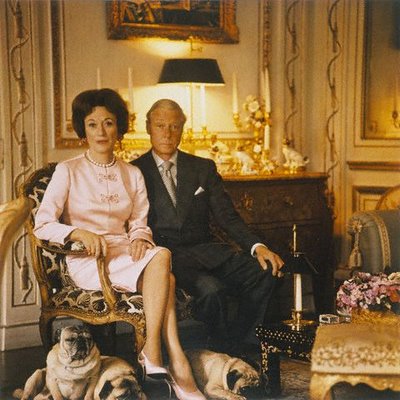
the Duke and Duchess of Windsor at home with their precious pug dogs. The Duchess, the former Wallis Warfield Simpson, often appeared in her stylish best in public with a pug tucked under one arm. It became a fashion trend - to carry a dog around with you when away from home.

the Duke and Duchess of Windsor at home with their precious pug dogs. The Duchess, the former Wallis Warfield Simpson, often appeared in her stylish best in public with a pug tucked under one arm. It became a fashion trend - to carry a dog around with you when away from home.

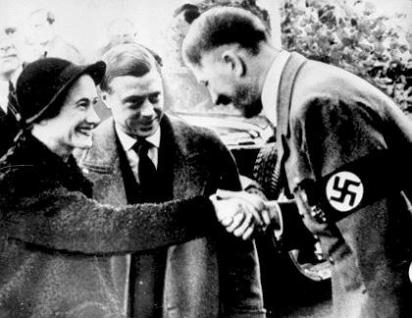
Granted, the Windsors were despicable people, dining with Adolf Hitler in 1937 and hobnobbing with fellow Nazi sympathizers and British ex-pats Oswald Mosley and wife Diana Mitford. Nevertheless, the Duke and Duchess – and their fancy friends – obsessed with clothing,  had tremendous style.

Adolf Hitler kisses the hand of the Duchess of Windsor as her husband the Duke looks on, admiringly. The Duke and Duchess of Windsor visited Germany in 1937 before WWII broke out across Europe. They were outspoken supporters of Nazi fascism and suspected of spying for Germany. At the beginning of the war, the Windsors were whisked out of France to safe haven in the Bahamas, where the Duke served out the war years as governor. There he could do Britain little harm - and he was less likely of being kidnapped by the Germans who were reportedly interested in installing him as a puppet king in a conquered Great Britain under German rule.

Adolf Hitler kisses the hand of the Duchess of Windsor as her husband the Duke looks on, admiringly. The Duke and Duchess of Windsor visited Germany in 1937 before WWII broke out across Europe. They were outspoken supporters of Nazi fascism and suspected of spying for Germany. At the beginning of the war, the Windsors were whisked out of France to safe haven in the Bahamas, where the Duke served out the war years as governor. There he could do Britain little harm - and he was less likely of being kidnapped by the Germans who were reportedly interested in installing him as a puppet king in a conquered Great Britain under German rule.

Fashion designer Gabrielle "Coco" Chanel (French, 1883-1971) at Lido Beach in 1936

Fashion designer Gabrielle "Coco" Chanel (French, 1883-1971) at Lido Beach in 1936

"Evening Dress," 1938. Gabrielle ("Coco") Chanel. Black Silk Net with Polychrome Sequins. The Metropolitan Museum of ARt, New York. Special Exhibit: "Blithe Spirit: The Windsor Set" The decoration of sequined fireworks on this evening dress, which was worn by the Countess Madeleine de Montgomery to Lady Mendl's seventy-fifth birthday party in 1939, is a fitting climax to le beau monde of the 1930s. It was the end of an era when, on Sept. 1, 1939, Parisians heard an early-morning radio announcemen from Herr Hitler in German, at once translated into French, that "as of this moment, we are at war with Poland." The thirties were over; the Second World War had begun.

"Evening Dress," 1938. Gabrielle ("Coco") Chanel. Black Silk Net with Polychrome Sequins. The Metropolitan Museum of Art, New York. Special Exhibit: "Blithe Spirit: The Windsor Set" The decoration of sequined fireworks on this evening dress, which was worn by the Countess Madeleine de Montgomery to Lady Mendl's seventy-fifth birthday party in 1939, is a fitting climax to le beau monde of the 1930s. It was the end of an era when, on Sept. 1, 1939, Parisians heard an early-morning radio announcement from Herr Hitler in German, at once translated into French, that "as of this moment, we are at war with Poland." The thirties were over; the Second World War had begun.

The Windsors were famous for their elegant Paris dinner parties, creating a demand for expensive clothes and jewels for them and their guests. Thus, the prewar years in France from 1935-1940 were rich in the decorative arts, putting trendy fashion designers front and center. It was a time when Gabrielle “Coco” Chanel was “rethinking the suit” to allow for the way women really move and Elsa Schiaparelli* was designing lobster dresses with surrealist Salvador Dali.*

Then Hitler invaded Poland and World War II shattered the fantasy world of endless cocktail parties and silk and organza gowns made to order. The Germans invaded and occupied France.

Shockingly, Coco Chanel spent the war years living at the Ritz in Paris with a Nazi officer. After the war was over, Chanel was arrested by the free French for suspicion of collaborating with the Nazis. She purportedly offered this explanation for sleeping with the enemy:

 “Really, sir, a woman of my age cannot be expected to look at his passport if she has a chance of a lover.”

It is generally believed that Winston Churchill  intervened with the French government, convincing them to let his old friend Coco Chanel escape to Switzerland rather than be paraded through the streets of Paris with her head shaved like other female Nazi collaborators.

Women accused of being Nazi collaborators are humiliated after the liberation of France, 1944. © Hulton-Deutsch Collection/Corbis

Women accused of being Nazi collaborators are humiliated after the liberation of France, 1944. © Hulton-Deutsch Collection/Corbis

Jackie Kennedy in her pink Chanel suit and pillbox hat, riding through Dallas in a motorcade just minutes before a sniper kills her husband, President John F. Kennedy

Fast forward 19 years. It's November 22, 1963. Jackie Kennedy,* in her pink Chanel suit and pillbox hat, is riding through Dallas in a motorcade just minutes before a sniper kills her husband, President John F. Kennedy

*For more on the Kennedys on this blog, please see right sidebar – Categories – People  – the Kennedys.
See “Wallis, the Duchess of Windsor,” which follows this blog post.

Read Full Post »