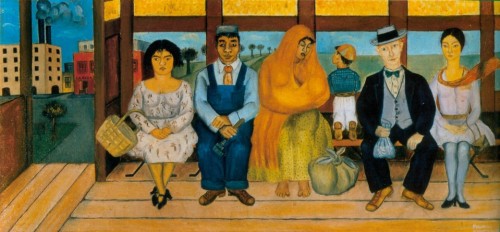
“The Bus,” by Frida Kahlo (1929). Frida painted her recollection of the last moments aboard the bus before the terrible accident that robbed her of her health. She is pictured on the far right. Notice that she is not dressed in traditional Mexican costume. She adopts that exotic look later, after her 1929 marriage to flamboyant Mexican muralist Diego Rivera.
Mexican artist Frida Kahlo (1907-1954) once said that she suffered two bad accidents in her life. The first one occurred on September 17, 1925. It would transform her life forever. Frida was only 18.
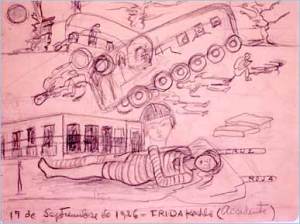
It was a gray day. A light rain had just fallen. After spending the afternoon wandering among the street stalls of downtown Mexico City, Frida and her boyfriend Alex Gómez Arias caught a bus that would take them home to Coyoacán. The new bus was brightly painted with two benches along the sides. It was nearly full but Alex and Frida found seats together near the back. The bus driver sped off to cross the busy streets on his way out of town.
As the bus driver began to turn onto Calzada de Tlapan, a street trolley approached. The bus driver rashly tried to pass in front of the turning streetcar. He didn’t make it. Alex remembers the point of impact:
The electric train [streetcar] with two cars approached the bus slowly. It hit the bus in the middle. Slowly the train pushed the bus. The bus had a strange elasticity. It bent more and more, but for a time it did not break. It was a bus with long benches on either side. I remember that at one moment my knees touched the knees of the person sitting opposite me. I was sitting next to Frida. When the bus reached its maximal flexibility it burst into a thousand pieces, and the train kept moving. It ran over many people.
I remained under the train. Not Frida. But among the iron rods of the train, the handrail broke and went through Frida from one side to the other at the level of the pelvis.”
Frida said that the “handrail pierced me the way a sword pierces a bull.” Alex continues:
When I was able to stand up, I got out from under the train. I had no lesions, only contusions. Naturally the first thing that I did was to look for Frida.
Something strange had happened. Frida was totally nude. The collision had unfastened her clothes. Someone in the bus, probably a house painter, had been carrying a packet of powdered gold. This package broke, and the gold fell all over the bleeding body of Frida. When people saw her, they cried, ‘La bailarina, la bailarina!’ With the gold on her red, bloody body, they thought she was a dancer.
I picked her up….and then I noticed with horror that Frida had a piece of iron in her body. A man said, ‘We have to take it out!’ He put his knee on Frida’s body and said, ‘Let’s take it out.’ When he pulled it out, Frida screamed so loud that when the ambulance from the Red Cross arrived, her screaming was louder than the siren. Before the ambulance came, I picked up Frida and put her in the display window of a billiard room. I took off my coat and put it over her. I thought she was going to die. Two or three people did die at the scene….others died later.”
Frida’s condition was so grave doctors didn’t believe they could save her. They thought she would die on the operating table. Her spinal column was broken in three places in the lumbar region. Her collarbone was broken and her third and fourth ribs. Her right leg had eleven fractures and her right foot was dislocated and crushed. Her left shoulder was out of joint, her pelvis broken in three places. The steel handrail produced a deep abdominal wound, entering through the left hip and exiting through the genitals. She convalesced for two years though she would never fully recover.
It was while she was confined to bed that Frida began to paint, using a small lap easel her mother bought for her. Frida had a mirror hung overhead in the canopy of her bed so she could use her reflection as a beginning subject for portraits.
"The Love Embrace of the Universe, the Earth (Mexico), Me, Diego, and Mr. Xolotl," by Frida Kahlo, 1949.
In the lower left of Frida Kahlo‘s painting, “The Love Embrace of the Universe” (above), a little dog is sound asleep in a huge hand. The dog is Frida Kahlo’s favorite pet dog, Mr. Xolotl. Mr. Xolotl (show-low -tul) was a xoloitxcuintli (show-low-eats-queen-tlee) dog. Frida had several of these unusual-looking dogs, a hairless breed with an ancestry that is traceable back 3,000 years to the Aztecs, hence their appeal to Frida, enormously proud of her MesoAmerican heritage. Xolos (show-lows), for short, are related to Mexican hairless chihuahuas. The Aztecs both revered and ate xolos.
"Frida Kahlo and her Itzcuintli Dogs," photo by Lola Alvarez Bravo, 1944
Nowadays, xolos are prized for the enormous amount of heat their bodies generate, although they do not have a higher-than-average body temperature. As a result, many sufferers of rheumatism and arthritis keep xolos as pets, claiming the dogs relieve their pain by acting as canine heaters.
The xolos are sometimes referred to as Colima dogs. They may range in size from 3 pounds to 60.
READERS: For more posts on Frida Kahlo, click here.
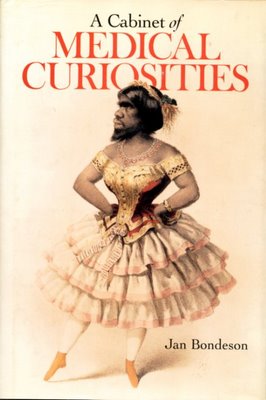
An illustration of Julia Pastrana, a Victorian stage performer who toured Europe, Canada, and the United States billed as the Bearded or Hairy Lady, the Nondescript, the Ape-Woman, the Marvelous Hybrid or Bear Woman.
Julia Pastrana (1834-1860) was one of the most famous human curiosities of her time, touring Europe, Canada, and the United States in the 1850s as “the Bearded Lady” or the “Ape-Woman.” Born poor in Mexico, she suffered from a rare inherited disorder (hypertrichosis), not understood during the Victorian Age, that caused her entire body to be covered in silky, black hair. Add to that a jutting jaw with huge teeth that made her look positively like a monkey. Yet while grotesque and freakish, she also exuded a feminine grace. She sang Spanish songs sweetly, had slender feet and hands, and displayed a buxom figure at a petite four-and-a-half feet tall. She styled her hair in elaborate coiffures and wore embroidered lace dresses that barely covered her knees. She spoke three languages, cooked, and sewed. In her stage act, she danced a Highland Fling.
When she toured London in 1857 in one of the monster shows popular at the time, she attracted journalists, doctors, and scientific minds. Julia was very popular. It cost 3 shillings to see her in the Regent Gallery, compared to the 6 shillings that a Victorian laborer might earn in a week. Promoted by her avarious manager and new husband, Theodore Lent, Julia was now billed as “The Nondescript,” suggesting that she was a unique species, perhaps “the missing link” between humans and the rest of the animal kingdom. Debate raged in the newspapers as to her origins and her appearance was described at length. She submitted to medical examinations freely and received many distinguished visitors. Charles Darwin mentioned her in his book, The Variation of Animal and Plants under Domestication, writing:
Julia Pastrana, a Spanish dancer, was a remarkably fine woman – she had a thick and masculine beard.”
Julia loved her husband very much and, in 1859 in Moscow, she became pregnant with their first child. Her doctors were worried. Julia’s narrow hips and small frame could mean a difficult childbirth, they warned. On March 20, 1860, Julia gave birth to a hair-covered little boy. He died within 35 hours. Julia died five days later, at age 26.
Theodore Lent was distraught. Julia had been the bank. Now the bank was closed! How was he to live now that his source of income had died? He had a Eureka moment. Why should the bank close? He sent Julia’s corpse and that of his newborn son to Professor Sukolov of Moscow University for embalming. The process took 6 months but the results were amazing. Julia’s mummified remains looked lifelike. He dressed Julia in one of her dancing costumes and his son in a cute sailor suit. He stood them up on a pedestal and took them on a tour, exhibiting them as pickled specimens for 20 years.
Julia Pastrana and son, embalmed, on tour after their deaths
When touring Sweden, Theodore met another hairy young woman named Zenora who suffered from a condition very similar to Julia. He married her and began touring her as Zenora Pastrana – Julia’s sister. Theodore grew richer and richer. In the 1880s, he and Zenora retired to St. Petersburg where they bought a waxworks museum. Theodore wasn’t able to enjoy his retirement for long because he became ill and was sent to a lunatic asylum where he died.
Over the course of the next 100 years, the mummies changed hands countless times, being sold to German fairs, an Austrian circus, and a Norwegian chamber of horrors. They came out of mothballs in 1970 and went on a short tour of Sweden and Norway. An American tour was aborted due to public outcry over the utter tastlessness of the idea. The mummies were put in storage by Norwegian owner Hans Lund in 1973.
In August of 1976, vandals broke into the storage unit. Julia’s mummified son was mutilated and his remains eaten by mice. Only her body remained. Then in 1979, the storage facility was again broken into and Julia’s body was stolen. It was assumed at the time to be destroyed.
Then, in February of 1990, a Norwegian journalist made a surprise discovery of a mummy in the basement of the Institute of Forensic Medicine in Oslo. It turns out that, back in 1979, the police had responded to a call involving some children who found an arm in a ditch. A search revealed the mummified body of Julia, badly mangled. The police did not know her identity. They took the mummy to the Institute.
It is believed by some, though not confirmed by me at this time, that the remains of Julia Pastrana have rested in a sealed coffin at the Department of Anatomy at Oslo University since 1997. “She is now a buried woman, not an exhibition object. She rests [at peace],” says Professor Gunnar Nicolaysen [translated from Norwegian].
By the summer of 1938, Frida Kahlo was on her way to being discovered as an artist in her own right, rather than only being referred to as the wife of famed Mexican muralist Diego Rivera. That summer, actor and art collector Edward G. Robinson had traveled to Mexico City just to see her paintings and had paid $200 each for four of them. Frida was thrilled. She had sold only a few of her paintings so far and had been content to just give them away. She later wrote of the Robinson sale:
“For me it was such a surprise that I marveled and said, “This way I am going to be able to be free; I’ll be able to travel and do what I want without asking Diego for money.”
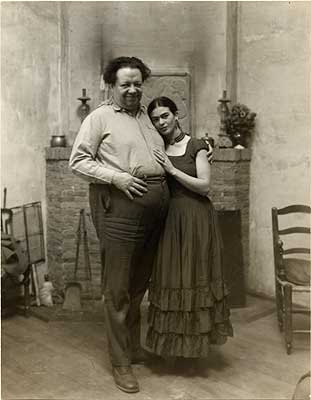
She and Diego had become increasingly estranged because of his many illicit extramarital affairs, including one with Frida’s sister Cristina. Frida was heartsick by Diego’s infidelities and retaliated by having multiple affairs of her own, with both men and women. Despite their discord, they remained deeply in love. Frida and Diego made up one of those married couples who could neither stay together nor apart. By the summer of 1939, they would be divorced – only to remarry a year later.
“Self-Portrait Dedicated to Leon Trotsky (Between the Curtains)” by Frida Kahlo, 1937
That November, Frida Kahlo traveled to New York City for her first one-person exhibition of her paintings, held at the Julien Levy Gallery, confident in her new status as celebrated artist. As always, her exotic Zapotec clothing and heavy jewelry created a buzz in the press. Her show was a great success. Time magazine noted that “the flutter of the week in Manhattan was caused by the first exhibition of paintings by famed muralist Diego Rivera’s…wife, Frida Kahlo.” Frida Kahlo’s hand, bedecked with huge rings, adorned a cover of Vogue.
Notables such as artist Georgia O’Keeffe attended the gallery exhibit as did playwright and former editor of the fashion magazine Vanity Fair Clare Boothe Luce.
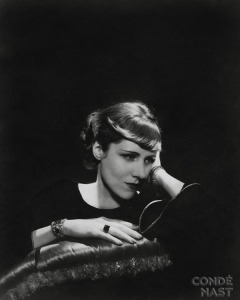
Claire Boothe Brokaw (Luce) (1903-1987) as photographed by Cecil Beaton for the August 1934 issue of Vanity Fair
Luce remembered the occasion well:
“The exhibition was crowded. Frida Kahlo came up to me through the crowd and at once began talking about Dorothy’s suicide [Dorothy Hale was a friend of both Kahlo and Luce’s].…Kahlo wasted no time suggesting that she do a recuerdo of Dorothy. I did not speak enough Spanish to understand what the word recuerdo meant….I thought Kahlo would paint a portrait of Dorothy in the style of her own self-portrait [dedicated to Trotsky][see above], which I bought in Mexico….
Suddenly it came to me that a portrait of Dorothy by a famous painter friend might be something [Dorothy’s] poor mother might like to have. I said so, and Kahlo thought so, too. I asked the price, Kahlo told me, and I said, ‘Go ahead. Send the portrait to me when it is finished. I will then send it on to Dorothy’s mother.’”
Dorothy Hale was a sometime actress, Ziegfeld showgirl, and socialite. Hale’s life had gone downhill seven years earlier after her husband Gardner Hale was killed when his car drove off a 500 foot cliff in Santa Maria, California. Hale’s career as an actress was drying up; she was failing her screen tests. She was in severe financial trouble and living on charity from friends. On October 20, 1938, Hale assembled her close friends for a party at her New York apartment and announced that she was taking a long trip. The farewell party lasted until the wee hours of the morning. Hale stayed up writing good-bye letters to her friends and drinking the last of the vodka. A little before 6 a.m. on the 21st, Hale put on her black velvet dress and pinned on it a corsage of small yellow roses sent to her by the sculptor Isamu Noguchi. She then climbed onto the windowsill of her luxury high-rise apartment suite and jumped to her death.
“The Suicide of Dorothy Hale” by Frida Kahlo, 1938/39
From the encounter between Luce and Kahlo at the gallery exhibit arose one of Frida Kahlo’s most shocking and controversial paintings, “The Suicide of Dorothy Hale” (1938/39). Kahlo painted Dorothy Hale as she jumped, fell, and landed, dead and bloody, on the concrete walk outside her apartment building. Blood-red lettering at the bottom of the retablo details the tragedy in Spanish:
“In New York City on the 21st of October 1938, at 6:00 in the morning, Dorothy Hale committed suicide by throwing herself from a very high window in the Hampshire House. In her memory, this portrait was executed by Frida Kahlo.”
Luce recalls the horror she felt when the painting was delivered to her home and she first laid eyes on it.
“[W]hen I pulled the painting out of the crate…I felt really physically sick. What was I going to do with this gruesome painting of the smashed corpse of my friend, and her blood dripping down all over the frame? I could not return it – across the top of the painting there was an angel waving an unfurled banner which proclaimed in Spanish that this was ‘The Suicide of Dorothy Hale, painted at the request of Clare Boothe Luce, for the mother of Dorothy’. I would not have requested such a gory picture of my worst enemy, much less of my unfortunate friend.”
Luce wanted to have the painting destroyed, but was dissuaded by friends. Instead, she had sculptor and friend Noguchi paint over the angel with the banner and gave the painting to a friend.
Luce couldn’t have known at the time that Kahlo was in a desperate state of mind as she always was when she was afraid of losing Diego. At the time she painted “The Suicide of Dorothy Hale,” Kahlo herself was having repeated thoughts of committing suicide.
READERS: For more posts on Frida Kahlo, click here.
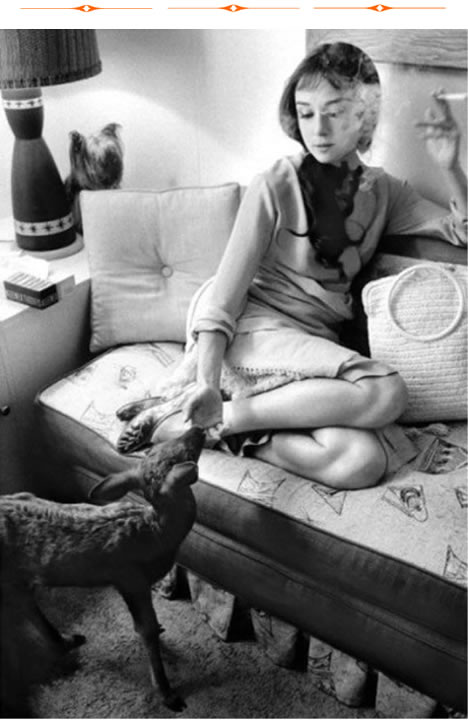
Audrey Hepburn in her dressing room during the filming of “Green Mansions.” She is feeding Ip the fawn while her Yorkshire terrier Mr. Famous looks on from the left.
[The book] Remembering Audrey, features candid portraits by Bob Willoughby, a photographer on the set of many of Hepburn’s films who became close enough to the beauty to literally follow her home. His visual account of Hepburn’s private life and career is peppered with unexpected moments, such as cameos by Pippin, nicknamed Ip, the fawn. When Hepburn was making her 1959 flick “Green Mansions,” directed by then-husband Mel Ferrer, the animal trainer on the set suggested that she take her on-screen sidekick, a baby deer, home with her so that he would learn to follow her. “It was truly amazing to see Audrey with that fawn,” remembers Willoughby in the caption alongside a photo of Pippin cuddling up to Hepburn like a lap dog as she naps on the couch. (Her pet dog, Mr. Famous, is curled in a ball at the other end of the sofa.) “While Audrey’s maid had been told about the little deer, she could not believe her eyes seeing Ip sleeping with Audrey so calmly,” writes Willoughby. “She was shaking her head and just kept smiling.”
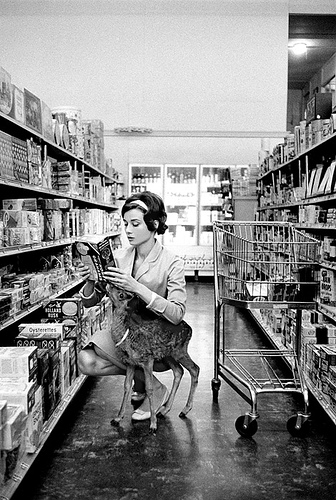
Audrey Hepburn shopping in Beverly Hills with her pet deer and costar, Pippin, known as “Ip.” (1958)
In another shot, the fawn inspects a box of Honey Grahams, shopping with Hepburn in a Beverly Hills supermarket. “Beverly Hills habitués are fairly blasé about what they see,” writes Willoughby, “but Audrey being followed around town by this lovely creature stopped everyone in their tracks.”
For more on Audrey Hepburn on this site, click here.
Here is part 5 0f 5 of the 1996 A & E “Biography” series on Eva Peron, “Evita: The Woman Behind the Myth.” Halfway through the tape, you will get an eyeful of Evita.
In a previous post, “The Strange Case of Patty Hearst: Part 1,” I wrote about the kidnapping of wealthy media heiress Patty Hearst by the Symbionese Liberation Army and her participation in their robbery of the Hibernia Bank in San Francisco on April 15, 1974. When the attorney general viewed a videotape of the bank robbery, identifying Patty as one of the five robbers, he issued a warrant for her arrest as a material witness. What Patty’s parents and all of America wanted to know: had this well-brought-up young lady really crossed over and joined her captors in their radical notion of justice? Or was Patty brainwashed and acting in fear of her life?
A month later, SLA members William and Emily Harris walked into Mel’s Sporting Goods in Englewood, California, to buy supplies for their safe house. While Emily paid at the register, William shoplifted some socks. A security guard noticed and attempted to arrest William Harris by placing a handcuff on his left wrist. They struggled and a .38-caliber handgun fell from William Harris’ waistband. Patty Hearst, on armed lookout from across the street in a red Volkswagen van, produced a semi-automatic rifle and started shooting out the store’s overhead sign. Shots cracked the concrete and shattered the window, and one of them ricocheted and slashed the forehead of the owner, Mrs. Huett. Everyone inside Mel’s took cover and William and Emily made their getaway with Patty behind the wheel of the van. They soon abandoned the van and took refuge in their safehouse at 1466 54th Street in Los Angeles.
From a parking ticket found inside the glove box of the abandoned van, the L.A.P.D. was able to locate the safe house. The next day, May 17, 400 L.A.P.D. officers along with the Federal Bureau of Investigation, California Highway Patrol, and Los Angeles Fire Department surrounded the neighborhood. They descended upon the hideout and conducted a live televised raid. It was one of the largest shootouts in police history with a reported total of over 9,000 rounds being fired by both the police and the SLA members who chose not to surrender. Six members of the SLA were killed, probably as a result of a combination of multiple gunshot wounds, smoke inhalation from the burning house, and burns. Among the dead was the SLA’s leader, Donald DeFreeze, an African American ex-convict who called himself General Field Marshal Cinque and Willie Wolfe, who was reported to be Patricia Hearst’s lover and called himself Cujo. Patty Hearst was not in the house during the siege. She and several other fugitives had seen the news coverage of the Mel’s Sporting Goods incident on TV the night before and fled.
Patty and the others remained on the run for over a year, crisscrossing the country and surviving by conducting small thefts. Authorities following the trail of SLA member Kathleen Soliah were eventually lead to the Harrises and Patty. On April 21, 1975, Kathleen Soliah (nee Sara Jane Olson) had robbed a bank in Carmichael, California, during which a mother of four was murdered and a young pregnant bank teller was kicked in the belly and later had a miscarriage. Patty had been Kathleen Soliah’s getaway driver.
1975 photo of Patty Hearst, handcuffed, in custody
Patty was finally arrested on September 18, 1975 at her apartment in the outer Mission District of San Francisco. As she was led away, Patty gave a clenched fist salute and listed her occupation on police papers as “urban guerrilla.” Patty Hearst’s mother, Catherine, expressed confidence that her daughter would not face imprisonment: “I don’t believe Patty’s legal problems are that serious. After all, she’s primarily a kidnap victim. She never went off and did anything of her own free will.”
Patty Hearst was brought to trial in 1976, represented by famed attorney F. Lee Bailey. (Read about the trial here.) Despite her claim that she had been tortured, raped, and brainwashed into submission by the SLA, the jury found it hard to believe her. She was convicted of armed robbery and sentenced to seven years in prison. After serving two years, President Jimmy Carter commuted her sentence. She married her bodyguard Bernard Shaw. In 2001, she received a full pardon from President Bill Clinton.
Patty Hearst with French bulldog Shann's Legally Blonde, winner of the 2008 "Best of Opposite Sex," Westminster Kennel Club
She now lives with her husband and two children, Gillian and Lydia. She raises French bulldogs that win red ribbons at Westminster Kennel Club competitions.
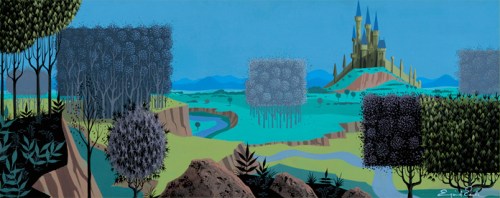
The iconic castle from “Sleeping Beauty,” by artist Eyvind Earle for Disney
Up until the release of Disney’s “Sleeping Beauty” in 1959, the Disney characters were normally drawn first for a film and then the background was drawn later to complement the characters. But this process was reversed in 1951 – causing some hard feelings – when Walt Disney Studios hired the new background painter, Eyvind Earle.
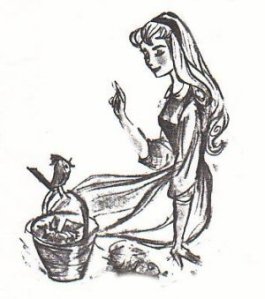
Tom Oreb's early drawing of Sleeping Beauty, influenced by Audrey Hepburn
Walt Disney wanted the setting to have a very Renaissance Germanic look and Earle’s style fit the bill. The problem was that, when Earle joined the studio, the characters for “Sleeping Beauty” had already been drawn. Soft and round in the Disney tradition, the characters clashed with Earle’s stylized angular backgrounds. Though it was unusual to take style direction from a background painter, that’s what the character artists were forced to do. They had to go back to the drawing board and reconceive all the characters in a style that suited Earle’s design.
Although Sleeping Beauty would have blonde hair in the film, character stylist Tom Oreb based the princess’ original design on the physical geometry of brunette Audrey Hepburn.
Audrey Hepburn
“The qualities of that actress’ slender, willowy physicality lend themselves beautifully to the design environment of the film,” said Disney historian Jeff Kurtti.
drawing of Sleeping Beauty by Marc Davis, redesigned for use in 1959 film
Originally,” said Disney animator Ron Dias, “Sleeping Beauty looked a lot like Audrey Hepburn; she was softer, rounder, more like the ‘designy’ Disney girl. Back at the drawing board, Marc Davis redesigned her. She became very angular, moving with more fluidity and elegance, but her design had a harder line. The edges of her dress became squarer, pointed even, and the back of her head came almost to a point rather than round and cuddly like the other Disney girls. It had to be done to complement the background.”
Click below to see Helene Stanley perform in the Disney Studio as the live action model for Sleeping Beauty as Disney artists sketch away. This video was part of the premiere of the Disneyland TV show.
Before they took off on their World Tour in June of 1966, the Beatles had put the finishing touches on their new album, “Revolver.” Click below to hear the song that would prove prescient of the “Fab Four’s” horrible experience in Manila – “Taxman.”
Monday, July 4, 1966
Manila, the Philippines, the second stop for the Beatles on their 1966 World Tour
The Manila Hotel
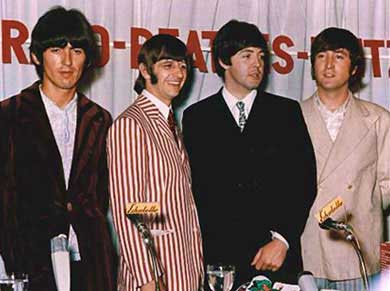
The Beatles: (l. to r.) George Harrison, Ringo Starr, Paul McCartney, John Lennon. ca. 1966
Manila, The Philippines:
Early in the morning, Tony Barrow, the Beatles’ publicist, and Vic Lewis, their booking agent, were awakened by sharp raps on the door of their suite. Two grim-looking men in military uniforms saluted and introduced themselves as the official reception committee from Malacañang Palace, the residence of President Ferdinand and First Lady Imelda Marcos.* They’d come to make final arrangements for the Beatles’ visit to the Palace for a luncheon hosted by the First Lady. (1)
Dictator Ferdinand Marcos with wife Imelda at his 1965 inauguration in the Philippines.
Neither Barrow nor Lewis knew what they were talking about. No one had told them that the Beatles were expected to make a presidential visit. The Beatles – John Lennon, Paul McCartney, George Harrison, and Ringo Starr – were sleeping, they explained, and couldn’t be disturbed. The band had just flown in from an exhausting concert in Tokyo. The “Fab Four” needed their rest, as they were schedule to give both afternoon and evening concerts in Manila that very day. Barrow and Lewis promised to pass along the request to Brian Epstein, the Beatles’ manager.
“This is not a request,” insisted the two men, one, a general, and the other, a commander, in the Philippine Army.
First Lady of the Philippines Imelda Marcos was a former beauty queen. Here she models a traditional gown. She regarded herself as a goddess and was used to having her way. 1963
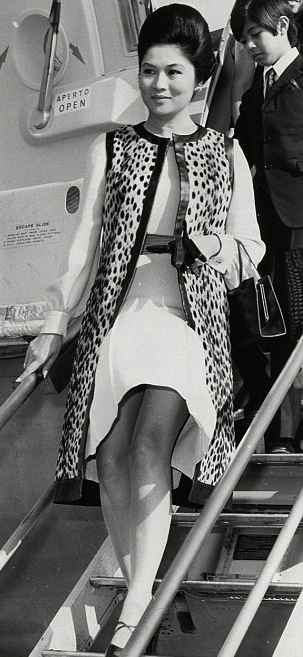
Fashion icon Imelda Marcos descends from a flight with her son Bong Bong. Undated photo
That afternoon, the Beatles performed their hits songs to an audience of 35,000. Afterwards, Tony Barrow and others in the Beatle’s entourage filed into Brian Epstein‘s suite to watch coverage of the concert on the evening news. They were pleased to discover that every channel featured scenes of screaming, swooning fans caught up in Beatlemania. However, Channel 5, one of the country’s major networks, ran additional footage not seen on the other channels. The scene showed the First Lady at the Palace with her disappointed luncheon guests, 200 children. The voice-over said, “The children began to arrive at ten. They waited until two….The place cards for the Beatles at the lunch table were removed.” Imelda Marcos was very mad as she and her guests filed into the grand dining room without their guests of honor. The spin was that the Beatles had deliberately snubbed the President and Mrs. Marcos by not showing up.
Brian Epstein went into full damage control mode. He issued a hastily written apology to the First Couple and called an interview with Channel 5 in his hotel suite, in which he professed complete ignorance of the invitation and praised the Marcoses. An hour later, the interview was broadcast but Brian’s appearance was blacked-out by static interference. That’s when everyone started to get nervous.
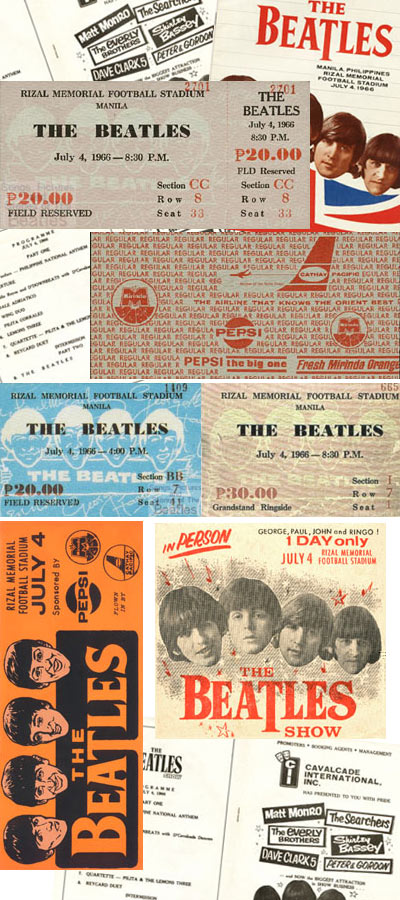
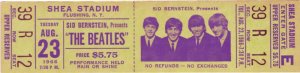
ticket stubs to the Beatles July 4, 1966 concerts in Manila
Worry soon turned to panic. After their evening show, the Beatles noticed that their police escort had disappeared. When their car pulled up to the Manila Hotel, the gates were locked against them. While they sat their in the idling car, wondering how they were going to get up to their suite, several dozen “organized troublemakers” attacked their car, banging on the windows, rocking it back and forth, and shouting threats in several languages. Vic Lewis shouted at the driver: “Drive on! Go through the people and smash the gates down!” The driver obeyed. At the entrance, everyone in the Beatles’ entourage ran into the hotel with the angry mob snapping at their heels.
Shortly, an official appeared at Vic Lewis’ suite demanding payment of local taxes. Lewis produced a contract stating that someone else – the promoter – had that responsibility, not the Beatles. This was brushed aside. Until all taxes were paid, said the taxman, no one in the Beatles party was being allowed to leave the country. When the man left, Lewis found Barrow. “We’ve got to get out of here – now.” He called the bell hop for help with the luggage.
The manager told Lewis that no one would be coming to help. “The whole hotel is going on strike. They think you’ve insulted President Marcos.” Bomb and death threats were telephoned to the deluged British Embassy and to the four Beatles’ hotel suite.
The next morning, Paul had seen the newspaper headlines blaring BEATLES SNUB PRESIDENT. The Beatles had known nothing of the invitation. “Oh, dear,” he thought. “We’ll just say we’re sorry.” About then “things started to get really weird,” recalled Ringo. He and John were hanging out in their bathrobes when a roadie popped his head in their room and shouted, “Come on! Get out of bed! Get packed – we’re getting out of here.”
Everyone in the entourage grabbed amplifiers and suitcases and made for the main elevators, but they were turned off. They had to take the service lift down. The halls were dark and lined with staff who shouted at them in Spanish and English. It was very frightening. When they got downstairs to check out, the front desk was deserted. Even their cars were gone. Someone managed to get a Town Car and everyone squeezed in and made for the airport.
But the airport route was sabotaged. Soldiers were stationed at intersections and roads were closed. Finally, they found a back road that led to the airport. The airport was deserted. “The atmosphere was scary,” remembered Tony Barrow, “as if a bomb was due to go off.” Once the Beatles got on the escalator, the power was shut off. As the Beatles moved through the terminal, little bands of demonstrators appeared, grabbing at them and trying to hit them.
Mobs rough up the Beatles at the Manila airport. John Lennon is at upper corner, right. July 6, 1966
They checked in for their flight as quickly as possible then were herded into a lounge “where an abusive crowd and police with guns had also gathered.” The cops began to shove the Beatles back and forth. It was impossible to tell the thugs from the military police. According to Ringo, “they started spitting at us, spitting on us.” The Beatles hid among a group of nuns and monks huddled by an alcove. Other members of their entourage, though, were kicked and beaten.
Finally, everyone was allowed to run across the tarmac to the plane. Vic Lewis felt sure he’d get a bullet in the back. The Beatles were terrified they’d be killed before they entered the safety of the airplane. Paul said, “When we got on the plane, we were all kissing the seats. It was feeling as if we’d found sanctuary. We had definitely been in a foreign country where all the rules had changed and they carried guns. So we weren’t too gung-ho about it at all.” Ringo remembered being afraid of going to jail. Ferdinand Marcos was a dictator (who, in a few years, would declare martial law in the Philippines.)
Everyone was poised for the plane to take off when the authorities came back on board and detained Tony Barrow for thiry minutes. For the plane to be allowed to take off with the Beatles on it, Tony was forced to pay a “leaving Manila tax” that amounted to the full amount of money the Beatles had made in their concerts before 80,000 fans.
Once the plane lifted off and everyone was safely in the air, all the anger of the past 24 hours boiled over. The Beatles blamed Brian for the debacle. He’d obviously received the invitation in Japan, ignoring it or misleading the Philippine authorities.
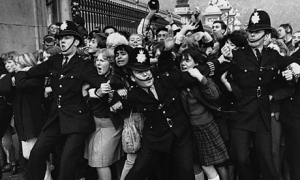
Beatlemania. October 1965, London, England, UK. Policemen struggle to restrain young Beatles fans outside Buckingham Palace as The Beatles receive their MBEs (Member of the British Empire) in 1965.
By the time the Beatles had landed in India, they had made a command decision. This would be their last tour. They were never going to go on another tour again. Never again, swore John, was he going to risk his life for a stadium filled with screaming 13-year-old girls.
Brian said, “Sorry, lads, we have got something fixed up for Shea Stadium. If we cancel it you are going to lose a million dollars.” So they played New York’s Shea Stadium later that summer. It was the first stop on their U.S. tour, their final tour as the Beatles.
I’ve been blogging about the Obamas and their state visit to London and Buckingham Palace. There has been much discussion on and offline as to whether or not Michelle Obama was out of line when she touched the Queen. Royal protocol dictates that no one touches the Queen.
In my recent post, “Michelle Obama Hugs Queen Elizabeth,” I gave the first report of the touchy-feely action in royal quarters – that Michelle initiated the contact by placing her hand on the Queen’s back. Now, though, according to Vanity Fair Online, it may have been Queen Elizabeth who started the touching by slipping her right hand around Michelle’s waist. (The New York Times confirmed this on April 3.)
‘A mutual and spontaneous display of affection and appreciation,’ was how a Buckingham Palace spokesman hastened to describe it.
Queen Elizabeth and Michelle Obama at Buckingham Palace
As I mentioned in my recent post, “President Barack and Michelle Obama Give Queen Elizabeth an IPod,” the Obamas have visited Buckingham Palace and met with Queen Elizabeth and Prince Philip. As the two couples mingled with other diplomats in London for the Group of 20 Meeting, First Lady Michelle Obama reached out and touched the Queen on her back. The Queen responded warmly, wrapping her right arm around Michelle’s waist. Those listening to the two women say that the Queen remarked on how tall Michelle is. They also were looking down and talking about their shoes.
Everyone’s buzzing about this historic moment: Michelle Obamatouched the Queen! Royal protocol demands that no one touch the Queen. Even her royal consort, Prince Philip, must walk several paces behind her when the two are in public.
First Lady Jacqueline Kennedy and General Charles DeGaulle at a dinner at Versailles, France, June 1, 1961.
All this attention to the Obamas and their first visit to Europe as the First Couple takes me back to 1961 when President John Fitzgerald and Jacqueline (pronounced JAK LEEN’) Bouvier Kennedy made a state visit to France. Jackie Kennedy mesmerized the French with her style and elegance. She spoke fluent French and boasted a paternal French bloodline (Bouvier). Jackie was so charming that she even won the heart of President Charles DeGaulle, a man not easily conquered. At a dinner at the Elysee Palace, DeGaulle talked extensively to Jackie, then turned to President Kennedy and said, “Your wife knows more French history than any French woman.”
Jackie Kennedy so upstaged John on their trip overseas that the President joked, “I am the man who accompanied Jacqueline Kennedy to Paris.” Upon the Kennedys’ return to America, their popularity soared. The American public – and the rest of the world – had fallen in love with Jackie. To this day, she remains an American idol.
Patricia Hearst shown with then fiancee Steven Weed
It was January 20, 2001, President Bill Clinton’s last day in office. In his last official act, Clinton granted a full pardon to a number of Americans, among them the notorious Patty Hearst, who had served two years for a bank robbery conviction.
Twenty seven years earlier, on February 4, 1974, Patty Hearst made headlines when she was abducted from her Berkeley, California, apartment which she shared with fiancee Steven Weed. Shots were fired and Weed was roughed up. Patty, wearing only her nightgown, was carried out front and stuffed into the trunk of a white getaway car. Her kidnappers were the radical urban guerrilla group, the Symbionese Liberation Army (SLA). Patty, a 19-year-old college sophomore, was the daughter of rich West Coast publishing tycoon Randolph Hearst. After Patty’s abduction, the SLA released a statement in which it called her kidnapping the “serving of an arrest warrant on Patricia Campbell Hearst.” It warned that any attempt to rescue Hearst would result in her execution. The message ended with: “DEATH TO THE FASCIST INSECT THAT PREYS UPON THE LIFE OF THE PEOPLE.”
The SLA had kidnapped the media heiress to increase news attention on their cause: their demand for the release of two imprisoned SLA members, Joseph Remiro and Russell Little, serving life terms for murder. Remiro and Little had been found guilty of killing Oakland school board member Marcus Foster, whom they detested for his idea of requiring Oakland school kids to carry identification cards. The SLA considered Foster to be a “fascist.” Foster was killed by the SLA as he walked out of a school board meeting. The hollow-point bullets they used to kill Dr. Foster had been packed with cyanide.
Patty’s abduction was sensational news around the world. At a time of student unrest and radical causes, Patty Hearst was an average though privileged girl who had given neither the law nor her family any real trouble. At first, through tapes given to the news media, the SLA demanded the Hearst family arrange for the release of Remiro and Little in exchange for Patty’s freedom. When that proved impossible, they demanded that the Hearst distribute millions of dollars in food to the needy as ransom. After the Hearsts donated over $6 million to the poor of the San Francisco Bay Area, the SLA refused to let Patty go, claiming the donated food had been inferior. Inexplicably, all negotiations ceased.
Patty Hearst (b. 1954) from a Symbionese Liberation Army photo
Over the next few weeks, the Hearsts received several tapes of Patty’s voice. More and more Patty began to expouse the cause of her captors. The Hearsts believed Patty was being forced to say these things, but then they received a photo of her with a carbine rifle in her arms, standing next to the seven-headed cobra, which was the SLA’s symbol. Then, on April 3, 1974, Patty is heard on a new audiotape saying: “I have been given the choice of being released…or joining the forces of the Symbionese Liberation Army and fighting for my freedom and the freedom of all oppressed people. I have chosen to stay and fight.” Patty also said that she had assumed the new name “Tania,” after the nom de guerre of revolutionary Che Guevera’s girlfriend. Patty had joined her captors.
Twelve days later, policemen were examining security camera footage of the Hibernia Bank robbery that day in San Francisco. The hold-up gang had shot two bystanders and gotten away with over $10,000. To their surprise, they recognized the face of missing girl Patty Hearst among the hold-up gang. She was brandishing a carbine and yelling orders like she was one of them. A warrant was issued for her arrest as a material witness. Opinion was divided: was Patty a willing participant or was she being forced to participate in the robbery against her will?
Shortly afterward, an audiotape was released by the SLA on which Hearst can be heard to say:
“Greetings to the people, this is Tania. Our actions of April 15 forced the Corporate State to help finance the revolution. As for being brainwashed, the idea is ridiculous beyond belief. I am a soldier in the People’s Army.”
Sojourner Truth (1797-1883), photograph by Mathew Brady c.1864
Born into slavery in New York, Isabella Baumfree (Sojourner Truth’s given name) was an abolitionist and women’s rights activist. She spoke Dutch until the age of nine when she was sold to a new owner along with a flock of sheep. Eventually freed, she became a devout Christian and began to travel and preach about freedom.
Asking the Lord for a new name to reflect her new life, she claimed “Sojourner” was given to her because she was to travel the land and “Truth” because she was to declare the truth to all people.
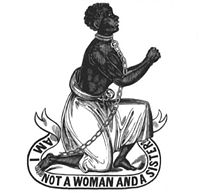
Sojourner Truth was a powerful speaker. Her most famous speech was delivered in 1851 at the Ohio Women’s Rights Convention. It is called “Ain’t I a Woman?” a slogan she adopted from a famous abolitionist image (See below.) The speech as shown here has been revised from the 19th century dialect in which she spoke.
When Sojourner got up to speak to the crowd, some men were present and they began to boo and hiss at her:
“Well, children, where there is so much racket, there must be something out of kilter. I think that ‘twixt the Negroes of the South and the women at the North, all talking about rights, the white men will be in a fix pretty soon. But what’s all this here talking about?
That man over there says that women need to be helped into carriages, and lifted over ditches, and to have the best place everywhere. Nobody ever helps me into carriages, or over mud-puddles, or gives me any best place! And ain’t I a woman? Look at me! Look at my arm! I have ploughed and planted, and gathered into barns, and no man could head me! And ain’t I a woman? I could work as much and eat as much as a man – when I could get it – and bear the lash as well! And ain’t I a woman? I have borne five children, and seen most all sold off to slavery, and when I cried out with my mother’s grief, none but Jesus heard me! And ain’t I a woman?”
Then they talk about this thing in the head; what’s this they call it? [member of audience whispers, “intellect”] That’s it, honey. What’s that got to do with women’s rights or Negroes’ rights? If my cup won’t hold but a pint, and yours holds a quart, wouldn’t you be mean not to let me have my little half measure full?
Abolition Movement poster
Then that little man in black there, he says women can’t have as much rights as men, ’cause Christ wasn’t a woman! Where did your Christ come from? Where did Christ come from? From God and a woman! Man had nothing to do with Him.If the first woman God ever made was strong enough to turn the world upside down all alone, these women together ought to be able to turn it back, and get it right side up again! And now they is asking to do it. The men better let them.
Obliged to you for hearing me, and now old Sojourner ain’t got nothing more to say.
Mary Todd Lincoln in mourning clothes, 1863. Even during the period in 1862 and 1863 when Mrs. Lincoln was in mourning for her son Willie and wore only black, she managed to go further into debt for new clothes. By 1864, she told Elizabeth Keckley: "The President glances at my rich dresses and is happy to believe that the few hundred dollars that I obtain from him supply all my wants. I must dress in costly materials. The people scrutinize every article that I wear with critical curiosity... If he is elected, I can keep him in ignorance of my affairs, but if he is defeated, then the bills will be sent." Only on January 1, 1865 did she completely shed her mourning attire.
After her son Willie’s death at age eleven on February 20, 1862, Mary Todd Lincoln went into deep mourning. She traded in her sparkling jewels, frilly white and colorful gowns, and flowered bonnets made fashionable by her icon the French EmpressEugénie (click to read earlier post) for widow’s weeds of dull black crepe. Her stylish White House parties were put to the side. Gaiety gave way to sadness. Mary had lost her favorite son, the perfect one, the one she considered most like her husband.
After Willie died, Mary’s youngest son, eight-year-old Tad, still tossed with the same typhoid fever that killed his brother. He lay critically ill nearby, but Mary, incapacitated by grief, would not and did not rush to his side to nurse him. Meanwhile, Willie’s embalmed body was laid out in the Green Room of the White House and his coffin was open. Mary mustered enough energy to place a sprig of laurel on Willie’s chest before retreating to her bedroom and shutting the door. She took to her bed, weeping and sobbing in such uncontrolled spasms that she became quite ill.
She did not come out of her bedroom to attend Willie’s funeral and never again entered the Green Room or the second floor guest room where Willie died. She rid the house of all of Willie’s toys and clothes and forbade his and Tad’s best friends, the Taft boys, from ever returning to the White House to play.
During Mary’s tormented period, Abraham, also heartbroken at his son’s death, sent for help. Two of Mary’s friends, a nurse, and Mary’s sister Elizabeth heeded the calling. One of the friends was the esteemed Washington seamstress Elizabeth Keckley. In memoirs she wrote with a ghostwriter six years later, she recalled a day when President Lincoln led his distraught wife (whom he called “Mother”) to the window, pointed to the lunatic asylum at a distance from the White House, and said,
“Mother, do you see that large white building on the hill yonder? Try and control your grief or it will drive you mad and we may have to send you there.”
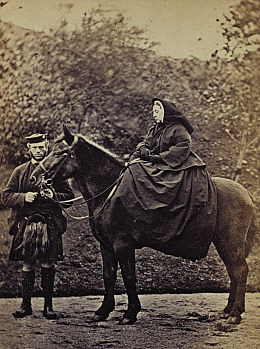
The recently widowed Queen Victoria wearing mourning clothes at Balmoral, Scotland, 1863. She is riding "Fyvie" and is accompanied by her faithful servant John Brown. Her husband, Prince Albert, died in December of 1861 of typhoid fever or perhaps cancer of the stomach. For forty more years, the rest of Victoria's life, she wore black widow's weeds. Suspicion was aroused by Victoria's partiality to John Brown as a servant; most of the members of the Royal Household referred to him as "the Queen's stallion" and defamatory pamphlets referred to her as "Mrs. Brown." A 1997 film with Judy Dench titled "Mrs. Brown" was about their rumored love affair.
It was three weeks before Mary could even be persuaded to get up out of bed and put on her mourning clothes. Queen Victoria (1819-1901) now became the First Lady’s fashion model. Victoria’s husband Prince Albert had died unexpectedly just three months earlier and Victoria had plunged herself and her entire staff into the deep black dress of mourning. Following Victoria’s lead and further compounding her debt to clothing merchants (click to read an earlier post), Mary Lincoln ordered an entire new wardrobe of dull black crepe dresses, bonnets, and weeping veils.
For more than a year, six months longer than was called for in the mourning manuals of the day, Mary wore first-degree mourning. Her black crepe straw bonnet was so heavily veiled that she could not turn her head, which gave her an odd appearance as she was always facing forward. She became a very public mourner. She wanted to draw attention to her grief as if she was the only one who had lost a child at a time when Civil War soldiers were dying in record numbers from Mississippi to Maryland on the nation’s bloody battlefields. During her mourning, she cancelled the Saturday afternoon Marine Band Concerts held on the White House lawn, explaining that, “When we are in sorrow, quiet is necessary.” She bought black jet jewelry to accent her sooty “widow’s weeds” and used writing paper with the thickest margins of black.
Finally, in 1863, Mary ordered another new wardrobe, running up yet more bills, and moved into the stage known as half-mourning, exchanging her lusterless black for fabric in lavender, gray, and somber purples with a little touch of white at the wrist. (1)
Click here to access my related post, “The Madness of Mary Lincoln.” Also, for more posts on the Lincolns, view the drop down menu, “Categories,” in the left column, find at the top, Abraham and Mary Todd Lincoln, and click.
(1) Baker, Jean H. Mary Todd Lincoln: A Biography. (New York: W.W. Norton & Company, 1987)
Elizabeth II (Elizabeth Alexandra Mary; born 21 April 1926) is the queen regnant of sixteen independent states known as the Commonwealth realms: the United Kingdom of Great Britain and Northern Ireland, Canada, Australia, New Zealand, Jamaica, Barbados, the Bahamas, Grenada, Papua New Guinea, the Solomon Islands, Tuvalu, Saint Lucia, Saint Vincent and the Grenadines, Belize, Antigua and Barbuda, and Saint Kitts and Nevis. All together, these countries have a combined population, including dependencies, of over 129 million.
It was June 24, 1953. Queen Elizabeth II was traveling to Scotland for the first time as Queen. In her coronation at Westminster Abbey 22 days earlier, Elizabeth had worshiped as an Anglican in the Church of England in her coronation robes. As Queen she was now the head of two churches, the Church of England and the Church of Scotland, which was Presbyterian. Having already been crowned in England, she now traveled to St. Giles Cathedral, the Mother Church of Presbyterianism, in Edinburgh, Scotland, to receive the ancient crown of Scotland.
When she arrived at the cathedral, the Queen was surrounded by the Scottish peerage in their velvet coats and coronets. Her husband, Prince Philip, was resplendently-dressed in a gold-braided uniform topped off by a plumed helmet. But when the crowd gathered at the ceremony got a look at Elizabeth, their new queen, they were shocked at how ordinary she looked. They had expected her to appear in her coronation robes. Instead she wore a simple gray blue coat, black leather shoes, and a gray blue felt hat. She looked just like a commoner! The most jarring part of her outfit was the big black purse she carried in the crook of her arm.
At the altar she stepped forward while the Duke of Hamilton and Brandon knelt before her in his coronation robes to proffer the crown of Scotland on a velvet cushion with gold tassels. As she (the Queen) reached toward him, her leather handbag, which was as large as a breadbox, almost hit him in the face. He quickly moved his head to avoid getting smacked by the royal purse. (1)
Since then, the Queen is rarely photographed without her purse tucked in the crook of her arm. She carries it with her throughout the day as she moves from room to room in Buckingham Palace. All tables and her desk at the palace are equipped with special hooks on which the Queen may hang her purse so that it may never be set on the floor. She never uses a clutch or a shoulderbag. Those bags would make it awkward in official duties of shaking hands and accepting flowers.
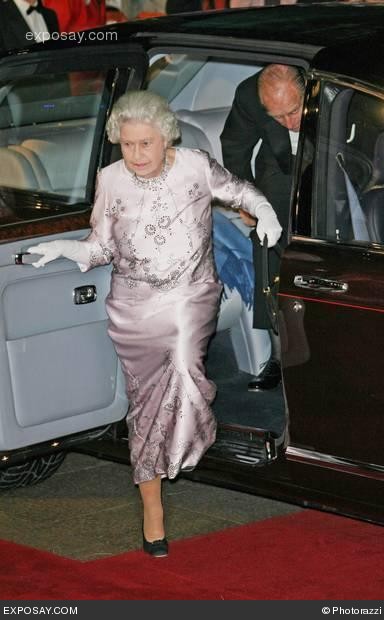
Queen Elizabeth (with black leather purse) and Prince Philip arrive at the Casino Royale World Premiere – Red Carpet – Nov. 14, 2006, London
Enquiring minds want to know: just what does Queen Elizabeth carry in that purse? As it turns out, there is more to the royal purse than its meager contents. It doubles as a signal device. When the Queen is carrying out her royal duties at some function, she uses her purse to communicate with her servants. When she shifts the bag from one arm to another, for instance, it means she’s ready to leave. When at a banquet, if the Queen sets her purse on the floor, it’s another bad sign. She finds the conversation boring and wants to escape. However, if the royal bag dangles happily from the crook of her left arm, she is happy and relaxed. (2)
One thing that can always be found inside the Queen’s purse is an S-shaped metal meat hook that she can place on the edge of a piece of furniture and hang her purse on it. She always carries a metal make-up case given to her by Prince Philip as a wedding gift. She carries a collection of good luck charms, most of them gifts from her children, including dogs, horses, saddles, and horsewhips, reports the Daily Express, and photos of her children. She is never without her mints, chocolate drops for her corgi dogs, and a crossword or two snipped from the papers by her attendants.
Majesty magazine reports that the Queen carries a comb, a handkerchief, a small gold compact and a tube of lipstick in her handbag. On Sundays, she carries paper money to place in the collection plate at church.
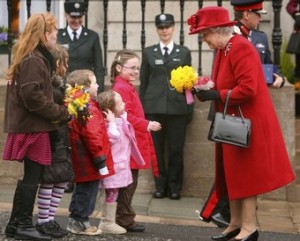
Britain’s Queen Elizabeth II (R) receives flowers from children as she departs St Patrick’s Cathedral in Armagh, Northern Ireland, March 20, 2008. The Queen handed out Maundy Thursday alms purses to 82 men and 82 women, the presentations are in recognition of their services to both church and community.
(1) Kelley, Kitty. The Royals. (New York: Warner Books, 1997)
(2) Dampier, Phil and Walton, Ashley. What’s In The Queen’s Handbag: And Other Royal Secrets. (Brighton, England: Book Guild, 2007)
For more on Queen Elizabeth, look in the left column under “Categories-People-Queen Elizabeth II.” I’ve written many posts on the Queen; I hope you enjoy them!





 In a previous post, “
 From a parking ticket found inside the glove box of the abandoned van, the L.A.P.D. was able to locate the safe house. The next day, May 17,














 Lisa's History Room

