Feeds:
Posts
Comments

Posts Tagged ‘biographies of women’

Carolyn King Waller

Carolyn King Waller

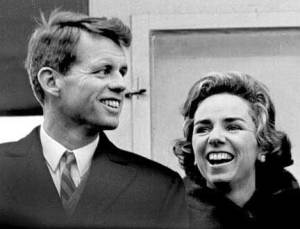
Lisa: Carolyn, today let’s dish on Ethel Kennedy. What were you telling me about her anger?

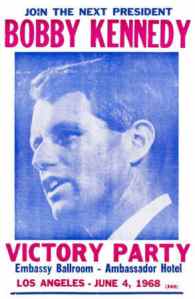
Bobby Kennedy California Primary Victory Party at the L.A. Ambassador Hotel, June 5, 1968, the night of his assassination

Bobby Kennedy California Primary Victory Party at the L.A. Ambassador Hotel, June 5, 1968, the night of his assassination

Carolyn: She loved Bobby so. She urged him to run for the presidency in 1968 and then, of course, he was assassinated. Jackie (Kennedy) had said that the same thing that had happened to Jack (murder) would happen to Bobby, but Ethel wouldn’t listen, and Jackie was right. But Ethel was the chief component in having Bobby run. She was extremely ambitious for Bobby. When Bobby started to run, Jackie said, “Oh, we’ll be in the White House again!”
And Ethel said, “Who is this we?”
Ethel’s anger was displaced when Bobby died. She was more Kennedy than Kennedy. Kennedys were always told not to show anything but courage to the outside world. Ethel couldn’t show the world that she was in private anguish over the loss of her beloved Bobby after he died. So she had displaced anger that she vented on her oldest sons: Joseph, Bobby Jr., and David – David had a drug problem but that had a lot of reasons to it. Bobby Jr. and Joseph got the worst of her wrath.
She pretty much let those kids run wild. She made them not want to be at home because she was raging. They became homeless in Hyannisport and Hickory Hill. They didn’t have a place to sleep at home. She sent them away the summer Bobby died. They were unwelcome at Ethel’s house. Some of the Kennedy elders kept their children away from Ethel’s kids because they were so wild. Ethel lived an unexamined life.

Lisa: Explain.

Carolyn: She never said I’m so angry, I’m so sad. She whaled into her older sons. She beat them with a hair brush. She sublimated her sadness. She had a black rage. For example, years earlier, when she found out that (actor) Paul Newman had become a supporter of Kenneth Keating of New York, a rival of Bobby Kennedy’s, she got mad. On a pretext, she invited Paul to play a friendly game of tennis with her.

Paul Newman

Paul Newman

LaDonna Harris witnessed the match:
“From the moment they got on the court, Ethel wouldn’t let up on Paul. Ethel has an unhealthy kind of competitiveness, a masculine kind of meanness. She told him he was a lousy player. She teased him nonstop….He just didn’t know how to deal with it. He finally walked off the court. He had tears in his eyes.” (1)

Carolyn: Ethel had a quirky sense of humor. She used live frogs for centerpieces at her dinner parties. People got pushed into swimming pools at her parties.

Bobby and Ethel Kennedy

Bobby and Ethel Kennedy

I think she called Lyndon Johnson Uncle Cornpone. I think she looked for weaknesses in others and then hurt them with it. I think the whole point here is that Ethel had displaced anger, her early years – she grew up in an atmosphere of too much liquor, bad upbringing – they let them run wild. They drove fast. Had a lot of money. She was ruthless. Bobby, too. But he was kinder. He liked children and animals. But not Ethel. She was cruel. Bobby was spiritual. He had a good side; he was a fine father. His kids somewhat fell apart when he died because they needed his nurturing. Bobby was the nurturer; that’s it.

(1) Oppenheimer, Jerry. The Other Mrs. Kennedy. (New York: St. Martin’s Press, 1994)

To read more on the Kennedys on this site, scroll down the right sidebar to “Categories – People – Kennedys.”

Read Full Post »

Imelda Marcos at 77

Imelda Marcos at 77

In 1986, the Marcos regime of the Philippines was overthrown in a people’s revolt and the dictator Ferdinand and wife Imelda Marcos were forced to flee the Malacañang Palace. (See last post.) Imelda fled wearing her espadrilles. Because she was flying to Hawaii in an American helicopter provided by U.S. President Reagan and paid with American tax dollars, she was unable to take her enormous wardrobe. In the palace closet, she left behind between 2 and 3 thousand shoes. Imelda Marcos was the First Lady of the Philippines, a country deep in poverty. The outrage was immediate and the news went international. President Marcos’ successor, Corazon Aquino, ordered many of Mrs Marcos’ shoes to be put on display as a demonstration of her extravagance.

In 1988, the band Big Audio Dynamite wrote this song about Imelda Marcos and her enormous collection of shoes. Click below to hear:

2000 ShoesArtist: Big Audio Dynamite

Phillipine star greedy girl
Took the money to buy the world
First a little then the lot
Others’ needs were soon forgot
Heard you like a love song
This here one is just for you
In keeping with your taste we hope
It’s called 2000 shoes

Never had a conscience
Or any moral views
Even any kind of taste
Just 2000 shoes
If I had the world to sell
Could strike a deal with you
I know you haven’t got the cash
Just 2000 shoes

Catwalk at the embassy
Supplied by human rights
Qadahafi and George Hamilton
Mao Tse Tung and disco lights

Never had a conscience
Or any moral views
Even any kind of taste
Just 2000 shoes
If I had the world to sell
Could strike a deal with you
I know you haven’t got the cash
Just 2000 shoes
2000 shoes

Phillipine star greedy girl
Took the money to buy the world
First a little then the lot
Others’ need were soon forgot
Heard you like a love song
This here one is just for you
In keeping with your taste we hope
It’s called 2000 shoes

So here it is Imelda
Sorry it’s the blues
Would have done it different
If I were in your shoes

Never had a consience
Or any moral views
Even any kind of taste
Just 2000 shoes
If I had the world to sell
Could strike a deal with you
I know you haven’t got the cash
Just 2000 shoes
2000 shoes

The world's bestknown shoe collector, former Philippine First Lady Imelda Marcos, has opened the Marikina City Footwear Museum in Manila in which most of the exhibits are her own footwear.

The world's best-known shoe collector, former Philippine First Lady Imelda Marcos, has opened a museum in which most of the exhibits are her own footwear.

But that wasn’t the end of the story. In 2001, Imelda returned to Manila in the Philippines, reentered politics (although still facing corruption charges for looting the national coffers for over 20 years), and opened a shoe museum to house some of her shoe collection. “They went into my closets looking for skeletons, but thank God, all they found were shoes, beautiful shoes,” a smiling Mrs. Marcos said that year, wearing a pair of locally made silver shoes for the day. The exhibits include shoes made by such world-famous names as Ferragamo, Givenchy, Chanel and Christian Dior, all size eight-and-a-half.

“More than anything, this museum will symbolise the spirit and culture of the Filipino people. Filipinos don’t wallow in what is miserable and ugly. They recycle the bad into things of beauty,” she said.

Imelda Marcos is a classic example of a person who, when life hands you lemons, you make lemonade.

.

Read Full Post »

eugenie
As mentioned in yesterday’s post, Mary Todd Lincoln slavishly followed the fashion lead of the Empress Eugénie, Empress Consort of France (1853-1871), the wife of Napoléon III, Emperor of the French. The empress’ style was reported in detail by the Vogue magazine of the day, Godey’s Lady’s Book. In 1860, age 32, the Empress Eugénie was considered one of the most beautiful women in Europe. At a ball, she outshone all other women. It was said that every man was in love with her. Her friend, the Princess de Metternich recalled that, on one occasion, the empress was

“attired in a white gown spangled with silver and dressed with her most beautiful diamonds. She had carelessly thrown over her shoulders a sort of burnous of white embroidered with gold, and the murmurs of admiration followed her like a trail of lighted gunpowder.”

In 1862, the Empress Eugénie set the fashion world on fire. She appeared at the races, one of the biggest social events of the year, without a shawl, a bold move for a society woman, especially for an empress. She was wearing an elegant, off-the-shoulder gown by the very up-and-coming couturier Charles Frederick Worth, an Englishman who had recently opened the haute couture shop, “The House of Worth,” in Paris. The empress did not want the lovely gown hidden from view. The world of fashion took note. “The streets of Paris were soon buzzing with ladies without shawls.”

From her childhood days, Mary Todd Lincoln adored being the center of male attention. Once she became the First Lady, she longed to become a fashion trend setter. Ignoring the dowdy style of the English Queen Victoria, she modeled herself after Empress Eugénie, sticking flowers in her hair and bodice, piling on the jewels, and opting for expensive gowns that dipped in the bust and shoulder. Husband Abraham Lincoln called Mary’s dresses her “cat-tails.” Mary tried hard to be fashionably dressed but she was generally displeased with the result; the hooped dresses and yards of fabric swamped her short frame and the excess jewelry and ornamentation was overwhelming.

Mary Todd Lincoln in a photograph by Mathew Brady, November 1861, in a heavy white silk dress onto which Washington modiste Elizabeth Keckley had sewn 60 velvet bows and countless black dots.

Mary Todd Lincoln in a photograph by Mathew Brady, November 1861, in a heavy white silk dress onto which modiste Elizabeth Keckley had sewn 60 velvet bows and countless black dots.

Mary’s departure from the high-necked muslins worn by Western women brought swift condemnation from Oregon Senator James Nesmith, a guest at an 1862 East Room reception, who wrote to his wife of the 43-year-old “weak-minded Mrs. Lincoln and her sorry show of skin and bones. She had her bosom on exhibition, a flower pot on her head – There was a train of silk dragging on the floor behind her of several yards in length.” Mary Lincoln, continued the senator, who used to “cook Old Abe’s dinner and milk the cows,” now seemed eager “to exhibit her milking apparatus to public gaze.”

Mary’s plunging necklines caught Abe’s eye, too. “Whew,” he is quoted as saying, “our cat has a long tail tonight – if some of that tail was nearer the head, it would be in better style.”

(1) Baker, Jean H. Mary Todd Lincoln. (New York: W. W. Norton & Company, Inc., 1987)

Read Full Post »

Mary Todd Lincoln, ca. 1861

When Mary and Abraham Lincoln moved into the White House in 1861, Mary was 42 years old, a time when women her age dressed in somber grays, dull browns, and boring blues. But not Mary Todd Lincoln. For her, expensive clothes were a mark of importance, of breeding. She proceeded to dress like a peacock, draping herself in bold blues, crimson, yellow, and royal purple, attracting a lot of unwanted attention and sparking criticism from the Washington social elite. Brought up among the overdressed ladies of Kentucky, her gowns and bonnets were ornamented with flowers, lace, dots, and bows sewn on yards of velvet, taffeta, and silk at a time of war when soldiers were going without blankets. Mary took her fashion cues from Eugenie, Empress of France, whose parties and clothes appeared in line drawings and detailed descriptions in one of Mary’s favorite magazines, Godey’s Lady’s Book. She was admonished for wearing low-necked dresses that revealed her “milking apparatus,” said one critic, and for the “flower beds which she carries on top of her head,” said another. A petite woman, the bell-shaped dresses overwhelmed her; hoops made her look shorter and squat.

Buoyed by a grandiose sense of self-importance coupled with her new position as the president’s wife, Mary demanded what she wanted. She expected everyone to do her bidding. She was surprised when clothing merchants sent her bills. The line between purchase and donation was fuzzy. Mary looked for donors to buy her gowns and hats, rewarding them with political favors. When she blew her four-year budget for White House renovations in under a year, she contrived several plots to secretly defray her debt. In one instance, she ordered the White House gardener into selling manure from the stables at ten cents a wagonload. It raised more stink than cash. Her spending eventually came to light and became a national scandal. Lincoln was mortified and had to deal with it, all the while referring to it benignly as his beloved Mary’s silly “flub-a-dub.”

Willian's of Pennsylvania Avenue, Washington's best known milliner at the time, made Mary Todd Lincoln's bonnets. Unfortunately, he also made bonnets for Mrs. Horatio Taft.

Now, back to what we were saying about Mary and her clothing:

It was an April evening in 1861. The Marine Band was playing a concert on the White House lawn. Mary and President Lincoln had invited many guests, among them Mary Cook Taft, wife of Horatio Taft, an examiner at the U.S. Patent Office. Mary Taft was wearing a delicate straw bonnet lavishly trimmed with pretty purple ribbons embroidered with little black figures. The bonnet had long strings which tied beneath her chin in a bow. Mary Taft’s teenage daughter, Julia, accompanied her to the promenade grounds that day and vividly recalled their costumes:

“My mother, of course, wore the bonnet, together with a purple and white silk over a moderate crinoline, and lavender kid gloves. I was dressed in white Swiss, much beruffled, but without hoop skirt or crinoline, which was an abiding grievance with me. But my hat…was very gratifying and almost compensated for the lack of crinoline.”

Women’s Fashions 1860

Mary and Julia walked around mingling with the other guests while the band played on. The national anthem brought those in chairs to their feet, men doffing their hats, and all standing in patriotic attention. At the close of the concert, the Taft women walked over to the south front where the presidential party was sitting, to pay their respects. Mary Lincoln could not take her eyes off Mary Taft’s bonnet. Julia recalled what happened next:

Julia Taft, undated photo

“After a few words of greeting, [Mrs. Lincoln] took my mother aside and talked with her for a moment. While I could not hear their conversation, I knew someway that they were talking about my mother’s bonnet and I was a bit puzzled at the look of amazement on my mother’s face. I did not see why my mother should look so surprised at a passing compliment from Mrs. Lincoln.”

Mary Lincoln wanted the purple strings off Mary Taft’s bonnet and asked for them. Mary Taft was angry—she loved her bonnet with its pretty purple ribbon— but what could she do? Mary Taft’s husband was a government appointee. Mrs. Lincoln could get him fired and then how would they pay for Julia’s private Washington school? So, begrudgingly, Mrs. Taft agreed to give up her ribbons to “Madam President” as Mary Lincoln requested to be called by the White House staff. 

The Washington milliner Willian sent for Mary Taft’s bonnet, removing the purple ribbons for Mary Lincoln, and sending back Mary Taft’s bonnet with new lavender ribbon. Not long after this incident, Julia, who was often in the White House as a babysitter for her little brothers, Bud and Holly, the inseparable playmates of Tad and Willie Lincoln, caught sight of Mary Lincoln wearing a purple dress and a bonnet trimmed with her mother’s purple ribbons. 

Mary Lincoln is shown with two of her four sons. Willie is to our left and Tad is to our right. Tad’s name is Thomas. He was so wiggly that he was nicknamed Tadpole. One of the Lincoln’s sons, Eddie, died when they had lived in Springfield. The eldest Lincoln boy, Robert, was studying at Harvard in 1860, the year this photo was taken.

Source: Bayne, Julia Taft. Tad Lincoln’s Father. Boston, Little, Brown, and Co., 1931.

Readers: For more on Mary Lincoln, click here.

Read Full Post »

Eva Duarte de Peron, First Lady of Argentina (1946-1952)

Eva Duarte de Peron, First Lady of Argentina (1946-1952)

At 8:52 p.m. on the night of July 26, 1952, all radio broadcasts in Argentina were interrupted for an emergency announcement: First Lady Eva Peron – “the Spiritual Leader of the Nation” – was dead of cancer at 33. All activity came to an abrupt halt. Movies stopped playing. Shops closed. Restaurants were emptied of patrons. Argentina went into mourning.

The enormous public display of grief took the government by surprise. Crowds gathered outside the official presidential residence, congesting the streets for ten blocks in any direction. In a panic to be near Eva Peron’s body when it was being moved, eight people were crushed to death in the pressing throngs and 2,000 were treated for injuries at area hospitals. The streets of Buenos Aires were overflowing with tall stacks of flowers laid in remembrance for the people’s beloved Evita. Although she never held an official political office, Eva Peron (1919-1952) was eventually given an official funeral worthy of a head of state. To the poor of Argentina, Senora Evita was a saint.

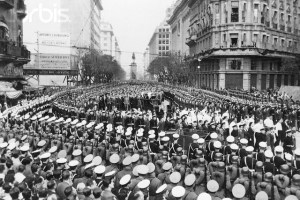
The Body of Eva Peron Being Carried Through the Honor Guard to the building of the General Labor Federation in Buenos Aires to Lie in State (Aug. 13, 1952)

The Body of Eva Peron Being Carried Through the Honor Guard to the building of the General Labor Federation in Buenos Aires to Lie in State (Aug. 13, 1952)

Before Eva had died, her husband, Argentine President Juan Domingo Peron (1895-1974), had contacted the famed embalmer, Dr. Pedro Ara, whose work was referred to as “the art of death,” to preserve Eva’s body. Dr. Ara’s technique of replacing the corpse’s blood with glycerine, which preserved all organs, created a lifelike appearance. Eva weighed only eighty pounds at death and was severely burned from radiation treatments but Dr. Ara was able to recreate her former beauty and give her an embalmment equal to that of Lenin. It has been suggested that Dr. Ara fell in love with Eva’s body. Plans were made to build a marble monument to Evita’s honor larger than the Statue of Liberty. During the construction her embalmed body lay in state for two years.

Then President Peron was overthrown and the body of Eva Peron stolen. For sixteen years, the whereabouts of Eva’s body remained a mystery. Juan fled to Spain in exile. Finally, in 1971, Eva’s body was discovered in a grave under a false name outside of Rome. It was exhumed and flown to Spain where Juan Peron kept the corpse in an open casket on the dining room table in his villa. Juan was now married to third wife Isabel who combed the corpse’s hair in a daily devotion and, at Juan’s request, was rumored to occasionally lie inside the coffin next to Evita to absorb some of her political magic.

In 1974, Juan returned to power as president of Argentina. Upon his death, wife Isabel succeeded him. Isabel returned Eva’s body to Argentina where it was briefly displayed next to Juan’s body.

Bodies of Juan and Eva Peron Lying in State (c. 1974-76)

Bodies of Juan and Eva Peron Lying in State (c. 1974-76)

Isabel was overthrown in 1976. The new military leaders had Eva Peron’s body safely buried in the Duarte family tomb under three plates of steel in the Recoleta Cemetery in Buenos Aires. The tomb was said to be secure enough to withstand a nuclear attack or a restless corpse.

Now read “Eva Peron’s Restless Corpse Part 2.”


Read Full Post »

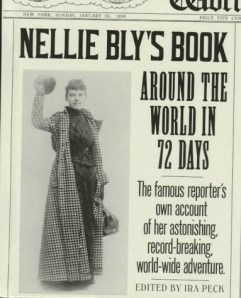
Upon return from her trip around the world, Nellie published an account of her travels

Upon return from her trip around the world, Nellie published an account of her travels

When we last left Nellie Bly, it was November 14, 1889 (see blog entries for Feb. 11 and 12) and she had just departed New York  for Southhampton, England, on an ocean steamer. In the next thirteen days, Nellie crossed the Atlantic, took a train to London, a boat across the English Channel to Calais, France, and a train through France and Italy. In Brindisi, Italy, she caught another steamer for China, the Victoria. Along the way, she wrote an account of her travels and cabled them back to her editor at the New York World for publication. The trip caused a sensation back home as readers followed her adventures with relish. 

Thirteen days into her journey, the steamer Victoria anchored at Port Said, Egypt, to take on coal.  Nellie and her fellow passengers gathered on deck and gazed out on a wide, sandy beach and a few  uninteresting houses. They gladly welcomed a change of scenery, though, and looked forward to some time on shore. Here is her account of that experience as recorded later in the book she wrote upon her return, Around the World in Seventy-Two Days:

Before the boat anchored the men armed themselves with canes, to keep off the beggars they said; and the women carried parasols for the same purpose. I had neither stick nor umbrella with me, and refused all offers to accept one for this occasion, having an idea, probably a wrong one, that a stick beats more ugliness into a person than it ever beats out.

Hardly had the anchor dropped than the ship was surrounded with a fleet of small boats, steered by half-clad Arabs, fighting, grabbing, pulling, yelling in their mad haste to be first. I never in my life saw such an exhibition of hungry greed for the few pence they expected to earn by taking the passengers ashore. Some boatmen actually pulled others out of their boats into the water in their frantic endeavors to steal each other’s places. When the ladder was lowered, numbers of them caught it and clung to it as if it meant life or death to them, and here they clung until the captain was compelled to order some sailors to beat the Arabs off, which they did with long poles, before the passengers dared venture forth. This dreadful exhibition made me feel that probably there was some justification in arming one’s self with a club.

Our party were about the first to go down the ladder to the boats. It had been our desire and intention to go ashore together, but when we stepped into the first boat some were caught by rival boatmen and literally dragged across to other boats. The men in the party used their sticks quite vigorously; all to no avail, and although I thought the conduct of the Arabs justified this harsh course of treatment, still I felt sorry to see it administered so freely and lavishly to those black, half-clad wretches, and marveled at their stubborn persistence even while cringing under the blows. Having our party divided there was nothing to do under the circumstances but to land and reunite on shore, so we ordered the Arabs to pull away. Midway between the Victoria and the shore the boatmen stopped and demanded their money in very plain and forcible English. We were completely at their mercy, as they would not land us either way until we paid what they asked. One of the Arabs told me that they had many years’ experience in dealing with the English and their sticks, and had learned by bitter lessons that if they landed an Englishman before he paid they would receive a stinging blow for their labor.

Read Full Post »

cartoon-nellie-around-the-worldYesterday, you will recall, we followed famed stunt reporter Nellie Bly as she tried to convince her editor to let her make a journalistic trip around the world in less than 80 days. Perhaps you noticed that I left out some information in yesterday’s post. I wrote that Nellie Bly’s New York World editor had two objections to sending her on the trip yet I proceeded to list only one of them for my readers, that, for such a journey, her editor thought she needed a male protector.
This is what Nellie recalled her boss having said that day:

“It is impossible for you to do it,” was the terrible verdict. “In the first place you are a woman and would need a protector, and even if it were possible for you to travel alone you would need to carry so much baggage that it would detain you in making rapid changes. Besides you speak nothing but English, so there is no use talking about it; no one but a man can do this.”

Nellie vigorously objected and her editor relented, eventually warming to the idea. A year passed before any more was spoken about it. Then one cold evening, Nellie was summoned into her editor’s office. When she entered, he looked up from the paper he was writing and asked her, “Can you start around the world day after tomorrow?”

“I can start this minute,” she replied without hesitating. She recalled his second objection, that she would travel with too much baggage, and set out to conquer that problem.

Early the next morning Nellie went to a dressmaker and ordered a custom dress to be made for her immediately. The dressmaker was at her service instantly. Nellie explained to him that she needed a traveling outfit that could stand constant wear for three months. She  was planning to go around the world in only one dress! After looking at several materials, the dressmaker selected two sensible fabrics: a plain blue broadcloth and a plaid camel’s hair. That afternoon, Nellie had her first fitting at 1:00, her second fitting at 5:00, and the dress was ready.

Nellie could then turn her attention to packing. She had bought one hand-bag and was determined to confine her baggage to its singular limit. “Packing that bag was the most difficult undertaking of my life….”

In her hand-bag, she packed:

two traveling caps, three veils, a pair of slippers, a complete outfit of toilet articles, ink-stand, pens, pencils, and copy-paper, pins, needles and thread, a dressing gown, a tennis blazer, a small flask and a drinking cup, several complete changes of underwear, a liberal supply of handkerchiefs and fresh ruchings and most bulky and uncompromising of all, a jar of cold cream to keep my face from chapping in the varied climates I should encounter.

That jar of cold cream was the bane of my existence. It seemed to take up more room than everything else in the bag and was always getting into just the place that would keep me from closing the satchel. Over my arm I carried a silk waterproof, the only provision I made against rainy weather.

She was given 200 lbs in English gold and Bank of England notes. She carried the gold in her pocket. The Bank of England notes she carried around her neck in a chamois-skin bag. She also took some American gold and paper money to see if it could be used at foreign ports. Her passport was in order. As she was traveling without an escort, a friend suggested that she carry a revolver, but Nellie refused to arm herself, saying she had a “strong belief in the world’s greeting” for her.

On November 14, 1889, Nellie Bly set sail from New York for Southhampton, England, on the ocean steamer, the August Victoria.

Read Full Post »


Nellie Bly

Nellie Bly

In 1888, stunt journalist Nellie Bly (see other entries in “Categories – Nellie Bly” in right sidebar) convinced her boss, the editor of the New York World, to send her on a trip around the world alone. She bet him that she could do it in eighty days or less. Where had she gotten this hairbrain scheme? From a book by Jules Verne, Around the World in Eighty Days. She was always getting wild and crazy ideas for her newspaper stories. Remember, of course, that the year before she had posed as an lunatic to get committed to an insane asylum. She had also posed as an unwed mother to expose the black market baby adoption rackets.

Nellie’s editor liked her idea but had two concerns. He thought she would need a male protector, that she shouldn’t travel alone.

 “Very well, start the man,” she said, “and I’ll start the same day for some other newspaper and beat him.”

Her editor got the idea. He couldn’t afford to let Nellie Bly quit his paper and go to work for a rival. New York newspaper competition was fierce and Nellie Bly’s articles dramatically boosted circulation for the World. He gave her the assignment.  A year later she was ready to go.

Next: Nellie in Egypt

Read Full Post »

Regarding some of my recent posts on insane asylums (see sidebar, “Categories: The Insane Asylum”), my neighbor and friend, Karen O’Quin, wrote:

I really liked your blog – thanks for sending!!  I see a theme there.  My experience with Austin State Hospital is that when I first started working at Travis State School in 1967, they only had men there – they called them “boys”.  Some had been there for years as they had been admitted to ASH long before because they were a little “weird” and then became too institutionalized to be let out.  They did not have IQs consistent with mental retardation.  Some were later placed in group homes.  I don’t know if you’ve read Mary, Mrs. A Lincoln, but it is her account of being committed to a lunatic asylum by her son, Robert.  Someone very recently found letters she had written to her attorneys from the asylum.  I think they were going to be a book, too. 

Mary Lincoln (1818-1882)

Mary Lincoln (1818-1882)

When I was young, I remember my mother talking about Mary Todd Lincoln, wife of Abraham Lincoln, and her inappropriate and extravagant spending sprees during the depth of the Civil War. Above all I remember Mom mentioning that Mary had a collection of about 300 pairs of gloves. Thinking about it now, it reminds me of Imelda Marcos, wife of the president of the Philippines, Ferdinand Marcos, and her closet rack of 2700 pairs of shoes.

Mary Todd and Abraham Lincoln came together as husband and wife from two very different worlds. Mary was pampered and rich; Abraham was tested and wise. Both were prone to depression but it was Mary, with her fragile mind, perhaps schizophrenic or bipolar, who finally cratered under the constant barrage of grief and loss that became her sad lot in life.  Three of her sons died while her husband was president during a bloody and acrimonious civil war. The hate mail sent to her husband was unbelievable. Then her beloved Abraham, her anchor, was assassinated. It was more than Mary could bear. She descended into madness.

She began to wander hotel corridors in her nightgown, was certain someone was trying to poison her, complained that an Indian spirit was removing wires from her eyes, and continued her frantic spending, purchasing yard after yard of elegant drapery when she had no windows in which to hang it. (PBS American Experience: “The Time of the Lincolns”)

The doctors treated her with laudanum which gave her hallucinations, eye spasms, and headaches. She began to behave bizarrely, creating a public scandal. Her only surviving son Robert, a practicing attorney, arranged an insanity trial and had her committed to the asylum Bellevue Place just outside Chicago. Although Mary was only hospitalized for three months, she never forgave Robert for the humiliation and deprivation.

A recently published book, The Madness of Mary Lincoln by Jason Emerson, awarded “Book of the Year” by the Illinois State Historical Society in 2007, examines Mary’s mental illness. The book is based on a rare find – a trunk of letters found in the attic of Robert Lincoln’s lawyer. They contain the lost letters written by Mary during her stay in the asylum. The book sheds light on the ongoing mystery of Mary’s mental illness, its nature, roots, and progression, and suggests that Abraham Lincoln had some understanding of it and provided stability.

Read Full Post »

I was thinking it was time for a good ghost story. I was tossing around some ideas in my head when I recalled something I’d seen on TV as a child. Of course we didn’t have any Discovery Channel back then, but the program was definitely a documentary type. It featured haunted houses and the people who lived in them. I remember the narrator talked with a family who lived in a house in which a rocking chair rocked with no one sitting in it. That felt a little hokey so I wasn’t spooked. It was when the narrator interviewed a person I recognized that I scooted to the edge of my seat.

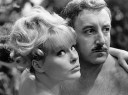
Sommer and Sellers in "A Shot in the Dark" (1964)

Sommer and Sellers in "A Shot in the Dark" (1964)

It was the beautiful, blonde, and sexy Hollywood actress Elke Sommer (b.1940). She was familiar to me because she had played the voluptuous maid Maria opposite Peter Sellers in the second Pink Panther movie, “A Shot in the Dark” (1964), which ReadersDigest.com names as one of the top funniest 50 films of all times. If you haven’t seen it, you should. Bumbling Inspector Clouseau (Sellers) trails after Maria whom he suspects of committing multiple murders, one of which is in a nudist camp.There’s a hilarious scene of Maria and Clouseau fleeing through Paris naked.a-shot-in-the-dark-movie-poster

Anyway, Elke and her husband Hollywood columnist and Bogart’s best friend Joe Hyams (1923-2009) lived in Benedict Canyon in North Beverly Hills. They claimed that a ghost was living in their house. My husband Tom also remembers seeing the same show when he was young.  “They (Elke and Joe) had a ghost in their dining room,” he recalled. “The chairs would move around at night. They would put marks on the floor below the chairs before they went to bed, then, the next morning, they’d look, and the chairs wouldn’t be standing on the marks anymore. The chairs would be all over the place.”

In the middle of the night, Elke and Joe would wake up to what sounded like a dinner party going on downstairs in the dining room, hearing voices, chairs scooting, glasses tinkling, and silverware clanging. Yet they would go downstairs and no one would be there. Elke said, “Things would move all the time and it would be very noisy and (it was) the usual poltergeist nonsense, you know.” (1) The ghost was described as being a middle-aged man wearing a white shirt. (2)

After battling the spirits with no relief, they called in some help, contacting the Parapsychological Institute at UCLA. When Life photographer Allan Grant arrived at the house to take some pictures, he was a sceptic – but not so when he left. He said:

Something happened that spooked me. On one roll of film that I shot in a particular room where they first spotted the ghost there were about four or five frames of film that were progressively fogged down to the end of the frame, giving it a ghostlike appearance, especially (of) Joe Hyams, who was in the shot. When that was processed and I took a look at it, I thought, there’s no way that would happen…in the center of a roll…something else had happened that I couldn’t explain and I’ve spent years as a photographer and that had never happened to me before….Something did happen in that house. (1)

The haunting continued. A mysterious fire erupted one night. Fortunately, Joe and Elke were able to get out through a window. Shortly thereafter, they moved out of the house permanently. (1) Joe Hyams wrote a book about it called The Day I Gave Up the Ghost. Evidently, though, the ghost didn’t give up. The “severely haunted house” at 2633 Benedict Canyon “was bought and sold more than seventeen times since Sommers vacated it, and many have reported ghostly phenomena.” (3)
 

(1) youtube interview: “Actress Elke Sommer with a Poltergeist.”
 http://www.youtube.com/watch?v=NRLasAUl-eI
(2) California Paranormal Travel Guide.
http://www.haunted-places.com/californ.htm
(3) Ghosts of Hollywood: Celebrities Who Have Seen Ghosts. http://paranormal.about.com/cs/trueghoststories/a/aa022304_3.htm

Read Full Post »

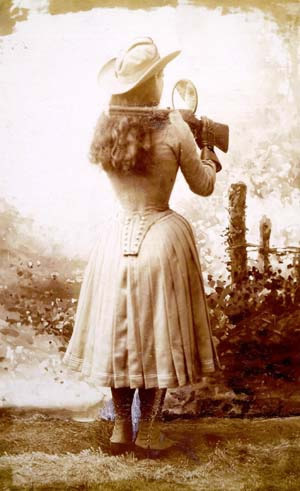
Expert Markswoman Annie Oakley performing her famous mirror trick
Expert Markswoman Annie Oakley performing her famous mirror trick (see Jan. 16 blog entry)

Aim at a high mark and you will hit it. No, not the first time, not the second time and maybe not the third. But keep on aiming and keep on shooting – for only practice will make you perfect. Finally, you’ll hit the bull’s-eye of success.
-Annie Oakley (1860-1926)

Chief Sitting Bull, whose army had defeated Custer’s troops at the Battle of Little Big Horn in 1876, was so impressed with Annie Oakley’s amazing precision with a shotgun that he gave her an Indian name, Watanya Cecila, or Little Sure Shot.

Annie Oakley was one of the first people to be filmed by Thomas Edison, inventor of the motion picture camera. (1) This 80-second film from late 1894 shows Annie firing a rifle 25 times in 27 seconds and shooting glass balls tossed in the air by manager husband Frank Butler. View a clip of it here:

http://www.youtube.com/watch?v=XN85Nj_bfQo

(1)Macy, Sue. Bull’s-Eye. National Geographic Society: Washington, D.C., 2001.

Read Full Post »

victorian-silhouetteIn Nellie Bly’s book, Ten Days in a Mad-House (see category, “Nellie Bly,” for related posts), Nellie Bly described various women she met in the Blackwell Island Women’s Lunatic Asylum. She was confined to Hall 6 with 45 of the least dangerous women in the institution. While some of them were certifiably “crazy,” (her words), many, she felt, had been wrongly locked up. A Frenchwoman, for example, named Josephine Despreau, fell sick in a boarding house and the woman of the house called in the police. They arrested her and took her to the station-house. She didn’t understand the proceedings because of the language barrier and the judge paid no attention to her protests. She was locked up in the insane asylum in no time.

Well into the twentieth century, it was easy to get a woman locked up in a mental institution. It was not unheard of for a man to tire of his wife in favor of another woman and get his wife declared insane and committed to an insane asylum. I was remarking upon this horror the other day and my mother told me that my great uncle Sam P did this very thing to his wife Helen. He had her committed to an asylum in San Antonio. Helen found a way out, though, and slipped away to Corpus Christi to live with her sister.

Do any of you have any asylum stories to share?

Read Full Post »

Carolyn King Waller

Carolyn King Waller

My mother Carolyn King Waller stopped by Lisa’s History Room this afternoon for a little chat. Carolyn was born in Corpus Christi, Texas, in 1934. She has a mind like a steel trap; her ability to recall stories from the past is legend.

Lisa: Thanks for stopping by today, Mom. Everyone knows that you love history. What would you say is your favorite period?
Carolyn: Probably the World War Two years, 1941 to 1945. And of course World War Two for other countries was longer that. 1941 to 1945 were America’s war years.
Lisa: And why is that your favorite period?
Carolyn: The fate of the world hung in the balance. It was a lot of drama – really, truly, good against evil.
Lisa: So it fascinates you.
Carolyn: I’m not the only one…others are fascinated by it still…of course, we didn’t know about the Jews being exterminated, 6 million…then the Stalin thing…Stalin moved in from the east, we (the Allies) moved in from the west. The countries that Stalin occupied in the east became known as the countries behind the Iron Curtain. Churchhill coined the phrase. The poor people who had been under Germany were then under Russia! We didn’t really free them. The people in those countries had no freedom. We slowly woke up to who Stalin was. The Russians never left, including East Berlin, so World War II strengthened the Russians, it helped one problem, it created a worse one though, by increasing the strength of the Communists. Roosevelt was blamed for that but there wasn’t much he could do. It was said that Roosevelt gave too much away to Stalin at the 1945 Conference of Yalta,

1945 Conference at Yalta

1945 Conference at Yalta

but there really was very little he could do about it. They (the Communists) were there – they had occupied Eastern Europe – they had “boots on the ground.” We didn’t know then that Stalin had murdered millions of his own people, that he was a monster. In the early days, Truman even said, “I like Old Joe.”
Lisa: What else makes it an interesting period?
Carolyn: Outsized personalities of Hitler, Stalin, Roosevelt, and Churchhill – huge . Churchhill was a fabulous orator, Roosevelt knew about ships, had knowledge of the military, selected good generals. Hitler was a poor strategist; he entered all those countries at once. He told the generals what to do but he wasn’t good at military strategy. He was just a madman.
Lisa: To learn more, are there some books you would recommend?
Carolyn: Books about the period abound, certainly the biographies of those four men, stories of the war itself would be good.
Lisa: Does a particular book come to mind?
Carolyn: Kennedy’s thesis that became a book, While England Slept, No Ordinary Time, the Churchill bios by William Manchester – The Last LionA Man Called Intrepid
Lisa: What films capture the flavor and the truth of the war?
Carolyn: “The Best Years of Our Lives” showed the problems of returning servicemen from the war. “Edge of Darkness,” with Errol Flynn and Ann Sheridan depicts the Norwegian struggle. Norway was given away by the Quisling leader. The Norwegians had to fight Germany in an underground movement. There may be another movie, “A Moon is Down,” by John Steinbeck about occupied Norway, but I’ve not seen it.
Lisa: What else?
Carolyn: “Escape” which was a book by Ethel Vance, with Robert Taylor and Norma Shearer; “Night Train to Munich,” with Rex Harrison; and, of course, “Casablanca; “Ministry of Fear,” with Ray Milland; “Cloak and Dagger,” with Gary Cooper and Lily Palmer,night-train-to-munich “Watch on the Rhine,” with Bette Davis and Paul Lucas, and “OSS,” with Alan Ladd. All of those are great movies.
Lisa: What was it like to be a young girl in the war years?
Carolyn: In elementary school, our room would get the American flag for the week if our class bought the most war stamps and bonds that week. The classes competed to have the flag on display at the front of the room. It was a big deal. I was at Fisher School two years. Stamps were ten cents, bonds were $18.75 redeemable in ten years for $25. You had a book of stamps and you would try to fill the book with stamps. You would turn in a certain amount of stamps to redeem for a bond. That paid for the war! My grandparents sold cattle during the war years and they gave me money to do it because I was always a big stamp buyer. The government was smart to do that. It was an easy way for the government to get money from the citizens to finance, to fight the war. So many (citizens) had schoolchildren. While boys – women and men were fighting and dying in the war around the world – I was a young girl busy doing cartwheels in the front yard and joining little clubs – I was totally isolated. I didn’t know anyone who died in the war.
Lisa: Changing the subject, you wanted to say something about (actress) Carole Lombard.

Carole Lombard and Clark Gable

Carole Lombard and Clark Gable

Carolyn: Yes. Japan attacked us on Dec. 7, 1941. In January 1942 Carole Lombard went on a war bond tour – to Indiana I think. She wanted to get home to see (her husband and actor) Clark Gable afterward, in a hurry, because they had had a fight over Lana Turner. She insisted on flying out to California late at night when it was dark and foolish to fly over the Rockies. She should have waited for a better plan but she insisted on flying out. She crashed in her plane in the Rockies. She was only 33. All they found of her were her earrings. Clark went to the scene and was distraught. He was always a good drinker, but he isolated himself for a few days afterward or so and drank heavily before he came back out. Roosevelt said she (Lombard) was one of our first casualties of the war or maybe even first hero. Before she had left, she had said to Clark Gable, “Pappy, you need to join this man’s army (meaning the United States Army).” After she died, Gable did just that; he enlisted. He was about 41. He didn’t need to sign up. They were not drafting men of his age. But he was distraught and he did it. He was made a captain or something at the top – he became brass right away – he was too important to be just a regular fellow. He may have been in the Army but he was still a celebrity.
Lisa: Was Clark Gable decorated?
Carolyn: He was stationed in Great Britain, he was an officer, he may have been in some forays over Germany.
Lisa: What will we be talking about during your next visit to Lisa’s History Room?
Carolyn: What should we talk about? Should we talk about history?
Lisa: Well, if you had something you wanted to tell, what would it be?
Carolyn: I’d tell about the depression years. We had butter beans at Mother’s, and (my grandmother) Nona cooked cheap things, rice pudding, bread pudding, onions….the hobos, I don’t want to say that, the homeless people, they would come to the back door. Nona would give them a plate of food and they would to go and sit out under a tree in the backyard and eat their food. People weren’t afraid of other people back then.
Lisa: Okay, save those stories for next time. Thank you so much for stopping by today.
Carolyn: Well, bless your heart, you make me feel like a celebrity!

Read Full Post »

annie-oakley-poster1I was just at Randall’s picking up some Haagen-Dazs chocolate ice cream for Katie, O’Doul’s for Tom, and mango sorbet for myself when I happened to glance at the magazine rack at the checkout stand. “Oprah’s Cocaine Relapse!” shouted the headline on the National Enquirer. “Stedman furious as her secret lover TELLS ALL. PLUS: THE SHOCKING VIDEO!”
How ironic. I’d just been reading about Annie Oakley, eager to blog about her, and not sure where to start, her life is so rich with stories. Leave it to the National Enquirer to give me the nudge. I’d write about the media libel that almost took down Annie Oakley’s reputation. Who’d have thought that Oprah Winfrey and Annie Oakley would have something in common?

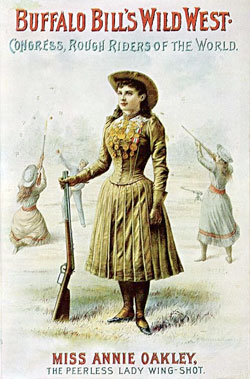
Actually, that’s not so strange. Annie Oakley (1860-1926) was, in her day, as big a superstar as Oprah Winfrey is today. As most everyone knows, Annie Oakley was to shooting what Lucille Mulhall (see last post, “America’s First Cowgirl”) was to roping. For 17 years, she received second billing as an expert markswoman with Buffalo Bill’s Wild West Show, at a time when women were largely restricted to home, church, and school. In 1887, she set sail with the troupe to England where they performed for Queen Victoria’s Golden Jubilee. For six months, they remained in Europe. Royalty from all over Europe came to see the show and Annie Oakley was one of its biggest attractions. She shot glass balls that her husband Frank Butler sent skyward. She charmed the audience with her girl-like antics. “The loudest applause of the night is reserved for Miss Annie Oakley, because her shooting entertainment is clever, precise, and dramatic,” a London reviewer wrote. (1)

Annie Oakley never walked onto the stage. She skipped in, bowing, waving, and throwing kisses. She had some thrilling riding tricks but her most famous antic involved shooting a target with the aid of a handheld mirror. She would turn her back on her target and take aim at it by looking in the mirror. Sometimes the target was an apple sitting on the head of her dog, Dave. Then she would prop her shotgun over her right shoulder, aim it behind her, and shoot without turning around. When she hit the target, when she almost always did, she would do a little jumpkick then skip happily out of the arena. The audiences loved it. If she missed the target, though, she would turn her face to the crowd and pout dramatically. The audiences loved that, too.

No doubt about it. Annie Oakley was an entertainer. But she never lost sight that she was foremost a lady. As an athlete, she might have been more comfortable in pants but she refused to wear them, considering them unladylike, and wore A-line or pleated skirts instead. Her costumes were always wholesome, her legs below her short skirt covered entirely by dark, pearl-button leggings, and her shirt longsleeved, covering neck and wrists. Her starched white blouse with its high collar gave her a prim look. She was considered by her friends as “straitlaced.” (1)

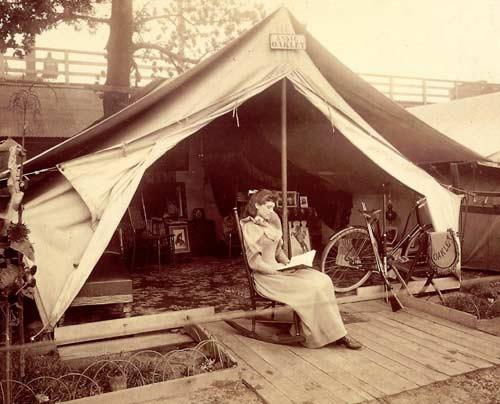
When she traveled, she and Frank shared a tent, which Annie made homey with knick-knacks, photographs, a welcome mat, and sometimes a white picket fence. Annie Oakley took great care to keep up respectability.

annie-oakley-in-tent5
So it came as a great shock to her when she learned of an article that appeared in two Chicago newspapers on August 11, 1903, smearing her good name. The papers reported that someone by the name of Annie Oakley was in a Chicago jail after pleading guilty to stealing “the trousers of a negro” to get money to buy cocaine. (2) “ANNIE OAKLEY ASKS COURT FOR MERCY–Famous Woman Crack Shot…Steals to Secure Cocaine,” screamed one headline.The bogus story was picked up by newspapers nationwide.

At the time, Annie was 42 years old and had just finished starring in The Western Girl. Any plans she may have had of continuing her acting career on the stage came to an abrupt halt. She filed lawsuits against 55 newspapers for blackening her good name. She spent the next seven years testifying in court about the damage done to her reputation by the false newspaper articles. She won 54 of the 55 lawsuits. The woman who had been arrested that August day turned out to have been an impostor posing as Annie Oakley who had confessed to the crime. Her name was Maude Fontenella. She had once performed in a burlesque Wild West show as “Any Oakley.” It was the fault of a Chicago reporter named Ernest Stout who filed the false story, saying that the police inspector had verified that the woman was the real Annie Oakley. (2) Annie Oakley was neither a thief nor a drug addict.

The scandal behind her, the verdicts just, Annie went back on the road with another wild west show, though now she wore a brown wig. Her hair had turned completely white.

I’ve read the National Enquirer on Oprah. It seems that Oprah has admitted on TV to past cocaine use. But, fortunately, in these modern times, her past indiscretion did not ruin her reputaiton.

(1) Macy, Sue. Bull’s Eye: A Photobiography of Annie Oakley. National Geographic Society: Washington, D.C., 2001.
(2) Kasper, Shirl. Annie Oakley. The University of Oklahoma Press: Norman, 1992.

Read Full Post »

Lucille Mulhall (1885-1940)

Lucille Mulhall (1885-1940)

Lucille Mulhall was an authentic cowgirl who found fame in both wild west shows and the rodeo circuit. She interests me for several reasons. For one, humorist Will Rogers began his career as a cowboy on her father Zack Mulhall’s Oklahoma ranch, later joining Mulhall’s wild west show, billed as the “Cherokee Kid.”

It was Will Rogers who claimed that the term “cowgirl” was first coined (circa 1900) to describe Lucille Mulhall and her ranch skills. Lucille is famous for many reasons, largely because she could rope and ride like none other. She could rope eight men riding abreast (1). She was the most famous cowgirl of her time, catching both Teddy Roosevelt’s eye (who invited her to the White House) and Geronimo’s (who gave her a beaded vest and a decorated bow).

But I started researching Lucille Mulhall largely because of a reference in many sources to her uncanny ability as a horse trainer. She could train horses to do things others couldn’t. Of her unique ability, Lucille Mulhall said,

My system of training consists of three things – patience, perseverence, and gentleness. Gentleness I consider one of the greatest factors in successful training….Governor, the horse I ride in our exhibitions,…has nearly forty tricks….He can shoot a gun; pull off a man’s coat and put it on again; can roll a barrel; can walk up stairs and down again – a difficult feat; is perfect in the march and the Spanish trot; extends the forelegs so that an easy mount may be made; kneels, lies down and sits up; indeed, he…does nearly everything but talk.

I’d love to have seen Governor’s tricks, especially the one when he pulls off a man’s coat. But what is unclear is whether or not Governor is pulling the coat off his own body or some man’s!

(1) Alter, Judy. Wild West Shows: Rough Riders and Sure Shots Watts: New York, 1997.

Read Full Post »

« Newer Posts - Older Posts »