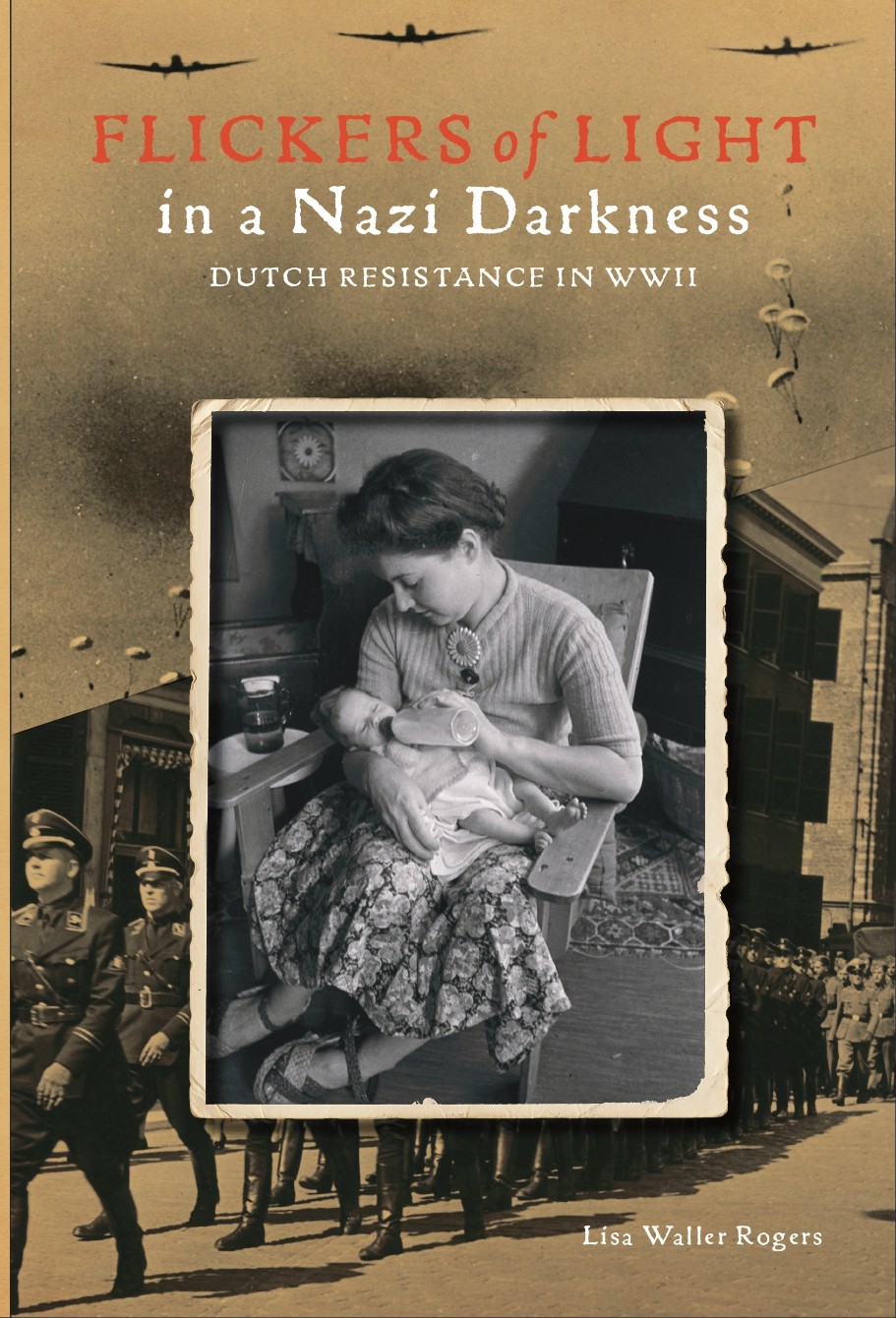
I am publishing a new book on Oct.17, Flickers of Light in a Nazi Darkness: Dutch Resistance in WWII. if you would like to read a free advanced reader copy on net galley, Follow the link at bottom.
summary:
Adolf Hitler was appointed Chancellor of Germany in 1933, marking the end of the Weimar Republic and the beginning of the Nazi dictatorship. As the tide of Nazism grew, so did anti-Jewish decrees which stripped away the rights of German Jews.
In May 1940, the Germans invaded and occupied the neutral country of the Netherlands. Little by little the Nazis took away the rights of the Dutch Jews and the only place they were safe was in their homes, until they weren’t. In 1942, Nazis conducted raids to deport them to labor and concentration camps. But not every Jew was caught. Thanks to the heroic action of Dutch resistance workers, at great risk to themselves, Dutch resistance workers hid Jews from the Nazis, and sought to keep them safe and fed through the long years of WWII. Not all of these efforts bore success, many Dutch workers were imprisoned and executed by the Nazis. Flickers of Light in a Nazi Darkness brings the story of some of these “Flickers of Light” resistance workers to life.
This children’s nonfiction book highlights ordinary individuals who chose humanity during World War II’s darkest times.
In May 1940, Nazis invaded the Netherlands, leading to severe restrictions and deportations of Jews by 1942. Dutch resistance workers emerged, risking their lives to hide families, forge documents, and provide protection. Despite many failures and sacrifices, these “flickers of light” saved lives and dignity.
Ms Rogers shares specific stories of these heroes, making their sacrifices personal while contextualizing the Nazi takeover.
The book balances historical accuracy with emotional depth, avoiding graphic details for young readers but maintaining the truth. It honors victims, celebrates resisters, and inspires hope and moral urgency.
This book fosters appreciation for freedom’s cost. Heart wrenching yet uplifting, it shows that individual bravery can shine through darkness.
**I would like to express my gratitude to NetGalley and the publisher for providing me with the opportunity to read this book in exchange for an honest review.
#ARC
#NetGalley
#FlickersOfLightInANaziDarkness
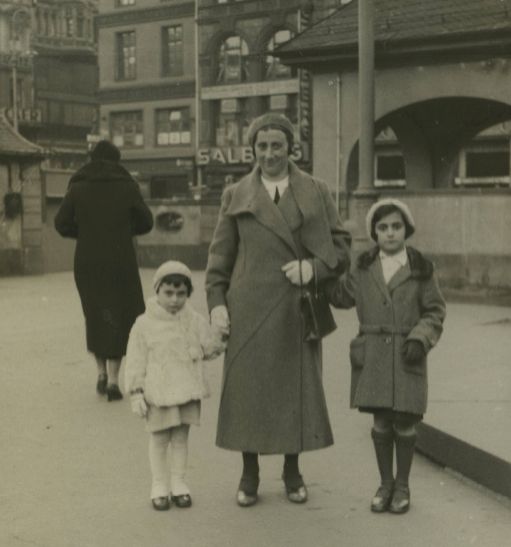
March 1933, the last picture taken of Anne, Edith, and Margot Frank in Germany, prior to emigrating to Holland. Anne is 3 years, 9 months old. They are standing in the Hauptwache square in the center of Frankfurt am Main.
I have just finished rereading Anne Frank: The Diary of a Young Girl. I was surprised to read that Anne had not been born in Amsterdam, where she hid from the Germans during World War II, but in Frankfort, Germany:
I will start by sketching in brief the story of my life. My father was 36 when he married my mother, who was then 25. My sister Margot was born in 1926 in Frankfort-on-Main, I followed on June 12, 1929, and, as we are Jewish, we emigrated to Holland in 1933….
The rest of our family, however, felt the full impact of Hitler’s anti-Jewish laws, so life was filled with anxiety.”1
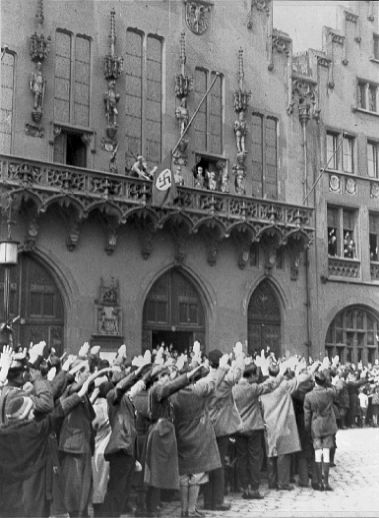
Following Hitler’s appointment as Chancellor, a Nazi flag is hoisted at the town hall in Frankfort, the Franks’ hometown in Germany. ca. January 31, 1933
Once Hitler was appointed Chancellor on January 30, 1933, Nazi Germany became too dangerous for the Franks, simply because they were Jewish.
The Nazis believed that Jews were subhuman and were bent on driving them out of Germany. The Nazi propaganda machine went full bore, inciting the German people to violence against the Jews, their neighbors and fellow citizens. At the helm were Joseph Goebbels, the Nazis’ main propagandist, and Julius Streicher.
Julius Streicher’s Nazi Party card was Number 2; Hitler’s was Number 7. Throughout the 1920s, Streicher had been a loyal agitator for Hitler. He published the rabid anti-Jewish newspaper Der Stürmer (“The Attacker”). He was believed to be a sexual pervert. In May 1933, Hitler made him chief of the Central Committee of the Defence against Jewish Atrocity and Boycott Agitation. That July, Streicher:
…had some Jews arrested and taken to a meadow to tear out grass with their teeth….A small squat man, his head shaven, he had a predilection for swaggering in public. He carried a whip, and used it.” 2
May 1934 issue of Der Stürmer, a weekly Nazi propaganda newspaper owned by Julius Streicher. This specific cover issue is notorious as an example of the anti-Semitic propaganda style of Der Stürmer. It invokes the infamous “blood libel against the Jews”, specifically the allegation that Jews were killing German Christian children and using their blood in religious rituals. The banner across the bottom of the page, “Die Juden sind unser Ungluck,’ means “The Jews are our misfortune.”
Goebbels and Streicher fomented lies about the Jews, making them the scapegoat for Germany’s poor economy and its humiliating defeat in World War I. They told the German people that the Jews were their enemies and not rightful citizens of Germany.
1933 Germany. Germans read issues of anti-Semitic propaganda newspaper, Der Stürmer, published by Nazi agitator Julius Streicher
In the first few weeks of his chancellorship, Hitler gained complete control of the police force, stripping regular uniformed police of the power to defend law-abiding citizens against unreasonable search, seizure, and arrest. He expanded the notoriously brutal Gestapo, his state secret police, and unleashed them and his other thugs with full power to seek out any suspected enemies to his leadership and detain them, without trial.
February 1, 1933. One day after Hitler becomes Chancellor, the Sturmabteilung (SA), the Nazi paramilitary group known as “the brownshirts” round up suspected Communists.
Organized attacks on Jews broke out across Germany. Since the local police had no power, the Jews had no one to turn to. Then, on April 1, 1933, the first officially-sanctioned national attack on German Jewry was held. Organized by Streicher, it called for a boycott of all Jewish businesses. Armed Nazi guards were posted in front of every Jewish business, intent upon blocking all clients from entering. The businesses were marked with yellow Stars of David, and trucks drove through the streets sporting anti-Jewish signs. Windows were shattered, business owners attacked, and stores plundered.
Hitler needed a place to stash his “enemies.” Two months into his chancellorship, he built Dachau outside of Munich, the first of many concentration camps.
Anne’s father, Otto Frank, began looking for other places for his family to live. Frank said many years later:
Because so many of my German countryman were turning into hordes of nationalistic, cruel, anti-Semitic criminals, I had to face the consequences, and though this did hurt me deeply, I realized that Germany was not the world and I left my country forever.”
Through his brother-in-law, Frank was able to set up a business in Holland. By the end of 1933, his wife Edith and daughters, Anne and Margot would join him there.
1934, Amsterdam. Margot, Anne, and their mother Edith Frank on the beach with Mrs. Schneider (back)
They were running from Hitler, but he would catch up with them later. He was not satisfied in just driving the Franks and all Jews out of Germany. He wanted to completely annihilate them. He would hunt them down across Europe and kill them until, in April 1945, the madness finally stopped.
Between 1933 and 1939, more than half of the 550,000 Jews living in Germany had fled.
1. Frank, Anne. Anne Frank: The Diary of a Young Girl. New York: Doubleday, 1952.
2. Pryce-Jones. Unity Mitford: A Quest. London: Weidenfeld and Nicolson, 1976.