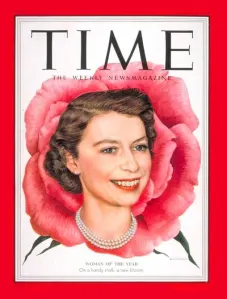
TIME magazine's 1952 Woman of the Year: Queen Elizabeth II of England (Jan. 5, 1953 cover)
In February 1952, Princess Elizabeth was touring Kenya with her husband Prince Philip, the Duke of Edinburgh when she received the bad news that her father, King George VI of Great Britain, had passed away. Thus, at the tender age of 25, Elizabeth ascended the throne to become Queen of the United Kingdom, Canada, Australia, New Zealand, South Africa, Pakistan, and Ceylon. She took the title Queen Elizabeth II although she was not a descendant of Queen Elizabeth I (1533-1603), who was the last Tudor queen. Queen Elizabeth II belongs to the Royal House of Windsor, formerly known as Saxe-Coburg and Gotha.
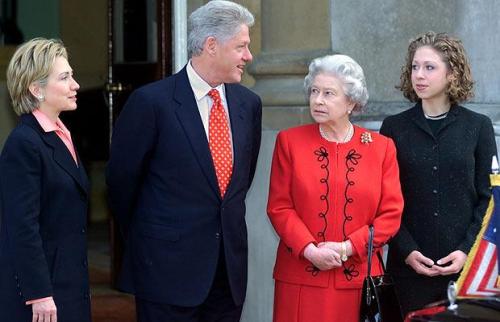
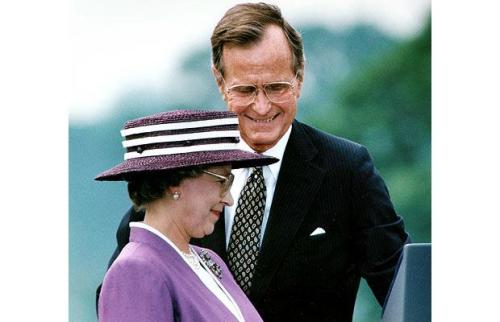
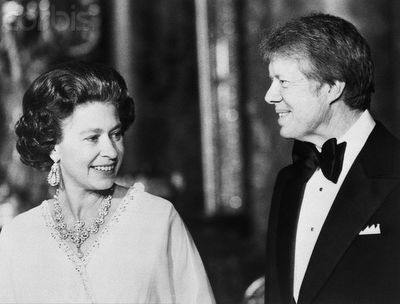
During the Queen’s reign, there have been 11 U.S. presidents. Queen Elizabeth II has met every one of them except Lyndon B. Johnson. She met Harry Truman before she became queen and Herbert Hoover when he was a former president.
Here is a photo gallery of Queen Elizabeth II and 12 U.S. Presidents:
The Queen with President Barack Obama in 2009
The Queen with President George W. Bush in 2003
The Queen with President Bill Clinton in 2000
The Queen with President George H. Bush in 1991
The Queen with President Ronald Reagan in 1982
The Queen with President Jimmy Carter in 1977
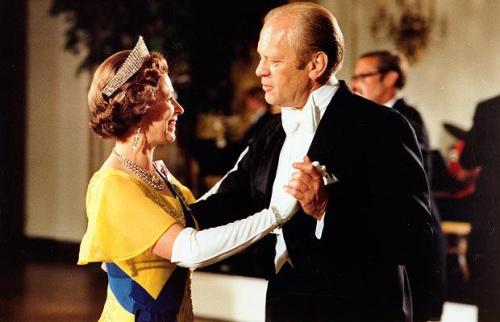
The Queen with President Gerald Ford in 1976
The Queen with President Richard Nixon in 1970
The Queen with President John F. Kennedy in 1961
The Queen with former President Herbert Hoover in 1957
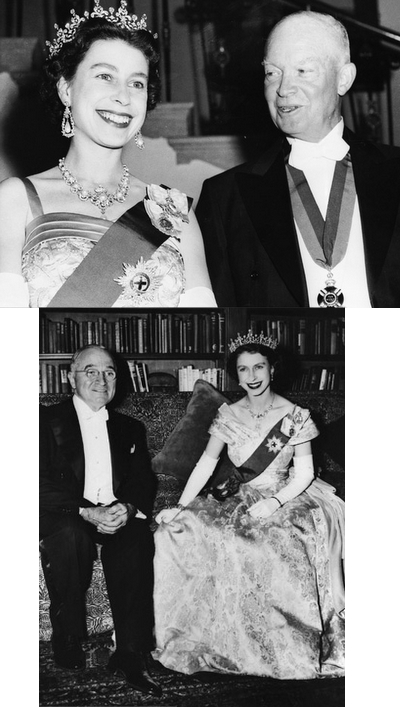
The Queen with Presidents Dwight D. Eisenhower (top) in 1957 and Harry Truman (bottom) in 1951
Readers, for more on the Queen, scroll down the right sidebar to “Categories” – “People” – “Queen Elizabeth II”
Doll maker Mattel has immortalized some of Lucy’s most famous roles by creating a line of collector Barbies. Mattel no longer makes the dolls but they are widely available for sale. One of the most popular dolls is the one shown below.
"I Love Lucy Barbie doll by Mattel: "L.A. at Last"
“Hooray for Hollywood! At least that’s what Lucy thinks in the episode L.A. at Last™. But after a disastrous encounter with William Holden at the famed Brown Derby Restaurant, she’s not so sure. Especially when Ricky invites Holden up to their hotel room to meet his biggest fan, Lucy. Mortified by her previous encounter, Lucy runs to the bedroom and disguises herself with glasses, scarf, and an oversized putty nose, which she manages to catch on fire, and then comically extinguishes in a cup of coffee! Lucy wears an authentic re-creation of the episode’s costume, which includes a black chiffon coatdress with black dots over a tan jumpsuit. Silvery dots adorn her waistband and a large bow at the collar to coordinate with her dangling earrings. She has rooted eyelashes underneath tortoiseshell glasses that rest on an over-sized, protruding nose. Curls of her signature-red hair peek out from the tan kerchief that completes her disguise.” (Mattel)
Zany Lucy Ricardo (played by Lucille Ball) from the immensely popular, long-running, classic 1950s television comedy "I Love Lucy"
Everybody has a favorite “I Love Lucy” episode and this is mine:
“L.A. at Last!”*
Lucy’s husband Ricky Ricardo is filming a picture out in L.A. and has taken Lucy and the Mertzes out to California with him. This scene opens with Lucy, Fred, and Ethel out star hunting. They are having lunch at the Brown Derby, a popular haunt for Hollywood movie stars.
As the three await their meal, Ethel mouth drops open. She is astonished to discover heartthrob William Holden being seated at the next booth. A video excerpt from “L.A. at Last!” is posted at the bottom of this post. When you view it, notice that Bill Holden asks the waiter to bring him a Cobb Salad. The Cobb Salad – now famous – was invented by the owner of the Brown Derby.
The original Brown Derby at 9537 Wilshire Boulevard was a landmark restaurant in Los Angeles, which was frequented by celebrities during the Golden Age of Hollywood. It was an example of novelty architecture, known for being physically shaped like a brown derby hat and for being the birthplace of the Cobb salad (which was named for the Cobbs, the owners of the Derby), and the home of hundreds of caricatures of celebrities.
Audrey Hepburn and William Holden from "Sabrina," 1954. The next year, "Bill" Holden makes a guest appearance on the "I Love Lucy" show. This episode, "L.A. at Last!" still in reruns, is one of the all-time favorites. At the time of the filming, Bill Holden was filming "The Country Girl" with Grace Kelly.
Now enjoy 6 minutes of Lucille Ball’s comic genius.
Photographer Annie Leibovitz doesn’t talk to her subjects when photographing them. “I certainly can’t talk to people and take pictures at the same time. For one thing, I look through a viewfinder when I work.” (1)
Butfamed photographer Richard Avedon had a different style. Leibovitz observed that Avedon “seduced his subjects with conversation. He had a Rolleiflex that he would look down at and then up from. It was never in front of his face” but next to him while he talked. (1)
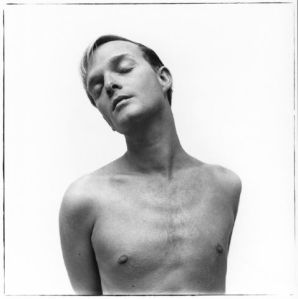
Truman Capote, author of "In Cold Blood" and "Breakfast at Tiffany's" photographed by Richard Avedon in New York City, 1955.
In this way, Avedon got what he wanted from his sitter. According to writer Truman Capote, Avedon was interested in “the mere condition of a face.”
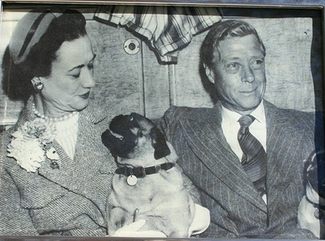
The Duchess and Duke of Windsor with one of their beloved pugs.
Some, though, felt that Avedon’s impulses had a cruel edge, showing the face in a harsh light. Here’s a case in point: In 1957, Richard Avedon scheduled a New York City appointment to photograph the Duke and Duchess of Windsor, formerly King Edward VIII of the United Kingdom and Wallis Warfield Simpson of Baltimore. The Windsors were very practiced at putting on happy, regal faces for the camera and Avedon anticipated that. As a royal pair, they were endlessly photographed since they had nothing better to do with themselves since the Duke abdicated the British throne in 1936, giving up crown and kingdom, and moving to France with Wallis.
But Avedon didn’t want that kind of stock photo of the royal pair. According to another fellow photographer, Diane Arbus, Avedon knew that the Windsors were avid dog lovers and would use this knowledge to cruel advantage.
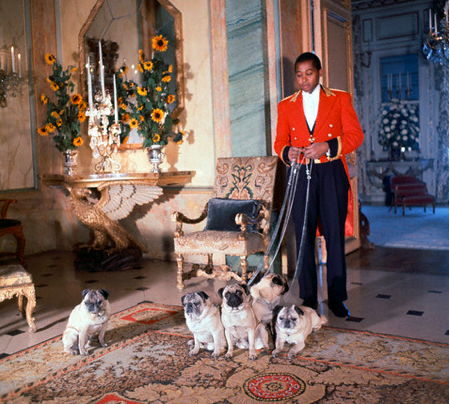
Valet in livery of the Bois de Bologne, Paris home of the Duke and Duchess of Windsor with pugs Mr. Disraeli, Mr. Chu, Trooper, Imp, and Davy Crockett
In 1997, Sotheby's auctioned off the contents of the Paris home of the Duke and Duchess of Windsor. Included in their possessions were these pug pillows arranged at the foot of the Duchess' bed. Although Wallis, the Duchess, was fastidious about cleanliness, she allowed the pugs to sleep in the bed with her. "“Paper money for the Duchess was either ordered new and crisp from a bank or wash cleaned and ironed by the housemaids; coins were always washed. Each evening, just before dinner was served, two maids could be found carrying bedsheets through the halls by their corners; the bed linens, having just been ironed, were destined for the rooms of the Duke and Duchess. Wallis could not stand wrinkles in her bed….Once the bed was made, a plastic sheet was spread atop the satin eiderdown so that the pugs could climb onto the bed with Wallis; there she would feed them the hand-baked dog biscuits prepared fresh each day by her chef. Usually the pugs slept on the bed with her, although the Duke’s favorite might disappear through the boudoir to his own spot at the foot of his master’s bed.” The Duchess of Windsor: The Uncommon Life of Wallis Simpson by Greg King
This is what he did: When Avedon arrived at the appointment to photograph the Windsors, he got them seated just as he wanted them then told them a lie. He explained how, on his way to meet them, his taxi had accidentally run over a dog in the street and killed it. As the Windsors flinched with sympathetic horror, Avedon clicked the shutter – and caught their expression. Here is that photo.
The Duchess and Duke of Windsor, New York, 1957. Photograph by Richard Avedon
The photograph caused an international sensation. Some said it made the Duchess look like a toad. British Royalists were outraged at the unflattering portrait. But Avedon defended lying to the couple to conceive the portrait, arguing that his photographs tended to show what people were really like.
If that was indeed true, the Windsors appeared to be two very dreadful people, a suspicion already aroused by their most ungracious familiarity with Adolf Hitler and his Nazi cronies in the pre WWII years. While living in an elegant Paris home provided by the French government on a lavish income bestowed on them by the British government, the Windsors regularly made pro-fascist remarks to the press as well as disparaging comments about their lack of loyalty to either of their host countries, France and Britain. They palled around with British traitors like Oswald Mosley and wife Diana Mitford in the French countryside until the Duke’s brother, the reigning King George VI of the United Kingdom got wise to the danger and shipped them off to the Bahamas for the duration of the war.
Avedon once remarked that the Windsors loved dogs more than they loved Jews.
(1) Leibovitz, Annie. Annie Leibovitz at Work. New York: Random House, 2008.
Readers: For more posts on this site on Annie Leibovitz or the Duke and Duchess of Windsor, scroll down the right sidebar: Categories: People.
Arnold Schwarzenegger in Malibu, California, 1988, photographed for Vanity Fair by Annie Leibovitz
The portraits of Arnold Schwarzenegger by Annie Leibowitzrepresent a long collaboration. The two first worked together in 1975, when Arnold was competing in the Mr. Olympia body-bulding contest in South Africa. Arnold was 28 then and had already won the contest five times. It was this Mr. Olympia competition that formed the basis for the film “Pumping Iron” that introduced Arnold to the world.
In her memoir*, Leibovitz recalls a photo session that took place in Arnold’s hotel room during the Mr. Olympia competition.
“Arnold was walking around naked that morning. Like most models or athletes who love their bodies, Arnold didn’t mind being naked….”
Arnold had big dreams for himself. Leibovitz heard Arnold say to the “Pumping Iron” filmmakers:
“‘I got the feeling that I was meant to be more than just an average guy running around, that I was chosen to do something special. I was always dreaming about very powerful people, dictators and things like that. Or some savior, like Jesus.’
Ten years later he was the Terminator. I shot him for the Vanity Fair Hall of Fame in 1988 [image shown here]. We were shooting on the beach and he said he had a horse, and I said well, bring it along, not thinking much about it. I couldn’t believe it when the horse showed up. It looked like Arnold. Arnold’s thigh in those white pants looks like the horse’s thigh.”
*Leibovitz, Annie. Annie Leibovitz at Work. New York: Random House, Inc., 2008.
1936 The Year of Three British Kings: dad George V and his 2 sons - George VI & Edward VIII
The year 1936 brought many changes within the British monarchy. In January of that year, the first monarch of the House of Windsor, King George V, died and his son, Edward VIII ascended the throne. King Edward VIII though was not destined to rule long. He had a married American mistress – Wallis Warfield Simpson – who was in the process of divorcing her second husband. The King’s choice of sweetheart would soon bring him tumbling down.
Wallis Warfield Simpson, Duchess of Windsor (1896-1986). Wallis' second husband Ernest Simpson couldn't keep her happy. She was accustomed to a grander style of living than he was capable of providing. They were living well beyond their means and having to fire servants when, in 1931, she was introduced to the playboy Prince of Wales, who ascended to the British throne in 1936 as King Edward VIII. The King - called "David" by his friends and family - dropped all his other married girlfriends and became obsessed with Wallis, showering her with jewels and clothes and taking her on expensive ocean cruises - while she was still Mrs. Married Simpson.
The King shocked the nation – already reeling from the King’s scandalous behavior of appearing in the society pages with Mrs. Simpson – by announcing that he planned to marry Mrs. Simpson.
The British people and the government would never have accepted Mrs. Simpson as their queen. Divorced people were not accepted at court, especially ones with two living ex-husbands. Although the King was not forbidden to marry Mrs. Simpson, Prime Minister Stanley Baldwin advised him, on religious and political grounds, that he must make a choice between the throne and marrying Mrs. Simpson – or the government would resign.
By December 1936, King Edward had made his decision. He used his power to expedite Wallis’ divorce from Ernest Simpson [divorces took years back then] then, declared to his kingdom – the United Kingdom, Canada, and India – that it was impossible to carry out his duties “without the help and support of the woman I love,” and gave up the throne. Edward became the only monarch in the history of Great Britain to voluntarily abdicate. Edward’s younger brother, King George VI, then ascended the throne. Edward did marry Wallis and they became the Duke and Duchess of Windsor, settling in France until World War II began.
Elizabeth Bowes-Lyon [pictured] was Wallis’ sister-in-law. She was married to King George VI, the Duke of Windsor’s younger brother who ascended the throne following his 1936 abdication. Elizabeth was known as “The Queen Mum” in later years, after King George VI died in 1952 and their daughter, “Lilibet,” became Queen Elizabeth II. Queen Elizabeth II’s mother – also called Queen Elizabeth when she was queen – died in 2002 at the age of 101. The Queen Mum hated Wallis, the Duchess of Windsor, and was determined that Wallis would never reenter British society after causing the abdication crisis. She also blamed the Duke and Wallis for the premature death of her husband George VI in 1952 upon the stress of his reign as king – again, because of her brother-in-law’s abdication to marry Wallis. Wallis wasn’t so happy with the Queen herself and returned her hostile sentiments, ridiculing the Queen’s fussy style of confectionary dress by nicknaming her “Cake.” Wallis had never forgotten the snub that King George VI gave her – at his wife Queen Elizabeth’s insistence – of refusing to allow Wallis to be referred to as “Her Royal Highness.”
The abdication and the subsequent exile to France of the newly titled Duke and Duchess of Windsor turned out to be a gigantic blessing for the UK, because, by September of 1939, Great Britain would declare war on Nazi Germany. It was a good thing King Edward VIII had been replaced with the level-headed King George VI and his queen, Queen Elizabeth (known later as the Queen Mum). They had the good sense to see the threat a Nazi Germany presented and the courage to lead the British people through the terrible bombings of Great Britain by the Nazis. King George VI began his reign as a reluctant king. He was a nervous man with a pronounced stutter who never wanted to rule. But, with Queen Elizabeth by his side, they were able to summon the strength from God and selves to help the British people endure the war and oppose the Nazi regime.
“When war broke out in 1939, George VI and his wife resolved to stay in London and not flee to Canada, as had been suggested. The King and Queen officially stayed in Buckingham Palace throughout the war, although they usually spent nights at Windsor Castle to avoid bombing raids. George VI and Queen Elizabeth narrowly avoided death when two German bombs exploded in a courtyard at Buckingham Palace while they were there.”
So, as history would have it, Great Britain owes an enormous debt to Wallis, the Duchess of Windsor, for spiriting the Duke away before he could do any real harm. At the time, it seemed a great sadness for the Duke to have to give up the throne because convention wouldn’t allow for him to be married to the Duchess. But now we know that it would have been a disaster for him to be King during World War II. Because, as it turned out, both he and the Duchess were Nazi sympathizers. They held their wedding ceremony at the Chateau de Cande in Mont, France, the home of Nazi collaborator Charles Bedaux.
Within months, Bedaux had arranged for them to travel to Germany to dine with Adolf Hitler. It was widely believed that Hitler planned to install the Duke back on the British throne after the Germans had conquered England. The Duke was desperate for a kingdom and made no secret of his fondness for fascism. Fortunately,the Duke’s brother, the King, got wind of his brother’s nefarious activities and schemes and, at the start of the War, whisked him and the Duchess off to a British island [the Bahamas] far out in the Caribbean. Had Edward been the British monarch during WWII, not George VI, we might today to looking at a frighteningly different world order.
King George V, the Duke of Windsor’s father, never thought much of his son David. He was disgusted by his son’s playboy ways and inability to grow up and settle down.
The King [George V] was reluctant to see Edward inherit the Crown, and was quoted as saying of Edward [the Duke of Windsor]:”After I am dead, the boy will ruin himself in 12 months.”
George V knew his son well. King Edward VIII…or “David,” the Prince of Wales, the Duke of Windsor, – he had so many names, it can be so confusing – was self-indulgent to the point of self-destruction. King Edward VIII’s reign as monarch was one of the shortest in British history, lasting only 325 days, or about 11 months, one month less than his father had so sagely predicted. Edward never did have a coronation ceremony. He was never crowned king.
Readers, for more on the Duke and Duchess of Windsor on this blog:
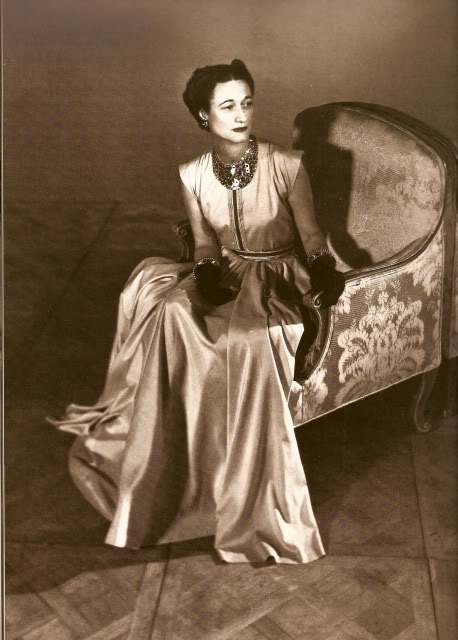
Wallis, the Duchess of Windsor (1896-1986), is remembered for her stylishness. She filled her empty life by buying expensive clothes from the big Paris fashion houses like Chanel and getting the Duke to buy her costly jewels from Cartier. The Duchess of Windsor was always immaculately dressed and never casual. In 1935, she made the Paris Couture best-dressed list and remained there for 40 years.
In my previous post, “Coco Chanel, Nazi Lovers, and the Windsor Set,” I described the wave of attention the Duke and Duchess of Windsor received when they settled in Paris in the late thirties. A glamorous social set of fashion designers, Nazi sympathizers, American heiresses, British ex-pats, and assorted other idle rich people welcomed the Windsors and became a sort of parallel court for the displaced royals. This French upper-crust group was dubbed “the Windsor Set.” The press buzzed about them like bees around a hive. All their comings and goings, designer clothes, fancy homes, and elegant soirees were endlessly photographed and reported in the society columns of the day.
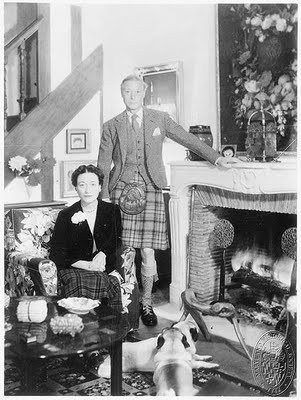
The Duchess and Duke of Windsor at home
At the center of this new social whirl was the Duchess of Windsor. She had never gotten over being snubbed by the British Royal Family and being barred from getting the attention she felt she and the Duke deserved.
Wallis had always been obsessed with her appearance. She knew she wasn’t a great beauty, having once said,
” Nobody ever called me beautiful, or even pretty.”
What she lacked in looks, she made up for in other ways. She selected simple, well-tailored clothes that accented her slim, almost boyish figure. Against this plain backdrop, she dripped with sometimes enormous jewels, sometimes mixing real gems with costume pieces, the real things being given to her by the Duke. Her taste ran to big colorful stones and yellow gold. She amassed a huge collection of jewelry which was sold at auction in 1987 for a record-shattering $50 million. “An 18-karat-gold cigarette case from Cartier—engraved with a map of Europe and set with 37 gems to mark the couple’s premarital holidays—sold for more than $290,000; Elizabeth Taylor phoned in a bid of $623,000 and snagged a diamond brooch.”
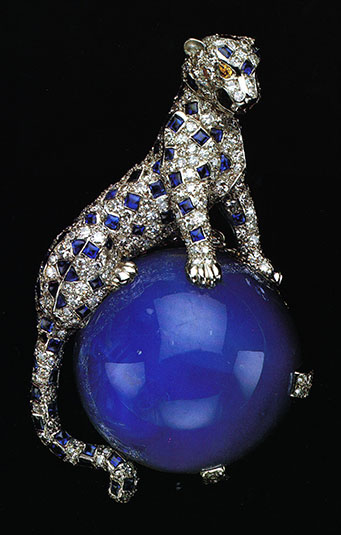
In 1949, the Duchess of Windsor acquired this diamond and sapphire panther pin from Cartier. The panther is crouched in a life like pose on a large perfect round cabochon star sapphire weighing 152.35 carats. This panther pin was one of the Duchess' favorite pieces which she frequently wore. It created an envy among other jewelry collectors and a demand for Cartier to produce more panther pieces. Today, the panther is a Cartier icon. The Duchess of Windsor's animal pieces became her signature.
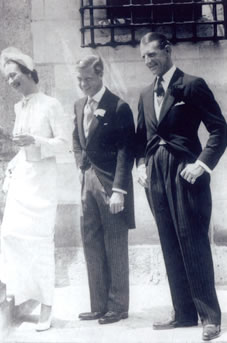
Wallis and Edward with best man Edward "Fruity" Metcalfe at their royal wedding, June 3, 1937, at the Chateau de Candé, Mont, France
Necklaces, bracelets, lapel pins – she had them all. The only gap in her jewelry collection was rings. The Duchess hated her hands. She thought they were big and ugly. (Notice the black gloves in the first photo above). Acclaimed British photographer Cecil Beaton photographed the Windsors many times. He took their wedding photos at the Chateau de Candé. Beaton remembered of that session that Wallis
“twisted and twirled her rugged hands. She laughed a square laugh, protruded her lower lip. Her eyes were excessively bright, slightly froglike, also wistful.”
Wallis Warfield (Simpson) marries the former King Edward VIII of Britain on June 3, 1937, in France, after he gave up the British throne to be with her. Wallis Warfield Simpson was an American divorcee. For the King to have married her and tried to install her as his Queen would have precipitated a constitutional crisis in Great Britain....The wedding day dawned bright and sunny. It was Wallis' third wedding; her dress was not white but blue. Blue was also the mood. The day before the wedding, the former king's brother, the new British king, George VI, sent Edward a letter granting him and Wallis new titles: the Duke and Duchess of Windsor. The titles were hollow; there was no dominion of Windsor to rule. Even worse: the King's letter contained a bomb - the former king, now titled the Duke, despite his abdication of the throne, could continue to "hold and enjoy...the title, style or attribute of Royal Highness," but his bride, the Duchess, could not, nor could any of their offspring. She, though a duchess, was denied what her sister-in-laws would enjoy - that her name would be preceded by the magic initials 'H.R.H.' At her entrance, no women had to curtsey, no men to bow. She would not be referred to as "Her Highness" but with the lower form of "Her Grace." "What a damnable wedding present!" Windsor shouted upon reading the King's letter. (Bryan III, J. and Murphy, Charles J.V., The Windsor Story. New York: Dell, 1979.)
In 1937, after King Edward VIII had given up the British throne to marry his American divorcee, Wallis Warfield Simpson, the two tiny, trim party animals were exiled to France, where they were doomed to live a life of idle nothingness. They were given the new but hollow titles of the Duke and Duchess of Windsor. Accustomed to a lifetime of adulation and privilege yet denied a kingdom, the Duke (and the Duchess), set about creating an imaginary realm of their own that would given them the validation they craved as royals. This new kingdom:
“…was a region whose borders were outlined in society pages, peopled mostly by glamorous nobodies lucky enough to have been born into wealth. It was an ornamental place, whose citizens, according to Andrew Bolton, the curator of ”Blithe Spirit” [a past costume exhibit at the Metropolitan Museum], were unsurpassed ”in the beauty, elegance and craftsmanship” of their dress. For self-indulgence, they were also hard to beat.”
The people who congregated around the Duke and Duchess were dubbed the “Windsor set.” They were all-consumed with the photographic image.
“They arranged those lives to suit the lens. Voluntarily estranged from the real aristocracy, the Duke of Windsor, with the aid of his wife, the former Wallis Warfield Simpson, set up a parallel court composed of people like Elsie de Wolfe, the interior decorator and social arbiter; Mona Bismarck, a gorgeous adventuress who was the daughter of a stableman on a Kentucky horse farm; and Daisy Fellowes, whose fortune derived from sewing machines and who had the distinction of being one of the first people on record to alter her nose surgically.”
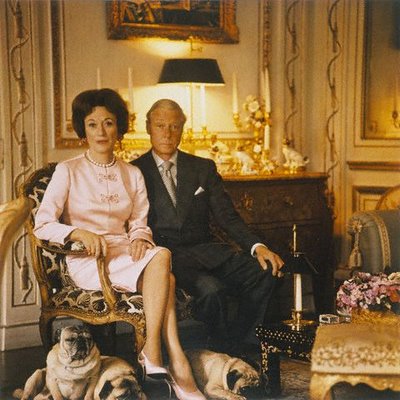
the Duke and Duchess of Windsor at home with their precious pug dogs. The Duchess, the former Wallis Warfield Simpson, often appeared in her stylish best in public with a pug tucked under one arm. It became a fashion trend - to carry a dog around with you when away from home.
Granted, the Windsors were despicable people, dining with Adolf Hitler in 1937 and hobnobbing with fellow Nazi sympathizers and British ex-pats Oswald Mosley and wife Diana Mitford. Nevertheless, the Duke and Duchess – and their fancy friends – obsessed with clothing, had tremendous style.
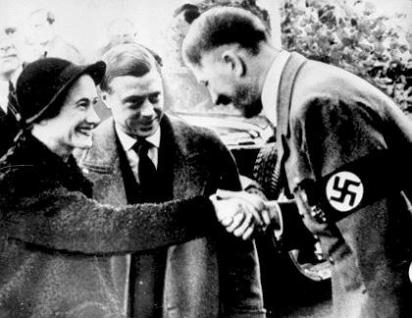
Adolf Hitler kisses the hand of the Duchess of Windsor as her husband the Duke looks on, admiringly. The Duke and Duchess of Windsor visited Germany in 1937 before WWII broke out across Europe. They were outspoken supporters of Nazi fascism and suspected of spying for Germany. At the beginning of the war, the Windsors were whisked out of France to safe haven in the Bahamas, where the Duke served out the war years as governor. There he could do Britain little harm - and he was less likely of being kidnapped by the Germans who were reportedly interested in installing him as a puppet king in a conquered Great Britain under German rule.
Fashion designer Gabrielle "Coco" Chanel (French, 1883-1971) at Lido Beach in 1936
"Evening Dress," 1938. Gabrielle ("Coco") Chanel. Black Silk Net with Polychrome Sequins. The Metropolitan Museum of Art, New York. Special Exhibit: "Blithe Spirit: The Windsor Set" The decoration of sequined fireworks on this evening dress, which was worn by the Countess Madeleine de Montgomery to Lady Mendl's seventy-fifth birthday party in 1939, is a fitting climax to le beau monde of the 1930s. It was the end of an era when, on Sept. 1, 1939, Parisians heard an early-morning radio announcement from Herr Hitler in German, at once translated into French, that "as of this moment, we are at war with Poland." The thirties were over; the Second World War had begun.
The Windsors were famous for their elegant Paris dinner parties, creating a demand for expensive clothes and jewels for them and their guests. Thus, the prewar years in France from 1935-1940 were rich in the decorative arts, putting trendy fashion designers front and center. It was a time when Gabrielle “Coco” Chanel was “rethinking the suit” to allow for the way women really move and Elsa Schiaparelli* was designing lobster dresses with surrealist Salvador Dali.*
Then Hitler invaded Poland and World War II shattered the fantasy world of endless cocktail parties and silk and organza gowns made to order. The Germans invaded and occupied France.
Shockingly, Coco Chanel spent the war yearsliving at the Ritz in Paris with a Nazi officer. After the war was over, Chanel was arrested by the free French for suspicion of collaborating with the Nazis. She purportedly offered this explanation for sleeping with the enemy:
“Really, sir, a woman of my age cannot be expected to look at his passport if she has a chance of a lover.”
It is generally believed that Winston Churchill intervened with the French government, convincing them to let his old friend Coco Chanel escape to Switzerland rather than be paraded through the streets of Paris with her head shaved like other female Nazi collaborators.
Fast forward 19 years. It's November 22, 1963. Jackie Kennedy,* in her pink Chanel suit and pillbox hat, is riding through Dallas in a motorcade just minutes before a sniper kills her husband, President John F. Kennedy
The Mamas and the Papas, from left to right: Michelle Phillips, John Phillips (in tube), Denny Doherty, and Mama Cass Elliot. The sixties pop rock band is remembered for its sweet harmony and enchanting melodies.
Father and Daughter, John and MacKenzie Phillips, in 1998.
Associated Press
Wed Sep 23, 12:37 pm ET
CHICAGO – Former child star Mackenzie Phillips said Wednesday her father, John Phillips, who was a leader of the 1960s pop group the Mamas and the Papas, raped her when she was a teenager and that her sexual relationship with him later became what she termed “consensual.”
Mackenzie Phillips writes in her new book, High on Arrival, that she had sex with her father on the night before she was to get married in 1979 at age 19, according to People magazine.
“On the eve of my wedding, my father showed up, determined to stop it,” writes Phillips, who was 19 and a heavy drug user at the time. “I had tons of pills, and Dad had tons of everything too. Eventually I passed out on Dad’s bed.”
“My father was not a man with boundaries. He was full of love, and he was sick with drugs. I woke up that night from a blackout to find myself having sex with my own father.”
She told “The Oprah Winfrey Show” in an interview that aired Wednesday that her siblings “definitely have a problem with this.” Winfrey also read a statement from Genevieve Waite, John Phillips’ wife at the time of the alleged abuse and Mackenzie’s stepmother that said he was “incapable, no matter how drunk or drugged he was, of having such a relationship with his own child.”
At far right, MacKenzie Phillips from a publicity photo for the 80s TV sitcom, “One Day at a Time.” MacKenzie Phillips is best known for her roles as an emotionally troubled and rebellious teenager.
Phillips, who starred on TV’s “One Day at a Time,” said the sexual relationship with her father lasted a decade and ended when she became pregnant and didn’t know who had fathered the child. She had an abortion, which her father paid for, and “and I never let him touch me again.”
Phillips told Winfrey that she first tried cocaine when she was 11 years old. Her father did drugs with her, taught her to roll joints and injected her with cocaine. Phillips said she’s been clean for a year after pleading guilty to possessing cocaine and entering a drug treatment program.
Phillips said the sexual relationship, although she believes it became consensual, was “an abuse of power” and “a betrayal” on her father’s part. She said she forgave John Phillips on his deathbed.
“I can’t be the only one this has happened to,” Phillips said. “Someone needs to put a face on consensual incest.”
Here is a video of the Mamas and the Papas singing “California Dreaming.” MacKenzie Phillips’ father, John Phillips – “Papa John” – plays guitar, wearing a fur hat. The other band members are Michelle Phillips (at the time, John Phillips’ wife and MacKenzie’s stepmother), Mama Cass Elliot, and Denny Doherty.
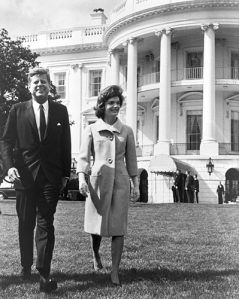
American Royalty: President John and Jackie Kennedy stroll the White House grounds.
It was a star-studded event. It was Saturday, May 19, 1962, and the young, dashing, and popular U.S. President John F. Kennedy was turning 45. The Democratic Party held a huge fundraiser at New York’s Madison Square Garden. The birthday salute was televised before a national audience and 15,000 people had paid for seats to catch the show live at the Garden. The cream of American show business turned out to pay homage to Kennedy – Ella Fitzgerald, Peggy Lee, Jack Benny, Henry Fonda, Harry Belafonte. Greek opera diva Maria Callas was also there. Actor Peter Lawford, the president’s brother-in-law, served as master-of-ceremonies. But the pièce de résistance – the showstopper – was the performer who sang the finale – sexpot and film star Marilyn Monroe.
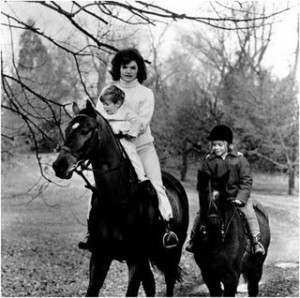
First Lady Jackie Kennedy riding horses with her children at their Middleburg, Virginia, retreat “Glen Ora.” Jackie grew up surrounded by horses and was an accomplished equestrian. President John Kennedy did not share her passion for horse shows and riding. He was allergic to horse hair. November 19, 1962.
It seemed that everyone was there – except the honoree’s wife – Jackie Kennedy. The president attended the ceremony without the First Lady at his side. When Jackie had learned that Marilyn was to be performing at the benefit, she decided she was not about to attend. She instead became a last-minute participant in the Loudoun Hunt Horse Show at Glen Ora, her weekend home. Jackie knew that her husband and Marilyn Monroe were lovers – and Jackie was not about to have her nose rubbed into it in front of a national audience.
Marilyn Monroe (1926-1962) was wild for Jack Kennedy. She accepted the invitation to appear in New York in violation of her contract with Twentieth-Century Fox – and their relationship was already at its breaking point. Production on her latest film, “Something’s Got to Give,” had been on start/stop for months due to Marilyn’s chronic tardiness and absence. Marilyn was in a narcotics and booze nosedive and living on impulse. She was in hot pursuit of Jack Kennedy and nothing would get in her way. She was scheduled to sing “Happy Birthday” to the president.
Marilyn Monroe in “Gentleman Prefer Blondes” (1953)
“A manic energy propelled her….” wrote Barbara Leaming in Marilyn Monroe:
“All weekend, the white-carpeted, unfurnished rooms at Fifth Helena echoed with Marilyn’s whispery voice. She lay in the tub singing “Happy Birthday.” She sat on the living room floor, endlessly tape recording and listening to herself….” (1)
Then, ignoring the studio’s stern warning, Marilyn flew from Hollywood to New York with Peter Lawford, singing on the airplane. She continued to practice once in her New York apartment. Those who listened said her interpretation grew sexier, more and more outrageous. Friend Paula Strasberg warned that it verged on self-parody.
Finally, the night of the performance arrived. Backstage, Marilyn got into her costume – a flesh-toned slip of a dress by Jean-Louis sewn with 2500 rhinestones. The gown was so snug Marilyn had to be sewn into it. Paralyzed with stage fright, Marilyn kept ignoring her cue to appear on stage. She hung back, drowning her fears in alcohol, before Milt Ebbins shoved her onto the stage.
“She walked like a geisha….” (1)
“The figure was famous and, for one breathless moment, the 15,000 people in Madison Square Garden thought they were going to see all of it. Onto the stage sashayed Marilyn Monroe, attired in a great bundle of white mink. Arriving at the lectern, she turned and swept the furs from her shoulders. A slight gasp rose from the audience before it was realized that she was really wearing a skintight flesh-toned gown.” (2)
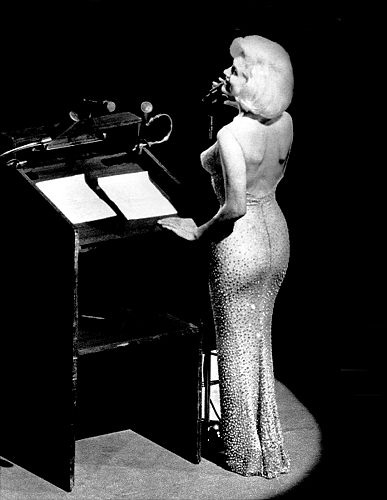
Marilyn Monroe at the microphone singing “Happy Birthday, Mr. President,” at President John F. Kennedy’s birthday bash, May 19, 1962.
“When she came down in that flesh-colored dress, without any underwear on…” said Hugh Sidey of Time, “you could just smell lust. I mean, Kennedy went limp or something. We all were just stunned to see this woman.”
“What an ass…what an ass,” whispered Kennedy.
“Happy…Birthday…to you,” Marilyn began to sing [whisper]. (3)
Her rendition of “Happy Birthday, Mister President” – was soft, seductive, and pathetic. The 35-year-old Marilyn was high as a kite (and wearing a wig that was slipping). Columnist Dorothy Kilgallen called it nothing less than:
“…making love to the President in the direct view of forty million Americans.”
President John F. Kennedy speaks to the audience at Madison Square Garden at his 45th birthday bash, May 19, 1962.
At the end of the performance, a noticeably-embarrassed President Kennedy took to the stage and announced disingenuously:
“I can now retire from politics after having had Happy Birthday sung to me in such a sweet wholesome way.” (2)
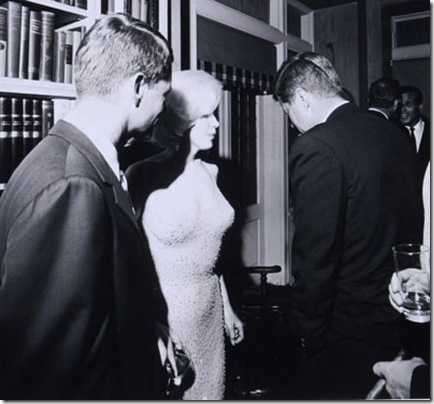
At an after-party, a photographer caught President Kennedy and brother Robert Kennedy hovering over Marilyn in the library, still wearing the see-through dress Marilyn called “skin and beads.”
Bobby Kennedy, Marilyn Monroe, and President John Kennedy gather following Monroe’s iconic performance of “Happy Birthday, Mr. President,” at Madison Square Garden, May 19, 1962. Marilyn is still wearing the gown she wore in the performance which she referred to as “skin and beads.” The auction house Christie’s later sold this dress for $1.2 million, the most money ever paid for a dress.
Kennedy’s Ambassador to the United Nations, Adlai Stevenson, was at the party and saw Marilyn’s “skin and beads” dress. He later wrote to Mary Lasker:
“I didn’t see the beads!”
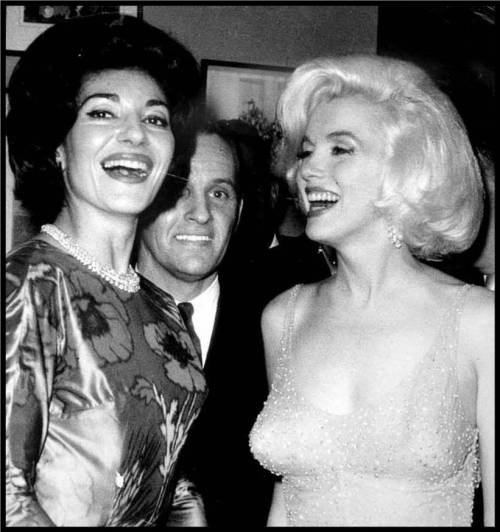
Greek opera diva Maria Callas (1923-1977) laughs it up with blonde bombshell Marilyn Monroe at President Kennedy’s 45th birthday bash at Madison Square Garden, May 19, 1962. First Lady Jackie Kennedy did not attend the celebration. Marilyn Monroe was President Kennedy’s lover when Jackie was Mrs. Kennedy. Maria Callas was the clandestine lover of Aristotle Onassis when Jackie was Mrs. Onassis.
Jackie Kennedy watched Marilyn’s performance on TV the next day. She was livid. The rumors about Jack and Marilyn were flying. Jackie called up sister-in-law Ethel Kennedy and complained that she just knew Bobby had staged the prank. Jackie ordered Jack to stop seeing Marilyn. (4) Jack also sent word to the press that there was nothing to the rumors of an extramarital affair between him and Marilyn Monroe, which, we know, was a lie.
President Kennedy broke off the relationship with Marilyn. Her performance at Madison Square Garden became her last public appearance. Marilyn became profoundly affected by the break-up with the President and her loss of other men, including ex-husband Arthur Miller, who had recently remarried.
As a result, the summer following the Madison Square Garden show, Marilyn dove deeper and deeper into a downward spiral of drugs and alcohol, storm and stress, and depressed isolation. Out of necessity, the production of her film, “Something’s Got to Give” came to a halt, because the star was a “no-show” on the set.
The movie was never finished. On August 5, Marilyn Monroe – born Norma Jeane Baker – was found dead in her home from a drug overdose – an apparent suicide – and the world was shocked.
Goodbye, Norma Jeane
(1) Leaming, Barbara. Marilyn Monroe. New York: Three Rivers Press, 1998.
(2) Smith, Sally Bedell.Grace and Power: The Private World of the Kennedy White House. New York: Random House, Inc., 2004. (excerpted from a Time magazine article)
(3) Klein, Edward. All Too Human: The Love Story of Jack and Jackie Kennedy. New York: Pocket Books, 1996.
(4) Taraborrelli, J. Randy. Jackie Ethel Joan. New York: Warner Books, Inc., 2000.
*Readers: I’ve written many posts on Jackie O and the Kennedys. Please look in the right sidebar – Categories – People – the Kennedys. Enjoy!
A handcuffed Lee Harvey Oswald is shot by Dallas nightclub owner Jack Ruby in the basement of the Dallas Police Department, Sunday, November 24, 1963, 2 days after the Kennedy assassination.
I was sitting at the hair salon today, getting highlights and a cut, talking with my stylist about assassins and where they were buried. I know where Abraham Lincoln‘s assassin, John Wilkes Booth, is buried – Baltimore, but, I wondered aloud, “Where is John F. Kennedy‘s assassin Lee Harvey Oswald buried?”
My first thought was Dallas, but that is where Oswald was murdered, not where he’s buried. Kennedy assassin Lee Harvey Oswald died at Parkland Memorial Hospital, the same Dallas hospital where President John F. Kennedy died just two days earlier on November 22, 1963, after being fatally wounded by Oswald as his presidential motorcade made its way through downtown Dallas.
After Kennedy was gunned down, Oswald was arrested and interrogated for two days. Then, on the morning of Sunday, November 24, as he was being transferred to the Dallas County Jail, Oswald was shot and wounded by Dallas nightclub owner Jack Ruby in the basement of the Dallas Police Department. He was rushed to the hospital but died shortly afterward. Oswald’s body was given to his family and was buried in a Fort Worth, Texas cemetery. Oswald’s original tombstone, which included his full name and dates of birth and death, was stolen. Today his obscure grave in the Fort Worth cemetery is marked by a stone that lies on the ground which reads simply: Oswald.
For those interested in tracking down Oswald’s grave, which is apparently hard to locate within the Shannon Rose Hill Memorial Park, click here for directions.
Jackie Kennedy holds son John F. Kennedy, Jr., born November 25, 1960, 16 days after his father, John F. Kennedy won the presidential election. He was nicknamed “John-John.” Three years later on his own birthday, John F. Kennedy, Jr. would salute his father’s coffin at his funeral.
Jacqueline Kennedy Onassis (1929-1994) is remembered for many things, her fashion statements, her redecoration of the White House, her brave young face at the 1963 funeral of her slain husband President John F. Kennedy. There were many things she cared about. But what mattered to her most in life was raising her two children, John F. Kennedy, Jr., and Caroline Kennedy (Schlossberg), to be good people. She said:
“If you bungle raising your children, I don’t think whatever else you do matters very much.”
She wanted so much for her children to lead normal lives. But, in the aftermath of JFK‘s assassination, it proved to be an impossible dream. She tried to continue living in their Georgetown home but tour buses added it to their route and reporters mobbed them on their doorstep. The crowds were too much to bear.
“The world is pouring terrible adoration at the feet of my children,” she’d once confided to her decorator Billy Baldwin, “and I fear for them, for this awful exposure. How can I bring them up normally?” (1)
Jackie ended up moving them all to New York where, to her dismay, she discovered her children weren’t being invited for playdates and parties by their school friends. It turned out that their parents were intimated by the Kennedy children’s fame.
Jackie Kennedy, wife of then-Senator John F. Kennedy, reads a bedtime story to daughter, Caroline, at the family home in Hyannisport, Massachusetts. Jackie Kennedy loved books and passed this joy on to her children. September 13, 1960
In the post-JFK years, Jackie wasn’t just mobbed by tourists and reporters. The beautiful and charming young widow was besieged by male suitors, among them author Philip Roth, Frank Sinatra, Marlon Brando, and director Mike Nichols. Jackie’s friend and White House advisor Letitia Baldrige said that, even in the pre-JFK years, “she [Jackie] had more men per square inch than any woman I’ve ever known.”
Jackie Kennedy Onassis with husband Ari Onassis on June 5, 1969, at New York’s Kennedy Airport
By 1968, Jackie’s most serious – and unlikely – suitor was Greek shipping tycoon Aristotle Onassis, “Ari,” for short. Whereas Jackie was cultured, sleek, and classy, Onassis was short, paunchy, and often rumpled and vulgar. Plus, he was 23 years Jackie’s senior. The Kennedy clan despised him. JFK’s younger brother, Robert “Bobby” Kennedy, who was running for president that year, urged Jackie to break off her relationship with Onassis. She promised him that she would put off talk of marriage until after the presidential election.
Then, on June 5, 1968, just moments after winning the California primary, Bobby Kennedy was assassinated. Jackie was devastated – and terrified.
I despise America,” a distraught Jackie told a friend. “If they are killing Kennedys, my children are the No. 1 targets. I want to get out of this country.”
She did, on October 20, when, in a small private ceremony, she wed Ari Onassis on the Greek isle of Skorpios. She was 39; he was 62. (1)
by guest blogger Loise King Waller, B.S. Political Science, summa cum laude, Boston University; J.D., University of Texas School of Law
From Joseph Kennedy‘s ambassadorship to England at a time when we were on the brink of WWII, the Kennedy family’s fate has, for better or worse, been inextricably linked with our nation’s. Although John Kennedy was young and untested when he took office in 1961 as President of the United States and presided over defeat at the Bay of Pigs, he finessed the Russians during the Cuban Missile Crisis and successfully avoided a nuclear showdown between the superpowers. The Civil Rights Act of 1964 would never have been passed without the initiative of his administration.
JFKs Attorney General, brother Robert Kennedy, courageously took on the mob, at great peril to himself and his family. His efforts to enfranchise minorities and mobilize antiwar sentiment during his ill-fated run for the presidency piqued the conscience of America.
Most people would agree that although he was not a perfect human being (who is?) Senator Ted Kennedy came of age as a distinguished statesman and tireless advocate of universal healthcare. We need him now. He will be missed.
To read more on the Kennedys on this site, scroll down the right sidebar to “Categories – People – Kennedys.”
Rose Kennedy, wife of newly-appointed American ambassador to Great Britain, Joseph Kennedy, is shown at center with two of her daughters, Kathleen "Kick" Kennedy (l) and Rosemary Kennedy, at their 1938 presentation at Buckingham Palace. Kathleen's lively personality made her a great hit among the British social set. In 1944, Kathleen made what many considered a brilliant marriage to William "Billy" Harrington, the Marquess of Hartington, the heir to the 10th Duke of Devonshire. Kathleen became the Marchioness of Harrington. Her mother, however, was incensed that Kathleen would marry an Anglican and refused to attend the wedding ceremony. Only Kathleen's eldest brother, Joe Kennedy, Jr., attended. Then, four months later, Billy was killed in the war and Kathleen became a widow. It wasn't long before Kathleen was back in the social whirl of London parties and country estate weekends, and with a new man - a married man. He was Peter Wentworth-Fitzwilliam, 8th Earl Fitzwilliam. Kathleen fell madly for him and publicly became his mistress. Rose was furious - but not why you think. She was incensed because Peter - like Kathleen's first husband, Billy - was an Anglican and not a Catholic. Nevertheless, over her mother's objections, Kathleen planned to wed Peter after his divorce, Catholic or not. Their wedding never came about. In a 1948 trip to the south of France, both Peter and Kathleen died in an airplane crash. Still furious with Kathleen, Rose Kennedy did not attend her daughter's funeral and discouraged Kathleen's eight surviving siblings from attending. Only Kathleen's father, Joseph P. Kennedy, attended her funeral service. Kathleen Kennedy Cavendish was buried in the Cavendish family plot in Devonshire, England. There her body remains today.
Factbox: Kennedy Political Dynasty Marked By Tragedy
By REUTERS
Published: August 26, 2009
(Compiled from Web sites by the World Desk Americas)
The lives of Kennedy family members, noted for their extraordinary accomplishments, have also been marked by tragedy, including the assassinations of President John Kennedy and of Senator Robert Kennedy.
Following is a chronology of some of the tragedies that befell the storied U.S. political dynasty:
1941: Rosemary Kennedy, (pictured here), the oldest daughter of Joseph and Rose Kennedy, who was mentally disabled, was institutionalized for the rest of her life after a lobotomy reduced her abilities. She died in 2005.
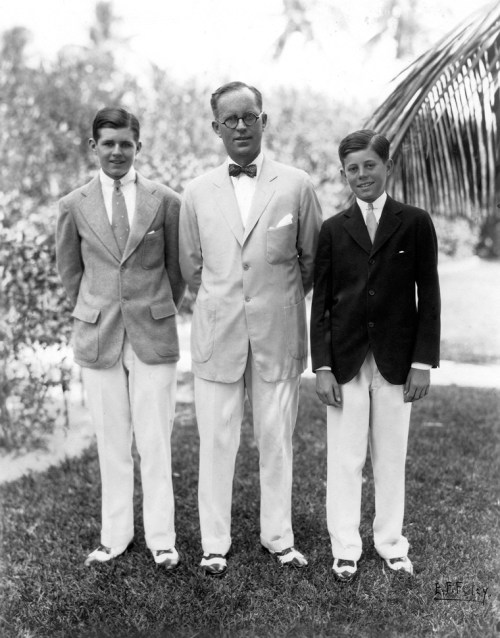
Joseph P. Kennedy, Sr. (c) with 2 of his 4 sons: Joe Kennedy, Jr. (l) and John F. Kennedy
1944: Joseph Kennedy Jr., the oldest of the nine Kennedy children, died at age 29 in a plane crash over the English Channel during World War Two while flying a mission.
1948: Kathleen Kennedy Cavendish, the fourth of the Kennedy children, was killed in a plane crash in France at age 28.
1963: President John Kennedy was assassinated on November 22 while riding in a presidential motorcade with his wife in Dallas, Texas, at age 46.
1964: Senator Edward Kennedy, the youngest in the family, narrowly escaped death in a plane crash that killed an aide.
1968: Senator Robert Kennedy was assassinated on June 5 in Los Angeles at age 42, just after he won California’s Democratic presidential primary election.
1969: Edward Kennedy drove off a bridge on his way home from a party on Chappaquiddick Island in Massachusetts. An aide in the car with him, Mary Jo Kopechne, died in the accident.
1984: David Kennedy, a son of Robert, died of a drug overdose at age 28.
1997: Another of Robert Kennedy’s sons, Michael, died in a skiing accident in Aspen, Colorado, at age 39.
1999: John Kennedy Jr. along with his wife and sister-in-law were killed when the plane he was flying crashed in the waters off Martha’s Vineyard in Massachusetts.
For more on the Kennedys, scroll down the right sidebar in “Categories – People – the Kennedys.”





 Readers: Read the two previous posts before continuing: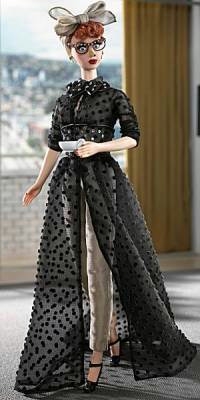





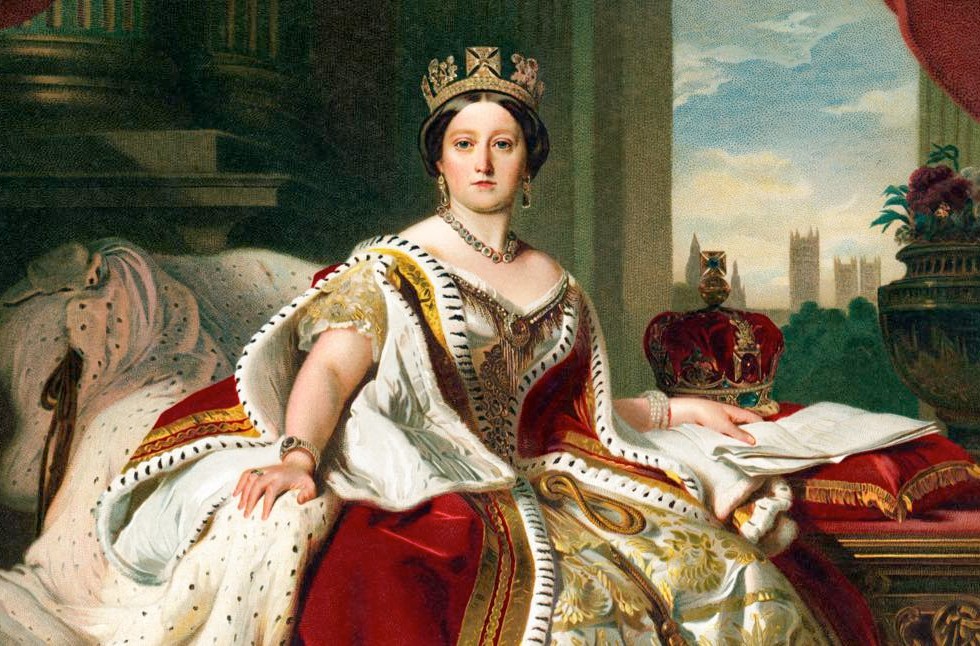
!["The Queen Mum" in later years. Queen Elizabeth II's mother died in 2002 at the age of 101. She hated the Duchess of Windsor and the Duchess of Windsor returned her sentiments, calling her the dowdy duchess [when the Queen Mum was the Duchess of York] and "Cake" for her confectionary style of dressing.](https://lisawallerrogers.com/wp-content/uploads/2009/10/queen-mum.jpg?w=468&h=524 "Queen Mum")











 Lisa's History Room

