Feeds:
Posts
Comments

Archive for the ‘ART, PHOTOGRAPHY, FASHION, & DESIGN’ Category

Wallis Warfield marries the former King Edward VIII of Britain on June 3, 1937, in France. The day before the wedding, the Prince's brother, the new British king, George VI, sent him a letter granting him and Wallis new titles: the Duke and Duchess of Windsor. The titles were hollow; there was no dominion of Windsor to rule. Even worse: the King's letter contained a bomb - the Prince, despite his abdication of the throne, could continue to "hold and enjoy...the title, style or attribute of Royal Highness," but his bride, the Duchess, could not, nor could any of their offspring. She, though a duchess, was denied what her sister-in-laws would enjoy - that her name would be preceded by the magic initials 'H.R.H.' "What a damnable wedding present!" Windsor shouted. (J.Bryan III and Charles J.V. Murphy,

Wallis Warfield (Simpson) marries the former King Edward VIII of Britain on June 3, 1937, in France, after he gave up the British throne to be with her. Wallis Warfield Simpson was an American divorcee. For the King to have married her and tried to install her as his Queen would have precipitated a constitutional crisis in Great Britain....The wedding day dawned bright and sunny. It was Wallis' third wedding; her dress was not white but blue. Blue was also the mood. The day before the wedding, the former king's brother, the new British king, George VI, sent Edward a letter granting him and Wallis new titles: the Duke and Duchess of Windsor. The titles were hollow; there was no dominion of Windsor to rule. Even worse: the King's letter contained a bomb - the former king, now titled the Duke, despite his abdication of the throne, could continue to "hold and enjoy...the title, style or attribute of Royal Highness," but his bride, the Duchess, could not, nor could any of their offspring. She, though a duchess, was denied what her sister-in-laws would enjoy - that her name would be preceded by the magic initials 'H.R.H.' At her entrance, no women had to curtsey, no men to bow. She would not be referred to as "Her Highness" but with the lower form of "Her Grace." "What a damnable wedding present!" Windsor shouted upon reading the King's letter. (Bryan III, J. and Murphy, Charles J.V., The Windsor Story. New York: Dell, 1979.)

In 1937, after King Edward VIII had given up the British throne to marry his American divorcee, Wallis Warfield Simpson, the two tiny, trim party animals were exiled to France, where they were doomed to live a life of idle nothingness. They were given the new but hollow titles of the Duke and Duchess of Windsor. Accustomed to a lifetime of adulation and privilege yet denied a kingdom, the Duke (and the Duchess), set about creating an imaginary realm of their own that would given them the validation they craved as royals. This new kingdom:

“…was a region whose borders were outlined in society pages, peopled mostly by glamorous nobodies lucky enough to have been born into wealth. It was an ornamental place, whose citizens, according to Andrew Bolton, the curator of ”Blithe Spirit” [a past costume exhibit at the Metropolitan Museum], were unsurpassed ”in the beauty, elegance and craftsmanship” of their dress. For self-indulgence, they were also hard to beat.”

The people who congregated around the Duke and Duchess were dubbed the “Windsor set.” They were all-consumed with the photographic image.

“They arranged those lives to suit the lens. Voluntarily estranged from the real aristocracy, the Duke of Windsor, with the aid of his wife, the former Wallis Warfield Simpson, set up a parallel court composed of people like Elsie de Wolfe, the interior decorator and social arbiter; Mona Bismarck, a gorgeous adventuress who was the daughter of a stableman on a Kentucky horse farm; and Daisy Fellowes, whose fortune derived from sewing machines and who had the distinction of being one of the first people on record to alter her nose surgically.”
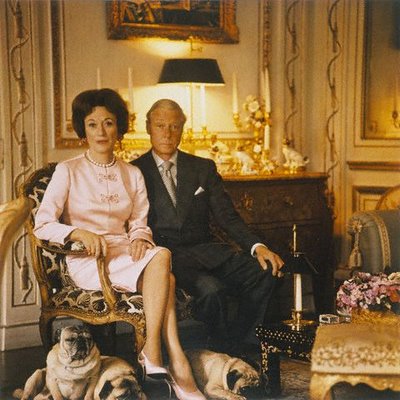
the Duke and Duchess of Windsor at home with their precious pug dogs. The Duchess, the former Wallis Warfield Simpson, often appeared in her stylish best in public with a pug tucked under one arm. It became a fashion trend - to carry a dog around with you when away from home.

the Duke and Duchess of Windsor at home with their precious pug dogs. The Duchess, the former Wallis Warfield Simpson, often appeared in her stylish best in public with a pug tucked under one arm. It became a fashion trend - to carry a dog around with you when away from home.

Granted, the Windsors were despicable people, dining with Adolf Hitler in 1937 and hobnobbing with fellow Nazi sympathizers and British ex-pats Oswald Mosley and wife Diana Mitford. Nevertheless, the Duke and Duchess – and their fancy friends – obsessed with clothing,  had tremendous style.
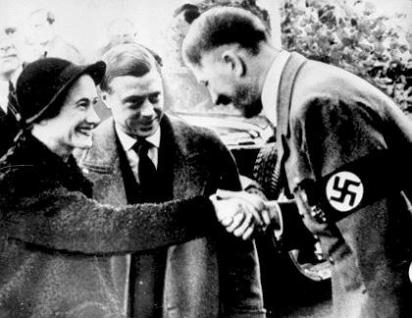
Adolf Hitler kisses the hand of the Duchess of Windsor as her husband the Duke looks on, admiringly. The Duke and Duchess of Windsor visited Germany in 1937 before WWII broke out across Europe. They were outspoken supporters of Nazi fascism and suspected of spying for Germany. At the beginning of the war, the Windsors were whisked out of France to safe haven in the Bahamas, where the Duke served out the war years as governor. There he could do Britain little harm - and he was less likely of being kidnapped by the Germans who were reportedly interested in installing him as a puppet king in a conquered Great Britain under German rule.

Adolf Hitler kisses the hand of the Duchess of Windsor as her husband the Duke looks on, admiringly. The Duke and Duchess of Windsor visited Germany in 1937 before WWII broke out across Europe. They were outspoken supporters of Nazi fascism and suspected of spying for Germany. At the beginning of the war, the Windsors were whisked out of France to safe haven in the Bahamas, where the Duke served out the war years as governor. There he could do Britain little harm - and he was less likely of being kidnapped by the Germans who were reportedly interested in installing him as a puppet king in a conquered Great Britain under German rule.

Fashion designer Gabrielle "Coco" Chanel (French, 1883-1971) at Lido Beach in 1936

Fashion designer Gabrielle "Coco" Chanel (French, 1883-1971) at Lido Beach in 1936

"Evening Dress," 1938. Gabrielle ("Coco") Chanel. Black Silk Net with Polychrome Sequins. The Metropolitan Museum of ARt, New York. Special Exhibit: "Blithe Spirit: The Windsor Set" The decoration of sequined fireworks on this evening dress, which was worn by the Countess Madeleine de Montgomery to Lady Mendl's seventy-fifth birthday party in 1939, is a fitting climax to le beau monde of the 1930s. It was the end of an era when, on Sept. 1, 1939, Parisians heard an early-morning radio announcemen from Herr Hitler in German, at once translated into French, that "as of this moment, we are at war with Poland." The thirties were over; the Second World War had begun.

"Evening Dress," 1938. Gabrielle ("Coco") Chanel. Black Silk Net with Polychrome Sequins. The Metropolitan Museum of Art, New York. Special Exhibit: "Blithe Spirit: The Windsor Set" The decoration of sequined fireworks on this evening dress, which was worn by the Countess Madeleine de Montgomery to Lady Mendl's seventy-fifth birthday party in 1939, is a fitting climax to le beau monde of the 1930s. It was the end of an era when, on Sept. 1, 1939, Parisians heard an early-morning radio announcement from Herr Hitler in German, at once translated into French, that "as of this moment, we are at war with Poland." The thirties were over; the Second World War had begun.

The Windsors were famous for their elegant Paris dinner parties, creating a demand for expensive clothes and jewels for them and their guests. Thus, the prewar years in France from 1935-1940 were rich in the decorative arts, putting trendy fashion designers front and center. It was a time when Gabrielle “Coco” Chanel was “rethinking the suit” to allow for the way women really move and Elsa Schiaparelli* was designing lobster dresses with surrealist Salvador Dali.*

Then Hitler invaded Poland and World War II shattered the fantasy world of endless cocktail parties and silk and organza gowns made to order. The Germans invaded and occupied France.

Shockingly, Coco Chanel spent the war years living at the Ritz in Paris with a Nazi officer. After the war was over, Chanel was arrested by the free French for suspicion of collaborating with the Nazis. She purportedly offered this explanation for sleeping with the enemy:

 “Really, sir, a woman of my age cannot be expected to look at his passport if she has a chance of a lover.”

It is generally believed that Winston Churchill  intervened with the French government, convincing them to let his old friend Coco Chanel escape to Switzerland rather than be paraded through the streets of Paris with her head shaved like other female Nazi collaborators.

Women accused of being Nazi collaborators are humiliated after the liberation of France, 1944. © Hulton-Deutsch Collection/Corbis

Women accused of being Nazi collaborators are humiliated after the liberation of France, 1944. © Hulton-Deutsch Collection/Corbis

Jackie Kennedy in her pink Chanel suit and pillbox hat, riding through Dallas in a motorcade just minutes before a sniper kills her husband, President John F. Kennedy
Fast forward 19 years. It's November 22, 1963. Jackie Kennedy,* in her pink Chanel suit and pillbox hat, is riding through Dallas in a motorcade just minutes before a sniper kills her husband, President John F. Kennedy
*For more on the Kennedys on this blog, please see right sidebar – Categories – People  – the Kennedys.
See “Wallis, the Duchess of Windsor,” which follows this blog post.

Read Full Post »

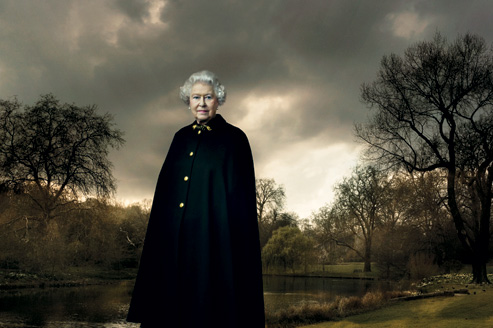
photo of Queen Elizabeth II at Buckingham Palace, March 28, 2007, by Annie Leibovitz

Annie Leibovitz photographed Queen Elizabeth. Here’s what she had to say about that experience.
Excerpted from Annie Leibovitz at Work, by Annie Leibovitz, published by Random House © 2008

The Queen

In 2007, a few weeks before Queen Elizabeth visited the United States for the 400th anniversary of the founding of Jamestown, I was asked to take her portrait. I was the first American to be asked by the Palace to make an official portrait of the Queen, which was very flattering. I felt honored. I also felt that because I was an American I had an advantage over every other photographer or painter who had made a portrait of her. It was O.K. for me to be reverent. The British are conflicted about what they think of the monarch. If a British portraitist is reverent, he’s perceived to be doting. I could do something traditional.

It’s ironic that the sitting with the Queen became controversial. I’m rather proud of having been in control of a complicated shoot. The controversy arose about two months after the pictures were published, when the BBC claimed that the Queen had walked out while we were shooting. This was completely untrue, and although they retracted the claim and issued an apology to the Queen and to me almost immediately, the scandal had a life of its own. The story, which came to be referred to as Queengate, wouldn’t die. Eventually the head of BBC One resigned over it.

When I was preparing for the shoot, I thought about using the landscape around Balmoral Castle, in Scotland. I brought this up in the very first conference call with the Palace. I said that Americans thought of the Queen as an outdoorswoman. I had been influenced by Helen Mirren’s performance in The Queen and I couldn’t help mentioning how much I liked her character in that film. There was a long silence on the other end of the line.

The second idea I had, after Balmoral, was to photograph the Queen on horseback. I asked where she rode and they said she went riding every Saturday at Windsor Castle. I said that I would love to see her in her riding clothes, and in a later conversation I asked if she could stop during her weekend ride and get off her horse and mount it again. That is, could I do a portrait of her in the trees. They said, No, it was not possible. She just rode the horse and came back, and, anyway, she didn’t wear riding clothes anymore. A few days later they said it was going to be Buckingham Palace and no horses.

I realized that I was going to need some time on the ground for this. When we arrived in London, we went straight to the palace and were shown all the rooms, including the throne room—everywhere except the private quarters. And then we scouted the back. There was a wintery sky and the trees didn’t have leaves. It was an appropriate mood for this moment in the Queen’s life. There was no way, however, that she was going to stand outside in formal attire.

For a sitting like this you don’t put all your eggs in one basket. You try to have as many options as possible. I kept thinking that somehow I would get the Queen outside, but I began choosing formal outfits. I narrowed the robes down to a very handsome Order of the Garter cape, but then we were told that she could wear only a white dress under it. We were lobbying for a gold dress. I was also hoping for a dress with more body to it. The Queen wears very streamlined dresses now that she’s older, and I wanted her in something with more volume. But she didn’t have anything like that. Finally everyone agreed that she could wear a gold-and-white dress under the Order of the Garter robe. The Queen was 80 years old. She was sturdy, but putting on and taking off a lot of heavy clothes is tiring, and she had to be dressed in layers to expedite things. The gold-white dress became the base.

I was still upset that I couldn’t get her outside. It was so beautiful out there. And it wasn’t cold or raining or anything. I began thinking about what Cecil Beaton had done. He brought in flowered backdrops. Beaton was big on backdrops. He made very stagy portraits. Perhaps because the pictures were made in black and white you don’t notice the backdrops. They sort of go out of focus. I realized that I could do something similar digitally. I decided to photograph the garden and the trees for a backdrop.

The Palace had given us 25 minutes with the Queen, so there had to be a battle plan. I chose a grand reception room, the White Drawing Room, as the principal setting because of the light from the tall windows. Supplementary lights had been pre-set so that when the Queen moved from one spot to another all we needed to do was switch them on. We had constructed a gray canvas backdrop in an anteroom, and she was to come in there wearing the Order of the Garter robe and the dress, but no tiara. The first shot was to be made on a balcony, with the sky behind her. That sky could be digitally exchanged later for the pictures I had taken in the gardens the day before. I didn’t want her to be wearing a tiara in the gardens.

The morning of the shoot, the Queen came walking down the hall very purposefully. She was definitely a force. This was all being taped by the BBC for a documentary. I would never have agreed to their being there if I felt I had any choice, but they had been following her around for months. Their microphone picked up her saying, “I’ve had enough of dressing like this, thank you very much,” as she marched down the hall. Later, when segments of footage for the BBC were edited for a promotional film, it appeared as if the Queen were stomping out of the photo session rather than going into it. Thus the brouhaha.

The Queen was about 20 minutes late, which we thought was a little strange. When that happens, you never know if it can be made up on the other end. My five-year-old daughter, Sarah, had come with us, and she curtsied and offered the Queen flowers, and I introduced my team. At this point I was in shock. The Queen had the tiara on. That was not the plan. It was supposed to be added later. The dresser knew that. The Queen started saying, “I don’t have much time. I don’t have much time,” and I took her to the first setup and showed her the pictures of the gardens. I think she understood what we had in mind. Then I walked her into the drawing room, probably sooner than I would have if things had been going well. She composed herself when I took some pictures.

I knew how tight everything was, especially with the loss of 20 minutes, and I asked the Queen if she would remove the tiara. (I used the word “crown,” which was a faux pas.) I suggested that a less dressy look might be better. And she said, “Less dressy! What do you think this is?” I thought she was being funny. English humor. But I noticed that the dresser and everyone else who had been working with her were staying about 20 feet away from her.

We removed the big robe, and I took the picture of the Queen looking out the window, and then I said, Listen, I was a little thrown when you first came in, and I have one more picture I’d like to try, with an admiral’s boat cloak. I was thinking of one of Cecil Beaton’s last pictures of the Queen. A very stark and simple and strong portrait in which she’s wearing a boat cloak. We went back into the anteroom, where the gray canvas backdrop had been set up, and she took off the tiara and put on the cloak. That’s the shot we digitally imposed on pictures of the garden.

Right after we finished, I went up to the press secretary and said how much I loved the Queen. How feisty she was. Later I mentioned to a couple of friends that she had been a bit cranky, but it was nothing unusual. What was remarkable about the shoot, and I wrote the Queen a note about this later, was something the BBC missed: her resolve, her devotion to duty. She stayed until I said it was over. Until I said, “Thank you.” We were finished a little before our allotted 25 minutes were up.


Readers, for more on this episode, read my post, “The Queen is Mad.”

Read Full Post »

Salvador Dali grew a flamboyant moustache, waxed and up-turned, styled after , influenced by seventeenth-century Spanish master painter Diego Velázquez

Salvador Dalí grew a flamboyant moustache, waxed and up-turned, influenced by seventeenth-century Spanish master painter Diego Velázquez. The moustache became Dalí's trademark look.

In 1953, Spanish-born Surrealist painter Salvador Dalí (1904-1989) wrote:

“Every morning upon awakening, I experience a supreme pleasure: that of being Salvador Dalí, and I ask myself, wonderstruck, what prodigious thing will he do today, this Salvador Dalí….”

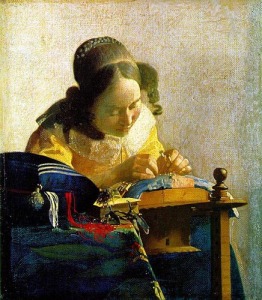
Salvador Dalí found deep meaning in Jan Vermeer's painting, "The Lacemaker" (ca. 1669-70)

Salvador Dalí found deep meaning in Jan Vermeer's painting, "The Lacemaker" (ca. 1669-70)

In December 1955, that “prodigious thing” meant that he was to borrow a friend’s white Rolls Royce Phantom II, fill it to the roof with 500 kg of cauliflower, and drive it to the Sorbonne in Paris. Then he would disembark and enter the school to give a lecture he’d impossibly titled, ‘Phenomenological Aspects of the Paranoiac Critical Method:’ 

“Some 2,000 ecstatic listeners were soon sharing Salvador’s Dalirium. Planting his elbows on a lecture table strewn with bread crumbs, Dalí blandly explained: “All emotion comes to me through the elbow.” Then he announced his latest finding in critical paranoia. The gamy meat of it: “Everything departs from the rhinoceros horn! Everything departs from [Dutch Master] Jan Vermeer’s The Lacemaker! Everything ends up in the cauliflower!” The rub, apologized Dalí, is that cauliflowers are too small to prove this theory conclusively.” (1)

As Dalí’s fame grew, his stunts and outrageous pronouncements became more frequent. He was an endless self-promoter, grandiose and pompous. He felt impelled, he admitted, to accumulate millions of dollars. He loved money. To keep the contracts coming, he was determined to keep himself in the public eye. His art and behavior were designed to provoke a response.

Salvador Dalí's most famouse painting, "The Persistence of Memory," 1931. His inspiration for the three melting watches came to him when he had a headache. His wife Gala had gone to the movies with friends and Dalí, ill, had stayed at home. He sat at the kitchen table for a long time, staring at the melting Camembert cheese. Before going to bed, he entered his studio and looked at the landscape he was working on - and decided to add three melting watches.

Salvador Dalí's most famous painting, "The Persistence of Memory," 1931. His inspiration for the drooping timepieces came to him one night when he had a headache. His wife Gala had gone to the movies with friends while Dalí, ill, had stayed behind at home. He sat at the kitchen table for a long time, staring at the melting Camembert cheese. Before going to bed, he entered his studio and looked at the landscape he had been working on - and - Voila! - decided to add three melting watches.

He delighted in playing the buffoon. While Dalí’s pranks were often funny, one was certainly dangerous. Once he donned a deep-sea diving suit before giving a lecture. The helmet was soundproof so no one could hear him. Dalí began to thrash about, flailing his arms soundlessly. The audience roared with laughter, thinking it was part of Dalí’s act. But he was suffocating inside the helmet. It was not until he almost fainted that he was rescued. Accused of going too far,  Dalí would often reply, “It’s the only place I ever wanted to go.”

Sometimes his stunts were offensive, such as when he and wife Gala appeared at a New York costume party dressed as the Lindbergh baby and his kidnapper. Other spectacles bordered on the criminal, like when he discovered that his Bonwit Teller window display in Manhattan had been rearranged. He became so enraged that he hurled a bathtub through the plate glass window and crashed, with the tub, inside the store.

Dalí created The Mae West Lips Sofa (1937) in the same shocking-pink color introduced by fashion designer Elsa Schiaparellli

Dalí created The Mae West Lips Sofa (1937) in the same shocking-pink color introduced by fashion designer Elsa Schiaparelli.

Dalí was endlessly creative in many genres other than painting. He created jewelry, designed clothes (see my post: “Elsa Schiaparelli: Shocking-Pink“) and furniture, painted sets for ballets and plays, wrote fiction, created window displays for department stores, and produced the dream sequence for director Alfred Hitchcock’s “Spellbound.He recorded a TV ad for Lanvin chocolates, designed the Chupa Chups candy labels, and was interviewed on TV in 1958 by Mike Wallace – during which Dalí imperiously referred to himself in the third person.

(1) TIME, Dec. 26, 1955

(2) “The Surreal World of Salvador Dali,” Smithsonian magazine, April 2005.

Read Full Post »

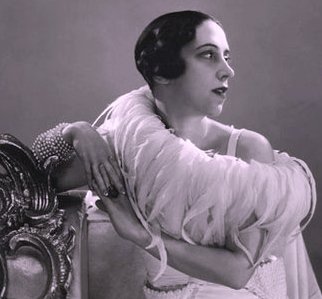
Italian-born fashion designer Elsa Schiaparelli in the 1930s

Italian-born fashion designer Elsa Schiaparelli in the 1930s

Between the two world wars, fashion design was dominated by two extraordinary pioneers, Gabrielle Chanel and Elsa Schiaparelli (1890-1973). Whereas Coco Chanel was a craftswoman who considered dressmaking a profession, Schiaparelli, on the other hand, regarded her work as art and herself as an artist.  

Schiaparelli’s designs were heavily influenced by artists in the dada and surrealist movements, particularly by Salvador Dali.  While Chanel’s clothes were known for their simplicity, Schiaparelli’s were known for their daring.

“Shocking-pink” was Schiaparelli’s signature color. She described hot pink as “life-giving, like all the light and the birds and the fish in the world put together, a color of China and Peru but not of the West.”

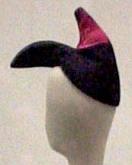
Schiaparelli shoe-hat which debuted in her Fall-Winter 1937-38 collection

Schiaparelli shoe-hat which debuted in her Fall-Winter 1937-38 collection

The designs Schiaparelli created in collaboration with Dali are among her best known. One of her most memorable designs created with Dali is known as the “shoe-hat” (shown here). Note that the hat is shaped like a woman’s high-heeled shoe, with the heel standing straight up and the toe tilted over the wearer’s forehead. The heel is of a shocking-pink color. This hat was worn by Singer sewing machine heiress Daisy Fellowes, among others.

Daisy Fellowes was one of Schiaparelli’s best clients. Fellowes was a French-American heiress with a taste for expensive jewels and clothes and a reputation for cutting remarks. “Though a footnote today, for nearly 50 years, Fellowes, the daughter of a French duke and granddaughter of the sewing-machine magnate Isaac Merritt Singer, was the trans-Atlantic fete set’s No. 1 bad girl.” She was also editor in chief of French Harper’s Bazaar, a philanthropist who donated her salary to an orphanage, and the author of a few sexy romance novels.

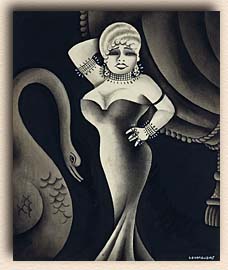
movie siren Mae West (1893-1980) by Miguel Covarrubias, 1928, for the New Yorker

a caricature of the American movie actress, the provocative Mae West (1893-1980) by Miguel Covarrubias, 1928, for the New Yorker magazine

Among other jewels purchased at Cartier‘s shop at 13 rue de la Paix in Paris, Fellowes owned a stunning 17.27ct pink diamond  called the Tête de Belier (Ram’s Head). It was Fellowes’ pink diamond that inspired the color known as shocking-pink or hot pink. Elsa Schiaparelli took note of the diamond, using shocking pink for the box design of her 1937 perfume which she named “Shocking.” The packaging of the box, designed by Leonor Fini, was also notable for the bottle in the shape of a woman’s torso. The shape was inspired by another of Schiaparelli’s celebrity clients, the American screen actress Mae West.

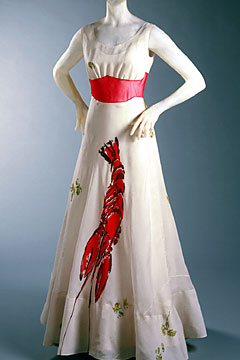
The Lobster Dress by Elsa Schiaparelli

The Lobster Dress by Elsa Schiaparelli

Another of the Schiaparelli/Dali designs is the iconic “Lobster Dress” which debuted in Schiaparelli’s Summer/Fall 1937 Collection. The Lobster dress is a simple white silk evening dress with a crimson waistband featuring a large lobster painted (by Dali) onto the skirt.It is rumored that Dali wanted to apply real mayonnaise to the lobster on the dress but that Schiaparelli objected.

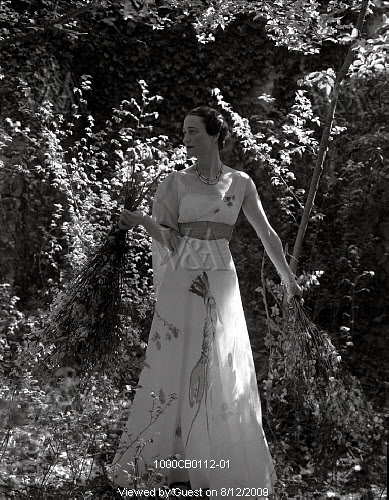
Dali’s lobster design for Schiaparelli was then interpreted into a fabric print by the leading silk designer Sache. It was famously worn by Wallis Warfield Simpson in a series of photographs by Cecil Beaton taken at the Château de Candé shortly before her marriage to Edward VIII. (shown here)

Wallis Simpson, the Duchess of Windsor (1895-1986), photo Cecil Beaton (1904-80). UK, early 20th century.

Wallis Simpson, the Duchess of Windsor (1895-1986), photo Cecil Beaton (1904-80). UK, early 20th century.

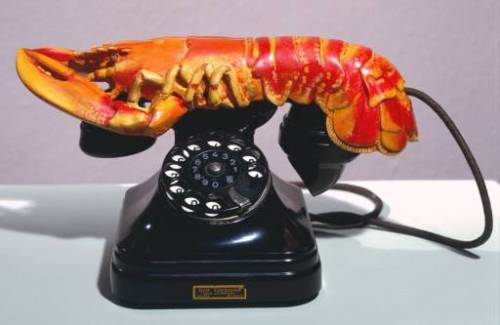
 Dali had been incorporating lobsters into his mixed media creations since 1934, most famously with “Lobster Telephone” (1936).

"Lobster Telephone," by Salvador Dali, 1936

"Lobster Telephone," by Salvador Dali, 1936

To see more of Schiaparelli’s fashion designs, click here.

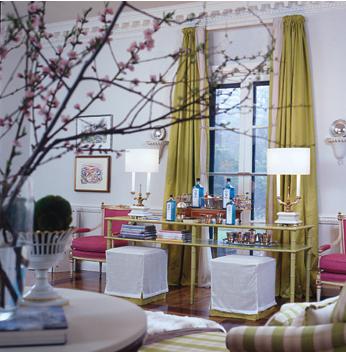
A modern room with touches of Schiaparelli pink in the two chairs and flowers in foreground

A modern room with touches of Schiaparelli pink in the two chairs and flowers in foreground

Read Full Post »

Madame X at the Met

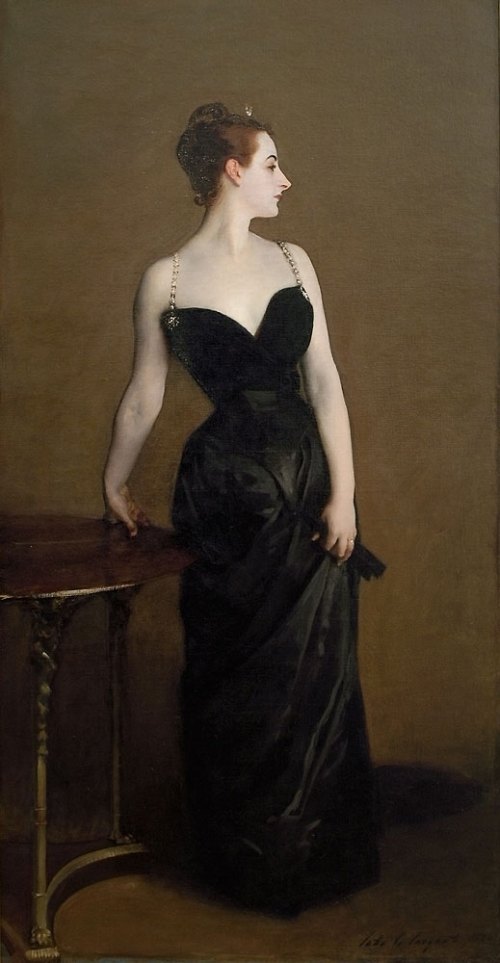
"Madame X" by American portrait painter John Singer Sargent, 1884

"Madame X" by American portrait painter John Singer Sargent, 1884

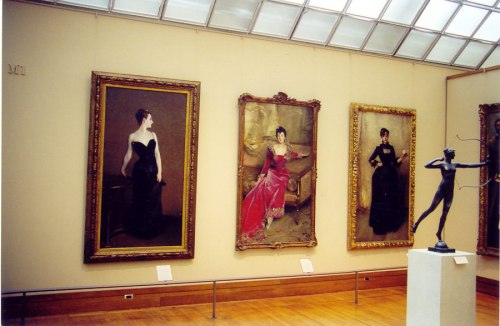
In the Metropolitan Museum of New York hangs a seven-foot tall portrait of a rather pale woman in a black velvet evening dress held up by sparkly straps. “Madame X” was painted by the American society painter John Singer Sargent.  The subject of the painting is Madame Virginie Gautreau, a professional beauty, who moved in the top tiers of Paris society and was often mentioned in the scandal sheets for her numerous dangerous indiscretions and passion for self-display. It was 1884 and Madame Gautreau was the Talk of Paris.

It was only a year earlier that John Singer Sargent had met her at a party. Once he laid eyes on her, he knew at once he must paint a portrait of her as an homage to her beauty – and a boost to his lagging career.  He felt that if he painted her, all Parisian society women would flock to his studio demanding that he paint their portraits. Sargent sent word to Madame Gautreau that she must sit for a portrait; she consented, realizing that a rising tide lifts all boats. She, too, needed the publicity to maintain her social superiority. Once they agreed, Sargent began to paint,  devoting himself to capture the “strange, weird, fantastic, curious beauty of that peacock-woman, Mme. Gautreau,” noted one observer.

Madame Gautreau was rumored to take great pains to be beautiful:

Gautreau achieved her affected, highly artificial look with hennaed hair, heavily penciled brows, rouged ears and powdered skin. She was rumored to mix her powder with mauve tint and to ingest arsenic wafers to make her skin more translucent, giving it even more of a bluish-purple tint.

Not all thought she was lovely to look at. She had her detractors. Some said her white pallor and icy charm made her resemble a cadaver.

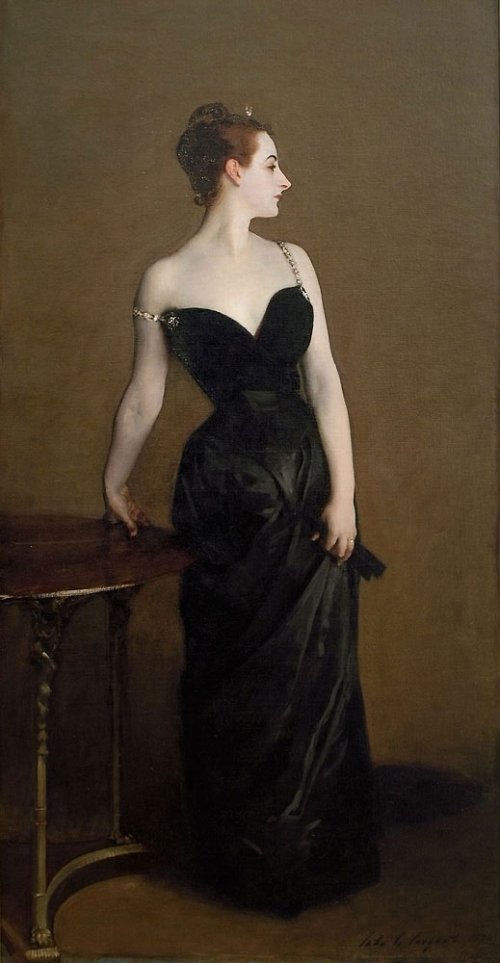
"Madame X" is shown as it must have originally appeared

"Madame X" is shown as it must have originally appeared

The painting that hangs in the Met today, “Madame X,” however, is not the same Madame X as the one that Sargent painted in 1884 and exhibited in Paris. That image no longer exists. We can only speculate what it looked like. The painting shown to the right here is what it may have looked like. That original, the one exhibited in Paris in 1884, showed Madame Gautreau’s dress with the right strap suggestively falling off her shoulder. (Compare to the painting at the top, the one at the Met. Her right strap, you’ll notice, sits firmly in place.)

When exhibited in Paris, the painting “with the falling strap” created an instant sensation but not in the way Sargent and Gautreau had hoped:


No sooner had the doors of the Palais de l’Industrie in the Champs-Élysées opened on May 1, 1884, than a crowd gathered in front of ”Madame X.” People hooted and pointed the tips of their umbrellas and canes at the painting. ”Look! She forgot her chemise!*” was heard over and over again. The critics were no kinder. ”Of all the undressed women at the Salon this year, the most interesting is Madame Gautreau . . . because of the indecency of her dress that looks like it is about to fall off,” wrote a critic for L’Artist. (*A chemise is a woman’s undergarment, a smock, that is worn under clothing and next to the skin. In that day, a French lady always wore a chemise under a dress.)

The painting was considered too provocative; sex pervaded it. Not even an actress, it was remarked, would wear a dress that shockingly low-cut and snug! And that strap! A little imagination conjured up a scene in which a slight struggle with a lover might knock Madame X’s right strap completely off her shoulder leading to… ! Paris was abuzz with the scandal. Madame Gautreau’s mother demanded that Sargent withdraw the painting from the exhibit. He refused.

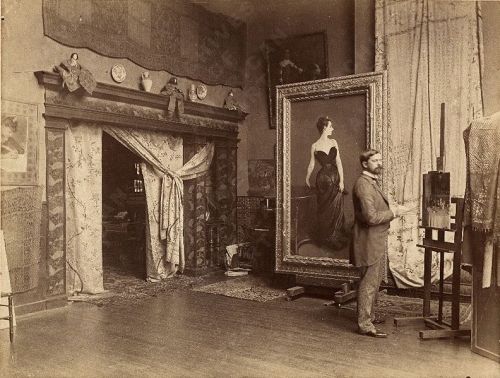
John Singer Sargent in Paris studio 1885 with the revised painting of Madame X

John Singer Sargent in Paris studio 1885 with the revised painting of Madame X

The painting, considered a beloved masterpiece today but pornographic by 1884 Parisian standards of decency, was trashed by the Paris critics so badly that Sargent, having lived in Paris for a decade then, was eventually forced to move to London to continue his profession. Sargent revised the painting to show the gown’s right strap securely in place. It is this retouched painting that hangs in the New York Metropolitan today.

Zip ahead to 1938 and the Upper East Side of Manhattan. Dorothy Hale was wearing her Madame X dress when she jumped to her death from her penthouse apartment. To learn more, read “Frida Kahlo: The Suicide of Dorothy Hale.”

"The Suicide of Dorothy Hale" by Frida Kahlo, 1938/39

"The Suicide of Dorothy Hale" by Frida Kahlo, 1938/39

Read Full Post »

Dorothy Hale and Isamu Noguchi at the premiere of Four Saints in Three Acts, February 7, 1934, Hartford, Connecticut

Dorothy Hale and Isamu Noguchi at the premiere of “Four Saints in Three Acts,” February 7, 1934, Hartford, Connecticut

In 1934, the socialite and actress Dorothy Hale took a road trip through Connecticut with two old friends, writer Clare Boothe Luce and sculptor Isamu Noguchi. They drove in a special car Noguchi had designed with his drinking buddy, futuristic inventor Buckminster Fuller. The car was called the Dymaxion.

The Dymaxion Car

The Dymaxion Car

Buckminster Fuller with his portrait by Isamu Noguchi, 1929, photo by Noguchi

Buckminster Fuller with his portrait by Isamu Noguchi, 1929, photo by Noguchi

The 20-foot long aluminum-bodied Dymaxion car caused a traffic jam wherever it went.  This was between the two world wars when cars were sedans and pick-up trucks. “Bucky” Fuller’s car was shaped like a teardrop and ran on three wheels. It went 90 m.p.h. and was fuel-efficient at 30 m.p.g. The 3-wheeler made a 360-degree turn on a dime. A periscope that came out of the roof gave extra visibility. It seated eleven passengers.

It was the car of the future – for a while. Unfortunately, only three Dymaxion cars were ever produced. Orchestra conductor Leopold Stokowski bought one. Amelia Earhart was interested in investing. Financing was a problem and Fuller was running out of cash.

Aviator Amelia Earhart

Aviator Amelia Earhart

Any hope of putting the Dymaxion in full-scale production dried up quickly when the car was involved in a fatal accident at the 1933 Chicago World’s Fair. Another car was blamed for the crash but that didn’t stop the negative publicity for the Dymaxion.

Sadly, only one of the Dymaxions exists today. You can view the restored exterior of the car at the National Automobile Museum in Reno, Nevada. Disappointingly, though, the car windows are painted opaque from the inside to prevent you looking inside. Evidently, the inside was in very bad shape when the car was acquired and little information exists as to its original look in order to guide the museum restoration artists. The rumor is that the car had been used as a chicken coop somewhere in the Midwest before it was discovered, which explains the wrecked state of the interior!

View this youtube video to see the amazing turning radius of the Dymaxion. While you’re viewing, keep a lookout for Amelia Earhart in the back seat.

http://www.youtube.com/watch?v=YlLZE23EJKs&feature=related

For more on Dorothy Hale, see my most popular post, Frida Kahlo: The Suicide of Dorothy Hale.”

Read Full Post »

"The Weaker Sex, by Charles Dana Gibson, 1903

"The Weaker Sex, by Charles Dana Gibson, 1903

“Illustrator Charles Dana Gibson’s (1867-1944) glamorous, winsome “Gibson girls” set the standard for female beauty in turn-of-the-century America. Here [in the above illustration], however, Gibson parodies his own creations, portraying his traditionally passive paradigms of womanhood as playfully assertive giants toying with a minuscule man.” (1)

(1) Library of Congress “Monstrous Craws & Character Flaws” Exhibit

Read Full Post »

"Fulang-Chang and I" by Frida Kahlo, 1937. Fulang-Chang was Frida's favorite spider monkey.

"Fulang-Chang and I" by Frida Kahlo, 1937. Fulang-Chang was Frida's favorite spider monkey.

As discussed in a previous post, “Frida Kahlo: A Few Small Nips,” Frida was devastated to learn of her husband Diego Rivera‘s affair with her younger sister Cristina. No one really knows exactly when Diego and Cristina began their affair, but, by early 1935, Frida had moved out of her San Angel house she shared with Diego and, taking her favorite spider monkey, rented an apartment in the center of Mexico City. Frida was determined to try and create and independent life for herself. She had not yet become a celebrated artist and was financially dependent upon Diego.

But Frida couldn’t make the break. Although Frida had a strong life force, she became desperately insecure without Diego around to praise her talents and beauty. Although she had moved out to get away from Diego, she continued to see him constantly, he keeping some of his clothes in her apartment and buying her a set of blue leather furniture just like the red set he’d given Cristina for her place. 

Frida was so mixed up and unhappy. Both living with Diego made her miserable and living without him made her miserable.

Cracks began to appear in the brave face Frida showed her friends. Old boyfriend Alex Gómez Arias visited her at her flat one day. Frida, glancing out the window, spotted her sister Cristina at a gas station across the road. Frida flew into a rage.

Look!” she cried. “Come here! Why does she come and fill up her car in front of my house?”

Diego Rivera

Diego Rivera

Finally, in early July, Frida packed and took off to New York with friends. After confiding her troubles, she came to a decision. She could not live without Diego. She reconciled herself to the fact that, should she stay married to Diego, he would continue his skirt-chasing. On July 23, 1935, she wrote him a letter:

[I know now that] all these letters, liaisons with petticoats, lady teachers of ‘English,’ gypsy models, assistants with ‘good intentions,’ ‘plenipotentiary emissaries from distant places,’ only represent flirtations, and that at bottom you and i love each other dearly….

All these things have been repeated throughout the seven years that we have lived together, and all the rages I have gone through have served only to make me understand in the end that I love you more than my own skin….”

Frida returned to San Angel to live, once again, with Diego. Diego continued his philandering ways. Frida herself began a flurry of affairs with a number of people, both men and women. The relationships were often fiery and fleeting. She was fascinated by great men and women.

Diego was not jealous of Frida’s women lovers but was extremely jealous of the men. One of Frida’s lovers included the American sculptor Isamu Noguchi who had come to Mexico to do a mural.

When Rivera discovered it, he was so enraged that he sped to the Coyoacán house, where the lovers were in bed. Frida’s mozo (houseboy), Chucho, warned his mistress of Diego’s arrival. Noguchi threw on his clothes, but one of the hairless dogs pounced upon a sock and ran off with it. Noguchi…abandoned the sock, scrambled up the orange tree in the patio, and fled over the roof. Of course, Diego found the sock and did what Mexican machos are supposed to do under such circumstances.

As Noguchi tells it: ‘Diego came by with a gun. He always carried a gun.'”(1)

Diego demanded that Frida and Noguchi end the affair.

(1) Herrera, Hayden.  Frida: A Biography of Frida Kahlo. New York: HarperCollins, 1983.

READERS: For more posts on Frida Kahlo, click here.

Read Full Post »

In this March 2007 photo, Britain's Queen Elizabeth II greets American photographer Annie Leibowitz at a reception prior to their photo shoot. Notice that the Queen has her black Launer purse on her arm.

In this March 2007 photo, Britain's Queen Elizabeth II greets American photographer Annie Leibovitz at a reception prior to their photo shoot. Notice that the Queen has her black Launer purse on her arm.

Prior to her May 2007 visit to the United States, Queen Elizabeth II sat for a series of official photographs by famous celebrity photographer Annie Leibovitz. Ms. Leibovitz is well known for her sometimes controversial celebrity photographs including one of a naked John Lennon hugging a fully clothed Yoko Ono.

December 8, 1980 photograph of John Lennon with wife Yoko Ono taken by Annie Leibowitz. Five hours after this photo shoot, Lennon was shot dead.

December 8, 1980 photograph of John Lennon with wife Yoko Ono taken by Annie Leibowitz.

Leibovitz has said the original concept for the now legendary John Lennon and Yoko Ono Rolling Stone cover was for both to appear nude, designed to mark the release of their album “Double Fantasy.” As legend has it, Lennon was game, shedding his clothes quickly, but Ono felt uncomfortable even taking off her top. Leibovitz recalled for Rolling Stone:

“I was kinda disappointed, and I said, ‘Just leave everything on.’ We took one Polaroid, and the three of us knew it was profound right away.”

It was December 8, 1980. Five hours later, Lennon was dead – shot and killed by Mark David Chapman in front of his Manhattan apartment.

Now back to what I was saying about the Queen:

Leibowitz took the official portraits of Queen Elizabeth II in March 2007. One of the photos, shown below, shows a very serene Queen sitting in the White Drawing Room at Buckingham Palace dressed in a pale gold evening dress, fur stole, and diamond tiara. The wide shot captures the Queen gazing towards a large open window and reveals some of the room’s furnishings and a reflection of a chandelier in a mirror. The room is dark except for the soft light flooding through the open window. All is calm.

Queen Elizabeth II photographed by Annie Leibowitz, March 2007

Queen Elizabeth II, photographed by Annie Leibowitz, March 2007

The session was going smoothly until Leibovitz asked the Queen to take off her tiara (crown) to look “less dressy” for the next photo. The Queen flew into a huff and replied:

“Less dressy? What do you think this is?”

Queen Elizabeth II, photographed by Annie Leibowitz, March 2007. The Queen is not amused after having been asked by Leibowitz to take off her crown, which is actually a tiara.

The Queen was definitely not amused and the tiara stayed on the royal head.

The incident was caught on tape and included in a  BBC documentary “A Year with the Queen.” The BBC kept the footage and included it in a  promotional trailer for the film. The trailer shows the Queen telling an aide, “I’m not changing anything. I’ve had enough dressing like this, thank you very much” and storming out of the room.  The BBC later apologized and admitted that the sequence of events shown on the trailer had been misrepresented, as the Queen was in fact walking to the sitting in the second scene, not exiting. This led to a BBC scandal and a shake-up of ethics training. The event is known as “Tiaragate” and “Crowngate.” According to sources, the Queen was still furious about the incident months later.

Here’s the NBC-TV report:

Read Full Post »

Diego Rivera, seated in front of a mural depicting the American class struggle, 1933.

Diego Rivera, seated in front of a mural depicting the American class struggle, 1933.

Frida Kahlo (1907-1954) went into her marriage (1929) with her eyes wide open. She knew that her husband, famed Mexican muralist Diego Rivera, spread his affections around. Diego engaged in numerous short-lived and casual relationships with the fawning women – actresses, models, artists, photographers – who flocked around him. He was Mexico‘s most celebrated artist of his time.

"Portrait of Lupe Marin," by Diego Rivera, 1938

"Portrait of Lupe Marin," by Diego Rivera, 1938

Diego’s many extramarital affairs had destroyed his previous marriage to Lupe Marín, Once, in front of a group of guests, a jealous Lupe made quite a scene, tearing a rival’s hair, ripping up some of Diego’s drawings, and beating Diego with her fists. Another time she smashed some of his archaeological artifacts and served the broken shards to Diego in a soup bowl.

At the beginning of their marriage, whenever Frida learned of yet another of Diego’s affairs, she managed to put on a good face.  She pretended it did not hurt her, excusing Diego by saying flippantly, “How would I be able to love someone who wasn’t attractive to other women?” She retaliated by having love affairs of her own, with men and with women, once telling acquaintance Jean van Heijenoort that her view of life was

Make love, take a bath, make love again.”

She held up until the year 1934. That was the year Frida and Diego returned from living three years in the United States. Their funds were low. Diego’s Rockefeller Center mural had caused a terrible controversy. Diego had painted a heroic portrait of the Russian Communist leader Vladimir Lenin in the mural and had refused to paint him out. Diego was fired and the mural was then destroyed. Homesick for Mexico, Frida made Diego return home, against his wishes. Diego sulked.

"Portrait of My Sister Cristina Kahlo," by Frida Kahlo, 1928 (portion)

"Portrait of My Sister Cristina Kahlo," by Frida Kahlo, 1928 (portion)

Demoralized and broke, both of them were also in poor health. Diego had maintained a grueling painting schedule on the scaffold, turning out murals in San Francisco, Detroit, and New York, and was “weak, thin, yellow, and morally exhausted,” Frida wrote to her friend Ella Wolfe that July. Frida had been in the hospital three times that year – for an appendectomy, a therapeutic abortion, and foot surgery.

No one knows exactly when Diego began his affair with Frida’s sister Cristina; it was probably in the summer of 1934. Frida was devastated. Cristina was not just her sister but her confidante. Cristina’s husband had left her in 1930 and, since then, she and her children had spent a great deal of time at Frida and Diego’s house. Cristina had served as a model many times for Diego’s murals and they had grown very close, too close, to Frida’s chagrin. Diego had, no doubt, seduced Cristina with his clever words, and convinced her that he needed her, reminding Cristina that Frida was too sick for lovemaking and that he, Diego, was sad and needy.

"Self-Portrait with Curly Hair," by Frida Kahlo, 1935

"Self-Portrait with Curly Hair," by Frida Kahlo, 1935

In her great anguish, Frida cut off her long hair and stopped wearing the native Mexican costumes that were her signature look and that made Diego so happy. She painted a self-portrait of her new look. This little painting, 7-1/4 x 5-3/4 inches, was called “Self-Portrait with Curly Hair.” Her smallest canvas ever,  Frida gave the little painting to Ella Wolfe, Frida’s longtime friend and the wife of Diego Rivera’s biographer, Bertram Wolfe. Ella kept the painting until 2000. In 2003, “Self-Portrait with Curly Hair” was auctioned off by Artemundi & Co. and sold for $1,351,500.00. Today, Frida Kahlo remains the most expensive-selling female artist in the history of art.

During that period of terrible pain from the betrayal by both  husband and sister, Frida painted another painting quite different from “Self-Portrait with Curly Hair.” This one was morbid, bloody, disquieting. Shown below, “A Few Small Nips” features a woman being literally “murdered by life,” as Frida herself felt, murdered both physically by her chronic pain and suffering and emotionally by Diego and Cristina. The painting’s theme is based on a newspaper account of a real murder. A drunken guy threw his girlfriend on a cot and stabbed her 20 times. When interviewed, the brutal murderer protested his innocence, saying, “But I only gave her a few small nips.”

"A Few Small Nips" by Frida Kahlo, 1935, is based on a newspaper account of a real murder. A drunk threw his girlfriend on a cot and stabbed her 20 times. When interviewed, he protested his innocence, saying, "But I only gave her a few small nips."

"A Few Small Nips" by Frida Kahlo, 1935.

NEXT: Frida to Diego: I Can’t Live, if Living is Without You!

Readers: For more on Frida Kahlo on this blog, click here.

Read Full Post »

Click here to read “Frida Kahlo’s First Bad Accident” before reading this post.

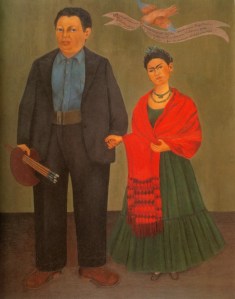
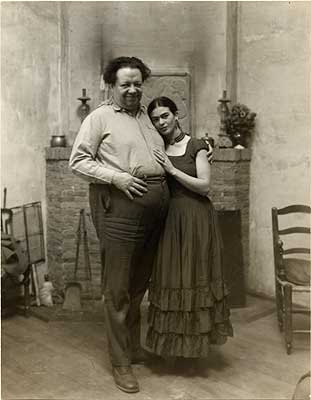
Frida Kahlo and Diego Rivera, their wedding photo, 1929

Frida Kahlo and Diego Rivera, their wedding photo, 1929

Frida Kahlo once said to a friend, “I have suffered two serious accidents in my life, one in which a streetcar ran over me….The other accident is Diego.”

She was referring to her husband, Diego Rivera (1886-1957), the world famous painter and active Communist. He painted large-scale murals in Mexico, New York City, Detroit, and San Francisco. Diego was 21 years older than Frida and their marriage in 1929 offered Frida, a budding artist, to move not only in elite Mexican artistic and intellectual circles, but those in Europe and America as well. But the price Frida paid for marrying a renowned “lady chaser” was high. Their marriage was tempestuous. They divorced once and remarried a year later; they were separated several times.

Many people were surprised by what they considered a strange match. Frida once told a journalist:

When I was seventeen, Diego began to fall in love with me. My father didn’t like him because he was a Communist and because they said he looked like a fat, fat, fat Breughel. They said it was like an elephant marrying a dove. Nevertheless, I arranged everything in the Coyoacán town hall for us to be married on the twenty-first of August, 1929.”

"The Flower Carrier" by Diego Rivera, 1935

"The Flower Carrier" by Diego Rivera, 1935

Frida was 22, Diego, 43. It was Diego’s first legal marriage, although, by then, there had been many women and two long-term relationships. For ten years during the 1910s, he lived in Paris with the Russian artist Angelina Beloff. Together they had a son who died young. Then, in 1922, he married the Mexican Lupe Marín, with whom he had two daughters. Though a serious commitment, Diego and Lupe had not legalized their relationship with a civil ceremony so Diego was free to marry Frida without divorcing Lupe.

Frida’s recollection of her wedding to Diego gives an idea of how difficult a man Diego was to be married to:

I borrowed petticoats, a blouse, and a rebozo from the maid, fixed the special apparatus on my foot so it wouldn’t be noticeable, and we were married. Nobody went to the wedding, only my father, who said to Diego, ‘Now, look, my daughter is a sick person and all her life she’s going to be sick. She’s intelligent but not pretty. Think it over awhile if you like, and if you still wish to marry her, marry her, I give you my permission.'”

"Frida and Diego Rivera" by Frida Kahlo, 1931

"Frida and Diego Rivera" by Frida Kahlo, 1931

Diego added that her father mentioned that she was un demonio – a devil. Frida continues, describing her wedding reception:

Then they gave us a big party in Roberto Montenegro’s house. Diego got horrendously drunk on tequila, waved his pistol about, broke some man’s little finger, and destroyed some things. Afterward, we got mad at each other; I left crying and went home. A few days went by and Diego came to get me and took me to his house at 104 Reforma.'”

Despite their stormy relationship, Diego and Frida loved and needed each other.

NEXT: Frida Kahlo: A Few, Small Nips

READERS: For more posts on Frida Kahlo, click here.

Read Full Post »

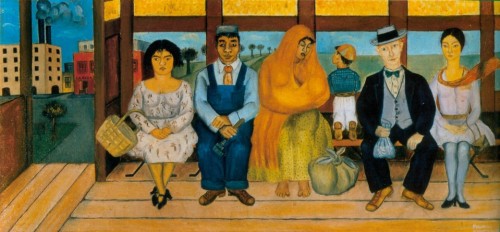
"The Bus," by Frida Kahlo (1929). Frida painted her recollection of the last moments aboard the bus before the terrible accident that robbed her of her health. She is pictured on the far right. Notice that she is not dressed in traditional Mexican costume. She adopted that exotic look later, after her 1929 marriage to flamboyant Mexican muralist Diego Rivera.

“The Bus,” by Frida Kahlo (1929). Frida painted her recollection of the last moments aboard the bus before the terrible accident that robbed her of her health. She is pictured on the far right. Notice that she is not dressed in traditional Mexican costume. She adopts that exotic look later, after her 1929 marriage to flamboyant Mexican muralist Diego Rivera.

Mexican artist Frida Kahlo (1907-1954) once said that she suffered two bad accidents in her life. The first one occurred on September 17, 1925. It would transform her life forever. Frida was only 18.

It was a gray day. A light rain had just fallen. After spending the afternoon wandering among the street stalls of downtown Mexico City, Frida and her boyfriend Alex Gómez Arias caught a bus that would take them home to Coyoacán. The new bus was brightly painted with two benches along the sides. It was nearly full but Alex and Frida found seats together near the back. The bus driver sped off to cross the busy streets on his way out of town.

As the bus driver began to turn onto Calzada de Tlapan, a street trolley approached. The bus driver rashly tried to pass in front of the turning streetcar. He didn’t make it. Alex remembers the point of impact:

The electric train [streetcar] with two cars approached the bus slowly. It hit the bus in the middle. Slowly the train  pushed the bus. The bus had a strange elasticity. It bent more and more, but for a time it did not break. It was a bus with long benches on either side. I remember that at one moment my knees touched the knees of the person sitting opposite me. I was sitting next to Frida. When the bus reached its maximal flexibility it burst into a thousand pieces, and the train kept moving. It ran over many people.

I remained under the train. Not Frida. But among the iron rods of the train, the handrail broke and went through Frida from one side to the other at the level of the pelvis.”

Frida said that the “handrail pierced me the way a sword pierces a bull.” Alex continues:

When I was able to stand up, I got out from under the train. I had no lesions, only contusions. Naturally the first thing that I did was to look for Frida.

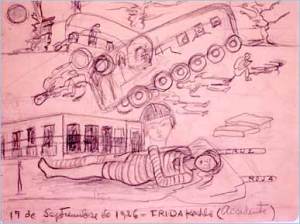
"Accident" by Frida Kahlo (1926)

Something strange had happened. Frida was totally nude. The collision had unfastened her clothes. Someone in the bus, probably a house painter, had been carrying a packet of powdered gold. This package broke, and the gold fell all over the bleeding body of Frida. When people saw her, they cried, ‘La bailarina, la bailarina!’ With the gold on her red, bloody body, they thought she was a dancer.

I picked her up….and then I noticed with horror that Frida had a piece of iron in her body. A man said, ‘We have to take it out!’  He put his knee on Frida’s body and said, ‘Let’s take it out.’ When he pulled it out, Frida screamed so loud that when the ambulance from the Red Cross arrived, her screaming was louder than the siren. Before the ambulance came, I picked up Frida and put her in the display window of a billiard room. I took off my coat and put it over her. I thought she was going to die. Two or three people did die at the scene….others died later.”

"Self-Portrait for Alejandro Gomez Arias," by Frida Kahlo (1926)

Frida’s condition was so grave doctors didn’t believe they could save her. They thought she would die on the operating table. Her spinal column was broken in three places in the lumbar region. Her collarbone was broken and her third and fourth ribs. Her right leg had eleven fractures and her right foot was dislocated and crushed. Her left shoulder was out of joint, her pelvis broken in three places. The steel handrail produced a deep abdominal wound, entering through the left hip and exiting through the genitals. She convalesced for two years though she would never fully recover.

It was while she was confined to bed that Frida began to paint, using a small lap easel her mother bought for her. Frida had a mirror hung overhead in the canopy of her bed so she could use her reflection as a beginning subject for portraits.

Next: Frida Kahlo: The Other Accident

READERS: For even more posts on Frida Kahlo, click here.

Read Full Post »

"The Love Embrace of the Universe, the Earth (Mexico), Me, Diego, and Mr. Xolotl," by Frida Kahlo, 1949.

"The Love Embrace of the Universe, the Earth (Mexico), Me, Diego, and Mr. Xolotl," by Frida Kahlo, 1949.

In the lower left of Frida Kahlo‘s painting, “The Love Embrace of the Universe” (above), a little dog is sound asleep in a huge hand. The dog is Frida Kahlo’s favorite pet dog, Mr. Xolotl. Mr. Xolotl (show-low -tul) was a xoloitxcuintli (show-low-eats-queen-tlee) dog. Frida had several of these unusual-looking dogs, a hairless breed with an ancestry that is traceable back 3,000 years to the Aztecs, hence their appeal to Frida, enormously proud of her MesoAmerican heritage. Xolos (show-lows), for short, are related to Mexican hairless chihuahuas. The Aztecs both revered and ate xolos.

"Frida Kahlo and her Itzcuintli Dogs," photo by Lola Alvarez Bravo, 1944

"Frida Kahlo and her Itzcuintli Dogs," photo by Lola Alvarez Bravo, 1944

Nowadays, xolos are prized for the enormous amount of heat their bodies generate, although they do not have a higher-than-average body temperature. As a result, many sufferers of rheumatism and arthritis keep xolos as pets, claiming the dogs relieve their pain by acting as canine heaters.

The xolos are sometimes referred to as Colima dogs. They may range in size from 3 pounds to 60.

READERS: For more posts on Frida Kahlo, click here.

Read Full Post »

Artists Diego Rivera and Frida Kahlo

Artists Diego Rivera and Frida Kahlo

By the summer of 1938, Frida Kahlo was on her way to being discovered as an artist in her own right, rather than only being referred to as the wife of famed Mexican muralist Diego Rivera. That summer, actor and art collector Edward G. Robinson had traveled to Mexico City just to see her paintings and had paid $200 each for four of them. Frida was thrilled. She had sold only a few of her paintings so far and had been content to just give them away. She later wrote of the Robinson sale:

“For me it was such a surprise that I marveled and said, “This way I am going to be able to be free; I’ll be able to travel and do what I want without asking Diego for money.”

She and Diego had become increasingly estranged because of his many illicit extramarital affairs, including one with Frida’s sister Cristina. Frida was heartsick by Diego’s infidelities and retaliated by having multiple affairs of her own, with both men and women. Despite their discord, they remained deeply in love. Frida and Diego made up one of those married couples who could neither stay together nor apart. By the summer of 1939, they would be divorced – only to remarry a year later.

"Self-Portrait Dedicated to Leon Trotsky (Between the Curtains)" 193

“Self-Portrait Dedicated to Leon Trotsky (Between the Curtains)” by Frida Kahlo, 1937

That November, Frida Kahlo traveled to New York City for her first one-person exhibition of her paintings, held at the Julien Levy Gallery, confident in her new status as celebrated artist. As always, her exotic Zapotec clothing and heavy jewelry created a buzz in the press. Her show was a great success. Time magazine noted that “the flutter of the week in Manhattan was caused by the first exhibition of paintings by famed muralist Diego Rivera’s…wife, Frida Kahlo.” Frida Kahlo’s hand, bedecked with huge rings, adorned a cover of Vogue.

Notables such as artist Georgia O’Keeffe attended the gallery exhibit as did playwright and former editor of the fashion magazine Vanity Fair Clare Boothe Luce.

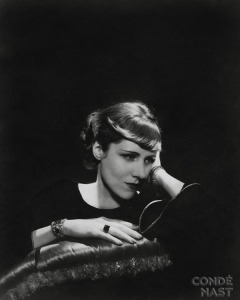
Claire Booth Brokaw (Luce) (1903-1987) as photographed by Cecil Beaton for the August 1934 issue of Vanity Fair

Claire Boothe Brokaw (Luce) (1903-1987) as photographed by Cecil Beaton for the August 1934 issue of Vanity Fair

Luce remembered the occasion well:

“The exhibition was crowded. Frida Kahlo came up to me through the crowd and at once began talking about Dorothy’s suicide [Dorothy Hale was a friend of both Kahlo and Luce’s].…Kahlo wasted no time suggesting that she do a recuerdo of Dorothy. I did not speak enough Spanish to understand what the word recuerdo meant….I thought Kahlo would paint a portrait of Dorothy in the style of her own self-portrait [dedicated to Trotsky][see above], which I bought in Mexico….

Suddenly it came to me that a portrait of Dorothy by a famous painter friend might be something [Dorothy’s] poor mother might like to have. I said so, and Kahlo thought so, too. I asked the price, Kahlo told me, and I said, ‘Go ahead. Send the portrait to me when it is finished. I will then send it on to Dorothy’s mother.’”

Dorothy Hale was a sometime actress, Ziegfeld showgirl, and socialite. Hale’s life had gone downhill seven years earlier after her husband Gardner Hale was killed when his car drove off a 500 foot cliff in Santa Maria, California. Hale’s career as an actress was drying up; she was failing her screen tests. She was in severe financial trouble and living on charity from friends.  On October 20, 1938, Hale assembled her close friends for a party at her New York apartment and announced that she was taking a long trip. The farewell party lasted until the wee hours of the morning. Hale stayed up writing good-bye letters to her friends and drinking the last of the vodka. A little before  6 a.m. on the 21st,  Hale put on her black velvet dress and pinned on it a corsage of small yellow roses sent to her by the sculptor Isamu Noguchi. She then climbed onto the windowsill of her luxury high-rise apartment suite and jumped to her death.

"The Suicide of Dorothy Hale" by Frida Kahlo, 1938/39

“The Suicide of Dorothy Hale” by Frida Kahlo, 1938/39

From the encounter between Luce and Kahlo at the gallery exhibit arose one of Frida Kahlo’s most shocking and controversial paintings, “The Suicide of Dorothy Hale” (1938/39). Kahlo painted Dorothy Hale as she jumped, fell, and landed, dead and bloody, on the concrete walk outside her apartment building. Blood-red lettering at the bottom of the retablo details the tragedy in Spanish:
“In New York City on the 21st of October 1938, at 6:00 in the morning, Dorothy Hale committed suicide by throwing herself from a very high window in the Hampshire House. In her memory, this portrait was executed by Frida Kahlo.”

Luce recalls the horror she felt when the painting was delivered to her home and she first laid eyes on it.

“[W]hen I pulled the painting out of the crate…I felt really physically sick. What was I going to do with this gruesome painting of the smashed corpse of my friend, and her blood dripping down all over the frame? I could not return it – across the top of the painting there was an angel waving an unfurled banner which proclaimed in Spanish that this was ‘The Suicide of Dorothy Hale, painted at the request of Clare Boothe Luce, for the mother of Dorothy’. I would not have requested such a gory picture of my worst enemy, much less of my unfortunate friend.”

Luce wanted to have the painting destroyed, but was dissuaded by friends. Instead, she had sculptor and friend Noguchi paint over the angel with the banner and gave the painting to a friend.

Luce couldn’t have known at the time that Kahlo was in a desperate state of mind as she always was when she was afraid of losing Diego. At the time she painted “The Suicide of Dorothy Hale,” Kahlo herself was having repeated thoughts of committing suicide.

READERS: For more posts on Frida Kahlo, click here.

For more on Dorothy Hale, read my post, “Dorothy Hale and the Dymaxion Car.”

Read Full Post »

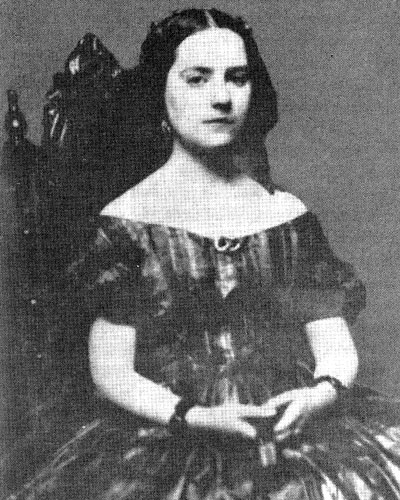
Mary Todd Lincoln, ca. 1861

When Mary and Abraham Lincoln moved into the White House in 1861, Mary was 42 years old, a time when women her age dressed in somber grays, dull browns, and boring blues. But not Mary Todd Lincoln. For her, expensive clothes were a mark of importance, of breeding. She proceeded to dress like a peacock, draping herself in bold blues, crimson, yellow, and royal purple, attracting a lot of unwanted attention and sparking criticism from the Washington social elite. Brought up among the overdressed ladies of Kentucky, her gowns and bonnets were ornamented with flowers, lace, dots, and bows sewn on yards of velvet, taffeta, and silk at a time of war when soldiers were going without blankets. Mary took her fashion cues from Eugenie, Empress of France, whose parties and clothes appeared in line drawings and detailed descriptions in one of Mary’s favorite magazines, Godey’s Lady’s Book. She was admonished for wearing low-necked dresses that revealed her “milking apparatus,” said one critic, and for the “flower beds which she carries on top of her head,” said another. A petite woman, the bell-shaped dresses overwhelmed her; hoops made her look shorter and squat.

Buoyed by a grandiose sense of self-importance coupled with her new position as the president’s wife, Mary demanded what she wanted. She expected everyone to do her bidding. She was surprised when clothing merchants sent her bills. The line between purchase and donation was fuzzy. Mary looked for donors to buy her gowns and hats, rewarding them with political favors. When she blew her four-year budget for White House renovations in under a year, she contrived several plots to secretly defray her debt. In one instance, she ordered the White House gardener into selling manure from the stables at ten cents a wagonload. It raised more stink than cash. Her spending eventually came to light and became a national scandal. Lincoln was mortified and had to deal with it, all the while referring to it benignly as his beloved Mary’s silly “flub-a-dub.”

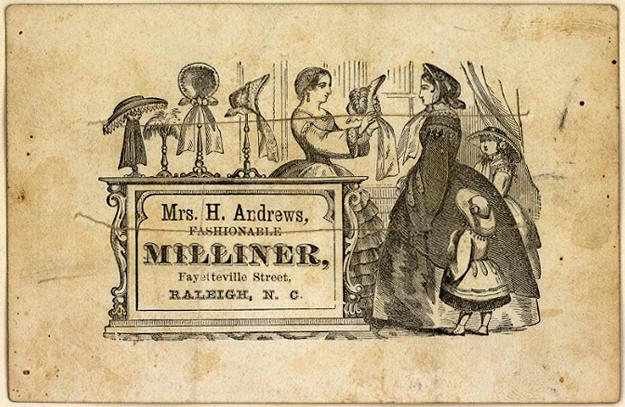
Willian's of Pennsylvania Avenue, Washington's best known milliner at the time, made Mary Todd Lincoln's bonnets. Unfortunately, he also made bonnets for Mrs. Horatio Taft.

Now, back to what we were saying about Mary and her clothing:

It was an April evening in 1861. The Marine Band was playing a concert on the White House lawn. Mary and President Lincoln had invited many guests, among them Mary Cook Taft, wife of Horatio Taft, an examiner at the U.S. Patent Office. Mary Taft was wearing a delicate straw bonnet lavishly trimmed with pretty purple ribbons embroidered with little black figures. The bonnet had long strings which tied beneath her chin in a bow. Mary Taft’s teenage daughter, Julia, accompanied her to the promenade grounds that day and vividly recalled their costumes:

“My mother, of course, wore the bonnet, together with a purple and white silk over a moderate crinoline, and lavender kid gloves. I was dressed in white Swiss, much beruffled, but without hoop skirt or crinoline, which was an abiding grievance with me. But my hat…was very gratifying and almost compensated for the lack of crinoline.”

Women’s Fashions 1860

Mary and Julia walked around mingling with the other guests while the band played on. The national anthem brought those in chairs to their feet, men doffing their hats, and all standing in patriotic attention. At the close of the concert, the Taft women walked over to the south front where the presidential party was sitting, to pay their respects. Mary Lincoln could not take her eyes off Mary Taft’s bonnet. Julia recalled what happened next:

Julia Taft, undated photo

“After a few words of greeting, [Mrs. Lincoln] took my mother aside and talked with her for a moment. While I could not hear their conversation, I knew someway that they were talking about my mother’s bonnet and I was a bit puzzled at the look of amazement on my mother’s face. I did not see why my mother should look so surprised at a passing compliment from Mrs. Lincoln.”

Mary Lincoln wanted the purple strings off Mary Taft’s bonnet and asked for them. Mary Taft was angry—she loved her bonnet with its pretty purple ribbon— but what could she do? Mary Taft’s husband was a government appointee. Mrs. Lincoln could get him fired and then how would they pay for Julia’s private Washington school? So, begrudgingly, Mrs. Taft agreed to give up her ribbons to “Madam President” as Mary Lincoln requested to be called by the White House staff. 

The Washington milliner Willian sent for Mary Taft’s bonnet, removing the purple ribbons for Mary Lincoln, and sending back Mary Taft’s bonnet with new lavender ribbon. Not long after this incident, Julia, who was often in the White House as a babysitter for her little brothers, Bud and Holly, the inseparable playmates of Tad and Willie Lincoln, caught sight of Mary Lincoln wearing a purple dress and a bonnet trimmed with her mother’s purple ribbons. 

Mary Lincoln is shown with two of her four sons. Willie is to our left and Tad is to our right. Tad’s name is Thomas. He was so wiggly that he was nicknamed Tadpole. One of the Lincoln’s sons, Eddie, died when they had lived in Springfield. The eldest Lincoln boy, Robert, was studying at Harvard in 1860, the year this photo was taken.

Source: Bayne, Julia Taft. Tad Lincoln’s Father. Boston, Little, Brown, and Co., 1931.

Readers: For more on Mary Lincoln, click here.

Read Full Post »

« Newer Posts - Older Posts »