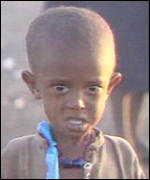
One of the millions of starving Ethiopians during the Famine of 1984-85
In 1985, Michael Jackson and Lionel Richie wrote a song that ended up making music history. The single, “We are the World,” was recorded to raise money to fight famine in Africa, particularly in Ethiopia, where a 20 year-old civil war raged. As a result of drought and poor harvests, millions of Ethiopians were starving and suffering from disease while their Marxist government spent money on weapons, money that had been intended for food and medicine.
Following BobGeldof‘s example of Live Aid in Great Britain, Harry Belafonte and Ken Kragen decided to organize an American fundraiser to help out the Ethiopian citizens. Originally, a charity concert was planned, but it was decided that a single recording would bring in more money. Quincy Jones agreed to produce. Michael Jackson and Lionel Ritchie collaborated on the song.
Jones contacted 45 musicians for the marathon overnight recording session. The supergroup was billed as “U.S.A.” for Africa and was assembled the night of the American Music Awards. Michael Jackson skipped the awards ceremony to record the chorus as a guide for the other musicians.
Getting two artists together in a sound studio would have been a small feat, but 45? Quincy Jones sent a memo to each artist to check their egos at the door.
Jones worked out which singers would perform which lyrics, studying recordings of each of the selected singers to decide which would work well with each other. He paired Billy Joel with Tina Turner, Willie Nelson with Dionne Warwick, and Michael Jackson with Prince, who was a no-show. (Prince called in the middle of the session to volunteer a guitar solo but the offer was declined. Prince did, however, contribute a solo recording for the album.) (1)
When released as a single, “We Are The World, ” rose rapidly to the top of the charts, reaching #1 on the Billboard Hot 100 on April 17, 1985, and remaining there for four weeks. It immediately sold out its initial shipment of 800,000 copies, and sales reached 1.5 million shortly afterwards. It proved the power of pop culture to make a positive change in the world and set off a wave of charity projects by other noted celebrities such as Elizabeth Taylor, Sharon Stone, Bruce Springsteen, and Willie Nelson.
Here are the lyrics for the chorus of “We Are the World”:
We Are The World – –
We are the world, We are the children
We are the ones who make a brighter day
So let’s start giving
There’s a choice we’re making
We’re saving our own lives
It’s true we’ll make a better day
Just you and me
Words and Music by Michael Jackson and Lionel Richie
Michael Jackson’s signature dance move, the Moonwalk, debuted in 1983 and revolutionized modern dance. Michael’s moonwalk was inspired by the French mime Marcel Marceau’s famous “walking against the wind” routine shown below in Mel Brooks’ “Silent Movie.” Click on the words, “Marcel Marceau,” centered below to see the video clip of Marcel walking against the wind:
Michael Jackson won a Grammy Award for this song, “Don’t Stop ‘Til You Get Enough.” He was happy back then and such a positive force in music. This is one of his best songs. Rock on, Michael.
In this March 2007 photo, Britain's Queen Elizabeth II greets American photographer Annie Leibovitz at a reception prior to their photo shoot. Notice that the Queen has her black Launer purse on her arm.
Prior to her May 2007 visit to the United States, Queen Elizabeth II sat for a series of official photographs by famous celebrity photographer Annie Leibovitz. Ms. Leibovitz is well known for her sometimes controversial celebrity photographs including one of a naked John Lennon hugging a fully clothed Yoko Ono.
December 8, 1980 photograph of John Lennon with wife Yoko Ono taken by Annie Leibowitz.
Leibovitz has said the original concept for the now legendary John Lennon and Yoko Ono Rolling Stone cover was for both to appear nude, designed to mark the release of their album “Double Fantasy.” As legend has it, Lennon was game, shedding his clothes quickly, but Ono felt uncomfortable even taking off her top. Leibovitz recalled for Rolling Stone:
“I was kinda disappointed, and I said, ‘Just leave everything on.’ We took one Polaroid, and the three of us knew it was profound right away.”
It was December 8, 1980. Five hours later, Lennon was dead – shot and killed by Mark David Chapman in front of his Manhattan apartment.
Now back to what I was saying about the Queen:
Leibowitz took the official portraits of Queen Elizabeth II in March 2007. One of the photos, shown below, shows a very serene Queen sitting in the White Drawing Room at Buckingham Palace dressed in a pale gold evening dress, fur stole, and diamond tiara. The wide shot captures the Queen gazing towards a large open window and reveals some of the room’s furnishings and a reflection of a chandelier in a mirror. The room is dark except for the soft light flooding through the open window. All is calm.
Queen Elizabeth II, photographed by Annie Leibowitz, March 2007
The session was going smoothly until Leibovitz asked the Queen to take off her tiara (crown) to look “less dressy” for the next photo. The Queen flew into a huff and replied:
“Less dressy? What do you think this is?”
The Queen was definitely not amused and the tiara stayed on the royal head.
The incident was caught on tape and included in a BBC documentary “A Year with the Queen.” The BBC kept the footage and included it in a promotional trailer for the film. The trailer shows the Queen telling an aide, “I’m not changing anything. I’ve had enough dressing like this, thank you very much” and storming out of the room. The BBC later apologized and admitted that the sequence of events shown on the trailer had been misrepresented, as the Queen was in fact walking to the sitting in the second scene, not exiting. This led to a BBC scandal and a shake-up of ethics training. The event is known as “Tiaragate” and “Crowngate.” According to sources, the Queen was still furious about the incident months later.
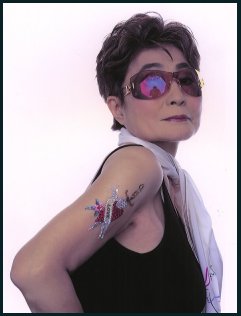
Yoko Ono (b. 1933) wearing her trademark wraparound sunglasses and sporting a tattoo. This photo by Mark C. O'Flaherty was taken in London in 2002, the year before Yoko Ono turned 70 and reprised her once-controversial stage show, "Cut Piece," in Paris.
In 2003, when Yoko Ono turned 70, she celebrated her birthday in much the same way the rest of us do. She put on her best outfit (a little black dress, of course), ordered a cake (chocolate), and invited a few friends to come to her party. And, to make it more fun, she hauled out some family photos to remember the old days and tacked them on the wall.
Sounds normal enough, right ? Hardly. The words “Yoko” and “normal” have never appeared in the same sentence before, until now. Yoko, after all, rose to fame first as an avant garde performance artist before she met and wed Beatle John Lennon. True to her fashion, Yoko staged her February 2003 birthday party to be an attention-getting bash. She invited 200 guests to one of New York’s poshest restaurants, Mr. Chow. The partygoers were an eclectic lot, including creative types like rockers (Lou Reed, Fred Schneider of the B-52s) and writers (Susan Sontag) as well as recording executives and media moguls. As for the decor:
The room was dominated by a blown-up picture of Ono and John Lennon with their words, “War Is Over If You Want It.” Another wall showed Ono’s “Film No. 4, Autumn,” which features 300 bare butts walking. A portion of the floor was covered with white canvas to create a “painting to be stepped on” of footprints. In another part of the party, Ono’s Bagism, a fabric bag big enough to enclose two people, was available for cavorting guests. Guests received goodie bags that contained Ono’s book “Grapefruit” and her “Box of Smile,” a mirror encased in a box.
Yoko has been in the jaw-dropping business since 1964 when she first performed “Cut Piece” at the Sogetsu Art Center in Tokyo. At the time she was struggling for recognition as a concept artist. “Cut Piece” was her most provocative piece of that period.
In these first performances [of ‘Cut Piece’] by Ono, the artist sat kneeling on the concert hall stage, wearing her best suit of clothing, with a pair of scissors placed on the floor in front of her. Members of the audience were invited to approach the stage, one at a time, and cut a bit of her clothes off—which they were allowed to keep.” Yoko left the stage completely nude.
Click to see a film of Yoko’s 1965 Tokyo performance of “Cut Piece.” [The music by Yoko Ono was added later.]
“The Japanese audiences’ volative reaction convinced Yoko that she could not stay in Japan if she expected to attract serious attention.” So she took the show on the road – to New York then London for the fateful meeting with Lennon at the Indica Gallery. (1)
Seven months after Yoko held her birthday bash, she decided to reprise “Cut Piece” for a Paris audience, saying that she was doing it for world peace. “Come and cut a piece of my clothing wherever you like the size of less than a postcard,” she offered, “and send it to the one you love.”
Sean Lennon, the son of John Lennon and Yoko Ono, cuts away a piece of his artist mother Yoko Ono's dress as she repeats her 1960s performance "Cut Piece," in Paris. (AP)
Wearing a layered black silk chiffon skirt (Chanel?) and a black blouse (Gucci?), Yoko sat in a chair onstage as audience members, including son Sean Lennon, came forward and snipped off pieces of her clothing. One woman cut a piece of her own jacket and gave it to Yoko.
“There were a few tense moments. One woman hacked rather brutally with the shears….Early on, one woman cut Yoko’s shoe…but Yoko was obviously not pleased and asked her not to do the shoe, but the damage was already done.”
Stripped down to her matching black bra, panties, and shoes, the show ended and Yoko was escorted off stage in a red kimono.
(1) Spitz, Bob. The Beatles: A Biography. New York: Little, Brown and Company, 2005.
Elvis Presley (1935-1977) in August 1969, the beginning of his Las Vegas concert years
From 1969 to 1977 were Elvis’ concert years. When performing in Las Vegas, he stayed at the International (now Hilton) Hotel, occupying the penthouse suite, room 3000. The suite was located on the 30th floor and stretched across the entire top floor.
Elvis was not alone in this sprawling suite. From the beginning of his stardom, Elvis had been accompanied by a core group of hangers-on that came to be known as the “Memphis Mafia.” By the seventies, Elvis was spending day and night with his party animal buddies, cousins from Memphis and Army buddies whose common bond was service to “the King” and who hung around him for the money, clothes, cars, and leftover girls. What began in the fifties as a group of a few guys following in Elvis’ wake had swelled into a greedy crowd.
As Elvis’ fame spread and his addiction to prescription drugs deepened, Elvis became ever more sealed off from the real world and exceedingly dependent upon the Memphis Mafia. According to Patrick Humphries, these men “acted as Elvis’ bodyguards, babysitters, drug procurers, girl-getters, mates and carbuyers.” Elvis was emotionally unstable and dangerous to himself and others, especially when there were guns lying around.
Elvis after a Las Vegas Concert, with Linda Thompson, March 21, 1976. He would then die of an apparent drug overdose in August, 1977.
Actress, songwriter, and former Miss Tennessee USA Linda Thompson dated Elvis during those days. In an interview with Andrew Hearn, she recounts a frightening incident when Elvis got a little trigger happy:
I’d just happened to have come out of the shower at the Las Vegas Hilton, the presidential suite, and he [Elvis] was lying on the sofa. In those days, they had these huge bull’s eye advertisements. Vegas came alive when Elvis was there and they had these billboards, posters, and placards. So he had one of these enormous bull’s eye things in the suite and he decided that he would just shoot for the target. It was a kind of cardboard cut-out of his name with this bull’s eye…like hit the mark, come see Elvis…whatever. So, Elvis pulled out his gun and shot at the bull’s eye and the bullet went through the wall, which was adjacent to my bathroom. It went through the wall, then through the toilet paper holder, which was metal, out through a mirrored door and shattererd it. I was standing at the sink and I heard ting, ting, and the sound of glass breaking. I felt the air behind my leg. When I looked down, there was a bullet hole in the door behind me. I opened that door and there was another shattered glass door and a bullet lying there.
I knew exactly what was happening. James Caughley came in and said, “Linda, are you okay?” and I said, Yeah, what the ____ was that?” and he said that it was just Elvis having a little target practice.” (1)
These shootings were common occurrences. Elvis had a stockpile of weapons and liked to shoot things. He once shot his car when it wouldn’t start. He shot up small appliances, and, on occasion, large ones. He shot at chandeliers and light switches. But what he became well-known for was shooting at the TV every time the singer Robert Goulet came on a program, as some claim.
Why did Elvis shoot out the TV set when Goulet appeared? Did he hate Goulet as a person or a singer, or both?
It is believed that Elvis hated Robert Goulet, best known for his portrayal of the dashing Prince Lancelot in the Broadway musical production of “Camelot” in 1960. Some say Elvis despised Robert Goulet because he didn’t sing with feeling. Others blame the bad blood on a letter Elvis received when he was in the Army in Germany (1958-1960). His hometown girlfriend, Anita Wood (see previous post, “The Elvis Sandwich“) had written him a letter, telling her how she was doing. She was, at the time, performing with Buddy Hackett and Robert Goulet. She stupidly allowed Robert Goulet to write a postscript at the bottom of her letter to Elvis in which Goulet told Elvis not to worry about Anita as he was looking after her. Elvis became green with jealousy and was incensed with Goulet. (2)
Or was Elvis resentful of Goulet because Goulet was his rival on the music scene when Elvis returned home from Germany? After all, after Goulet’s triumph in “Camelot,” he was called the next great matinee idol. In 1961, the New York Daily News Magazine called Goulet “just the man to help stamp out rock ‘n’ roll.” Judy Garland described the suave Goulet as a living 8-by-10 glossy. He had blue bedroom eyes, and female fans would toss him their room keys during his concerts.
Yet even another possibility exists for Elvis’ dislike of Goulet. On May 25, 1965, Goulet mangled the lyrics to “The Star-Spangled Banner” at the Muhammed Ali-Sonny Liston heavyweight championship fight. He replaced the lyrics “dawn’s early light” with “dawn’s early night” and “gave proof through the night” with “gave proof through the fight.” Although Goulet had been born in Massachusetts, his parentage was French-Canadian, and people were outraged that he didn’t know the words of the United States National Anthem. His gaffe was widely reported and he never lived the incident down.
Robert Goulet (1933-2007) had heard about Elvis shooting out TVs whenever he saw him singing on a television program. Goulet insisted, though, that Elvis bore him no ill will and was actually his friend. He dismissed the assertion that Elvis shot out the TV only when he came on it to sing. He claimed that Elvis shot the TV when other singers like Mel Torme and Frank Sinatra came on. Goulet did not think he was the select target.
On August 14, 2004, right in the middle of Elvis week, Goulet was in Memphis, Tennessee, Elvis’ hometown and the site of Graceland, Elvis’ home, and sat down for an interview with Christopher Blank of the Memphis Commercial Appeal newspaper:
“The 70-year-old entertainer Robert Goulet is in Memphis to play King Arthur in “Camelot” at the Orpheum Theater through Sunday. Since it’s Elvis Week, we asked Goulet about his part in a well-known anecdote about Elvis: The king of rock and roll was known to aim a gun at his television when he saw something there that displeased him.
THE COMMERCIAL APPEAL: And now I’ve got to ask you what my colleagues say is going to be the hardest question.
GOULET: I’m not Jewish. I’m not gay.
CA: No, those are easy.
GOULET: (Laughs.)
CA: You know Memphis is an Elvis town and you factor into a local legend.
GOULET: When he shot the television set? He also shot 50 other people. They told me that he had about a hundred sets in the basement. And he’d shoot the ___ thing out – you know he was on pills and he didn’t know quite what he was doing and he’d BANG! and they’d look at each other and say, “Get another set!” They mention me all the time. I don’t know why. I remember once we sat together backstage for two hours. And he was a charming, delightful, delightful man. And at one point I said, “That’s a beautiful ring you have there.” He said “You like it?” I said, “It’s beautiful!”
He took it off his hand and put it on mine. He gave me his ring. And years later all the jewelry I had in my house – I trust everybody. I was brought up to believe that you cannot steal, cheat or lie and I’ve been stolen from, cheated or lied to all of my life. And so jewelry – who needs it? But this one was something special to me and it’s gone.
CA: Somebody took it?
GOULET: I hired a guy to take care of my house when I was gone. I’m so naive it’s ridiculous. ‘Cause, you know, when we hire people today we do a background check. I didn’t do that. . . . I was in Dallas doing something and I got a call from LAPD (Los Angeles Police Department). “We have a Stutz Blackhawk, silver, with gold trim with RGG license plate?” I said “You have it? How do you have it?” “Well, we saw this guy going through Watts driving this car with the window open throwing out hundred dollar bills.” He had taken all my jewelry and everything else I had of import and taken my car and driven it down to L.A. But all my good stuff is just gone, finished. It’s all part of dying.
CA: So tell me a little more about the Elvis connection. We write so much about Elvis here. What was your reaction when you heard he’d shot the TV?
GOULET: The point is I knew he was not himself so therefore it wasn’t anything to do with me. He shot out Mel Torme. He shot out Frank. But I get all the credit.”
(2) West, Sonny. Elvis: Still Taking Care of Business. Chicago: Triumph Books, 2007.
Private Presley with his first public girlfriend, Anita Wood from Memphis
Anita Wood and Elvis got to know each other in Memphis, Elvis’ hometown, and were close friends from 1957-1962. She wrote to him in Germany where he was stationed with the U.S. Army. Years later she was interviewed about her relationship with Elvis, and recalled:
“He called me Little because I was very small at the time, tiny. ‘Little girl, go fix me a sandwich, peanut butter and jelly sandwich.’ Now, you know, back when I fixed a sandwich for him, we mixed up the peanut butter and banana together. We didn’t put it [the sandwich] in butter and put it in a skillet. We just put [the mixture] on white bread. But…the other day, this man was fixing a peanut butter and jelly sandwich that Elvis liked and they sliced the bananas in thick slices and put it in this butter and cooked it…so he [Elvis] may have started liking that later. But when I was dating him [1957-1962], he liked just a plain old-fashioned mashed banana [sandwich].”
The Elvis Sandwich (sometimes simply “The Elvis”) is a fried sandwich consisting of peanut butter, bananas, and sometimes bacon. It was supposedly one of Elvis Presley’s favorite foods.
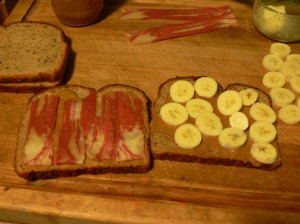
The Elvis Sandwich appears open-faced before it is closed and fried.
The Elvis Sandwich is simple to make. This recipe comes from his cook:
Toast two slices of soft white bread in a toaster. Spread peanut butter on one slice, slice banana on top of the peanut butter, and cover with the other piece of toast. Fry the sandwich in a hot skillet with melted butter.
Elvis Presley joined the U.S. Army in March 25, 1958, completing his basic training at Fort Hood, Texas, and serving in Germany.
Elvis was an expert at Kenpo Karate. His Karate name was Tiger.
On a flight from L.A. to Washington, D.C., on Dec. 21, 1970, Elvis wrote this letter to President Richard M. Nixon:
Mr. President:
First I would like to introduce myself. I am Elvis Presley and admire you and Have Great Respect for your office. I talked to Vice President Agnew in Palm Springs a week ago and expressed my concern for our country. The Drug Culture, The Hippie Elements, the SDS, Black Panthers, etc do not consider me as their enemy or as they call it The Establishment. I call it America and I Love it. Sir I can and will be of any Service that I can to help the country out. I have no concerns or motives other than helping the country out. So I wish not to be given a title or an appointed position, I can and will do more good if I were made a Federal Agent at Large, and I will help out by doing it my way through my communications with people of all ages.
December 21, 1970 letter from Elvis to President Nixon
First and Foremost I am an entertainer but all I need is the Federal credentials. I am on the Plane with Sen. George Murphy and We have been discussing the problems that our country is faced with. Sir I am Staying at the Washington hotel [sic] Room 505-506-507. I have 2 men who work with me by the name of Jerry Schilling and Sonny West. I am registered under the name of Jon Burrows. I will be here for as long as it takes to get the credentials of a Federal Agent. I have done in depth study of Drug Abuse and Communist Brainwashing Techniques and I am right in the middle of the whole thing, where I can and will do the most good. I am Glad to help just so long as it is kept very Private. You can have your staff or whomever call me anytime today tonight or Tomorrow. I was nominated the coming year one of America’s Ten Most outstanding young men. That will be in January 18 in my Home Town of Memphis Tenn. I am sending you the short autobiography about myself so you can better understand this approach. I would love to meet you just to say hello if you’re not too busy.Respectfully,
Elvis Presley
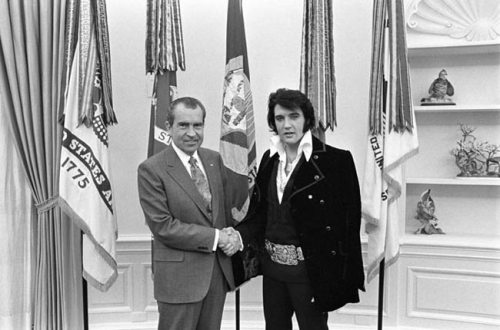
When he landed in Washington, Elvis checked into the Hotel Washington across the street from the White House. He then delivered the letter to the White House. A 12:30 meeting was hurriedly scheduled for Elvis to meet President Nixon in the Oval Office.
President Richard Nixon received Elvis Presley in the Oval Office, Dec. 21, 1970
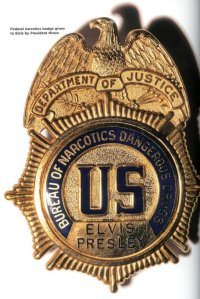
At the meeting, Elvis made his pitch to the president to help him in his “drug drive” and to restore respect for the American flag. But what Elvis really wanted was a badge. Elvis had an abiding respect for law enforcement officials and had an extensive badge collection from his travels across the U.S. Elvis had become inflamed with the desire to be deputized by the federal Bureau of Narcotics and Dangerous Drugs (BNDD). This obsession was the whole purpose for his spur-of-the-moment, cross-country flight to Washington, D.C.
Badge presented to Elvis Presley deputizing him as a special agent of the Bureau of Narcotics and Dangerous Drugs
After lunch in the White House mess and a tour of the White House, Elvis was presented with the BNDD badge by BNDD deputy director John Finlator at White House aide Bud Krogh’s office. Finlator promised to send along additional credentials.
A planned auction of more than 1,000 items from the former home of the King of Pop Michael Jackson has been cancelled.
Nearly 1,400 items from the singer’s Neverland Ranch in California were due to be auctioned off by Julien’s Auctions next week and the proceeds given to Michael Jackson. But Jackson’s production company sued the auction house to stop the sale. Jackson’s attorneys argued that Jackson had not been allowed to preview the sale items and retrieve personal memorabilia as promised in the contract with Julien’s. A last-minute settlement means Jackson’s belongings will now be returned to him. In response, Jackson has dropped the lawsuit against the auction house.
A public preview of the collection had already begun in Los Angeles. Although the auction has since been halted, the exhibition of Jackson’s possessions will continue through the end of next week. The items included in the public exhibit include Jackson’s famous crystal-encrusted white glove, a golden throne, crown, and the gates to the Neverland Ranch topped by a British coat-of-arms. Neverland, Jackson’s sprawling estate for many years (named after the mythical home of Peter Pan and the Lost Boys who never grew up), originally included a zoo and theme park. Jackson left Neverland in 2005, after he was acquitted of child abuse charges in a high-profile court case. Pressing financial problems forced him to sell part-ownership of the property last year.
A five-volume, 900-page catalog of Jacksoniana is available for browsing online (juliensauctions .com).
Readers, for more on this blog on Michael Jackson, click here.
In my two previous posts, “Elvis the Pelvis” and “Elvis: Too Sexy for His Shirt,” I wrote about Elvis Presley and the TV appearances that made him a star. His hip-gyrating performance of “Hound Dog” on NBC’s June 5, 1956, “The Milton Berle Show,” created a huge new fan base and a storm of controversy. Moral crusaders tried to keep him off the air. Critics in the press labeled his performances “vulgar” and “obscene.” Elvis was dubbed, “Elvis the Pelvis.” Top-rated TV host Ed Sullivan vowed, “I wouldn’t have Presley on my show at any time,” as he considered Elvis unsuitable for family viewing.
In a New York radio interview, Elvis said, in his defense,
“Rock and roll music, if you like it, and you feel it, you can’t help but move to it. That’s what happens to me. I have to move around. I can’t stand still. I’ve tried it, and I can’t do it.”
As they say in show business, all publicity is good publicity. The Berle show drew such high ratings that comedian Steve Allen, not a fan of rock ‘n’ roll, rushed to book Elvis for “The Steve Allen Show” for July 1, 1956. “The Steve Allen Show” ran on NBC opposite its chief rival, “The Ed Sullivan Show” on Sunday nights. It was Steve’s aim to defeat Ed in the TV ratings game.
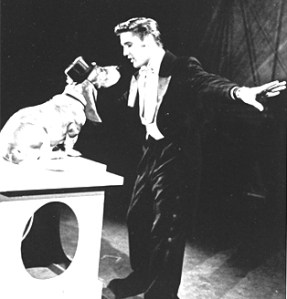
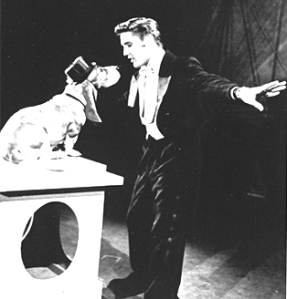
Steve wasn’t about to let Elvis strut suggestively on his program. He decided to introduce a “new Elvis,” one the whole family could love. He costumed Elvis in a top hat and tails and had him sing “Hound Dog” to a basset hound. With its sad eyes and droopy ears, the hound dog severely upstaged Elvis who was reduced to minimal movement.
Colonel Tom Parker, Elvis, and Ed Sullivan
Elvis was reportedly angry with his treatment on Steve’s show, but the ratings were phenomenal. Elvis’ manager, the ruthless Colonel Tom Parker, was able to sign Elvis for three engagements on “The Ed Sullivan Show.” Ed offered Elvis the unprecedented amount of $50,000 for the three shows.
Ed Sullivan was asked to explain why he’d reversed his opinion of Elvis:
“What I said then was off the reports I’d heard. I hadn’t even seen the guy. Seeing the kinescopes, I don’t know what the fuss was all about. For instance, the business about rubbing the thighs. He rubbed one hand on his hip to dry off the perspiration from playing his guitar.”
Presley’s first Ed Sullivan appearance (September 9, 1956) was seen by some 55–60 million viewers, one out of every three Americans. On the third Sullivan show on January 6, 1957, Elvis sang only slow paced ballads and a gospel song. Nevertheless, for the first time, Elvis was shown to the television audience only ‘from the waist up.’ The conventional wisdom has been that Elvis was “cropped” at the request of TV host Sullivan to please network censors by hiding Elvis’ hip movements. However, this was Elvis’ third appearance on the show and Elvis’ first two appearances hadn’t been censored. He had been shown full-bodied both times before. It is more likely that Elvis’ notoriously greedy manager, Colonel Tom Parker, and not network censors or Ed Sullivan, who ordered that Elvis be shot from the waist up to generate publicity.
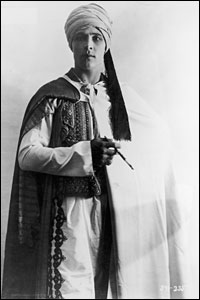
Italian-born actor Rudolph Valentino in the 1921 silent film, "The Sheik"
In spite of any misgivings about the controversial nature of his performing style, Ed Sullivan declared at the end of the third appearance that Presley was “a real decent, fine boy” and that they had never had “a pleasanter experience” on the show.
Below is a clip from Elvis’ 3rd appearance on “The Ed Sullivan Show,” January 6, 1957, – the official “Waist-Up Appearance” in which Elvis sings, “Too Much.” One biographer has suggested that Elvis’ spangled vest, heavily made-up eyes, and hair falling in his face made Elvis resemble the smoldering silent film idol Rudolph Valentino as he appeared in “The Sheik.” What do you think?
Elvis in “Harum Scarum” (1965)
Whew! Waist-up or full-bodied, Elvis proves he’s got what it takes.
If Elvis really did want to dress up like Valentino in “The Sheik,” then, in 1965, he got his wish when he was cast as Johnny Tyronne in his nineteenth movie, “Harum Scarum.” Elvis’ wife, Priscilla Presley, recalls in her memoirs that Elvis liked the exotic Arab costumes so much that, after wrapping up filming for the day, Elvis wore his full make-up and costumes home from the movie set.
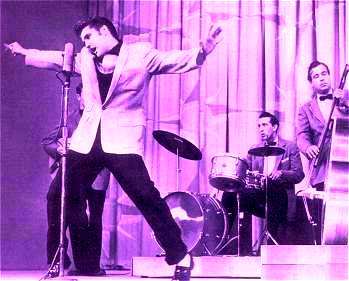
Elvis performing "Hound Dog" ("The Milton Berle Show," June 5, 1956)
In my last post, “Elvis the Pelvis,” I wrote about Elvis’ sensational and controversial performance on “The Milton Berle Show” (NBC) on June 5, 1956, when he sang “Hound Dog.” His playful yet sensual rendition of the blues number – his hips gyrated provocatively – rocketed Elvis to fame while also unleashing a floodgate of criticism. Elvis was too sexy for prime time TV, some said.
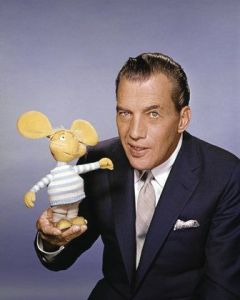
Ed Sullivan, host of “The Ed Sullivan Show,” CBS’ long-running (1948-1971), top-rated Sunday night variety show. Ed is shown with the little lovable Italian mouse puppet, Topo Gigio, that made more than fifty Sullivan appearances. On the show, Topo Gigio greeted Ed with a sugary "Hello Eddie!" and ended his weekly visits by crooning to the host, "Eddie, Keesa me goo'night!"
At the time, TV variety and comedy shows were the rage and “The Ed Sullivan Show” (CBS) was the #1 show on TV. The host of the top-rated Sunday night show was Ed Sullivan, nicknamed “Old Stone Face” for his deadpan delivery. But Ed Sullivan made up for what he lacked in personality in instinct. He had a knack for spotting talent and promoting it. Many entertainers who began on his program became household names. But Ed was a family-minded man. Elvis Presley may have been the flavor of the day, the month, or even the year, but Ed let it be known that he didn’t consider Elvis family entertainment and that he would never allow Elvis to appear on his show.
But TV ratings are hard to ignore for TV hosts. This was 1956, the infancy of TV programming. While only 0.5% of U.S. households had a television set in 1946, 55.7% had one in 1954. ABC existed but only began to air programs like “Leave it to Beaver” in the mid-1950s. The only two TV networks were NBC and CBS. In 1956, NBC offered Steve Allen a new, prime time Sunday night aimed at dethroning CBS’ top-rated “Ed Sullivan Show.” It was NBC’s aim for Steve Allen to defeat Ed Sullivan in the ratings.
Comedian Steve Allen’s personal distaste for rock and roll didn’t cloud his business sense. He needed a ratings boost and Elvis was hot stuff. Steve had seen Elvis on another TV show, didn’t catch his name, but was enchanted by his gangly, country-boy charm. He sent a memo to his staff to find out who the entertainer was and book him for “The Steve Allen Show.” They booked Elvis for a July 1, 1956, performance on “The Steve Allen Show,” three weeks after Elvis’ performance on “The Milton Berle Show.” From the time of the memo to the date Elvis performed on “The Steve Allen Show,” Steve’s show outperformed Ed Sullivan’s in the ratings game.
Writing in Hi, Ho, Steverino!, Steve Allen recalls:
Elvis singing "Hound Dog" ("The Steve Allen Show," July 1, 1956)
When I booked Elvis, I naturally had no interest in just presenting him vaudeville-style and letting him do his spot as he might in concert. Instead we worked him into the comedy fabric of our program. I asked him to sing “Hound Dog” (which he had recorded just the day before) dressed in a classy Fred Astaire wardrobe–white tie and tails–and surrounded him with graceful Greek columns and hanging draperies that would have been suitable for Sir Laurence Olivier reciting Shakespeare.
For added laughs, I had him sing the number to a sad-faced basset hound that sat on a low column and also wore a little top hat. We certainly didn’t inhibit Elvis’ then-notorious pelvic gyrations, but I think the fact that he had on formal evening attire made him, purely on his own, slightly alter his presentation.
Elvis Presley with his manager, the notorious "Colonel Parker"
“Inasmuch as Elvis later made appearances on The Ed Sullivan Show, I’ve often been asked why I didn’t make the same arrangements with him myself. Here’s the reason: Before we even left the studio the night Elvis appeared on our show, Ed telephoned Presley’s manager, Colonel Tom Parker, backstage at our own theatre. So desperate was he to make the booking, in fact, that he broke what had until that moment been a $7,500 price ceiling on star-guests, offering the Colonel $10,000 per shot. Parker told Sullivan he’d get back to him, walked over to us, shared the news of Sullivan’s offer, and said, ‘I feel a sense a loyalty to you fellows because you booked Elvis first, when we needed the booking; so if you’ll meet Sullivan’s terms we’ll be happy to continue to work on your program.’
“I thanked him for his frankness but told him I thought he should accept Ed’s offer. The reason, primarily, was that I didn’t think it reasonable to continue to have to construct sketches and comic gimmicks in which Presley, a noncomic, could appear. Ed’s program, having a vaudeville-variety format, was a more appropriate showcase for Elvis’ type of performance.
“For his own part, Elvis had a terrific time with us and lent himself willingly to our brand of craziness. He was an easy-going, likeable, and accommodating performer. He quickly become the biggest star in the country; but when I ran into him from time-to-time over the years it was clear that he had never let his enormous success go to his head.”
Elvis Presley (1935-1977) The King of Rock 'n' Roll
With the release of his first record album in April, 1956, Elvis Presley began to receive lucrative offers for TV, Las Vegas, and movie appearances. On April 1, he made a screen test for Paramount Pictures and would go on to make the picture, “Love Me Tender.” On April 3, he sang “Heartbreak Hotel” on NBC-TV’s “The Milton Berle Show,” and received rave reviews, causing Berle’s TV rival, Ed Sullivan, to sit up and take notice.
On April 23, he went to Las Vegas, where he was scheduled to perform until May 6, but his show was such a flop with the middle-aged audiences that his manager, Colonel Parker, cut the run from four weeks to two. While there, though, Elvis stopped by the Sands Hotel and saw Freddie Bell and the Bellboys live. It was a game-changing moment. He heard them sing Leiber and Stoller’s blues song “Hound Dog” and loved their version of it. With Freddie’s blessing, Elvis added “Hound Dog” to his live performances.
Then, on June 5, Elvis made Rock-n-Roll History and catapulted to superstardom. It was his second appearance on “The Milton Berle Show.” Backed up by the Jordanaires, he performed “Hound Dog” before a studio and TV audience. His sensual rendition of the bluesy song both electrified and stunned the nation. At the beginning of the number, Elvis gave it a standard, upbeat tempo. Then, halfway through the number, he slowed down the beat to a crawl, swiveling his hips in time to the music, and driving the studio audience wild with his raw sex appeal. Some critics likened Elvis’ performance to a striptease. The next day, he was referred to as “Elvis the Pelvis” and an international campaign began to keep him off the airwaves.
Watch the clip below. June 5, 1956. “The Milton Berle Show.” Elvis Presley sings “Hound Dog.”
Before they took off on their World Tour in June of 1966, the Beatles had put the finishing touches on their new album, “Revolver.” Click below to hear the song that would prove prescient of the “Fab Four’s” horrible experience in Manila – “Taxman.”
Monday, July 4, 1966
Manila, the Philippines, the second stop for the Beatles on their 1966 World Tour
The Manila Hotel
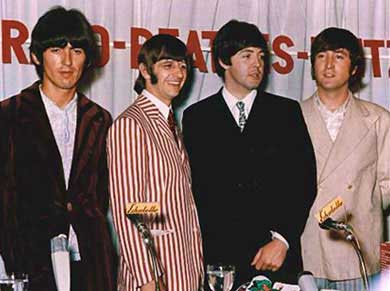
The Beatles: (l. to r.) George Harrison, Ringo Starr, Paul McCartney, John Lennon. ca. 1966
Manila, The Philippines:
Early in the morning, Tony Barrow, the Beatles’ publicist, and Vic Lewis, their booking agent, were awakened by sharp raps on the door of their suite. Two grim-looking men in military uniforms saluted and introduced themselves as the official reception committee from Malacañang Palace, the residence of President Ferdinand and First Lady Imelda Marcos.* They’d come to make final arrangements for the Beatles’ visit to the Palace for a luncheon hosted by the First Lady. (1)
Dictator Ferdinand Marcos with wife Imelda at his 1965 inauguration in the Philippines.
Neither Barrow nor Lewis knew what they were talking about. No one had told them that the Beatles were expected to make a presidential visit. The Beatles – John Lennon, Paul McCartney, George Harrison, and Ringo Starr – were sleeping, they explained, and couldn’t be disturbed. The band had just flown in from an exhausting concert in Tokyo. The “Fab Four” needed their rest, as they were schedule to give both afternoon and evening concerts in Manila that very day. Barrow and Lewis promised to pass along the request to Brian Epstein, the Beatles’ manager.
“This is not a request,” insisted the two men, one, a general, and the other, a commander, in the Philippine Army.
First Lady of the Philippines Imelda Marcos was a former beauty queen. Here she models a traditional gown. She regarded herself as a goddess and was used to having her way. 1963
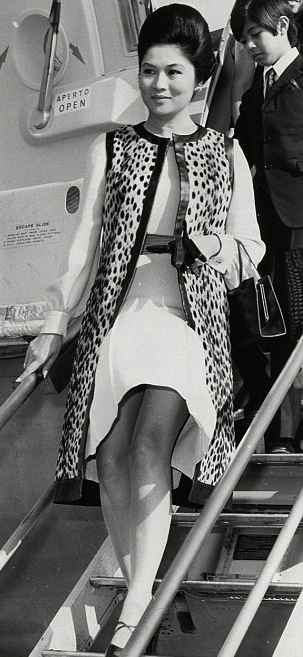
Fashion icon Imelda Marcos descends from a flight with her son Bong Bong. Undated photo
That afternoon, the Beatles performed their hits songs to an audience of 35,000. Afterwards, Tony Barrow and others in the Beatle’s entourage filed into Brian Epstein‘s suite to watch coverage of the concert on the evening news. They were pleased to discover that every channel featured scenes of screaming, swooning fans caught up in Beatlemania. However, Channel 5, one of the country’s major networks, ran additional footage not seen on the other channels. The scene showed the First Lady at the Palace with her disappointed luncheon guests, 200 children. The voice-over said, “The children began to arrive at ten. They waited until two….The place cards for the Beatles at the lunch table were removed.” Imelda Marcos was very mad as she and her guests filed into the grand dining room without their guests of honor. The spin was that the Beatles had deliberately snubbed the President and Mrs. Marcos by not showing up.
Brian Epstein went into full damage control mode. He issued a hastily written apology to the First Couple and called an interview with Channel 5 in his hotel suite, in which he professed complete ignorance of the invitation and praised the Marcoses. An hour later, the interview was broadcast but Brian’s appearance was blacked-out by static interference. That’s when everyone started to get nervous.
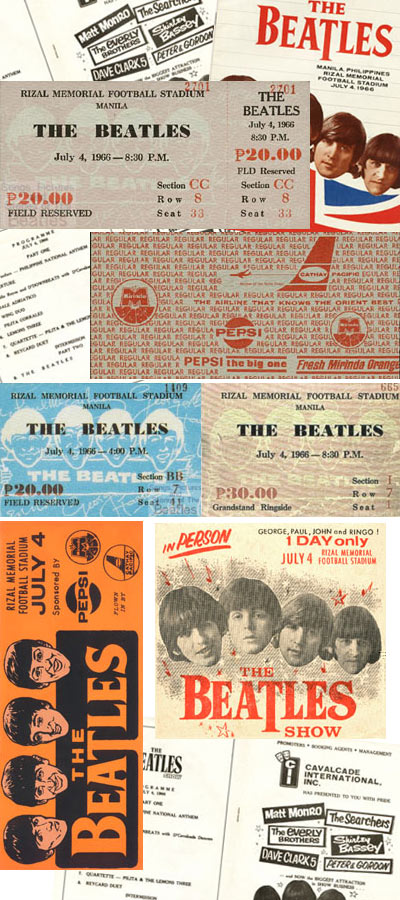
ticket stubs to the Beatles July 4, 1966 concerts in Manila
Worry soon turned to panic. After their evening show, the Beatles noticed that their police escort had disappeared. When their car pulled up to the Manila Hotel, the gates were locked against them. While they sat their in the idling car, wondering how they were going to get up to their suite, several dozen “organized troublemakers” attacked their car, banging on the windows, rocking it back and forth, and shouting threats in several languages. Vic Lewis shouted at the driver: “Drive on! Go through the people and smash the gates down!” The driver obeyed. At the entrance, everyone in the Beatles’ entourage ran into the hotel with the angry mob snapping at their heels.
Shortly, an official appeared at Vic Lewis’ suite demanding payment of local taxes. Lewis produced a contract stating that someone else – the promoter – had that responsibility, not the Beatles. This was brushed aside. Until all taxes were paid, said the taxman, no one in the Beatles party was being allowed to leave the country. When the man left, Lewis found Barrow. “We’ve got to get out of here – now.” He called the bell hop for help with the luggage.
The manager told Lewis that no one would be coming to help. “The whole hotel is going on strike. They think you’ve insulted President Marcos.” Bomb and death threats were telephoned to the deluged British Embassy and to the four Beatles’ hotel suite.
The next morning, Paul had seen the newspaper headlines blaring BEATLES SNUB PRESIDENT. The Beatles had known nothing of the invitation. “Oh, dear,” he thought. “We’ll just say we’re sorry.” About then “things started to get really weird,” recalled Ringo. He and John were hanging out in their bathrobes when a roadie popped his head in their room and shouted, “Come on! Get out of bed! Get packed – we’re getting out of here.”
Everyone in the entourage grabbed amplifiers and suitcases and made for the main elevators, but they were turned off. They had to take the service lift down. The halls were dark and lined with staff who shouted at them in Spanish and English. It was very frightening. When they got downstairs to check out, the front desk was deserted. Even their cars were gone. Someone managed to get a Town Car and everyone squeezed in and made for the airport.
But the airport route was sabotaged. Soldiers were stationed at intersections and roads were closed. Finally, they found a back road that led to the airport. The airport was deserted. “The atmosphere was scary,” remembered Tony Barrow, “as if a bomb was due to go off.” Once the Beatles got on the escalator, the power was shut off. As the Beatles moved through the terminal, little bands of demonstrators appeared, grabbing at them and trying to hit them.
Mobs rough up the Beatles at the Manila airport. John Lennon is at upper corner, right. July 6, 1966
They checked in for their flight as quickly as possible then were herded into a lounge “where an abusive crowd and police with guns had also gathered.” The cops began to shove the Beatles back and forth. It was impossible to tell the thugs from the military police. According to Ringo, “they started spitting at us, spitting on us.” The Beatles hid among a group of nuns and monks huddled by an alcove. Other members of their entourage, though, were kicked and beaten.
Finally, everyone was allowed to run across the tarmac to the plane. Vic Lewis felt sure he’d get a bullet in the back. The Beatles were terrified they’d be killed before they entered the safety of the airplane. Paul said, “When we got on the plane, we were all kissing the seats. It was feeling as if we’d found sanctuary. We had definitely been in a foreign country where all the rules had changed and they carried guns. So we weren’t too gung-ho about it at all.” Ringo remembered being afraid of going to jail. Ferdinand Marcos was a dictator (who, in a few years, would declare martial law in the Philippines.)
Everyone was poised for the plane to take off when the authorities came back on board and detained Tony Barrow for thiry minutes. For the plane to be allowed to take off with the Beatles on it, Tony was forced to pay a “leaving Manila tax” that amounted to the full amount of money the Beatles had made in their concerts before 80,000 fans.
Once the plane lifted off and everyone was safely in the air, all the anger of the past 24 hours boiled over. The Beatles blamed Brian for the debacle. He’d obviously received the invitation in Japan, ignoring it or misleading the Philippine authorities.
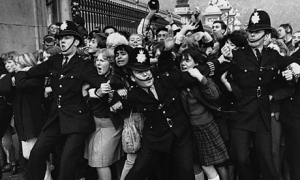
Beatlemania. October 1965, London, England, UK. Policemen struggle to restrain young Beatles fans outside Buckingham Palace as The Beatles receive their MBEs (Member of the British Empire) in 1965.
By the time the Beatles had landed in India, they had made a command decision. This would be their last tour. They were never going to go on another tour again. Never again, swore John, was he going to risk his life for a stadium filled with screaming 13-year-old girls.
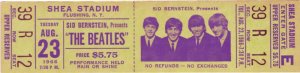
Brian said, “Sorry, lads, we have got something fixed up for Shea Stadium. If we cancel it you are going to lose a million dollars.” So they played New York’s Shea Stadium later that summer. It was the first stop on their U.S. tour, their final tour as the Beatles.
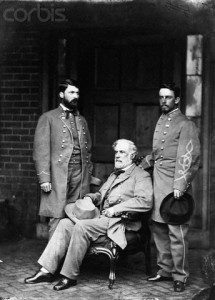
Confederate General Robert E. Lee, seated, with 2 of his officers, photographed by Mathew Brady in April, 1865, following Lee's surrender to General Ulysses S. Grant at the Appomattox Court House in Richmond, Virginia.
At daylight on April 10, 1865, the firing of 500 cannons spread the news throughout Washington, D.C., that the War Between the States was over and the Union preserved. The cannons were so loud that they broke windows on Lafayette Square, the neighborhood around the White House. (1) “Guns are firing, bells ringing, flags flying, bands playing, men laughing, children cheering – all, all jubilant,” wrote Secretary of the Navy Gideon Wells. (2)
Expecting the president to make a speech, several thousand people gathered outside the White House. President Lincoln was not sure what to say as he was planning on giving a formal address the following evening.Just then, his twelve-year-old son Tad appeared at a second-floor window, waving a captured Confederate flag. It gave the president an idea. He asked the Marine Band to play a favorite tune of his, “Dixie,” the unofficial Confederate anthem.
“I have always thought ‘Dixie” one of the best tunes I ever heard,” he told the surprised crowd. “It is good to show the rebels that with us they will be free to hear it again.”
True to the promise he made in his second inaugural address, Lincoln was already trying to bind up the nation’s wounds.
Now let’s hear Elvis Presley sing “Dixie.”
(1) White, Ronald C. A. Lincoln. (New York: Random House, 2009)
(2) Fleming, Candace. The Lincolns: A Scrapbook Look at Abraham and Mary. (New York: Schwartz & Wade, 2008)
 Jones worked out which singers would perform which lyrics, studying recordings of each of the selected singers to decide which would work well with each other. He paired Billy Joel with Tina Turner, Willie Nelson with Dionne Warwick, and Michael Jackson with Prince, who was a no-show. (Prince called in the middle of the session to volunteer a guitar solo but the offer was declined. Prince did, however, contribute a solo recording for the album.) (1)




 It is believed that Elvis hated Robert Goulet, best known for his portrayal of the dashing Prince Lancelot in the Broadway musical production of “Camelot” in 1960. Some say Elvis despised Robert Goulet because he didn’t sing with feeling. Others blame the bad blood on a letter Elvis received when he was in the Army in Germany (1958-1960). His hometown girlfriend, Anita Wood (see previous post, “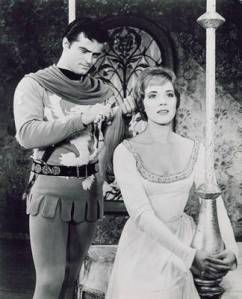
 GOULET: When he shot the television set? He also shot 50 other people. They told me that he had about a hundred sets in the basement. And he’d shoot the ___ thing out – you know he was on pills and he didn’t know quite what he was doing and he’d BANG! and they’d look at each other and say, “Get another set!” They mention me all the time. I don’t know why. I remember once we sat together backstage for two hours. And he was a charming, delightful, delightful man. And at one point I said, “That’s a beautiful ring you have there.” He said “You like it?” I said, “It’s beautiful!”



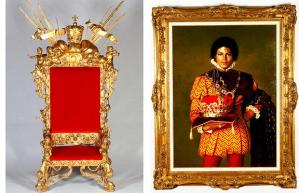 A public preview of the collection had already begun in Los Angeles. Although the auction has since been halted, the exhibition of Jackson’s possessions will continue through the end of next week. The items included in the public exhibit include Jackson’s famous crystal-encrusted white glove, a golden throne, crown, and the gates to the Neverland Ranch topped by a British coat-of-arms. Neverland, Jackson’s sprawling estate for many years (named after the mythical home of Peter Pan and the Lost Boys who never grew up), originally included a zoo and theme park. Jackson left Neverland in 2005, after he was acquitted of child abuse charges in a high-profile court case. Pressing financial problems forced him to sell part-ownership of the property last year.
 nights. It was Steve’s aim to defeat Ed in the TV ratings game.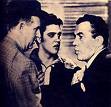








 Lisa's History Room