Feeds:
Posts
Comments

Imelda Marcos (b. 1929), “one of the ten richest women in the world” (Cosmopolitan magazine, December, 1975)

In December, 1975, Cosmopolitan magazine named Imelda Marcos, the First Lady of the Phillippines, as one of the ten richest women in the world. It even went a step further and speculated that Imelda was perhaps the richest woman in the world, richer than Queen Elizabeth II of Great Britain.

Everyone knew Imelda was rich; she made sure of that. She had an insatiable desire for expensive things and flaunted them. No one at the time really knew where she got all the money that she spent so impulsively. She was, after all, unemployed and had no independent wealth. In addition, her husband, the dictator, Ferdinand Marcos, had made less than $5,000 a year for the last ten years in office.

Nonetheless, there was Imelda, spending $40,000 on a Honolulu shopping spree in 1974, without trying anything on. Her excess knew no limits and she spared herself no luxury:

“Another report had Imelda and a gaggle of friends demanding Bloomingdale’s in New York be closed for a private shopping extravaganza, then marching through the store pointing to desired items and saying, ‘Mine. Mine. Mine. Mine.’”(1) She was referred to by one sales clerk as ‘the Mine Girl.’

Imelda Marcos from a Vanity Fair interview, 2007

Imelda Marcos from a Vanity Fair interview, 2007

Responding to criticism of her self-indulgence and the spending of public money for high-profile projects that did nothing to alleviate the poverty of the Filipinos, Imelda remarked that is was her “duty” to be “some kind of light, a star to give [the poor] guidelines.”

By 1981, Imelda’s personal popularity was at an all-time high. She jetsetted around the globe, shopping and hobnobbing with celebrities such as the perennially-tanned American actor George Hamilton.

After having secured the Miss Universe Pageant for the Philippines in 1974 – which necessitated the rapid construction of the 10,000-seat Folks Art Center – Imelda continued to indulge her “edifice complex,” building 14 luxury hotels, a multimillion-dollar Nutrition Center, Convention Center, Heart Center and, in 1981, the infamous Manila Film Center.

Imelda Marcos designed the Manila Film Center after the Greek Parthenon, shown here.

Imelda wanted Manila to rival Cannes as a world film capital. At the cost of $25 million, Imelda approved plans for the Manila Film Center to be built to host an international film festival. Opening night was set for January 18, 1982. The project was grandiose and expensive; the building on Manila Bay was designed to look like the Parthenon.

Delays hampered the progress. As the deadline drew nearer, it required 4,000 workers, working in 3 shifts, around the clock, if the building was going to be ready.

Then, at 3 a.m. on November 17, the upper scaffold collapsed and sent workers falling into wet cement. A witness said that some of the workers were impaled on upright steel bars.

Imelda was contacted about the accident. She was told that the recovery of the bodies would take alot of  time – time, evidently, that Imelda didn’t want to give up. She ordered the construction to continue as planned and that the bodies – maybe as many as 169 – be covered with cement. It is believed that many of those who fell into the cement may have been buried alive.

The full story has never been told, as news crews, rescuers, and ambulance teams were barred from the scene for nine full hours, while the government, under martial law, prepared its official version of events, censoring all news and silencing all witnesses.

Despite all, the festival opened on schedule on January18, 1981, and had among its guests Brooke Shields, Franco Nero, Ben Kingsley, and Robert Duvall. The first film shown in the theater was the tasteful bioepic, “Gandhi.”  Unknowingly, the stars partied atop a mausoleum of dead workers.

Brooke Shields (b. 1965) was only 16 years old when she traveled to Manila for the international film festival as the guest of First Lady Imelda Marcos.

“During opening night, Imelda ‘strode on stage in a Joe Salazar black and emerald green terno with a hemline thick with layer upon layer of peacock feathers.’ “Some said there were diamonds embedded in the skirt.

The next year, as a result of the accident scandal, the government withheld $5 million in festival funding. Imelda was in a fix. She had to pay for the festival somehow, so she ran pornography films in the festival’s second and, understandably, last year.

(1) Klaffke, Pamela. Spree: A Cultural History of Shopping.

Readers: For more on Imelda and Ferdinand Marcos on this blog, click here.   

A close-up of Imelda Marcos looking into a gold-plated compact mirror, her first name encrusted in diamonds. Called the ‘Steel Butterfly,’ Imelda Marcos was the beautiful wife and confidante of Philippine dictator Ferdinand Marcos. The Marcos regime (1965-86) was marked by notorious corruption, political repression, and financial improprieties of the highest order.

For other resources, click here.


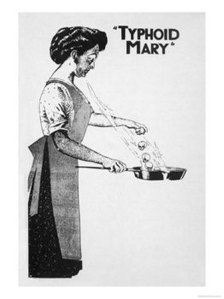
Typhoid Mary

Mary Mallon (1869-1938) was nicknamed "Typhoid Mary," and gained notoriety as history's most famous super-spreader of disease. ("Typhoid Mary," Lisa's History Room)

Yes, there really was a Typhoid Mary. She was Mary Mallon (1869-1938) an Irish immigrant who cooked for wealthy New York families. She is history’s most famous super-spreader of disease.  

Mary Mallon was first caught in 1906 when a sanitary engineer was hired to investigate a typhoid outbreak at Oyster Bay, Long Island. Six members of banker Charles Henry Warren’s household had fallen dangerously ill. Warren hired George Soper to discover the source of the contamination before the highly-contagious and deadly disease spread across the privileged enclave of Oyster Bay. (1)  Oyster Bay was the site of Sagamore Hill, known as “the Summer White House” of President Theodore Roosevelt from 1902-1908.

George Soper took his assignment very seriously. He first checked the household plumbing. He put dye in the toilet to see if it contaminated the drinking water. It didn’t.  He checked the local shellfish to see if the bay was polluted with sewage. It wasn’t. He examined the milk supply in case it was contaminated. It, too, was free of bacteria. (2)   

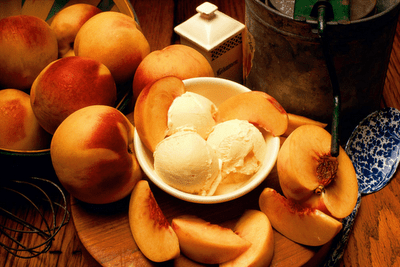
Next, he interviewed the staff. He found that the family had changed cooks on August 4th, when Warren had hired Mary Mallon. Shortly after Mary began as cook, Soper was informed, she had served the household a favorite dessert for Sunday dinner: ice cream topped with freshly-cut peaches

"Typhoid Mary" Mallon served homemade ice cream and freshly-cut peaches to the Warren household before six of them were sickened.

"Typhoid Mary" Mallon served homemade ice cream and freshly-cut peaches to the Warren household. ("Typhoid Mary," Lisa's History Room)

On August 27, Warren’s daughter, Margaret, fell ill with typhoid fever. Next, Mrs. Warren and two maids became ill, followed by the gardener and another of the Warrens’ daughters.  

Knowing that typhoid typically goes from exposure to outbreak in three weeks’ time, Soper had Clue #1: The epidemic had begun with the arrival of the new cook. If his suspicion was correct, Mary Mallon was a carrier who had passed on the disease when preparing the peaches with unscrubbed hands.  

Unfortunately, when Soper made this astonishing discovery, Mary no longer worked at the Warrens’. Undeterred, Soper set out to find her. Checking with her employment agency, Soper discovered a second and even more astounding truth:  Typhoid had struck seven of the last eight families Mary had worked for. Mary Mallon was spreading typhoid in her path – and she had to be stopped.

But, first, Soper had to prove scientifically that Mallon was a carrier.  

This 1883 Puck drawing shows the New York City Board of Health wielding a bottle of the disinfectant, carbolic acid, in an attempt to keep cholera at bay. Immigrants poured into New York City at the turn of the Twentieth Century. Crowded into unsanitary slums, disease ran rampant. By 1890, the era of bacteriology had arrived and scientists understood that diseases like typhoid and cholera arose from germs. Efforts were made to not just clean up the cities but isolate the disease carriers. ("Typhoid Mary," Lisa's History Room)

Mary was difficult to find, but Soper tirelessly tracked her down. Rather overzealously, he  

“confronted her in her next employer’s kitchen and asked for blood, urine, and stool samples; she swore she had never been sick and advanced on him with a carving fork. He called in the New York City health department; she threatened its doctor.  

Finally, it took five police officers and a chase over backyard fences to subdue her and get her a hospital. High levels of Salmonella typhosa bacilli were found in a stool sample. She was quarantined in a cottage on the Riverside Hospital grounds on an island in the East River.”  (1)

Mary Mallon - "Typhoid Mary" - in quarantine on North Brother Island in the East River

Mary Mallon was a medical prisoner. She had been jailed without a trial. Although she was a carrier of typhoid, she was perfectly healthy. She had been shut up in a sanitarium with tubercular patients. She had been treated like a leper.  

She sued. People felt sorry for her. Not everyone felt her imprisonment was deserved. In time, she went from Public Menace #1 to a cause célèbre.  

Part of the New York American article of June 20, 1909, which first identified Mary Mallon as "Typhoid Mary."

“Eventually, a new health commissioner decided that Mallon could be freed from quarantine if she agreed to no longer work as a cook and to take reasonable steps to prevent transmitting typhoid to others.  

 Eager to regain her freedom, Mallon accepted these terms. On February 19, 1910, Mallon agreed that she “[was] prepared to change her occupation (that of cook), and w[ould] give assurance by affidavit that she w[ould] upon her release take such hygienic precautions as w[ould] protect those with whom she c[ame] in contact, from infection.”   

She therefore was released from quarantine and returned to the mainland.” (3)  

But, alas and alack, that’s not the end of the story. For a while after her release, Mary kept her word and worked as a laundress, which paid lower wages than a cook.  It was not long afterward, though, that she adopted an assumed name – Mary Brown – and went back to work as a cook. 

In 1915, while working as a cook at New York’s Sloane Hospital for Women, she infected 25 people, one of whom died. The typhoid bacteria was traced to a pudding Mary had prepared. She was subsequently arrested and returned to quarantine on the island, where she was confined until her death in 1938.  

The cottage on North Brother Island in New York's East River where Mary Mallon, better known as "Typhoid Mary," was quarantined (1907-1910; 1915-1938).

Mary Mallon (wearing glasses) photographed with bacteriologist Emma Sherman on North Brother Island in 1931 or 1932, over 15 years after she had been quarantined there permanently. She worked at the facility and her lab coat was reported to be filthy. (Typhoid Mary: An Urban Historical by Anthony Bourdain)

(1) “The Deadly Trails of Typhoid Mary,” by Donald G. McNeil, Jr. The New York Times, April 14, 2003.  

(2) “The Most Dangerous Woman in America,” NOVA, aired Oct. 12, 2004.

J

Justine Lévy, the French author of "Nothing Serious" (titled "Rien de Grave" in France,) a thinly-veiled fictional account based on Ms. Lévy’s bad encounter with husband-stealer Carla Bruni, whom she calls "The Terminator."

“On Wednesday evening, Sept. 21, 2005, the designer Diane von Furstenberg hosted a cocktail party in honor of Justine Lévy, the author of Nothing Serious (titled Rien de Grave in France), a roman à clef based on Ms. Lévy’s recent, sensational personal life.

Ms. Lévy, 31, is the dewy daughter of the French celebrity-philosopher Bernard-Henri Lévy, and her book whipped up quite a scandal in France, illuminating certain universal truths about men, women and sex, and even jostling The Da Vinci Code from the best-seller list in the process.

…Ms. Lévy had a rather tragic encounter with the supermodel-cum-chanteuse Carla Bruni—the Angelina Jolie of Europe.

Ms. Lévy was married to a rising philosopher named Raphaël Enthoven, who was the son of her father’s best friend, Jean-Paul. She had a late-term abortion at the insistence of her career-obsessed husband and went through a messy two-year addiction to amphetamines.

That was before Ms. Bruni arrived on the scene. Ms. Bruni had somewhat of a home-wrecking reputation and was credited in the press with causing Mick Jagger’s split from his wife. In 2003, she remade herself into a pop singer and won the 2004 Victoires de la Musique in France.

Carla Bruni sings at the 2004 Victoires de la Musique in France

She was also, at one point, the mistress of Ms. Lévy’s father-in-law. She dumped the father for the son [Raphaël], shattering Ms. Lévy’s Raphaël Enthoven Jr. were married and have a son, Aurélien, born in 2001.]

Carla Bruni, former husband Raphaël Enthoven, and their son, Aurélien, circa 2003-2004

Nothing Serious, …published … by Melville House, is a fictionalized version of this story, with characters thinly disguised through pseudonyms. Of the Ms. Bruni–type character, the book’s femme-bot ‘Paula,’ Ms. Lévy writes:

‘I thought she was beautiful and dangerous with that immobile face, as if sculpted out of wax, when she smiled her bones sort of moved to reveal her teeth …. I thought she was beautiful and bionic, with the look of a killer,”’referring to her as the ‘Terminator.”

…(of Bruni, Lévy said):

 ‘If I see her, I kill her.’ “(1)

(1) Kolhatkar, Sheelah.  “It’s A Chattefight As Novelist Levy Nips Carla Bruni”. The New York Observer, October 2, 2005.

Italian model Marpessa, Prince Dimitri of Yugoslavia, Carla Bruni, and Cindy Crawford at a Versace gala, 1992. Photo: Marina Garnier

Back in 1992, Carla Bruni (b. 1967) – First Lady of France, Italian heiress, international supermodel, singer – was romantically linked to Rolling Stones rocker Mick Jagger.

Jerry Hall and Mick Jagger

Jerry Hall and Mick Jagger

At the time, Jagger was married to supermodel Jerry Hall, who blamed Carla for the breakup of her marriage.

“Hall is said to be so jealous of Bruni that at a rock concert in London this summer she poured a mug of beer on Jean Pigozzi’s head and drove him from the backstage V.I.P. area, accusing him of having entertained Mick and Carla at his Cap d’Antibes compound.” (1)

Nevertheless, when interviewed by Bob Colacello of Vanity Fair that November, Bruni vigorously denied having an affair with Mick, although the press and close friends confirmed the affair.

At the time of the interview, Carla was flying high as an international supermodel, making over a million dollars a year. She had been on the covers of Harpers & Queen, Italian Elle, and Marie Claire, and was seen that month gliding down about 70 runways at the Paris, Milan, and New York ready-to-wear collections.

The video clip below shows Carla Bruni (Sarkozy) on the runway 1991-1995. Fashion designers featured include Dior, Versace, Chanel, Chantal Thomas.

Before Jagger, Bruni had been linked romantically linked to Donald Trump (when married to Marla Maples) and Eric Clapton.

Carla Bruni and Eric Clapton at a benefit for rain forests about 1992.

Clearly, the publicity had not hurt her career, Bruni confessed to Vanity Fair:

“‘A knife has two sides, the good side and the bad side. The good side is that the publicity is going to bring me more work and more money. The bad side is that it hurts….

Maybe I can get a subscription to scandals. Once a year. Every time my modeling rate goes down. Whom am I going to get next year? Hmmm.'”(1)

(1) Colacello, Bob.  “La Dolce Carla.” Vanity Fair, November, 1992.

Readers: For more on Carla Bruni, click here.

Queen Victoria at her Golden Jubilee, 1887. Note the tiny crown atop her mourning veil.

In my previous post, “Queen Alexandra’s Royal Bosom,” I mention that Queen Victoria refused to wear a crown to the Thanksgiving service at Westminster Abbey that was part of her Golden Jubilee celebration in June, 1887. She did, however, consent to wear a crown for her official Jubilee photograph (shown here), which we may assume she wore to the banquet celebrating her 50 years on the British throne. Fifty European Kings and princes and the American author Samuel Clemens (AKA Mark Twain) attended.

After her husband Prince Albert’s death in 1861, the Queen had largely disappeared from public view. She had vowed to publicly mourn her husband until her death and wear nothing but black widow’s weeds and her white lace mourning veil. In 1870, under government pressure, Victoria began to appear in public again. But she refused to wear her Imperial State Crown again, for several reasons. Chiefly, it was too big and heavy and was impossible to wear with her mourning veil.

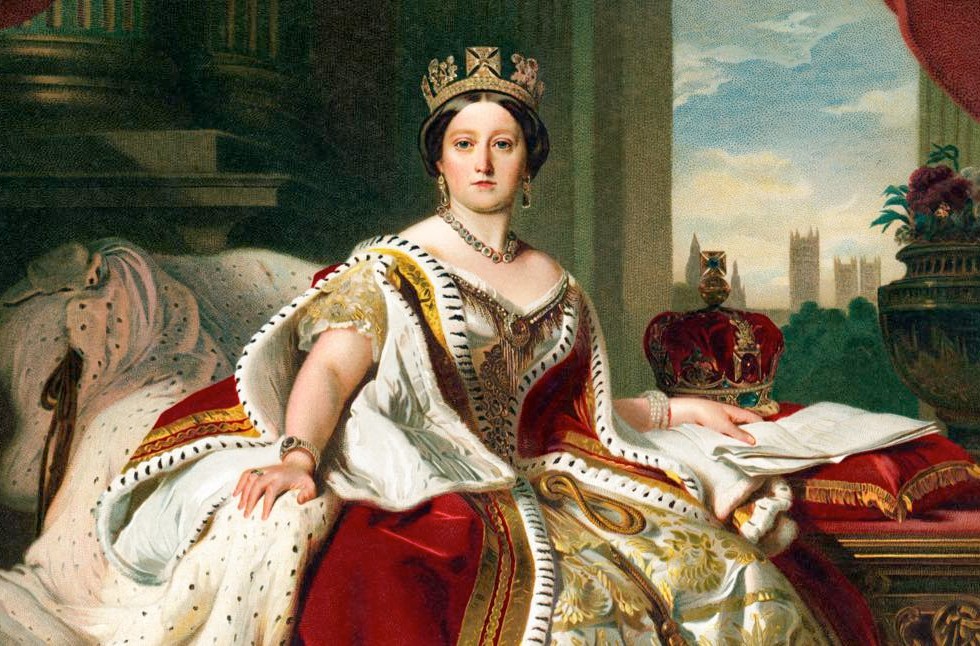
The Imperial State Crown of Great Britain worn by Queen Victoria at her coronation. It includes a base of four crosses pattée alternating with four fleurs-de-lis, above which are four half-arches surmounted by a cross. Inside is a velvet cap with an ermine border. The Imperial State Crown includes several precious gems, including: 2,868 diamonds, 273 pearls, 17 sapphires, 11 emeralds, and 5 rubies.

Queen Victoria shown wearing the Imperial State Crown at her Coronation, 1837

Consequently, a new crown, a small one, was designed for the Queen. It sat atop her mourning veil. The Queen was satisfied and so was the government. Wearing the tiny crown atop her veil allowed her to look like both a widow and a queen.

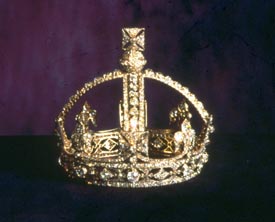
“The crown followed standard design for British crowns. It was made up of four half-arches, which met at a monde, on which sat a cross. Each half-arch ran from the monde down to a cross pattee along the band at the bottom. Between each cross pattee was a fleur-de-lis. However, because of its small size (9 centimeters across and 10 centimeters high) Victoria’s small diamond crown possesses no internal cloth cap. The crown was manufactured by R & S Garrard & Company.”
 

Queen Victoria's Small Diamond Crown created in 1870 measures 3.7 inches (9.9 cm) high and 3.4 inches (9 cm) in diameter. It was worn atop a widow's cap. The silver crown was made in 1870, using some 1,300 diamonds from a large necklace and other jewelry in the Queen's personal collection. Queen Victoria's Small Diamond Crown remains on show in the Jewel House in the Tower of London.

"The Landing of H.R.H. the Princess Alexandra at Gravesend, March 7, 1863," by Henry Nelson O'Neil, 1864.

When Princess Alexandra of Denmark arrived on English soil in 1863 to marry the Prince of Wales, the heir of Queen Victoria, she was the very picture of modesty. No jewelry was visible and she wore a handmade bonnet. Alexandra may have been Danish royalty, but she wasn’t rich. Matter of fact, her family had lived on handouts to get by. She was shy, kind, and very beautiful. Everyone loved her immediately.

Queen Victoria, 1873

Queen Victoria of Great Britain, 1873

When Alexandra joined the British royal family, over two years had passed since Queen Victoria‘s husband, Prince Albert, had died.  Yet Victoria was still plunged into deep mourning. Victoria had wished she had died with her beloved Albert. Upon his death, she had renounced all pleasures and vowed to wear dreary black crape dresses the rest of her life as a token of mourning. She spent many of her waking hours kneeling in Albert’s carefully-preserved bedroom, crying and pleading with God to help her. (See “Queen Victoria in the Blue Room with a Bust.”)

Alexandra discovered that Victoria had amassed an enormous jewelry collection.  But, after Albert’s death, the Queen had became convinced that excessive display of jewels awakened anti-monarchial feelings in the English people. Princess Alexandra tried to convince her to wear her pretty, glittering things but to no avail. Famously, Victoria refused to wear a crown to the Thanksgiving service honoring her 1887 Golden Jubilee. The Queen of Great Britain arrived at the state ceremony wearing a bonnet.

Whereas Victoria had renounced all pleasures, Princess Alexandra had just begun to live. She had grown up poor and now she was rich and the future Queen of England! She was not about to be sucked into Victorian mourning dress. Although her husband, “Bertie,” was a serial adulterer, Alexandra accepted his infidelity and got on with her life, moving with him from party to party with the artsy crowd. Dressing herself in fine jewels and frivolous clothes became her passion – and she indulged herself completely.

Queen Alexandra at her Coronation, 1902

Initially, Princess (later Queen) Alexandra adopted dog collar chokers, called a ‘collier de chien’ to cover a small scar on her neck. For state and formal occasions, though, she plastered herself from head to waist in necklaces, tiaras, ribbons, sashes, and brooches of pearls, diamonds, and other jewels. Her long strings of pearls became her signature look. Alexandra became quite popular and women copied her style and bearing. American tycoon Cornelius Vanderbilt, Jr., remarked that:

Queen Alexandra “possessed the world’s most perfect shoulders and bosom for the display of jewels.”
 

Readers: “Queen Victoria’s Tiny Crown” follows this post.

Queen Victoria and Prince Albert, 1854. They had been married 14 years and are both about 34 years old. This is the first time Victoria had been photographed. Queen Victoria reigned as Queen Regnant of the United Kingdom of Great Britain and Ireland from 1837-1901 and as the first Empress of India of the British Raj from 1876 -1901. Her reign as the Queen lasted 63 years and 7 months, longer than that of any other British monarch before or since, and her reign is the longest of any female monarch in history. The time of her reign is known as the Victorian Era, a period of industrial, cultural, political, scientific, and military progress within the United Kingdom.

Throughout their 21-year marriage, Prince Albert and Queen Victoria delighted in showering each other with gifts of art. A new major exhibition of the Royal Collection (March 19-October 31, 2010) at the Queen’s Gallery, Buckingham Palace, is the first ever to focus on the royal couple’s shared enthusiasm for art. “Victoria & Albert: Art & Love” showcases over 400 paintings, drawings, photographs, jewelry, and sculpture from the years of their courtship (1836-1839) and marriage (1840) until Albert’s untimely death of typhoid (1861).

Gold, enamel, and tooth brooch belonging to Queen Victoria (1847, probably commissioned by Prince Albert)

Many trinkets exchanged between the royal couple were sentimental in nature, marking special occasions in the royal household, such as this gold and enamel brooch, seen for the first time ever. This unusual and tiny brooch in the form of a thistle has, as its flower, the first milk tooth lost by the firstborn of their nine children, Princess Victoria (1840-1901). An inscription on the reverse states the tooth was pulled by Prince Albert at Ardverikie (Loch Laggan), on September 13, 1847. (To see more of Victoria’s jewelry made with teeth, click here.)

Princess Victoria was the subject of many art commissions; her parents were overjoyed at her birth because she almost wasn’t born. When the Queen was four months pregnant, she had been the target of a failed assassination attempt. Edward Oxford fired two shots at her as she and Prince Albert rode up Constitution Hill in a carriage in June of 1840. Fortunately, neither the queen, prince, or the unborn Princess Royal was harmed.

An attempt is made to assassinate Queen Victoria by Edward Oxford, June 10. 1840, as the Queen rides up Constitution Hill with Prince Albert. Oxford was arrested for high treason, tried, and acquitted by reason of insanity.

Prince Albert was a man of many talents. He designed many of Queen Victoria’s jewels, including this 1842 brooch featuring a miniature of Princess Victoria as a bejewelled angel.

Queen Victoria's enamel, gold, and jewel brooch, 1842, with a miniature of Princess Victoria as an angel, Prince Albert, designer; William Essex, after William Ross, miniaturist

The queen appreciated Albert’s talent in jewelry design. She wrote:

“Albert has such taste & arranges everything for me about my jewels.”

In addition to designing the queen’s personal jewelry, Prince Albert designed many pieces of her state jewelry. He designed most of her tiaras, including the Oriental Circlet, also a part of this year’s special exhibition.

Queen Victoria's State Jewelry: "The Oriental Circlet," 1853. Diamonds, rubies, gold. The inspiration for the design of this tiara, which includes ‘Moghul’ arches framing lotus flowers, came from Prince Albert who had been greatly impressed by the Indian jewels presented to the Queen by the East India Company.

Readers, you might also enjoy: “Queen Victoria in the Blue Room with a Bust.”

Carla Bruni and Arno Klarsfeld at a 1995 Gianni Versace show.

First Lady of France Carla Bruni-Sarkozy was raised as the daughter of Italian concert pianist Marisa Borini and industrialist and classical composer Alberto Bruni-Tedeschi. However, in a 2008 interview published in Vanity Fair magazine, Bruni-Sarkozy revealed a bombshell: Her biological father is not really Bruni-Tedeschi.

Carla found out about her illegitimate birth in 1996, at age 28, when her legal father, Bruni-Tedeschi, was gravely ill. He summoned Carla to his deathbed and spilled the long-kept secret:  Genetically, he revealed, Carla was not his daughter. Rather, he went on, she is the love child born of an affair his wife conducted for six years with a man half her age. Carla’s biological father is the Italian-born, Brazilian grocery magnate Maurizio Remmert, who, as a young classical guitarist, met Marisa Borini when the two played in a quintet together.

How did Carla react to the news?

 “It was not a shock, and that is how I knew it was true, because I felt calm when he told me that,” says Carla. “I think lies are toxic for children, much more than a bad truth. Sometimes lies, when you are growing up, make you walk in a funny way to adapt. But I felt relieved. Isn’t it strange? I stopped feeling weird.”

Carla Bruni with mother Marisa Borini

Although Bruni-Tedeschi asked her not to tell her mother of their conversation, Carla did anyway, confronting her mother about a year later, after her father’s death. Her mother confirmed the truth, saying:

“What did you expect me to do? Go into the nursery to announce this to you?”

(That should tell us a little bit about Marisa, the mother….)

Carla Bruni's 2 millionnaire dads: Alberto Bruni Tedeschi (left) said on his deathbed that Maurizio Remmert (right) is Carla's real dad.

In 2008, Carla’s biological dad Remmert broke his 40-year silence on the matter and confirmed that he is Carla’s real dad. Remmert lives in São Paulo, where he is a grocery magnate, and Carla is in frequent contact with him. Since learning the painful truth, Carla has been through years of therapy.

Also check out these related posts:

“Carla Bruni Sings at Nelson Mandela Birthday Concert” and “Carla Bruni, Homewrecker?”

St. Lawrence (or Laurence) of Rome d. 258

Saint Lawrence (or Laurence) of Rome (c. 225-258) is one of the most honored of the Christian martyrs. Not much is known of him. He may have been born in Huesca, Spain. A deacon of the Roman Catholic Church during a time of Christian persecution, Lawrence was entrusted with safeguarding the Church’s holy relics, among them the Holy Chalice. In Christian history, the Holy Chalice is believed to be the cup Jesus and his Apostles drank wine from at the Last Supper. At this first Eucharistic feast, Jesus consecrated the wine for the Apostles to drink, thus changing it into the blood of Christ.

Detail from “The Last Supper,” by Juan de Juanes, oil, 1560s, showing Jesus with the elements of the Christian Eucharist: bread and wine. The cup pictured is The Holy Chalice of Valencia, believed to be the cup Jesus and the Apostles drank wine from at the Last Supper. This Holy Chalice is one of four believed to be the actual cup used in the Last Supper. The Holy Chalice of Valencia (Spain) is believed to be the chalice St. Lawrence rescued from Rome in 258 A.D.

 
From 257-261  A.D., the Roman Emperor Valerian was aggressively persecuting Christians and stripping the Church of power and property. In 258 A.D., he ordered the beheading of Pope Sixtus II. Alarmed, Lawrence immediately began selling  church possessions and giving away the money to the poor. For safekeeping, he gave the Holy Chalice to a soldier to spirit it away to Lawrence’s homeland in Spain, in present-day Aragon.  

The Holy Chalice of Valencia

Then came the order from the Roman prefect (commander) for Lawrence to turn over all the treasures of the Church.  Lawrence rushed out into the city. He gathered together lepers, the blind, the sick, widows, orphans, the elderly, the poor, the crippled, and the homeless and took the crowd to be presented to the Roman prefect. 

Here,” Lawrence announced to the commander, gesturing at all the people assembled, “here is the church’s treasure.” 

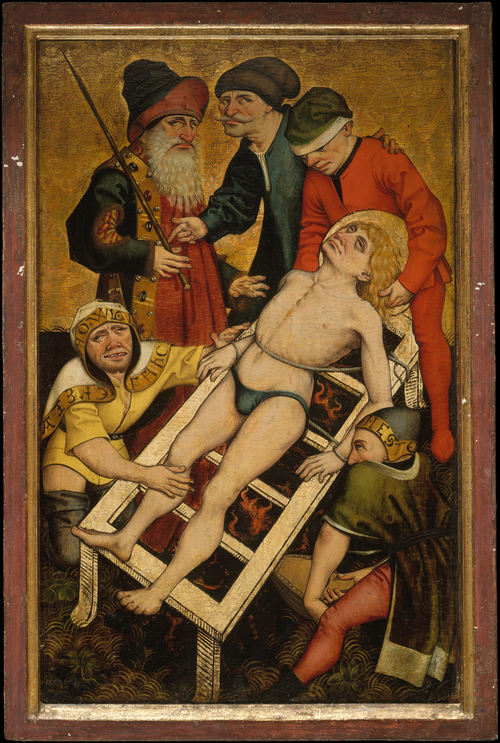
The commander was incensed. He ordered that Lawrence be stripped of his clothing and bound with ropes. He had Lawrence laid on his back upon a gridiron and roasted over a slow fire.   

"The Martyrdom of Saint Lawrence," oil on wood, by Masters of the Acts of Mercy (Austrian, Salzburg, c. 1465)

After prolonged and indescribable suffering, Lawrence is said to have quipped to his torturers: 

“One side is done now; you can turn me over now.” (which they did, turning him face down above the flames) 

After saying a prayer for the Christian conversion of Rome, he died. 

St. Lawrence is the patron saint of cooks and comedians alike. In art, he is often portrayed carrying a long cross on his shoulder and a gospel book in his hand. His emblems are the gridiron and a bag of money for the poor. (1) 

(1) White, Kristin E. White (compiled by).  A Guide to the Saints. New York: Ivy Books, 1991.

Texas pioneers John Holland Jenkins and Mary Jane Foster Jenkins

Texas pioneers John Holland Jenkins and Mary Jane Foster Jenkins

John Holland Jenkins (1822-1890) fought for Texas for 30 years. At age 13, he joined General Ed Burleson’s First Regiment in the Texas Revolution of 1836. Once the Mexicans were driven back, Jenkins returned to Bastrop, Texas, where he quickly earned a reputation as an Indian fighter. He became a Texas Ranger and, later, a Confederate soldier.

In later life, Jenkins became an author of an invaluable memoir, Recollections of Early Texas. Read today with 21st Century eyes, Jenkins’ accounts of gritty frontier days may come across to some as politically incorrect, especially in regard to native Americans. When the book was printed in 1958, Texas folklorist J. Frank Dobie wrote a foreword, somewhat predicting a backlash:

“Johnny Jenkins seems to consider it his duty to put down the truth – whether it is complimentary or not.”

Here is Jenkins’ account of an experience with a group of Tonkawa Indians, one of the many tribes of Plains Indians still roaming Texas when the Anglo settlers arrived in the Mid-19th Century. While some historians dispute that the Tonkawas, like the coastal Karankawas, were cannibals, Jenkins does not:

“There was a cowardly tribe among us, the Tonkawas, who were at peace with the whites, but hated all other Indians of every tribe. Only a short time before this, a band of Wacoes had killed five of them while out hunting, and, of course, this increased their hatred toward [the Waco] Indians. Hearing that I had killed one of their enemies [a Waco], they came in a body, thirty of them, and insisted that I should go with them and show them the dead warrior.

As we went, their excitement and speed increased, and every now and then they would trot on faster than ever, while I trotted with them, determined to keep up and see what they intended doing. When they discovered the body, they seemed wild with delight or frenzy. They sprang upon the body, scalped him, cut off both legs at the knees, both hands at the wrists, pulled out his fingernails and toenails, strung them around their necks, and then motioned for me to move aside. Seeing they meant further violence to the body, already horribly mutilated, I demanded why I must move. They said, ‘We must shoot him through the head for good luck….’

I moved aside, and they shot….They then went back to the house and camped, getting me to furnish them some beef. They boiled their beef, and the hands and feet of the dead Waco together…. Upon inquiry, I found they intended having a dance, and would feed their squaws on the hands and feet of the dead Indian, believing that this would make them bring forth brave men who would hate their enemies and be able to endure hardness and face dangers.

They erected a pole, to which they attached the scalp, hands, and feet of the Waco, and then with horrible yells and gestures, all danced around it, while the squaws constantly danced up to the pole and took bites from the hands and feet and then would go back and dance again. They would prolong these dances three, five, and sometimes ten days.”

The Tonkawas had a Plains Indian culture, subsisting mainly on buffalo and small game until the Apaches and Comanches began pushing them from their hunting grounds. The Tonkawas then became a destitute culture, scavenging for food. They befriended the Anglo settlers who came to Central Texas in the mid-19th Century, relying on them for food, supplies, and an alliance against their Indian enemies. The Tonkawas wore little clothing. The women went topless and tattooed themselves extensively. They painted black stripes on their mouths, noses, and backs, and painted concentric circles around their breasts. Painting by the Berlandier Expedition, 1828.

Readers: You might enjoy other frontier tales also on this website. Scroll down the right sidebar to Categories/Frontier Tales. Enjoy!

In this 1851, Texas pioneer Mary Adams Maverick is shown with 5 of her children. In 21 years, she bore 10 children. Four died of illness before reaching the age of 8. Her first-born, Sam, Jr., lived to be 98.

In this 1851 photograph, Texas pioneer Mary Adams Maverick is shown with 5 of her children. In 21 years, she bore 10 children. Four died of illness before reaching the age of 8. Her first-born child, however, lived to be 98!

On August 4, 1836, Mary Ann Adams Maverick (1818-1898) married Samuel A. Maverick, in Mary’s hometown of Tuskaloosa, Alabama. Mary was 18: Sam, 33. Sam had recently returned from Texas where he had fought in the Texas Revolution.

For the next several months, the newlyweds traveled throughout the South, visiting relatives, before arriving at Sam’s family home in South Carolina. There, on May 14, 1837, Mary gave birth to their first child, a boy.

Sam’s father did everything in his power to induce his son and family to settle with him in South Carolina. “Father Maverick” offered Sam and Mary a plantation complete with mills, vineyards, orchards, lands, and shops. Or, if a plantation wasn’t their fancy, he offered instead a new style house and improvements.

But Father Maverick’s efforts were “all in vain,” wrote Mary in her memoirs,

“for my husband dreamed constantly of Texas, and said: ‘We must go back.'” (1)

Sam wanted to build his land empire in the new Republic of Texas.

In October 1837, Mary, Sam, and their baby boy left South Carolina for Alabama. For the next six weeks, they – and their 10 “negroes” – stayed with Mary’s family while they made final preparations for their long overland journey to Texas.

“December 7, 1837, we set off for Texas. With heavy hearts, we said goodbye to Mother, and my brothers and sister. Mother ran after us for one more embrace. She held me in her arms and wept aloud, and said: ‘Oh, Mary, I will never see you again on Earth.’ I felt heartbroken and often recalled that thrilling cry; and I have never beheld my dear Mother again.” (1)

 
(1) Green, Rena Maverick (ed.). Memoirs of Mary A. Maverick. The Alamo Printing Co., San Antonio, 1921.

"Comanche War Party on the March, Fully Equipped," oil painting by George Catlin, 1846-1848. By the time Texas won its independence from Mexico in 1836, the frontier war between the settlers and the Comanche Indians was at full throttle, with brutal attacks being waged on both sides.

Here is an article that appeared in an 1840 Texas newspaper:

A little remedy against Indian arrows:

Take about 16 or 24 sheets of common blotting paper; lay between them some thin layers of cotton or silk; make a kind of jacket of it to be put on in the moment of danger, and you will be invulnerable from the chin to the leg, from the most of Indian arrows and even bullets. It is no more cowardice than to stand behind a tree or to be a cuirassier [a mounted soldier wearing armor]; and in our big European wars, the lives of many thousands of brave soldiers were thus preserved. I recommend it by experience.

H. Mollhausen, captain of artillery                          

Texas Sentinel, March 1840

Readers, other posts of similar interest are:

The Scalping of Robert McGee

“The Scalping of Josiah Wilbarger”

Frances Griffiths is shown playing with fairies in Cottingley Beck, near Bradford in England, in 1917. Her cousin Elsie Wright was the photographer. This is one of 5 photographs the cousins took of themselves playing along a creek with dancing fairies.

Do you believe in fairies? Frances Griffiths, 16, and her cousin Elsie Wright, 10, did. They claimed to play with dancing fairies along the enchanted stream [the beck] behind Elsie’s house in Cottingley Village, England – and they had 5 photographs to prove it. There in the frames, dancing around the girls, were four female fairies!

When Elsie’s parents saw the photos, they didn’t know what to think. Elsie’s father examined them and proclaimed them clever fakes. But Elsie’s mother wasn’t so sure. Mrs. Wright wanted to believe the girls, as she was a spiritualist. [Among the country folk in England at the time was a lively fairy-faith. ] The parents searched the girls’ shared bedroom and around the beck for scraps of paper to reveal tomfoolery. Still nothing turned up. Mrs. Wright was inclined to believe the girls. Her husband made his camera off-limits.

Time passed. At first the photographs were only shared with close friends and family, but, in 1919, Mrs. Wright attended a lecture on fairy life, bringing the prints with her. By 1920 the prints had come to the attention of one of the leading spiritualists of the time, Edward Gardner, who examined them and had two new negatives made, clarifying the pictures.

The story of the Cottingley fairies got even more attention when Sir Arthur Conan Doyle (creator of the Sherlock Holmes mysteries) learned of them.

Detective Sherlock Holmes and Doctor Watson, played by Basil Rathbone and Nigel Bruce. The characters of Holmes and Watson were created by British doctor Sir Arthur Conan Doyle, a renowned spiritualist.

Sir Arthur Conan Doyle was famous for more than his books. He was an outspoken believer in the spirit world. He immediately believed the Cottingley fairy story and began writing letters to the Wright family in support. Doyle published his book The Coming of Fairies in 1922, maintaining until his death that the Cottingley fairies were real.

Still, public opinion was divided. Supporters claimed the photos provided long-awaited proof of the existence of spirits. Others said the photos were nothing more than clever fakes. The Cottingley Fairy Photos caused heated debate. Nevertheless, the girls held to their story, even as they aged.

Finally in 1983 Elsie came clean. She divulged in a letter to a friend that the photographs were indeed a hoax. She described how she and Frances had used the fairies in Princess Mary’s Gift Book as inspiration for cut0uts. They then used hatpins to prop up the paper dolls in the bushes for pictures.

Fairy figures in Princess Mary's Gift Book


Elsie insisted that they had meant no harm. They were just having a bit of fun. It had been Elsie’s idea as a way to get back at her parents for scolding her little cousin. Evidently, her mother and father had gotten angry with Frances for getting her clothes wet one day while playing in the beck. Frances had claimed to be playing with fairies when she’d fallen, and the elder Wrights had teased her. Elsie had come up with the idea of taking the first pictures to have the last laugh. All along they had planned on confessing their little trick until Arthur Conan Doyle got involved. By then, the matter had grown so out of proportion thatthe girls became terrified of a public backlash should they confess.


Elsie Wright is shown receiving a flower from a fairy. This is one of the famous Cottingley fairy photos from 1917.

Freedmen’s Monument, Lincoln Park, Washington, D.C.; sculptor, Thomas Ball. The sculpture was funded solely from freed slaves, primarily from African-American Union veterans, to pay homage to the American president who had issued the Emancipation Proclamation, thus liberating them from bondage in the Confederate States. The statue was dedicated on April 14, 1876, 11 years after Abraham Lincoln's assassination by the Confederate rebel John Wilkes Booth. Abolitionist and former slave Frederick Douglass delivered the dedication speech.

Oration in Memory of Abraham Lincoln

Frederick Douglass delivered a speech at the unveiling of the Freedmen’s Monument in Memory of Abraham Lincoln at Lincoln Park, Washington, D.C., on April 14, 1876. This is the conclusion of what Douglass said to the crowd:


“Fellow-citizens, the fourteenth day of April, 1865, of which this is the eleventh anniversary, is now and will ever remain a memorable day in the annals of this Republic. It was on the evening of this day, while a fierce and sanguinary rebellion was in the last stages of its desolating power; while its armies were broken and scattered before the invincible armies of Grant and Sherman; while a great nation, torn and rent by war, was already beginning to raise to the skies loud anthems of joy at the dawn of peace, it was startled, amazed, and overwhelmed by the crowning crime of slavery–the assassination of Abraham Lincoln. It was a new crime, a pure act of malice. No purpose of the rebellion was to be served by it. It was the simple gratification of a hell-black spirit of revenge. But it has done good after all. It has filled the country with a deeper abhorrence of slavery and a deeper love for the great liberator.

Had Abraham Lincoln died from any of the numerous ills to which flesh is heir; had he reached that good old age of which his vigorous constitution and his temperate habits gave promise; had he been permitted to see the end of his great work; had the solemn curtain of death come down but gradually–we should still have been smitten with a heavy grief, and treasured his name lovingly. But dying as he did die, by the red hand of violence, killed, assassinated, taken off without warning, not because of personal hate–for no man who knew Abraham Lincoln could hate him–but because of his fidelity to union and liberty, he is doubly dear to us, and his memory will be precious forever.”

Abolitionist and former slave Frederick Douglass, daguerrotype, 1855. Douglass recruited black men to serve in the Union Army during the Civil War.

Readers, I’ve posted many articles on Abe Lincoln. Scroll down the right sidebar to Categories/People/Abraham Lincoln for more! Enjoy.

Also on this blog: “Frederick Douglass, An American Slave.”

The American abolitionist, Frederick Douglass, in a rare photo taken c. 1840, around the time he became a runaway slave.

Frederick Douglass (1817-1895)

The following is an excerpt from the Narrative of the Life of Frederick Douglass, an American Slave (1845), which includes recollections of Douglass’ experiences on a Maryland plantation:

“To describe the wealth of Colonel Lloyd [his master] would be almost equal to describing the riches of Job. He kept from 10-15 house servants. He was said to own a thousand slaves, and I think this estimate quite within the truth. Colonel Lloyd owned so many that he did not know them when he saw them; nor did all the slaves of the out-farms know him. It is reported of him, that, while riding along the road one day, he met a colored man, and addressed him in the usual manner of speaking to colored people on the public highways of the South:

‘Well, boy, whom do you belong to?’

“To Colonel Lloyd,’ replied the slave.

‘Well, does the colonel treat you well?’

‘No, sir,’ was the ready reply.

‘What, does he work you too hard?’

‘Yes, sir.’

‘Well, don’t [sic] he give you enough to eat?’

‘Yes, sir, he gives me enough, such as it is.’

The colonel, after ascertaining where the slave belonged, rode on; the man also went on about his business, not dreaming that he had been conversing with his master. He thought, said, and heard nothing more of the matter, until two or three weeks afterwards. The poor man was then informed by his overseer that, for having found fault with his master, he was now to be sold to a Georgia trader….

It is partly in consequence of such facts that slaves, when inquired of as to their condition and the character of their masters, almost universally say they are contented, and that their masters are kind. The slaveholders have been known to send in spies among their slaves, to ascertain their views and feelings in regard to their condition. The frequency of this has had the effect to establish among the slaves the maxim that a still tongue makes a wise head.”

Also on this blog: “Abe Lincoln: The Freedmen’s Monument