Feeds:
Posts
Comments

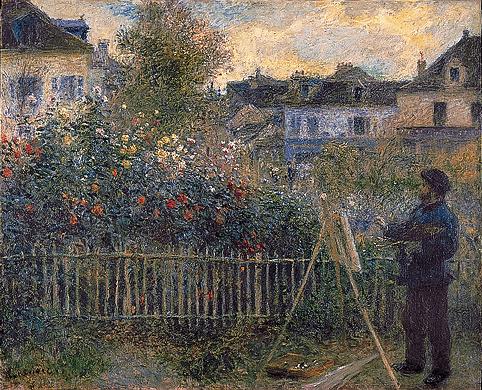
As a young man, French painter Claude Monet (1840-1926) abandoned the traditional approach to painting – standing in a studio, copying the old masters – in favor of painting scenes in the open air. Monet delighted in the interplay of color and light found in nature. He loved to paint in his garden at Argenteuil, a pretty, bustling village just outside of Paris.

"Monet Painting in His Argenteuil Garden," by Auguste Renoir, 1873

A spectacular stretch of the Seine, where the river reached its widest and deepest points, ran through Argenteuil.  Shortly after moving there in 1871, Monet bought a boat and converted it into a floating studio. He kept it moored near his home and used it to get a vista of the riverbank from the water.

"Claude Monet Painting on His Studio Boat," by Édouard Manet, 1874. The shadowy female figure sitting with the artist is his wife and model Camille Doncieux Monet.

Living with Monet at Argenteuil were his wife Camille Doncieux and their son Jean. Camille had been Monet’s model since they met in 1865. The couple lived in depressing poverty.

Claude Monet (1860) and wife Camille Doncieux Monet (undated)

Right up to her death, Camille posed for her husband’s paintings, more often than not, appearing as an indistinct female figure in a rural landscape.

"River Scene at Bennecourt," Claude Monet, 1868

Sometimes Camille has her back to the observer; othertimes her face is veiled or hidden.

"Camille on the Beach at Trouville," by Claude Monet, 1870

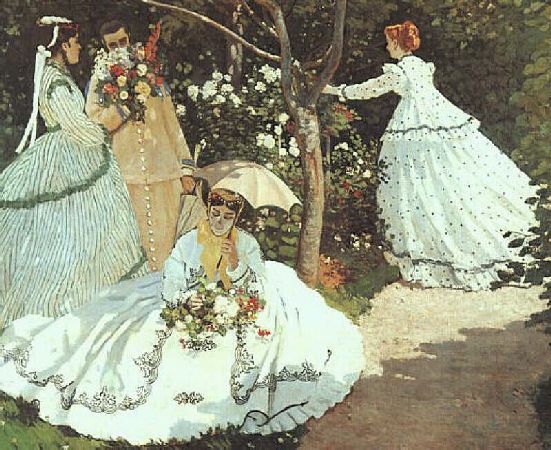
Camille was quite the devoted model. In Monet’s painting, “Women in a Garden” (1866-67), she posed for all four female figures!

"Women in a Garden," Claude Monet, 1866-67

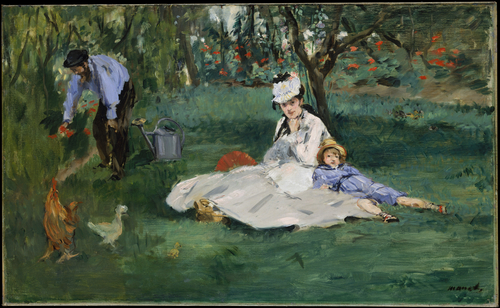
Camille was so cooperative that she freely posed for Monet’s painter friends, too.

"The Monet Family in Their Garden at Argenteuil," by Édouard Manet, 1874. Camille and son Jean relax while Claude Monet tends his garden.

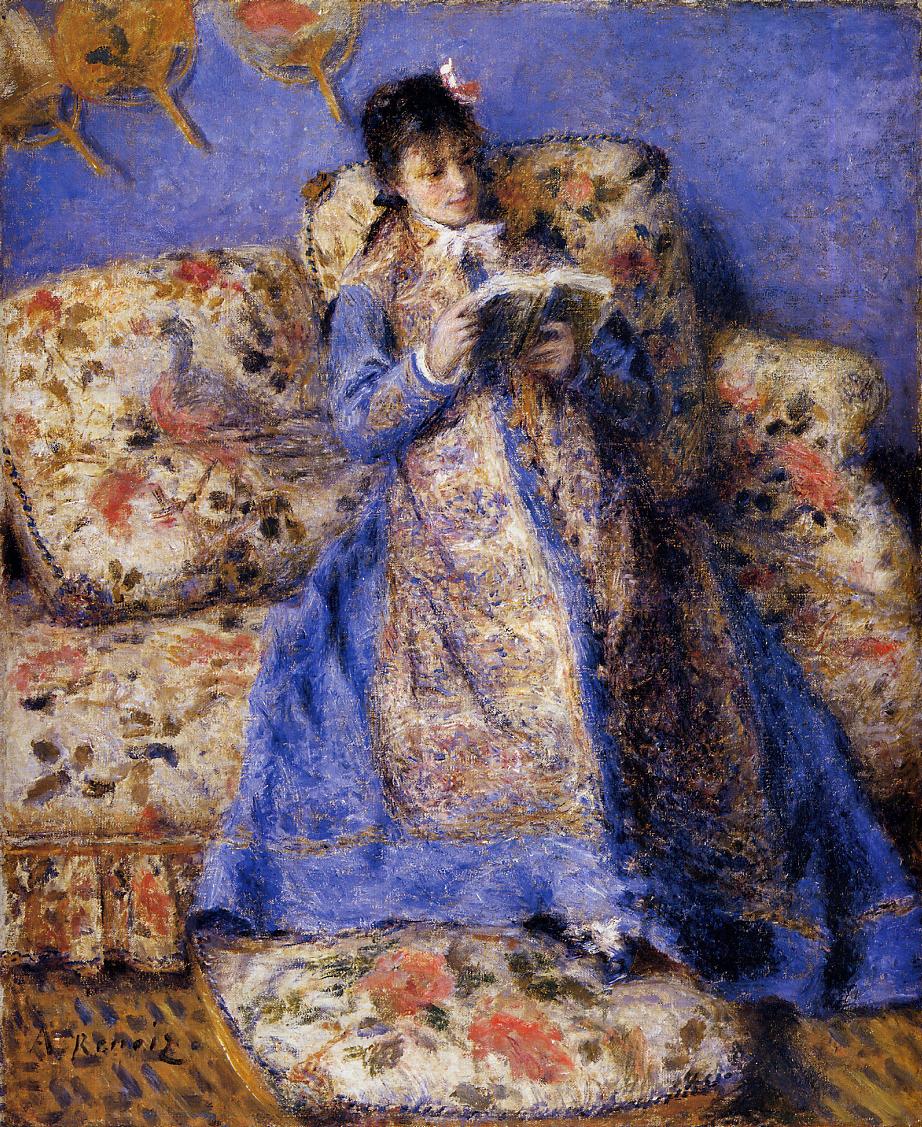
Auguste Renoir painted Madame Monet – known as “La Monette” – several times.

"Camille Monet Reading," by Auguste Renoir, 1872

Here is one of the rare times her husband paints her face clearly enough to distinguish her features, particularly her huge and sad-looking eyes. She often looks melancholy.

"The Bench," by Claude Monet, 1873

In 1876, Camille Monet fell ill with what is believed to have been cervical cancer. In “Camille Holding a Posy of Violets,” below, one can see the toll the disease has had on her health. She looks tired, older, and pale. It is speculated that her expression betrays her disgust with her husband who, by then, was openly carrying on a flirtation with their mutual friend, Alice Hoschede. Alice and her two children shared a house with the Monets.

"Camille Holding a Posy of Violets," or "Portrait," by Claude Monet, 1877

In 1878, Camille gave birth to a second son, Michel. Her health was dangerously weakened. Although Monet was not as attentive as he could have been to his wife, he loved Camille and was devastated that she was dying. For a time, he lost the desire to paint.

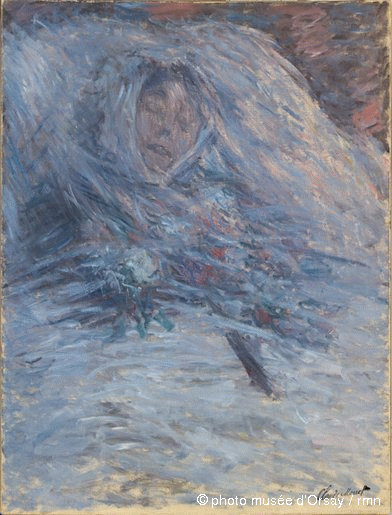
Finally Camille’s long suffering came to an end on September 5, 1879. Monet was grief-stricken. But even his internal pain could not stifle his passion to paint. Camille – his model-wife – was his muse, his inspiration to paint. At her deathbed, he took out his paints and painted her last portrait.

"Camille on her Deathbed," by Claude Monet, 1879

“I caught myself watching her tragic forehead,” Monet wrote afterwards to a friend, “almost mechanically observing the sequence of changing colours that death was imposing on her rigid face. Blue, yellow, grey and so on… my reflexes compelled me to take unconscious action in spite of myself.”

Little is known about Camille Doncieux Monet (1847-1879) mainly because Monet’s mistress and second wife, Alice Hoschede, was so jealous of Camille that she demanded that Monet destroy all mementos – letters, photos – anything – that attested to Camille’s very existence. (1)

(1) Gedo, Mary Mathews. Monet and His Muse: Camille Monet in the Artist’s Life. Chicago: University of Chicago Press, 2010.

British Prime Minister David Cameron’s government is moving ahead with plans to change succession laws so that if Will and Kate have a daughter, she will be able to ascend to the throne. Under existing rules, if the Duke and Duchess of Cambridge‘s first child is a girl but their second child is a boy, the son would pass over his sister and inherit the throne. Cameron wrote,

We espouse gender equality in all other aspects of life, and it is an anomaly that in the rules relating to the highest public officer we continue to enshrine male superiority.”

Read more at People.

For more on this blog about Will & Kate, click here.

Jackie Kennedy

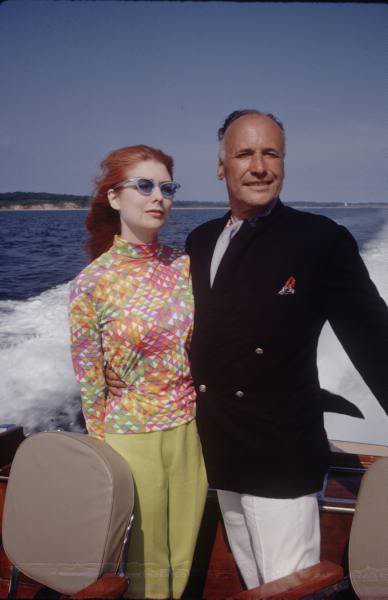
In 1966, multimillionaire Robert David Lion Gardiner invited Jackie Kennedy to visit him on to his private islet, Gardiners Island, off the coast of Long Island. Gardiners Island had been in Gardiner’s family for four centuries and was one of the largest privately-owned islands in the world.

Eunice Bailey Oakes Gardiner and Robert David Lion Gardiner

Gardiner arranged a dinner party for Jackie which was attended by both Gardiner and wife, the former British model Eunice Bailey Oakes, and several others.

After dinner, the guests retired to the lavish wood-paneled den, where coffee and cognac were served. According to Gardiner, he watched as Jackie took out a cigarette and looked around for a light. A gold cigarette lighter belonging to Eunice lay on a  nearby table. Jackie picked it up and used it to light her cigarette. Then, inexplicably, she slipped the lighter into her evening bag.

Gardiner was aghast. Jackie Kennedy had deliberately stolen his wife’s lighter.

Gardiner didn’t know what to do. Several uncomfortable minutes later, he went over to his humidor and took out a cigar. Turning to the roomful of guests, he asked:

Have any of you seen my wife’s gold cigarette lighter?” 

Getting no response, he addressed his most distinguished guest:

Did you, Mrs. Kennedy? I believe you were the last one to use it.”

Jackie shrugged, replying in her little girl voice:  

I have no idea where it went. ”

The lighter was never returned to its owner. Gardiner was furious and retaliated by spreading stories accusing Jackie of kleptomania.

Jackie Kennedy and Aristotle Onassis, June 5, 1969, at Kennedy Airport, New York. The couple had been married less than a year.

The gossip reached the Greek ears of Aristotle Onassis, Jackie’s husband from 1968-75, who sent Gardiner a check for $5,000, along with a note threatening legal action for slander. Jackie had admitted to Ari that she had accidentally placed the lighter in her purse that evening at Gardiner’s but had, since then, simply lost track of it.

At some point, though, the missing lighter “resurfaced.” After Jacqueline Kennedy Onassis’s death in 1994, the lighter was auctioned off at Sotheby’s in New York as part of her multi-million-dollar estate.

Source: Bobby and Jackie: A Love Story. New York: Atria, 2009.

Readers, for more posts on Jackie Kennedy on this blog, click here.

Pigeons gather in a square in Barcelona.

Note: Pigeons and doves form the bird family Columbidae, of which there are 300 species. Ornithologically, there is no simple way to distinguish a pigeon from a dove. Some specialists refer to the smaller species as “doves” and the larger ones as “pigeons,” but this is not consistently applied.

Collared Doves can be tamed in urban areas, such as these two being handfed in Poland.

Collared doves can be tamed in urban areas, such as these two sweeties being handfed in Poland.

In reference to the works of Spanish artist Pablo Picasso, the issue is further muddled. The titles of many of his works include the Spanish word la paloma, which means both “pigeon” and “dove,” so we aren’t sure which bird he intended to depict, if, indeed, he did intend to create such a distinction.

Finally, Picasso biographers, art curators, and translators have added their own layers of confusion. For example, the painting, “Child Holding a Dove,” (National Gallery, London) has been given two different French title translations: “L’Enfant A La Colombe” (Child With the Dove)  and “L’Enfant Au Pigeon” (Child With A Pigeon).

Therefore, for the purpose of this article, the terms, “pigeon” and “dove,” are used interchangeably, as is common practice, except when otherwise explicitly stated.

Now for our story:

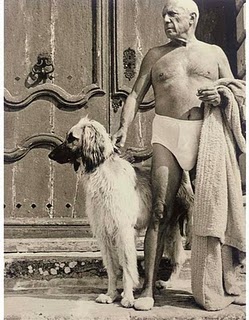
“Picasso in Underwear,” photo by David Douglas Duncan, 1957. From the earliest age, the most famous artist of the 20th Century did whatever he wanted, which might include posing in his jockeys on his front doorstep at age 76.

Famed Spanish artist Pablo Picasso (1881-1973) grew up around pigeons. His father, José Ruiz Blasco, an artist in his own right, bred pigeons (rock doves), which became his favorite subject to paint. Ruiz became known as El Palomero (The Pigeon Fancier). Pablo’s father taught him how to paint pigeons. (1)

In Pablo’s hometown of Málaga, Spain, pigeons roosted in the sycamore trees in the Plaza de la Merced, where he and his sisters played. While the girls frolicked in the square, Pablo used a stick to make bird drawings in the dirt. (2)

Much to the dismay of his elementary school teachers, Little Pablo, or “Pablito,” drew constantly. Every once in a while, he brought a pigeon to class and spent his time sketching it rather than doing his assigned schoolwork.

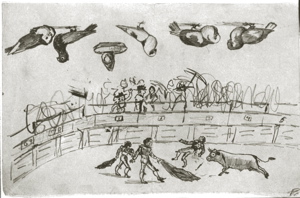
Pablo used every inch of his drawing paper, covering the page with scenes of his favorite subjects: bullfights and pigeons. (3)

Guided by his father, Picasso received professional art instruction. His talent grew and was recognized. By the age of 15, he was successfully exhibiting his artwork. By 1901, he was splitting his time between Barcelona and Paris, falling increasingly in the company of artists heavily influenced by post-impressionists such as Vincent Van Gogh.

That same year, at the age of 20, Picasso had become so respected an artist that he had a Paris show in the Galerie Vollard almost to himself, sharing it with another Basque. At this exhibition, Picasso

sold 15 of his 65 paintings and drawings before the exhibition had even opened.” (4)

Through all these changes, however, pigeons still charmed him, as is evident in his sentimental 1901 painting, “Child Holding a Dove” (1901), a piece that ushered in his somber Blue Period.

Pigeons even appeared during his cubist period, as in “Woman With Pigeons” ( 1930).

“Woman With Pigeons,” by Pablo Picasso, 1930.

Before 1937, Picasso had not used his art for political expression. It was in that year, though, that he was to create his most famous work. Commissioned by the Spanish Republican government, Picasso created an enormous mural called “Guernica.” It was named after a Spanish town in the Basque country that had been firebombed by Nazis, backers of the Nationalist forces of General Franco during the Spanish Civil War (1937-1939).

Guernica, Spain, after the April 26, 1937, aerial bombing by Nazis. It was market day and the quiet village was filled with women and children. There were few men left in Guernica, as most were off fighting in the Spanish Civil War against Franco. The Nazis bombed the town for two hours, slaughtering hundreds of innocents. When the town caught fire, those not burned to death tried to escape the inferno by taking refuge in the outskirts of town. Yet there was no escape, as they found themselves trapped all around by bombed-out bridges and roads. Some of these women and children were gunned down by aerialists. The Nazis supported the rebel forces of General Franco to test out war tactics and weapons. Although there was a military target outside Guernica, a munitions factory, it was left unscathed by the April 1937 bombing. It is believed that the bombing was used to intimidate those in opposition to Franco’s impending rule.

After the painting “Guernica” (see below) was exhibited in the Paris International Exhibition (1937), it toured Europe and the U.S., drawing international attention to the Spanish Civil War and the horrors of war.

“Guernica,” by Pablo Picasso. (1937)

 “Guernica” gained monumental status, becoming a potent anti-war symbol and thrusting Pablo Picasso to the forefront of the Peace Movement. In May of 1940, Hitler invaded France. Throughout WWII, Picasso lived in Nazi-occupied Paris, where he was continually harassed by the Gestapo who were familiar with his anti-Nazi mural.

Picasso continued to paint and draw pigeons and doves. In 1949, author Louis Aragon chose the artist’s lithograph, “La Colombe,” (The Dove) for the poster commemorating the Peace Conference in Paris. (5)

“La Colombe” (The Dove) by Picasso, 1949

Posters of “La Colombe” were all over Paris when Picasso’s daughter was born that April so he named his daughter Paloma (Spanish for dove).

In this 1951 image, Pablo Picasso is shown with 2 of his 4 children, whose mother was Francoise Gilot: Paloma (b. 1949) in his arms and Claude (b. 1947) Photo Edward Quinn, © edwardquinn.com

The model for the famous “peace dove” was one of artist Henri Matisse ‘s doves.

Henri Matisse in his studio with his doves. Vence, France. 1944. photo by Henri-Cartier Bresson

Matisse and Picasso had known each other since 1904 when they were introduced at the Paris salon of Gertrude Stein, an important collector of art, particularly Matisse’s. Matisse and Picasso had a profound influence on one another and their art.

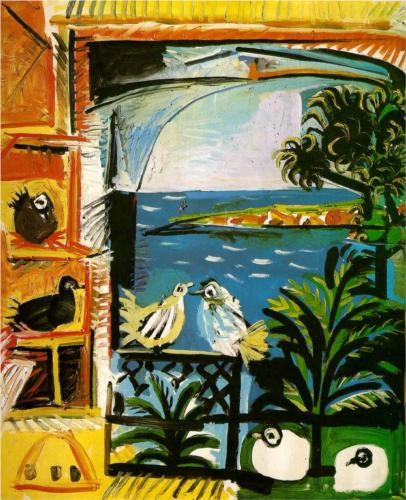
After Matisse died in 1954, Picasso was deeply saddened. He moved his family to a large villa near Cannes in the south of France and painted a series called “Studio” in homage to Matisse. He painted almost a dozen canvases of the same view from his third floor studio window – with the lush background of sky and garden and sea – while, in the foreground, “white doves” (6) nested and played in a dovecote Picasso had built on his terrace. Picasso did not ordinarily paint what he saw; he drew upon his imagination for artistic inspiration. It was his old friend Matisse who drew from nature. Therein lay Picasso’s tribute to Matisse.

“The Studio (Pigeons),” by Picasso, 1957, is painted in a style reminiscent of Matisse.

Meanwhile, the “Dove of Peace” Picasso had created for the 1949 Paris Peace Conference had caught on. It had become a symbol for the peace movement, the Communist Party, and other liberal groups. In the years that followed, Picasso agreed to create other peace doves for conferences across Europe.

The modern peace dove is a more whimsical bird than the 1949 original. This proud bird is portrayed in happy flight, bearing numerous bouquets of olive branches and flowers in its wings, beak, and feet.

one of the many versions of Picasso’s iconic “Dove of Peace”

(1)”Lines That Kept Moving and Knew No Boundaries,” by Smith, Roberta. New York Times, October 7, 2011.

(2) Hart, Tony. Famous Children: Picasso. New York: Barron’s Educational Series, 1994.

(3) Krull, Kathleen. Lives of the Artists: Masterpieces, Messes (and What the Neighbors Thought). New York: Harcourt Brace & Company, 1995.

(4) link

(5) Clark, Hiro. Picasso: In His Words. New York: Welcome Books, 2002.

(6) Douglas, David. Viva Picasso: A Centennial Celebration 1881-1981. Studio, 1980.


Pablo Picasso and sister Lola, 1888. (What’s up with the haircut, Pablo?)
Spanish painter Pablo Picasso (1881-1973) could draw before he could walk. According to his mother, 
 

his first word was piz, short for the Spanish word lapiz, meaning pencil. 
“Pablito” asked for a pencil constantly and, once he got one in hand, would draw for hours, covering entire sheets of paper with countless spirals. (1)   


A Spanish "caracola" filled with candied fruit and iced with a confectioner's sugar glaze

In later interviews, Picasso revealed that his passion for spirals came from the caracolaor Spanish sticky bun, his favorite pastry. “Caracola” means “snail” in Spanish. Caracolas started with a single strip of dough wound tightly around the center, creating a spiraling snail-like design in the cake. Caracolas were served hot in the market stalls in Málaga, Spain, Picasso’s home for his first ten years.  

Pablo found artistic inspiration in nature as well as at the breakfast table. With Málaga situated on the Costa Del Sol, Pablo would walk on the beach with his father, finding dazzling variety in the shells washing up on the Mediterranean shore.     

Málaga, Spain

There were so many patterns, he discovered, spiralling and more!  


Shells found on a beach in Málaga, Spain, Pablo Picasso's birthplace. 2010

Pablo was entranced. From a young age, Pablo became a voracious collector of seashells as well as peach pits, pebbles, cherry stems, and leaves.   

Picasso grew up and became very famous, but he never lost his early love for spirals and curvy, coiling lines. 


Picasso Draws a Centaur, 1949

As an adult artist, he used spirals over and over again in his drawing and painting.  

An undated Picasso line drawing of a Harlequin. image from book, Pablo Picasso, by Ernest Raboff)

"Two Dressed Models and a Sculpture of a Head" by Pablo Picasso, 1933. Notice the cascade of spiraling vines on all 3 heads.

 Often Picasso’s predilection for curves and spirals would show up in his paintings of women’s breasts. (3)     

"Girl in Front of Mirror," by Pablo PIcasso, 1932

(1) McNeese, Tim. Pablo Picasso. New York: Chelsea House, 2006.      

(2) Lepscky, Ibi. Pablo Picasso. New York: Barron’s Educational Series, Inc., 1984.      

(3) Penrose, Roland. Picasso, His Life and Work. Berkeley: The University of California, Icon Editions, 1973.     


Addiction claims another victim. Amy Winehouse is dead at age 27.

Chemical dependence claimed another victim today: 27 year old Amy Winehouse, British rocker, was found dead at her London flat this afternoon. 

The Definition of Addiction 

Answer yes or no to the following seven questions. Most questions have more than one part, because everyone behaves slightly differently in addiction. You only need to answer yes to one part for that question to count as a positive response. 

  1. Tolerance. Has your use of drugs or alcohol increased over time?
  2. Withdrawal. When you stop using, have you ever experienced physical or emotional withdrawal? Have you had any of the following symptoms: irritability, anxiety, shakes, sweats, nausea, or vomiting?
  3. Difficulty controlling your use. Do you sometimes use more or for a longer time than you would like? Do you sometimes drink to get drunk? Do you stop after a few drink usually, or does one drink lead to more drinks?
  4. Negative consequences. Have you continued to use even though there have been negative consequences to your mood, self-esteem, health, job, or family?
  5. Neglecting or postponing activities. Have you ever put off or reduced social, recreational, work, or household activities because of your use?
  6. Spending significant time or emotional energy. Have you spent a significant amount of time obtaining, using, concealing, planning, or recovering from your use? Have you spend a lot of time thinking about using? Have you ever concealed or minimized your use? Have you ever thought of schemes to avoid getting caught?
  7. Desire to cut down. Have you sometimes thought about cutting down or controlling your use? Have you ever made unsuccessful attempts to cut down or control your use?

If you answered yes to at least 3 of these questions, then you meet the medical definition of addiction. This definition is based on the of American Psychiatric Association (DSM-IV) and the World Health Organization (ICD-10) criteria.(1

Read more about the death of Amy Winehouse at the Daily Mail.

Read more about Amy Winehouse’s life at NPR.

Queen Elizabeth II and Catherine, the Duchess of Cambridge, took a preview tour of Buckingham Palace’s royal wedding exhibit on Friday. 

Catherine, Duchess of Cambridge, and her grandmother-in-law, Queen Elizabeth II of Great Britain, are on their way to view Buckingham Palace's royal wedding exhibit, July 22, 2011. Uncharacterically, the Queen is not carrying her trusty handbag.

The Royal Collection show, called “The Royal Wedding Dress: A Story of Great British Design,” opened to the public today. It brings together the Duchess of Cambridge’s Alexander McQueen white and ivory Irish lace wedding dress, shoes, tiara, earrings, and a replica bouquet for the public to view up close.

Among the items displayed at the Queen's London residence include the Cartier Halo tiara, worn by Kate Middleton on her wedding day. The understated headpiece was made in 1936 and purchased by the Duke of York (later King George VI) for his wife, Elizabeth's mother (also Elizabeth). Queen Elizabeth received it as an 18th-birthday present, at which time she was Princess Elizabeth. The delicate diamond tiara was lent to Kate by the Queen.

The Palace expects over 500,000 people to buy tickets to the ten-week exhibit. Both at home and abroad, Prince William and Kate are wildly popular, as evidenced by the overwhelmingly warm reception they received earlier this summer on their 2011 Royal Tour of Canada with a detour to Hollywood.

Kate Middleton's bridal shoes will be on display at Buckingham Palace this summer. Custom made by Alexander McQueen's Sarah Burton to match her wedding dress, Kate's elegant pumps are made of ivory duchesse satin with lace hand-embroidered by the Royal School of Needlework.

Kate and William’s wedding cake was a fruit cake designed by Fiona Cairns. It was covered in cream and white icing, decorated with over 900 sugar paste flowers and elaborate scrollwork. Fiona Cairns’ cakes are in huge demand; Sir Paul McCartney orders one every Christmas.

Kate designed her wedding cake to match its surroundings. She took into account that her wedding reception was to be held in the Picture Gallery in Buckingham Palace. The room has high ceilings so she chose a cake that towered but was not too tall or thin. She wanted something with presence. Architectural elements in the room, for instance, garlands on the walls, were reproduced loosely on the fourth tier piping: roses, acorns, ivy leaves, apple blossom and bridal roses. The cakemaker would not reveal her exact recipe but did disclose that she used a range of produce from dried fruits such as raisins and sultanas to walnuts, cherries, grated oranges and lemon, French brandy and free-range eggs and flour to create her historic confection.

Of course, the centerpiece of the exhibit was Kate’s wedding dress and veil. An ongoing tradition, viewing royal wedding gowns has wide public appeal. For instance, Princess Diana‘s 1981 Elizabeth Emanuel wedding gown continues to be viewed and is currently part of a travelling exhibition. 

Kate and the Queen view Kate's wedding gown display in Buckingham Palace. July 20, 2011.

Upon viewing the installation of Kate’s wedding dress and veil, the Queen was heard to exclaim, 

“Horrid, isn’t it? Horrid and dreadful!”


The Queen is not amused.

The ivory and white Alexander McQueen gown is displayed in a dark and gloomy fashion with the veil and tiara hovering eerily above. 

The Duchess of Cambridge's wedding gown is displayed without a mannequin.

It appeared the mannequin’s lack of a head may have upset the Queen.

Source: HuffStyle 

Readers: For more on Lisa’s History Room about the British Royal Family, click here.

The Romanov Children in 1906: Tsar Nicholas II and Tsarina Alexandra had four daughters and one son. (L-R) The Grand Duchess Olga (b.1895), Tsarevich Alexei (b.1904), Grand Duchesses Tatiana (b.1897), Maria (b.1899) and Anastasia (b.1901) Romanov. They were the last Imperial children of Russia. They were murdered with their parents 12 years after this photo was taken, in 1918.

The Romanov girls – Olga, Tatiana, Maria, and Anastasia – were born only six years apart, which brought them close. As daughters of the Tsar, they naturally grew up in a very cloistered environment, without the usual playmates. This brought them even closer, closer than most sisters. They loved each other very dearly. 

The grand duchesses thought of themselves as one unit and, by adolescence, decided to declare this unity by adopting the single autograph, “OTMA,” derived from the first letters of their names. As OTMA, they jointly gave gifts and signed correspondence.

Unlike most sisters, they did not squabble over possessions. Rather, they freely shared their belongings with one another. Tatiana once remarked to Baroness Buxhoeveden, one of her ladies-in waiting: 

We sisters always borrow from each other when we think the jewels of one will suit the dress of the other.” 

The girls were thrilled when their mother, Empress Alexandra, gave birth to a son in 1904. They warmly welcomed little Alexei, the tsarevich or heir,  into their fold. He became everyone’s baby, especially when it was learned he was gravely ill with hemophilia.

Since there were five of them then, the grand duchesses modified the acronym OTMA to reflect the addition of their baby brother. OTMA thus became OTMAA.

Readers: For more about the Russian Royal Family on Lisa’s History Room, click here.

Princess Charlene beams with joy at her new husband, Prince Albert II of Monaco, following the religious blessing of their marriage.

July 4, 2011

The Daily Mail:

“The new Princess Charlene of Monaco tried to flee home to South Africa three times before her ‘arranged marriage’ to Prince Albert, it was alleged yesterday.

The former Charlene Wittstock, 33, reportedly made her first escape attempt when she travelled to Paris in May to try on her wedding dress.

The allegations, which are surprising considering she went ahead with the wedding on Saturday, emerged in the French newspaper Le Journal du Dimanche , It went on to report that later in May, Charlene made a second apparent attempt to escape during the Monaco Formula 1 Grand Prix.

Monaco Grand Prix along the Monaco Harbor.

A month before their royal wedding, Charlene Wittstock and Prince Albert II of Monaco attend a dinner following the Monaco Formula 1 Grand Prix. May 31, 2011.

Then, last week, royal officials are said to have confiscated her passport en route to Nice airport via the helicopter service that runs between the Mediterranean principality and France. She was then persuaded to go on with the marriage.

‘Several sources have confirmed that an arrangement was reached between the future bride and groom,’ reported Le Journal du Dimanche.”

The reports followed confirmation by palace sources while the wedding was in full swing that Prince Albert, 53, was due to have DNA tests because of claims by at least one woman that he has fathered another illegitimate child. He already has a 19-year-old daughter and six-year-old son. Le Journal du Dimanche quoted Monaco “policy advisers” among those discussing “two illegitimate children -one already born, the other to come.” (The Vancouver Sun)

Jazmin Grace Grimaldi, the child of Prince Albert II of Monaco and Tamara Rotolo, was born in Palm Springs, California, on March 4, 1992.

Alexandre "Alex" Coste is the natural son of HSH Prince Albert II of Monaco and former flight attendant from the African Republic of Togo Nicole Coste. He was born on August 24, 2003.

“Sources said the Monaco palace had hoped the glitzy wedding – attended by a host of celebrities and European royalty – would ‘overshadow’ new claims about secret children fathered by Albert.

The Monaco Palace

Instead, Charlene was in floods of tears at one point, while her 53-year-old husband looked on impassively.

Princess Charlene weeps at the religious ceremony blessing her marriage to Prince Albert II of Monaco.

Meanwhile, the reception that followed provoked ridicule with tacky features such as a giant wedding cake that towered over the couple and a mirrored dance floor.

Monaco's Prince Albert II and Princess Charlene cut a small cake while standing by their enormous (leaning?) wedding cake at the Gala Dinner at the Opera Garnier in Monaco, July 2, 2011. Pink Proteas flowers from Princess Charlene's native South Africa adorn the many-tiered confection. The wedding cake was redcurrant and vanilla. Charlene is radiant in her second Armani gown of the day.

Among the guests were Prince and Princess Michael of Kent, actor Roger Moore and Topshop boss Sir Philip Green and his wife, Tina.

Fireworks light the sky over the Monte Carlo Casino after the gala dinner to celebrate the wedding of Prince Albert II to Charlene Wittstock of South Africa. July 2, 2011

Tomorrow the couple are due to fly to South Africa on honeymoon, presenting Charlene with her best chance yet of ‘escaping’ Monaco.”

Source: The Daily Mail

Readers, for more on the Monaco Royals, Princess Albert II and Princess Charlene, on Lisa’s History Room, click here.

Newlyweds Prince Albert II and Princess Charlene of Monaco depart from the Monaco palace after their religious wedding ceremony, Saturday, July 2, 2011. (AP Photo/Benoit Tessier, Pool)

Charlene Wittstock's Armani gown worn for the religious ceremony took 2,500 hours to prepare as "kilometers" of platinum-coated thread was sewn into 430 yards of off-white silk. Charlene's broad swimming champion's shoulders bore the weight of 40,000 Swarovski crystals, 20,000 mother of pearl tear drops, and 30,000 golden stones.

Princess Charlene's wedding gown had two trains. The skirt of the gown folded out to a shorter train, while the crossover neckline extended into a longer train on top.

Princess Charlene chose a light veil of off white tulle that rested on her head from the back.

Charlene anchored her wedding veil with an elaborate curving diamond hairpiece, possibly loaned by her new sister-in-law, Princess Caroline.


Readers: For more on Prince Albert and Princess Charlene here on Lisa’s History Room, click here.

Readers: For stories about Princess Grace of Monaco on Lisa’s History Room, click here.

Prince William and Catherine, the Duke and Duchess of Cambridge, braved temperatures in the nineties as they continue their Royal Tour of Canada at a stop in Ottawa. Kate wore a striking red hat adorned with the Canadian maple leaf as well as a brooch loaned from the Queen. In his speech, Prince William referred to his grandmother as the “Queen of Canada.” Queen Elizabeth II remains Canada’s head-of-state.Prince William waves to the Ottawa crowd as Catherine steps out in a striking red hat adorned with red maple leaves, a symbol found on the Canadian flag. July 2011  

Kate flashes a smile as we get a close-up of her red hot fascinator by Sylvia Fletcher for Lock and Co.

Kate wears a family heirloom loaned to her by Queen Elizabeth II: a diamond brooch of a maple leaf, Canada's national emblem.

Queen Elizabeth II wore the maple brooch when she toured Canada 60 years earlier, in 1951.

The flag of Canada features a red, 11-tipped maple leaf against a white field, flanked by vertical red bands. Canada is a federal state that is governed as a parliamentary democracy and a constitutional monarchy with Queen Elizabeth II as its head of state. It is a bilingual nation with both English and French as official languages at the federal level.

Readers: For more on the British Royal Family here on Lisa’s History Room, click here

Albert Alexandre Louis Pierre Grimaldi, born March 14, 1958, at the Prince’s Palace in Monaco, is the second child born to Prince Rainier III and Princess Grace.On April 6, 2005, Prince Rainier III died and Hereditary Prince Albert became Albert II, Sovereign Prince of Monaco.


Princess Grace of Monaco holds 2 of her children in this early 1960 photo: Princess Caroline, 3, and Prince Albert, 22 mos. Caroline and Albert were born 14 months apart.

Princess Grace, seated, and her husband, Prince Rainier III, pose for a family portrait with their 3 children: baby Princess Stephanie, Princess Caroline, and Prince Albert II. ca. 1965.

The Grimaldis smile for the camera: Prince Rainier holds Princess Stephanie with blue-eyed Prince Albert looking on from behind. Dark-haired beauty Princess Caroline flanks her mother, Princess Grace on our right. photo ca. 1967.

Prince Albert was adored by his mother, Princess Grace of Monaco. undated photo

READERS: For more on the Grimaldis of Monaco and the Royal Wedding, click here.

South African Charlene Wittstock, 33, weds Prince Albert of Monaco, 53.

A day after the civil wedding that transformed one-time Olympic swimmer Charlene Wittstock into the Princess of Monaco, the South African and her prince, Albert II exchanged vows in the religious ceremony today.

The happy both couple both answered ‘oui’ (yes) to the Archbishop of Monaco, Bernard Barsi, who conducted the service in front of 850 guests.

Wearing an off-the-shoulder Armani dress, the new Princess Charlene on Monaco looked serene and beautiful as she wed Prince Albert in the courtyard of the Prince’s Palace.

Read more at The Daily Mail.

Center, Prince Albert of Monaco and his fiancé Charlene Wittstock pose with the band The Eagles, performing in Monaco to celebrate the wedding of Albert and Charlene. June 30, 2011.

Prince Albert of Monaco and Charlene Wittstock of South Africa are scheduled to wed today in Monte Carlo despite revelations in the French Press earlier in the week that the never-before-married Prince Albert, 53, may have fathered a third love child. Upon learning of the Le Monde article, Miss Wittstock, 20 years Albert’s junior, reportedly tried to flee the tiny Riviera principality.

As reported in The Daily Mail, “the couple’s lawyers have furiously denied a rift, while police have claimed that Miss Wittstock even

had her passport confiscated at the Nice airport to stop her getting on a flight.” 

Despite this hiccup, the wedding is going ahead as planned. The engaged couple put on a happy show of unity last night as they attended a concert by The Eagles. The free show was held at Monaco’s stadium and attracted thousands of fans from the principality and neighboring areas.

The wedding nuptials include a civil ceremony today and a Catholic Church ceremony tomorrow. 

In this June 2011 photo for Vogue magazine, Charlene Wittstock shows off her impressive physique. She was a South African Olympic swimmer who will become Princess Charlene of Monaco on Friday, July 1, 2011, when she weds Prince Albert of Monaco. Prince Albert is the son of the late Grace Kelly, American film actress, and Prince Rainier III of Monaco.

Charlene Wittstock stands on a precipice in Monaco.
To see a gallery of Charlene Wittstock photos at the Daily Beast, click here.  

The nuptials at Monte Carlo may rival the British royal wedding in lavishness and excess. While newlyweds William and Kate, the Duke and Duchess of Cambridge, are unable to attend the festivities because they are currently in Canada on a North American tour, the guest list is still expected to be impressive. Shrouded in secrecy, it is rumored to include crowned heads of Europe, politicians, and glitterati such as international supermodel Naomi Campbell, German haute couture designer Karl LagerfeldFrench President Nicolas Sarkozy and his wife, First Lady Carla Bruni.

Musician and former model Carla Bruni is expecting her second child, her first with Sarkozy.

The June 2011 issue of French magazine Elle features First Lady of France Carla Bruni Sarkozy with her growing pregnancy bump. Carla Bruni is a former model, and has graced the cover of Elle many times.

Before she was the First Lady of France: Carla Bruni models a designer bikini and pearl-rimmed sunglasses.

READERS: For more on Lisa’s History Room about Carla Bruni, click here  


In the photo above, Prince Albert’s mother, Princess Grace of Monaco, is shown climbing the stairs of the Princely Palace in Monaco, ca. 1960. Princess Grace is the Hollywood actress Grace Kelly who gave up her film career to marry Rainier III, Prince of Monaco, in 1956. Together they raised three children: Caroline, Princess of Hanover, Albert II, Prince of Monaco, and Princess Stéphanie of Monaco.

Readers: For more on Lisa’s History Room about Princess Grace, click here.

Landing in Ottawa, Canada, Prince William and Catherine begin the Royal Tour of 2011, their first tour as husband and wife.

Prince William and Catherine, the Duke and Duchess of Cambridge, are in Canada today, the first leg of the Royal Tour 2011 of North America. For more, click here.

For more about the British Royal Family on this blog, Lisa’s History Room, click here.