Feeds:
Posts
Comments

Posts Tagged ‘biographies of women’

Audrey Hepburn as Cockney flower seller in 1964 musical film, "My Fair Lady." Julie Andrews had played the lead in the Broadway play but producer Jack Warner wanted Audrey Hepburn as Eliza Doolittle for his film. Warner's film was to cost him $5 million. Audrey was well-known, talented, and her films never lost money. He wanted Audrey, not Julie. It caused quite a flap in the movie industry, with many feeling Julie Andrews should have had the role. Julie Andrew was then cast as Mary Poppins. That year, Audrey was snubbed at the Academy Awards, not even being nominated for her "My Fair Lady" performance. Julie Andrews won the Best Actress Oscar for "Mary Poppins."

Audrey Hepburn as Cockney flower seller in 1964 musical film, “My Fair Lady.” Julie Andrews had played the lead in the Broadway play but producer Jack Warner wanted Audrey Hepburn as Eliza Doolittle for his film. Warner’s film was to cost him $5 million. Audrey was well-known, talented, and her films never lost money. He wanted Audrey, not Julie. It caused quite a flap in the movie industry, with many feeling that singer Julie Andrews should have had the role. So Audrey was cast in “My Fair Lady.” Shortly Disney cast Julie Andrews in the musical spectacle, “Mary Poppins”. That year, Audrey was snubbed at the Academy Awards, not even being nominated for her “My Fair Lady” performance. Julie Andrews won the Best Actress Oscar for “Mary Poppins.”

In the 1964 Academy Award winning musical, “My Fair Lady,” linguistics professor Henry Higgins places a bet with his colleague Colonel Pickering. He boasts that, in six months time, he can transform a low-bred, disheveled Cockney flower seller named Eliza Doolittle into a duchess by teaching her to speak properly. Eliza is agreeable; she wants to speak better so she can get a job in a flower shop.

Eliza appears at Professor Higgins’ house to make arrangements for language lessons. Higgins’ housekeeper Mrs. Pearce escorts her into the library, where Higgins is discussing the possible experiment with Pickering.

Pickering: Won’t you sit down, Miss Doolittle?

Eliza (coyly): Oh, I don’t mind if I do. (She sits down on sofa.)

(Eliza offers to pay for voice lessons but Pickering wants to sponsor her.)

Eliza: Oh, you’re real good. Thank you, Captain.

Higgins (tempted, looking at her) It’s almost irresistible. She’s so deliciously low – so horribly dirty!

Eliza: Aoooow! I ain’t dirty: I washed my face and hands afore I come, I did.

Higgins: I’ll take it! I’ll make a duchess of this draggletailed gutter-snipe!

Eliza: Aoooooooow!

Higgins: (carried away): I’ll start today! Now! This moment! Take her away and clean her, Mrs. Pearce. Sandpaper if it won’t come off any other way. Is there a good fire in the kitchen?

Mrs. Pearce: Yes, but –

Higgins (storming on): Take all her clothes off and burn them. Ring up and order some new ones. Wrap her up in brown paper till they come.

Audrey Hepburn as Eliza Doolittle

Rex Harrison as Professor Henry Higgins

Wilfrid Hyde-White as Colonel Hugh Pickering

Mona Washbourne as Mrs. Pearce, Higgins’ housekeeper

Mrs. Pearce prepares the bath for Eliza.

Mrs. Pearce prepares the bath for Eliza.

Cecil Beaton, in charge of sets and costumes, recalls the day this scene was taped for “My Fair Lady”. He recalled it in his diary:

Wednesday, 21 August (1963)

…I wanted to congratulate Audrey (Hepburn) on her appearance, so went down on to the set for a word with her. I watched her being shot, listening to Higgins telling Pickering that, but for her appalling accent, Liza (sic: Eliza) could be passed off as a duchess. The play of expression on her face was such that one could almost see her brain at work with ideas that followed one another like a succession of pictures….

Thursday, 22 August (1963)

At lunch-time Audrey, wearing her dirty hair and face, came into my room to say ‘Ullow’. Every dawn Audrey has to have her hair covered with grease, then with a lot of brown Fuller’s Earth. The effect is really dirty, and psychologically must be very depressing. Tiring, too: it takes another hour to wash out the dirt before going home after the day’s shooting….

Audrey is remarkably disciplined: her memory never at fault, she appears on the set word  perfect, and she can give exactly the same performance over and over again. She confessed, however, that yesterday’s pea-shelling scene had been the greatest strain for she had to eat so many raw peas; at best, she does not care for them even when they are at their youngest and smallest, but having had to eat a bushel of huge Californian peas out of their inflated pods, she then went home to dinner and was served duck and green peas!

Tuesday, 27 August (1963)

On the set Audrey was still doing ‘Loverly’. Finding it difficult to work to different ‘play-backs’ she had been nervously taut most of the day. Now, by mid-afternoon, she was tired out. Her hairdresser was massaging the back of her neck: everyone sorry for her, and the atmosphere tense.

Cecil Beaton's costume design for character Eliza Doolittle in "My Fair Lady" musical film 1964

Cecil Beaton’s costume design for character Eliza Doolittle in “My Fair Lady” musical film 1964

Although Audrey practiced extensively to be able to sing in “My Fair Lady,” in the end it was decided that 90% of her vocal numbers would be dubbed with the voice of Marni Nixon. However, she did sing ‘Wouldn’t it be Loverly,’ shown in the following video:

For more on Audrey Hepburn, click here.

“My Fair Lady” movie trivia

“My Fair Lady” movie quotes


Read Full Post »

Audrey Hepburn 1953

Audrey Hepburn 1953

In 1954, British photographer and creative artist, Cecil Beaton, wrote this article for “Vogue” about a rising film star named Audrey Hepburn. Miss Hepburn was 25 and the newest sensation. She had just won the Academy Award for Best Actress for “Roman Holiday.”

It is always a dramatic moment when the Phoenix rises anew from its ashes. For if “queens have died young and fair,” they are also reborn, appearing in new guises which often create their own terms of appreciation. Even while the pessimists were predicting that no new feminine ideal could emerge from the aftermath of war, an authentic existentialist Galatea was being forged in the person of Miss Audrey Hepburn.

No one can doubt that Audrey Hepburn’s appearance succeeds because it embodies the spirit of today. She had, if you like, her prototypes in France – Damia, Edith Piaf, or Juliet Greco. But it took the rubble of Belgium [sicHolland] an English accent, and an American success to launch the striking personality that best exemplifies our new Zeitgeist [spirit of the age].

French waif

French waif

Nobody ever looked like her before World War II; it is doubtful if anybody ever did, unless it be those wild children of the French Revolution whose stride in the foreground of romantic canvases. Yet we recognize the rightness of this appearance in relation to our historical needs. And the proof is that thousands of imitations have appeared. The woods are full of emaciated young ladies with rat-nibbled hair and moon-pale faces.

Heron's eyes

Heron’s eyes

What does their paragon really look like? Audrey Hepburn has enormous heron’s eyes and dark eye-brows slanted towards the Far East. Her facial features show character rather than prettiness: the bridge of the nose seems almost too narrow to carry its length, which bares into a globular tip with nostrils startlingly like a duck’s bill. Her mouth is wide, with a cleft under the lower lip too deep for classical beauty, and the delicate chin appears even smaller by contrast with the exaggerated width of her jaw bones. Seen at the full, the outline of her face is perhaps too square; yet she intuitively tilts her head with a restless and perky asymmetry.

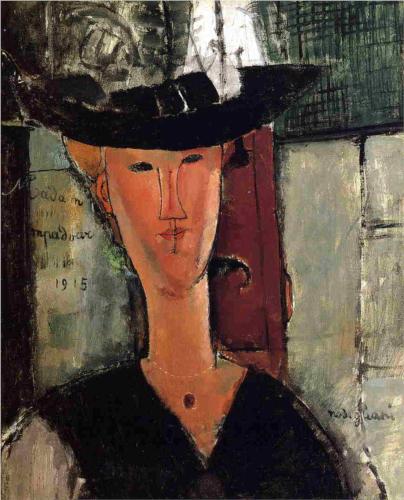
Madame Pompadour by Amedeo Modigliani, 1914.

Madame Pompadour by Amedeo Modigliani, 1914.

She is like a portrait by Modigliani where the various distortions are not only interesting in themselves but make a completely satisfying composite.

Beneath this child-like head (as compact as a coconut with its cropped hair and wispy monkey-fur fringe) is a long, incredibly slender and straight neck.

A rod-like back continues the vertical line of the nape, and she would appear exaggeratedly tall were it not for her natural grace.

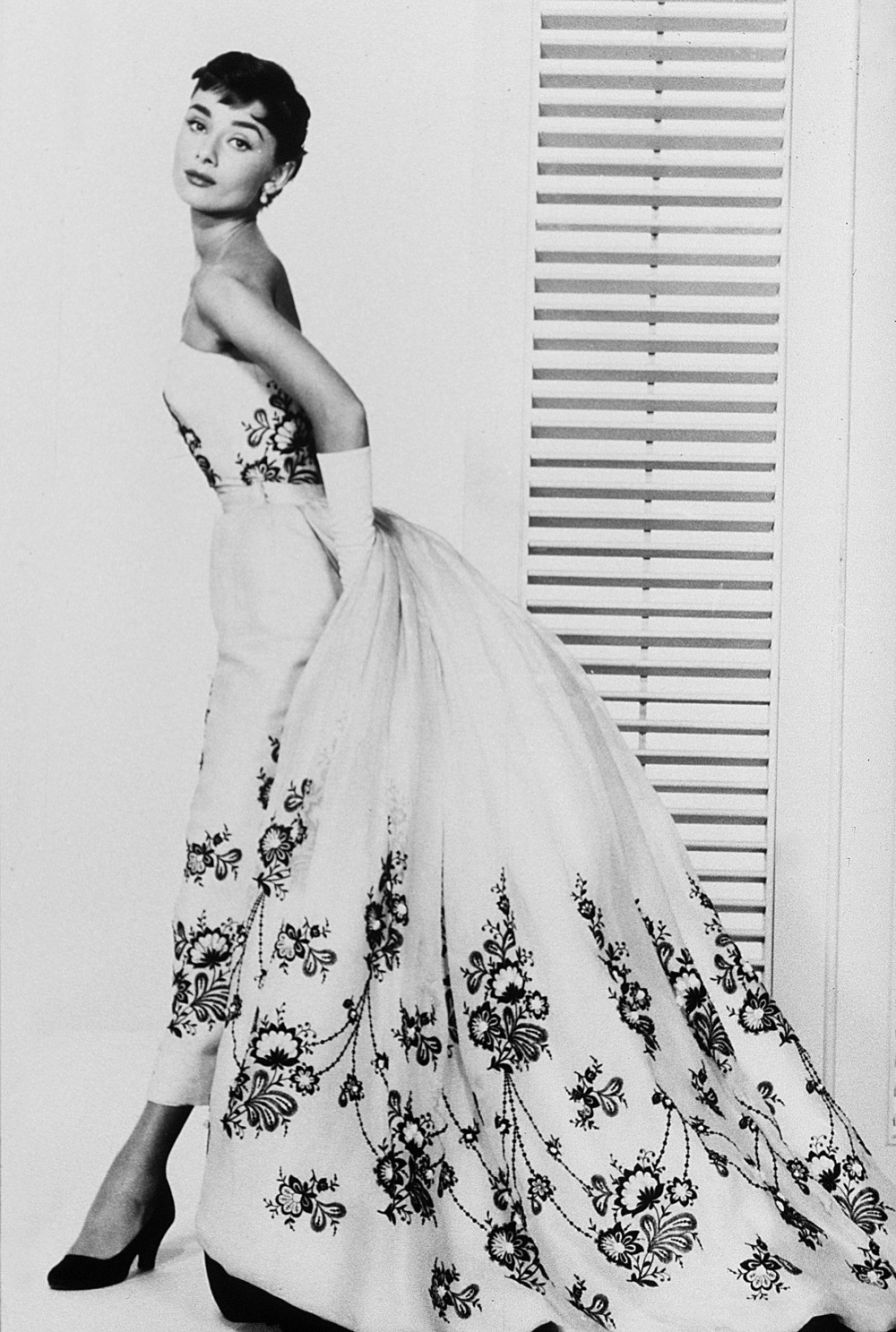
1954 Sabrina dress

Audrey appears in a Givenchy dress from the 1954 movie, “Sabrina.”

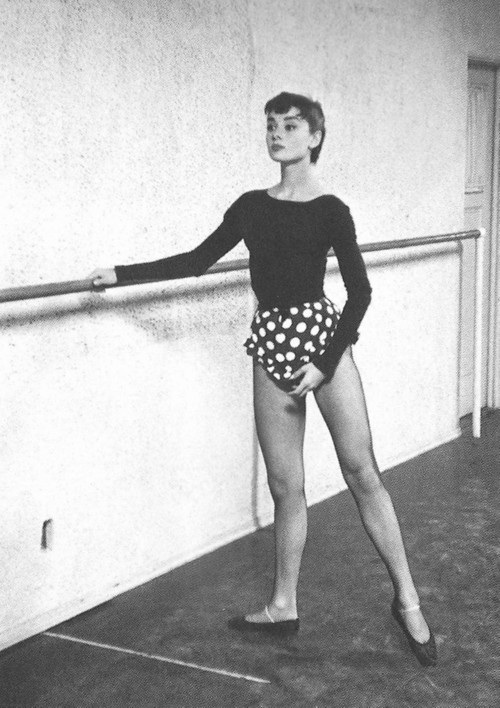
Audrey Hepburn’s stance is a combination of an ultra fashion plate and a ballet dancer. Indeed, she owes a large debt to the ballet for her bearing and abandon in movement, which yet suggest a personal quality, an angular kinship with cranes and storks. She can assume almost acrobatic poses, always maintaining an innate elegance in her incredibly lithe torso, long, flat waist, tapering fingers and endless legs.

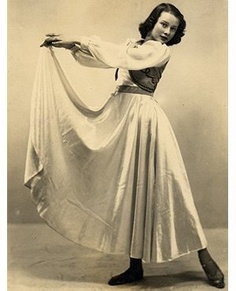
Audrey Hepburn was an accomplished ballerina. Undated photo, ca. 1954

Audrey Hepburn was an accomplished ballerina. Undated photo, ca. 1954

With arms akimbo or behind her back, she habitually plants her feet wide apart–one heel dug deep with the toe pointing skywards. And it is more natural for her to squat cross-legged on the floor than to sit in a chair.

Fratellini Poster

Fratellini Poster

Like the natural artist that she is Audrey Hepburn is bold and sure in her effects. There is no lack of vigor in her rejection of the softly pretty. She wears no powder, so that her white skin has a bright sheen. Using a stick of grease paint with a deft stroke, she draws heavy bars of black upon her naturally full brows; and almost in Fratellini fashion, liberally smudges both upper and lower eyelids with black.

To complete the clown boldness, she enlarges her mouth even at the ends, thus making her smile expand to an enormous slice from Sambo’s watermelon. The general public, in its acceptance of such an uncompromisingly stark appearance, has radically forsaken the prettily romantic or pseudo-mysterious heroines of only two decades ago.

1953 Audrey Hepburn grins upon receiving her Oscar for "Roman Holiday."

1953 Audrey Hepburn grins upon receiving her Oscar for “Roman Holiday.”

In clothing, this ingénue Ichabod wears a “junior miss” version of highwayman coats, clergyman cassocks, or students’ pants, overalls, scarfs.

Audrey Hepburn in loafers and scarf. Undated photo

Audrey Hepburn in loafers and scarf. Undated photo

Yet she is infinitely more soignée than most students, possessing, in fact, an almost Oriental sense of the exquisite.

Audrey Hepburn in the 1954 film, "Sabrina."

Audrey Hepburn in the 1954 film, “Sabrina.”

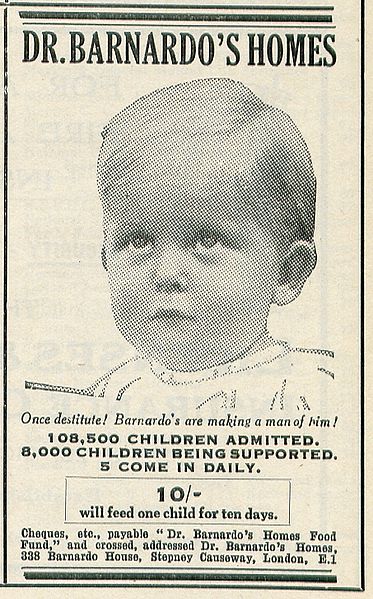
Barnardo's Boys were orphans

Barnardo’s Boys were orphans

And she is immaculately shod, whether in pumps, sandals, or court shoes. Audrey Hepburn is the gamine, the urchin, the lost Barnardo boy.

Audrey Hepburn from the 1954 film, "Sabrina"

Audrey Hepburn from the 1954 film, “Sabrina”

Sometimes she appears to be dangerously fatigued; already, at her lettuce age, there are apt to be shadows under the eyes, while her cheeks seem taut and pallid.

She is a wistful child of a war-chided era, and the shadow thrown across her youth underlines even more its precious evanescence. But if she can reflect sorrow, she seems also to enjoy the happiness life provides for her with such bounty.

It is a rare phenomenon to find a very young girl with such inherent “star quality.” As a result of her enormous success, Audrey Hepburn has already acquired the extra incandescent glow which comes as a result of being acclaimed, admired, and loved. Yet while developing her radiance, she has too much innate candor to take on that gloss of artificiality Hollywood is apt to demand of its queens.

Audrey Hepburn winks in sunlight. undated photo, ca. 1952

Audrey Hepburn winks in sunlight. undated photo, ca. 1952

Her voice is peculiarly personal. With its unaccustomed rhythm and sing-song cadence on a flat drawl, it has a quality of heartbreak. Though such a voice might easily become mannered, she spends much time in improving its musical range.

In fact, with the passing of every month, Audrey Hepburn increases in dramatic stature. Intelligent and alert, wistful but enthusiastic, frank yet tactful, assured without conceit and tender without sentimentality, she is the most promising theatrical talent to appear since the war. Add to this the remarkable distinction she emanates, and it is not rash to say she also gives every indication of being the most interesting public embodiment of our new feminine ideal.

US Vogue, November 01, 1954

 Click here for more on Audrey Hepburn.

Read Full Post »

Tanaquil Le Clercz, born in Paris to a French father and an American mother, studied dance in NYC. undated photo

Tanaquil Le Clercq, born in Paris to a French father and an American mother, studied dance in NYC. Tanaquil was the name of an Etruscan queen with prophetic powers. Undated photo

In 1944, when fifteen-year-old Tanaquil Le Clercq (1929-2000) was one of ballet master George Balanchine‘s star pupils, she danced the role of a girl stricken with polio in his short piece “Resurgence.” The performance was a March of Dimes benefit held at the Waldorf Astoria in New York City. The music was Mozarts String Quintet in G minor, and at the close of the plangent adagio [slow part]…

Balanchine, as the Threat of Polio, came onstage wearing a large black cape and enveloped her [Tanaquil]; she sank to the floor [stricken ill with polio]. In the final movement – a sunny allegro – she reappeared in a wheelchair, children tossed dimes, and she rose and danced again.”1

In 1944, few diseases frightened people more than polio. At that time, there was no cure. Polio struck in the warm summer months, sweeping through towns in epidemics every few years. It was known that polio was highly contagious. What was not known – and was particularly terrifying – was how the virus was transmitted. People did everything they had done in the past to avoid infection but these tactics never worked. They avoided crowds. They stopped going to theatres, swimming pools. Schools closed for weeks at a time.

Though most people recovered quickly from polio, some suffered temporary or permanent paralysis and even death. Many polio survivors were disabled for life. Charities like the March of Dimes raised money to help families deal with their stricken loved ones and to search for a cure. Finally, in 1955, a vaccine became available.

Tanaquil Le Clercq and Nicholas Magallanes in "Jones Beach," 1950

Tanaquil Le Clercq and Nicholas Magallanes in “Jones Beach,” 1950

For the next twelve years, Tanaquil Le Clercq /tan-uh-kill luh-clair/would continue to dazzle audiences of the New York City Ballet with her “perky young vivacity” and “crisp and tangy style.” With her long and limber flamingo legs, Tanaquil Le Clercq – “Tanny” to her friends – defined the Balanchine Ballerina style. Allegra Kent, a young dancer at the time, recalls those limber legs. Once she arrived at ballet class to discover Tanny with a bandage on her nose. Tanny explained her injury, saying that

she had just kicked her leg too high but that she was going to be fine.”2

Tanaquil Le Clercq in her long-limbed beauty, 1953

1954 ad for George Balanchine's smash hit, The Nutcracker

1954 ad for George Balanchine’s smash hit, The Nutcracker

New York City Ballet, front row, George Balanchine seated next to his muse on the right, prima ballerina Tanaquil Le Clercq, 1952

On New Year’s Eve 1952, Tanny became George Balanchine’s fourth official wife. Every dancer knew she was Balanchine’s favorite, his inspiration to create, his muse. And now she was his wife. She was 23; he was 48.

To understand Tanny’s broad appeal, here is a video clip from one of her 1956 Paris performances. In “Western Symphony,” a satire on the American Wild West, Tanny plays a dance hall girl strutting around a saloon with a cowboy.  She has wit:

The Paris performance of “Western Symphony” was part of a 10-week European tour, begun in August 1956, that encompassed Salzburg, Vienna, Zurich, Venice, Berlin, Munich, Frankfurt, Brussels, Antwerp, Paris, Cologne, Copenhagen, and Stockholm. It was an ambitious schedule, brutal and exhausting, especially when prima ballerina Maria Tallchief (Balanchine’s third wife) unexpectedly departed mid-tour and Tanny had to fill in for her. Although most of the dancers had been given the polio vaccine before the trip, Le Clercq decided at the last minute to wait.

Coughing, thin, and tired, Tanny collapsed in Copenhagen. On November 1, she was rushed to the hospital. She fell into a coma and could not breathe on her own. They placed her in an iron lung. Tanny had contracted polio. She was 27.

The iron lung ward at Rancho Los Amigos Hospital in Downey, CA, ca 1953. (Photo: PBS)

The iron lung ward at Rancho Los Amigos Hospital in Downey, CA, ca 1953. (Photo: PBS)

It made international news. “Tanaquil Le Clercq Stricken With Polio,” reported the New York Times on November 2, 1956. The dance world was shocked.

Tanny remained in the Blegdamshospitalet (Copenhagen Polio Hospital) for four and a half months before returning home. Although she survived the disease, she was permanently paralyzed from the waist down. The most beautiful dancer of the New York City Ballet would never walk again. Tanny, who had danced ballet since the age of 7, would never again dance. Her career was over.

But not her marriage. Balanchine took a year off to take care of Tanny himself. Deeply mystical, he could not shake the feeling that he had somehow played an evil part in her fate. He recalled that March of Dimes performance twelve years before when he had played the part of the Threat of Polio. He had reached out his foul hand and laid it on Tanny, afflicting her in what then seemed then but an innocent little play.

‘It was an omen,’ he would later say. ‘It foretold the future.'” 3

However, in the March of Dimes play, after the shower of dimes was bestowed on the wheelchair-bound Tanny, she retrieved her ballet slippers, put them on, and danced joyfully across then off the stage.

‘It was, alas, a balletic finale.’ Balanchine reflected. ‘Nothing like that ending will happen in Tanny’s real life.'” 3


Tanaquil Le Clercq and husband George Balanchine in an undated photo. They would divorce.


1 “Dancing Around the Truth” by Holly Brubach. The New York Times, February 15, 1012.

2 “Tanaquil Le Clercq.” Ballet Encyclopedia online.

3 Taper, Bernard. Balanchine: a Biography. University of California Press, 1996.

Read Full Post »

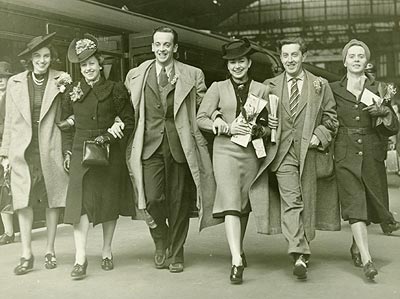
Members of the Sadler's Wells Ballet Company leave Victoria Station, London, for a tour of Holland, May 1940

Members of the Sadler’s Wells Ballet Company leave Victoria Station, London, for a tour of Holland, May 1940. Director Ninette de Valois is on the far right.

When the Germans invaded Holland on May 10, 1940, Ninette de Valois found herself trapped in The Hague. She was the director of the Sadler’s Wells Ballet Company from England. She and her 42 dancers had been on a Dutch tour. On the day of the invasion, de Valois had been sitting at a sidewalk café with two members of the dance company. It was noon. Suddenly, a stray bullet ricocheted from the pavement, passed between their heads, and crashed through the café’s plate glass window behind them. The bullet had been fired from a German plane swooping over the city square. The diners were rushed inside to safety.

That morning, some of the dancers had flocked to the rooftop of their hotel to watch German parachutists float down and land in the area around the Hague, where Queen Wilhelmina resided.  Thousands of leaflets also fluttered down from the enemy aircraft, some landing on the rooftop, that proclaimed:

Strong German troop units have surrounded the city. Resistance is of no use. Germany does not fight your country but Great Britain. In order to continue this battle the German Army has been forced to penetrate your country. The German Army protects the life and goods of every peace-loving citizen. However, the German troops will punish every deed of violence committed by the population with a death sentence.” 1

For five days, the Dutch army fought bravely, but it was no match for the German war machine. The Netherlands had a policy of neutrality and had had no recent experience of resisting outside invading forces. Queen Wilhelmina and the Dutch Royal Family from the Royal House of Orange-Nassau refused to accept the Nazi offer of protection and sailed to England on the HMS Hereford sent by King George VI.

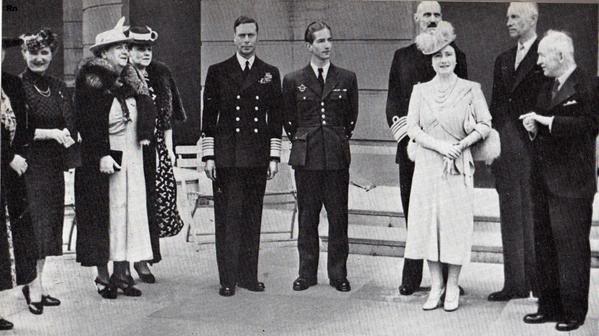
The Exiled Royals with the King and Queen of England, WWII (photo undated). From left to right: Queen Marie of Yugoslavia,Miss Benesj,Queen Wilhelmina of the Netherlands,Miss Raczkiewicz,King George VI of England,King Peter of Yugoslavia,King Haakon of Norway, Queen Elizabeth (The Queen mother) of England, the President of Poland, M. Raczkiewicz and Dr. Benesj, President of Tsjecho- Slovakia.

The Exiled Royals with the King and Queen of England, WWII (photo undated). From left to right: Queen Marie of Yugoslavia,Miss Benesj,Queen Wilhelmina of the Netherlands,Miss Raczkiewicz,King George VI of England,King Peter of Yugoslavia,King Haakon of Norway, Queen Elizabeth (The Queen mother) of England, the President of Poland, M. Raczkiewicz and Dr. Benesj, President of Tsjecho- Slovakia.

The Netherlands surrendered on May 15.

For the next seven weeks, the citizens of Holland did not resist the German occupation. They buried their dead and mourned their losses. They were shocked and demoralized. They felt abandoned by their queen.

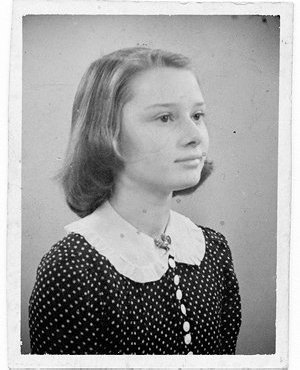
Audrey Hepburn-Ruston, ca. 1941 (age 12)

Audrey Hepburn-Ruston, ca. 1941 (age 12)

Audrey Hepburn was eleven years old when the Germans took over her town of Arnhem, Holland:

“The first few months we didn’t quite know what had happened.”

But Queen Wilhelmina reached out to her subjects across the North Sea via newsreels and BBC radio broadcasts, revitalizing Dutch hope for Allied liberation, and condemning German aggression. She urged them to resist the moffen (German Huns). For the next five years, the radio voice of the Queen would be the main source of inspiration for the Dutch Resistance Movement.

Princess Juliana and Prince Bernhard celebrate their engagement 1936. Note the white carnation in the Prince's lapel.

Princess Juliana and Prince Bernhard celebrate their engagement 1936. Note the white carnation in the Prince’s lapel.

An opportunity for the Dutch citizens to protest the German occupation arrived on June 29. It was the birthday of Prince Bernhard, the Queen’s son-in-law. Since he had been a student, the Prince had worn a trademark white carnation in his lapel.

So, on June 29, the Dutch people demonstrated their loyalty to Queen and country and their defiance of Nazi rule. People participated all across the country, but the activity was strongest in Amsterdam and The Hague.

People displayed vases full of carnations in the windows of homes and stores. Women and girls wore orange skirts, orange being the national color, symbolic of the Royal House of Orange. The Dutch flag was flown. Men pinned white carnations in the buttonhole of their coats, in imitation of Prince Bernhard, a German who was anti-Nazi.  Some people rode bicycles around town all dressed in orange.

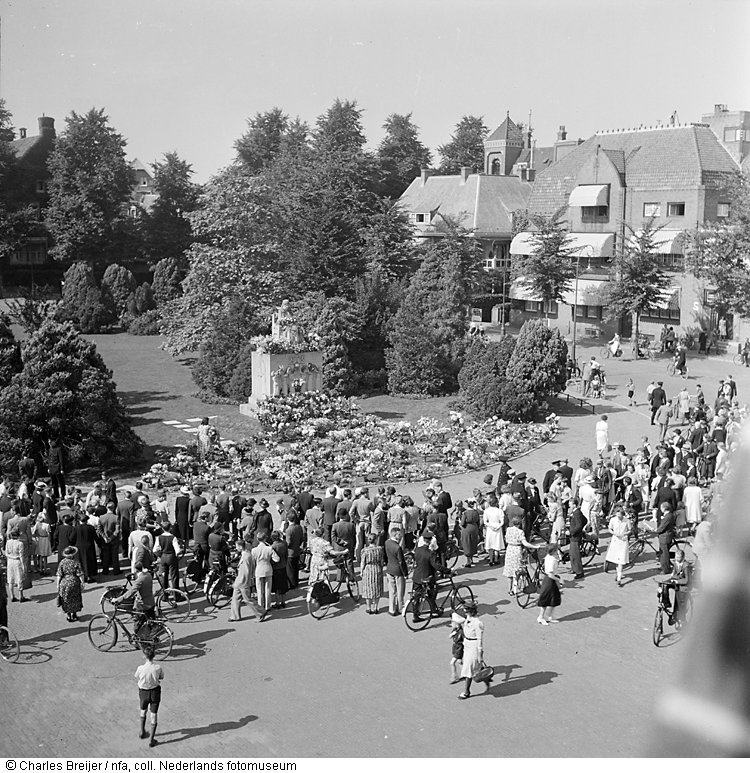
Crowds gathered at the statue of Queen Emma, Wilhelmina’s mother, in Amsterdam to lay flowers.

The Queen Emma monument is festooned with flowers on Carnation Day, 1940

The Queen Emma monument is festooned with flowers on Carnation Day, 1940

At first, only single flowers were placed on the statue’s lap. Then others arrived carrying great pots of flowers. Soon the area at the base of the statue was covered in flowers. On the nearby lawn, the letter B was formed with a clever flower arrangement. People brought cut-out pictures of the royal family and laid these beside the flowers.

A street organ began to play the national anthem. Softly at first, people began to sing. Shortly, though, more people lifted their voices in patriotic song. Emotion was running high.

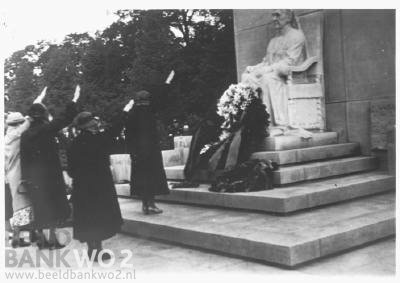
Men belonging to the WA, the military arm of the Dutch Nazi organization (NSB), shoved into crowds and started fights. The WA goons wore black shirts. Many people were injured.

NSB members (Dutch Nazis or collaborators) show up at a statue of Queen Emma on Carnation Day, giving the straight arm salute.

NSB members (Dutch Nazis or collaborators) show up at a statue of Queen Emma on Carnation Day, giving the straight arm salute.

People gathered at the Queen’s residence in the Hague, the Noordeinde Palace, to lay flowers on the balcony and to sign the birthday register.  The German commander of the Wehrmacht feared a riot. He ordered German fighter planes to fly above the city, diving now and then, but not to shoot, to get the crowd to disperse.

This day became known as Anjerdag, “Carnation Day.”

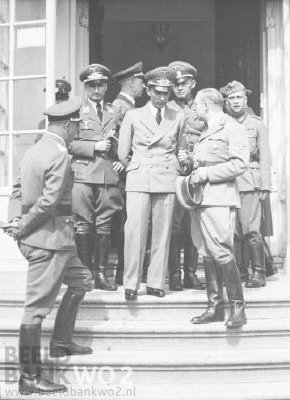
German propaganda minister Joseph Goebbels is shown at the entrance to Queen Wilhelmina's residence, the Noordeinde Palace in The Hague on Carnation Day. The nonviolent protest demonstration by the Dutch citizens greatly alarmed their German occupiers. Hitler was informed and the Nazis began their crackdown on Dutch life, liberty, and the pursuit of happiness.

German propaganda minister Joseph Goebbels (center) is shown at the entrance to Queen Wilhelmina’s residence, the Noordeinde Palace, in The Hague on Carnation Day. The nonviolent protest demonstrations by the Dutch citizens greatly alarmed their German occupiers. Hitler was informed and the Nazis began their crackdown on Dutch life, liberty, and the pursuit of happiness.

The Germans were furious with this civil act of disobedience. They ordered images of the Dutch Royal Family to be removed from all public places. Street names were renamed. The Prince Bernhard Square, for example, became “Gooiplein.” The Royal Library was soon referred to as the National Library. On the first of August, the top Nazi in Holland, Reichskommissar Seyss-Inquart, announced that it was forbidden to celebrate a birthday of a member of the Dutch Royal family.

Postnote:  In early 1941, a baby girl was born to a Mr. and Mrs. Niehot of The Hague. They wanted to name their newborn baby Nelia after their midwife, Nelia Epker, but she suggested they give their child an ‘Orange‘ name. The result was announced in the newspaper in a birth advertisement: Irene Beatrix Juliana Wilhelmina Niehot.

This announcement was met with great joy. Irene and Beatrix were the young daughters of Crown Princess Juliana.

May 1940, London. Elizabeth Van Swinderen, wife of the former Dutch minister to Great Britain, points out London barrage balloons to Princess Juliana of the Netherlands. Juliana is with her children, Beatrix by her side and Irene in the baby carriage.

May 1940, London. Elizabeth Van Swinderen, wife of the former Dutch minister to Great Britain, points out London barrage balloons to Princess Juliana of the Netherlands, who is pushing the stroller. Juliana is with her children, Beatrix is by her side and Irene is in the baby carriage.

Perfect strangers sent cards, flowers, cakes and even money to the Niehot family. When the midwife Nelia Epker placed a thank-you advertisement in March 1941, listing the baby’s royal names once again, Nelia was arrested. She would not return to the Netherlands until August 1945, a survivor of Camp Ravensbrück. 2

1 Gottlief, Robert, ed. Reading Dance: A Gathering of Memoirs, Reportage, Criticism, Profiles, Interviews, and Some Uncategorizable Extras. New York: Pantheon Books, 2008.

2 Dutch Resistance Museum


Read Full Post »

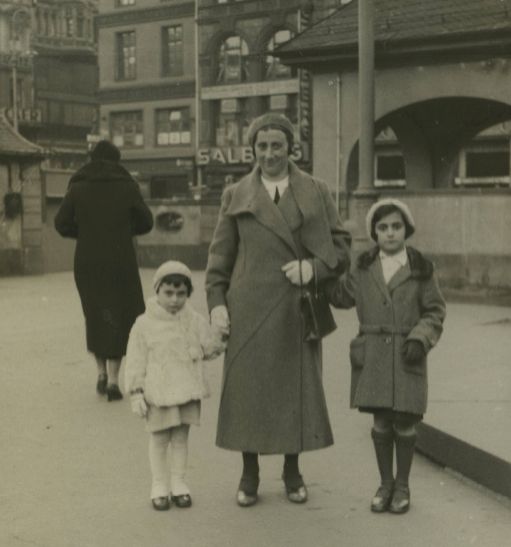
March 1933, the last picture taken of Anne, Edith, and Margot in Germany, prior to emigrating to Holland. Anne is 3 years old. They are standing in the Hauptwache square in the center of Frankfurt am Main

March 1933, the last picture taken of Anne, Edith, and Margot Frank in Germany, prior to emigrating to Holland. Anne is 3 years, 9 months old. They are standing in the Hauptwache square in the center of Frankfurt am Main.

I have just finished rereading Anne Frank: The Diary of a Young Girl. I was surprised to read that Anne had not been born in Amsterdam, where she hid from the Germans during World War II, but in Frankfort, Germany:

I will start by sketching in brief the story of my life. My father was 36 when he married my mother, who was then 25. My sister Margot was born in 1926 in Frankfort-on-Main, I followed on June 12, 1929, and, as we are Jewish, we emigrated to Holland in 1933….

The rest of our family, however, felt the full impact of Hitler’s anti-Jewish laws, so life was filled with anxiety.”1

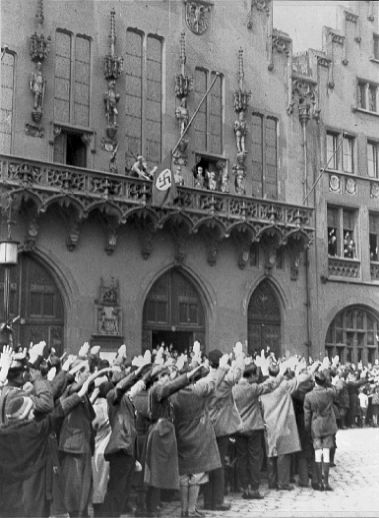
Following Hitler's appointment as Chancellor, a Nazi flag is hoisted at the town hall in Frankfort, the Franks' hometown in Germany. February 1933

Following Hitler’s appointment as Chancellor, a Nazi flag is hoisted at the town hall in Frankfort, the Franks’ hometown in Germany. ca. January 31, 1933

Once Hitler was appointed Chancellor on January 30, 1933, Nazi Germany became too dangerous for the Franks, simply because they were Jewish.

The Nazis believed that Jews were subhuman and were bent on driving them out of Germany. The Nazi propaganda machine went full bore, inciting the German people to violence against the Jews, their neighbors and fellow citizens. At the helm were Joseph Goebbels, the Nazis’ main propagandist, and Julius Streicher.

Julius Streicher’s Nazi Party card was Number 2; Hitler’s was Number 7. Throughout the 1920s, Streicher had been a loyal agitator for Hitler. He published the rabid anti-Jewish newspaper Der Stürmer (“The Attacker”). He was believed to be a sexual pervert. In May 1933, Hitler made him chief of the Central Committee of the Defence against Jewish Atrocity and Boycott Agitation. That July, Streicher:

…had some Jews arrested and taken to a meadow to tear out grass with their teeth….A small squat man, his head shaven, he had a predilection for swaggering in public. He carried a whip, and used it.” 2

May 1934 issue of Der Stürmer, a weekly Nazi propaganda newspaper owned by Julius Streicher. This specific cover issue is notorious as an example of the anti-Semitic propaganda style of Der Stürmer. It invokes the infamous "blood libel against the Jews", specifically the allegation that Jews were killing German Christian children and using their blood in religious rituals. The banner across the bottom of the page, "Die Juden sind unser Ungluck,' means "The Jews are our misfortune."

May 1934 issue of Der Stürmer, a weekly Nazi propaganda newspaper owned by Julius Streicher. This specific cover issue is notorious as an example of the anti-Semitic propaganda style of Der Stürmer. It invokes the infamous “blood libel against the Jews”, specifically the allegation that Jews were killing German Christian children and using their blood in religious rituals. The banner across the bottom of the page, “Die Juden sind unser Ungluck,’ means “The Jews are our misfortune.”

Goebbels and Streicher fomented lies about the Jews, making them the scapegoat for Germany’s poor economy and its humiliating defeat in World War I. They told the German people that the Jews were their enemies and not rightful citizens of Germany.

1933 Germany. Germans read issues of anti-Semitic propaganda newspaper, Der Stürmer, published by Nazi agitator Julius Streicher

1933 Germany. Germans read issues of anti-Semitic propaganda newspaper, Der Stürmer, published by Nazi agitator Julius Streicher

In the first few weeks of his chancellorship, Hitler gained complete control of the police force, stripping regular uniformed police of the power to defend law-abiding citizens against unreasonable search, seizure, and arrest. He expanded the notoriously brutal Gestapo, his state secret police, and unleashed them and his other thugs with full power to seek out any suspected enemies to his leadership and detain them, without trial.

February 1, 1933. One day after Hitler becomes Chancellor, the Sturmabteilung (SA), the Nazi paramilitary group known as "the brownshirts" round up suspected Communists.

February 1, 1933. One day after Hitler becomes Chancellor, the Sturmabteilung (SA), the Nazi paramilitary group known as “the brownshirts” round up suspected Communists.

Organized attacks on Jews broke out across Germany. Since the local police had no power, the Jews had no one to turn to. Then, on April 1, 1933, the first officially-sanctioned national attack on German Jewry was held. Organized by Streicher, it called for a boycott of all Jewish businesses. Armed Nazi guards were posted in front of every Jewish business, intent upon blocking all clients from entering. The businesses were marked with yellow Stars of David, and trucks drove through the streets sporting anti-Jewish signs. Windows were shattered, business owners attacked, and stores plundered.

Hitler needed a place to stash his “enemies.” Two months into his chancellorship, he built Dachau outside of Munich, the first of many concentration camps.

Anne’s father, Otto Frank, began looking for other places for his family to live. Frank said many years later:

Because so many of my German countryman were turning into hordes of nationalistic, cruel, anti-Semitic criminals, I had to face the consequences, and though this did hurt me deeply, I realized that Germany was not the world and I left my country forever.”

Through his brother-in-law, Frank was able to set up a business in Holland. By the end of 1933, his wife Edith and daughters, Anne and Margot would join him there.

1934, Amsterdam. Margot, Anne, and their mother Edith Frank on the beach with Mrs. Schneider (back)

1934, Amsterdam. Margot, Anne, and their mother Edith Frank on the beach with Mrs. Schneider (back)

They were running from Hitler, but he would catch up with them later. He was not satisfied in just driving the Franks and all Jews out of Germany. He wanted to completely annihilate them. He would hunt them down across Europe and kill them until, in April 1945, the madness finally stopped.

Between 1933 and 1939, more than half of the 550,000 Jews living in Germany had fled.

Between 1933 and 1939, more than half of the 550,000 Jews living in Germany had fled.

1. Frank, Anne. Anne Frank: The Diary of a Young Girl. New York: Doubleday, 1952.

2. Pryce-Jones. Unity Mitford: A Quest. London: Weidenfeld and Nicolson, 1976.

Read Full Post »

Audrey Hepburn (ca. 1935-37, perhaps in Brussels, age 6-8)

Audrey Hepburn (ca. 1935-37, perhaps in Brussels, age 6-8)

It was May 9, 1940, and Audrey Kathleen Hepburn (Ruston) had just turned eleven years old. She was living in Holland with her mother, her two older brothers, and other relatives. Her father lived in London. Her parents were divorced.

To celebrate Audrey’s birthday, her mother, Dutch Baroness Ella van Heemstra Ruston, had bought tickets for her and Audrey to see a performance by the great English dance troupe, The Sadler’s Wells Ballet. The company was touring Holland, France, and Belgium. Audrey’s town of Arnhem was to be one of their stops.

Audrey (1929-1993) had been living in Holland for only nine months. Previously, she had been in boarding school in England. But, in September 1939, Hitler invaded Poland. All at once, England was no longer a safe place for a little girl, as it had declared war on Germany. At her mother’s request, Audrey’s father scooped up Audrey from her school and put her on a big orange plane to Holland (also known as the Netherlands), where her mother’s family lived. Holland intended to stay neutral in the war with Germany and was considered a safe place for riding out the conflict.

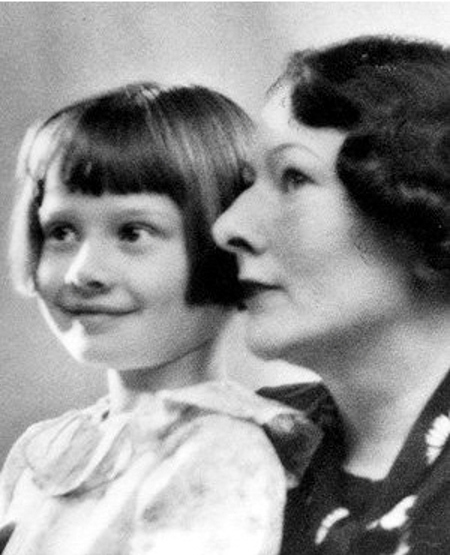
Audrey Hepburn and her mother Ella, Baroness van Heemstra Hepburn-Ruston, ca. 1936.

Audrey Hepburn and her mother Ella, Baroness van Heemstra Hepburn-Ruston, ca. 1936.

Audrey had not seen her dad since that day at the airport. She missed him so! Her parents’ divorce had left an aching hole in her heart. But on this particular May day, Audrey was not sad. She was looking forward to the ballet! Her mother had given her more than one reason to smile:

My mother had our little dressmaker make me a long taffeta dress. It went all the way to the ground, and it rustled. There was a little round collar, a little bow here, and a little button in front. The reason she got me this, at great expense, was that I was to present a bouquet of flowers at the end of the performance to…the director of the company.”

The evening finally arrived. Audrey wore her beautiful new long dress and got to see the famous Margot Fonteyn dance in “Horoscope” and “Façade” by choreographer Frederick Ashton. It was marvelous.

Margot Fonteyn in the Polka from Ashton's Facade, 1940. Fonteyn was the principal dancer of the Royal Ballet Company for 20 years.

Margot Fonteyn as the Polka from Ashton’s Facade, 1940. Fonteyn was the principal dancer of the Royal Ballet Company (originally the Sadler’s Wells) for 20 years.

Afterwards, Audrey’s mother took the stage and gave a formal thanks to the troupe first in Dutch, then in English. Next was Audrey’s big moment. To her surprise, her bouquet of tulips and roses was hurriedly accepted. A quick supper followed, as the dancers hustled about afterward, gathering up their props and costumes, to get on their bus to leave Arnhem that very evening. According to the British consul, there was suspicious German military activity nearby. The dancers didn’t want to get stuck in Holland if the Germans did attack and closed off the borders.

As Audrey’s head lay on the pillow that night, the Germans invaded Holland, Belgium, and Luxembourg. The Dutch were totally shocked. They never dreamed Hitler would attack them, his “Dutch cousins”! Just the night before, matter of fact, Hitler had made a radio broadcast, promising to all who listened that he had no plans whatsoever of attacking Holland. For five days, the Germans came down on the Dutch with the force of Hell. They never bothered issuing a formal declaration of war either.

 German parachutists invading the Netherlands, May 10-15, 1940

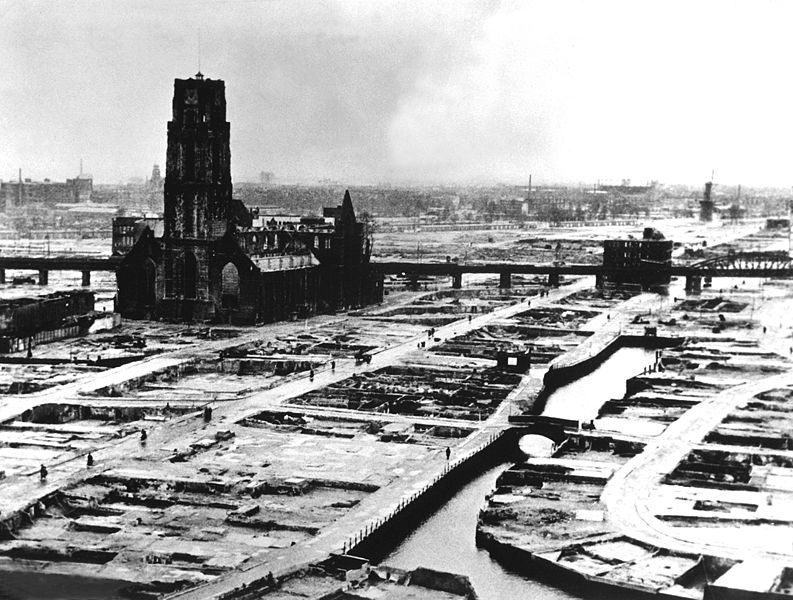
This is the city center of Rotterdam, Holland, following the German Blitz of May 14, 1940. A ceasefire was already in progress but the Nazis bombed anyway.

They blasted the city of Rotterdam with an air attack that killed 1,000 Dutch civilians and left 85,000 homeless (accounts vary as to the exact number).

Incendiary bombs were dropped on the Hague. Nazi troops tore through Audrey’s town of Arnhem, looting and despoiling as they pleased. The Germans threatened to bomb every Dutch city until they were demolished until Holland surrendered. The Dutch military, though terribly outnumbered, fought back anyway, but they were no match for the conquering horde, and were forced to surrender. After five days, Holland capitulated. It would be occupied by the Nazis for five very long years. The Germans wanted to take over the world and destroy the Jewish population.

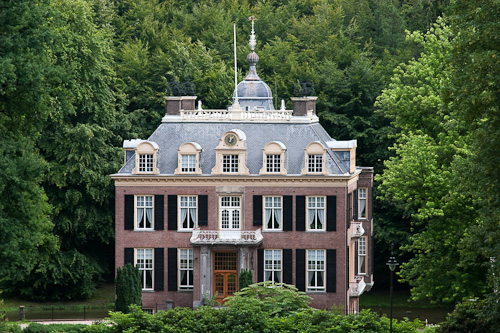
At first, Audrey’s family was allowed to remain at their regal ancestral home, Castle Zypendaal (or Zijpendaal). Audrey Hepburn’s mother’s family was of Dutch nobility.

Audrey Hepburn's mother's family was of Dutch nobility. This is one of their homes, the Castle Zypendaal in Arnhem.

Audrey Hepburn’s mother’s family was of Dutch nobility. This is one of their homes, the Castle Zypendaal in Arnhem.

Over the next ten months, the van Heemstra bank accounts, securities, and jewelry would be confiscated by the Nazis. Rations were imposed on food and fuel which were soon in short supply for the suffering Dutch people. Food became completely nonexistent during the Hunger Winter of 1944 as the Germans cut off all imports of foods to punish the Dutch Resistance (secret group that fought back against the Nazis from inside Holland). During that time, Audrey confessed to eating bread made from flour from tulip bulbs and grass to keep from starving to death like 20,000 other Dutch citizens did that winter.

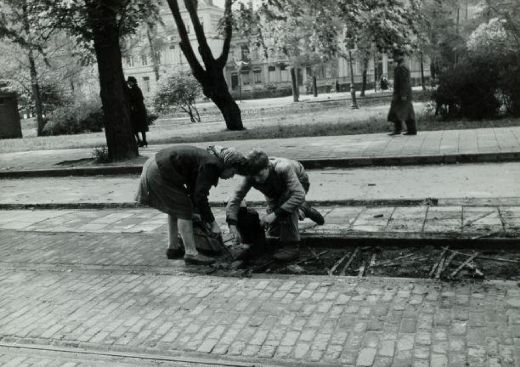
The Hunger Winter, 1944-45. Wood is taken from the tram rail in Holland to burn as fuel.

The Hunger Winter, 1944-45. Wood is taken from the tram rail in Holland to burn as fuel.

The German occupiers spread anti-English sentiment, banning the import of British jams and biscuits and outlawing the Girl and Boy Scouts. The Germans hoped they could whip the Dutch into a hatred for the English and recruit them in the battle against Britain.

Audrey Hepburn-Ruston was an English name and Audrey spoke English. She carried a British passport. With the Nazis cracking down on the English, the Baroness was worried. Quickly, Audrey’s mother gave Audrey a new identity as a little Dutch girl. For the war years, the Baroness changed her daughter’s name to Edda van Heemstra. Audrey – now Edda – took Dutch language lessons so she could pass as Dutch and not be arrested for being English. Audrey did not risk speaking English for the rest of the war.

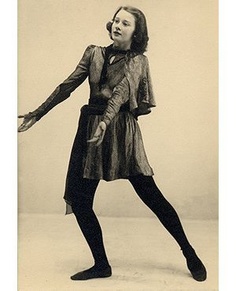
Audrey Hepburn at a dance recital, 1944, Arnhem Conservatory, Holland (age 15)

Audrey Hepburn at a dance recital, 1944, Arnhem Conservatory, Holland (age 15)

Audrey was keen to be a famous ballet dancer and her mother was the quintessential stage mom. In 1941, Ella sent Audrey to the Arnhem Conservatory to study dance. It was then that Audrey decided that she wanted to grow up to become a ballerina. Her dream was to

“wear a tutu and dance at Covent Garden.”

Her mother made her ballet slippers from scraps of felt, as materials became scarcer and scarcer, since the Nazis took the best for themselves, always.

As a child of war, Audrey learned to cope with hunger, fear, and deprivation through art, music, and dance. Soon, though, she and some other dancers began staging private, secret dance shows to raise money for the Dutch Resistance.

I designed the dances myself. I had a friend that played the piano, and my mother made the costumes. They were very amateurish attempt – but…it amused people.”

The recitals were given in houses with windows and doors closed, and no one outside knew what was going on. Afterward, money was collected and turned over to the Dutch Resistance. To keep from being discovered, the audiences did not clap.

“The best audience I ever had made not a single sound at the end of my performance.”

Audrey Hepburn during a dance recital in Arnhem, Holland, 1944

Audrey Hepburn during a dance recital in Arnhem, Holland, 1944

Sometimes at these “black performances,” resistance workers attended. They gave the young performers money and folded messages to be stuffed into the children’s shoes and transported the next day to resistance workers. The children risked death to save the lives of resistance workers and Audrey was one of these children.

One winter day, Audrey was walking along a city street when three truckloads full of German soldiers toting rifles stopped suddenly. The soldiers ordered all the girls in their sight to line up and get in the trucks. Audrey did as she was told. As the trucks drove off, Audrey kept saying the Lord’s Prayer to herself in Dutch. Then the convoy stopped unexpectedly. Some soldiers jumped out and began abusing some Jews. Audrey said:

“I remember hearing the dull sound of a rifle butt hitting a man’s face. And I jumped down, dropped to my knees, and rolled under the truck. I then skittered out, hoping the driver would not notice me – and he didn’t.”

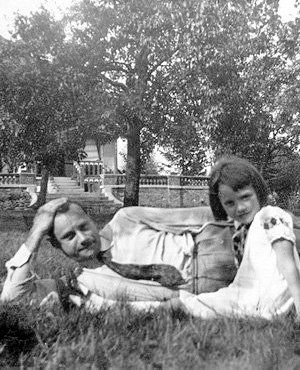
Audrey with father, preNazi Occupation, ca. 1934-35, age 5-6

Audrey with father, preNazi Occupation, ca. 1934-35, age 5-6

And where was Audrey’s father all this time? He was arrested in England and accused of peddling Nazi propaganda for the notorious leader of the British Union of Fascists, Sir Oswald Mosley. He remained under house arrest for the duration of the war on the Isle of Man with other suspected Nazi sympathizers.

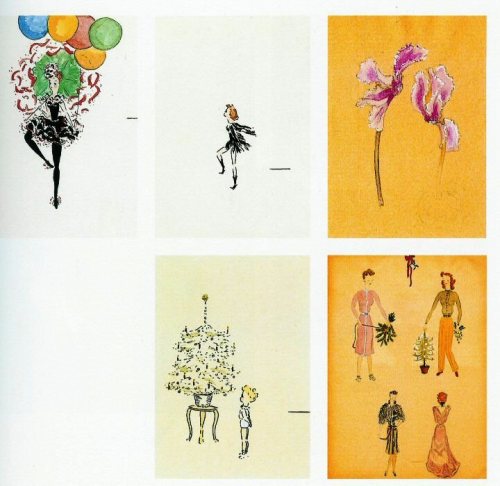
Below are some beautiful drawings Audrey made during the war.

Audrey Hepburn's childhood artwork

Audrey Hepburn’s childhood artwork

Read Full Post »

About a month before doctors amputated her right leg at the knee, Frida Kahlo drew a picture of her severed feet on a pedestal. It is one of many diary entries in which she expresses her anguish at the impending operation. In public, though, she acted lighthearted, saying playfully to friends, "Did you know they are going to cut off my paw?"

From Frida Kahlo’s diary, “Why do I need feet if I have wings to fly.”

About a month before doctors amputated her right leg at the knee, Mexican artist Frida Kahlo drew a picture of her severed feet on a pedestal. Instead of healthy veins protruding from the amputated feet, dead, thorny vines snake out. The flesh is yellow, anemic, and the page is stained with her blood.

This is one of many diary entries in which Frida explores her anguish over the impending operation. She knew that she had no other choice but to cut off her leg. In truth, her right leg was skinny, crippled, shriveled, and lame. It hung from her body as if it were broken. Two toes were missing from the foot. The leg was infected with gangrene. It hurt her terribly.

Her husband Mexican muralist Diego Rivera urged her to accept her fate and submit to yet another operation. Maybe she would be able to get a good prosthetic leg, he urged, and walk a little.

For Diego’s sake, she said to the doctors,

“Prepare me for the operation!”

Then, putting on a brave face for her friends, she asked them, 

“Did you know they are going to cut off my paw?”

For more on Frida Kahlo on this blog, click here.

Herrera, Hayden. Frida: A Biography of Frida Kahlo. New York: HarperCollins Publishers, Inc., 1983.
The Diary of Frida Kahlo: An Intimate Self-Portrait. Introduction by Carlos Fuentes. Essays by Sarah M. Lowe. New York: Abradale, 1995.

Read Full Post »

From ABC News/Univision

Frida Kahlo’s Closet is Opened After 58 Years

Frida Kahlo is seen smoking after a 1946 operation.

Frida Kahlo, wearing Chinese pajamas, is seen smoking after a 1946 operation.

“Imagine being in Frida Kahlo‘s childhood home and opening up a closet that has been locked for decades. Inside are hundreds of personal items – personal photographs, love letters, medications, jewelry, shoes, and clothing that still hold the smell of perfume and the last cigarette she smoked.

That is exactly what happened when Hilda Trujillo Soto, the director of the Frida Kahlo Museum opened the closets that had been locked since the Mexican artist’s death in 1954. Inside were over 300 items belonging to Frida Kahlo, and now, a wide array of what was found is on display at the Casa Azul, the Frida Kahlo Museum in the Coyoacán neighborhood of Mexico City.

The exterior of Frida Kahlo's home called Casa Azul outside Mexico City, 1952.

The exterior of Frida Kahlo’s home called Casa Azul outside Mexico City, 1952.

The exhibit, Appearances Can Be Deceiving: The Dresses of Frida Kahlo, a collaboration between the museum and Vogue Mexico, brings to an end an elaborate 50 year scheme to keep private the intimate details of Kahlo’s life. It started when she died in 1954, as a distraught Diego Rivera, the famous Mexican muralist and Frida Kahlo’s husband, locked the doors to her closet and never let anyone enter for fear that the contents would be mishandled and ruined.”

Kahlo contracted polio when she was six, leaving her right leg shorter and thinner than her left. Then, when she was 18, a metal tube pierced  through Frida’s abdomen during a bus crash, subjecting her to painful operations and  long periods of bed rest throughout her life.

In keeping with her flamboyance and ebullient spirit, Frida wore long, flowing tehuana skirts, lacy and colorful, that hid this affliction and celebrated her Mexican heritage.

frida-kahlo-dresses-on-display-exhibition-in-mexico-city

Frida Kahlo’s dresses in the Tehuantepec style are on exhibit in Mexico City at the Casa Azul, January 2013.

Frida Kahlo Self-Portrait, 1848, shows her dressed in traditional Tehuantepec costume.

Frida Kahlo Self-Portrait, 1848, shows her dressed in traditional Tehuantepec costume.

Later in life, Frida’s right leg had to be amputated. Included in the exhibit is a ornate red boot with the prosthetic leg Kahlo wore after the amputation.

Mexico Frida Fashion

A prostetic leg belonging to Mexican artist Frida Kahlo is on exhibit at the Casa Azul in Mexico City (Jan. 2013). Frida’s fashion sense combined both form and function – a red boot attached to an artificial leg. Frida Kahlo’s right leg was amputated in 1953 due to gangrene.

Also on view are three ornate corsets, one styled by Jean-Paul Gaultier in memory of Frida after her death. Frida had to wear plaster corsets to alleviate her excrutiating spine pain.

Frida Kahlo, 1941, displays her Communist sympathies with her therapeutic plaster chest cast

Frida Kahlo, 1941, displays her Communist sympathies with her therapeutic plaster chest cast

For more on Frida Kahlo on this blog, click here.

Read Full Post »

Natalie Wood (1938-1981) January 2013 autopsy report says death may not have been solely accidental

Natalie Wood (1938-1981) January 2013 autopsy report says death may not have been solely accidental

From the Daily Beast:

FOUL PLAY? Wood Autopsy Hints at Assault

“A year after the LAPD reopened the 1981 drowning case of Natalie Wood, a new autopsy report suggests the late actress may have been assaulted before she plunged into the Pacific Ocean. The coroner has amended Wood’s cause of death from accidental drowning to “drowning and other undetermined factors,” detailing bruises on her body that “appeared fresh” along with scratches down her legs. It remains unclear whether the abrasions resulted from falling off the dinghy, attempting to climb back on, or something potentially darker. There were also conflicting statements as to when Wood went missing and whether or not she had a confrontation with her husband, Robert Wagner.”

Read more from the Los Angeles Times.

For more on Natalie Wood on this blog, click here.

Read Full Post »

Elizabeth Taylor in costume as “Cleopatra,” from the 1963, 20th Century Fox production of the same name

Yet another iconic item worn by actress Elizabeth Taylor is on the auction block – a wig she wore in the 1963 film, “Cleopatra.” Ms. Taylor wore many different hairdos in the movie and British wigmaster Stanley Hall made three wigs for each style. The wig for sale is made of real human hair, medium brown, and is adorned with hanging braids and gold beads.

Elizabeth Taylor is photographed with some props from the 1963 film, “Cleopatra.”

In the movie, Ms. Taylor’s character wears this particular wig when she tries to convince Julius Caesar, played by Rex Harrison, to accept supreme control of the empire. (1) The wig is being sold by Heritage Auctions of Dallas, Texas, and is set to fetch around $11,000.

Elizabeth Taylor in the arms of Richard Burton, from the movie, “Cleopatra,” 1963.

It was during the 1962 filming of “Cleopatra” in Rome that 30-year-old Elizabeth Taylor fell madly in love with her other male costar and onscreen lover, Richard Burton, 36, cast as Mark Antony. The two were both married to others at the time.

At the time, Ms. Taylor was already a big film star being paid the unprecedented amount of a million dollars to play Cleopatra. Mr. Burton, however, who was Welsh, was a Shakespearean stage actor largely unknown outside of England.

Richard Burton (l), talks with Eddie Fisher and his wife Elizabeth Taylor on the Cinecitta set in Rome, early 1962.

When people began to whisper that perhaps Ms. Taylor and Mr. Burton were conducting an illicit affair, the couple denied the accusations. So uncontrollable was their love and lust, that their affair was

“bloody obvious,” to use Burton’s term – so flagrantly on display. (2)

When the director of “Cleopatra” shouted “Cut!” at the end of love scenes, Taylor and Burton would continue to kiss.

They carried on on the movie set, film lot, in their private villas, and took their love to town – to the Via Veneto. But they were not safely in America, where  there was a time-honored tradition not to pry into the private lives of public people and where the studio would have squelched any unflattering press. They were in Rome – the land of the paparazzi.

The Italian “paparazzi” were a new style of journalist. These young, Vespa-riding photographers with cameras with zoom lenses slung around their neck were hungry for a money-making photo that would reveal the affair to the waiting world. With a pack mentality, they were ruthlessly intent upon snapping photos of the jetset enjoying La Dolce Vita, the sweet life, popularized in the film of that same name. And Liz and Dick were getting hot and heavy on the Via Veneto.

From February thru July, paparazzi stalked Taylor and Burton’s every move, hoping for that money-making photo that would expose the lovers to the world. And they got them, too, forcing both Liz and Dick to deal with their respective spouses.

Liz Taylor and Richard Burton emerge from the restaurant Tre Scalini in the Piazza Navona, spring, 1962.

The Burton-Taylor Affair – “Le Scandale,” as Burton termed it – created international interest and thus, international coverage.

Richard Burton leans in for a kiss from Elizabeth Taylor on the Cinecitta sound stage, circa March 30, 1962. Paparazzo Elio Sorci hid under a car across from the movie lot all day to snap this photo which came to be known as the “kissing picture.” It blew the lid off the Taylor-Burton affair, appearing in first the Italian papers before making its way to New York.

The public, it seemed, had an unquenchable appetite to follow the drama. Gone were the days when American readers of Photoplay and Modern Screen were content to read fictional accounts of their favorite movie stars generated by the big movie studios.

Elizabeth Taylor gazes into the eyes of her true love, Richard Burton, as they sail off the Amalfi Coast where the filming of “Cleopatra” was wrapping up. June, 1962. Marcello Geppetti, photographer.

It is hard to overstate the excitement caused at the time by Elizabeth and Richard’s grand passion. Everyone was following the saga, even First Lady Jackie Kennedy, who asked the publicist Warren Cowan in early 1963,

“Warren, do you think Elizabeth Taylor will marry Richard Burton?”(3)

Richard Burton and Elizabeth Taylor in the glow of their love, caught by paparazzo on a yacht off the coast of Ischia in the Bay of Naples, June 1962.

Initially, the pair were condemned by the press for their public adultery until publishers woke up and realized how much the “Liz and Dick” machine increased tabloid, newspaper, magazine, and book sales.

Photoplay July 1962. Everyone had an opinion about the Taylor Burton affair.

Note to readers: Today also begins the first auction at Christie’s, New York, of  The Collection of Elizabeth Taylor, which I was privileged to view on December 3, 2011. (2)

(1) Source: The Guardian

(2) “Remembering Liz (1932-2011),” Life Commemorative, 2011.

(3) Kashner, Sam and Schoenberger, Nancy. Furious Love: Elizabeth Taylor, Richard Burton, and the Marriage of the Century. New York: HarperCollins Publishers, 2010.

Readers: For more on Elizabeth Taylor on Lisa’s History Room, click here.

Read Full Post »

Actress Elizabeth Taylor had stunning beauty. She was such a gorgeous little girl that, when people would see her for the first time, they would gasp in astonishment, staring at her sapphire eyes wreathed in thick black lashes and the shiny black hair framing her porcelain face.  “What a pretty child !” they would exclaim, prompting the well-rehearsed Elizabeth to curtsey and smile.

Elizabeth Taylor in “Lassie Come Home,” 1943.

But Elizabeth was not always gorgeous, said her mother, Sara Taylor, a former stage actress. She considered Elizabeth to be quite an ugly baby when born in London on February 27, 1932.

Sara Taylor cradles her newborn daughter, the future movie queen Elizabeth Taylor (1932-2011)

At first glance at her newborn, Sara was repulsed:

“As the precious bundle was placed in my arms, my heart stood still. There inside the cashmere shawl was the funniest-looking baby I had ever seen. Her hair was long and black. Her ears were covered with thick black fuzz, and inlaid into the sides of her head….”(1)

Baby Elizabeth’s arms, shoulders, and back were covered with a thick downy pelt called lanugo, not uncommon in newborns.

“The infant looked like a little monkey,” remembered Viennese art dealer and family friend Ernest Lowy. (2)

Compounding the problem, Elizabeth’s eyes were screwed tightly shut. For ten days, the doctor tried to pry them open unsuccessfully, finding only the whites visible. Then one day, Baby Elizabeth suddenly snapped open her eyes and gazed up at her new mother. Sara found herself gazing down into two pools of deep violet fringed by thick black lashes – double rows of lashes! Then the baby smiled. Sara considered this a special greeting from her daughter and told the nurse so. The nurse chuckled, reminding Mrs. Taylor that infants can’t express emotion:

“That was no smile,” the nurse indicated, “only a little gas.” (3)

Elizabeth Taylor in profile, ca. 1934

The dark fuzz fell off and a swan emerged.

Elizabeth Taylor didn’t begin to walk until she was 16 months old. She is shown here with one of the many dogs for which she cared during her lifetime. ca.1934-35


As a young girl, Elizabeth Taylor had a big head on a little body. “What a podge!” she remarked, upon seeing a young photo of herself. 1934.


Peter Lawford and Elizabeth Taylor in this publicity shot for "Julia Misbehaves" (1948). In this unretouched 1950 publicity photo, one can see La Liz's arms were covered in a dark and velvety down, in keeping with her being a beautiful brunette.

Peter Lawford and Elizabeth Taylor in this publicity shot for “Julia Misbehaves” (1948). In this unretouched 1950 publicity photo, one can see La Liz’s arms were covered in a dark and velvety down, in keeping with her being a beautiful brunette.


(1) Ladies’ Home Journal,  March- April 1954.

(2) Heymann, C. David. Liz: An Intimate Biography of Elizabeth Taylor. New York: Simon & Schuster, Inc., 1995, 2011.

(3)  Walker, Alexander. Elizabeth: The Life of Elizabeth Taylor. New York: Grove Press, 1990, 1997.

Readers: For more on Elizabeth Taylor on Lisa’s History Room, click here.

Read Full Post »

Robert Wagner and Natalie Wood aboard their yacht the Splendour. Undated photo.

Robert Wagner and Natalie Wood aboard their yacht the Splendour. Undated photo.

According to a witness whose account has never been disclosed, Hollywood star Natalie Wood  was screaming for help as she drowned in 1981.

Retired stockbroker Marilyn Wayne said she tried to report the star’s ‘last desperate cries for help’ but was ignored.

Los Angeles police last week said ‘substantial new evidence’ has led them to reopen their investigation into the death 30 years ago this week.

Learn more at the Daily Mail Online.

Readers: For more on Natalie Wood on Lisa’s History Room, click here.

Read Full Post »

Natalie Wood was born "Natalia Nikolaevna Zakharenko" on July 20, 1938, to Russian immigrant parents. She began acting in Hollywood movies at the age of 4. She died by drowning at the age of 43 during the production of "Brainstorm" (1983) with Christopher Walken.

How did actress Natalie Wood, famous for her star turn in Rebel Without a Cause and West Side Story, end up drowning off Santa Catalina Island, California, in 1981 while boating with actor husband Robert Wagner and costar Christopher Walker? Though officially ruled an accident at the time, the circumstances that led to her death and the nature of her tumble off the yacht the Splendour she owned with Wagner have remained one of Hollywood’s darkest mysteries.

Robert Wagner bends over to kiss flowers that cover the casket of his wife Natalie Wood during her graveside ceremonies on December 2, 1981. If Wagner discovered that his wife was missing from their yacht around midnight, why did he wait over an hour to use the ship's radio to call for help? These and other questions surrounding Woods' death remain unanswered.

Today, 30 years later, the Los Angeles Sheriff’s Department has announced that it is reopening the case of Natalie Woods’ drowning due to “credible information” from multiple sources. One source is Dennis Davern, who was the boat captain of the Splendour that dark and fateful night, a night full of boozing and yelling and tragedy. Davern now says that he lied in his original statement to the police and that Robert Wagner is responsible for Wood’s death.

"Splendour," the yacht owned by Natalie Wood and Robert Wagner

Learn more at MSNBC.

Readers: For more on Natalie Wood on Lisa’s History Room, click here.

Read Full Post »
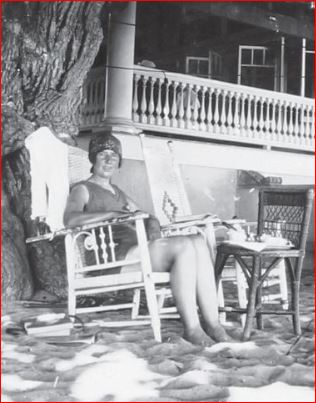
British American screenstar Elizabeth Taylor (1932-2011) as a young girl.

Just after actress Elizabeth Taylor was born, her parents were ushered into the doctor’s office and told that their newborn daughter had a mutation. 

 “Well, that sounded just awful,” her mother Sara Taylor said later,”a mutation.”

The mutation was not a deformity, however. It meant that little Elizabeth was born with double rows of eyelashes.

Elizabeth Taylor, age 10

Sara breathed a little easier to learn that.

“I thought,well, now, that doesn’t sound so terrible at all.”

Elizabeth’s eyes were stunning – large and blue, rimmed by deep, thick lashes. When caught in the light, the color of her eyes was almost violet. (1)

Elizabeth Taylor had luminous beauty - and double rows of eyelashes.

Double rows of eyelashes are usually the result of a mutation at FOXC2 , a gene that influences all kinds of tissue development in embryos. FOXC2 mutations are thought to be responsible for, among other things, lymphedema-distichiasissyndrome , a hereditary disease that can cause disorders of the lymphatic system, in addition to double eyelashes.

The eyelash mutation isn’t always as cosmetically enhancing as Taylor’s turned out to be — the extra eyelashes can sometimes grow inward and damage the cornea. In addition, seven percent of people with lymphedema-distichiasis syndrome also suffer from congenital heart disease.

Coincidentally, Taylor herself had a history of heart problems. In 2009, Taylor underwent surgery to repair a leaky heart valve. Her death on March 23, 2011, was attributed to congestive heart failure.

In April 2010, Elizabeth Taylor launched a new line of perfume "Violet Eyes": "This sensual perfume is inspired by her iconic eye color; it is feminine, captivating, sophisticated and intriguing. Filled with a bouquet of the flowers Elizabeth Taylor loves, the composition is both modern and mysterious."

Source:  Slate

Readers, for more on Elizabeth Taylor at Lisa’s History Room, click here.

Read Full Post »
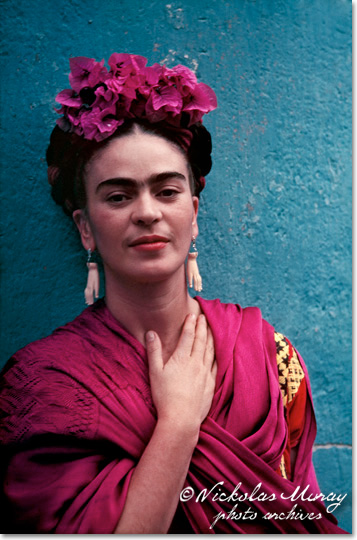
Elizabeth Taylor on the Rome set of the film, "Cleopatra," 1962, where she began her scandalous affair with costar Richard Burton. Dame Liz wears her diamond ring from her late husband Mike Todd and the diamond, emerald, and gold bangle watch by Bulgari, Jaeger-LeCoultre

Christie’s auction house is selling screen sensation Elizabeth Taylor’s complete jewelry collection in New York City on Dec. 13-16, 2011. Among the pieces to be sold is the diamond, emerald, and gold “snake” brackelet watch by Bulgari, ca. 1961, shown below:

This cobra bangle watch by Bulgari, estimated at $12,000-15,000, is to be sold at Christie's auction of the Elizabeth Taylor Collection, Dec. 13, 2011.

Readers: For more on The Collection of Elizabeth Taylor Auction by Christie’s, click here and here.

Readers: For more on Elizabeth Taylor here at Lisa’s History Room, click here.

Read Full Post »

« Newer Posts - Older Posts »